Multifunctional Barophotonic Control of Resonators and Metasurfaces
Pith reviewed 2026-06-30 19:52 UTC · model grok-4.3
The pith
Applying up to 5 GPa of pressure shifts resonances in silicon nitride by 30 nm and tunes polarization conversion in metasurfaces.
A machine-rendered reading of the paper's core claim, the machinery that carries it, and where it could break.
Core claim
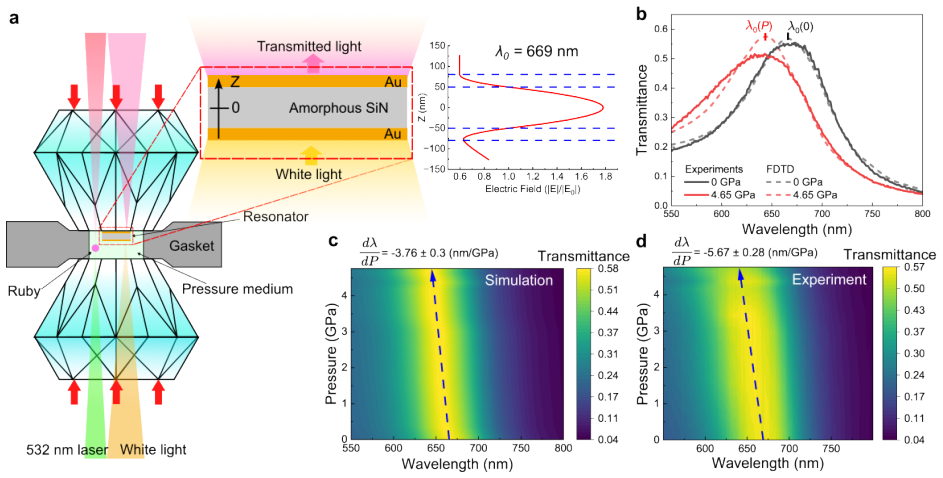
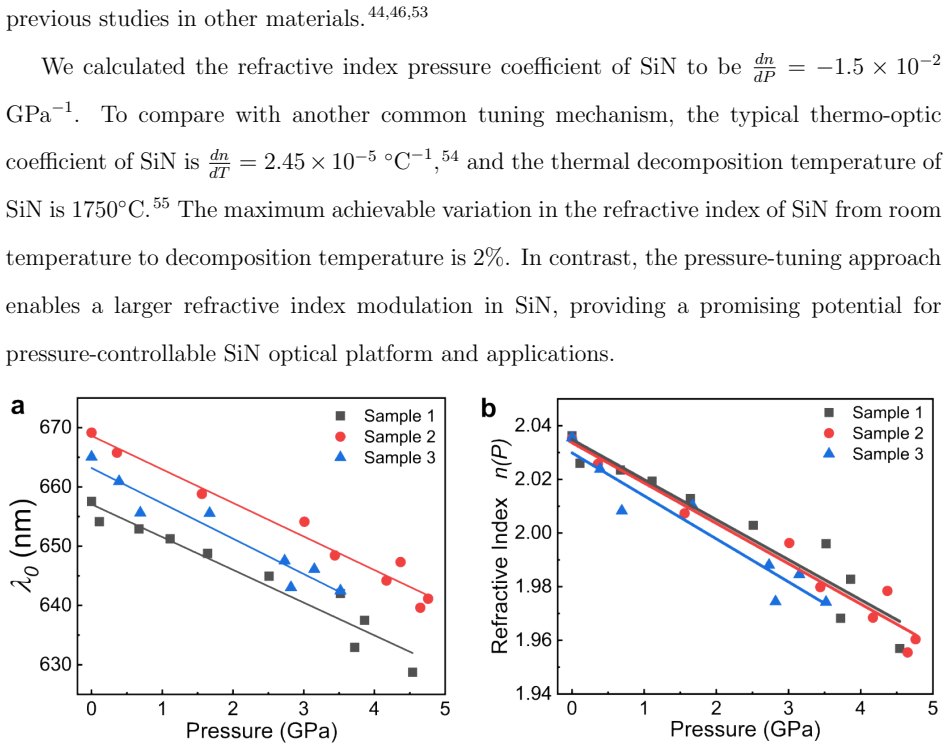
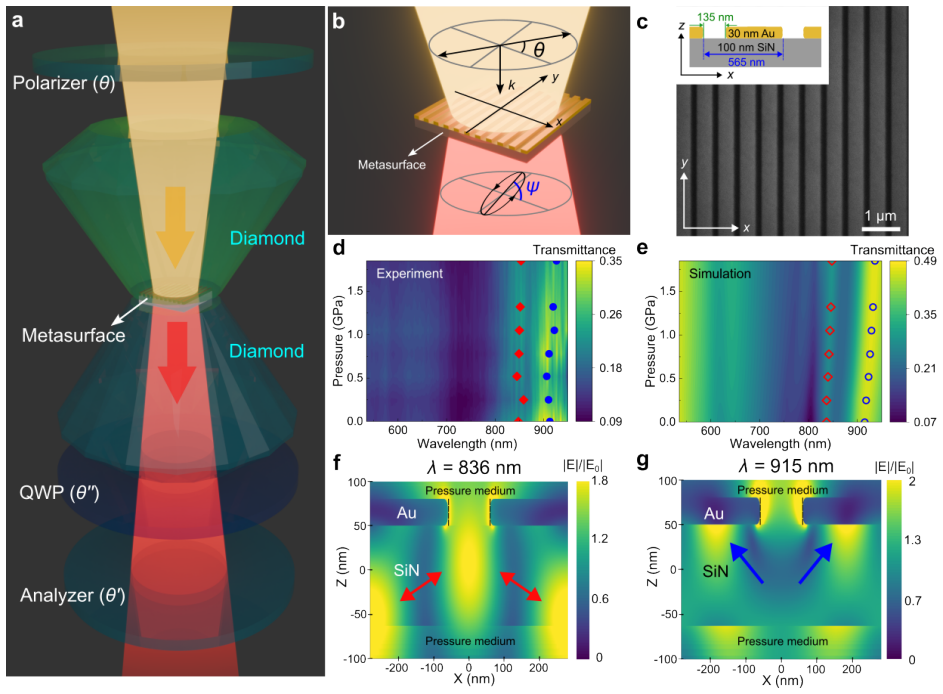
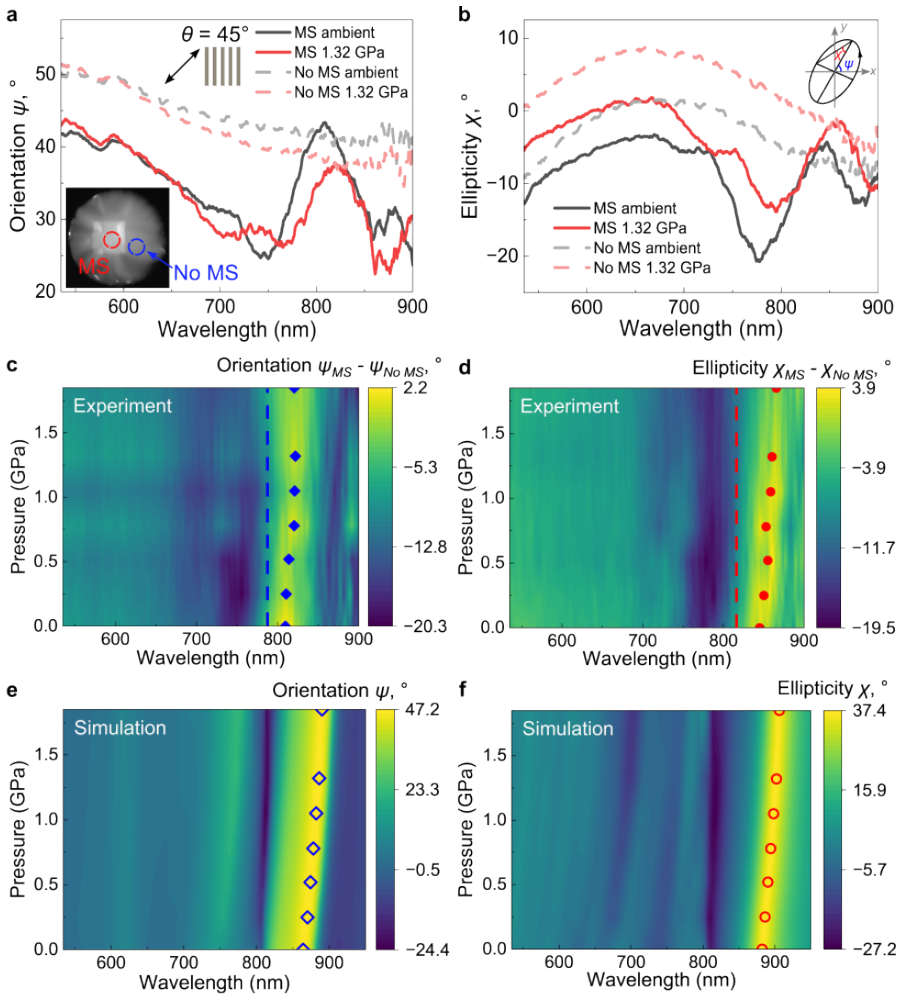
Hydrostatic pressure provides a noninvasive mechanism for modulating the refractive index and resonance conditions in silicon nitride without introducing free carriers or structural damage. Applying pressures up to 5 GPa produces Fabry-Pérot resonance shifts of up to 30 nm and relative refractive index decreases of up to 4%. This effect is used to realize an extreme-pressure-tunable polarization-converting metasurface that adjusts the ellipticity and orientation of output light.
What carries the argument
Pressure-induced refractive index modulation in silicon nitride nanostructures, which alters resonance conditions and polarization response.
If this is right
- Establishes pressure-controllable silicon nitride as a viable platform for reconfigurable photonics.
- Supports applications in deep-ocean exploration, planetary interiors, and space environments.
- Allows tuning of output light ellipticity and orientation angle through applied pressure.
- Provides a material-agnostic tuning method that avoids structural damage or carrier injection.
Where Pith is reading between the lines
- The same pressure mechanism could be tested in other dielectric materials to expand the range of tunable platforms.
- Integration with existing high-pressure chambers might enable in-situ characterization of nanophotonic sensors.
- Multi-stimulus devices could combine pressure tuning with electrical or optical inputs for additional control dimensions.
Load-bearing premise
The measured resonance shifts and refractive index changes result purely from pressure-induced material modulation without confounding factors such as mechanical deformation, temperature effects, or measurement artifacts.
What would settle it
Direct index measurement on bulk silicon nitride under identical pressures showing zero change, or resonance spectra recorded with pressure applied but no wavelength shift observed.
Figures
read the original abstract
Actively tunable nanophotonic platforms that control light-matter interactions enable reconfigurable optical systems and programmable photonic integrated circuits. Hydrostatic pressure provides a noninvasive and material-agnostic mechanism for modulating the refractive index and resonance conditions without introducing free carriers or structural damage. Here, we demonstrate multiple pressure-dependent functionalities in silicon nitride nanostructures, including resonance tuning, refractive index modulation, and polarization state conversion. Applying a pressure of up to 5 GPa, we observe a Fabry-P\'erot resonance shift of up to 30 nm and a relative refractive index decrease of up to 4%. Based on the results, we design and examine, to the best of our knowledge, the first extreme-pressure-tunable, polarization-converting metasurface, which tunes the ellipticity and orientation angle of the output light. These findings establish pressure-controllable silicon nitride as a viable platform for reconfigurable photonics and extreme-environment nanophotonic systems, including deep-ocean exploration, planetary interiors, and space applications.
Editorial analysis
A structured set of objections, weighed in public.
Referee Report
Summary. The manuscript claims to demonstrate hydrostatic pressure (up to 5 GPa) as a noninvasive tuning mechanism for silicon nitride resonators and metasurfaces, reporting a Fabry-Pérot resonance shift of up to 30 nm, a relative refractive index decrease of up to 4%, and the first extreme-pressure-tunable polarization-converting metasurface that modulates output ellipticity and orientation angle.
Significance. If the quantitative claims can be unambiguously attributed to barophotonic index modulation after separating geometric effects, the work would establish pressure as a material-agnostic route to reconfigurable nanophotonics with applications in extreme environments; the experimental demonstration of multiple functionalities in a single platform would be a notable addition to tunable photonics.
major comments (2)
- [Abstract] Abstract: the 30 nm resonance shift and 4% index change are presented as resulting purely from pressure-induced modulation of the dielectric function, yet no finite-element analysis of elastic compression, pressure-dependent geometry corrections, or control measurements on non-resonant films are described to isolate index change from dimensional strain at 5 GPa; resonance wavelength depends on both n and physical dimensions, so unaccounted strain constitutes a load-bearing ambiguity for the central barophotonic claim.
- [Results] Results section (pressure-dependent measurements): without reported strain calculations or temperature/artifact controls, the quantitative attribution of spectral shifts to refractive-index tuning alone cannot be verified, directly affecting the validity of the 4% Δn figure and the subsequent metasurface design.
minor comments (1)
- [Abstract] Abstract: the phrasing 'to the best of our knowledge' for the polarization-converting metasurface would benefit from a brief comparison to any prior extreme-pressure photonic work to strengthen the novelty statement.
Simulated Author's Rebuttal
We thank the referee for the detailed and constructive report. The comments correctly identify that the current manuscript does not include finite-element analysis of elastic compression or control measurements to isolate refractive-index changes from geometric strain. We will revise the manuscript to address this directly.
read point-by-point responses
-
Referee: [Abstract] Abstract: the 30 nm resonance shift and 4% index change are presented as resulting purely from pressure-induced modulation of the dielectric function, yet no finite-element analysis of elastic compression, pressure-dependent geometry corrections, or control measurements on non-resonant films are described to isolate index change from dimensional strain at 5 GPa; resonance wavelength depends on both n and physical dimensions, so unaccounted strain constitutes a load-bearing ambiguity for the central barophotonic claim.
Authors: We agree that the abstract and main text currently present the 30 nm shift and 4% Δn without explicit separation of geometric strain from index modulation. This is a valid concern because resonance wavelength depends on both quantities. In the revised manuscript we will add (i) finite-element simulations of hydrostatic compression of the SiN structures up to 5 GPa, (ii) the resulting thickness and lateral-dimension changes, and (iii) control ellipsometry measurements on non-resonant SiN films under the same pressure conditions. These additions will allow quantitative subtraction of the geometric contribution and will support the stated 4% index change. revision: yes
-
Referee: [Results] Results section (pressure-dependent measurements): without reported strain calculations or temperature/artifact controls, the quantitative attribution of spectral shifts to refractive-index tuning alone cannot be verified, directly affecting the validity of the 4% Δn figure and the subsequent metasurface design.
Authors: We concur that the results section lacks the strain calculations and controls needed to verify the index-only attribution. The revised results section will incorporate the finite-element strain analysis and non-resonant film controls described above. The metasurface design will be re-evaluated with the corrected index values; if the effective index change is smaller than 4%, the design parameters will be updated accordingly and the new performance metrics reported. revision: yes
Circularity Check
No circularity: experimental measurements and design based on results
full rationale
The paper is an experimental demonstration of pressure effects on silicon nitride resonators and a metasurface. The abstract and provided text describe direct observations (Fabry-Pérot shifts up to 30 nm, refractive index decrease up to 4%) and a design 'based on the results' without any derivation chain, equations, fitted parameters presented as predictions, or self-citations that reduce claims to inputs. No load-bearing steps exist that could be circular by construction. The work is self-contained as an empirical report against external benchmarks.
Axiom & Free-Parameter Ledger
axioms (1)
- domain assumption Hydrostatic pressure modulates refractive index and resonance conditions in silicon nitride without introducing free carriers or structural damage
Reference graph
Works this paper leans on
-
[1]
High spectral purity Kerr frequency comb radio frequency photonic oscillator
Liang, W.; Eliyahu, D.; Ilchenko, V.; Savchenkov, A.; Matsko, A.; Seidel, D.; Maleki, L. High spectral purity Kerr frequency comb radio frequency photonic oscillator. Nature Communications 2015, 6, 7957
2015
-
[2]
N.; Karpov, M.; Kordts, A.; Pfeifle, J.; Pfeiffer, M
Marin-Palomo, P.; Kemal, J. N.; Karpov, M.; Kordts, A.; Pfeifle, J.; Pfeiffer, M. H. P.; Trocha, P.; Wolf, S.; Brasch, V.; Anderson, M. H.; Rosenberger, R.; Vijayan, K.; Freude, W.; Kippenberg, T. J.; Koos, C. Microresonator-based solitons for massively parallel coherent optical communications. Nature 2017, 546, 274–279
2017
-
[3]
B.; Wang, P.-H.; Xuan, Y.; Leaird, D
F\"ul\"op, A.; Mazur, M.; Lorences-Riesgo, A.; Helgason, O. B.; Wang, P.-H.; Xuan, Y.; Leaird, D. E.; Qi, M.; Andrekson, P. A.; Weiner, A. M.; Torres-Company, V. High-order coherent communications using mode-locked dark-pulse Kerr combs from microresonators. Nature Communications 2018, 9, 1598
2018
-
[4]
H.; Ma, Q.; Ning, Y
Xiao, Q.; Fan, L. H.; Ma, Q.; Ning, Y. M.; Gu, Z.; Chen, L.; Li, L.; You, J. W.; Niu, Y. F.; Cui, T. J. Secure wireless communication of brain–computer interface and mind control of smart devices enabled by space-time-coding metasurface. Nature Communications 2025, 16, 7914
2025
-
[5]
Q.; Dai, J
Yang, H. Q.; Dai, J. Y.; Li, H. D.; Wu, L.; Shen, Z. H.; Zhou, Q. Y.; Zhang, M. Z.; Wang, S. R.; Wang, Z. X.; Wu, J. W.; Jin, S.; Tang, W.; Cheng, Q.; Cui, T. J. Adaptively programmable metasurface for intelligent wireless communications in complex environments. Nature Communications 2025, 16, 6070
2025
-
[6]
R.; Chen, Z
Wang, S. R.; Chen, Z. Y.; Chen, S. N.; Dai, J. Y.; Zhang, J. W.; Qi, Z. J.; Wu, L. J.; Sun, M. K.; Zhou, Q. Y.; Li, H. D.; Luo, Z. J.; Cheng, Q.; Cui, T. J. Simplified radar architecture based on information metasurface. Nature Communications 2025, 16, 6505
2025
-
[7]
High-sensitivity and fast-response fiber-tip Fabry–Pérot hydrogen sensor with suspended palladium-decorated graphene
Ma, J.; Zhou, Y.; Bai, X.; Chen, K.; Guan, B.-O. High-sensitivity and fast-response fiber-tip Fabry–Pérot hydrogen sensor with suspended palladium-decorated graphene. Nanoscale 2019, 11, 15821–15827
2019
-
[8]
ock, D.; Shin, E.; Kwon, S.-H.; Schneider, C.; H\
Dusanowski, .; K\"ock, D.; Shin, E.; Kwon, S.-H.; Schneider, C.; H\"ofling, S. Purcell-Enhanced and Indistinguishable Single-Photon Generation from Quantum Dots Coupled to On-Chip Integrated Ring Resonators. Nano Letters 2020, 20, 6357–6363
2020
-
[9]
Optomechanical ring resonator for efficient microwave-optical frequency conversion
Chen, I.-T.; Li, B.; Lee, S.; Chakravarthi, S.; Fu, K.-M.; Li, M. Optomechanical ring resonator for efficient microwave-optical frequency conversion. Nature Communications 2023, 4, 7594
2023
-
[10]
B.; Antoniuk, L.; Lettner, N.; Waltrich, R.; Klotz, M.; Maier, P.; Agafonov, V.; Kubanek, A
Bayer, G.; Berghaus, R.; Sachero, S.; Filipovski, A. B.; Antoniuk, L.; Lettner, N.; Waltrich, R.; Klotz, M.; Maier, P.; Agafonov, V.; Kubanek, A. Optical driving, spin initialization and readout of single SiV ^- centers in a Fabry-Perot resonator. Communications Physics 2023, 6, 300
2023
-
[11]
Topological dissipation in a time-multiplexed photonic resonator network
Leefmans, C.; Dutt, A.; Williams, J.; Yuan, L.; Parto, M.; Nori, F.; Fan, S.; Marandi, A. Topological dissipation in a time-multiplexed photonic resonator network. Nature Physics 2022, 18, 442–449
2022
-
[12]
Electrically Tunable Diffraction Efficiency from Gratings in Al-Doped ZnO
George, D.; Li, L.; Lowell, D.; Ding, J.; Cui, J.; Zhang, H.; Philipose, U.; Lin, Y. Electrically Tunable Diffraction Efficiency from Gratings in Al-Doped ZnO. Applied Physics Letters 2017, 110, 071110
2017
-
[13]
Subvolt high-speed free-space modulator with electro-optic metasurface
Soma, G.; Ariu, K.; Karakida, S.; Tsubai, Y.; Tanemura, T. Subvolt high-speed free-space modulator with electro-optic metasurface. Nature Nanotechnology 2025, 20, 1625–1632
2025
-
[14]
D.; Sabatti, A.; Weigand, H.; Bailly-Rioufreyt, E.; Vincenti, M
Francescantonio, A. D.; Sabatti, A.; Weigand, H.; Bailly-Rioufreyt, E.; Vincenti, M. A.; Carletti, L.; Kellner, J.; Zilli, A.; Finazzi, M.; Celebrano, M.; Grange, R. Efficient GHz electro-optical modulation with a nonlocal lithium niobate metasurface in the linear and nonlinear regime. Nature Communications 2025, 16, 7000
2025
-
[15]
Electrically-controlled digital metasurface device for light projection displays
Li, J.; Yu, P.; Zhang, S.; Liu, N. Electrically-controlled digital metasurface device for light projection displays. Nature Communications 2020, 11, 3574
2020
-
[16]
R.; Liu, S.; Zubyuk, V
Shcherbakov, M. R.; Liu, S.; Zubyuk, V. V.; Vaskin, A.; Vabishchevich, P. P.; Keeler, G.; Pertsch, T.; Dolgova, T. V.; Staude, I.; Brener, I.; Fedyanin, A. A. Ultrafast all-optical tuning of direct-gap semiconductor metasurfaces. Nature Communications 2017, 8, 17
2017
-
[17]
Stretchable All-Dielectric Metasurfaces with Polarization-Insensitive and Full-Spectrum Response
Zhang, C.; Jing, J.; Wu, Y.; Fan, Y.; Yang, W.; Wang, S.; Song, Q.; Xiao, S. Stretchable All-Dielectric Metasurfaces with Polarization-Insensitive and Full-Spectrum Response. ACS Nano 2020, 14, 1418–1426
2020
-
[18]
Y.; Kim, H.; Kim, B
Kim, J. Y.; Kim, H.; Kim, B. H.; Chang, T.; Lim, J.; Jin, H. M.; Mun, J. H.; Choi, Y. J.; Chung, K.; Shin, J.; Fan, S.; Kim, S. O. Highly Tunable Refractive Index Visible-Light Metasurface from Block Copolymer Self-Assembly. Nature Communications 2016, 7, 12911
2016
-
[19]
S.; Simpson, R
Liu, H.; Dong, W.; Wang, H.; Lu, L.; Ruan, Q.; Tan, Y. S.; Simpson, R. E.; Yang, J. K. W. Rewritable color nanoprints in antimony trisulfide films. Science Advances 2014, 6, eabb7171
2014
-
[20]
Peng, J.; Jeong, H.-H.; Lin, Q.; Cormier, S.; Liang, H.-L.; Volder, M. F. L. D.; Vignolini, S.; Baumberg, J. J. Scalable electrochromic nanopixels using plasmonics. Science Advances 2019, 5, eaaw2205
2019
-
[21]
Thermally Dependent Dynamic Meta-Holography Using a Vanadium Dioxide Integrated Metasurface
Liu, X.; Wang, Q.; Zhang, X.; Li, H.; Xu, Q.; Xu, Y.; Chen, X.; Li, S.; Liu, M.; Tian, Z.; Zhang, C.; Zou, C.; Han, J.; Zhang, W. Thermally Dependent Dynamic Meta-Holography Using a Vanadium Dioxide Integrated Metasurface. Advanced Optical Materials 2019, 7, 1900175
2019
-
[22]
J.; Tang, K.; McIntyre, P
Park, J.; Kang, J.-H.; Liu, X.; Maddox, S. J.; Tang, K.; McIntyre, P. C.; Bank, S. R.; Brongersma, M. L. Dynamic Thermal Emission Control with InAs-Based Plasmonic Metasurfaces. Science Advances 2018, 4, eaat3163
2018
-
[23]
G.; Jr., R
Zhu, Z.; Evans, P. G.; Jr., R. F. H.; Valentine, J. G. Dynamically Reconfigurable Metadevice Employing Nanostructured Phase-Change Materials. Nano Letters 2017, 17, 4881–4885
2017
-
[24]
Phase-change materials for non-volatile photonic applications
Wuttig, M.; Bhaskaran4, H.; Taubner, T. Phase-change materials for non-volatile photonic applications. Nature Photonics 2017, 11, 465–476
2017
-
[25]
S.; Norberg, E
Liu, W.; Li, M.; Guzzon, R. S.; Norberg, E. J.; Parker, J. S.; Lu, M.; Coldren, L. A.; Yao, J. A fully reconfigurable photonic integrated signal processor. Nature Photonics 2016, 10, 190–195
2016
-
[26]
Bogaerts, W.; Pérez, D.; Capmany, J.; Miller, D. A. B.; Poon, J.; Englund, D.; Morichetti, F.; Melloni, A. Programmable Photonic Circuits. Nature 2020, 586, 207–216
2020
-
[27]
Xu, X.; Ren, G.; Feleppa, T.; Liu, X.; Boes, A.; Mitchell, A.; Lowery, A. J. Self-Calibrating Programmable Photonic Integrated Circuits. Nature Photonics 2022, 16, 595–602
2022
-
[28]
Programmable metasurfaces for future photonic artificial intelligence
Abou-Hamdan, L.; Marinov, E.; Wiecha, P.; del Hougne, P.; Wang, T.; Genevet, P. Programmable metasurfaces for future photonic artificial intelligence. Nature Reviews Physics 2025, 7, 331–347
2025
-
[29]
Recent Progress in Reconfigurable and Intelligent Metasurfaces: A Comprehensive Review of Tuning Mechanisms, Hardware Designs, and Applications
Saifullah, Y.; He, Y.; Boag, A.; Yang, G.-M.; Xu, F. Recent Progress in Reconfigurable and Intelligent Metasurfaces: A Comprehensive Review of Tuning Mechanisms, Hardware Designs, and Applications. Advanced Science 2022, 9, 2203747
2022
-
[30]
Reconfigurable Micro/Nano-Optical Devices Based on Phase Transitions: From Materials, Mechanisms to Applications
Li, C.; Pan, R.; Gu, C.; Guo, H.; Li, J. Reconfigurable Micro/Nano-Optical Devices Based on Phase Transitions: From Materials, Mechanisms to Applications. Advanced Science 2024, 11, 2306344
2024
-
[31]
X.; Wu, J
Wang, Z. X.; Wu, J. W.; Xu, H.; Dai, J. Y.; Liu, S.; Cheng, Q.; Cui, T. J. A Dual-Polarization Programmable Metasurface for Green and Secure Wireless Communication. Advanced Science 2024, 11, 2403624
2024
-
[32]
Band Engineering of Large-Twist-Angle Graphene / hBN Moiré Superlattices with Pressure
Gao, Y.; Lin, X.; Smart, T.; Ci, P.; Watanabe, K.; Taniguchi, T.; Jeanloz, R.; Ni, J.; Wu, J. Band Engineering of Large-Twist-Angle Graphene / hBN Moiré Superlattices with Pressure. Physical Review Letters 2020, 125, 226403
2020
-
[33]
Layer-Dependent Pressure Effect on the Electronic Structure of 2D Black Phosphorus
Huang, S.; Lu, Y.; Wang, F.; Lei, Y.; Song, C.; Zhang, J.; Xing, Q.; Wang, C.; Xie, Y.; Mu, L.; Zhang, G.; Yan, H.; Chen, B.; Yan, H. Layer-Dependent Pressure Effect on the Electronic Structure of 2D Black Phosphorus. Physical Review Letters 2021, 127, 186401
2021
-
[34]
R.; Hasan, M
Zhang, L.; Tang, Y.; Khan, A. R.; Hasan, M. M.; Wang, P.; Yan, H.; Yildirim, T.; Torres, J. F.; Neupane, G. P.; Zhang, Y.; Li, Q.; Lu, Y. 2D Materials and Heterostructures at Extreme Pressure. Advanced Science 2020, 7, 2002697
2020
-
[35]
S.; Bhullar, M.; Stahl, K.; Lu, W.; Chen, T.; Feng, L.; Hu, X.; Zhang, Q.; Glazyrin, K.; Kunz, M.; Zhao, Y.; Wang, S.; Yao, Y.; Stavrou, E
Ahmad, A. S.; Bhullar, M.; Stahl, K.; Lu, W.; Chen, T.; Feng, L.; Hu, X.; Zhang, Q.; Glazyrin, K.; Kunz, M.; Zhao, Y.; Wang, S.; Yao, Y.; Stavrou, E. Pressure-Induced Metallization and Isostructural Transitions in 3R- MoS _ 2 . Advanced Science 2025, 12, e05031
2025
-
[36]
Engineering Near-Infrared Light Emission in Mechanically Exfoliated InSe Platelets through Hydrostatic Pressure for Multicolor Microlasing
Zhao, L.; Liang, Y.; Cai, X.; Du, J.; Wang, X.; Liu, X.; Wang, M.; Wei, Z.; Zhang, J.; Zhang, Q. Engineering Near-Infrared Light Emission in Mechanically Exfoliated InSe Platelets through Hydrostatic Pressure for Multicolor Microlasing. Nano Letters 2022, 22, 3840–3847
2022
-
[37]
Lasing-Mode Switch of a Hexagonal ZnO Pyramid Driven by Pressure within a Diamond Anvil Cell
Huang, Y.; Yang, L.; Liu, C.; Liu, X.; Liu, J.; Huang, X.; Zhu, P.; Cui, T.; Sun, C.; Bao, Y. Lasing-Mode Switch of a Hexagonal ZnO Pyramid Driven by Pressure within a Diamond Anvil Cell. The Journal of Physical Chemistry Letters 2019, 10, 610–616
2019
-
[38]
High Pressure Restrains the Photo-Induced Polyhedra Distortion in 0D Antimony-Based Metal Halide
Wang, J.; Wang, L.; Yuan, W.; Yuan, Y.; Wang, F.; Wang, K.; Guo, H. High Pressure Restrains the Photo-Induced Polyhedra Distortion in 0D Antimony-Based Metal Halide. Advanced Science 2025, 12, e02189
2025
-
[39]
Stimuli-Responsive and Defect-Regulated Luminescent Organic Metal Halide for High-Security Anti-Counterfeiting and Force Sensing
Jiang, C.; Yan, J.; Du, R.; Li, Y.; Wu, M.; Xu, B.; Qiu, J. Stimuli-Responsive and Defect-Regulated Luminescent Organic Metal Halide for High-Security Anti-Counterfeiting and Force Sensing. Advanced Science 2025, 12, e10163
2025
-
[40]
S.; Meunier, V.; Puech, P
Kundu, A.; Tristant, D.; Sheremetyeva, N.; Yoshimura, A.; Torres Dias, A.; Hazra, K. S.; Meunier, V.; Puech, P. Reversible Pressure-Induced Partial Phase Transition in Few-Layer Black Phosphorus. Nano Letters 2020, 20, 5929–5935
2020
-
[41]
Pressure Engineering Promising Transparent Oxides with Large Conductivity Enhancement and Strong Thermal Stability
Liu, X.; Li, M.; Zhang, Q.; Wang, Y.; Li, N.; Peng, S.; Yin, T.; Guo, S.; Liu, Y.; Yan, L.; Zhang, D.; Kim, J.; Liu, G.; Wang, Y.; Yang, W. Pressure Engineering Promising Transparent Oxides with Large Conductivity Enhancement and Strong Thermal Stability. Advanced Science 2022, 9, 2202973
2022
-
[42]
R.; Balasubramanian, M.; Liu, Z.; Wang, S
Liu, S.; DeFilippo, A. R.; Balasubramanian, M.; Liu, Z.; Wang, S. G.; Chen, Y.-S.; Chariton, S.; Prakapenka, V.; Luo, X.; Zhao, L.; Martin, J. S.; Lin, Y.; Yan, Y.; Ghose, S. K.; Tyson, T. A. High-Resolution In-Situ Synchrotron X-Ray Studies of Inorganic Perovskite CsPbBr _ 3 : New Symmetry Assignments and Structural Phase Transitions. Advanced Science 20...
2021
-
[43]
M.; da Jornada, J
Balzaretti, N. M.; da Jornada, J. A. H. Volume Dependence of the Electronic Polarizability of Magnesium Oxide. High Pressure Research 1990, 2, 183–191
1990
-
[44]
M.; da Jornada, J
Balzaretti, N. M.; da Jornada, J. A. H. Pressure dependence of the refractive index of diamond, cubic silicon carbide and cubic boron nitride. Solid State Communications 1996, 99, 943–948
1996
-
[45]
R.; Syassen, K.; Cardona, M
Go \ n i, A. R.; Syassen, K.; Cardona, M. Effect of pressure on the refractive index of Ge and GaAs . Physical Review B 1990, 41, 10104–10110
1990
-
[46]
R.; Kaess, F.; Reparaz, J
Go \ n i, A. R.; Kaess, F.; Reparaz, J. S.; Alonso, M. I.; Garriga, M.; Callsen, G.; Wagner, M. R.; Hoffmann, A.; Sitar, Z. Dependence on pressure of the refractive indices of wurtzite ZnO, GaN, and AlN . Physical Review B 2014, 90, 045208
2014
-
[47]
Refractive index of GaP and its pressure dependence
Strössner, K.; Ves, S.; Cardona, M. Refractive index of GaP and its pressure dependence. Physical Review B 1985, 32, 6614–6619
1985
-
[48]
M.; Rodríguez, F
Mart\' n-S\'anchez, C.; Sánchez-Iglesias, A.; Mulvaney, P.; Liz-Marzán, L. M.; Rodríguez, F. Plasmonic Sensing of Refractive Index and Density in Methanol–Ethanol Mixtures at High Pressure. The Journal of Physical Chemistry C 2020, 124, 8978–8983
2020
-
[49]
Gold nanorods as a high-pressure sensor of phase transitions and refractive-index gauge
Runowski, M.; Sobczak, S.; Marciniak, J.; Bukalska, I.; Lis, S.; Katrusiak, A. Gold nanorods as a high-pressure sensor of phase transitions and refractive-index gauge. Nanoscale 2021, 11, 8718–8726
2021
-
[50]
Gold Nanorods: The Most Versatile Plasmonic Nanoparticles
Zheng, J.; Cheng, X.; Zhang, H.; Bai, X.; Ai, R.; Shao, L.; Wang, J. Gold Nanorods: The Most Versatile Plasmonic Nanoparticles. Chemical Reviews 2021, 121, 13342–13453
2021
-
[51]
Young’s modulus of silicon nitride used in scanning force microscope cantilevers
Khan, A.; Philip, J.; Hess, P. Young’s modulus of silicon nitride used in scanning force microscope cantilevers. Journal of Applied Physics 2004, 95, 1667–1672
2004
-
[52]
F.; Shebanova, O.; Salamat, A
Xu, B.; Dong, J.; McMillan, P. F.; Shebanova, O.; Salamat, A. Equilibrium and metastable phase transitions in silicon nitride at high pressure: A first-principles and experimental study. Physical Review B 2011, 84, 014113
2011
-
[53]
Optical Properties of the High-Pressure Phases of S nO _ 2 : First-Principles Calculation
Li, Y.; Fan, W.; Sun, H.; Cheng, X.; Li, P.; Zhao, X.; Hao, J.; Jiang, M. Optical Properties of the High-Pressure Phases of S nO _ 2 : First-Principles Calculation. The Journal of Physical Chemistry A 2010, 114, 1052–1059
2010
-
[54]
Arbabi, A.; Goddard, L. L. Measurements of the Refractive Indices and Thermo-Optic Coefficients of Si3N4 and SiOx Using Microring Resonances. Optics Letters 2013, 38, 3878–3881
2013
-
[55]
D.; Whitney, E
Batha, H. D.; Whitney, E. D. Kinetics and Mechanism of the Thermal Decomposition of Si _3 N _ 4 . Journal of the American Ceramic Society 1973, 56, 365–369
1973
-
[56]
H.; wen Xu, L.; zheng Che, R.; then Chen, L.; fang Wang, J
Eggert, J. H.; wen Xu, L.; zheng Che, R.; then Chen, L.; fang Wang, J. High pressure refractive index measurements of 4:1 methanol:ethanol. Journal of Applied Physics 1992, 72, 2453–2461
1992
-
[57]
K.; Xu, J.; Bell, P
Mao, H. K.; Xu, J.; Bell, P. M. Calibration of the Ruby Pressure Gauge to 800 kbar Under Quasi-Hydrostatic Conditions. Journal of Geophysical Research: Solid Earth 1986, 91, 4673–4676
1986
-
[58]
Compression curves of transition metals in the Mbar range: Experiments and projector augmented-wave calculations
Dewaele, A.; Torrent, M.; Loubeyre, P.; Mezouar, M. Compression curves of transition metals in the Mbar range: Experiments and projector augmented-wave calculations. Physical Review B 2008, 78, 104102
2008
-
[59]
Fluorescence pressure calculation and thermocouple tools
Kantor, I. Fluorescence pressure calculation and thermocouple tools. http://kantor.50webs.com/ruby.htm
-
[60]
Polarized Light: Production and Use; Harvard University Press, 1962
Shurcliff, W. Polarized Light: Production and Use; Harvard University Press, 1962
1962
-
[61]
H.; Rubin, N
Dorrah, A. H.; Rubin, N. A.; Zaidi, A.; Tamagnone, M.; Capasso, F. Metasurface Optics for On-Demand Polarization Transformations along the Optical Path. Nature Photonics 2021, 15, 287--296
2021
-
[62]
Principles of Optics 60th Anniversary Edition; Cambridge University Press, 2020
Born, M.; Wolf, E. Principles of Optics 60th Anniversary Edition; Cambridge University Press, 2020
2020
-
[63]
R.; Fan, Z.; Shvets, G
Bosch, M.; Shcherbakov, M. R.; Fan, Z.; Shvets, G. Polarization states synthesizer based on a thermo-optic dielectric metasurface. Journal of Applied Physics 2019, 126, 073102
2019
-
[64]
B.; Christy, R
Johnson, P. B.; Christy, R. W. Optical Constants of the Noble Metals. Physical Review B 1972, 6, 4370–4379
1972
-
[65]
Y.; Shkondin, E.; Lavrinenko, A
Beliaev, L. Y.; Shkondin, E.; Lavrinenko, A. V.; Takayama, O. Optical, structural and composition properties of silicon nitride films deposited by reactive radio-frequency sputtering, low pressure and plasma-enhanced chemical vapor deposition. Thin Solid Films 2022, 763, 139568
2022
-
[66]
F.; Rybin, M
Limonov, M. F.; Rybin, M. V.; Poddubny, A. N.; Kivshar, Y. S. Fano Resonances in Photonics. Nature Photonics 2017, 11, 543–554
2017
-
[67]
MURNAGHAN, F. D. The Compressibility of Media under Extreme Pressures. Proceedings of the National Academy of Sciences 1944, 30, 244--247
1944
-
[68]
A.; Seibt, S.; Mulvaney, P.; Rodr\' guez, F
Mart\' n-S\'anchez, C.; Barreda-Arg\"ueso, J. A.; Seibt, S.; Mulvaney, P.; Rodr\' guez, F. Effects of Hydrostatic Pressure on the Surface Plasmon Resonance of Gold Nanocrystals. ACS Nano 2019, 13, 498–504
2019
-
[69]
S IDAT 33 XX\\ 77 HH9a IDAT \\ ??
Mart\' n-S\'anchez, C.; Gonz\'alez-Rubio, G.; Mulvaney, P.; Guerrero-Mart\' nez, A.; Liz-Marz\'an, L. M.; Rodr\' guez, F. Monodisperse Gold Nanorods for High-Pressure Refractive Index Sensing. The Journal of Physical Chemistry Letters 2019, 10, 1587–1593 mcitethebibliography document Figure_1.png0000664000000000000000002465320515201376216011751 0ustar roo...
2019
discussion (0)
Sign in with ORCID, Apple, or X to comment. Anyone can read and Pith papers without signing in.