Recognition: 2 theorem links
· Lean TheoremEclipses of Nearby Radio-Loud Galactic Nuclei by Stars in Nuclear Star Clusters
Pith reviewed 2026-05-15 02:55 UTC · model grok-4.3
The pith
Large evolved stars in nuclear star clusters can eclipse the millimeter radio cores of nearby active galactic nuclei with about 10 percent depth.
A machine-rendered reading of the paper's core claim, the machinery that carries it, and where it could break.
Core claim
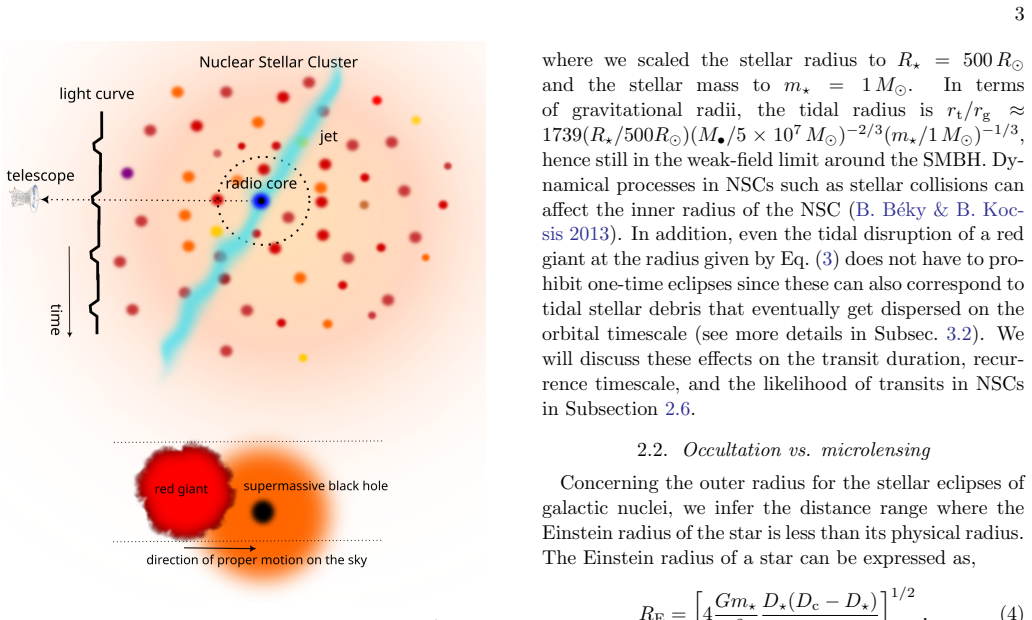
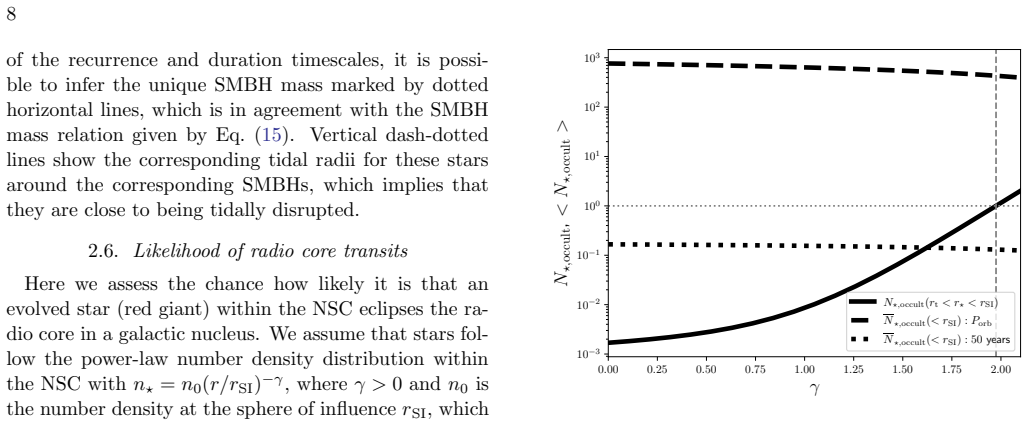
In the millimeter domain, evolved stars with stellar radii of ≳500 R_⊙ can cause eclipses with the relative depth of ∼10%. Typical recurrence timescales are at least 10 years and the eclipse durations are ∼10 days. Towards lower frequencies the eclipse temporal profiles become shallower and broader while towards higher frequencies they are deeper and narrower. Although expected to be rare due to selection effects and evolved stars being prone to tidal disruption, recurrent eclipses of mm radio cores can be applied to infer SMBH masses and constrain the composition of the Nuclear Star Cluster of the host nucleus.
What carries the argument
The occultation of a compact millimeter radio core by large evolved stars in the nuclear star cluster, where the star's size is sufficient to partially or fully cover the core and produce a measurable flux decrease.
Load-bearing premise
That sufficiently large evolved stars with radii of at least 500 solar radii exist in nuclear star clusters and survive tidal disruption long enough to produce observable eclipses of the radio core.
What would settle it
A multi-year monitoring campaign at millimeter wavelengths of several nearby radio-loud AGN that detects no recurrent flux dips of approximately 10 percent depth with durations around 10 days would falsify the prediction of observable eclipses.
Figures




read the original abstract
It is of a general interest to look for signatures of stellar bodies orbiting supermassive black holes (SMBHs) in galactic nuclei other than the Galactic center. Previously stellar transits were analyzed in UV, optical, and X-ray domains as well as potential microlensing signatures due to more compact bodies orbiting SMBH accretion disks. Here we complement previous studies by considering nearby ($z=0.001$) radio-loud active galactic nuclei targeted by different facilities in the millimeter domain. At these wavelengths the radio core is sufficiently small so that it can be occulted by large evolved stars in dense nuclear star clusters. We find that in the millimeter domain evolved stars with stellar radii of $\gtrsim 500\,R_{\odot}$ can cause eclipses with the relative depth of $\sim 10\%$. Typical recurrence timescales are at least 10 years and the eclipse durations are $\sim 10$ days. Towards lower frequencies the eclipse temporal profiles become shallower and broader while towards higher frequencies they are deeper and narrower. Although expected to be rare due to selection effects and evolved stars being prone to tidal disruption, recurrent eclipses of mm radio cores can be applied to infer SMBH masses and constrain the composition of the Nuclear Star Cluster of the host nucleus.
Editorial analysis
A structured set of objections, weighed in public.
Referee Report
Summary. The manuscript proposes that large evolved stars (radii ≳500 R_⊙) in the nuclear star clusters of nearby (z=0.001) radio-loud AGN can eclipse the millimeter radio core, producing events with relative depth ∼10%, durations ∼10 days, and recurrence timescales ≳10 years. These eclipses are suggested as a probe of SMBH masses and NSC stellar composition, with frequency-dependent changes in profile shape (shallower/broader at lower frequencies, deeper/narrower at higher frequencies). The estimates are derived from standard geometric considerations of stellar radii, orbital assumptions, and core compactness.
Significance. If the core compactness assumption holds and such events are detectable, the work would provide a novel radio-wavelength method to constrain SMBH masses and NSC properties in AGN, complementing UV/optical/X-ray transit and microlensing studies. The frequency-dependent predictions are a clear strength. However, the order-of-magnitude character of the estimates and the load-bearing assumption that the mm core is compact enough (angular size ≲1 μas) to allow 10% depth limit the immediate significance pending quantitative justification.
major comments (2)
- [Abstract and §2] Abstract and §2 (core size discussion): the claim that the radio core is 'sufficiently small' to permit ∼10% depth from a ≳500 R_⊙ star (angular radius ∼0.6 μas at 4 Mpc) is not supported by any explicit size comparison. Typical VLBI mm-core sizes of several to tens of μas would reduce the occulted flux fraction well below 10% for most alignments, undermining the central observable-depth prediction.
- [§3] §3 (eclipse parameter estimates): the recurrence timescale (≳10 yr), duration (∼10 days), and depth (∼10%) are stated without explicit formulas, error propagation, or sensitivity to impact parameter, orbital velocity, or NSC density profile. This leaves the numbers as order-of-magnitude statements whose robustness cannot be assessed from the provided derivation.
minor comments (2)
- [Abstract] Abstract: 'different facilities' is vague; specify the mm arrays or telescopes considered for detection to clarify observational feasibility.
- [Throughout] Throughout: ensure all equations for eclipse geometry are numbered and referenced in the text; currently the abstract presents results without pointing to the defining relations.
Simulated Author's Rebuttal
We thank the referee for the detailed and constructive report. The comments highlight areas where the manuscript would benefit from greater explicitness in derivations and supporting comparisons. We agree that these points require attention and will revise the manuscript to address them directly while preserving the core geometric approach and predictions.
read point-by-point responses
-
Referee: [Abstract and §2] Abstract and §2 (core size discussion): the claim that the radio core is 'sufficiently small' to permit ∼10% depth from a ≳500 R_⊙ star (angular radius ∼0.6 μas at 4 Mpc) is not supported by any explicit size comparison. Typical VLBI mm-core sizes of several to tens of μas would reduce the occulted flux fraction well below 10% for most alignments, undermining the central observable-depth prediction.
Authors: We acknowledge that the current text does not provide an explicit angular-size comparison between the star and the mm core. The assumption of sufficient compactness (core angular size ≲1 μas to allow ~10% depth) is drawn from the expectation that mm-wave emission originates from the most compact regions near the SMBH, but we agree this needs quantitative support. In the revised manuscript we will add a paragraph in §2 that (i) quotes the stellar angular radius calculation (0.6 μas at 4 Mpc for 500 R_⊙), (ii) cites VLBI results for nearby radio-loud AGN (e.g., M87 at 86 GHz shows core components ≲0.5 μas; NGC 1052 at 43 GHz shows compact cores ~1 μas) indicating that the effective mm core size relevant for occultation can be comparable to or smaller than the stellar angular size, and (iii) includes the simple covering-fraction formula f_occ = (overlap area) / core area for a uniform-brightness core, showing that a core radius ≲2× stellar radius yields depths ≳10% for impact parameters b < R_star. We will also note that frequency-dependent core size (smaller at higher ν) naturally produces the predicted deeper/narrower profiles. revision: yes
-
Referee: [§3] §3 (eclipse parameter estimates): the recurrence timescale (≳10 yr), duration (∼10 days), and depth (∼10%) are stated without explicit formulas, error propagation, or sensitivity to impact parameter, orbital velocity, or NSC density profile. This leaves the numbers as order-of-magnitude statements whose robustness cannot be assessed from the provided derivation.
Authors: We agree that §3 presents the characteristic values (recurrence ≳10 yr, duration ~10 days, depth ~10%) without the underlying expressions or sensitivity analysis. In the revision we will insert explicit formulas: eclipse duration t_dur ≈ (2 / v_orb) √(R_star² − b²) for impact parameter b; recurrence time estimated from the orbital period at the NSC radius where the stellar density allows a non-negligible probability of alignment, using a power-law density profile ρ(r) ∝ r^−γ with γ≈1.5–2; and depth via the area-overlap fraction assuming a circular core of angular radius θ_core. We will add a short sensitivity discussion showing how t_dur and depth vary with b (0 to R_star) and with assumed SMBH mass (10^7–10^9 M_⊙) that sets v_orb, and will state the dominant uncertainties (NSC density normalization and the distribution of evolved-star radii) without claiming formal error propagation beyond order-of-magnitude robustness. revision: yes
Circularity Check
No significant circularity detected
full rationale
The paper's estimates of eclipse depth (~10%), recurrence timescales (≥10 yr), and durations (~10 days) are obtained by applying standard stellar radii (≳500 R_⊙), orbital periods in nuclear star clusters, and an external assumption that the mm radio core is sufficiently compact to be occulted. These quantities are drawn from independent astrophysical inputs rather than from any self-defined equations, fitted parameters renamed as predictions, or load-bearing self-citations. No derivation step reduces by construction to the paper's own prior results; the central claims remain externally falsifiable via VLBI core-size measurements and stellar population models.
Axiom & Free-Parameter Ledger
axioms (2)
- domain assumption Evolved stars with radii ≳500 R_⊙ are present and survive in nuclear star clusters of radio-loud AGN
- domain assumption The radio core at millimeter wavelengths is sufficiently compact to be occulted by such stars
Lean theorems connected to this paper
-
IndisputableMonolith/Cost/FunctionalEquation.leanwashburn_uniqueness_aczel unclear?
unclearRelation between the paper passage and the cited Recognition theorem.
ΔFν/Fν ≃ πθ⋆²/πθc² = (R⋆/Rc(ν))² … τ_rec ≃ 2π r⋆^{3/2}(GM•)^{1/2} … τ_dur = 2(R⋆+Rc)/v_sky
-
IndisputableMonolith/Foundation/RealityFromDistinction.leanreality_from_one_distinction unclear?
unclearRelation between the paper passage and the cited Recognition theorem.
rt ≈ R⋆(M•/m⋆)^{1/3} … sphere of influence r_SI = GM•/σ⋆²
What do these tags mean?
- matches
- The paper's claim is directly supported by a theorem in the formal canon.
- supports
- The theorem supports part of the paper's argument, but the paper may add assumptions or extra steps.
- extends
- The paper goes beyond the formal theorem; the theorem is a base layer rather than the whole result.
- uses
- The paper appears to rely on the theorem as machinery.
- contradicts
- The paper's claim conflicts with a theorem or certificate in the canon.
- unclear
- Pith found a possible connection, but the passage is too broad, indirect, or ambiguous to say the theorem truly supports the claim.
Reference graph
Works this paper leans on
-
[1]
Bahcall, J. N., & Wolf, R. A. 1977, ApJ, 216, 883, doi: 10.1086/155534 B´ eky, B., & Kocsis, B. 2013, ApJ, 762, 35, doi: 10.1088/0004-637X/762/1/35
-
[2]
Cappellari, M., Neumayer, N., Reunanen, J., et al. 2009, MNRAS, 394, 660, doi: 10.1111/j.1365-2966.2008.14377.x Event Horizon Telescope Collaboration, Akiyama, K.,
-
[3]
Alberdi, A., et al. 2019, ApJL, 875, L1, doi: 10.3847/2041-8213/ab0ec7 Event Horizon Telescope Collaboration, Akiyama, K.,
-
[4]
2022, ApJL, 930, L12, doi: 10.3847/2041-8213/ac6674
Alberdi, A., et al. 2022, ApJL, 930, L12, doi: 10.3847/2041-8213/ac6674
-
[5]
2022, A&A, 658, A172, doi: 10.1051/0004-6361/202039778
Fahrion, K., Leaman, R., Lyubenova, M., & van de Ven, G. 2022, A&A, 658, A172, doi: 10.1051/0004-6361/202039778
-
[6]
2005, SSRv, 116, 523, doi: 10.1007/s11214-005-3947-6
Ferrarese, L., & Ford, H. 2005, SSRv, 116, 523, doi: 10.1007/s11214-005-3947-6
-
[7]
Genzel, R. 2022, Reviews of Modern Physics, 94, 020501, doi: 10.1103/RevModPhys.94.020501 GRAVITY Collaboration, Abuter, R., Amorim, A., et al. 2019, A&A, 625, L10, doi: 10.1051/0004-6361/201935656 G¨ ultekin, K., Richstone, D. O., Gebhardt, K., et al. 2009, ApJ, 698, 198, doi: 10.1088/0004-637X/698/1/198
-
[8]
Heckman, T. M., & Best, P. N. 2014, ARA&A, 52, 589, doi: 10.1146/annurev-astro-081913-035722
work page internal anchor Pith review doi:10.1146/annurev-astro-081913-035722 2014
-
[9]
D., Akiyama, K., Blackburn, L., et al
Johnson, M. D., Akiyama, K., Blackburn, L., et al. 2023, Galaxies, 11, 61, doi: 10.3390/galaxies11030061
-
[10]
Kormendy, J., & Ho, L. C. 2013, ARA&A, 51, 511, doi: 10.1146/annurev-astro-082708-101811
work page internal anchor Pith review doi:10.1146/annurev-astro-082708-101811 2013
-
[11]
Kovalev, Y. Y., Kellermann, K. I., Lister, M. L., et al. 2005, AJ, 130, 2473, doi: 10.1086/497430
-
[12]
How Compact are the Cores of AGN? Sub-Parsec Scale Imaging with VLBI at Millimeter Wavelengths
Krichbaum, T. P., Lee, S. S., Lobanov, A. P., Marscher, A. P., & Gurwell, M. A. 2008, in Astronomical Society of the Pacific Conference Series, Vol. 386, Extragalactic Jets: Theory and Observation from Radio to Gamma Ray, ed. T. A. Rector & D. S. De Young, 186, doi: 10.48550/arXiv.0708.3915
work page internal anchor Pith review Pith/arXiv arXiv doi:10.48550/arxiv.0708.3915 2008
-
[13]
Leung, H. W., Bovy, J., Mackereth, J. T., et al. 2023, MNRAS, 519, 948, doi: 10.1093/mnras/stac3529
-
[14]
2002, ApJL, 580, L171, doi: 10.1086/345520
Mandel, K., & Agol, E. 2002, ApJL, 580, L171, doi: 10.1086/345520
-
[15]
2013, Dynamics and Evolution of Galactic Nuclei (Princeton: Princeton University Press) M¨ uller, A
Merritt, D. 2013, Dynamics and Evolution of Galactic Nuclei (Princeton: Princeton University Press) M¨ uller, A. L., Naddaf, M.-H., Zajaˇ cek, M., et al. 2022, ApJ, 931, 39, doi: 10.3847/1538-4357/ac660a
-
[16]
2020, A&A Rv, 28, 4, doi: 10.1007/s00159-020-00125-0
Neumayer, N., Seth, A., & B¨ oker, T. 2020, A&A Rv, 28, 4, doi: 10.1007/s00159-020-00125-0
-
[17]
Schartmann, M., Burkert, A., Alig, C., et al. 2012, ApJ, 755, 155, doi: 10.1088/0004-637X/755/2/155 Sch¨ odel, R., Nogueras-Lara, F., Gallego-Cano, E., et al. 2020, A&A, 641, A102, doi: 10.1051/0004-6361/201936688
-
[18]
Vedantham, H. K., Readhead, A. C. S., Hovatta, T., et al. 2017, ApJ, 845, 90, doi: 10.3847/1538-4357/aa7741 Zajaˇ cek, M., Araudo, A., Karas, V., Czerny, B., & Eckart, A. 2020, ApJ, 903, 140, doi: 10.3847/1538-4357/abbd94
discussion (0)
Sign in with ORCID, Apple, or X to comment. Anyone can read and Pith papers without signing in.