Learning Selective Merge Policies for Deadline-Constrained Coded Caching via Deep Reinforcement Learning
Pith reviewed 2026-05-19 17:21 UTC · model grok-4.3
pith:VT6CMHEO Add to your LaTeX paper
What is a Pith Number?\usepackage{pith}
\pithnumber{VT6CMHEO}
Prints a linked pith:VT6CMHEO badge after your title and writes the identifier into PDF metadata. Compiles on arXiv with no extra files. Learn more
The pith
A graph-attention policy network trained by reinforcement learning learns selective merge decisions that cut packet expiration rates by 40.9 percent in deadline-constrained coded caching.
A machine-rendered reading of the paper's core claim, the machinery that carries it, and where it could break.
Core claim
The paper claims that formulating deadline-constrained coded delivery as a masked discrete-action queue-state control problem and training a graph-attention policy network via proximal policy optimization produces a selective merge policy that reduces the broadcast-packet expiration ratio ρ by 40.9 percent (0.208 versus 0.352) relative to the strongest prior coded multi-casting baseline on the uniform-demand benchmark and simultaneously records the highest broadcast-efficiency score σ among all coded methods evaluated in the Track A battery.
What carries the argument
Graph-attention policy network that selects merge actions in a masked discrete space to balance immediate multicast opportunities against future deadline risks in the request queue.
If this is right
- The policy merges at only about 31.8 percent rate for tight deadlines, which outperforms always-merge or aggressive-merge heuristics.
- The same selective behavior improves both expiration ratio and broadcast-efficiency score on the uniform-demand benchmark.
- Performance advantages persist across variations inside the simulator family used for training and testing.
- Learned selective policies can replace hand-designed merge rules while still respecting the masked action constraints of the queue model.
Where Pith is reading between the lines
- If the simulator matches live network behavior, content-delivery systems could adopt the policy to raise reliability for time-sensitive streams on existing infrastructure.
- The finding that lower merge rates help under tight deadlines may apply to other online multicast or scheduling settings where present combinations affect later constraints.
- Reinforcement-learning control of merge decisions could be tested on non-uniform demand patterns or larger user populations to check robustness beyond the reported benchmarks.
Load-bearing premise
The simulator used for training and evaluation accurately captures the real-world trade-offs between current multicast opportunities and future deadline violations.
What would settle it
Deploy the learned policy on a live coded-caching testbed with real video requests and deadline timers, then check whether the measured expiration ratio remains near 0.208 or rises markedly above the simulated value.
Figures


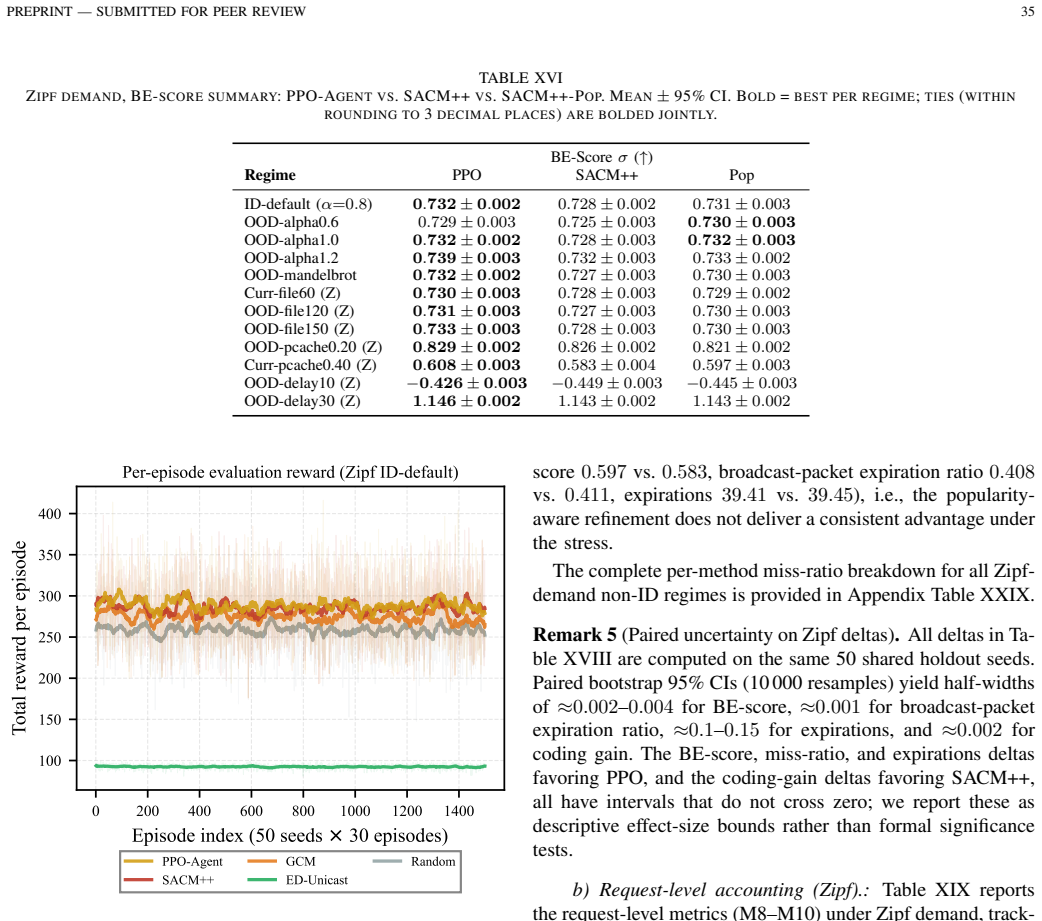

read the original abstract
With the coded caching, the server can use the information the users have cached to serve multiple users at a time by sending a single coded multi-casting message, i.e., the merged message, thereby relieving the peak network loads. However, for the delay-sensitive applications of the users, like the video streaming services, it becomes essential to choose which messages to merge online, considering the strict deadlines for each request. The problem, however, is that while the merge is helpful for the formation of the current coded multi-casting message, it can be harmful for the subsequent ones. We proposed a DRL-based solution that formulates the deadline-constrained coded delivery as a masked discrete-action queue-state control problem, while we trained a graph-attention policy network via proximal policy optimization. The policy network reduces the broadcast-packet expiration ratio $\rho$ by $40.9%$ ($0.208$ vs. $0.352$) with respect to the best coded multi-casting baseline (SACM++) on the uniform-demand benchmark, while also attaining the best broadcast-efficiency score $\sigma$ across the Track A battery among the coded multi-casting methods. The interesting fact we observed is that for the applications of the users with tight deadlines, the method of selective merging is better than the method of aggressive merging, i.e., the policy network learns to merge at only $\approx 31.8%$ rate, even though the same observation holds across the variations within the same simulator family.
Editorial analysis
A structured set of objections, weighed in public.
Referee Report
Summary. The paper proposes a deep reinforcement learning approach to learn selective merge policies for deadline-constrained coded caching. It formulates the problem as a masked discrete-action queue-state control MDP and trains a graph-attention policy network using proximal policy optimization (PPO). On a uniform-demand benchmark, the policy achieves a 40.9% reduction in broadcast-packet expiration ratio ρ (0.208 vs. 0.352) relative to the SACM++ baseline while attaining the highest broadcast-efficiency score σ among coded multicasting methods; it also reports learning a selective merge rate of approximately 31.8%.
Significance. If the simulator faithfully captures the trade-off between immediate multicast opportunities and future deadline violations, the result would demonstrate that selective (rather than aggressive) merging is preferable for tight-deadline applications and would provide a practical DRL-based method for online coded delivery. The use of graph-attention networks on queue states and the explicit masking of invalid actions are technically sound extensions of standard PPO to this domain.
major comments (2)
- [Abstract and §5] Abstract and §5 (Numerical Results): The headline claim of a 40.9% reduction in ρ and the 31.8% merge rate are presented without error bars, ablation studies on the graph-attention architecture or PPO hyperparameters, or full training curves; this leaves the central empirical claim only partially supported by the visible evidence.
- [§4] §4 (Simulation Environment): All reported gains, including the selective-merge advantage, are generated inside a single unvalidated simulator family that models the problem as a masked discrete-action queue-state MDP; no calibration against live-network traces, comparison to an analytical deadline model, or sensitivity analysis on arrival statistics or channel variability is provided, directly affecting the reliability of the 40.9% ρ improvement.
minor comments (2)
- [§2] Notation for the broadcast-efficiency score σ and expiration ratio ρ should be defined explicitly in the problem formulation section rather than only in the abstract.
- [§3] The manuscript would benefit from a brief discussion of how the masking mechanism interacts with the graph-attention layers to enforce deadline constraints.
Simulated Author's Rebuttal
We thank the referee for the constructive feedback and for acknowledging the technical soundness of the graph-attention PPO formulation and action masking. We respond to each major comment below and indicate the revisions we will make.
read point-by-point responses
-
Referee: [Abstract and §5] Abstract and §5 (Numerical Results): The headline claim of a 40.9% reduction in ρ and the 31.8% merge rate are presented without error bars, ablation studies on the graph-attention architecture or PPO hyperparameters, or full training curves; this leaves the central empirical claim only partially supported by the visible evidence.
Authors: We agree that the reported gains would be more convincingly supported by additional statistical and architectural analysis. In the revised manuscript we will add error bars computed from multiple independent training runs using different random seeds, include ablation studies that isolate the contribution of the graph-attention layers and vary key PPO hyperparameters, and provide the full training curves showing both reward and expiration-ratio convergence. These additions will directly address the concern that the 40.9 % reduction and 31.8 % merge rate are only partially evidenced. revision: yes
-
Referee: [§4] §4 (Simulation Environment): All reported gains, including the selective-merge advantage, are generated inside a single unvalidated simulator family that models the problem as a masked discrete-action queue-state MDP; no calibration against live-network traces, comparison to an analytical deadline model, or sensitivity analysis on arrival statistics or channel variability is provided, directly affecting the reliability of the 40.9% ρ improvement.
Authors: The simulator implements the standard masked discrete-action MDP formulation used throughout the coded-caching literature for deadline-constrained delivery. We will add a sensitivity analysis section that varies packet-arrival rates, deadline tightness, and channel variability to demonstrate that the selective-merge policy remains advantageous across these parameter ranges. Direct calibration against live-network traces and comparison with a closed-form analytical deadline model lie outside the scope of the present algorithmic study and were not performed. revision: partial
- Calibration against live-network traces and comparison to an analytical deadline model, as these require external data sources and models not developed within the current work.
Circularity Check
No circularity; performance metrics are simulation outputs from trained policy
full rationale
The paper formulates deadline-constrained coded caching as a masked discrete-action MDP and trains a graph-attention policy via PPO. All reported figures (40.9% ρ reduction, 0.208 vs 0.352, 31.8% merge rate, best σ score) are measured outcomes of running the trained policy on uniform-demand and Track A benchmarks inside the simulator. No algebraic derivation, parameter fit, or self-citation is invoked to obtain these numbers; they are not equivalent to any input by construction. The simulator dynamics are an external modeling choice whose fidelity is a separate validation question, not a circularity issue within the derivation chain.
Axiom & Free-Parameter Ledger
free parameters (1)
- PPO and graph-attention hyperparameters
axioms (1)
- domain assumption The masked discrete-action queue-state formulation correctly encodes the future-harm trade-off of merging
Lean theorems connected to this paper
-
IndisputableMonolith/Foundation/RealityFromDistinction.leanreality_from_one_distinction unclear?
unclearRelation between the paper passage and the cited Recognition theorem.
We proposed a DRL-based solution that formulates the deadline-constrained coded delivery as a masked discrete-action queue-state control problem, while we trained a graph-attention policy network via proximal policy optimization.
-
IndisputableMonolith/Cost/FunctionalEquation.leanwashburn_uniqueness_aczel unclear?
unclearRelation between the paper passage and the cited Recognition theorem.
The policy network reduces the broadcast-packet expiration ratio ρ by 40.9% (0.208 vs. 0.352) ... learns to merge at only ≈31.8% rate
What do these tags mean?
- matches
- The paper's claim is directly supported by a theorem in the formal canon.
- supports
- The theorem supports part of the paper's argument, but the paper may add assumptions or extra steps.
- extends
- The paper goes beyond the formal theorem; the theorem is a base layer rather than the whole result.
- uses
- The paper appears to rely on the theorem as machinery.
- contradicts
- The paper's claim conflicts with a theorem or certificate in the canon.
- unclear
- Pith found a possible connection, but the passage is too broad, indirect, or ambiguous to say the theorem truly supports the claim.
Reference graph
Works this paper leans on
-
[1]
Ericsson mobility report, June 2024,
Ericsson AB, “Ericsson mobility report, June 2024,” Ericsson, Tech. Rep., 2024. [Online]. Available: https://www.ericsson.com/en/ reports-and-papers/mobility-report
work page 2024
-
[2]
Mobile edge caching: A survey,
J. Liu, Y . Shi, Z. M. Fadlullah, and N. Kato, “Mobile edge caching: A survey,”IEEE Communications Surveys & Tutorials, vol. 20, no. 3, pp. 2109–2133, 2018
work page 2018
-
[3]
Fundamental limits of caching,
M. A. Maddah-Ali and U. Niesen, “Fundamental limits of caching,” IEEE Transactions on Information Theory, vol. 60, no. 5, pp. 2856– 2867, 2014. PREPRINT — SUBMITTED FOR PEER REVIEW 55
work page 2014
-
[4]
Decentralized coded caching attains order-optimal memory-rate tradeoff,
——, “Decentralized coded caching attains order-optimal memory-rate tradeoff,”IEEE/ACM Transactions on Networking, vol. 23, no. 4, pp. 1029–1040, 2015
work page 2015
-
[5]
Coded Caching for Delay-Sensitive Content
U. Niesen and M. A. Maddah-Ali, “Coded caching for delay-sensitive content,”CoRR, vol. abs/1407.4489, 2014. [Online]. Available: http://arxiv.org/abs/1407.4489
work page internal anchor Pith review Pith/arXiv arXiv 2014
-
[6]
An approximation algorithm for optimal clique cover delivery in coded caching,
S. M. Asghari, Y . Ouyang, A. Nayyar, and A. S. Avestimehr, “An approximation algorithm for optimal clique cover delivery in coded caching,”IEEE Transactions on Communications, vol. 67, no. 7, pp. 4683–4695, 2019
work page 2019
-
[7]
An Efficient Multiple-Groupcast Coded Multicasting Scheme for Finite Fractional Caching
M. Ji, K. Shanmugam, A. M. Tulino, J. Llorca, and G. Caire, “An effi- cient multiple-groupcast coded multicasting scheme for finite fractional caching,”arXiv preprint arXiv:1511.07539, 2015
work page internal anchor Pith review Pith/arXiv arXiv 2015
-
[8]
Efficient algorithms for coded multicasting in heterogeneous caching networks,
G. Vettigli, M. Ji, K. Shanmugam, J. Llorca, A. M. Tulino, and G. Caire, “Efficient algorithms for coded multicasting in heterogeneous caching networks,”Entropy, vol. 21, no. 3, p. 324, 2019
work page 2019
-
[9]
Reinforcement learning for adaptive caching with dynamic storage pricing,
A. Sadeghi, F. Sheikholeslami, A. G. Marques, and G. B. Giannakis, “Reinforcement learning for adaptive caching with dynamic storage pricing,”IEEE Journal on Selected Areas in Communications, vol. 37, no. 10, pp. 2267–2281, 2019
work page 2019
-
[10]
A reinforcement-learning approach to proactive caching in wireless networks,
S. O. Somuyiwa, A. Gy ¨orgy, and D. G¨und¨uz, “A reinforcement-learning approach to proactive caching in wireless networks,”IEEE Journal on Selected Areas in Communications, vol. 36, no. 6, pp. 1331–1344, 2018
work page 2018
-
[11]
A deep reinforcement learning-based framework for content caching,
C. Zhong, M. C. Gursoy, and S. Velipasalar, “A deep reinforcement learning-based framework for content caching,” in2018 52nd Annual Conference on Information Sciences and Systems (CISS). IEEE, 2018, pp. 1–6
work page 2018
-
[12]
Learning to code: Coded caching via deep reinforcement learning,
N. Naderializadeh and S. M. Asghari, “Learning to code: Coded caching via deep reinforcement learning,” in2019 53rd Asilomar Conference on Signals, Systems, and Computers. IEEE, 2019, pp. 1774–1778
work page 2019
-
[13]
A closer look at invalid action masking in policy gradient algorithms,
S. Huang and S. Onta ˜n´on, “A closer look at invalid action masking in policy gradient algorithms,”arXiv preprint arXiv:2006.14171, 2020
-
[14]
SB3-Contrib: Maskable PPO (invalid action masking) documen- tation,
“SB3-Contrib: Maskable PPO (invalid action masking) documen- tation,” https://sb3-contrib.readthedocs.io/en/master/modules/ppo mask. html, 2026, accessed: 2026-01-11
work page 2026
-
[15]
P. Veli ˇckovi´c, G. Cucurull, A. Casanova, A. Romero, P. Li `o, and Y . Bengio, “Graph attention networks,” 2018
work page 2018
-
[16]
Thinking fast and slow with deep learning and tree search,
T. Anthony, Z. Tian, and D. Barber, “Thinking fast and slow with deep learning and tree search,” 2017
work page 2017
-
[17]
A reduction of imitation learning and structured prediction to no-regret online learning,
S. Ross, G. Gordon, and D. Bagnell, “A reduction of imitation learning and structured prediction to no-regret online learning,” inProceedings of the 14th International Conference on Artificial Intelligence and Statistics (AISTATS), 2011, pp. 627–635
work page 2011
-
[18]
Policy invariance under reward transformations: Theory and application to reward shaping,
A. Y . Ng, D. Harada, and S. Russell, “Policy invariance under reward transformations: Theory and application to reward shaping,” inProceed- ings of the 16th International Conference on Machine Learning (ICML), 1999, pp. 278–287
work page 1999
-
[19]
Proximal Policy Optimization Algorithms
J. Schulman, F. Wolski, P. Dhariwal, A. Radford, and O. Klimov, “Prox- imal policy optimization algorithms,”arXiv preprint arXiv:1707.06347, 2017
work page internal anchor Pith review Pith/arXiv arXiv 2017
-
[20]
High-Dimensional Continuous Control Using Generalized Advantage Estimation
J. Schulman, P. Moritz, S. Levine, M. I. Jordan, and P. Abbeel, “High- dimensional continuous control using generalized advantage estimation,” arXiv preprint arXiv:1506.02438, 2015
work page internal anchor Pith review Pith/arXiv arXiv 2015
-
[21]
Y . Bengio, J. Louradour, R. Collobert, and J. Weston, “Curriculum learning,” inProceedings of the 26th Annual International Conference on Machine Learning (ICML). ACM, 2009, pp. 41–48
work page 2009
-
[22]
R. Pedarsani, M. A. Maddah-Ali, and U. Niesen, “Online coded caching,” in2014 52nd Annual Allerton Conference on Communication, Control, and Computing (Allerton). IEEE, 2014
work page 2014
-
[23]
Y . Jiang, W. Huang, M. Bennis, and F.-C. Zheng, “Decentralized asyn- chronous coded caching design and performance analysis in fog radio access networks,”IEEE Transactions on Mobile Computing, vol. 19, no. 3, pp. 540–551, 2020
work page 2020
-
[24]
Deep learning for wireless coded caching with unknown and time-variant content popularity,
Z. Zhang and M. Tao, “Deep learning for wireless coded caching with unknown and time-variant content popularity,”IEEE Transactions on Wireless Communications, vol. 20, no. 2, pp. 1152–1163, 2021
work page 2021
-
[25]
Coded caching for time-varying files popularities and asynchronous delivery,
M. Amir, E. Bedeer, M. H. Ahmed, and T. Khattab, “Coded caching for time-varying files popularities and asynchronous delivery,”IEEE Open Journal of the Communications Society, vol. 2, pp. 1458–1472, 2021
work page 2021
-
[26]
Optimal scheduling in asyn- chronous coded caching,
H. Yang, L. F. Xie, J. Liu, and L. Lu, “Optimal scheduling in asyn- chronous coded caching,”IEEE Transactions on Vehicular Technology, vol. 71, no. 4, pp. 4454–4459, 2022
work page 2022
-
[27]
Deep reinforcement learning that matters,
P. Henderson, R. Islam, P. Bachman, J. Pineau, D. Precup, and D. Meger, “Deep reinforcement learning that matters,” inProceedings of the AAAI Conference on Artificial Intelligence, vol. 32, no. 1, 2018
work page 2018
-
[28]
Deep reinforcement learning at the edge of the statistical precipice,
R. Agarwal, M. Schwarzer, P. S. Castro, A. C. Courville, and M. G. Bellemare, “Deep reinforcement learning at the edge of the statistical precipice,” inAdvances in Neural Information Processing Systems (NeurIPS), vol. 34, 2021
work page 2021
-
[29]
SB3-Contrib: Experimen- tal reinforcement learning algorithms for Stable-Baselines3,
A. Raffin and Stable-Baselines Contributors, “SB3-Contrib: Experimen- tal reinforcement learning algorithms for Stable-Baselines3,” https:// github.com/Stable-Baselines-Team/stable-baselines3-contrib, 2022, ac- cessed: 2025-09-21
work page 2022
-
[30]
Stable-Baselines3: Reliable reinforcement learning implementa- tions,
A. Raffin, A. Hill, A. Gleave, A. Kanervisto, M. Ernestus, and N. Dor- mann, “Stable-Baselines3: Reliable reinforcement learning implementa- tions,”Journal of Machine Learning Research, vol. 22, no. 268, pp. 1–8, 2021
work page 2021
-
[31]
Gymnasium: A Standard Interface for Reinforcement Learning Environments
M. Towers, A. Kwiatkowski, J. Terry, J. U. Balis, G. De Cola, T. Deleu, M. Goul ˜ao, A. Kallinteris, A. KG, M. Krimber, R. Perez-Vicente, A. Pierr´e, S. Schulhoff, J. J. Tai, A. Tan, and O. G. Younis, “Gymnasium: A standard interface for reinforcement learning environments,”arXiv preprint arXiv:2407.17032, 2024
work page internal anchor Pith review Pith/arXiv arXiv 2024
-
[32]
Inference by eye: Confidence intervals and how to read pictures of data,
G. Cumming and S. Finch, “Inference by eye: Confidence intervals and how to read pictures of data,”American Psychologist, vol. 60, no. 2, pp. 170–180, 2005
work page 2005
discussion (0)
Sign in with ORCID, Apple, or X to comment. Anyone can read and Pith papers without signing in.