Magnetic Turbulence Boosts Supernova Signals of Axion-Photon Conversion
Pith reviewed 2026-05-19 16:06 UTC · model grok-4.3
The pith
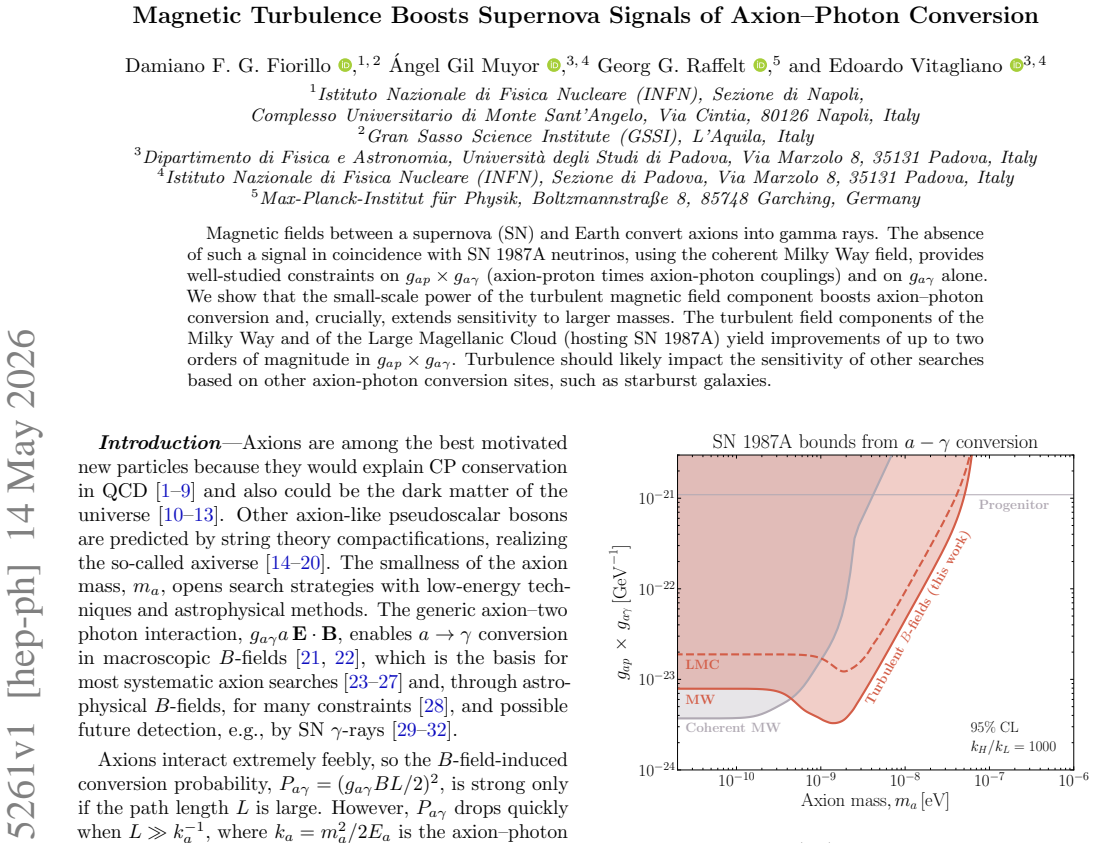
Turbulent magnetic fields boost axion-to-gamma conversion from supernovae by up to two orders of magnitude.
A machine-rendered reading of the paper's core claim, the machinery that carries it, and where it could break.
Core claim
The turbulent field components of the Milky Way and of the Large Magellanic Cloud yield improvements of up to two orders of magnitude in g_ap × g_aγ by boosting axion-photon conversion and extending sensitivity to larger masses.
What carries the argument
The small-scale power spectrum of the turbulent magnetic field, which raises the axion-photon oscillation probability across the relevant propagation distances.
If this is right
- Non-observations of gamma rays from SN 1987A now constrain the product g_ap × g_aγ more tightly by up to two orders of magnitude.
- Sensitivity extends to higher axion masses where only the coherent field would have produced negligible conversion.
- Turbulence is expected to modify the reach of other axion-photon conversion searches that rely on magnetic fields in starburst galaxies or similar environments.
- Previous constraints derived from coherent-field assumptions alone require re-evaluation once turbulence is included.
Where Pith is reading between the lines
- Future high-resolution observations of galactic turbulence could be used to sharpen the predicted conversion probability for specific supernova distances.
- The same small-scale magnetic power may enhance conversion signals from other axion production channels or for different particle species in comparable astrophysical settings.
- Gamma-ray telescope strategies aimed at supernova remnants could be optimized by folding in turbulent-field models rather than coherent-field approximations.
Load-bearing premise
The assumed spectrum and coherence properties of the turbulent magnetic field components are accurate for the relevant propagation distances and axion mass range.
What would settle it
A refined map or simulation showing that the turbulent magnetic field power spectrum lacks sufficient small-scale components over kiloparsec distances from the Large Magellanic Cloud would eliminate the predicted boost in conversion efficiency.
Figures


read the original abstract
Magnetic fields between a supernova (SN) and Earth convert axions into gamma rays. The absence of such a signal in coincidence with SN 1987A neutrinos, using the coherent Milky Way field, provides well-studied constraints on $g_{ap}\times g_{a\gamma}$ (axion-proton times axion-photon couplings) and on $g_{a\gamma}$ alone. We show that the small-scale power of the turbulent magnetic field component boosts axion-photon conversion and, crucially, extends sensitivity to larger masses. The turbulent field components of the Milky Way and of the Large Magellanic Cloud (hosting SN 1987A) yield improvements of up to two orders of magnitude in $g_{ap}\times g_{a\gamma}$. Turbulence should likely impact the sensitivity of other searches based on other axion-photon conversion sites, such as starburst galaxies.
Editorial analysis
A structured set of objections, weighed in public.
Referee Report
Summary. The manuscript argues that small-scale turbulent magnetic field components in the Milky Way and Large Magellanic Cloud (site of SN 1987A) enhance axion-photon conversion probabilities relative to the coherent field alone. This leads to up to two orders of magnitude improvement in sensitivity to the product g_ap × g_aγ and extends the accessible axion mass range, with similar implications suggested for other astrophysical conversion sites such as starburst galaxies.
Significance. If the turbulence modeling is robust, the result would materially strengthen existing SN1987A-derived bounds on axion couplings and highlight a previously under-appreciated systematic in magnetic-field-based axion searches. The work supplies a concrete, falsifiable prediction for how turbulence spectra affect conversion at oscillation lengths set by higher m_a.
major comments (2)
- [§4 (turbulent spectrum modeling)] The central claim of a two-order-of-magnitude boost (abstract and §4) rests on the turbulent power spectrum supplying sufficient amplitude at wave-numbers k ≳ 1 pc^{-1} that match the axion oscillation scale k_osc ≈ m_a²/(2ω) for the newly accessible masses. The manuscript should demonstrate this explicitly by showing the conversion probability versus m_a both with and without the turbulent component, including the adopted spectral index, coherence-length cutoff, and normalization for the LMC and Milky Way.
- [Results summary table] Table 1 or equivalent summary of results: the reported improvement factors must be accompanied by uncertainty bands arising from plausible variations in the turbulence parameters (e.g., Kolmogorov vs. steeper index, minimum coherence length). Without this, it is unclear whether the quoted “up to two orders” is representative or an optimistic outlier.
minor comments (2)
- [§2] Notation for the mixing angle and oscillation wavenumber should be defined once in §2 and used consistently; the current alternation between θ and φ is confusing.
- [Figure 3] Figure 3 (conversion probability vs. distance): the line-of-sight integration should indicate the relative contribution of the coherent versus turbulent segments so readers can see where the boost originates.
Simulated Author's Rebuttal
We thank the referee for their thoughtful and constructive report. Their comments have prompted us to strengthen the presentation of our turbulence modeling and to quantify the robustness of our results. We address each major comment below and have revised the manuscript accordingly.
read point-by-point responses
-
Referee: [§4 (turbulent spectrum modeling)] The central claim of a two-order-of-magnitude boost (abstract and §4) rests on the turbulent power spectrum supplying sufficient amplitude at wave-numbers k ≳ 1 pc^{-1} that match the axion oscillation scale k_osc ≈ m_a²/(2ω) for the newly accessible masses. The manuscript should demonstrate this explicitly by showing the conversion probability versus m_a both with and without the turbulent component, including the adopted spectral index, coherence-length cutoff, and normalization for the LMC and Milky Way.
Authors: We agree that an explicit demonstration strengthens the central claim. In the revised §4 we have added a new figure that plots the axion-photon conversion probability versus m_a for both the coherent field alone and the coherent-plus-turbulent field. The figure caption and surrounding text now specify the Kolmogorov spectral index (n = −11/3), the coherence-length cutoff at 1 pc, and the adopted normalization of the turbulent field strength (B_turb = 3 μG for the Milky Way and 5 μG for the LMC). The plot shows that the additional power at k ≳ 1 pc^{-1} accounts for the extension of sensitivity to higher masses and for the bulk of the reported boost. revision: yes
-
Referee: [Results summary table] Table 1 or equivalent summary of results: the reported improvement factors must be accompanied by uncertainty bands arising from plausible variations in the turbulence parameters (e.g., Kolmogorov vs. steeper index, minimum coherence length). Without this, it is unclear whether the quoted “up to two orders” is representative or an optimistic outlier.
Authors: We have revised Table 1 to include uncertainty bands on the improvement factors. The bands are obtained by varying the spectral index between n = −11/3 (Kolmogorov) and n = −4 (steeper), and by changing the minimum coherence length between 0.1 pc and 10 pc while keeping the total turbulent power fixed. The revised table shows that the improvement remains at least one order of magnitude across this range and reaches up to two orders for the fiducial Kolmogorov case; the quoted “up to two orders” is therefore representative rather than an outlier. revision: yes
Circularity Check
No significant circularity; derivation applies standard mixing equations to modeled turbulence
full rationale
The paper derives the boosted conversion probability by integrating the axion-photon mixing term along lines of sight through both coherent and turbulent Galactic and LMC magnetic fields, using a power-law spectrum for the turbulent component together with stated coherence lengths. This modeling step does not reduce to a self-definition, a fitted parameter renamed as a prediction, or a load-bearing self-citation chain; the improvement in g_ap × g_aγ follows directly from the oscillatory integral evaluated on the assumed turbulence spectrum. No equation is shown to be equivalent to its input by construction, and external constraints on turbulence at large scales are invoked only as motivation rather than as the sole justification for the result. The derivation therefore remains self-contained against the physical model inputs.
Axiom & Free-Parameter Ledger
axioms (2)
- domain assumption Axion production in core-collapse supernovae follows established models.
- domain assumption The turbulent magnetic field power spectrum and coherence length are known and applicable to SN-Earth propagation.
Lean theorems connected to this paper
-
IndisputableMonolith/Cost/FunctionalEquation.leanwashburn_uniqueness_aczel unclear?
unclearRelation between the paper passage and the cited Recognition theorem.
Aaγj = gaγ/2 ∫ Bj(s) e^{-i ka s} ds ; Paγ(ka) = g²aγ/4 ∬ B⊥(s)·B⊥(s′) cos[ka(s−s′)] ds ds′
-
IndisputableMonolith/Foundation/DimensionForcing.leanalexander_duality_circle_linking unclear?
unclearRelation between the paper passage and the cited Recognition theorem.
turbulent field modeled as isotropic Gaussian random field with Kolmogorov power spectrum |Bk|² ∝ k^{-β-2} (β=5/3) between kL and kH
What do these tags mean?
- matches
- The paper's claim is directly supported by a theorem in the formal canon.
- supports
- The theorem supports part of the paper's argument, but the paper may add assumptions or extra steps.
- extends
- The paper goes beyond the formal theorem; the theorem is a base layer rather than the whole result.
- uses
- The paper appears to rely on the theorem as machinery.
- contradicts
- The paper's claim conflicts with a theorem or certificate in the canon.
- unclear
- Pith found a possible connection, but the passage is too broad, indirect, or ambiguous to say the theorem truly supports the claim.
Reference graph
Works this paper leans on
-
[1]
R. D. Peccei and H. R. Quinn,CP Conservation in the Presence of Instantons,Phys. Rev. Lett.38(1977) 1440
work page 1977
-
[2]
R. D. Peccei and H. R. Quinn,Constraints Imposed by CP Conservation in the Presence of Instantons,Phys. Rev. D16(1977) 1791
work page 1977
-
[3]
Weinberg,A New Light Boson?,Phys
S. Weinberg,A New Light Boson?,Phys. Rev. Lett.40 (1978) 223
work page 1978
-
[4]
Wilczek,Problem of Strong P and T Invariance in the Presence of Instantons,Phys
F. Wilczek,Problem of Strong P and T Invariance in the Presence of Instantons,Phys. Rev. Lett.40(1978) 279
work page 1978
-
[5]
J. E. Kim,Weak Interaction Singlet and Strong CP Invariance,Phys. Rev. Lett.43(1979) 103
work page 1979
-
[6]
M. A. Shifman, A. I. Vainshtein and V. I. Zakharov,Can Confinement Ensure Natural CP Invariance of Strong Interactions?,Nucl. Phys. B166(1980) 493
work page 1980
-
[7]
M. Dine, W. Fischler and M. Srednicki,A Simple Solution to the Strong CP Problem with a Harmless Axion,Phys. Lett. B104(1981) 199
work page 1981
-
[8]
A. R. Zhitnitsky,On Possible Suppression of the Axion Hadron Interactions,Sov. J. Nucl. Phys.31(1980) 260. Translated fromYad. Fiz.31(1980) 497
work page 1980
-
[9]
The landscape of QCD axion models
L. Di Luzio, M. Giannotti, E. Nardi and L. Visinelli,The landscape of QCD axion models,Phys. Rept.870(2020) 1 [2003.01100]
work page internal anchor Pith review Pith/arXiv arXiv 2020
-
[10]
J. Preskill, M. B. Wise and F. Wilczek,Cosmology of the Invisible Axion,Phys. Lett. B120(1983) 127
work page 1983
-
[11]
L. F. Abbott and P. Sikivie,A Cosmological Bound on the Invisible Axion,Phys. Lett. B120(1983) 133
work page 1983
-
[12]
M. Dine and W. Fischler,The Not So Harmless Axion, Phys. Lett. B120(1983) 137
work page 1983
- [13]
-
[14]
P. Svrcek and E. Witten,Axions In String Theory, JHEP06(2006) 051 [hep-th/0605206]
work page internal anchor Pith review Pith/arXiv arXiv 2006
-
[15]
A. Arvanitaki, S. Dimopoulos, S. Dubovsky, N. Kaloper and J. March-Russell,String Axiverse,Phys. Rev. D81 6 (2010) 123530 [0905.4720]
work page internal anchor Pith review Pith/arXiv arXiv 2010
-
[16]
The type IIB string axiverse and its low-energy phenomenology
M. Cicoli, M. Goodsell and A. Ringwald,The type IIB string axiverse and its low-energy phenomenology,JHEP 10(2012) 146 [1206.0819]
work page internal anchor Pith review Pith/arXiv arXiv 2012
-
[17]
M. Demirtas, C. Long, L. McAllister and M. Stillman, The Kreuzer-Skarke Axiverse,JHEP04(2020) 138 [1808.01282]
work page internal anchor Pith review Pith/arXiv arXiv 2020
-
[18]
J. Halverson, C. Long, B. Nelson and G. Salinas, Towards string theory expectations for photon couplings to axionlike particles,Phys. Rev. D100(2019) 106010 [1909.05257]
-
[19]
M. Demirtas, N. Gendler, C. Long, L. McAllister and J. Moritz,PQ axiverse,JHEP06(2023) 092 [2112.04503]
-
[20]
N. Gendler, D. J. E. Marsh, L. McAllister and J. Moritz, Glimmers from the axiverse,JCAP09(2024) 071 [2309.13145]
-
[21]
Sikivie,Experimental Tests of the Invisible Axion, Phys
P. Sikivie,Experimental Tests of the Invisible Axion, Phys. Rev. Lett.51(1983) 1415. ErratumPhys. Rev. Lett.52(1984) 695
work page 1983
-
[22]
G. Raffelt and L. Stodolsky,Mixing of the Photon with Low Mass Particles,Phys. Rev. D37(1988) 1237
work page 1988
-
[23]
P. W. Graham, I. G. Irastorza, S. K. Lamoreaux, A. Lindner and K. A. van Bibber,Experimental Searches for the Axion and Axion-Like Particles,Ann. Rev. Nucl. Part. Sci.65(2015) 485 [1602.00039]
work page internal anchor Pith review Pith/arXiv arXiv 2015
-
[24]
I. G. Irastorza and J. Redondo,New experimental approaches in the search for axion-like particles,Prog. Part. Nucl. Phys.102(2018) 89 [1801.08127]
work page internal anchor Pith review Pith/arXiv arXiv 2018
-
[25]
Sikivie,Invisible Axion Search Methods,Rev
P. Sikivie,Invisible Axion Search Methods,Rev. Mod. Phys.93(2021) 015004 [2003.02206]
-
[26]
A. Berlin and Y. Kahn,New Technologies for Axion and Dark Photon Searches,Ann. Rev. Nucl. Part. Sci.75 (2025) 83 [2412.08704]
-
[27]
M. Baryakhtar, L. Rosenberg and G. Rybka,Searching for the QCD Dark Matter Axion,2504.10607
-
[28]
C. O’Hare. Github Page https://github.com/cajohare
-
[29]
P. Carenza, C. Evoli, M. Giannotti, A. Mirizzi and D. Montanino,Turbulent axion-photon conversions in the Milky Way,Phys. Rev. D104(2021) 023003 [2104.13935]
- [30]
-
[31]
D. F. G. Fiorillo, ´A. Gil Muyor, H.-T. Janka, G. G. Raffelt and E. Vitagliano,Axion-photon conversion in transient compact stars: Systematics, constraints, and opportunities,JCAP03(2026) 053 [2509.13322]
work page internal anchor Pith review Pith/arXiv arXiv 2026
-
[32]
F. R. Cand´ on, D. F. G. Fiorillo, ´A. Gil Muyor, H.-T. Janka, G. G. Raffelt and E. Vitagliano, Stripped-Envelope Supernovae for QCD Axion Detection, Phys. Rev. Lett.136(2026) 171001 [2511.13815]
work page internal anchor Pith review Pith/arXiv arXiv 2026
-
[33]
K. van Bibber, P. M. McIntyre, D. E. Morris and G. G. Raffelt,A Practical Laboratory Detector for Solar Axions,Phys. Rev. D39(1989) 2089
work page 1989
-
[34]
K. Van Bibber, N. R. Dagdeviren, S. E. Koonin, A. Kerman and H. N. Nelson,Proposed experiment to produce and detect light pseudoscalars,Phys. Rev. Lett. 59(1987) 759
work page 1987
- [35]
-
[36]
Panagia,Distance to SN 1987A and the LMC, in: New Views of the Magellanic Clouds, Proc
N. Panagia,Distance to SN 1987A and the LMC, in: New Views of the Magellanic Clouds, Proc. IAU Symposium No. 190, Victoria, Canada, 12–17 July 1998, eds. Y.-H. Chu et al., Astron. Soc. of the Pacific (1999), 549–553. ADS Link: https://articles.adsabs.harvard.edu /pdf/1999IAUS..190..549P
work page 1998
-
[37]
A Geometric Determination of the Distance to SN 1987A and the LMC
N. Panagia,A Geometric Determination of the Distance to SN 1987A and the LMC,astro-ph/0309416. in: IAU Colloq. 192: Cosmic Explosions, On the 10th Anniversary of SN1993J, J.-M. Marcaide and K. W. Weiler (eds.),Springer Proc. Phys.99(2005) 585
work page internal anchor Pith review Pith/arXiv arXiv 2005
-
[38]
A distance to the Large Magellanic Cloud that is precise to one per cent
G. Pietrzy´ nski et al.,A distance to the Large Magellanic Cloud that is precise to one per cent,Nature567(2019) 200 [1903.08096]. [39]Kamiokande-IICollaboration, K. Hirata et al., Observation of a Neutrino Burst from the Supernova SN 1987a,Phys. Rev. Lett.58(1987) 1490
work page internal anchor Pith review Pith/arXiv arXiv 2019
-
[39]
K. S. Hirata et al.,Observation in the Kamiokande-II Detector of the Neutrino Burst from Supernova SN 1987a,Phys. Rev. D38(1988) 448
work page 1988
-
[40]
R. M. Bionta et al.,Observation of a Neutrino Burst in Coincidence with Supernova SN 1987a in the Large Magellanic Cloud,Phys. Rev. Lett.58(1987) 1494. [42]IMBCollaboration, C. B. Bratton et al.,Angular Distribution of Events From Sn1987a,Phys. Rev. D37 (1988) 3361
work page 1987
-
[41]
E. N. Alekseev, L. N. Alekseeva, V. I. Volchenko and I. V. Krivosheina,Possible Detection of a Neutrino Signal on 23 February 1987 at the Baksan Underground Scintillation Telescope of the Institute of Nuclear Research,JETP Lett.45(1987) 589
work page 1987
-
[42]
E. N. Alekseev, L. N. Alekseeva, I. V. Krivosheina and V. I. Volchenko,Detection of the Neutrino Signal From SN1987A in the LMC Using the Inr Baksan Underground Scintillation Telescope,Phys. Lett. B205(1988) 209
work page 1988
-
[43]
Koshiba,Observational neutrino astrophysics,Phys
M. Koshiba,Observational neutrino astrophysics,Phys. Rept.220(1992) 229
work page 1992
- [44]
-
[45]
G. G. Raffelt,Stars as Laboratories for Fundamental Physics. University of Chicago Press, 1996
work page 1996
- [46]
-
[47]
A. Arza et al.,The COSMIC WISPers White Paper: The physics case for Weakly Interacting Slim Particles, 2603.03433
- [48]
-
[49]
M. S. Turner,Axions from SN 1987A,Phys. Rev. Lett. 60(1988) 1797
work page 1988
-
[50]
A. Burrows, M. S. Turner and R. P. Brinkmann,Axions and SN 1987A,Phys. Rev. D39(1989) 1020
work page 1989
- [51]
-
[52]
A. Burrows, M. T. Ressell and M. S. Turner,Axions and SN 1987A: Axion Trapping,Phys. Rev. D42(1990) 3297
work page 1990
-
[53]
G. G. Raffelt,Astrophysical axion bounds,Lect. Notes 7 Phys.741(2008) 51 [hep-ph/0611350]
work page internal anchor Pith review Pith/arXiv arXiv 2008
-
[54]
P. Carenza, T. Fischer, M. Giannotti, G. Guo, G. Mart´ ınez-Pinedo and A. Mirizzi,Improved axion emissivity from a supernova via nucleon-nucleon bremsstrahlung,JCAP10(2019) 016 [1906.11844]. ErratumJCAP05(2020) E01
-
[55]
D. Forrest, E. Chupp, J. Ryan, M. Cherry, I. Gleske, C. Reppin, K. Pinkau, E. Rieger, G. Kanbach, R. Kinzer et al.,The gamma ray spectrometer for the solar maximum mission,Solar Physics65(1980) 15
work page 1980
-
[56]
E. L. Chupp, W. T. Vestrand and C. Reppin, Experimental Limits on the Radiative Decay of SN 1987A Neutrinos,Phys. Rev. Lett.62(1989) 505
work page 1989
-
[57]
E. W. Kolb and M. S. Turner,Limits to the Radiative Decays of Neutrinos and Axions from Gamma-Ray Observations of SN 1987A,Phys. Rev. Lett.62(1989) 509
work page 1989
-
[58]
L. Oberauer, C. Hagner, G. Raffelt and E. Rieger, Supernova bounds on neutrino radiative decays, Astropart. Phys.1(1993) 377
work page 1993
-
[59]
J. W. Brockway, E. D. Carlson and G. G. Raffelt, SN 1987A gamma-ray limits on the conversion of pseudoscalars,Phys. Lett. B383(1996) 439 [astro-ph/9605197]
work page internal anchor Pith review Pith/arXiv arXiv 1996
-
[60]
J. A. Grifols, E. Masso and R. Toldra,Gamma-rays from SN 1987A due to pseudoscalar conversion,Phys. Rev. Lett.77(1996) 2372 [astro-ph/9606028]
work page internal anchor Pith review Pith/arXiv arXiv 1996
-
[61]
Revisiting the SN1987A gamma-ray limit on ultralight axion-like particles
A. Payez, C. Evoli, T. Fischer, M. Giannotti, A. Mirizzi and A. Ringwald,Revisiting the SN1987A gamma-ray limit on ultralight axion-like particles,JCAP02(2015) 006 [1410.3747]
work page internal anchor Pith review Pith/arXiv arXiv 2015
-
[62]
S. Hoof and L. Schulz,Updated constraints on axion-like particles from temporal information in supernova SN1987A gamma-ray data,JCAP03(2023) 054 [2212.09764]
-
[63]
Signatures of axion-like particles in the spectra of TeV gamma-ray sources
A. Mirizzi, G. G. Raffelt and P. D. Serpico,Signatures of Axion-Like Particles in the Spectra of TeV Gamma-Ray Sources,Phys. Rev. D76(2007) 023001 [0704.3044]
work page internal anchor Pith review Pith/arXiv arXiv 2007
-
[64]
M. Meyer, D. Montanino and J. Conrad,On detecting oscillations of gamma rays into axion-like particles in turbulent and coherent magnetic fields,JCAP09(2014) 003 [1406.5972]
work page internal anchor Pith review Pith/arXiv arXiv 2014
- [65]
-
[66]
P. Carenza, R. Sharma, M. C. D. Marsh, A. Brandenburg and E. Ravensburg,Magnetohydrodynamics predicts heavy-tailed distributions of axion-photon conversion, Phys. Rev. D108(2023) 103029 [2208.04333]
-
[67]
M. Unger and G. R. Farrar,The Coherent Magnetic Field of the Milky Way,Astrophys. J.970(2024) 95 [2311.12120]
-
[68]
R. Jansson and G. R. Farrar,The Galactic Magnetic Field,Astrophys. J. Lett.761(2012) L11 [1210.7820]. [71]PlanckCollaboration, R. Adam et al.,Planck intermediate results.: XLII. Large-scale Galactic magnetic fields,Astron. Astrophys.596(2016) A103 [1601.00546]. OurB rms = 5µG is a factor of √ 2 larger than given in the Planck paper, which used an older ve...
work page internal anchor Pith review Pith/arXiv arXiv 2012
-
[69]
Loops and spurs: The angular power spectrum of the Galactic synchrotron background
P. Mertsch and S. Sarkar,Loops and spurs: The angular power spectrum of the Galactic synchrotron background, JCAP06(2013) 041 [1304.1078]
work page internal anchor Pith review Pith/arXiv arXiv 2013
-
[70]
M. C. Beck, A. M. Beck, R. Beck, K. Dolag, A. W. Strong and P. Nielaba,New constraints on modelling the random magnetic field of the MW,JCAP05(2016) 056 [1409.5120]
work page internal anchor Pith review Pith/arXiv arXiv 2016
-
[71]
The outer scale of turbulence in the magneto-ionized Galactic interstellar medium
M. Haverkorn, J. C. Brown, B. M. Gaensler and N. M. McClure-Griffiths,The outer scale of turbulence in the magneto-ionized Galactic interstellar medium,Astrophys. J.680(2008) 362 [0802.2740]
work page internal anchor Pith review Pith/arXiv arXiv 2008
-
[72]
A. Korochkin, D. Semikoz and P. Tinyakov,The coherent magnetic field of the Milky Way halo, the Local Bubble, and the Fan region,Astron. Astrophys.693 (2025) A284 [2407.02148]
-
[73]
M. Unger and G. R. Farrar,The Galactic Magnetic Field and UHECR Deflections,PoSUHECR2024(2025) 003 [2502.15876]
-
[74]
S. A. Mao, N. M. McClure-Griffiths, B. M. Gaensler, M. Haverkorn, R. Beck, D. McConnell, M. Wolleben, S. Stanimirovi´ c, J. M. Dickey and L. Staveley-Smith, Magnetic Field Structure of the Large Magellanic Cloud from Faraday Rotation Measures of Diffuse Polarized Emission,Astrophys. J.759(2012) 25 [1209.1115]
work page internal anchor Pith review Pith/arXiv arXiv 2012
-
[75]
B. M. Gaensler, M. Haverkorn, L. Staveley-Smith, J. M. Dickey, N. M. McClure-Griffiths, J. R. Dickel and M. Wolleben,The Magnetic field of the Large Magellanic Cloud revealed through Faraday rotation,Science307 (2005) 1610 [astro-ph/0503226]
work page internal anchor Pith review Pith/arXiv arXiv 2005
-
[76]
J. D. Livingston, N. M. McClure-Griffiths, Y. K. Ma, C. Bustard, S. A. Mao, B. M. Gaensler and J. Kaczmarek,Magnetic fields in the Large Magellanic Cloud and their connection to the Magellanic System, Mon. Not. R. Astron. Soc.535(2024) 1944
work page 2024
-
[77]
Supplemental Material. It includes bounds ong ap ×g aγ when varying the assumed CL, bounds ong aγ alone, a discussion on dissipation scale for the turbulence and its structure function. Finally, we detail how fluctuations in the magnetic field affect the conversion probability in the massless and heavy axion regimes
-
[78]
J. W. Armstrong, B. J. Rickett and S. R. Spangler, Electron density power spectrum in the local interstellar medium,Astrophys. J.443(1995) 209
work page 1995
-
[79]
P. Goldreich and S. Sridhar,Toward a theory of interstellar turbulence. II. Strong Alfv´ enic turbulence, Astrophys. J.438(1995) 763
work page 1995
-
[80]
A. Seta, C. Federrath, J. D. Livingston and N. M. McClure-Griffiths,Rotation measure structure functions with higher-order stencils as a probe of small-scale magnetic fluctuations and its application to the Small and Large Magellanic Clouds,Mon. Not. Roy. Astron. Soc.518(2022) 919 [2206.13798]
discussion (0)
Sign in with ORCID, Apple, or X to comment. Anyone can read and Pith papers without signing in.