WorldParticle: Unified World Simulation of Lagrangian Particle Dynamics via Transformer
Pith reviewed 2026-05-21 08:11 UTC · model grok-4.3
The pith
A single transformer architecture unifies simulation of cloth, elastic solids, fluids, granular materials, and molecular dynamics on Lagrangian particles.
A machine-rendered reading of the paper's core claim, the machinery that carries it, and where it could break.
Core claim
The paper claims that a prediction-correction scheme on a shared Lagrangian particle representation, driven by a single transformer corrector, suffices to model cloth, elastic solids, Newtonian and non-Newtonian fluids, granular materials, and molecular dynamics. The corrector consists of a particle tokenizer encoding local particle-particle, particle-boundary, and topology interactions; a super-token encoder that alternates self-attention with progressive merging to halve the token count at each level; and a super-token decoder that lifts the compact representation back to full particle resolution via cross-attention to predict residual position and velocity updates. The resulting model, on
What carries the argument
The learned corrector that tokenizes particles, hierarchically merges them into super tokens through alternating self-attention and token merging, then decodes corrections via cross-attention from the reduced set.
If this is right
- The same architecture generalizes across the six dynamics categories to unseen materials, boundary configurations, initial conditions, and external forces.
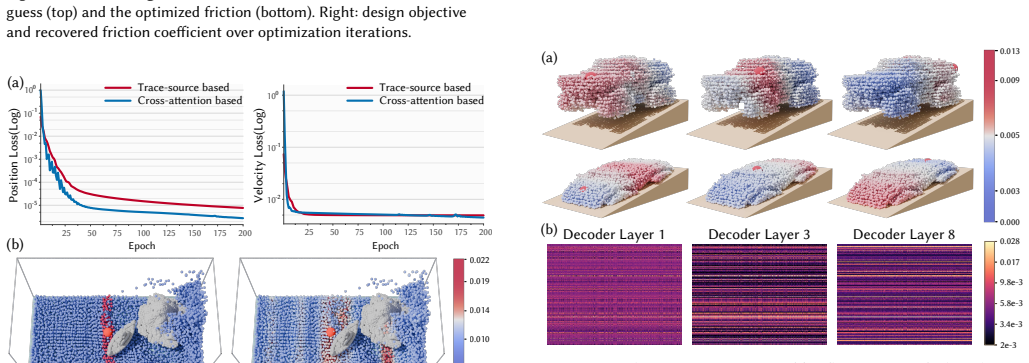
- The model supports downstream tasks such as interactive control, inverse design, and learning from real-world manipulation data.
- Progressive token merging reduces attention cost by halving the token count at each successive encoder layer.
- The approach reduces the need for per-phenomenon solver engineering.
Where Pith is reading between the lines
- If the corrector generalizes as claimed, the same trained weights could be applied to mixed scenes containing several of the six phenomena at once without additional engineering.
- The hierarchical merging pattern could be reused in other large-scale particle systems where full pairwise attention is too expensive.
- Training on combined data from multiple dynamics categories might improve robustness to entirely new physics not present in the original training set.
- The design opens a route to real-time graphics applications that currently switch between separate simulators.
Load-bearing premise
The learned corrector can accurately capture and generalize inter-particle interactions for all six dynamics categories without per-category retraining or architectural changes.
What would settle it
Apply the trained model to a previously unseen material property or boundary configuration drawn from one of the six categories and check whether the predicted particle trajectories deviate significantly from reference solver outputs.
Figures


read the original abstract
A unified simulator that can model diverse physical phenomena without solver-specific redesign is a long-standing goal across simulation science. We present a learning-based particle simulator built on a single transformer architecture to model cloth, elastic solds, Newtonian and non-Newtonian fluids, granular materials, and molecular dynamics. Our model follows a prediction-correction design on a shared Lagrangian particle representation. An explicit predictor first advances particles under the known external forces, producing an intermediate state that captures externally driven motion but not inter-particle interactions. A learned corrector then predicts the residual position and velocity updates through three stages: a particle tokenizer that encodes local particle-particle, particle-boundary, and topology-guided interactions; a super-token encoder that hierarchically merges particle tokens into a compact set of super tokens via alternating self-attention and token merging; and a super-token decoder that lifts these super tokens back to particle resolution through cross-attention to predict per-particle position and velocity corrections. Progressive token merging reduces the attention cost at successive encoder layers by halving the token count at each level, and the decoder communicates through the compact super-token set rather than full particle-to-particle attention. Across the six dynamics categories, the same architecture generalizes to unseen materials, boundary configurations, initial conditions, and external forces. We further demonstrate downstream interactive control, inverse design, and learning from real-world manipulation data, reducing the need for per-phenomenon solver engineering.
Editorial analysis
A structured set of objections, weighed in public.
Referee Report
Summary. The manuscript presents WorldParticle, a single transformer-based architecture for unified Lagrangian particle simulation of six dynamics categories (cloth, elastic solids, Newtonian/non-Newtonian fluids, granular materials, and molecular dynamics). It uses a prediction-correction scheme: an explicit predictor advances particles under external forces, while a learned corrector employs a particle tokenizer for local and topology-guided interactions, a super-token encoder with alternating self-attention and progressive halving merges, and a cross-attention decoder to predict per-particle residuals. The central claim is that this fixed architecture generalizes to unseen materials, boundary configurations, initial conditions, and external forces, enabling downstream tasks such as interactive control, inverse design, and learning from real-world data without per-phenomenon solver redesign.
Significance. If the generalization claims hold with strong empirical support, the work would represent a meaningful advance toward solver-agnostic simulation in graphics and physics, potentially reducing engineering overhead across disparate phenomena. The hierarchical token-merging strategy for computational efficiency and the shared architecture for diverse physics would be notable if validated; downstream applications in control and inverse problems add practical value. However, the absence of quantitative benchmarks in the core description limits immediate assessment of impact.
major comments (2)
- [Abstract] Abstract and architecture description: the generalization claim across all six dynamics to unseen materials, boundaries, initial conditions, and forces is load-bearing for the paper's contribution, yet no error metrics, baselines, ablation studies, or quantitative validation results are referenced to support it. Without these, the soundness of the central claim cannot be evaluated.
- [super-token encoder] Super-token encoder description: progressive token merging that halves the token count at each level implicitly assumes salient interaction information survives aggressive downsampling. This assumption is critical for the learned corrector's ability to capture short-range potentials (molecular dynamics) or contact networks (granular flow) and to generalize without per-category changes; loss of local structure would directly undermine the uniform-architecture claim.
minor comments (2)
- [Abstract] Abstract contains a typo: 'elastic solds' should read 'elastic solids'.
- Notation for the three-stage corrector (tokenizer, encoder, decoder) is introduced without an accompanying diagram or pseudocode, which would clarify the data flow from particle tokens to super-tokens and back.
Simulated Author's Rebuttal
We thank the referee for the constructive comments, which help clarify the presentation of our generalization claims and architectural assumptions. We respond to each major comment below.
read point-by-point responses
-
Referee: [Abstract] Abstract and architecture description: the generalization claim across all six dynamics to unseen materials, boundaries, initial conditions, and forces is load-bearing for the paper's contribution, yet no error metrics, baselines, ablation studies, or quantitative validation results are referenced to support it. Without these, the soundness of the central claim cannot be evaluated.
Authors: We agree that the abstract would benefit from explicit references to supporting quantitative evidence. The manuscript body (Sections 4–6) reports error metrics (position and velocity L2 errors), baseline comparisons against per-phenomenon particle simulators, and ablation studies isolating the tokenizer, hierarchical encoder, and decoder across all six dynamics categories, including generalization tests on unseen materials, boundaries, initial conditions, and forces. We will revise the abstract to cite these key quantitative results and performance highlights. revision: yes
-
Referee: [super-token encoder] Super-token encoder description: progressive token merging that halves the token count at each level implicitly assumes salient interaction information survives aggressive downsampling. This assumption is critical for the learned corrector's ability to capture short-range potentials (molecular dynamics) or contact networks (granular flow) and to generalize without per-category changes; loss of local structure would directly undermine the uniform-architecture claim.
Authors: The referee correctly identifies that preservation of local structure is essential. Our design addresses this by performing local encoding in the particle tokenizer at full resolution prior to any merging; each super-token encoder layer then applies self-attention before halving, enabling aggregation of salient features. Experiments on molecular dynamics and granular materials confirm that short-range potentials and contact networks are captured accurately under the shared architecture. We will add a dedicated paragraph and supporting visualizations in the method section to explicitly discuss how local information is retained through the hierarchy. revision: partial
Circularity Check
No significant circularity detected; model is a trained architecture with empirical generalization claims
full rationale
The paper proposes a single transformer architecture for unified particle simulation across six dynamics categories using an explicit predictor for external forces followed by a learned corrector. The corrector consists of a particle tokenizer, hierarchical super-token encoder with progressive merging, and cross-attention decoder. These components are trained on external data to predict residuals, and claims of generalization to unseen materials, boundaries, and forces rest on empirical results rather than any derivation that reduces by construction to fitted inputs or self-citations. No equations or steps in the provided description equate predictions to inputs tautologically, and the token-merging design is an efficiency choice whose validity is testable via performance on held-out cases. The derivation chain is self-contained as a data-driven proposal without load-bearing self-referential reductions.
Axiom & Free-Parameter Ledger
Reference graph
Works this paper leans on
- [1]
-
[2]
FlashAttention-2: Faster Attention with Better Parallelism and Work Partitioning , author=. 2024 , booktitle=
work page 2024
-
[3]
and Lin, Huancheng and Komura, Taku , title =
Huang, Kemeng and Chitalu, Floyd M. and Lin, Huancheng and Komura, Taku , title =. 2024 , issue_date =. doi:10.1145/3643028 , journal =
-
[4]
Huang, Kemeng and Lu, Xinyu and Lin, Huancheng and Komura, Taku and Li, Minchen , title =. 2025 , issue_date =. doi:10.1145/3735126 , journal =
- [5]
-
[6]
Deep Residual Learning for Image Recognition , author=. 2016 , booktitle=
work page 2016
- [7]
-
[8]
Query-Key Normalization for Transformers , author=. 2020 , booktitle=
work page 2020
-
[9]
Su, Jianlin and Ahmed, Murtadha and Lu, Yu and Pan, Shengfeng and Bo, Wen and Liu, Yunfeng , title =. 2024 , issue_date =. doi:10.1016/j.neucom.2023.127063 , journal =
- [10]
-
[11]
Computer Graphics Forum , volume=
Deep Fluids: A Generative Network for Parameterized Fluid Simulations , author=. Computer Graphics Forum , volume=. 2019 , doi=
work page 2019
-
[12]
Computer Graphics Forum , volume=
Latent Space Physics: Towards Learning the Temporal Evolution of Fluid Flow , author=. Computer Graphics Forum , volume=. 2019 , doi=
work page 2019
-
[13]
CROM: Continuous Reduced-Order Modeling of PDEs Using Implicit Neural Representations , author=. 2023 , booktitle=
work page 2023
-
[14]
and Carlberg, Kevin and Grinspun, Eitan , title =
Chang, Yue and Chen, Peter Yichen and Wang, Zhecheng and Chiaramonte, Maurizio M. and Carlberg, Kevin and Grinspun, Eitan , title =. 2023 , publisher =. doi:10.1145/3610548.3618158 , booktitle =
-
[15]
and Chen, Peter Yichen and Grinspun, Eitan , title =
Chang, Yue and Benchekroun, Otman and Chiaramonte, Maurizio M. and Chen, Peter Yichen and Grinspun, Eitan , title =. 2025 , issue_date =. doi:10.1145/3731148 , journal =
-
[16]
Liu, Mengfei and Chang, Yue and Wang, Zhecheng and Chen, Peter Yichen and Grinspun, Eitan , title =. 2025 , publisher =. doi:10.1145/3757377.3763810 , booktitle =
-
[17]
Chen, Siyuan and Chen, Yixin and Panuelos, Jonathan and Benchekroun, Otman and Chang, Yue and Grinspun, Eitan and Wang, Zhecheng , title =. 2025 , issue_date =. doi:10.1145/3730826 , journal =
-
[18]
Low-Rank Koopman Deformables with Log-Linear Time Integration , author=. 2026 , eprint=
work page 2026
-
[19]
Factorized Neural Implicit DMD for Parametric Dynamics , author=. 2026 , eprint=
work page 2026
-
[20]
Odd-DC: Generalizable Neural Model Reduction via Odd Difference-of-Convex Structure , author=. 2026 , eprint=
work page 2026
-
[21]
Interaction Networks for Learning about Objects, Relations and Physics , author=. 2016 , booktitle=
work page 2016
-
[22]
Learning Particle Dynamics for Manipulating Rigid Bodies, Deformable Objects, and Fluids , author=. 2019 , booktitle=
work page 2019
-
[23]
Lagrangian Fluid Simulation with Continuous Convolutions , author=. 2020 , booktitle=
work page 2020
- [24]
-
[25]
Learning Mesh-Based Simulation with Graph Networks , author=. 2021 , booktitle=
work page 2021
-
[26]
Learning Neural Constitutive Laws from Motion Observations for Generalizable PDE Dynamics , author=. 2023 , booktitle=
work page 2023
-
[27]
Zong, Zeshun and Li, Xuan and Li, Minchen and Chiaramonte, Maurizio M. and Matusik, Wojciech and Grinspun, Eitan and Carlberg, Kevin and Jiang, Chenfanfu and Chen, Peter Yichen , title =. 2023 , publisher =. doi:10.1145/3610548.3618207 , booktitle =
-
[28]
Modi, Vismay and Sharp, Nicholas and Perel, Or and Sueda, Shinjiro and Levin, David I. W. , title =. 2024 , issue_date =. doi:10.1145/3658184 , journal =
-
[29]
Fourier Neural Operator for Parametric Partial Differential Equations , author=. 2021 , booktitle=
work page 2021
-
[30]
GNOT: A General Neural Operator Transformer for Operator Learning , author=. 2023 , booktitle=
work page 2023
-
[31]
Transolver: A Fast Transformer Solver for PDEs on General Geometries , author=. 2024 , booktitle=
work page 2024
-
[32]
Universal Physics Transformers: A Framework For Efficiently Scaling Neural Operators , author=. 2024 , booktitle=
work page 2024
- [33]
-
[34]
Point Transformer V2: Grouped Vector Attention and Partition-based Pooling , author=. 2022 , booktitle=
work page 2022
-
[35]
PoinTr: Diverse Point Cloud Completion with Geometry-Aware Transformers , author=. 2021 , booktitle=
work page 2021
-
[36]
Masked Autoencoders for Point Cloud Self-supervised Learning , author=. 2022 , booktitle=
work page 2022
-
[37]
Wang, Peng-Shuai , title =. 2023 , issue_date =. doi:10.1145/3592131 , journal =
-
[38]
Swin3D: A Pretrained Transformer Backbone for 3D Indoor Scene Understanding , author=. 2023 , eprint=
work page 2023
-
[39]
ViewFormer: NeRF-free Neural Rendering from Few Images Using Transformers , author=. 2022 , booktitle=
work page 2022
-
[40]
IBRNet: Learning Multi-View Image-Based Rendering , author=. 2021 , booktitle=
work page 2021
-
[41]
LVSM: A Large View Synthesis Model with Minimal 3D Inductive Bias , author=. 2025 , booktitle=
work page 2025
-
[42]
Zeng, Chong and Dong, Yue and Peers, Pieter and Wu, Hongzhi and Tong, Xin , title =. 2025 , publisher =. doi:10.1145/3721238.3730595 , booktitle =
-
[43]
P3D: Scalable Neural Surrogates for High-Resolution 3D Physics Simulations with Global Context , author=. 2026 , booktitle=
work page 2026
-
[44]
PhysCtrl: Generative Physics for Controllable and Physics-Grounded Video Generation , author=. 2025 , booktitle=
work page 2025
-
[45]
A Compositional Object-Based Approach to Learning Physical Dynamics , author=. 2017 , booktitle=
work page 2017
-
[46]
SPNets: Differentiable Fluid Dynamics for Deep Neural Networks , author=. 2018 , booktitle=
work page 2018
-
[47]
Accelerating Eulerian Fluid Simulation With Convolutional Networks , author=. 2017 , booktitle=
work page 2017
-
[48]
Chu, Mengyu and Thuerey, Nils , title =. 2017 , issue_date =. doi:10.1145/3072959.3073643 , journal =
-
[49]
Xie, You and Franz, Aleksandra and Chu, Mengyu and Thuerey, Nils , title =. 2018 , issue_date =. doi:10.1145/3197517.3201304 , journal =
-
[50]
and Jameson, Antony and Kochenderfer, Mykel J
Morton, Jeremy and Witherden, Freddie D. and Jameson, Antony and Kochenderfer, Mykel J. , title =. Proceedings of the 32nd International Conference on Neural Information Processing Systems , pages =. 2018 , publisher =
work page 2018
-
[51]
Bertiche, Hugo and Madadi, Meysam and Escalera, Sergio , title =. 2021 , issue_date =. doi:10.1145/3478513.3480479 , journal =
-
[52]
Bertiche, Hugo and Madadi, Meysam and Escalera, Sergio , title =. 2022 , issue_date =. doi:10.1145/3550454.3555491 , journal =
-
[53]
SENC: Handling Self-collision in Neural Cloth Simulation , author=. 2024 , booktitle=
work page 2024
-
[54]
Journal of Computational Physics , volume=
Physics-informed neural networks: A deep learning framework for solving forward and inverse problems involving nonlinear partial differential equations , author=. Journal of Computational Physics , volume=. 2019 , doi=
work page 2019
-
[55]
Nature Machine Intelligence , volume=
Learning nonlinear operators via DeepONet based on the universal approximation theorem of operators , author=. Nature Machine Intelligence , volume=. 2021 , doi=
work page 2021
-
[56]
Multipole Graph Neural Operator for Parametric Partial Differential Equations , author=. 2020 , booktitle=
work page 2020
-
[57]
ACM/IMS Journal of Data Science , volume=
Physics-Informed Neural Operator for Learning Partial Differential Equations , author=. ACM/IMS Journal of Data Science , volume=. 2024 , doi=
work page 2024
-
[58]
Geometry-Informed Neural Operator for Large-Scale 3D PDEs , author=. 2023 , booktitle=
work page 2023
-
[59]
Transactions on Machine Learning Research , year=
Multi-Grid Tensorized Fourier Neural Operator for High-Resolution PDEs , author=. Transactions on Machine Learning Research , year=
-
[60]
Transactions on Machine Learning Research , year=
U-NO: U-shaped Neural Operators , author=. Transactions on Machine Learning Research , year=
- [61]
-
[62]
Convolutional Neural Operators for Robust and Accurate Learning of PDEs , author=. 2023 , booktitle=
work page 2023
-
[63]
BENO: Boundary-Embedded Neural Operators for Elliptic PDEs , author=. 2024 , booktitle=
work page 2024
-
[64]
Choose a Transformer: Fourier or Galerkin , author=. 2021 , booktitle=
work page 2021
-
[65]
Transactions on Machine Learning Research , year=
Transformer for Partial Differential Equations' Operator Learning , author=. Transactions on Machine Learning Research , year=
-
[66]
DPOT: Auto-Regressive Denoising Operator Transformer for Large-Scale PDE Pre-Training , author=. 2024 , booktitle=
work page 2024
-
[67]
Poseidon: Efficient Foundation Models for PDEs , author=. 2024 , booktitle=
work page 2024
-
[68]
Pretraining Codomain Attention Neural Operators for Solving Multiphysics PDEs , author=. 2024 , booktitle=
work page 2024
-
[69]
Geometry Aware Operator Transformer as an Efficient and Accurate Neural Surrogate for PDEs on Arbitrary Domains , author=. 2025 , booktitle=
work page 2025
-
[70]
Point-BERT: Pre-training 3D Point Cloud Transformers with Masked Point Modeling , author=. 2022 , booktitle=
work page 2022
-
[71]
Point Transformer V3: Simpler, Faster, Stronger , author=. 2024 , booktitle=
work page 2024
-
[72]
The Newton Contributors , title =
-
[73]
Chen, Anka He and Liu, Ziheng and Yang, Yin and Yuksel, Cem , title =. 2024 , issue_date =. doi:10.1145/3658179 , journal =
-
[74]
Bender, Jan and others , license =
-
[75]
Polyscope , author =
-
[76]
Nucleic Acids Research , volume =
Vander Meersche, Yann and Cretin, Gabriel and Gheeraert, Aria and Gelly, Jean-Christophe and Galochkina, Tatiana , title =. Nucleic Acids Research , volume =. 2024 , month =
work page 2024
-
[77]
OpenMM 8: Molecular Dynamics Simulation with Machine Learning Potentials , author=. 2023 , eprint=
work page 2023
-
[78]
Journal of Visual Communication and Image Representation , volume=
Position based dynamics , author=. Journal of Visual Communication and Image Representation , volume=. 2007 , publisher=
work page 2007
-
[79]
ACM Transactions on Graphics (TOG) , volume=
A material point method for snow simulation , author=. ACM Transactions on Graphics (TOG) , volume=. 2013 , publisher=
work page 2013
-
[80]
Proceedings of the IEEE/CVF International Conference on Computer Vision , pages=
Phystwin: Physics-informed reconstruction and simulation of deformable objects from videos , author=. Proceedings of the IEEE/CVF International Conference on Computer Vision , pages=
discussion (0)
Sign in with ORCID, Apple, or X to comment. Anyone can read and Pith papers without signing in.