Quantum Feature Amplification Network (QFAN) as An Autoregressive Quantum Generative Model
Pith reviewed 2026-05-20 18:56 UTC · model grok-4.3
The pith
A small fixed three-qubit circuit generates calorimeter shower images by producing them sequentially in conditioned blocks.
A machine-rendered reading of the paper's core claim, the machinery that carries it, and where it could break.
Core claim
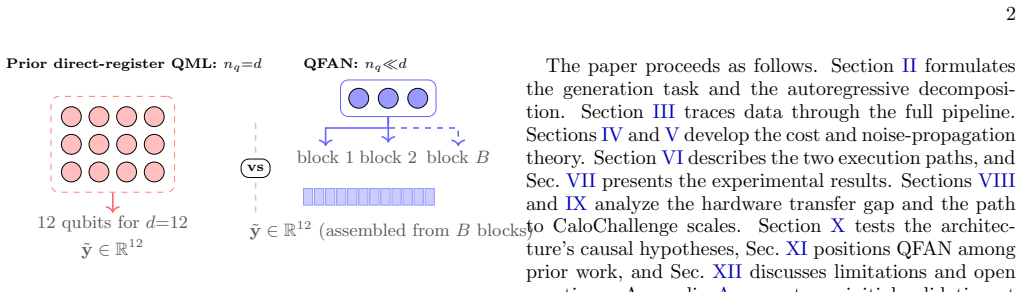
The Quantum Feature Amplification Network generates an image as a sequence of blocks using the same small parameterized quantum circuit each time, conditioned on a compressed summary of previously generated pixels. A three-qubit circuit with twelve shared variational parameters, closed-form ridge decoders, and a post-hoc residual sampler reproduces per-pixel intensity distributions, inter-pixel correlations, and total energy distributions of calorimeter showers on both simulator and IBM quantum hardware. The qubit requirement is fixed by block size rather than full image size, and the per-step quantum processing cost is independent of image size for the Pauli-observable family used here.
What carries the argument
Autoregressive block-wise generation that reuses one small quantum circuit for each block while conditioning it on a compressed summary of earlier pixels, combined with ridge decoders and a residual sampler to produce the final intensities.
If this is right
- The number of qubits needed stays fixed by the chosen block size instead of growing with the full image resolution.
- The cost of each generation step remains independent of total image size for the family of Pauli observables employed.
- The sequential model reproduces the key statistical properties of calorimeter showers on both classical simulators and actual quantum hardware.
- A conservative bound on how shot noise accumulates through the generation chain can be derived and checked against the observed results.
Where Pith is reading between the lines
- If the conditioning summary continues to capture the necessary information, the same circuit family could be tested on detector-scale images without a proportional rise in qubit count.
- The decoder-capacity heuristic that limits reachable sequential depth could be checked directly by increasing block count while holding the circuit fixed.
- Similar block-wise conditioning might be applied to other quantum generative tasks that currently face register-size limits.
Load-bearing premise
A compressed summary of the pixels generated so far is enough to let each new block preserve long-range correlations and global energy constraints without errors that the residual sampler cannot fix.
What would settle it
Running the same three-qubit circuit on images with many more blocks than demonstrated and checking whether the measured total-energy distribution or long-range pixel correlations deviate from the training data beyond the correction range of the residual sampler.
Figures


read the original abstract
Direct-register quantum generative models for calorimeter shower simulation tie the quantum output dimension to the image dimension, so the required register size grows with the full image. Recent quantum-assisted methods reduce this pressure only by moving part of the generative task into hybrid latent-variable models. Consequently, current quantum demonstrations remain far below detector-scale geometries used in high-energy physics. We introduce the Quantum Feature Amplification Network (QFAN), which removes this register-size bottleneck by generating an image as a sequence of blocks. Each block is produced by the same small parameterized quantum circuit, conditioned on a compressed summary of the pixels already generated. Reusing the circuit fixes the qubit requirement by block size rather than full image size, while the per-step quantum processing cost is independent of image size for the Pauli-observable family used here. We derive a conservative worst-case bound on shot-noise propagation through the generation chain and give an empirical decoder-capacity heuristic for the reachable sequential depth. A three-qubit circuit with twelve shared variational parameters, closed-form ridge decoders, and a post-hoc residual sampler reproduces per-pixel intensity distributions, inter-pixel correlations, and total energy distributions of calorimeter showers on both simulator and IBM quantum hardware. At this scale, the hardware-simulator gap is consistent with optimization-budget limits dominating over device noise, although the experiments do not causally separate these effects. The results establish a hardware-compatible proof of principle and motivate, but do not validate, larger-scale extrapolations within this circuit family.
Editorial analysis
A structured set of objections, weighed in public.
Referee Report
Summary. The paper introduces the Quantum Feature Amplification Network (QFAN), an autoregressive quantum generative model that generates calorimeter shower images as a sequence of blocks. Each block is produced by the same three-qubit parameterized quantum circuit (with twelve shared variational parameters) conditioned on a compressed summary of previously generated pixels, using closed-form ridge decoders and a post-hoc residual sampler. The central claim is that this architecture reproduces per-pixel intensity distributions, inter-pixel correlations, and total energy distributions on both quantum simulators and IBM quantum hardware, while deriving a conservative worst-case bound on shot-noise propagation and an empirical decoder-capacity heuristic for sequential depth.
Significance. If the reproduction results hold under quantitative scrutiny, the work would be significant for quantum generative modeling in high-energy physics by removing the qubit-register scaling bottleneck with image size. The fixed small-circuit reuse, shot-noise bound derivation, and hardware demonstration constitute concrete strengths that could motivate larger extrapolations within this circuit family, though the current scale remains modest.
major comments (3)
- Abstract: The headline reproduction claim for per-pixel intensities, inter-pixel correlations, and total energy distributions on hardware lacks quantitative error bars, statistical tests (e.g., Kolmogorov-Smirnov or chi-squared distances), full training details, or ablation studies on the compression scheme. Without these, it is impossible to assess whether the observed agreement is robust or primarily carried by the ridge decoders and residual sampler rather than the quantum autoregressive chain.
- Abstract, paragraph on sequential generation: The assumption that a compressed summary of prior pixels suffices to sustain long-range correlations and global energy constraints without uncorrectable error accumulation is not directly quantified. No measurement of cumulative deviation from target total-energy distributions after the demonstrated number of blocks is reported, leaving open the possibility that the post-hoc residual sampler masks deficiencies in the quantum conditioning.
- Abstract: The derived conservative worst-case bound on shot-noise propagation is mentioned but neither stated explicitly nor compared to the empirical hardware-simulator gap. This omission makes it difficult to evaluate whether the bound is tight enough to support the claim that optimization-budget limits dominate over device noise.
minor comments (2)
- Notation for the compressed summary and ridge decoder should be introduced with explicit equations in the main text rather than left at a high-level description.
- The empirical decoder-capacity heuristic would benefit from a short table or plot showing reachable depth versus block size or compression ratio.
Simulated Author's Rebuttal
We thank the referee for the careful reading and constructive comments on our manuscript. We address each major comment point by point below, indicating where we agree that revisions are warranted and what changes we will implement.
read point-by-point responses
-
Referee: [—] Abstract: The headline reproduction claim for per-pixel intensities, inter-pixel correlations, and total energy distributions on hardware lacks quantitative error bars, statistical tests (e.g., Kolmogorov-Smirnov or chi-squared distances), full training details, or ablation studies on the compression scheme. Without these, it is impossible to assess whether the observed agreement is robust or primarily carried by the ridge decoders and residual sampler rather than the quantum autoregressive chain.
Authors: We agree that the abstract would be strengthened by explicit quantitative support. The full manuscript contains visual comparisons of per-pixel distributions, correlations, and total energy, along with hardware versus simulator results, but we will revise the abstract to reference these quantitative aspects and expand the main text (or supplementary material) with error bars on the reported histograms, Kolmogorov-Smirnov distances between generated and target distributions, and additional training hyperparameter details. We will also include a brief ablation discussion on the compression scheme to clarify the respective contributions of the quantum circuit versus the classical ridge decoders and residual sampler. revision: yes
-
Referee: [—] Abstract, paragraph on sequential generation: The assumption that a compressed summary of prior pixels suffices to sustain long-range correlations and global energy constraints without uncorrectable error accumulation is not directly quantified. No measurement of cumulative deviation from target total-energy distributions after the demonstrated number of blocks is reported, leaving open the possibility that the post-hoc residual sampler masks deficiencies in the quantum conditioning.
Authors: We acknowledge that direct quantification of cumulative deviation would better substantiate the sequential generation claim. In the revised manuscript we will add plots and metrics showing the evolution of total-energy distribution fidelity (e.g., mean absolute deviation or Wasserstein distance) as a function of the number of generated blocks. These measurements will be presented both with and without the residual sampler to demonstrate that the compressed conditioning maintains long-range correlations up to the reported depth and that the sampler serves as a final correction rather than a concealment of quantum-chain deficiencies. revision: yes
-
Referee: [—] Abstract: The derived conservative worst-case bound on shot-noise propagation is mentioned but neither stated explicitly nor compared to the empirical hardware-simulator gap. This omission makes it difficult to evaluate whether the bound is tight enough to support the claim that optimization-budget limits dominate over device noise.
Authors: We will state the conservative worst-case bound explicitly in both the revised abstract and the main text, including its derivation outline. We will also add a direct numerical comparison of the bound against the observed hardware-simulator discrepancies for the key observables. This will allow readers to assess whether the bound supports the interpretation that optimization budget is the dominant limitation at the present scale, while noting that a full causal isolation of noise sources would require additional controlled experiments beyond the current scope. revision: yes
Circularity Check
No circularity: derivation and empirical validation are self-contained
full rationale
The paper introduces QFAN as a sequential block-generation procedure using a fixed three-qubit circuit conditioned on a compressed prior summary, derives a worst-case shot-noise bound, and reports empirical reproduction of calorimeter distributions via optimized variational parameters, closed-form ridge decoders, and a residual sampler. None of these steps reduce by the paper's own equations to a quantity defined in terms of itself; the variational optimization is standard supervised fitting against external data, the noise bound is a conservative analytic estimate independent of the target distributions, and the hardware results are direct measurements rather than predictions forced by construction. No self-citation load-bearing steps or uniqueness theorems appear in the provided text. The central claim therefore rests on independent empirical content rather than tautological redefinition.
Axiom & Free-Parameter Ledger
free parameters (1)
- twelve shared variational parameters
axioms (1)
- domain assumption A compressed summary of previously generated pixels is sufficient to maintain inter-pixel correlations and total energy constraints across the full image sequence.
Lean theorems connected to this paper
-
IndisputableMonolith/Foundation/RealityFromDistinction.leanreality_from_one_distinction unclear?
unclearRelation between the paper passage and the cited Recognition theorem.
A three-qubit circuit with twelve shared variational parameters, closed-form ridge decoders, and a post-hoc residual sampler reproduces per-pixel intensity distributions...
-
IndisputableMonolith/Cost/FunctionalEquation.leanwashburn_uniqueness_aczel unclear?
unclearRelation between the paper passage and the cited Recognition theorem.
We derive a conservative worst-case bound on shot-noise propagation through the generation chain
What do these tags mean?
- matches
- The paper's claim is directly supported by a theorem in the formal canon.
- supports
- The theorem supports part of the paper's argument, but the paper may add assumptions or extra steps.
- extends
- The paper goes beyond the formal theorem; the theorem is a base layer rather than the whole result.
- uses
- The paper appears to rely on the theorem as machinery.
- contradicts
- The paper's claim conflicts with a theorem or certificate in the canon.
- unclear
- Pith found a possible connection, but the passage is too broad, indirect, or ambiguous to say the theorem truly supports the claim.
Reference graph
Works this paper leans on
-
[1]
QFAN reproduces the MC shapes across all 25 pixels
Per-pixel marginals Figure 8 shows the marginal intensity distribution for each of the 25 pixels, MC truth (blue) and simulator-path QFAN (red). QFAN reproduces the MC shapes across all 25 pixels. The ratio panels scatter around unity with no systematic drift toward the later blocks, providing direct evidence that the sketch conditioning does not degrade ...
-
[2]
Correlation structure Figure 9 shows the 25×25 correlation matrices for MC truth, simulator-path QFAN, and the MC−SIM differ- ence. The MC matrix reveals a block-diagonal structure with inter-block anti-correlations reflecting energy con- servation. The simulator reproduces the overall struc- ture. Residuals are concentrated at block boundaries and do not...
-
[3]
10) peaks nearE≈ 4.8 and shows a mild-to-moderate negative skew
Total energy The total-energy distribution (Fig. 10) peaks nearE≈ 4.8 and shows a mild-to-moderate negative skew. QFAN reproduces the overall peak position and width well, with broadly similar tail behavior. The residual differences are modest: QFAN is slightly enhanced on the low-energy side aroundE∼4.0–4.3, while the MC distribution is somewhat larger i...
- [4]
-
[5]
AT- LAS/CMS, CERN Yellow Reports (2020)
ATLAS Collaboration,ATLAS HL-LHC Computing Conceptual Design Report, Tech. Rep. CERN-LHCC- 2020-015, LHCC-G-178 (CERN, 2020) closest identi- fiable source for the manuscript’s placeholder “AT- LAS/CMS, CERN Yellow Reports (2020)”
work page 2020
-
[6]
M. Paganini, L. de Oliveira, and B. Nachman, Phys. Rev. D97, 014021 (2018), arXiv:1712.10321 [hep-ex]
work page internal anchor Pith review Pith/arXiv arXiv 2018
-
[7]
C. Krause and D. Shih, Phys. Rev. D107, 113003 (2023), arXiv:2106.05285 [hep-ph]
-
[8]
V. Mikuni and B. Nachman, Phys. Rev. D106, 092009 (2022), arXiv:2206.11898 [physics.ins-det]
- [9]
- [10]
-
[11]
F. Rehm, S. Vallecorsa, M. Grossi, K. Borras, and D. Kr¨ ucker, A full quantum generative adversarial network model for high energy physics simulations (2023), preprint; direct quantum calorimeter generator demonstrated on downsized eight-pixel shower images, arXiv:2305.07284 [quant-ph]
- [12]
- [13]
-
[14]
M. Charikar, K. Chen, and M. Farach-Colton, inAu- tomata, Languages and Programming: 29th International Colloquium, ICALP 2002, Lecture Notes in Computer Science, Vol. 2380 (Springer, 2002) pp. 693–703
work page 2002
-
[15]
J. C. Spall, IEEE Trans. Autom. Control37, 332 (1992)
work page 1992
-
[16]
C. Krause, M. Faucci Giannelli, G. Kasieczka, B. Nach- man, D. Salamani, D. Shih, A. Zaborowska, O. Am- ram, K. Borras, M. R. Buckley, E. Buhmann, T. Buss, R. P. Da Costa Cardoso, A. L. Caterini, N. Chernyavskaya, F. A. G. Corchia, J. C. Cresswell, S. Diefenbacher, E. Dreyer, V. Ekambaram, E. Eren, F. Ernst, L. Favaro, M. Franchini, F. Gaede, E. Gross, S....
work page 2025
-
[17]
A. P´ erez-Salinas, A. Cervera-Lierta, E. Gil-Fuster, and J. I. Latorre, Quantum4, 226 (2020), arXiv:1907.02085 [quant-ph]
-
[18]
M. Treinish, L. Bello, J. Gambetta,et al., Qiskit: An open-source SDK for working with quantum comput- ers, Zenodo,https://zenodo.org/records/13328537 (2024), software release
-
[19]
IBM Quantum, IBM Quantum backend: ibm fez,https: //quantum.cloud.ibm.com/computers?system=ibm_fez (2026), 156-qubit Heron r2 processor, accessed 2026-03- 12
work page 2026
-
[20]
S. Monaco, J. Slim, K. Borras, and D. Kr¨ ucker, desyqml/clic: Initial public release, Zenodo,https:// doi.org/10.5281/zenodo.16027525(2025)
-
[21]
A. Rahimi and B. Recht, inAdvances in Neural Infor- mation Processing Systems 20 (NIPS 2007), edited by J. Platt, D. Koller, Y. Singer, and S. Roweis (Curran As- sociates, Inc., Vancouver, B.C., Canada, 2007) pp. 1177– 1184
work page 2007
-
[22]
E. Bermot, C. Zoufal, M. Grossi, J. Schuhmacher, F. Tacchino, S. Vallecorsa, and I. Tavernelli, in2023 IEEE International Conference on Quantum Computing and Engineering (QCE)(2023) pp. 331–341, related HEP quantum-generative reference; not a calorimeter shower generator, arXiv:2304.14439 [quant-ph]
discussion (0)
Sign in with ORCID, Apple, or X to comment. Anyone can read and Pith papers without signing in.