XSearch: Explainable Code Search via Concept-to-Code Alignment
Pith reviewed 2026-05-20 16:26 UTC · model grok-4.3
The pith
Reformulating code search as explicit concept-to-code alignment yields better out-of-distribution performance and built-in explanations.
A machine-rendered reading of the paper's core claim, the machinery that carries it, and where it could break.
Core claim
XSearch reformulates code search as a deductive concept alignment problem: it identifies functional concepts in the query and explicitly aligns them with corresponding code statements through an encoder trained with concept-alignment objectives, replacing global embedding similarity with explicit matching to produce inherent explanations and reduce shortcut learning that harms generalization.
What carries the argument
Concept-to-code alignment, which extracts functional concepts from queries and matches them to code statements instead of using vector similarity.
If this is right
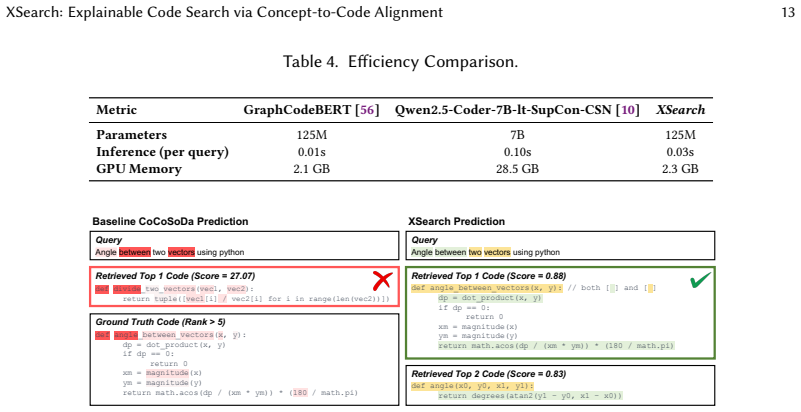
- Performance on out-of-distribution benchmarks rises from 0.02 to 0.33, a 15-fold improvement over eight prior retrievers.
- The method outperforms both encoder and decoder baselines that use up to 7 billion parameters.
- Concept-alignment explanations allow users to evaluate retrieved code faster and more accurately in studies.
- The explain-then-predict structure reduces reliance on statistical shortcuts that hurt generalization.
Where Pith is reading between the lines
- The same alignment idea could be tested on related retrieval problems such as API recommendation or bug localization.
- Explicit concept matches might support interactive refinement where users correct or add concepts during search.
- Hybrid systems could combine the alignments with generative models to produce or edit code that satisfies the identified concepts.
Load-bearing premise
Functional concepts can be reliably identified from natural-language queries and that aligning these concepts to code statements captures the query's true functional requirements without shortcut learning.
What would settle it
Construct a new test set of queries whose functional requirements depend on interactions among multiple code statements that do not map cleanly to single identifiable concepts, then measure whether the reported performance gains over baselines disappear.
Figures





read the original abstract
Semantic code search has been widely adopted in both academia and industry. These approaches embed natural-language queries and code snippets into a shared embedding space and retrieve results based on vector similarity. Despit strong performance on benchmark datasets, they often suffer from poor explainability and generalization. Retrieved code may appear semantically similar yet miss critical functional requirements of the query, while providing no explanation of why the result was retrieved. Moreover, such failures become more severe under distribution shift, where models struggle to generalize to unseen benchmarks. In this work, we propose XSearch, an intrinsically explainable code search framework. Our key insight is that by relying on global embedding similarity, existing retrievers inherently take an inductive view. They learn statistical patterns rather than truly understanding the query's functional requirements. We address this problem by reformulating code search as a deductive concept alignment problem. XSearch (i) identifies functional concepts in the query and (ii) explicitly aligns them with corresponding code statements. This explain-then-predict design produces inherent concept-level explanations and mitigates shortcut learning that harms out-of-distribution generalization. We train an encoder with explicit concept-alignment objectives and perform retrieval through explicit matching between query concepts and code statements. Experiments show that, trained on CodeSearchNet using GraphCodeBERT (125M parameters), XSearch improves performance on out-of-distribution benchmarks from 0.02 to 0.33 (15x) over eight state-of-the-art retrievers, and consistently outperforms both encoder- and decoder-based baselines with up to 7B parameters. A user study demonstrates that concept-alignment explanations enable users to evaluate retrieved results faster and more accurately.
Editorial analysis
A structured set of objections, weighed in public.
Referee Report
Summary. The manuscript proposes XSearch, an intrinsically explainable code search framework that reformulates semantic code search as a deductive concept alignment task. It identifies functional concepts from natural-language queries and explicitly aligns them to corresponding code statements via an encoder trained with concept-alignment objectives on CodeSearchNet using GraphCodeBERT. The central claims are a 15× improvement on out-of-distribution benchmarks (0.02 to 0.33) over eight state-of-the-art retrievers, consistent outperformance of encoder- and decoder-based baselines up to 7B parameters, and a user study showing that concept-alignment explanations improve evaluation speed and accuracy.
Significance. If the reported OOD gains and attribution to the deductive reformulation hold after verification, the work would be significant for addressing shortcut learning and explainability deficits in neural code search. The explicit concept-to-statement matching offers a concrete mechanism for inherent explanations, which is a strength relative to post-hoc interpretability methods in the field.
major comments (2)
- [Abstract and experimental evaluation] The central OOD generalization claim (0.02 → 0.33) is load-bearing for the paper's contribution, yet the abstract and experimental sections provide no error bars, ablation studies on the alignment loss, or details on the concept identification procedure. Without these, it is impossible to determine whether gains arise from the claimed deductive reformulation or from auxiliary training choices.
- [§3 (method overview)] The argument that explicit concept alignment mitigates shortcut learning rests on the premise that step (i)—identifying functional concepts from the query—is reliable and non-inductive. If this step is performed by a learned component trained on CodeSearchNet-style data, the approach reduces to an enhanced inductive model; this distinction is not resolved by the current description and directly affects the validity of the inductive-vs-deductive framing.
minor comments (2)
- [§3.1] Clarify the precise definition and extraction rules for 'functional concepts' with a formal notation or running example to aid reproducibility.
- [User study] The user study would benefit from reporting participant count, task design, and statistical tests for the observed improvements in speed and accuracy.
Simulated Author's Rebuttal
We thank the referee for the constructive and detailed comments on our manuscript. We address each major comment below and indicate the revisions we will make to strengthen the presentation and clarify key aspects of the work.
read point-by-point responses
-
Referee: [Abstract and experimental evaluation] The central OOD generalization claim (0.02 → 0.33) is load-bearing for the paper's contribution, yet the abstract and experimental sections provide no error bars, ablation studies on the alignment loss, or details on the concept identification procedure. Without these, it is impossible to determine whether gains arise from the claimed deductive reformulation or from auxiliary training choices.
Authors: We agree that the current presentation would be strengthened by additional supporting details for the OOD results. In the revised manuscript we will add error bars from multiple random seeds to the reported metrics, include ablation experiments that isolate the contribution of the concept-alignment objectives, and expand the experimental section with a precise description of the concept identification procedure. These changes will make it easier to attribute performance gains to the proposed reformulation. revision: yes
-
Referee: [§3 (method overview)] The argument that explicit concept alignment mitigates shortcut learning rests on the premise that step (i)—identifying functional concepts from the query—is reliable and non-inductive. If this step is performed by a learned component trained on CodeSearchNet-style data, the approach reduces to an enhanced inductive model; this distinction is not resolved by the current description and directly affects the validity of the inductive-vs-deductive framing.
Authors: We acknowledge that the current description in §3 does not fully resolve the inductive-versus-deductive distinction for the concept identification step. In the revision we will expand the method overview to explicitly state how functional concepts are extracted from the query (including any reliance on learned versus rule-based components) and to articulate why the overall pipeline still qualifies as deductive relative to standard embedding-based retrievers. This clarification will directly address the validity of the framing. revision: yes
Circularity Check
No circularity: empirical gains presented as independent of training objective by construction
full rationale
The paper describes training an encoder on CodeSearchNet with explicit concept-alignment objectives and reports OOD retrieval gains as measured outcomes on held-out benchmarks. No equations, fitting procedures, or self-citations are shown that would make the 0.02-to-0.33 improvement definitionally equivalent to the alignment loss or to any prior result by the same authors. The inductive-versus-deductive framing is advanced as a modeling choice whose validity is tested externally rather than presupposed by the training recipe itself. The derivation therefore remains self-contained against external benchmarks.
Axiom & Free-Parameter Ledger
axioms (1)
- domain assumption Functional concepts present in natural-language queries can be identified and aligned to corresponding code statements in a manner that captures the query's functional requirements.
invented entities (1)
-
functional concepts
no independent evidence
Lean theorems connected to this paper
-
IndisputableMonolith/Foundation/RealityFromDistinction.leanreality_from_one_distinction unclear?
unclearRelation between the paper passage and the cited Recognition theorem.
reformulating code search as a deductive concept alignment problem... explicit concept-to-code alignment
-
IndisputableMonolith/Cost/FunctionalEquation.leanwashburn_uniqueness_aczel unclear?
unclearRelation between the paper passage and the cited Recognition theorem.
alignment loss... InfoNCE... concept centroids
What do these tags mean?
- matches
- The paper's claim is directly supported by a theorem in the formal canon.
- supports
- The theorem supports part of the paper's argument, but the paper may add assumptions or extra steps.
- extends
- The paper goes beyond the formal theorem; the theorem is a base layer rather than the whole result.
- uses
- The paper appears to rely on the theorem as machinery.
- contradicts
- The paper's claim conflicts with a theorem or certificate in the canon.
- unclear
- Pith found a possible connection, but the passage is too broad, indirect, or ambiguous to say the theorem truly supports the claim.
Reference graph
Works this paper leans on
- [1]
-
[2]
Anonymous. 2025. XSearch. https://sites.google.com/view/xai-search/home Accessed: 2025-03-15
work page 2025
-
[3]
Suborno Deb Bappon, Saikat Mondal, and Banani Roy. 2024. AUTOGENICS: Automated Generation of Context-Aware Inline Comments for Code Snippets on Programming Q&A Sites Using LLM. In2024 IEEE International Conference on Source Code Analysis and Manipulation (SCAM). IEEE, 24–35
work page 2024
-
[4]
Kaj Bostrom, Harsh Jhamtani, Hao Fang, Sam Thomson, Richard Shin, Patrick Xia, Benjamin Van Durme, Jason Eisner, and Jacob Andreas. 2024. Language-to-Code Translation with a Single Labeled Example. InProceedings of the 2024 Conference on Empirical Methods in Natural Language Processing. 8101–8112
work page 2024
-
[5]
Wing-Kwan Chan, Hong Cheng, and David Lo. 2012. Searching connected API subgraph via text phrases. InProceedings of the ACM SIGSOFT 20th international symposium on the foundations of software engineering. 1–11
work page 2012
-
[6]
Gong Chen, Xiaoyuan Xie, Daniel Tang, Qi Xin, and Wenjie Liu. 2024. HedgeCode: A Multi-Task Hedging Contrastive Learning Framework for Code Search. In2025 IEEE/ACM 47th International Conference on Software Engineering (ICSE). IEEE Computer Society, 89–100
work page 2024
-
[7]
Junkai Chen, Xing Hu, Zhenhao Li, Cuiyun Gao, Xin Xia, and David Lo. 2024. Code Search is All You Need? Improving Code Suggestions with Code Search. InProceedings of the IEEE/ACM 46th International Conference on Software Engineering. 1–13
work page 2024
- [8]
-
[9]
Xinyun Chen, Chang Liu, and Dawn Song. 2018. Tree-to-tree neural networks for program translation.Advances in neural information processing systems31 (2018)
work page 2018
-
[10]
Yuxuan Chen, Guangsheng Ou, Mingwei Liu, Yanlin Wang, and Zibin Zheng. 2024. Are Decoder-Only Large Language Models the Silver Bullet for Code Search?arXiv preprint arXiv:2410.22240(2024)
work page internal anchor Pith review Pith/arXiv arXiv 2024
- [11]
-
[12]
Luca Di Grazia and Michael Pradel. 2023. Code search: A survey of techniques for finding code.Comput. Surveys55, 11 (2023), 1–31
work page 2023
-
[13]
Aleksandra Eliseeva, Yaroslav Sokolov, Egor Bogomolov, Yaroslav Golubev, Danny Dig, and Timofey Bryksin. 2023. From commit message generation to history-aware commit message completion. In2023 38th IEEE/ACM International Conference on Automated Software Engineering (ASE). IEEE, 723–735
work page 2023
-
[14]
Guodong Fan, Shizhan Chen, Cuiyun Gao, Jianmao Xiao, Tao Zhang, and Zhiyong Feng. 2024. Rapid: Zero-shot domain adaptation for code search with pre-trained models.ACM Transactions on Software Engineering and Methodology33, 5 (2024), 1–35
work page 2024
-
[15]
Zhiyu Fan, Xiang Gao, Martin Mirchev, Abhik Roychoudhury, and Shin Hwei Tan. 2023. Automated repair of programs from large language models. In2023 IEEE/ACM 45th International Conference on Software Engineering (ICSE). IEEE, 1469–1481
work page 2023
-
[16]
Zhangyin Feng, Daya Guo, Duyu Tang, Nan Duan, Xiaocheng Feng, Ming Gong, Linjun Shou, Bing Qin, Ting Liu, Daxin Jiang, et al . 2020. Codebert: A pre-trained model for programming and natural languages.arXiv preprint arXiv:2002.08155(2020)
work page internal anchor Pith review Pith/arXiv arXiv 2020
-
[17]
Michael Fu, Chakkrit Tantithamthavorn, Trung Le, Van Nguyen, and Dinh Phung. 2022. VulRepair: a T5-based automated software vulnerability repair. InProceedings of the 30th ACM joint european software engineering conference and symposium on the foundations of software engineering. 935–947
work page 2022
- [18]
-
[19]
Wenchao Gu, Zongyi Lyu, Yanlin Wang, Hongyu Zhang, Cuiyun Gao, and Michael R. Lyu. 2025. SPENCER: Self- Adaptive Model Distillation for Efficient Code Retrieval.ACM Transactions on Software Engineering and Methodology (2025)
work page 2025
-
[20]
Wenchao Gu, Yanlin Wang, Lun Du, Hongyu Zhang, Shi Han, Dongmei Zhang, and Michael Lyu. 2022. Accelerating code search with deep hashing and code classification. InProceedings of the 60th Annual Meeting of the Association for Computational Linguistics (Volume 1: Long Papers). 2534–2544. 20 Liu et al
work page 2022
-
[21]
Xiaodong Gu, Hongyu Zhang, and Sunghun Kim. 2018. Deep code search. InProceedings of the 40th international conference on software engineering. 933–944
work page 2018
-
[22]
Daya Guo, Shuai Lu, Nan Duan, Yanlin Wang, Ming Zhou, and Jian Yin. 2022. Unixcoder: Unified cross-modal pre-training for code representation.arXiv preprint arXiv:2203.03850(2022)
work page internal anchor Pith review Pith/arXiv arXiv 2022
-
[23]
Daya Guo, Shuo Ren, Shuai Lu, Zhangyin Feng, Duyu Tang, Shujie Liu, Long Zhou, Nan Duan, Alexey Svyatkovskiy, Shengyu Fu, et al. 2020. Graphcodebert: Pre-training code representations with data flow.arXiv preprint arXiv:2009.08366 (2020)
work page internal anchor Pith review Pith/arXiv arXiv 2020
-
[24]
Daya Guo, Qihao Zhu, Dejian Yang, Zhenda Xie, Kai Dong, Wentao Zhang, Guanting Chen, Xiao Bi, Yu Wu, YK Li, et al. 2024. DeepSeek-Coder: When the Large Language Model Meets Programming–The Rise of Code Intelligence. arXiv preprint arXiv:2401.14196(2024)
work page internal anchor Pith review Pith/arXiv arXiv 2024
-
[25]
Vincent J Hellendoorn, Charles Sutton, Rishabh Singh, Petros Maniatis, and David Bieber. 2019. Global relational models of source code. InInternational conference on learning representations
work page 2019
- [26]
-
[27]
Emily Hill, Manuel Roldan-Vega, Jerry Alan Fails, and Greg Mallet. 2014. NL-based query refinement and contextu- alized code search results: A user study. In2014 Software Evolution Week-IEEE Conference on Software Maintenance, Reengineering, and Reverse Engineering (CSMR-WCRE). IEEE, 34–43
work page 2014
- [28]
- [29]
-
[30]
Binyuan Hui, Jian Yang, Zeyu Cui, Jiaxi Yang, Dayiheng Liu, Lei Zhang, Tianyu Liu, Jiajun Zhang, Bowen Yu, Keming Lu, et al. 2024. Qwen2.5-coder technical report.arXiv preprint arXiv:2409.12186(2024)
work page internal anchor Pith review Pith/arXiv arXiv 2024
-
[31]
Faria Huq, Masum Hasan, Md Mahim Anjum Haque, Sazan Mahbub, Anindya Iqbal, and Toufique Ahmed. 2022. Review4repair: Code review aided automatic program repairing.Information and Software Technology143 (2022), 106765
work page 2022
-
[32]
Hamel Husain, Ho-Hsiang Wu, Tiferet Gazit, Miltiadis Allamanis, and Marc Brockschmidt. 2019. Codesearchnet challenge: Evaluating the state of semantic code search.arXiv preprint arXiv:1909.09436(2019)
work page internal anchor Pith review Pith/arXiv arXiv 2019
-
[33]
Jeevana Priya Inala, Chenglong Wang, Mei Yang, Andres Codas, Mark Encarnación, Shuvendu Lahiri, Madanlal Musuvathi, and Jianfeng Gao. 2022. Fault-aware neural code rankers.Advances in Neural Information Processing Systems35 (2022), 13419–13432
work page 2022
-
[34]
Chen Ji, Su Yang, Hongyu Sun, and Yuqing Zhang. 2024. Applying Contrastive Learning to Code Vulnerability Type Classification. InProceedings of the 2024 Conference on Empirical Methods in Natural Language Processing. 11942–11952
work page 2024
-
[35]
Siyuan Jiang, Jia Li, He Zong, Huanyu Liu, Hao Zhu, Shukai Hu, Erlu Li, Jiazheng Ding, Yu Han, Wei Ning, et al. 2024. aixcoder-7b: A lightweight and effective large language model for code completion.arXiv e-prints(2024), arXiv–2410
work page 2024
- [36]
- [37]
- [38]
-
[39]
Kisub Kim, Dongsun Kim, Tegawendé F Bissyandé, Eunjong Choi, Li Li, Jacques Klein, and Yves Le Traon. 2018. FaCoY: a code-to-code search engine. InProceedings of the 40th International Conference on Software Engineering. 946–957
work page 2018
- [40]
- [41]
- [42]
-
[43]
Lingwei Li, Li Yang, Huaxi Jiang, Jun Yan, Tiejian Luo, Zihan Hua, Geng Liang, and Chun Zuo. 2022. AUGER: automatically generating review comments with pre-training models. InProceedings of the 30th ACM Joint European Software Engineering Conference and Symposium on the Foundations of Software Engineering. 1009–1021
work page 2022
-
[44]
Raymond Li, Loubna Ben Allal, Yangtian Zi, Niklas Muennighoff, Denis Kocetkov, Chenghao Mou, Marc Marone, Christopher Akiki, Jia Li, Jenny Chim, et al. 2023. Starcoder: may the source be with you!arXiv preprint arXiv:2305.06161 (2023)
work page internal anchor Pith review Pith/arXiv arXiv 2023
-
[45]
Wen-Ding Li and Kevin Ellis. 2025. Is programming by example solved by llms?Advances in Neural Information Processing Systems37 (2025), 44761–44790. XSearch: Explainable Code Search via Concept-to-Code Alignment 21
work page 2025
-
[46]
Xiaonan Li, Yeyun Gong, Yelong Shen, Xipeng Qiu, Hang Zhang, Bolun Yao, Weizhen Qi, Daxin Jiang, Weizhu Chen, and Nan Duan. 2022. Coderetriever: A large scale contrastive pre-training method for code search. InProceedings of the 2022 conference on empirical methods in natural language processing. 2898–2910
work page 2022
-
[47]
Zhen Li, Deqing Zou, Shouhuai Xu, Hai Jin, Yawei Zhu, and Zhaoxuan Chen. 2021. Sysevr: A framework for using deep learning to detect software vulnerabilities.IEEE Transactions on Dependable and Secure Computing19, 4 (2021), 2244–2258
work page 2021
-
[48]
Zhen Li, Deqing Zou, Shouhuai Xu, Xinyu Ou, Hai Jin, Sujuan Wang, Zhijun Deng, and Yuyi Zhong. 2018. Vuldeepecker: A deep learning-based system for vulnerability detection.arXiv preprint arXiv:1801.01681(2018)
work page internal anchor Pith review Pith/arXiv arXiv 2018
-
[49]
Tsung-Yi Lin, Priya Goyal, Ross Girshick, Kaiming He, and Piotr Dollár. 2017. Focal loss for dense object detection. In Proceedings of the IEEE international conference on computer vision. 2980–2988
work page 2017
-
[50]
Chao Liu, Xin Xia, David Lo, Cuiyun Gao, Xiaohu Yang, and John Grundy. 2021. Opportunities and challenges in code search tools.ACM Computing Surveys (CSUR)54, 9 (2021), 1–40
work page 2021
- [51]
-
[52]
Meili Lu, Xiaobing Sun, Shaowei Wang, David Lo, and Yucong Duan. 2015. Query expansion via wordnet for effective code search. In2015 IEEE 22nd International Conference on Software Analysis, Evolution, and Reengineering (SANER). IEEE, 545–549
work page 2015
-
[53]
Fei Lv, Hongyu Zhang, Jian-guang Lou, Shaowei Wang, Dongmei Zhang, and Jianjun Zhao. 2015. Codehow: Effective code search based on api understanding and extended boolean model (e). In2015 30th IEEE/ACM International Conference on Automated Software Engineering (ASE). IEEE, 260–270
work page 2015
-
[54]
Henry B Mann and Donald R Whitney. 1947. On a test of whether one of two random variables is stochastically larger than the other.The annals of mathematical statistics(1947), 50–60
work page 1947
-
[55]
Collin McMillan, Mark Grechanik, Denys Poshyvanyk, Qing Xie, and Chen Fu. 2011. Portfolio: finding relevant functions and their usage. InProceedings of the 33rd International Conference on Software Engineering. 111–120
work page 2011
-
[56]
Microsoft. 2021. GraphCodeBERT model. https://huggingface.co/microsoft/graphcodebert-base
work page 2021
-
[57]
Ansong Ni, Srini Iyer, Dragomir Radev, Veselin Stoyanov, Wen-tau Yih, Sida Wang, and Xi Victoria Lin. 2023. Lever: Learning to verify language-to-code generation with execution. InInternational Conference on Machine Learning. PMLR, 26106–26128
work page 2023
-
[58]
Liming Nie, He Jiang, Zhilei Ren, Zeyi Sun, and Xiaochen Li. 2016. Query expansion based on crowd knowledge for code search.IEEE Transactions on Services Computing9, 5 (2016), 771–783
work page 2016
-
[59]
Yu Nong, Rainy Sharma, Abdelwahab Hamou-Lhadj, Xiapu Luo, and Haipeng Cai. 2022. Open science in software engineering: A study on deep learning-based vulnerability detection.IEEE Transactions on Software Engineering49, 4 (2022), 1983–2005
work page 2022
-
[60]
Aaron van den Oord, Yazhe Li, and Oriol Vinyals. 2018. Representation learning with contrastive predictive coding. arXiv preprint arXiv:1807.03748(2018)
work page internal anchor Pith review Pith/arXiv arXiv 2018
-
[61]
OpenAI. 2024. GPT-4o Technical Report. https://openai.com/index/hello-gpt-4o/. Accessed: 2025-01
work page 2024
-
[62]
Yun Peng, Shuzheng Gao, Cuiyun Gao, Yintong Huo, and Michael Lyu. 2024. Domain knowledge matters: Improving prompts with fix templates for repairing python type errors. InProceedings of the 46th ieee/acm international conference on software engineering. 1–13
work page 2024
-
[63]
David Piorkowski, Austin Z Henley, Tahmid Nabi, Scott D Fleming, Christopher Scaffidi, and Margaret Burnett. 2016. Foraging and navigations, fundamentally: developers’ predictions of value and cost. InProceedings of the 2016 24th ACM SIGSOFT International Symposium on Foundations of Software Engineering. 97–108
work page 2016
-
[64]
Mukund Raghothaman, Yi Wei, and Youssef Hamadi. 2016. SWIM: synthesizing what I mean: code search and idiomatic snippet synthesis. InProceedings of the 38th International Conference on Software Engineering. 357–367
work page 2016
-
[65]
Baptiste Roziere, Jonas Gehring, Fabian Gloeckle, Sten Sootla, Itai Gat, Xiaoqing Ellen Tan, Yossi Adi, Jingyu Liu, Romain Sauvestre, Tal Remez, et al. 2023. Code llama: Open foundation models for code.arXiv preprint arXiv:2308.12950 (2023)
work page internal anchor Pith review Pith/arXiv arXiv 2023
- [66]
-
[67]
Anthony Saieva, Saikat Chakraborty, and Gail Kaiser. 2024. Reinforest: Reinforcing semantic code similarity for cross-lingual code search models. In2024 IEEE International Conference on Source Code Analysis and Manipulation (SCAM). IEEE, 177–188
work page 2024
-
[68]
Chaochen Shi, Borui Cai, Yao Zhao, Longxiang Gao, Keshav Sood, and Yong Xiang. 2023. Coss: Leveraging statement semantics for code summarization.IEEE Transactions on Software Engineering49, 6 (2023), 3472–3486
work page 2023
-
[69]
Ensheng Shi, Yanlin Wang, Wenchao Gu, Lun Du, Hongyu Zhang, Shi Han, Dongmei Zhang, and Hongbin Sun. 2023. Cocosoda: Effective contrastive learning for code search. In2023 IEEE/ACM 45th International Conference on Software 22 Liu et al. Engineering (ICSE). IEEE, 2198–2210
work page 2023
-
[70]
Jaspreet Singh and Avishek Anand. 2019. Exs: Explainable search using local model agnostic interpretability. In Proceedings of the twelfth ACM international conference on web search and data mining. 770–773
work page 2019
- [71]
-
[72]
Benjamin Steenhoek, Md Mahbubur Rahman, Richard Jiles, and Wei Le. 2023. An empirical study of deep learning models for vulnerability detection. In2023 IEEE/ACM 45th International Conference on Software Engineering (ICSE). IEEE, 2237–2248
work page 2023
- [73]
-
[74]
Chia-Yi Su and Collin McMillan. 2024. Distilled GPT for source code summarization.Automated Software Engineering 31, 1 (2024), 22
work page 2024
- [75]
- [76]
- [77]
-
[78]
Ze Tang, Xiaoyu Shen, Chuanyi Li, Jidong Ge, Liguo Huang, Zhelin Zhu, and Bin Luo. 2022. AST-trans: Code summarization with efficient tree-structured attention. InProceedings of the 44th International Conference on Software Engineering. 150–162
work page 2022
- [79]
-
[80]
Rosalia Tufano, Simone Masiero, Antonio Mastropaolo, Luca Pascarella, Denys Poshyvanyk, and Gabriele Bavota
discussion (0)
Sign in with ORCID, Apple, or X to comment. Anyone can read and Pith papers without signing in.