GenShield: Unified Detection and Artifact Correction for AI-Generated Images
Pith reviewed 2026-05-20 19:21 UTC · model grok-4.3
The pith
A unified autoregressive model detects AI-generated images and corrects their artifacts in a mutually reinforcing closed loop.
A machine-rendered reading of the paper's core claim, the machinery that carries it, and where it could break.
Core claim
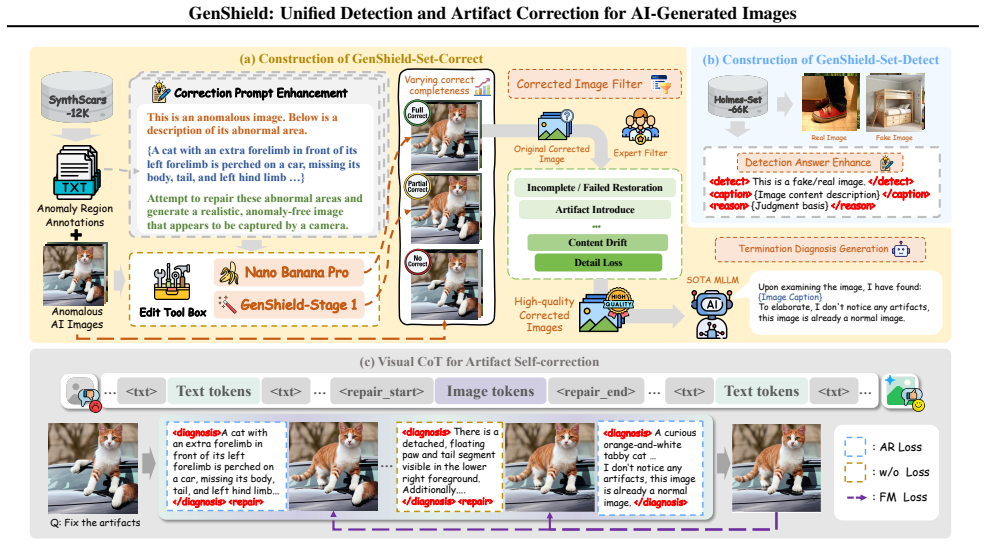
GenShield is a unified autoregressive framework that jointly performs explainable AIGI detection and controllable artifact correction in a closed loop from diagnosis to restoration, revealing a mutually reinforcing relationship between these two tasks, enabled by a Visual Chain-of-Thought based curriculum learning strategy.
What carries the argument
GenShield, the unified autoregressive framework that integrates detection and correction with Visual Chain-of-Thought curriculum learning for self-explained multi-step repair.
Load-bearing premise
Detection and artifact correction improve each other when trained jointly in a closed loop instead of interfering or needing separate models.
What would settle it
Showing that a model trained only for detection or only for correction outperforms the joint GenShield model on their respective tasks would challenge the mutual reinforcement claim.
Figures


read the original abstract
Diffusion-based image synthesis has made AI-generated images (AIGI) increasingly photorealistic, raising urgent concerns about authenticity in applications such as misinformation detection, digital forensics, and content moderation. Despite the substantial advances in AIGI detection, how to correct detected AI-generated images with visible artifacts and restore realistic appearance remains largely underexplored. Moreover, few existing work has established the connection between AIGI detection and artifact correction. To fill this gap, we propose GenShield, a unified autoregressive framework that jointly performs explainable AIGI detection and controllable artifact correction in a closed loop from diagnosis to restoration, revealing a mutually reinforcing relationship between these two tasks. We further introduce a Visual Chain-of-Thought based curriculum learning strategy that enables self-explained, multi-step ``diagnose-then-repair'' correction with an explicit stopping criterion. A high-quality dataset with large-scale ``artifact-restored'' pairs is also constructed alongside a unified evaluation pipeline. Extensive experiments on our correction benchmark and mainstream AIGI detection benchmarks demonstrate state-of-the-art performance and strong generalization of our method. The code is available at https://github.com/zhipeixu/GenShield.
Editorial analysis
A structured set of objections, weighed in public.
Referee Report
Summary. The manuscript proposes GenShield, a unified autoregressive framework that jointly performs explainable AIGI detection and controllable artifact correction in a closed loop. It introduces a Visual Chain-of-Thought curriculum learning strategy with an explicit stopping criterion, constructs a high-quality dataset of artifact-restored pairs, and presents a unified evaluation pipeline. The work claims state-of-the-art performance and strong generalization on a new correction benchmark as well as mainstream AIGI detection benchmarks.
Significance. If the central claims hold, the paper would make a meaningful contribution by linking detection and correction tasks through a mutually reinforcing closed-loop architecture, an area that remains underexplored. The release of code and the new artifact-restored dataset constitute concrete strengths that could support reproducibility and follow-on work in digital forensics and content moderation.
major comments (2)
- [§5 (Experiments) and §3.2 (Training Strategy)] The manuscript's core claim—that joint training in the closed-loop autoregressive framework produces a mutually reinforcing effect between detection and correction—lacks supporting ablation studies. No quantitative comparison is presented between the unified GenShield model and separately trained detection-only or correction-only models on identical data, metrics, and training regimes. This comparison is load-bearing for justifying the unified architecture over independent specialized models.
- [§5 and Dataset Construction subsection] Claims of SOTA performance and strong generalization (Abstract) are difficult to assess because the experimental section provides insufficient detail on baseline implementations, exact metrics (e.g., precision-recall curves, PSNR/SSIM variants), error bars across multiple runs, and precise construction of the artifact-restored pairs in the new dataset.
minor comments (2)
- [§3.1] Notation for the autoregressive tokenization of images and the stopping criterion in the Visual Chain-of-Thought should be defined more explicitly with a small example or pseudocode for clarity.
- [Figures 2 and 4] Figure captions for the pipeline diagram and qualitative correction results could include more quantitative annotations (e.g., per-image detection scores or restoration metrics) to aid interpretation.
Simulated Author's Rebuttal
We sincerely thank the referee for the constructive and detailed feedback on our manuscript. We address each major comment below and will make the necessary revisions to improve the clarity and strength of our claims.
read point-by-point responses
-
Referee: [§5 (Experiments) and §3.2 (Training Strategy)] The manuscript's core claim—that joint training in the closed-loop autoregressive framework produces a mutually reinforcing effect between detection and correction—lacks supporting ablation studies. No quantitative comparison is presented between the unified GenShield model and separately trained detection-only or correction-only models on identical data, metrics, and training regimes. This comparison is load-bearing for justifying the unified architecture over independent specialized models.
Authors: We agree that direct ablation studies comparing the unified GenShield model to separately trained detection-only and correction-only models would provide stronger quantitative support for the mutually reinforcing effect. While our current experiments demonstrate the joint model's performance on both tasks within the closed-loop framework, we acknowledge that side-by-side comparisons under identical data, metrics, and training conditions are important for justifying the unified approach. In the revised manuscript, we will add these ablation experiments and report the results to quantify the benefits of joint training. revision: yes
-
Referee: [§5 and Dataset Construction subsection] Claims of SOTA performance and strong generalization (Abstract) are difficult to assess because the experimental section provides insufficient detail on baseline implementations, exact metrics (e.g., precision-recall curves, PSNR/SSIM variants), error bars across multiple runs, and precise construction of the artifact-restored pairs in the new dataset.
Authors: We agree that additional experimental details are needed to allow full assessment of the SOTA claims and generalization results. We will revise the manuscript to provide: more precise descriptions of baseline implementations and training procedures; full details on the exact metrics used, including precision-recall curves and specific PSNR/SSIM variants; error bars or standard deviations from multiple runs; and a clearer, step-by-step account of how the artifact-restored pairs were constructed for the new dataset. These changes will improve reproducibility and transparency. revision: yes
Circularity Check
No circularity: empirical framework proposal with independent experimental validation
full rationale
The paper introduces a new unified autoregressive model, a Visual Chain-of-Thought curriculum learning strategy, a custom high-quality dataset of artifact-restored pairs, and a unified evaluation pipeline. All central claims rest on experimental results across correction and detection benchmarks rather than any derivation, fitted parameter, or self-citation that reduces to the input by construction. No equations or first-principles steps are present that could exhibit self-definitional, fitted-input, or self-citation circularity. This is a standard empirical ML contribution whose validity is externally falsifiable via the released code and benchmarks.
Axiom & Free-Parameter Ledger
axioms (1)
- domain assumption Joint training of detection and correction tasks produces mutually reinforcing improvements rather than task interference.
Reference graph
Works this paper leans on
-
[1]
Line segments: The shadows in the image do not align with the light source. The girl's shadow on the skateboard and the floor is inconsistent with the direction of the light, suggesting that the image may have been manipulated. Additionally, the parallel lines of the shelves in the background do not converge at a single vanishing point, which is unnatural...
-
[2]
Edges: There are noticeable discontinuities and inconsistencies in the edges, particularly around the girl's arms and the skateboard. The edges appear overly sharp in some areas and blurred in others, which is a common artifact in AI-generated images
-
[3]
Texture: The texture of the girl's clothing, especially the denim overalls, appears unnaturally smooth and lacks the detailed texture of real denim. Additionally, the background products on the shelves have a repetitive and blurry texture pattern, which is not typical in real photographs
-
[4]
Distortion: The girl's hands and the skateboard exhibit slight distortions that do not conform to the natural shapes of real objects. The skateboard, in particular, appears to be slightly warped, which is not typical for a real skateboard
-
[5]
This hyper-realistic coloring is a common characteristic of AI-generated images
Overall Hue: The overall tone of the image is overly vibrant, especially in the colors of the girl's clothing and the background. This hyper-realistic coloring is a common characteristic of AI-generated images
-
[6]
This suggests that the image may have been generated or manipulated by AI
Clarity: The image shows signs of unnatural pixel blurriness, particularly in the background and around the edges of the girl's clothing. This suggests that the image may have been generated or manipulated by AI
-
[7]
Perspective: The perspective of the image is inconsistent. The girl appears to be riding the skateboard at an unnatural angle, and the depth of field does not change reasonably between the foreground and background
-
[8]
Shadows: The shadows in the image are not consistent with the light source. The girl's shadow on the skateboard and the floor is not aligned with the direction of the light, which is a common flaw in AI-generated images
-
[9]
Faces: The girl's facial features appear overly perfect and lack the natural imperfections of a real face. The edges of her face and facial features are slightly blurred and distorted, which is a common artifact in AI-generated images
-
[10]
Body Structure: The girl's body structure exhibits some anatomical errors. Her arms and hands appear disproportionately large compared to her body, and her posture while riding the skateboard is unnatural
-
[11]
These clues collectively suggest that the image is AI-generated
Common Sense: It is highly unusual for a young girl to be riding a skateboard in a supermarket aisle, which violates common sense and typical behavior in real-life scenarios. These clues collectively suggest that the image is AI-generated. </reason> [GT: Fake] Please evaluate whether this image is an AI creation or something real, and provide an explanati...
-
[12]
Line segments: The shadows cast by the boats do not consistently align with a single light source. Some boats have shadows that suggest the light is coming from the top left, while others have shadows indicating light from the top right. This inconsistency in lighting suggests that the image may have been artificially generated
-
[13]
This blurriness is particularly noticeable around the smaller boats and those closer to the shore
Edges: Upon closer inspection, some of the boat edges appear slightly blurred or pixelated, which is not typical for a high- resolution aerial photograph. This blurriness is particularly noticeable around the smaller boats and those closer to the shore
-
[14]
Texture: The water texture appears overly smooth and uniform, lacking the natural variations and reflections that would be expected in a real aerial photograph. Additionally, the greenish hue of the water is unusually consistent, which is not typical for natural water bodies
-
[15]
Distortion: Some of the boats, particularly those in the center of the image, exhibit slight distortions in their shapes. The proportions of these boats do not perfectly match those of real boats, suggesting artificial generation
-
[16]
Overall Hue: The overall color tone of the image is somewhat unnatural. The greenish tint of the water and the vibrancy of the boat colors are exaggerated, which is a common characteristic of AI-generated images
-
[17]
This lack of sharpness is not typical for a high-resolution aerial photograph
Clarity: The image shows signs of unnatural pixel blurriness, especially around the edges of the boats and the shoreline. This lack of sharpness is not typical for a high-resolution aerial photograph
-
[18]
Perspective: The perspective of the image seems slightly off. The boats closer to the shore appear disproportionately large compared to those further out, which is not consistent with natural perspective rules
-
[19]
Some shadows are too sharp or too soft, indicating artificial generation
Shadows: The shadows cast by the boats do not align with the expected direction of the light source. Some shadows are too sharp or too soft, indicating artificial generation. By considering these clues, it becomes evident that the image is likely AI-generated rather than a genuine photograph. </reason> [GT: Fake] Figure 8.AIGI Detection Results of our Gen...
-
[20]
The lighting and shadows are natural and align with a single light source, which is the sun
Line segments: The overall style, color, and details of the image are consistent. The lighting and shadows are natural and align with a single light source, which is the sun. The shadows cast by the skateboarder and the skateboard are consistent with the direction of the sunlight. The parallel lines of the skateboard and the ground converge appropriately,...
-
[21]
Edges: The edges of the skateboarder, the skateboard, and the background elements are clear and consistent. There are no signs of unnatural pixel distribution or discontinuous edges that might suggest AI generation
-
[22]
There are no repetitive patterns or blurry textures that would indicate AI generation
Texture: The textures in the image, such as the fabric of the skateboarder's clothing, the surface of the skateboard, and the grass in the background, appear natural and detailed. There are no repetitive patterns or blurry textures that would indicate AI generation
-
[23]
There is no unnatural distortion that would suggest AI manipulation
Distortion: The objects in the image, including the skateboarder and the skateboard, exhibit natural shapes and proportions. There is no unnatural distortion that would suggest AI manipulation
-
[24]
Overall Hue: The overall tone of the image is balanced and natural. The colors are neither overly vibrant nor too dull, and there are no inconsistencies in the hue that would suggest AI generation
-
[25]
The details are clear, and there is no unnatural pixel blurriness or jagged edges
Clarity: The image has a high resolution with no visible compression artifacts. The details are clear, and there is no unnatural pixel blurriness or jagged edges
-
[26]
Perspective: The perspective and proportional relationships in the image are consistent. The depth of field changes reasonably, with the skateboarder in focus and the background slightly blurred, adhering to the laws of physics
-
[27]
Shadows: The shadows in the image are consistent with the direction of the sunlight. The skateboarder and the skateboard cast shadows that align with the light source, indicating that the image is real
-
[28]
The skateboarder's pose and the position of the skateboard are realistic and physically plausible
Physical Laws: The image adheres to physical laws. The skateboarder's pose and the position of the skateboard are realistic and physically plausible
-
[29]
There are no signs of anatomical errors that might suggest AI generation
Body Structure: The skateboarder's body structure, including the head, neck, body, arms, hands, legs, and feet, appears anatomically correct. There are no signs of anatomical errors that might suggest AI generation
-
[30]
Common Sense: The image does not violate common sense. The skateboarder's attire, the setting, and the action being performed are all consistent with a real-world scenario. These clues collectively suggest that the image is real and not AI-generated. </reason> [GT: Real] Please evaluate whether this image is an AI creation or something real, and provide a...
-
[31]
The zebra's stripes and the grass blades cast shadows that align with the direction of the sunlight
Line segments: The lighting and shadows in the image are consistent with a single light source, which is the sun. The zebra's stripes and the grass blades cast shadows that align with the direction of the sunlight. There are no unnatural distortions or inconsistencies in the line segments of the zebra's body or the surrounding environment
-
[32]
There are no signs of pixelation, discontinuous edges, or AI-generated artifacts
Edges: The edges of the zebra and the grass are clear and well-defined. There are no signs of pixelation, discontinuous edges, or AI-generated artifacts. The transition between the zebra and the background is smooth and natural
-
[33]
There are no repetitive patterns or blurry areas that would suggest AI generation
Texture: The texture of the zebra's fur and the grass is realistic and detailed. There are no repetitive patterns or blurry areas that would suggest AI generation. The grass appears natural and varied, with different shades of green and individual blades visible
-
[34]
The zebra's proportions and the perspective of the field are consistent with real-world observations
Distortion: The zebra's body and the surrounding environment do not exhibit any unnatural distortions. The zebra's proportions and the perspective of the field are consistent with real-world observations
-
[35]
Overall Hue: The overall tone of the image is natural and consistent with outdoor lighting. The colors are neither overly vibrant nor too dull, and there are no inconsistencies in the hue that would suggest AI manipulation
-
[36]
Clarity: The image has a high resolution with no visible compression artifacts. The details of the zebra's stripes and the grass are clear and sharp, with no signs of pixel blurriness or jagged edges
-
[37]
Perspective: The perspective of the image is consistent and realistic. The zebra's size and position relative to the field and the background suggest a natural depth of field. The blurring between the foreground and background is gradual and conforms to physical laws
-
[38]
There are no unnatural or inconsistent shadows that would suggest AI generation
Shadows: The shadows cast by the zebra and the grass are consistent with the direction of the sunlight. There are no unnatural or inconsistent shadows that would suggest AI generation
-
[39]
The zebra's stance and the behavior of the grass and shadows are consistent with real-world physics
Physical Laws: The image does not violate any physical laws. The zebra's stance and the behavior of the grass and shadows are consistent with real-world physics
-
[40]
There are no elements that violate common sense or appear out of place
Common Sense: The image depicts a common and realistic scene of a zebra in its natural habitat. There are no elements that violate common sense or appear out of place. These clues collectively suggest that the image is real and not AI-generated. </reason> [GT: Real] Figure 9.More AIGI Detection Results of our GenShield. 22 GenShield: Unified Detection and...
discussion (0)
Sign in with ORCID, Apple, or X to comment. Anyone can read and Pith papers without signing in.