Beyond Geometry: Efficient Topologically-Grounded Navigation in Complex 3D Environments
Pith reviewed 2026-05-20 13:04 UTC · model grok-4.3
The pith
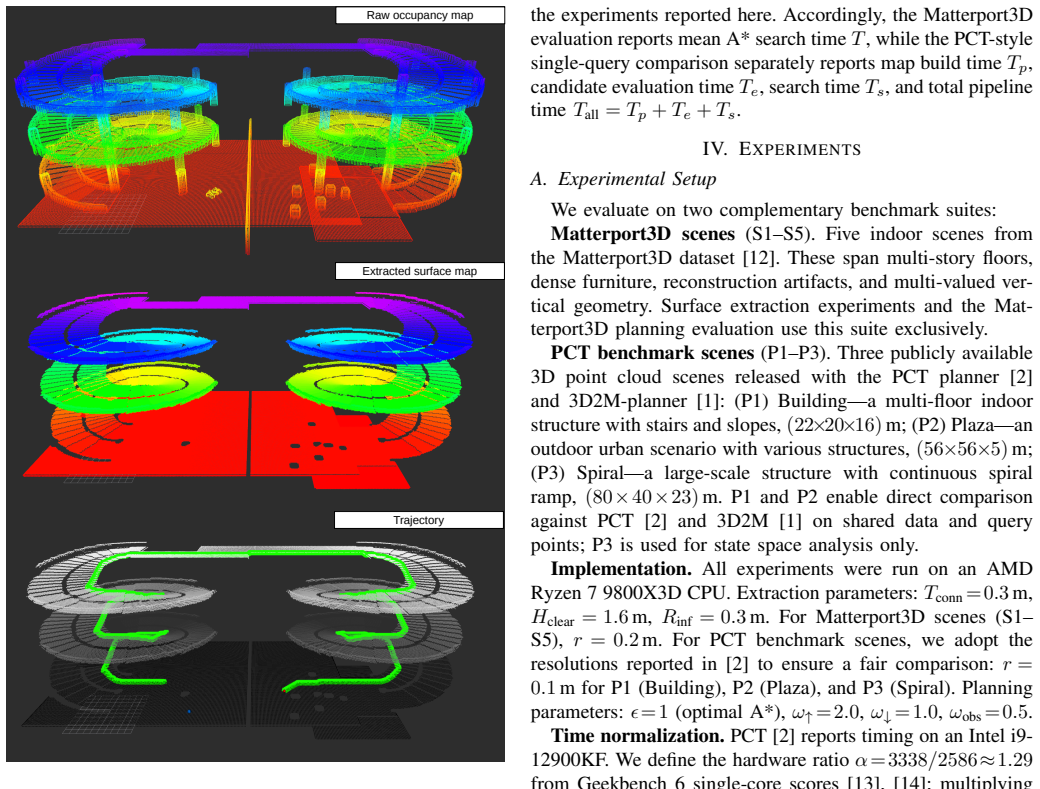
A surface extraction framework builds a reduced state space of reachable standing positions for ground robots in complex 3D environments by applying ground support, overhead clearance, and connectivity constraints.
A machine-rendered reading of the paper's core claim, the machinery that carries it, and where it could break.
Core claim
The surface extraction framework constructs a reduced state space of physically reachable standing positions by enforcing ground support, overhead clearance, and seed-based connectivity constraints. Evaluation across five Matterport3D indoor scenes and three PCT benchmark scenes demonstrates over 80% state space reduction and sub-millisecond A* search on the Matterport3D scenes, with 100% planning success across all 300 tested queries.
What carries the argument
The surface extraction framework that enforces ground support, overhead clearance, and seed-based connectivity constraints to produce a compact graph of reachable standing positions for path planning.
If this is right
- The reduced state space enables A* path searches to finish in under one millisecond on large Matterport3D scenes.
- Planning succeeds on every one of the 300 tested queries without loss of feasible paths.
- The same surface extraction process works across both Matterport3D indoor scans and PCT benchmark scenes.
- State space size drops by more than 80 percent relative to full voxel representations while retaining topological connectivity.
Where Pith is reading between the lines
- The reduced graphs could allow frequent replanning when the environment changes slightly between queries.
- Similar constraint sets might be defined for other robot morphologies or for outdoor uneven terrain.
- Combining the extracted surfaces with uncertainty-aware perception could handle noisy sensor data about ground support.
- The approach suggests a general pattern for replacing dense geometric maps with sparse, constraint-filtered topological maps in other 3D robotics tasks.
Load-bearing premise
The three constraints of ground support, overhead clearance, and seed-based connectivity are sufficient to identify exactly the set of physically reachable standing positions in arbitrary complex 3D environments.
What would settle it
A single scene containing a physically reachable standing position that the extracted surface graph excludes, or an unreachable position that it includes, would demonstrate that the constraints fail to capture reachability correctly.
Figures

read the original abstract
Ground robot navigation in complex 3D environments is often hindered by geometric ambiguity, where non-traversable structures such as furniture share local geometric properties with navigable ground. Furthermore, the computational cost of searching massive voxel spaces remains a significant challenge. To address these issues, we present a surface extraction framework that constructs a reduced state space of physically reachable standing positions by enforcing ground support, overhead clearance, and seed-based connectivity constraints. Evaluation across five Matterport3D indoor scenes and three PCT benchmark scenes demonstrates over 80\% state space reduction and sub-millisecond A* search on the Matterport3D scenes, with 100\% planning success across all 300 tested queries.
Editorial analysis
A structured set of objections, weighed in public.
Referee Report
Summary. The paper presents a surface extraction framework for ground robot navigation in complex 3D environments. It constructs a reduced state space of physically reachable standing positions by enforcing three constraints—ground support, overhead clearance, and seed-based connectivity—to address geometric ambiguity and high computational cost in voxel spaces. Evaluation on five Matterport3D scenes and three PCT benchmark scenes reports over 80% state space reduction, sub-millisecond A* search times on Matterport3D, and 100% planning success across 300 queries.
Significance. If the three constraints reliably delineate exactly the reachable standing positions without false negatives (excluded valid paths) or false positives (included unreachable positions), the framework could enable substantially more efficient path planning in cluttered indoor 3D scenes. The reported empirical metrics on standard benchmarks provide concrete evidence of runtime gains and success rates under the tested conditions.
major comments (2)
- [§3.2] §3.2 (Constraint definitions): The central claim of an 80% state-space reduction and 100% planning success rests on the assumption that ground support + overhead clearance + seed-based connectivity exactly capture the set of physically reachable standing positions. No comparison to an exhaustive reachable-set baseline (e.g., full voxel connectivity search) is provided to quantify false negatives or false positives, particularly in scenes with overhangs, narrow gaps, or furniture-induced local constraints.
- [§4.2] §4.2 (Matterport3D and PCT results): The 100% success rate is measured only on 300 selected queries; the manuscript does not report the distribution of query difficulty, any failure cases, or metrics such as path length deviation from a ground-truth reachable planner. This leaves open whether seed connectivity disconnects valid but locally constrained paths.
minor comments (2)
- [Figure 3] Figure 3: The visualization of extracted surfaces would benefit from an overlay of the original voxel grid to illustrate the precise effect of each constraint.
- [§2] §2 (Related work): The discussion of prior topological navigation methods could include a direct comparison table of state-space reduction ratios reported in the literature.
Simulated Author's Rebuttal
We thank the referee for the constructive feedback on our surface extraction framework. The comments correctly identify areas where additional validation would strengthen the claims regarding reachable position identification and experimental robustness. We address each major comment below, indicating planned revisions to the manuscript.
read point-by-point responses
-
Referee: [§3.2] §3.2 (Constraint definitions): The central claim of an 80% state-space reduction and 100% planning success rests on the assumption that ground support + overhead clearance + seed-based connectivity exactly capture the set of physically reachable standing positions. No comparison to an exhaustive reachable-set baseline (e.g., full voxel connectivity search) is provided to quantify false negatives or false positives, particularly in scenes with overhangs, narrow gaps, or furniture-induced local constraints.
Authors: We agree that direct quantitative comparison against an exhaustive reachable-set computation would provide stronger evidence against false negatives and false positives. However, such an exhaustive search on full voxel grids is computationally prohibitive for the large indoor scenes considered, which is a core motivation for our reduced state space. In the revised manuscript we will add a dedicated paragraph in §3.2 discussing this limitation, report the fraction of positions filtered by each individual constraint, and include qualitative inspection of positions near overhangs and narrow gaps in two scenes to illustrate that no obviously reachable standing locations were excluded by the seed-connectivity step. revision: partial
-
Referee: [§4.2] §4.2 (Matterport3D and PCT results): The 100% success rate is measured only on 300 selected queries; the manuscript does not report the distribution of query difficulty, any failure cases, or metrics such as path length deviation from a ground-truth reachable planner. This leaves open whether seed connectivity disconnects valid but locally constrained paths.
Authors: The 300 queries were chosen to span varying distances and clutter levels across the five Matterport3D and three PCT scenes, but we acknowledge that explicit difficulty metrics and path-length comparisons were omitted. In the revision we will add a table summarizing query statistics (average Euclidean distance, number of obstacles within 2 m of the straight-line path) and, for a random subset of 50 queries, report path lengths obtained by our planner versus a standard 3D A* run on the unreduced voxel grid. No failures were observed; we will explicitly state this and describe the manual verification process used to confirm that all returned paths remained collision-free. revision: yes
Circularity Check
No circularity: framework construction with independent empirical validation
full rationale
The paper introduces a surface extraction framework that builds a reduced state space by applying ground support, overhead clearance, and seed-based connectivity constraints, then reports empirical results (over 80% reduction, sub-millisecond A* search, 100% success on 300 queries) from evaluation on Matterport3D and PCT benchmark scenes. No equations, fitted parameters, or self-citations are shown that reduce the claimed reductions or success metrics back to the inputs by construction. The derivation is a direct algorithmic construction evaluated against external benchmarks, remaining self-contained without load-bearing self-referential steps.
Axiom & Free-Parameter Ledger
axioms (1)
- domain assumption Enforcing ground support, overhead clearance, and seed-based connectivity is sufficient to identify all physically reachable standing positions.
Lean theorems connected to this paper
-
IndisputableMonolith/Foundation/AbsoluteFloorClosure.leanreality_from_one_distinction unclear?
unclearRelation between the paper passage and the cited Recognition theorem.
surface extraction framework that constructs a reduced state space of physically reachable standing positions by enforcing ground support, overhead clearance, and seed-based connectivity constraints
What do these tags mean?
- matches
- The paper's claim is directly supported by a theorem in the formal canon.
- supports
- The theorem supports part of the paper's argument, but the paper may add assumptions or extra steps.
- extends
- The paper goes beyond the formal theorem; the theorem is a base layer rather than the whole result.
- uses
- The paper appears to rely on the theorem as machinery.
- contradicts
- The paper's claim conflicts with a theorem or certificate in the canon.
- unclear
- Pith found a possible connection, but the passage is too broad, indirect, or ambiguous to say the theorem truly supports the claim.
Reference graph
Works this paper leans on
-
[1]
Towards efficient trajectory generation for ground robots beyond 2d environment,
J. Wang, L. Xu, H. Fu, Z. Meng, C. Xu, Y . Cao, X. Lyu, and F. Gao, “Towards efficient trajectory generation for ground robots beyond 2d environment,” in2023 IEEE International Conference on Robotics and Automation (ICRA), 2023, pp. 7858–7864
work page 2023
-
[2]
Efficient global nav- igational planning in 3-d structures based on point cloud tomography,
B. Yang, J. Cheng, B. Xue, J. Jiao, and M. Liu, “Efficient global nav- igational planning in 3-d structures based on point cloud tomography,” IEEE/ASME Transactions on Mechatronics, vol. 30, no. 1, pp. 321–332, 2024
work page 2024
-
[3]
A. B ¨ockmann, J. Machowinski, and M. H. K. Lodhi, “ugv nav4d: Advanced multi-surface navigation for unmanned ground vehicles using 4d path planning techniques,”Journal of Open Source Software, vol. 9, no. 104, p. 6983, 2024
work page 2024
-
[4]
Multi-level surface maps for out- door terrain mapping and loop closing,
R. Triebel, P. Pfaff, and W. Burgard, “Multi-level surface maps for out- door terrain mapping and loop closing,” in2006 IEEE/RSJ international conference on intelligent robots and systems. IEEE, 2006, pp. 2276– 2282
work page 2006
-
[5]
Kinectfusion: Real-time dense surface mapping and tracking,
R. A. Newcombe, S. Izadi, O. Hilliges, D. Molyneaux, D. Kim, A. J. Davison, P. Kohi, J. Shotton, S. Hodges, and A. Fitzgibbon, “Kinectfusion: Real-time dense surface mapping and tracking,” in2011 10th IEEE international symposium on mixed and augmented reality. Ieee, 2011, pp. 127–136
work page 2011
-
[6]
Real-time large-scale dense rgb-d slam with volumetric fusion,
T. Whelan, M. Kaess, H. Johannsson, M. Fallon, J. J. Leonard, and J. McDonald, “Real-time large-scale dense rgb-d slam with volumetric fusion,”The International Journal of Robotics Research, vol. 34, no. 4-5, pp. 598–626, 2015
work page 2015
-
[7]
Octomap: An efficient probabilistic 3d mapping framework based on octrees,
A. Hornung, K. M. Wurm, M. Bennewitz, C. Stachniss, and W. Burgard, “Octomap: An efficient probabilistic 3d mapping framework based on octrees,”Autonomous robots, vol. 34, no. 3, pp. 189–206, 2013
work page 2013
-
[8]
3d navigation mesh generation for path planning in uneven terrain,
S. P ¨utz, T. Wiemann, J. Sprickerhof, and J. Hertzberg, “3d navigation mesh generation for path planning in uneven terrain,”Ifac-Papersonline, vol. 49, no. 15, pp. 212–217, 2016
work page 2016
-
[9]
3d gaussian splatting for real-time radiance field rendering
B. Kerbl, G. Kopanas, T. Leimk ¨uhler, G. Drettakiset al., “3d gaussian splatting for real-time radiance field rendering.”ACM Trans. Graph., vol. 42, no. 4, pp. 139–1, 2023
work page 2023
-
[10]
A universal grid map library: Implemen- tation and use case for rough terrain navigation,
P. Fankhauser and M. Hutter, “A universal grid map library: Implemen- tation and use case for rough terrain navigation,” inRobot Operating System (ROS) The Complete Reference (Volume 1). Springer, 2016, pp. 99–120
work page 2016
-
[11]
Sequential operations in digital picture processing,
A. Rosenfeld and J. L. Pfaltz, “Sequential operations in digital picture processing,”Journal of the ACM (JACM), vol. 13, no. 4, pp. 471–494, 1966
work page 1966
-
[12]
Matterport3d: Learning from rgb-d data in indoor environments,
A. Chang, A. Dai, T. Funkhouser, M. Halber, M. Niebner, M. Savva, S. Song, A. Zeng, and Y . Zhang, “Matterport3d: Learning from rgb-d data in indoor environments,” in2017 International Conference on 3D Vision (3DV). IEEE Computer Society, 2017, pp. 667–676
work page 2017
-
[13]
AMD Ryzen 7 9800X3D benchmark,
Geekbench, “AMD Ryzen 7 9800X3D benchmark,” Geekbench Browser. [Online], 2024. [Online]. Available: https://browser.geekbench. com/processors/amd-ryzen-7-9800x3d
work page 2024
-
[14]
Intel Core i9-12900KF benchmark,
——, “Intel Core i9-12900KF benchmark,” Geekbench Browser. [Online], 2021. [Online]. Available: https://browser.geekbench.com/ processors/intel-core-i9-12900kf
work page 2021
-
[15]
Continuous shortest path vector field navigation on 3d triangular meshes for mo- bile robots,
S. P ¨utz, T. Wiemann, M. K. Piening, and J. Hertzberg, “Continuous shortest path vector field navigation on 3d triangular meshes for mo- bile robots,” in2021 IEEE International Conference on Robotics and Automation (ICRA). IEEE, 2021, pp. 2256–2263
work page 2021
-
[16]
Robotic online path planning on point cloud,
M. Liu, “Robotic online path planning on point cloud,”IEEE transac- tions on cybernetics, vol. 46, no. 5, pp. 1217–1228, 2015
work page 2015
discussion (0)
Sign in with ORCID, Apple, or X to comment. Anyone can read and Pith papers without signing in.