You Can't Fool Us: Understanding the Resilience of LLM-driven Agent Communities to Misinformation
Pith reviewed 2026-05-19 23:14 UTC · model grok-4.3
The pith
Higher open-minded thinking in simulated communities reduces misinformation uptake and speeds recovery, while polarization leaves more lingering support.
A machine-rendered reading of the paper's core claim, the machinery that carries it, and where it could break.
Core claim
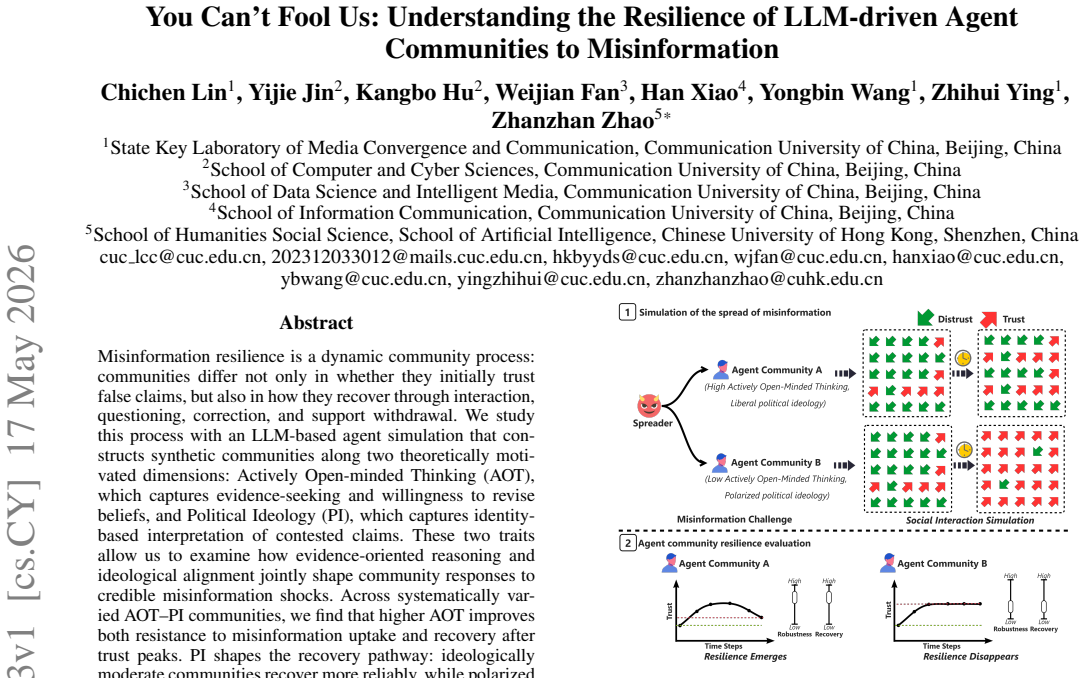
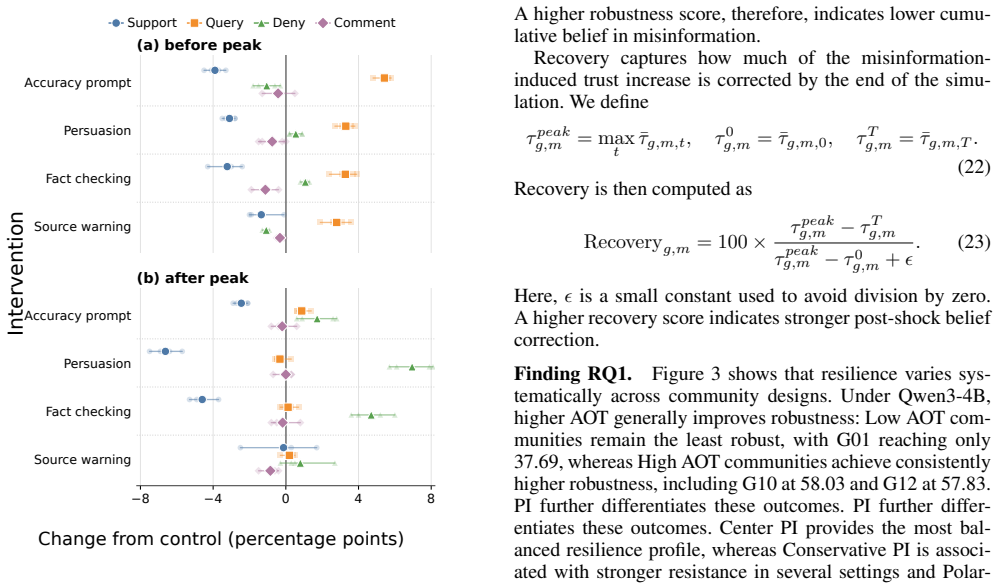
Across systematically varied AOT-PI communities, higher AOT improves both resistance to misinformation uptake and recovery after trust peaks. PI shapes the recovery pathway: ideologically moderate communities recover more reliably, while polarized communities retain more residual support. Stance-level analysis shows that resilience depends on whether agents move from questioning a claim to denying or correcting it and withdrawing prior support. Intervention experiments further show that persuasion and fact checking better support post-peak correction, whereas accuracy prompts mainly induce early caution and source warnings have weaker effects.
What carries the argument
LLM-based agent simulation that assigns Actively Open-minded Thinking (AOT) and Political Ideology (PI) traits to model how communities process and recover from misinformation shocks through interaction and correction.
If this is right
- Higher AOT reduces initial trust in false claims and accelerates return to lower support levels after a peak.
- Moderate political ideology enables more reliable movement from questioning to active correction and support withdrawal.
- Polarized ideology leaves higher residual support even after recovery begins.
- Persuasion and fact-checking interventions improve post-peak correction more than accuracy prompts or source warnings.
- Resilience emerges from specific stance transitions rather than from uniform skepticism.
Where Pith is reading between the lines
- The same simulation method could be used to pre-test combinations of traits or interventions before field studies with people.
- Designing public programs that increase open-minded thinking might improve community-level correction of false claims.
- Validation against human data would be required before treating the simulation outputs as direct predictions for policy.
Load-bearing premise
LLM agents assigned AOT and PI traits can faithfully reproduce the psychological processes and social interactions that shape real human community responses to misinformation.
What would settle it
Run parallel experiments with real human groups whose AOT and PI levels have been measured in advance, then compare their uptake curves, recovery trajectories, stance shifts, and responses to the same interventions against the patterns produced by the agent simulations.
Figures




read the original abstract
Misinformation resilience is a dynamic community process: communities differ not only in whether they initially trust false claims, but also in how they recover through interaction, questioning, correction, and support withdrawal. We study this process with an LLM-based agent simulation that constructs synthetic communities along two theoretically motivated dimensions: Actively Open-minded Thinking (AOT), which captures evidence-seeking and willingness to revise beliefs, and Political Ideology (PI), which captures identity-based interpretation of contested claims. These two traits allow us to examine how evidence-oriented reasoning and ideological alignment jointly shape community responses to credible misinformation shocks. Across systematically varied AOT-PI communities, we find that higher AOT improves both resistance to misinformation uptake and recovery after trust peaks. PI shapes the recovery pathway: ideologically moderate communities recover more reliably, while polarized communities retain more residual support. Stance-level analysis shows that resilience depends on whether agents move from questioning a claim to denying or correcting it and withdrawing prior support. Intervention experiments further show that persuasion and fact checking better support post-peak correction, whereas accuracy prompts mainly induce early caution and source warnings have weaker effects. Together, this work provides a mechanism-level account of community misinformation resilience, showing how psychological composition and intervention design shape whether communities move from misinformation exposure toward correction or persistent support.
Editorial analysis
A structured set of objections, weighed in public.
Referee Report
Summary. The paper uses LLM-based agent simulations to construct synthetic communities varying along Actively Open-minded Thinking (AOT) and Political Ideology (PI) dimensions. It examines dynamic responses to credible misinformation shocks, reporting that higher AOT improves initial resistance to uptake and post-peak recovery, while moderate PI communities recover more reliably than polarized ones. Stance transitions (from questioning to denial/correction and support withdrawal) and intervention experiments (persuasion, fact-checking, accuracy prompts, source warnings) are used to derive a mechanism-level account of community resilience.
Significance. If the simulation results hold under validation, the work offers a mechanism-level view of how cognitive traits and intervention types jointly influence misinformation recovery pathways, extending beyond static uptake measures. Systematic variation of AOT and PI and the focus on recovery dynamics are positive features. Significance is limited by the absence of external anchoring to human data or controls for simulation artifacts.
major comments (3)
- [§3 (Agent Construction and Trait Assignment)] §3 (Agent Construction and Trait Assignment): The central claims attribute resistance, recovery, and residual support patterns specifically to AOT and PI. However, the manuscript provides no ablation experiments that isolate these trait prompts from base LLM priors, default response tendencies, or prompt phrasing effects. This is load-bearing, as the mechanism-level account requires demonstrating that the observed stance transitions are driven by the assigned traits rather than simulation artifacts.
- [§4 (Results on AOT/PI Effects)] §4 (Results on AOT/PI Effects): No direct comparison is reported to existing human-subject experiments on AOT and misinformation belief updating or recovery. Without such grounding, it remains unclear whether the simulated patterns reproduce or extend known human dynamics, weakening the generalizability of the claim that higher AOT improves both resistance and recovery.
- [§5 (Intervention Experiments)] §5 (Intervention Experiments): The finding that persuasion and fact-checking outperform accuracy prompts and source warnings for post-peak correction rests on single-model runs without reported robustness checks across different LLMs or prompt rephrasings. This is load-bearing for the intervention-design implications.
minor comments (2)
- [Abstract and §2] The abstract and §2 could more explicitly state the exact discrete levels or ranges used for AOT and PI to allow replication.
- [Results figures] Recovery trajectory figures would benefit from explicit reporting of run-to-run variance or statistical tests on the AOT and PI main effects.
Simulated Author's Rebuttal
We thank the referee for their constructive comments, which identify key areas to bolster the validity of our simulation-based findings on community resilience to misinformation. We address each point below and commit to revisions that enhance the isolation of trait effects, grounding in human literature, and robustness of intervention results.
read point-by-point responses
-
Referee: §3 (Agent Construction and Trait Assignment): The central claims attribute resistance, recovery, and residual support patterns specifically to AOT and PI. However, the manuscript provides no ablation experiments that isolate these trait prompts from base LLM priors, default response tendencies, or prompt phrasing effects. This is load-bearing, as the mechanism-level account requires demonstrating that the observed stance transitions are driven by the assigned traits rather than simulation artifacts.
Authors: We agree that demonstrating the specific contribution of the AOT and PI trait assignments is crucial for the mechanism-level claims. Our design uses the same base LLM and varies only the trait-describing prompts across conditions, which provides initial control for model priors. To address this directly, we will add ablation experiments in the revised manuscript, including conditions with scrambled or neutral trait prompts and alternative phrasings of the AOT/PI descriptions. These will be reported in an expanded §3 to confirm that stance transition patterns are driven by the intended traits. revision: yes
-
Referee: §4 (Results on AOT/PI Effects): No direct comparison is reported to existing human-subject experiments on AOT and misinformation belief updating or recovery. Without such grounding, it remains unclear whether the simulated patterns reproduce or extend known human dynamics, weakening the generalizability of the claim that higher AOT improves both resistance and recovery.
Authors: We acknowledge the value of linking simulation results to human empirical findings. Although the paper emphasizes novel dynamic aspects of community recovery that are challenging to observe in human studies, we will revise the discussion in §4 to include explicit comparisons with prior human-subject research on AOT and misinformation. This will reference studies demonstrating that higher AOT reduces susceptibility to false claims and discuss how our findings on post-peak recovery extend these insights to community-level processes. revision: yes
-
Referee: §5 (Intervention Experiments): The finding that persuasion and fact-checking outperform accuracy prompts and source warnings for post-peak correction rests on single-model runs without reported robustness checks across different LLMs or prompt rephrasings. This is load-bearing for the intervention-design implications.
Authors: The intervention results were obtained using a consistent high-capacity LLM to ensure comparability across the extensive simulation runs. We agree that robustness to model choice and prompt variations strengthens the practical implications. In the revised version, we will include additional runs using a second LLM and varied prompt formulations for the key interventions, reporting consistency in the relative effectiveness of persuasion and fact-checking. These checks will be added to §5. revision: yes
Circularity Check
No significant circularity: simulation outcomes emerge from upstream trait definitions and rules
full rationale
The paper constructs synthetic communities by assigning AOT and PI traits to LLM agents via prompts, then runs interaction simulations under misinformation shocks. Reported patterns (higher AOT improving resistance/recovery; PI modulating residual support) are direct outputs of these defined rules and stance-transition observations, not quantities fitted to the same results or reduced by construction to inputs. No equations, parameter fitting to target outcomes, self-citations as load-bearing premises, or ansatz smuggling appear in the abstract or setup. The work is a standard simulation study whose central claims remain independent of the reported findings themselves.
Axiom & Free-Parameter Ledger
free parameters (2)
- AOT levels
- PI levels
axioms (1)
- domain assumption LLM agents can model human-like belief updating, questioning, correction, and support withdrawal when given psychological trait prompts.
Lean theorems connected to this paper
-
IndisputableMonolith/Foundation/ArithmeticFromLogic.leanreality_from_one_distinction unclear?
unclearRelation between the paper passage and the cited Recognition theorem.
We study this process with an LLM-based agent simulation that constructs synthetic communities along two theoretically motivated dimensions: Actively Open-minded Thinking (AOT)... and Political Ideology (PI)...
-
IndisputableMonolith/Cost/FunctionalEquation.leanwashburn_uniqueness_aczel unclear?
unclearRelation between the paper passage and the cited Recognition theorem.
higher AOT improves both resistance to misinformation uptake and recovery after trust peaks. PI shapes the recovery pathway...
What do these tags mean?
- matches
- The paper's claim is directly supported by a theorem in the formal canon.
- supports
- The theorem supports part of the paper's argument, but the paper may add assumptions or extra steps.
- extends
- The paper goes beyond the formal theorem; the theorem is a base layer rather than the whole result.
- uses
- The paper appears to rely on the theorem as machinery.
- contradicts
- The paper's claim conflicts with a theorem or certificate in the canon.
- unclear
- Pith found a possible connection, but the passage is too broad, indirect, or ambiguous to say the theorem truly supports the claim.
Reference graph
Works this paper leans on
-
[1]
Borah, A.; Mihalcea, R.; and Perez-Rosas, V
Belief-Sim: Towards Belief-Driven Simulation of De- mographic Misinformation Susceptibility.arXiv preprint arXiv:2603.03585. Borah, A.; Mihalcea, R.; and Perez-Rosas, V . 2026. Per- suasion at Play: Understanding Misinformation Dynamics in Demographic-Aware Human-LLM Interactions. InPro- ceedings of the 19th Conference of the European Chapter of the Assoc...
-
[2]
LLM Agents Grounded in Self-Reports Enable General-Purpose Simulation of Individuals
Generative agent simulations of 1,000 people.arXiv preprint arXiv:2411.10109. Pennycook, G.; Epstein, Z.; Mosleh, M.; Arechar, A. A.; Eckles, D.; and Rand, D. G. 2021. Shifting attention to accu- racy can reduce misinformation online.Nature, 592(7855): 590–595. Pennycook, G.; and Rand, D. G. 2019. Lazy, not biased: Susceptibility to partisan fake news is ...
work page internal anchor Pith review Pith/arXiv arXiv 2021
-
[3]
How accurate are accuracy-nudge interventions? A preregistered direct replication of Pennycook et al.Psycho- logical Science, 32(7): 1169–1178. Roozenbeek, J.; Freeman, A. L. J.; and van der Linden, S
-
[4]
Beyond the Crowd: LLM-Augmented Community Notes for Governing Health Misinformation
Susceptibility to misinformation is consistent across question framings and response modes and better explained by myside bias and partisanship than analytical thinking. Judgment and Decision Making, 17(3): 547–573. Roozenbeek, J.; and van der Linden, S. 2019. Fake news game confers psychological resistance against online misin- formation.Palgrave Communi...
work page internal anchor Pith review Pith/arXiv arXiv 2019
-
[5]
For most authors... (a) Would answering this research question advance sci- ence without violating social contracts, such as violat- ing privacy norms, perpetuating unfair profiling, exac- erbating the socio-economic divide, or implying dis- respect to societies or cultures? The study uses con- trolled LLM agent simulations to analyze misinforma- tion res...
-
[6]
Additionally, if your study involves hypotheses testing... (a) Did you clearly state the assumptions underlying all theoretical results? The paper does not present for- mal theoretical results or proofs. It is organized around research questions and controlled simulation experi- ments. (b) Have you provided justifications for all theoretical re- sults? Th...
-
[7]
Additionally, if you are including theoretical proofs... (a) Did you state the full set of assumptions of all theo- retical results? The paper does not include theoretical proofs. (b) Did you include complete proofs of all theoretical re- sults? The paper does not include theoretical proofs
-
[8]
Additionally, if you ran machine learning experiments... (a) Did you include the code, data, and instructions needed to reproduce the main experimental results, ei- ther in the supplemental material or as a URL? We do not include the full code at submission because the CoSim implementation is still under active develop- ment, including ongoing extensions ...
-
[9]
Additionally, if you are using existing assets, such as code, data, models, or curating and releasing new assets, without compromising anonymity... (a) If your work uses existing assets, did you cite the cre- ators? We cite the existing LLM backbones, simula- tion related work, and misinformation research used in the study. (b) Did you mention the license...
-
[10]
Additionally, if you used crowdsourcing or conducted research with human subjects,without compromising anonymity... (a) Did you include the full text of instructions given to participants and screenshots? The study does not in- volve crowdsourcing or human participants. (b) Did you describe any potential participant risks, with mentions of Institutional R...
work page 2025
-
[11]
Decimals are allowed, preferably with 1 or 2 decimal places
Provide a credibility score from 0 to 10. Decimals are allowed, preferably with 1 or 2 decimal places
-
[12]
Provide a detailed and evidence- based explanation
-
[13]
Output only a JSON object in the following format: 32 33{ 34"score": 6.7, 35"reason": "The claim appears to have a reliable source, but some details lack explicit evidence, so it is slightly credible." 36} Social Interaction Simulation Prompts of Social Interaction SimulationThe social in- teraction module uses three prompts. Prompt C1 updates each agent’...
discussion (0)
Sign in with ORCID, Apple, or X to comment. Anyone can read and Pith papers without signing in.