Joule-Thomson effect and Efficiency of deformed AdS-Schwarzschild black hole in presence of quintessence
Pith reviewed 2026-05-19 23:17 UTC · model grok-4.3
pith:3G3ZKWTY Add to your LaTeX paper
What is a Pith Number?\usepackage{pith}
\pithnumber{3G3ZKWTY}
Prints a linked pith:3G3ZKWTY badge after your title and writes the identifier into PDF metadata. Compiles on arXiv with no extra files. Learn more
The pith
Deformed AdS-Schwarzschild black holes with quintessence shift temperature minima and raise inversion temperatures via parameters α and β.
A machine-rendered reading of the paper's core claim, the machinery that carries it, and where it could break.
Core claim
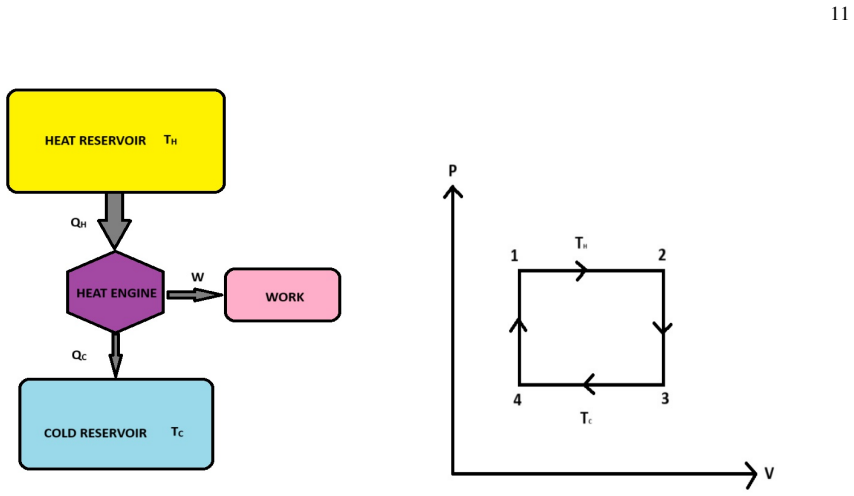
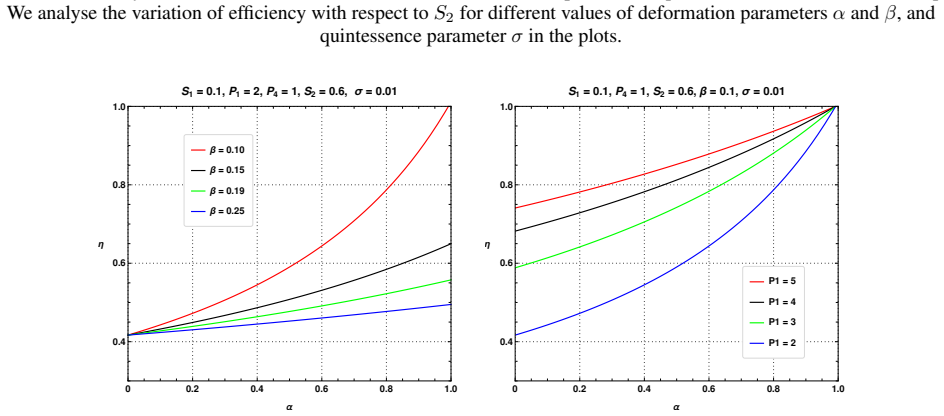
The central claim is that the deformation parameter α, control parameter β, and quintessence parameter σ jointly modify the Hawking temperature and Joule-Thomson coefficient of the black hole, shifting the temperature minimum, enlarging the cooling region, and raising the inversion temperature, with σ producing a weaker influence; the same parameters also control heat-engine efficiency, which increases with α and decreases with higher β and σ.
What carries the argument
The modified black hole metric defined by the three parameters α, β, and σ, which determines the thermodynamic quantities (temperature, pressure, volume) and their derivatives in extended phase space.
If this is right
- The cooling region in isenthalpic processes expands as α or β increases.
- Inversion temperatures rise with larger α and β, extending the range where cooling occurs.
- Black-hole heat-engine efficiency improves with the deformation parameter α but declines with increases in β or σ.
- Thermal stability regions change according to the combined influence of the three parameters.
Where Pith is reading between the lines
- If deformed metrics of this form arise in realistic gravitational theories, their altered inversion curves could provide indirect signatures in cosmological or astrophysical settings.
- The parameter dependence suggests testable extensions to other thermodynamic processes, such as phase transitions or critical phenomena in the same black-hole family.
- Connections to quintessence models may allow these results to inform broader studies of dark-energy effects on black-hole thermodynamics.
Load-bearing premise
The modified metric with parameters α, β, and σ is assumed to describe a physically realizable black hole whose thermodynamic quantities obey the standard first law and Smarr relation of extended phase space without additional constraints from the underlying field equations.
What would settle it
A direct computation showing that the first law of thermodynamics fails to hold for the given metric parameters, or numerical evaluation of inversion curves that exhibit no shift when α or β is varied.
Figures





read the original abstract
We study the Joule-Thomson expansion and extended thermodynamics of a modified black hole characterised by the parameters $\alpha$, $\beta$, and $\sigma$. Analysis of the Hawking temperature, Joule-Thomson coefficient, inversion curves, and isenthalpic trajectories shows that these parameters significantly modify the heating-cooling behaviour and thermal stability of the system. The deformation parameter $\alpha$ and control parameter $\beta$ shift the temperature minimum, enlarge the cooling region, and raise the inversion temperature, while $\sigma$ produces a weaker but consistent influence. The heat-engine analysis reveals that $\alpha$ enhances efficiency, whereas higher $\beta$ and $\sigma$ reduce it. Overall, the results demonstrate that geometric deformation and quintessence jointly govern the unified thermodynamic structure of the black hole.
Editorial analysis
A structured set of objections, weighed in public.
Referee Report
Summary. The paper examines the Joule-Thomson expansion and heat engine efficiency for a deformed AdS-Schwarzschild black hole in the presence of quintessence, with deformation parameters α, β, and σ. Using the standard extended-phase-space dictionary, it computes the Hawking temperature T = f'(r_+)/4π, entropy S = π r_+², and pressure P = −Λ/8π, then derives the Joule-Thomson coefficient μ_JT = (∂T/∂P)_H, inversion curves, isenthalpic trajectories, and heat-engine efficiency η = 1 − Q_C/Q_H. The central claims are that α and β shift the temperature minimum, enlarge the cooling region, and raise the inversion temperature (with σ exerting a weaker but consistent effect), while α increases efficiency and higher β, σ decrease it.
Significance. If the metric satisfies the Einstein equations with the quintessence stress-energy, the results would provide concrete illustrations of how geometric deformations and a dark-energy-like component jointly modify black-hole thermodynamic processes in extended phase space. The work supplies explicit trends for the JT coefficient, inversion temperature, and efficiency as functions of the three parameters, which could serve as benchmarks for future studies of modified black-hole thermodynamics. The parameter-free limiting cases (α = β = σ = 0 recovering the standard AdS-Schwarzschild results) are a modest strength.
major comments (2)
- [§2 (metric ansatz)] §2 (metric ansatz): the line element is introduced as a phenomenological deformation of the AdS-Schwarzschild-quintessence metric without an explicit check that G_μν = 8π(T_μν^quintessence + T_μν^Λ) for w = −2/3. Because the thermodynamic potentials T, S, V, and P are read off directly from this f(r), any failure of the field equations would invalidate the first law and Smarr relation used throughout §§3–5; the reported shifts in T_min and the enlargement of the cooling region would then be artifacts of the ansatz rather than consequences of the Einstein equations.
- [§3.2 (Joule-Thomson coefficient)] §3.2 (Joule-Thomson coefficient): μ_JT is computed from the standard extended-phase-space identity without additional work terms that would arise if the deformation parameters α, β, σ introduce extra degrees of freedom. The claim that α and β enlarge the cooling region therefore rests on the unverified assumption that dM = T dS + V dP continues to hold exactly; a direct verification of the first law for the deformed metric is required before the inversion-curve results can be regarded as robust.
minor comments (2)
- [Abstract] The abstract states that σ produces a “weaker but consistent influence,” yet no quantitative measure (e.g., relative shift in T_min or Δη) is supplied; a short table comparing the magnitudes of the three parameters’ effects would improve clarity.
- [§2] Notation for the quintessence parameter σ is introduced without reference to the standard normalization in the literature (e.g., the usual Kiselev parameter); a brief comparison would help readers place the results.
Simulated Author's Rebuttal
We thank the referee for the thorough review and insightful comments on our manuscript. We address each major comment in detail below and outline the revisions we plan to make.
read point-by-point responses
-
Referee: [§2 (metric ansatz)] §2 (metric ansatz): the line element is introduced as a phenomenological deformation of the AdS-Schwarzschild-quintessence metric without an explicit check that G_μν = 8π(T_μν^quintessence + T_μν^Λ) for w = −2/3. Because the thermodynamic potentials T, S, V, and P are read off directly from this f(r), any failure of the field equations would invalidate the first law and Smarr relation used throughout §§3–5; the reported shifts in T_min and the enlargement of the cooling region would then be artifacts of the ansatz rather than consequences of the Einstein equations.
Authors: We appreciate the referee highlighting this important point. The metric is constructed as a phenomenological extension incorporating the deformation parameters while reducing to the standard AdS-Schwarzschild-quintessence solution when α = β = σ = 0. To strengthen the foundation, we will include in the revised version an explicit calculation of the Einstein tensor components for the proposed metric and demonstrate that the resulting stress-energy tensor corresponds to a quintessence field with w = −2/3 plus the cosmological constant contribution. This verification will confirm the validity of the thermodynamic quantities and relations used in the subsequent sections. revision: yes
-
Referee: [§3.2 (Joule-Thomson coefficient)] §3.2 (Joule-Thomson coefficient): μ_JT is computed from the standard extended-phase-space identity without additional work terms that would arise if the deformation parameters α, β, σ introduce extra degrees of freedom. The claim that α and β enlarge the cooling region therefore rests on the unverified assumption that dM = T dS + V dP continues to hold exactly; a direct verification of the first law for the deformed metric is required before the inversion-curve results can be regarded as robust.
Authors: We agree that a direct verification of the first law is essential for the robustness of our results. In the revised manuscript, we will compute the differential dM explicitly in terms of dS and dP, treating α, β, and σ as fixed parameters, and show that dM = T dS + V dP holds without additional conjugate terms for these deformations. If any extra terms arise, we will incorporate them into the analysis of the Joule-Thomson coefficient and inversion curves. This will provide a solid basis for the reported effects on the cooling region and inversion temperature. revision: yes
Circularity Check
No significant circularity in derivation chain
full rationale
The paper introduces a phenomenological deformed metric with free parameters α, β, σ and applies the standard dictionary of extended black-hole thermodynamics (T = f'(r_+)/4π, S = π r_+², P = -Λ/8π) to compute the Joule-Thomson coefficient, inversion curves, and heat-engine efficiency. These quantities are direct functions of the input metric; the reported shifts in temperature minimum, cooling region, and efficiency are simply the numerical or analytic consequences of varying the parameters inside those expressions. No parameter is fitted to a subset of the same thermodynamic data and then re-labeled as a prediction, no load-bearing self-citation supplies a uniqueness theorem, and no ansatz is smuggled from prior work by the same authors. The derivation therefore remains self-contained within the usual first-law and Smarr relations applied to the given line element.
Axiom & Free-Parameter Ledger
free parameters (1)
- α, β, σ
axioms (2)
- domain assumption The cosmological constant is identified with thermodynamic pressure in the extended phase space.
- domain assumption The modified metric with parameters α, β, σ yields a valid black-hole solution whose Hawking temperature and entropy obey the first law.
Lean theorems connected to this paper
-
IndisputableMonolith/Foundation/AlexanderDuality.leanalexander_duality_circle_linking unclear?
unclearRelation between the paper passage and the cited Recognition theorem.
the deformation parameter α and control parameter β shift the temperature minimum, enlarge the cooling region, and raise the inversion temperature, while σ produces a weaker but consistent influence
-
IndisputableMonolith/Cost/FunctionalEquation.leanwashburn_uniqueness_aczel contradicts?
contradictsCONTRADICTS: the theorem conflicts with this paper passage, or marks a claim that would need revision before publication.
We start with the four-dimensional action ... Gμν + Λgμν = κ T(tot)μν
What do these tags mean?
- matches
- The paper's claim is directly supported by a theorem in the formal canon.
- supports
- The theorem supports part of the paper's argument, but the paper may add assumptions or extra steps.
- extends
- The paper goes beyond the formal theorem; the theorem is a base layer rather than the whole result.
- uses
- The paper appears to rely on the theorem as machinery.
- contradicts
- The paper's claim conflicts with a theorem or certificate in the canon.
- unclear
- Pith found a possible connection, but the passage is too broad, indirect, or ambiguous to say the theorem truly supports the claim.
Reference graph
Works this paper leans on
-
[1]
Witten, Introduction to black hole thermodynamics, Eur
E. Witten, Introduction to black hole thermodynamics, Eur. Phys. J. Plus140, 430 (2025), arXiv:2412.16795 [hep-th]
-
[2]
Einstein, The Field Equations of Gravitation, Sitzungsber
A. Einstein, The Field Equations of Gravitation, Sitzungsber. Preuss. Akad. Wiss. Berlin (Math. Phys. )1915, 844 (1915)
work page 1915
-
[3]
T. P. Sotiriou and V . Faraoni, f(R) Theories Of Gravity, Rev. Mod. Phys.82, 451 (2010), arXiv:0805.1726 [gr-qc]
work page internal anchor Pith review Pith/arXiv arXiv 2010
-
[4]
Universality of P-V Criticality in Horizon Thermodynamics
D. Hansen, D. Kubiznak, and R. B. Mann, Universality of P-V Criticality in Horizon Thermodynamics, JHEP01, 047, arXiv:1603.05689 [gr-qc]
work page internal anchor Pith review Pith/arXiv arXiv
-
[5]
Thermodynamics of Black Holes in Massive Gravity
R.-G. Cai, Y .-P. Hu, Q.-Y . Pan, and Y .-L. Zhang, Thermodynamics of Black Holes in Massive Gravity, Phys. Rev. D91, 024032 (2015), arXiv:1409.2369 [hep-th]
work page internal anchor Pith review Pith/arXiv arXiv 2015
-
[6]
S. Carlip, Black Hole Thermodynamics, Int. J. Mod. Phys. D23, 1430023 (2014), arXiv:1410.1486 [gr-qc]
work page internal anchor Pith review Pith/arXiv arXiv 2014
-
[7]
S. Soroushfar, A. I. Kashkooli, H. Farahani, P. Rudra, and B. Pourhassan, Geodesics and thermodynamics of Einstein-Power-Yang–Mills AdS black holes, Phys. Dark Univ.47, 101800 (2025)
work page 2025
-
[8]
R. Karmakar and U. D. Goswami, Quasinormal modes, thermodynamics and shadow of black holes in Hu–Sawickif(R)gravity theory, Eur. Phys. J. C84, 969 (2024), arXiv:2406.18329 [gr-qc]
- [9]
-
[10]
N. J. Gogoi, D. J. Gogoi, and J. Bora, Topology of 5-dimensional Einstein–Gauss–Bonnet AdS black hole thermodynamics surrounded by a cloud of Strings, Phys. Dark Univ.50, 102099 (2025)
work page 2025
-
[11]
J. D. Bekenstein, Black holes and the second law, Lett. Nuovo Cim.4, 737 (1972)
work page 1972
- [12]
- [13]
-
[14]
S.-W. Wei, Y .-X. Liu, and R. B. Mann, Black Hole Solutions as Topological Thermodynamic Defects, Phys. Rev. Lett.129, 191101 (2022), arXiv:2208.01932 [gr-qc]
- [15]
-
[16]
S.-W. Wei and Y .-X. Liu, Topology of black hole thermodynamics, Phys. Rev. D105, 104003 (2022), arXiv:2112.01706 [gr-qc]
-
[17]
Joule-Thomson Expansion of Charged AdS Black Holes
¨O. ¨Okc¨u and E. Aydıner, Joule–Thomson expansion of the charged AdS black holes, Eur. Phys. J. C77, 24 (2017), arXiv:1611.06327 [gr-qc]
work page internal anchor Pith review Pith/arXiv arXiv 2017
- [18]
-
[19]
Y . Sekhmani, D. J. Gogoi, R. Myrzakulov, and J. Rayimbaev, Phase structures and critical behavior of rational non-linear electrodynamics Anti de Sitter black holes in Rastall gravity, Commun. Theor. Phys.76, 045403 (2024), arXiv:2403.04888 [gr-qc]
- [20]
-
[21]
M. Tataryn and M. Stetsko, Thermodynamics of a static electric-magnetic black hole in Einstein-Born-Infeld-AdS theory with different horizon geometries, Gen. Rel. Grav.53, 72 (2021), arXiv:2304.02753 [gr-qc]
-
[22]
A. Dehghani, B. Pourhassan, S. Zarepour, and E. N. Saridakis, Thermodynamic schemes of charged BTZ-like black holes in arbitrary dimensions, Phys. Dark Univ.42, 101371 (2023), arXiv:2305.08219 [hep-th]
- [23]
- [24]
-
[25]
R.-B. Wang, S.-J. Ma, L. You, Y .-C. Tang, Y .-H. Feng, X.-R. Hu, and J.-B. Deng, Thermodynamics of AdS-Schwarzschild-like black hole in loop quantum gravity, Eur. Phys. J. C84, 1161 (2024), arXiv:2405.08241 [gr-qc]
- [26]
-
[27]
R.-B. Wang, S.-J. Ma, L. You, J.-B. Deng, and X.-R. Hu, Thermodynamics of Schwarzschild-AdS black hole in non-commutative geometry, Chin. Phys. C49, 065101 (2025), arXiv:2410.03650 [gr-qc]
- [28]
- [29]
-
[30]
E. Dai, F. Javed, A. Waseem, M. Alosaimi, and R. M. Zulqarnain, Thermodynamic insights into Joule–Thomson expansion, particle dynamics, and emission energy of AdS black holes in Horndeski theory, Phys. Dark Univ.49, 102014 (2025)
work page 2025
- [31]
-
[32]
N. Media and T. I. Singh, Joule-Thomson Expansion of Kerr-Newman-de Sitter Black Hole Under Lorentz Violation Theory, Int. J. Theor. Phys.64, 82 (2025)
work page 2025
-
[33]
Joule-Thomson Expansion of Kerr-AdS Black Holes
¨O. ¨Okc¨u and E. Aydıner, Joule–Thomson expansion of Kerr–AdS black holes, Eur. Phys. J. C78, 123 (2018), arXiv:1709.06426 [gr-qc]
work page internal anchor Pith review Pith/arXiv arXiv 2018
-
[34]
H. Ghaffarnejad, E. Yaraie, and M. Farsam, Quintessence Reissner Nordstr ¨om Anti de Sitter Black Holes and Joule Thomson effect, Int. J. Theor. Phys.57, 1671 (2018), arXiv:1802.08749 [gr-qc]
-
[35]
Joule-Thomson Expansion of RN-AdS Black Holes in $f(R)$ gravity
M. Chabab, H. El Moumni, S. Iraoui, K. Masmar, and S. Zhizeh, Joule-Thomson Expansion of RN-AdS Black Holes inf(R)gravity, LHEP02, 05 (2018), arXiv:1804.10042 [gr-qc]
work page internal anchor Pith review Pith/arXiv arXiv 2018
-
[36]
M. Rostami, J. Sadeghi, S. Miraboutalebi, A. A. Masoudi, and B. Pourhassan, Charged accelerating AdS black hole off(R)gravity and the Joule–Thomson expansion, Int. J. Geom. Meth. Mod. Phys.17, 2050136 (2020), arXiv:1908.08410 [gr-qc]
- [37]
- [38]
- [39]
- [40]
-
[41]
R. H. Ali, G. Abbas, A. Jawad, B. S. Alkahtani, and G. Mustafa, Mathematical formalism of Joule-Thomson process for ADS-RN black hole coupled with non-linear electrodynamics field, Nucl. Phys. B1010, 116735 (2025)
work page 2025
-
[42]
S. Chaudhary, A. Jawad, and M. Yasir, Thermodynamic geometry and Joule-Thomson expansion of black holes in modified theories of gravity, Phys. Rev. D105, 024032 (2022)
work page 2022
- [43]
-
[44]
S. Rani, H. Riaz, U. Zafar, A. Jawad, N. Myrzakulov, and S. Shaymatov, Stability and topological thermodynamics of black holes through modified entropy, Eur. Phys. J. C85, 971 (2025)
work page 2025
-
[45]
S. Rani, A. Jawad, M. Heydari-Fard, and U. Zafar, Thermodynamic and shadow analysis of Dehnen type dark matter Halo corrected Schwarzschild black hole surrounded by thin disk, Eur. Phys. J. C85, 677 (2025)
work page 2025
-
[46]
S. Rani, A. Jawad, H. Raza, S. Shaymatov, M. Muzaffar, and H. Riaz, Thermodynamic properties and geometries of bardeen black hole surrounded by string clouds, Eur. Phys. J. C84, 904 (2024)
work page 2024
- [47]
- [48]
-
[49]
Y . Ladghami, A. Bargach, A. Bouali, T. Ouali, and G. Mustafa, Spacetime foam effects on charged AdS black hole thermodynamics, Nucl. Phys. B1018, 117015 (2025), arXiv:2411.06271 [hep-th]
- [50]
- [51]
- [52]
-
[53]
F. Liu, Y .-Z. Du, R. Zhao, and H.-F. Li, The phase transitions and Joule–Thomson processes of charged de Sitter black holes with cloud of string and quintessence, Chin. J. Phys.95, 371 (2025)
work page 2025
- [54]
-
[55]
T.-Y . Liu, Joule-thomson expansion of vanished cooling region for five-dimensional neutral Gauss-Bonnet AdS black hole, Gen. Rel. Grav.56, 140 (2024)
work page 2024
-
[56]
G. Mustafa, F. Javed, S. K. Maurya, S. Alkarni, O. Donmez, A. Cilli, and E. G¨udekli, Joule-Thomson expansion, motion of particles and QPOs around Bardeen-AdS black hole immersed in a fluid of strings, JHEAp44, 437 (2024)
work page 2024
- [57]
-
[58]
A. H. Rezaei and K. Nozari, Joule–Thomson expansion in a mimetic black hole, Sci. Rep.14, 19475 (2024)
work page 2024
- [59]
-
[60]
Masmar, Joule–Thomson expansion for a nonlinearly charged Anti-de Sitter black hole, Int
K. Masmar, Joule–Thomson expansion for a nonlinearly charged Anti-de Sitter black hole, Int. J. Geom. Meth. Mod. Phys.20, 2350080 (2023)
work page 2023
-
[61]
Y . Sekhmani, Z. Dahbi, A. Najim, and A. Waqdim, Joule–Thomson expansion of 5-dimensional R-charged black holes, Annals Phys. 444, 169060 (2022)
work page 2022
-
[62]
Q.-M. Feng, J. Pu, and Q.-Q. Jiang, Effects of magnetic monopole charge on Joule–Thomson expansion of regular Ay ´on Beato–Garc´ıa black hole, Class. Quant. Grav.39, 155007 (2022)
work page 2022
-
[63]
J. Barrientos and J. Mena, Joule-Thomson expansion of AdS black holes in quasitopological electromagnetism, Phys. Rev. D106, 044064 (2022), arXiv:2206.06018 [gr-qc]
- [64]
-
[65]
J.-T. Xing, Y . Meng, and X.-M. Kuang, Joule-Thomson expansion for hairy black holes, Phys. Lett. B820, 136604 (2021)
work page 2021
-
[66]
Y . Meng, B. B. Chen, and J. Tang, Cooling–heating phase transition of the Euler–Heisenberg-AdS black hole, Mod. Phys. Lett. A36, 2150165 (2021)
work page 2021
- [67]
-
[68]
Biswas, Joule-Thomson expansion of AdS black holes in Einstein Power-Yang-mills gravity, Phys
A. Biswas, Joule-Thomson expansion of AdS black holes in Einstein Power-Yang-mills gravity, Phys. Scripta96, 125310 (2021), arXiv:2106.11066 [gr-qc]
- [69]
- [70]
- [71]
- [72]
- [73]
-
[74]
Lan, Joule-Thomson expansion of neutral AdS black holes in massive gravity, Nucl
S.-Q. Lan, Joule-Thomson expansion of neutral AdS black holes in massive gravity, Nucl. Phys. B948, 114787 (2019)
work page 2019
-
[75]
C. H. Nam, Heat engine efficiency and Joule–Thomson expansion of nonlinear charged AdS black hole in massive gravity, Gen. Rel. Grav.53, 30 (2021), arXiv:1906.05557 [gr-qc]
work page internal anchor Pith review Pith/arXiv arXiv 2021
-
[76]
Joule-Thomson expansion of charged AdS black holes in Rainbow gravity
D. Mahdavian Yekta, A. Hadikhani, and ¨O. ¨Okc¨u, Joule-Thomson expansion of charged AdS black holes in Rainbow gravity, Phys. Lett. B795, 521 (2019), arXiv:1905.03057 [hep-th]
work page internal anchor Pith review Pith/arXiv arXiv 2019
-
[77]
Joule-Thomson expansion in AdS black hole with a global monopole
A. Rizwan C. L., N. Kumara A., D. Vaid, and K. M. Ajith, Joule-Thomson expansion in AdS black hole with a global monopole, Int. J. Mod. Phys. A33, 1850210 (2019), arXiv:1805.11053 [gr-qc]
work page internal anchor Pith review Pith/arXiv arXiv 2019
-
[78]
Joule-Thomson expansion of $d$-dimensional charged AdS black holes
J.-X. Mo, G.-Q. Li, S.-Q. Lan, and X.-B. Xu, Joule-Thomson expansion ofd-dimensional charged AdS black holes, Phys. Rev. D98, 124032 (2018), arXiv:1804.02650 [gr-qc]
work page internal anchor Pith review Pith/arXiv arXiv 2018
-
[79]
P. Paul and S. I. Kruglov, Magnetic black holes in 4D Einstein–Gauss–Bonnet massive gravity coupled to nonlinear electrodynamics, Int. J. Geom. Meth. Mod. Phys.22, 2450330 (2025), arXiv:2403.02056 [gr-qc]
-
[80]
C. V . Johnson and F. Rosso, Holographic Heat Engines, Entanglement Entropy, and Renormalization Group Flow, Class. Quant. Grav. 36, 015019 (2019), arXiv:1806.05170 [hep-th]
work page internal anchor Pith review Pith/arXiv arXiv 2019
discussion (0)
Sign in with ORCID, Apple, or X to comment. Anyone can read and Pith papers without signing in.