The Silent Brush: Evaluating Artistic Style Leakage in AI Art Generation
Pith reviewed 2026-05-20 14:28 UTC · model grok-4.3
The pith
Text-to-image models reproduce artistic styles from training data without any prompt reference due to uneven encoding strengths and interaction dynamics among artworks.
A machine-rendered reading of the paper's core claim, the machinery that carries it, and where it could break.
Core claim
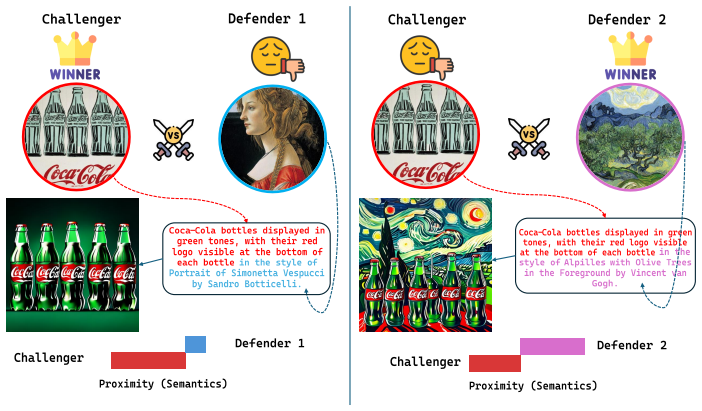
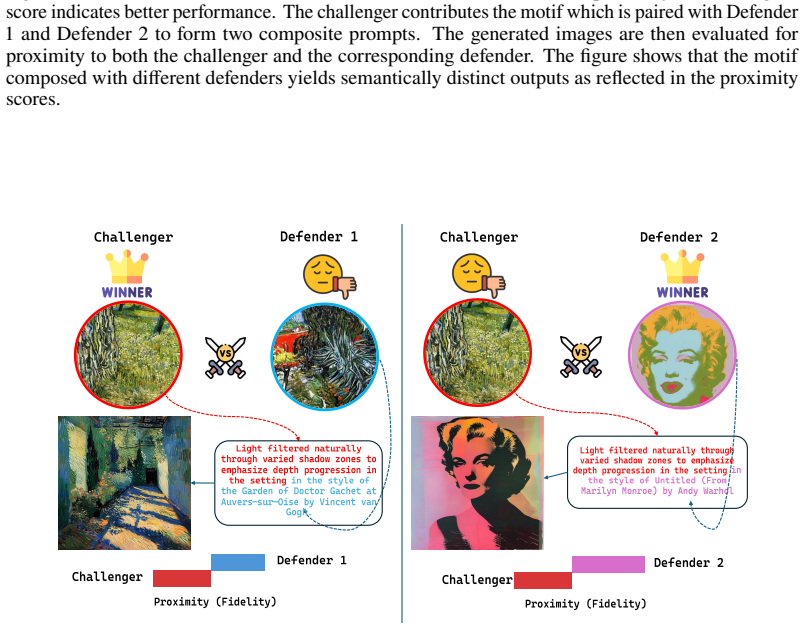
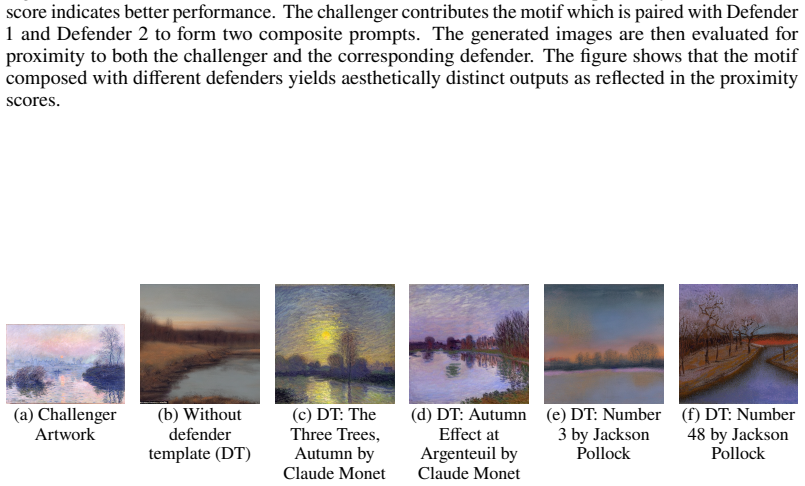
The Silent Brush is the reappearance of stylistic traits from training artworks in model generations without explicit prompt mention. Art Arena is the evaluation protocol that measures how strongly artworks are encoded, how they interact with one another, and how frequently their stylistic traits reappear in generated outputs. Results on widely used diffusion models show that The Silent Brush arises from differences in representational strength and interaction dynamics between artworks, leading to asymmetric blending in model generations.
What carries the argument
Art Arena, the evaluation protocol that measures representational strength of individual artworks, their interaction dynamics, and the frequency of unprompted stylistic reappearance in outputs.
If this is right
- Stronger-encoded artworks impose their styles on outputs even when weaker artworks are the intended reference.
- Pairwise interaction dynamics between artworks are not symmetric, so style dominance depends on which pair is involved.
- The same leakage pattern appears across multiple diffusion-based text-to-image systems when evaluated with the same protocol.
- Evaluation of unintended reuse must track interaction dynamics rather than relying only on near-duplicate retrieval or membership inference.
Where Pith is reading between the lines
- If the measured strength differences prove stable, targeted removal or down-weighting of dominant artworks during training could reduce specific style leakages.
- The protocol could be adapted to test whether similar asymmetric blending occurs for non-artistic concepts such as object categories or color palettes.
- Prompt engineering or post-generation style transfer might serve as practical countermeasures once the dominant artworks for a given output are identified.
Load-bearing premise
The Art Arena protocol accurately isolates stylistic leakage from confounding factors such as prompt phrasing, model architecture specifics, or dataset composition, allowing the measured interactions to generalize across text-to-image systems.
What would settle it
If Art Arena measurements of unequal representational strength between two artworks consistently produce symmetric rather than asymmetric style blending in controlled generations, the claimed causal link between strength differences and asymmetric outcomes would be falsified.
Figures





read the original abstract
Generative text-to-image models are typically trained on large-scale web-scraped datasets that include diverse visual content such as copyrighted and stylistically distinctive artworks, raising concerns about ownership, attribution, and the unintended reuse of protected visual expressions. A key issue is that models can learn stylistic patterns from this data and reproduce them in generated outputs without any explicit reference in the prompt. We refer to this phenomenon as The Silent Brush, where such learned styles reappear even when they are not requested. Existing evaluation methods mainly focus on near-duplicate retrieval or membership inference and do not account for this form of unintended stylistic resurfacing across prompts. To address these gaps, we first formulate guiding principles for evaluation of The Silent Brush. We then introduce Art Arena, an evaluation protocol that measures how strongly artworks are encoded, how they interact, and how frequently their stylistic traits reappear in generated outputs without explicit mention in prompts. We evaluate Art Arena on widely used text-to-image diffusion models, including Stable Diffusion v1.5, Stable Diffusion XL (SDXL), and SANA-1.5, and design it to generalize across text-to-image generative systems. Our results show that The Silent Brush arises from differences in representational strength and interaction dynamics between artworks, leading to asymmetric blending in model generations. Code and evaluation resources are available at: https://anonymous.4open.science/r/ArtArena-EBE4.
Editorial analysis
A structured set of objections, weighed in public.
Referee Report
Summary. The paper defines 'The Silent Brush' as unintended stylistic leakage in text-to-image diffusion models, where learned artistic styles from web-scraped training data reappear in generated outputs without explicit prompting. It outlines guiding principles for evaluation, introduces the Art Arena protocol to quantify encoding strength, inter-artwork interactions, and reappearance frequency of stylistic traits, and applies it to Stable Diffusion v1.5, SDXL, and SANA-1.5. The central claim is that observed asymmetric blending arises from differences in representational strength and interaction dynamics rather than prompt or dataset artifacts, with code and resources provided for generalization across systems.
Significance. If the Art Arena protocol can be shown to isolate stylistic leakage from confounders, the work would provide a useful empirical tool for studying unintended style reproduction in generative models, with relevance to copyright, attribution, and model auditing. The release of code and evaluation resources supports potential reproducibility and extension by others.
major comments (2)
- [Abstract and §3] Abstract and §3 (Art Arena protocol description): the protocol measures encoding strength and reappearance frequency but provides no explicit controls such as fixed prompt templates, balanced sampling of style frequencies from the pretraining corpus, or ablations of conditioning mechanisms. This leaves open whether reported asymmetries reflect intrinsic representational properties or prompt sensitivity and dataset frequency effects.
- [Results and evaluation sections] Results and evaluation sections: the abstract and main claims assert that The Silent Brush arises from representational strength differences leading to asymmetric blending, yet no quantitative metrics, error bars, data exclusion criteria, or statistical tests are referenced. Without these, it is not possible to assess whether the central empirical observations support the causal attribution over alternative explanations.
minor comments (2)
- [Introduction] Introduction: the distinction between The Silent Brush and prior membership-inference or near-duplicate retrieval methods could be sharpened with a brief comparison table.
- [§4] §4 (model evaluations): clarify how the protocol ensures generalization claims across text-to-image systems beyond the three tested models.
Simulated Author's Rebuttal
We thank the referee for their constructive and detailed feedback on our work. We have carefully addressed each major comment below and revised the manuscript accordingly to improve experimental controls and statistical rigor. These changes strengthen the presentation of the Art Arena protocol and the support for our central claims regarding stylistic leakage.
read point-by-point responses
-
Referee: [Abstract and §3] Abstract and §3 (Art Arena protocol description): the protocol measures encoding strength and reappearance frequency but provides no explicit controls such as fixed prompt templates, balanced sampling of style frequencies from the pretraining corpus, or ablations of conditioning mechanisms. This leaves open whether reported asymmetries reflect intrinsic representational properties or prompt sensitivity and dataset frequency effects.
Authors: We appreciate this observation on experimental design. The original Art Arena protocol employed a fixed set of neutral prompt templates across all model evaluations to reduce prompt-induced variability, as noted in §3. To further isolate effects, the revised manuscript now includes an explicit ablation of conditioning mechanisms (new Appendix B) and a sensitivity analysis varying prompt phrasing. Regarding balanced sampling, our sampling was intentionally drawn from the empirical distribution of styles in web-scraped corpora to reflect realistic leakage conditions rather than artificial balance; however, we have added a new subsection in §3.3 discussing frequency biases and report results from a balanced subsample experiment showing that the observed asymmetries persist. These revisions support attribution to representational strength and interaction dynamics while acknowledging dataset influences. revision: yes
-
Referee: [Results and evaluation sections] Results and evaluation sections: the abstract and main claims assert that The Silent Brush arises from representational strength differences leading to asymmetric blending, yet no quantitative metrics, error bars, data exclusion criteria, or statistical tests are referenced. Without these, it is not possible to assess whether the central empirical observations support the causal attribution over alternative explanations.
Authors: We acknowledge the value of enhanced statistical reporting for validating the causal claims. The revised manuscript now reports mean encoding strength and reappearance frequency with standard deviations across 5 independent runs per condition, includes error bars on all figures in §4, and specifies data exclusion criteria (generations with CLIP similarity below 0.2 to reference styles are excluded). We have added statistical tests including paired t-tests for blending asymmetry significance (p < 0.01 reported for key comparisons) and ANOVA for interaction effects between artworks, with full results in a new Table 3. These quantitative elements provide clearer support for the role of representational strength differences over prompt or frequency artifacts alone. revision: yes
Circularity Check
No circularity: empirical protocol with independent observations
full rationale
The paper introduces the Art Arena evaluation protocol as a set of guiding principles and measurements for encoding strength, interactions, and reappearance frequency of stylistic traits in text-to-image models. It reports empirical results on specific models (Stable Diffusion v1.5, SDXL, SANA-1.5) attributing asymmetric blending to representational differences. No equations, fitted parameters, or predictions are described that reduce by construction to the protocol inputs or self-citations. The derivation chain consists of protocol design followed by observation reporting, remaining self-contained against external benchmarks without self-referential definitions or load-bearing self-citations.
Axiom & Free-Parameter Ledger
invented entities (1)
-
The Silent Brush
no independent evidence
Lean theorems connected to this paper
-
IndisputableMonolith/Cost/FunctionalEquation.leanwashburn_uniqueness_aczel unclear?
unclearRelation between the paper passage and the cited Recognition theorem.
We introduce Art Arena, an evaluation protocol that measures how strongly artworks are encoded, how they interact, and how frequently their stylistic traits reappear in generated outputs without explicit mention in prompts.
-
IndisputableMonolith/Foundation/BranchSelection.leanbranch_selection unclear?
unclearRelation between the paper passage and the cited Recognition theorem.
Our results show that The Silent Brush arises from differences in representational strength and interaction dynamics between artworks, leading to asymmetric blending in model generations.
What do these tags mean?
- matches
- The paper's claim is directly supported by a theorem in the formal canon.
- supports
- The theorem supports part of the paper's argument, but the paper may add assumptions or extra steps.
- extends
- The paper goes beyond the formal theorem; the theorem is a base layer rather than the whole result.
- uses
- The paper appears to rely on the theorem as machinery.
- contradicts
- The paper's claim conflicts with a theorem or certificate in the canon.
- unclear
- Pith found a possible connection, but the passage is too broad, indirect, or ambiguous to say the theorem truly supports the claim.
Reference graph
Works this paper leans on
-
[1]
Abhishek Dangeti, Pavan Gajula, Vivek Srivastava, and Vikram Jamwal. Style-based clustering of visual artworks and the play of neural style-representations.arXiv preprint arXiv:2409.08245,
-
[2]
Lingxiao Chen, Liqin Wang, and Wei Lu. Stylesentinel: Reliable artistic copyright verification via stylistic fingerprints.arXiv preprint arXiv:2508.01335,
-
[3]
The work of art in the age of mechanical reproduction, 1936.New York,
Walter Benjamin. The work of art in the age of mechanical reproduction, 1936.New York,
work page 1936
-
[4]
Color encoding in latent space of stable diffusion models.arXiv preprint arXiv:2512.09477,
Guillem Arias, Ariadna Solà, Martí Armengod, and Maria Vanrell. Color encoding in latent space of stable diffusion models.arXiv preprint arXiv:2512.09477,
-
[6]
A Neural Algorithm of Artistic Style
Leon A Gatys, Alexander S Ecker, and Matthias Bethge. A neural algorithm of artistic style.arXiv preprint arXiv:1508.06576,
work page internal anchor Pith review Pith/arXiv arXiv
-
[7]
High- resolutionimagesynthesiswithlatentdiffusionmodels
Robin Rombach, Andreas Blattmann, Dominik Lorenz, Patrick Esser, and Björn Ommer. High- resolutionimagesynthesiswithlatentdiffusionmodels. InProceedingsoftheIEEE/CVFconference on computer vision and pattern recognition, pages 10684–10695, 2022b. Enze Xie, Junsong Chen, Yuyang Zhao, Jincheng Yu, Ligeng Zhu, Chengyue Wu, Yujun Lin, Zhekai Zhang,MuyangLi,Jun...
-
[8]
Clipscore: A reference- free evaluation metric for image captioning
Jack Hessel, Ari Holtzman, Maxwell Forbes, Ronan Le Bras, and Yejin Choi. Clipscore: A reference- free evaluation metric for image captioning. InProceedings of the 2021 conference on empirical methods in natural language processing, pages 7514–7528,
work page 2021
-
[9]
Measuring style similarity in diffusion models.arXiv preprint arXiv:2404.01292, 2024
GowthamiSomepalli,AnubhavGupta,KamalGupta,ShramayPalta,MicahGoldblum,JonasGeiping, Abhinav Shrivastava, and Tom Goldstein. Measuring style similarity in diffusion models.arXiv preprint arXiv:2404.01292,
-
[10]
On memorization in diffusion models
Xiangming Gu, Chao Du, Tianyu Pang, Chongxuan Li, Min Lin, and Ye Wang. On memorization in diffusion models.arXiv preprint arXiv:2310.02664, 2023b. Shawn Shan, Jenna Cryan, Emily Wenger, Haitao Zheng, Rana Hanocka, and Ben Y Zhao. Glaze: Protecting artists from style mimicry by{Text-to-Image} models. In32nd USENIX Security Symposium (USENIX Security 23), ...
-
[11]
Yan Pang and Tianhao Wang. Black-box membership inference attacks against fine-tuned diffusion models.arXiv preprint arXiv:2312.08207,
-
[12]
Classactioncomplaint: Andersenetal.v.stability ailtd.etal
SarahAndersen,KellyMcKernan,andKarlaOrtiz. Classactioncomplaint: Andersenetal.v.stability ailtd.etal. https://ipwatchdog.com/wp-content/uploads/2023/02/Andersen_et_al_ v._Stability_AI.pdf,
work page 2023
-
[13]
Getty images (us) inc and others v
High Court of Justice of England and Wales. Getty images (us) inc and others v. stability ai limited: Approved high court judgment.https://www.judiciary.uk/wp-content/uploads/2025/ 11/Getty-Images-v-Stability-AI.pdf,
work page 2025
-
[14]
Image-generatingaicancopyandpastefromtrainingdata,raisingipconcerns.techcrunch (2022),
KWiggers. Image-generatingaicancopyandpastefromtrainingdata,raisingipconcerns.techcrunch (2022),
work page 2022
-
[15]
Identifying and eliminating csam in generative ml training data and mod- els
12 David Thiel. Identifying and eliminating csam in generative ml training data and mod- els. https://stacks.stanford.edu/file/druid:kh752sm9123/ml_training_data_ csam_report-2023-12-23.pdf, December
work page 2023
-
[16]
Ninad Joshi, Vivek Srivastava, and Shirish Karande
Official LAION announcement of the Re-LAION-5B dataset revision. Ninad Joshi, Vivek Srivastava, and Shirish Karande. Dota: Latent distribution conditioned data attributionfordiffusionmodels.InProceedingsoftheIEEE/CVFWinterConferenceonApplications of Computer Vision, pages 2022–2031,
work page 2022
-
[17]
Jie-Jing Shao, Jiang-Xin Shi, Xiao-Wen Yang, Lan-Zhe Guo, and Yu-Feng Li. Investigating the limitation of clip models: The worst-performing categories.arXiv preprint arXiv:2310.03324,
-
[18]
E-LPIPS: Robust Perceptual Image Similarity via Random Transformation Ensembles
Chitwan Saharia, William Chan, Saurabh Saxena, Lala Li, Jay Whang, Emily L Denton, Kamyar Ghasemipour, Raphael Gontijo Lopes, Burcu Karagol Ayan, Tim Salimans, et al. Photorealistic text-to-image diffusion models with deep language understanding.Advances in neural information processing systems, 35:36479–36494, 2022b. Markus Kettunen, Erik Härkönen, and J...
work page internal anchor Pith review Pith/arXiv arXiv 1906
-
[19]
R-lpips: An adversarially robust perceptual similarity metric.arXiv preprint arXiv:2307.15157,
SaraGhazanfari,SiddharthGarg,PrashanthKrishnamurthy,FarshadKhorrami,andAlexandreAraujo. R-lpips: An adversarially robust perceptual similarity metric.arXiv preprint arXiv:2307.15157,
-
[20]
Csgo: Content-style composition in text-to-image generation,
Peng Xing, Haofan Wang, Yanpeng Sun, Qixun Wang, Xu Bai, Hao Ai, Renyuan Huang, and Zechao Li. Csgo: Content-stylecompositionintext-to-imagegeneration.arXivpreprintarXiv:2408.16766,
-
[21]
Dreamo: A unified framework for image customization
Chong Mou, Yanze Wu, Wenxu Wu, Zinan Guo, Pengze Zhang, Yufeng Cheng, Yiming Luo, Fei Ding, Shiwen Zhang, Xinghui Li, et al. Dreamo: A unified framework for image customization. In Proceedings of the SIGGRAPH Asia 2025 Conference Papers, pages 1–12,
work page 2025
-
[22]
13 Appendix Appendix Contents A.1 Ethical Considerations and Limitations . . . . . . . . . . . . . . . . . . . . . . . . 14 A.2 Related Work . . . . . . . . . . . . . . . . . . . . . . . . . . . . . . . . . . . . . 14 A.3 Motif Extraction . . . . . . . . . . . . . . . . . . . . . . . . . . . . . . . . . . . . 16 A.4 Artworks and their extracted motifs . ....
work page 2023
-
[23]
Impression, Sunrise in the style of Claude Monet
by Jackson Pollock Marilyn Monroe by Andy Warhol 3 The Japanese Bridge (The Bridge in Monet’s Garden) by Claude Monet Number 32 by Jackson Pollock Cross by Andy Warhol 4 Water Lilies by Claude Monet Portrait of a Man by Rembrandt Beatles by Andy Warhol 5 Pathway in Monet’s Garden at Giverny by Claude Monet Tree with Ivy in the Asylum Gar- den by Vincent v...
work page 2021
discussion (0)
Sign in with ORCID, Apple, or X to comment. Anyone can read and Pith papers without signing in.