Polarization Observations of a Sample of 6.7 GHz Methanol Masers
Pith reviewed 2026-05-20 09:42 UTC · model grok-4.3
The pith
Polarization variations across 6.7 GHz methanol maser spectra and between epochs are most likely caused by changes in magnetic fields.
A machine-rendered reading of the paper's core claim, the machinery that carries it, and where it could break.
Core claim
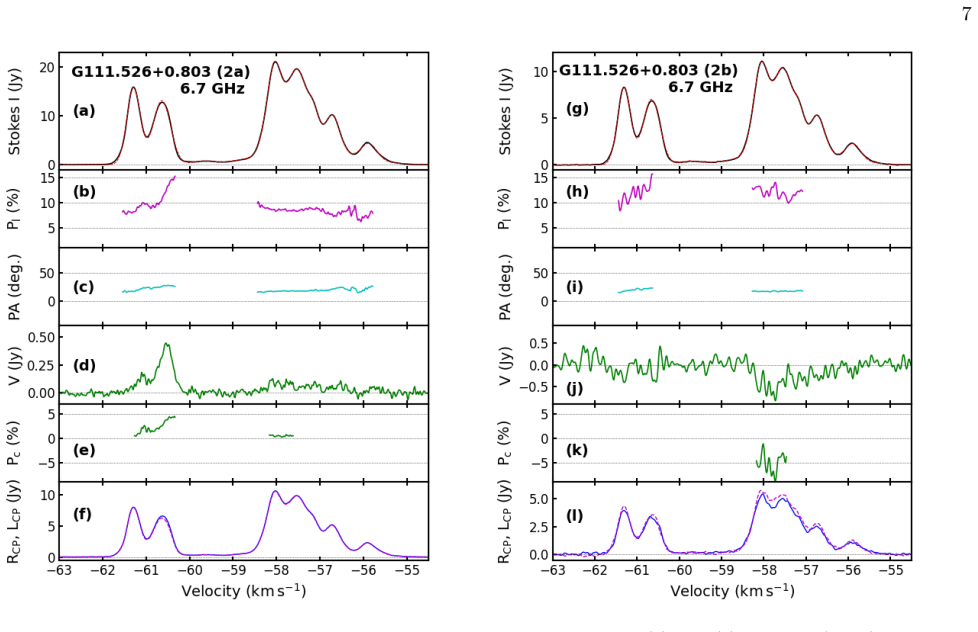
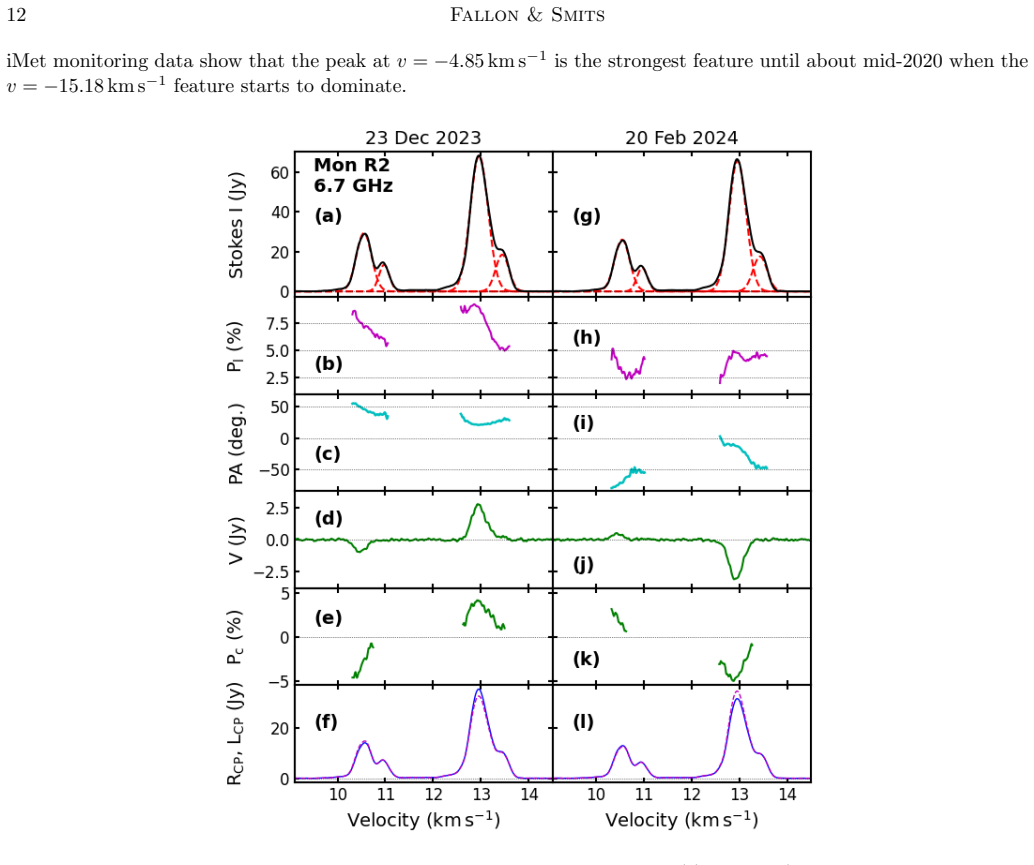
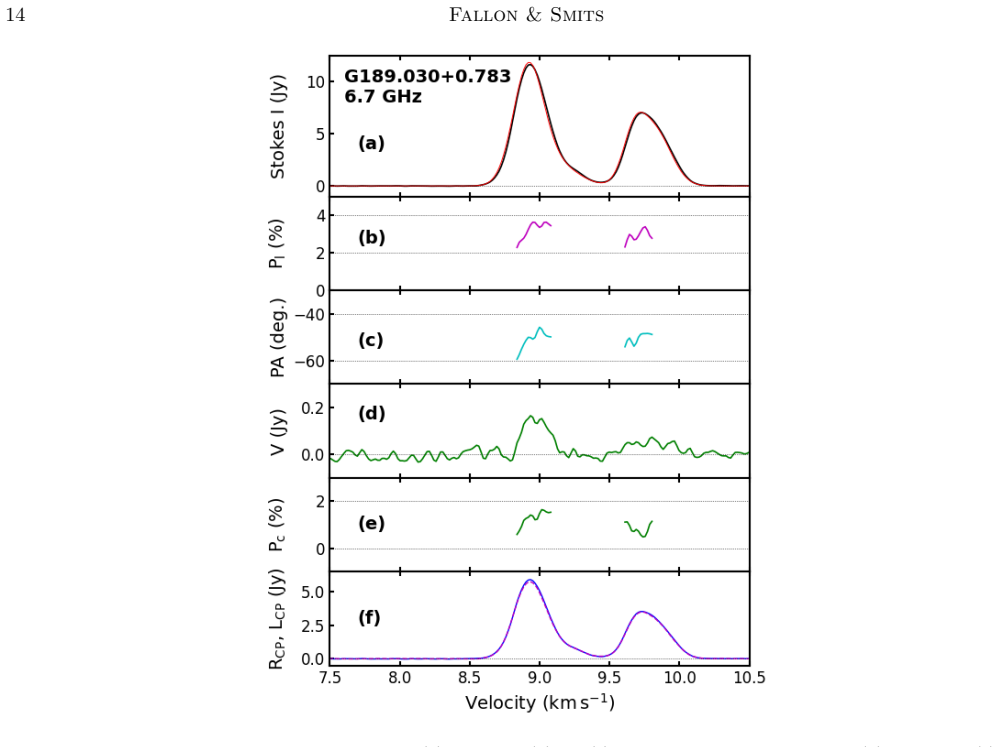
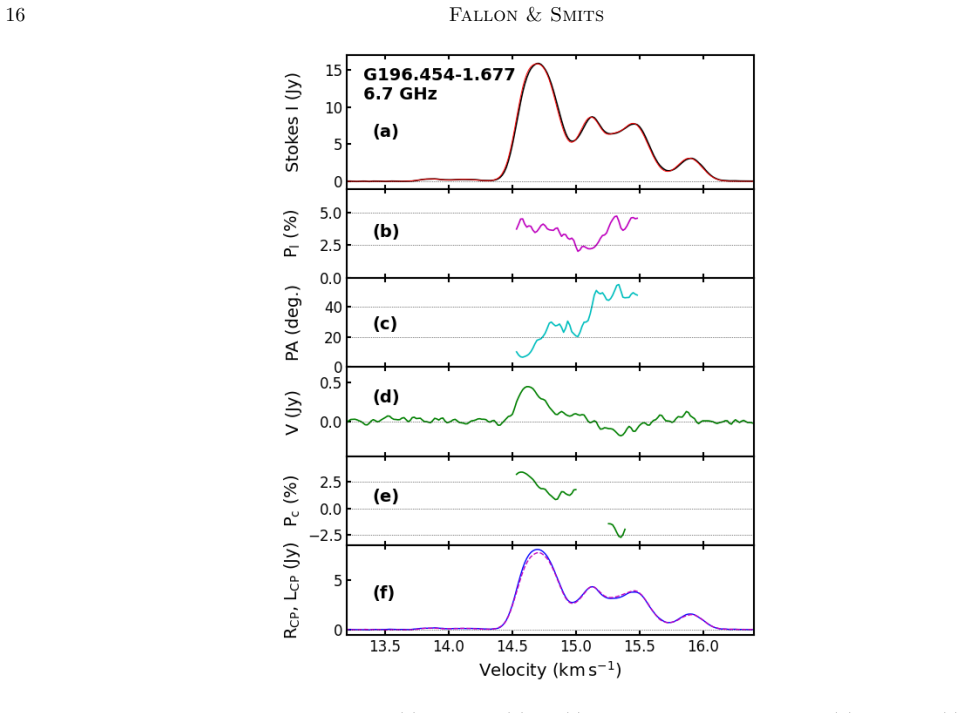
Spectra of 6.7 GHz methanol masers from 21 pointings of known star-forming regions are reported. The C-band observations, using the Green Bank Telescope in full Stokes mode, have measured how polarization properties vary across the maser profiles in each spectrum and vary between different epochs of observation. Zeeman splitting is observed in several sources, with splitting values derived from velocity separation between RCP and LCP components via Gaussian fitting. These values are seen to change with time and appear to correspond to changes in the linear and circular polarization. The polarization properties varying across the spectra and changing with time are most likely due to varia
What carries the argument
Time-variable Zeeman splitting measured from the velocity separation of right- and left-circularly polarized maser components, correlated with changes in linear and circular polarization fractions.
If this is right
- Magnetic fields in the gas surrounding 6.7 GHz methanol masers are dynamic on the timescales sampled by the observations.
- Repeated full-Stokes monitoring can track the evolution of magnetic-field strength and direction in individual star-forming regions.
- Single-epoch polarization measurements may underestimate the range of field conditions present in maser environments.
- The observed correspondence between Zeeman splitting and polarization percentage provides an additional diagnostic for magnetic-field geometry.
Where Pith is reading between the lines
- If magnetic-field variations are common, models of magnetic regulation during high-mass star formation will need to incorporate time-dependent field strengths rather than static configurations.
- Longer-term monitoring campaigns could reveal whether the field changes are periodic, stochastic, or tied to specific dynamical events such as outflows or accretion bursts.
- Comparison with polarization data at other maser transitions (e.g., 12.2 GHz or 22 GHz water) could test whether the same field variations affect multiple species simultaneously.
Load-bearing premise
The measured changes in Zeeman splitting and polarization fractions are produced by intrinsic variations in the magnetic field rather than by propagation effects, source variability, or instrumental factors.
What would settle it
A set of new epochs in which polarization fractions change significantly while the velocity separation between RCP and LCP components remains constant (or vice versa) would show that the variations are not driven by magnetic-field changes.
Figures





read the original abstract
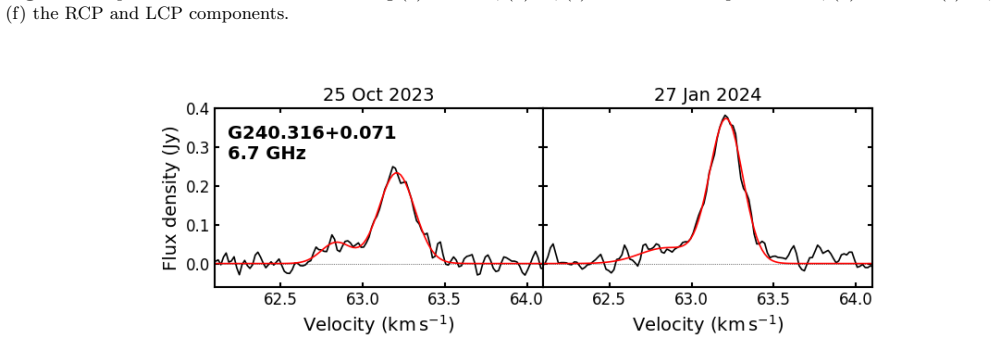
Spectra of 6.7 GHz methanol masers from 21 pointings of known star-forming regions are reported. The C-band observations, using the Green Bank Telescope in full Stokes mode, have measured how polarization properties vary across the maser profiles in each spectrum and vary between different epochs of observation. Two-thirds of the sources are observed to have 6.7 GHz methanol masers, including one new detection (G240.316+0.071). Linear polarization is in the range 0 to 15% and circular polarization 0 to $\pm$9%, in line with previously reported values. The only instances where polarization is not observed is when these polarization ranges are below 3$\sigma$ detection limits. Zeeman splitting is observed in several sources, with splitting values derived from velocity separation between RCP and LCP components via Gaussian fitting. These values are seen to change with time and appear to correspond to changes in the linear and circular polarization. The polarization properties varying across the spectra and changing with time are most likely due to variations in the magnetic fields.
Editorial analysis
A structured set of objections, weighed in public.
Referee Report
Summary. The manuscript reports Green Bank Telescope C-band full-Stokes observations of 6.7 GHz methanol masers toward 21 pointings in star-forming regions. Spectra are presented for the two-thirds of sources with detections (including the new source G240.316+0.071). Linear polarization fractions range from 0 to 15% and circular from 0 to ±9%, consistent with prior work. Zeeman splitting is measured via Gaussian fits to the velocity separation between RCP and LCP components; these fitted splittings are reported to change between epochs and to correspond with changes in linear and circular polarization percentages. The authors conclude that the polarization properties varying across the spectra and with time are most likely due to variations in the magnetic fields.
Significance. If the time variations in fitted Zeeman splitting and polarization are shown to be intrinsic to the magnetic field rather than arising from source variability or propagation effects, the work would add useful multi-epoch constraints on magnetic-field dynamics in high-mass star-forming regions. The direct telescope measurements, Gaussian fitting for splitting values, and reporting of ranges consistent with earlier studies are clear strengths of the observational dataset.
major comments (2)
- [Abstract] Abstract: The central claim that observed time variations in Zeeman splitting (derived from RCP-LCP velocity separation via Gaussian fitting) and corresponding polarization changes are most likely due to intrinsic magnetic-field variations is not supported by any explicit test that rules out differential intensity variability among multiple unresolved maser spots within the single-dish GBT beam. Because the beam sums emission from all spots, evolution in the relative amplitudes of distinct spectral components can shift the composite profile and the fitted splitting even if the local B-field at each spot remains constant.
- [Abstract] Abstract and methods description: No details are provided on baseline subtraction procedures, the full error budget on the Gaussian-fitted splitting values, or the stability of individual velocity components across epochs. Without these, the statistical significance of the reported time changes cannot be assessed and the interpretation remains vulnerable to the alternative explanation of source variability.
minor comments (1)
- [Abstract] Consider adding a table of fitted parameters (velocity, width, amplitude, polarization fraction, and splitting) for each epoch and source to allow readers to evaluate the time variations directly.
Simulated Author's Rebuttal
We thank the referee for the careful and constructive review of our manuscript. We address each major comment below and indicate the revisions planned for the next version.
read point-by-point responses
-
Referee: [Abstract] Abstract: The central claim that observed time variations in Zeeman splitting (derived from RCP-LCP velocity separation via Gaussian fitting) and corresponding polarization changes are most likely due to intrinsic magnetic-field variations is not supported by any explicit test that rules out differential intensity variability among multiple unresolved maser spots within the single-dish GBT beam. Because the beam sums emission from all spots, evolution in the relative amplitudes of distinct spectral components can shift the composite profile and the fitted splitting even if the local B-field at each spot remains constant.
Authors: We agree that the large GBT beam encompasses multiple unresolved maser spots and that differential intensity variability among them could in principle alter the composite line profile and the fitted RCP-LCP separation without any change in the local magnetic field. Our current dataset does not include an explicit test (such as multi-component modeling or comparison with higher-resolution data) that rules out this alternative. In the revised manuscript we will add a dedicated paragraph in the discussion section that explicitly presents this possibility, qualifies the interpretation of the time variations, and notes that interferometric follow-up would be required to distinguish between intrinsic B-field changes and source-structure variability. revision: partial
-
Referee: [Abstract] Abstract and methods description: No details are provided on baseline subtraction procedures, the full error budget on the Gaussian-fitted splitting values, or the stability of individual velocity components across epochs. Without these, the statistical significance of the reported time changes cannot be assessed and the interpretation remains vulnerable to the alternative explanation of source variability.
Authors: We accept that the original manuscript omitted these methodological details. In the revised version we will expand the methods section to describe the baseline subtraction procedure, report the full error budget on the Gaussian fits (including formal fitting uncertainties and any additional systematic contributions), and include a quantitative comparison of the velocity centroids and widths of the main components between epochs to demonstrate their stability. revision: yes
Circularity Check
Direct observational report with no circular derivation chain
full rationale
The paper is a report of GBT full-Stokes spectra for 6.7 GHz methanol masers. It measures linear and circular polarization percentages directly from the data and derives Zeeman splitting values from velocity separations obtained via Gaussian fitting to RCP and LCP components. Temporal changes are noted and interpreted as most likely due to magnetic field variations. No equations, fitted parameters renamed as predictions, or self-citations are used to derive the central claim; the attribution remains an interpretive statement grounded in the reported observations rather than reducing to a self-referential definition or load-bearing prior result by the same authors. The work is self-contained as an empirical description against external benchmarks of single-dish maser polarimetry.
Axiom & Free-Parameter Ledger
axioms (1)
- domain assumption Velocity separation between RCP and LCP components corresponds to Zeeman splitting induced by magnetic fields in the maser region.
Lean theorems connected to this paper
-
IndisputableMonolith/Cost/FunctionalEquation.leanwashburn_uniqueness_aczel unclear?
unclearRelation between the paper passage and the cited Recognition theorem.
Zeeman splitting is observed in several sources, with splitting values derived from velocity separation between RCP and LCP components via Gaussian fitting. These values are seen to change with time and appear to correspond to changes in the linear and circular polarization.
-
IndisputableMonolith/Foundation/RealityFromDistinction.leanreality_from_one_distinction unclear?
unclearRelation between the paper passage and the cited Recognition theorem.
The polarization properties varying across the spectra and changing with time are most likely due to variations in the magnetic fields.
What do these tags mean?
- matches
- The paper's claim is directly supported by a theorem in the formal canon.
- supports
- The theorem supports part of the paper's argument, but the paper may add assumptions or extra steps.
- extends
- The paper goes beyond the formal theorem; the theorem is a base layer rather than the whole result.
- uses
- The paper appears to rely on the theorem as machinery.
- contradicts
- The paper's claim conflicts with a theorem or certificate in the canon.
- unclear
- Pith found a possible connection, but the passage is too broad, indirect, or ambiguous to say the theorem truly supports the claim.
Reference graph
Works this paper leans on
-
[1]
Interstellar Hydroxyl Masers in the Galaxy. I. The VLA Survey. , keywords =. doi:10.1086/313406 , adsurl =
-
[2]
, year = 1960, month = jan, volume =
An attempt to detect the galactic magnetic field, using Zeeman splitting of the hydrogen line. , year = 1960, month = jan, volume =. doi:10.1093/mnras/120.2.187 , adsurl =
-
[3]
New detections of excited OH masers at 5-cm wavelength. , keywords =. doi:10.1093/mnras/269.1.L11 , adsurl =
-
[4]
The Zeeman effect in 21 centimeter line radiation - Methods and initial results. , keywords =. doi:10.1086/159544 , adsurl =
- [5]
-
[6]
Excited-state OH masers at 6.035 GHz. , keywords =. doi:10.1093/mnras/273.2.328 , adsurl =
-
[7]
Galactic Radio Astronomy , year = 1974, editor =
Magnetic Fields in OH Maser Clouds. Galactic Radio Astronomy , year = 1974, editor =
work page 1974
-
[8]
Polarisation properties of methanol masers. , keywords =. doi:10.1051/0004-6361/202039149 , archivePrefix =. 2010.04737 , primaryClass =
-
[9]
, year = 1974, month = jul, volume =
Formaldehyde Line Emission at 4.8 GHz Near NGC 7538. , year = 1974, month = jul, volume =. doi:10.1086/181553 , adsurl =
- [10]
-
[11]
Inverse MultiView. II. Microarcsecond Trigonometric Parallaxes for Southern Hemisphere 6.7 GHz Methanol Masers G232.62+00.99 and G323.74-00.26. , keywords =. doi:10.3847/1538-4357/acdbc5 , archivePrefix =. 2212.03555 , primaryClass =
-
[12]
A search for the favored hyperfine transition of a 6.7 GHz methanol maser line. , keywords =. doi:10.1051/0004-6361/202555576 , archivePrefix =. 2508.14529 , primaryClass =
-
[13]
The Zeeman Effect in Astrophysical Water Masers and the Observation of Strong Magnetic Fields in Regions of Star Formation. , keywords =. doi:10.1086/170862 , adsurl =
-
[14]
Frontiers in Astronomy and Space Sciences , keywords =
The Role of Magnetic Fields in Protostellar Outflows and Star Formation. Frontiers in Astronomy and Space Sciences , keywords =. doi:10.3389/fspas.2019.00054 , archivePrefix =. 1912.05605 , primaryClass =
-
[15]
The Measurement of Polarization in Radio Astronomy. The WSPC Handbook of Astronomical Instrumentation, Volume 1: Radio Astronomical Instrumentation , year = 2021, editor =. doi:10.1142/9789811203770_0006 , adsurl =
-
[16]
Velocity and magnetic fields within 1000 AU from a massive YSO
Velocity and magnetic fields within 1000 AU of a massive YSO. , keywords =. doi:10.1051/0004-6361/201526806 , archivePrefix =. 1509.05428 , primaryClass =
work page internal anchor Pith review Pith/arXiv arXiv doi:10.1051/0004-6361/201526806
-
[17]
H _ 2 O masers associated with IRAS sources in regions of star formation. , keywords =
-
[18]
Circular Polarization of Circumstellar Water Masers around S Per
Circular polarization of circumstellar water masers around S Per. , keywords =. doi:10.1051/0004-6361:20010890 , archivePrefix =. astro-ph/0107070 , primaryClass =
work page internal anchor Pith review Pith/arXiv arXiv doi:10.1051/0004-6361:20010890
-
[19]
The Discovery of a New, Very Strong, and Widespread Interstellar Methanol Maser Line. , keywords =. doi:10.1086/186177 , adsurl =
-
[20]
Detection of 5 1-6 0 A+ -methanol masers towards southern galactic OH masers. , keywords =. doi:10.1093/mnras/256.3.519 , adsurl =
-
[21]
Probing the Magnetic Field at Sub-Parsec Radii in the Accretion Disk of NGC 4258
Probing the Magnetic Field at Subparsec Radii in the Accretion Disk of NGC 4258. , keywords =. doi:10.1086/429559 , archivePrefix =. astro-ph/0502240 , primaryClass =
work page internal anchor Pith review Pith/arXiv arXiv doi:10.1086/429559
-
[22]
IRAS sources beyond the solar circle. III. Observations of H2O, OH, CH3OH and CO. , keywords =
-
[23]
Classification and statistical properties of galactic H2O masers. , keywords =
-
[24]
Galactic methanol masers at 6.6 GHz. , keywords =. doi:10.1093/mnras/272.1.96 , adsurl =
-
[25]
Precise Laboratory Measurements of Methanol Rotational Transition Frequencies in the 5 to 13 GHz Region. , keywords =. doi:10.1086/175095 , adsurl =
-
[26]
Coincidence of maser emission from OH at 6.035 GHz and methanol at 6.668 GHz. , keywords =. doi:10.1093/mnras/289.1.203 , adsurl =
-
[27]
Observations of methanol masers in NGC7538: probable detection of a circumstellar disc. , keywords =
-
[28]
The Medicina survey of methanol masers at 6.7 GHz. , keywords =. doi:10.1051/aas:1999127 , adsurl =
-
[29]
A survey of the 6.7 GHz methanol maser emission from IRAS sources. I. Data. , keywords =. doi:10.1051/aas:2000334 , adsurl =
-
[30]
New detections of OH sources towards the 6.7 GHz methanol masers. , keywords =. doi:10.1051/aas:2000297 , adsurl =
-
[31]
Polarization properties of the 6.7 GHz methanol masers in NGC6334F
Polarization properties of 6.7 GHz methanol masers in NGC6334F. Cosmic Masers: From Proto-Stars to Black Holes , year = 2002, editor =. doi:10.48550/arXiv.astro-ph/0110127 , archivePrefix =. astro-ph/0110127 , primaryClass =
work page internal anchor Pith review Pith/arXiv arXiv doi:10.48550/arxiv.astro-ph/0110127 2002
-
[32]
A near-infrared study of the NGC 7538 star forming region
A Near-Infrared Study of the NGC 7538 Star-forming Region. , keywords =. doi:10.1086/425068 , archivePrefix =. astro-ph/0408219 , primaryClass =
work page internal anchor Pith review Pith/arXiv arXiv doi:10.1086/425068
-
[33]
A general catalogue of 6.7-GHz methanol masers. I. Data. , keywords =. doi:10.1051/0004-6361:20035855 , archivePrefix =. astro-ph/0411564 , primaryClass =
work page internal anchor Pith review Pith/arXiv arXiv doi:10.1051/0004-6361:20035855
-
[34]
2006, MNRAS, 366, 575, doi: 10.1111/j.1365-2966.2005.09884.x
The association of OH and methanol masers in W3(OH). , keywords =. doi:10.1111/j.1365-2966.2005.09130.x , adsurl =
-
[35]
The Magnetic Field in the Star-forming Region Cepheus A from Water Maser Polarization Observations
The magnetic field in the star-forming region Cepheus A. from H _ 2 O maser polarization observations. , keywords =. doi:10.1051/0004-6361:20054275 , archivePrefix =. astro-ph/0510452 , primaryClass =
work page internal anchor Pith review Pith/arXiv arXiv doi:10.1051/0004-6361:20054275
-
[36]
Locating of massive protostars
Discovery of two new methanol masers in NGC 7538. Locating of massive protostars. , year = 2006, month = mar, volume =. doi:10.1051/0004-6361:200600006 , adsurl =
-
[37]
Methanol maser polarization in W3(OH). , keywords =. doi:10.1111/j.1745-3933.2006.00201.x , archivePrefix =. astro-ph/0606300 , primaryClass =
-
[38]
Hunter, J. D. , Title =. Computing in Science & Engineering , Volume =
-
[39]
2007, MNRAS, 379, 401, doi: 10.1111/j.1365-2966.2007.11752.x —
A MERLIN Study of 6-GHz excited-state OH and 6.7-GHz methanol masers in ON1. , keywords =. doi:10.1111/j.1365-2966.2007.12418.x , archivePrefix =. 0709.0604 , primaryClass =
-
[40]
2007, MNRAS, 379, 401, doi: 10.1111/j.1365-2966.2007.11752.x —
First images of 6.7-GHz methanol masers in DR21(OH) and DR21(OH)N. , keywords =. doi:10.1111/j.1365-2966.2007.12737.x , archivePrefix =. 0711.2783 , primaryClass =
-
[41]
First VLBI observations of methanol maser polarisation, in G339.88-1.2
First VLBI observations of methanol maser polarisation, in G339.88-1.26. , keywords =. doi:10.1051/0004-6361:20078670 , archivePrefix =. 0804.2106 , primaryClass =
work page internal anchor Pith review Pith/arXiv arXiv doi:10.1051/0004-6361:20078670
-
[42]
A new probe of magnetic fields during high-mass star formation. Zeeman splitting of 6.7 GHz methanol masers. , keywords =. doi:10.1051/0004-6361:200809447 , archivePrefix =. 0804.1141 , primaryClass =
work page internal anchor Pith review Pith/arXiv arXiv doi:10.1051/0004-6361:200809447
-
[43]
A high-sensitivity 6.7 GHz methanol maser survey toward H2O sources
A high-sensitivity 6.7 GHz methanol maser survey toward H2O sources. , keywords =. doi:10.1051/0004-6361:200809472 , archivePrefix =. 0803.2232 , primaryClass =
work page internal anchor Pith review Pith/arXiv arXiv doi:10.1051/0004-6361:200809472
-
[44]
Trigonometric Parallaxes of Massive Star-Forming Regions. I. S 252 & G232.6+1.0. , keywords =. doi:10.1088/0004-637X/693/1/397 , archivePrefix =. 0811.0595 , primaryClass =
work page internal anchor Pith review Pith/arXiv arXiv doi:10.1088/0004-637x/693/1/397
-
[45]
Possible magnetic field variability during the 6.7 GHz methanol maser flares of G09.62+0.20
Possible magnetic field variability during the 6.7 GHz methanol maser flares of G09.62+0.20. , keywords =. doi:10.1051/0004-6361/200912298 , archivePrefix =. 0904.4806 , primaryClass =
work page internal anchor Pith review Pith/arXiv arXiv doi:10.1051/0004-6361/200912298
-
[46]
Methanol masers probing the ordered magnetic field of W75N
Methanol masers probing the ordered magnetic field of W75N. , keywords =. doi:10.1051/0004-6361/200912790 , archivePrefix =. 0908.3585 , primaryClass =
work page internal anchor Pith review Pith/arXiv arXiv doi:10.1051/0004-6361/200912790
-
[47]
Precise Positions of Methanol Masers
Precise Positions of Methanol Masers. , keywords =. doi:10.1071/AS09013 , archivePrefix =. 0907.5255 , primaryClass =
work page internal anchor Pith review Pith/arXiv arXiv doi:10.1071/as09013
-
[48]
Young Stars and Protostellar Cores near NGC 2023
Young stars and protostellar cores near NGC 2023. , keywords =. doi:10.1051/0004-6361/200912550 , archivePrefix =. 0909.2614 , primaryClass =
work page internal anchor Pith review Pith/arXiv arXiv doi:10.1051/0004-6361/200912550 2023
-
[49]
Magnetic field regulated infall on the disc around the massive protostar CepheusAHW2. , keywords =. doi:10.1111/j.1365-2966.2010.16297.x , archivePrefix =. 1002.2214 , primaryClass =
-
[50]
The 6-GHz methanol multibeam maser catalogue - I. Galactic Centre region, longitudes 345 to 6. , keywords =. doi:10.1111/j.1365-2966.2010.16339.x , archivePrefix =. 1002.2475 , primaryClass =
-
[51]
Class I and Class II methanol masers in high-mass star forming regions
Class I and Class II methanol masers in high-mass star-forming regions. , keywords =. doi:10.1051/0004-6361/200913679 , archivePrefix =. 1004.3689 , primaryClass =
work page internal anchor Pith review Pith/arXiv arXiv doi:10.1051/0004-6361/200913679
-
[52]
On the uncertainty of magnetic field strength determinations
Zeeman splitting of 6.7 GHz methanol masers. On the uncertainty of magnetic field strength determinations. , keywords =. doi:10.1051/0004-6361/201116648 , adsurl =
-
[53]
2011, MNRAS, 416, 1654, doi: 10.1111/j.1365-2966.2011.19113.x
Magnetic fields from OH maser maps at 6035 and 6030 MHz at Galactic sites 351.417+0.645 and 353.410-0.360. , keywords =. doi:10.1111/j.1365-2966.2011.18510.x , adsurl =
-
[54]
The properties and polarization of the H2O and CH3OH maser environment of NGC7538-IRS1
The properties and polarization of the H _ 2 O and CH _ 3 OH maser environment of NGC 7538-IRS 1. , keywords =. doi:10.1051/0004-6361/201117108 , archivePrefix =. 1107.5313 , primaryClass =
work page internal anchor Pith review Pith/arXiv arXiv doi:10.1051/0004-6361/201117108
-
[55]
Polarisation of Class II Methanol Masers
Polarisation of Class II Methanol Masers. , keywords =. doi:10.1071/AS11029 , archivePrefix =. 1109.2988 , primaryClass =
work page internal anchor Pith review Pith/arXiv arXiv doi:10.1071/as11029
-
[56]
2011, MNRAS, 416, 1654, doi: 10.1111/j.1365-2966.2011.19113.x
The 6-GHz methanol multibeam maser catalogue - IV. Galactic longitudes 186 -330 including the Orion-Monoceros region. , keywords =. doi:10.1111/j.1365-2966.2011.20229.x , archivePrefix =. 1201.0787 , primaryClass =
-
[57]
Probing the magnetic fields of massive star-forming regions with methanol maser polarization. , keywords =. doi:10.1111/j.1365-2966.2012.20472.x , archivePrefix =. 1201.1687 , primaryClass =
-
[58]
EVN observations of 6.7 GHz methanol maser polarization in massive star-forming regions
EVN observations of 6.7 GHz methanol maser polarization in massive star-forming regions. , keywords =. doi:10.1051/0004-6361/201118658 , archivePrefix =. 1203.4566 , primaryClass =
work page internal anchor Pith review Pith/arXiv arXiv doi:10.1051/0004-6361/201118658
-
[59]
Methanol and excited OH masers towards W51 - I. Main and South. , keywords =. doi:10.1111/j.1365-2966.2012.20900.x , archivePrefix =. 1203.2527 , primaryClass =
-
[60]
Astronomische Nachrichten , keywords =
The Torun catalogue of 6.7 GHz methanol masers. Astronomische Nachrichten , keywords =. doi:10.1002/asna.201211702 , adsurl =
-
[61]
GBTIDL: Reduction and Analysis of GBT Spectral Line Data
-
[62]
EVN observations of 6.7 GHz methanol maser polarization in massive star-forming regions. II. First statistical results. , keywords =. doi:10.1051/0004-6361/201321501 , archivePrefix =. 1306.6335 , primaryClass =
work page internal anchor Pith review Pith/arXiv arXiv doi:10.1051/0004-6361/201321501
-
[63]
The magnetic field at milliarcsecond resolution around IRAS20126+4104
The magnetic field at milliarcsecond resolution around <ASTROBJ>IRAS 20126+4104</ASTROBJ>. , keywords =. doi:10.1051/0004-6361/201322795 , archivePrefix =. 1401.7987 , primaryClass =
work page internal anchor Pith review Pith/arXiv arXiv doi:10.1051/0004-6361/201322795
-
[64]
Observations of 6.7 GHz methanol masers with East-Asian VLBI Network. I. VLBI images of the first epoch of observations. , keywords =. doi:10.1093/pasj/psu015 , archivePrefix =. 1311.3431 , primaryClass =
work page internal anchor Pith review Pith/arXiv arXiv doi:10.1093/pasj/psu015
-
[65]
EVN observations of 6.7 GHz methanol maser polarization in massive star-forming regions - III. The flux-limited sample , DOI= "10.1051/0004-6361/201425420", url= "https://doi.org/10.1051/0004-6361/201425420", journal =
-
[66]
Excited-state hydroxyl maser polarimetry: Who ate all the {\pi}s?
Excited-state hydroxyl maser polarimetry: who ate all the s?. , keywords =. doi:10.1093/mnras/stv936 , archivePrefix =. 1504.07062 , primaryClass =
work page internal anchor Pith review Pith/arXiv arXiv doi:10.1093/mnras/stv936
-
[67]
On the Relationship of UC HII Regions and Class II Methanol Masers. I. Source Catalogs. , keywords =. doi:10.3847/0004-637X/833/1/18 , archivePrefix =. 1609.03280 , primaryClass =
work page internal anchor Pith review Pith/arXiv arXiv doi:10.3847/0004-637x/833/1/18
-
[68]
Disk-mediated accretion burst in a high-mass young stellar object
Disk-mediated accretion burst in a high-mass young stellar object. Nature Physics , keywords =. doi:10.1038/nphys3942 , archivePrefix =. 1704.02628 , primaryClass =
work page internal anchor Pith review Pith/arXiv arXiv doi:10.1038/nphys3942
-
[69]
Methanol masers reveal the magnetic field of the high-mass protostar IRAS 18089-1732
Methanol masers reveal the magnetic field of the high-mass protostar IRAS 18089-1732. , keywords =. doi:10.1051/0004-6361/201731297 , archivePrefix =. 1708.02961 , primaryClass =
work page internal anchor Pith review Pith/arXiv arXiv doi:10.1051/0004-6361/201731297
-
[70]
The Extraordinary Outburst in the Massive Protostellar System NGC 6334I-MM1: Emergence of Strong 6.7 GHz Methanol Masers. , keywords =. doi:10.3847/1538-4357/aaa962 , archivePrefix =. 1801.02141 , primaryClass =
work page internal anchor Pith review Pith/arXiv arXiv doi:10.3847/1538-4357/aaa962
-
[71]
Characterization of methanol as a magnetic field tracer in star-forming regions
Characterization of methanol as a magnetic field tracer in star-forming regions. Nature Astronomy , keywords =. doi:10.1038/s41550-017-0341-8 , archivePrefix =. 1802.05764 , primaryClass =
work page internal anchor Pith review Pith/arXiv arXiv doi:10.1038/s41550-017-0341-8
-
[72]
A Masing Event in NGC6334I: Contemporaneous Flaring of Hydroxyl, Methanol and Water Masers
A masing event in NGC 6334I: contemporaneous flaring of hydroxyl, methanol, and water masers. , keywords =. doi:10.1093/mnras/sty996 , archivePrefix =. 1804.05308 , primaryClass =
work page internal anchor Pith review Pith/arXiv arXiv doi:10.1093/mnras/sty996
-
[73]
Discovery of H _ 2 O, CH _ 3 OH, and OH Masers in the Extreme Outer Galaxy. , keywords =. doi:10.3847/1538-4357/aaee86 , adsurl =
-
[74]
EVN observations of 6.7 GHz methanol maser polarization in massive star-forming regions. IV. Magnetic field strength limits and structure for seven additional sources. , keywords =. doi:10.1051/0004-6361/201834578 , archivePrefix =. 1902.08210 , primaryClass =
work page internal anchor Pith review Pith/arXiv arXiv doi:10.1051/0004-6361/201834578 1902
-
[75]
Discovery of Six New Class II Methanol Maser Transitions, Including the Unambiguous Detection of Three Torsionally Excited Lines toward G 358.931-0.030. , keywords =. doi:10.3847/2041-8213/ab191c , archivePrefix =. 1904.06853 , primaryClass =
work page internal anchor Pith review Pith/arXiv arXiv doi:10.3847/2041-8213/ab191c 2041
-
[76]
C. L. Brogan and T. R. Hunter and A. P. M. Towner and B. A. McGuire and G. C. MacLeod and M. A. Gurwell and C. J. Cyganowski and J. Brand and R. A. Burns and A. Caratti o Garatti and X. Chen and J. O. Chibueze and N. Hirano and T. Hirota and K.-T. Kim and B. H. Kramer and H. Linz and K. M. Menten and A. Remijan and A. Sanna and A. M. Sobolev and T. K. Sri...
-
[77]
Nature Astronomy , year = 2020, month =
A heatwave of accretion energy traced by masers in the G358-MM1 high-mass protostar. Nature Astronomy , year = 2020, month =. doi:10.1038/s41550-019-0989-3 , adsurl =
-
[78]
New ex-OH maser detections in the northern celestial hemisphere. , keywords =. doi:10.1051/0004-6361/202037623 , archivePrefix =. 2106.11585 , primaryClass =
-
[79]
GBT Memo 306: Frequency-switching and position-switching GBTIDL analysis code used for determining Stokes and polarization parameters
-
[80]
EVN observations of 6.7 GHz methanol maser polarization in massive star-forming regions. V. Completion of the flux-limited sample. , keywords =. doi:10.1051/0004-6361/202142125 , archivePrefix =. 2111.08023 , primaryClass =
discussion (0)
Sign in with ORCID, Apple, or X to comment. Anyone can read and Pith papers without signing in.