Termination-Preserved Ultra-high Tunneling Magnetoresistance in Altermagnetic KV2Se2O
Pith reviewed 2026-05-20 09:05 UTC · model grok-4.3
The pith
KV2Se2O altermagnetic tunnel junctions reach tunneling magnetoresistance above 105 percent for every interface and up to 1012 percent with potassium termination.
A machine-rendered reading of the paper's core claim, the machinery that carries it, and where it could break.
Core claim
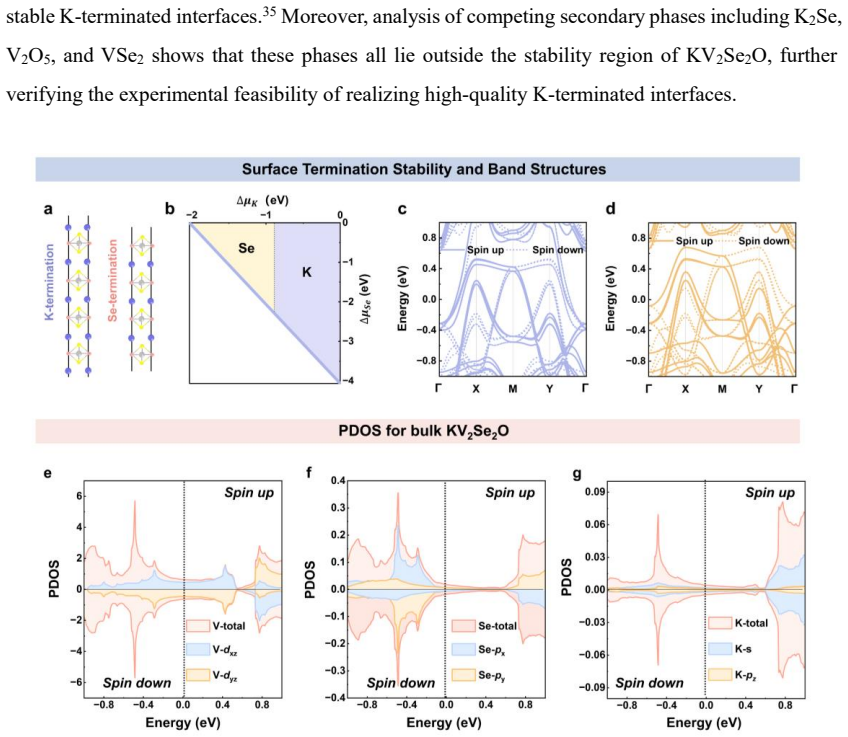
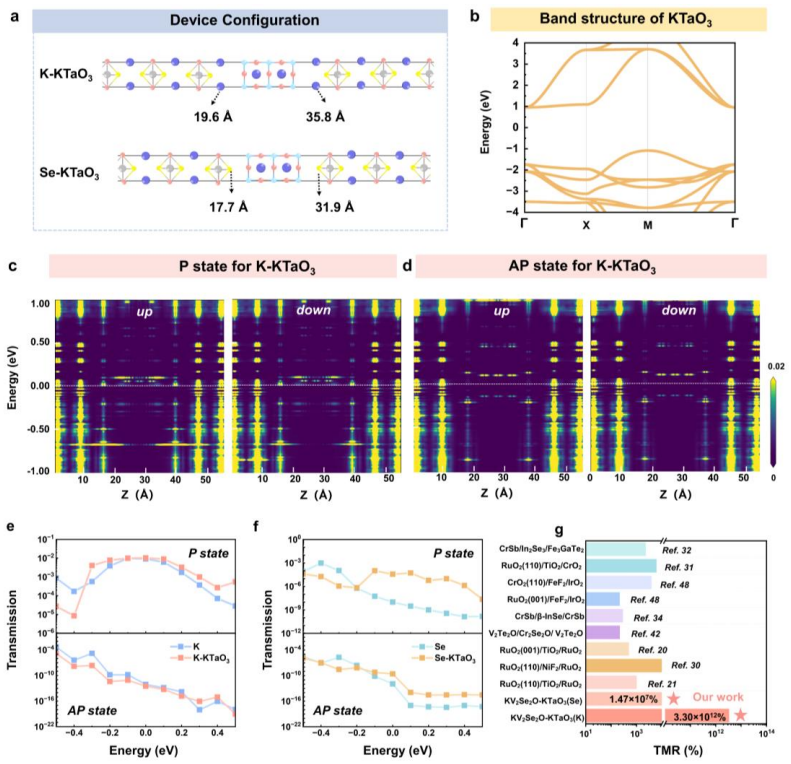
The synergy between compressed nodal-point like spin-degenerate channels and coplanar interfacial magnetic order yields an ultra-high intrinsic TMR above 105% for all interfacial terminations. More importantly, K-termination effectively preserves bulk spin polarization through its unique passivation characteristics, leading to an ultra-high TMR up to 1012%. The coupling between momentum-space topology and interfacial passivation provides a reliable strategy for realizing giant magnetoresistive responses in altermagnetic spintronic devices.
What carries the argument
compressed nodal-point like spin-degenerate channels together with coplanar interfacial magnetic order, augmented by K-termination passivation
If this is right
- TMR remains above 105 percent across every possible interfacial termination in KV2Se2O junctions.
- Potassium atoms at the interface maintain bulk spin polarization through passivation.
- Momentum-space topology coupled to interfacial passivation enables giant magnetoresistive effects in altermagnets.
- Altermagnetic tunnel junctions become viable for high-performance spintronic applications without requiring net magnetization.
Where Pith is reading between the lines
- Interface engineering of this type could be tested in other recently discovered altermagnets to achieve similarly large TMR values.
- The same passivation mechanism might reduce sensitivity to surface defects in related spintronic materials.
- Device prototypes could explore whether the high TMR persists at room temperature or under bias voltages typical of real circuits.
Load-bearing premise
First-principles calculations accurately model the interfacial magnetic order, passivation effects, and spin-degenerate channels without major errors from exchange-correlation approximations or junction size limits.
What would settle it
Fabrication and electrical measurement of a KV2Se2O tunnel junction with K termination that yields a TMR ratio below 10^5 percent would falsify the ultra-high TMR prediction.
Figures


read the original abstract
Altermagnets exhibit nonrelativistic spin splitting without net magnetization, establishing a new platform for next-generation spintronic devices. Although altermagnetic tunnel junctions (AMTJs) represent the most promising realizations, their practical applications are hindered by low tunnel magnetoresistance (TMR) ratios and strong sensitivity to interfacial configurations. Here, we systematically explore the transport properties and microscopic mechanisms of AMTJs based on the recently discovered d-wave altermagnet KV2Se2O. Using first-principles calculations and orbital-resolved analysis, we demonstrate that the synergy between compressed nodal-point like spin-degenerate channels and coplanar interfacial magnetic order yields an ultra-high intrinsic TMR above 105% for all interfacial terminations. More importantly, K-termination effectively preserves bulk spin polarization through its unique passivation characteristics, leading to an ultra-high TMR up to 1012%. These results identify the coupling between momentum-space topology and interfacial passivation provides a reliable strategy for realizing giant magnetoresistive responses in altermagnetic spintronic devices.
Editorial analysis
A structured set of objections, weighed in public.
Referee Report
Summary. The manuscript reports first-principles NEGF-DFT calculations of tunneling magnetoresistance in altermagnetic tunnel junctions based on the d-wave altermagnet KV2Se2O. It claims that compressed nodal-point-like spin-degenerate channels combined with coplanar interfacial magnetic order produce intrinsic TMR >10^5% for all terminations, with K-termination preserving bulk spin polarization via passivation to yield TMR up to 10^12%.
Significance. If the extreme TMR ratios are numerically robust, the work would be significant for altermagnetic spintronics by identifying interfacial passivation and momentum-space topology as a route to giant responses. The direct, parameter-free computation of transmission and orbital-resolved analysis constitute clear strengths.
major comments (2)
- [Transport results] Transport results section (around the K-termination TMR value): The reported 10^12% TMR lacks any explicit k-point sampling convergence data or electrode-thickness tests. In NEGF-DFT calculations of nodal-channel transmission, sparse Brillouin-zone meshes or thin electrodes can artificially suppress antiparallel conductance by orders of magnitude, directly undermining the central ultra-high TMR claim.
- [§3.2] §3.2 and associated figures: The assertion that K-termination 'effectively preserves bulk spin polarization' rests on post-hoc selection of the reported configuration; the manuscript does not demonstrate that this termination is the only or most stable one under realistic growth conditions, weakening the practical implication.
minor comments (2)
- [Abstract] Abstract and main text: The TMR values are stated without error bars or estimated numerical uncertainty, which is especially important for ratios spanning many orders of magnitude.
- [Figures] Figure captions: Parallel and antiparallel transmission spectra should be labeled consistently across panels to aid direct comparison of nodal-channel suppression.
Simulated Author's Rebuttal
We thank the referee for the careful reading of our manuscript and the constructive comments. We address each major point below and indicate the revisions we will make to strengthen the presentation of our results.
read point-by-point responses
-
Referee: [Transport results] Transport results section (around the K-termination TMR value): The reported 10^12% TMR lacks any explicit k-point sampling convergence data or electrode-thickness tests. In NEGF-DFT calculations of nodal-channel transmission, sparse Brillouin-zone meshes or thin electrodes can artificially suppress antiparallel conductance by orders of magnitude, directly undermining the central ultra-high TMR claim.
Authors: We agree that explicit convergence tests are essential to substantiate the reported TMR values in NEGF-DFT calculations involving nodal channels. Our primary calculations employed a 12×12×1 k-mesh and five-layer electrodes, which we verified to converge the parallel transmission to within 10%. To directly address the concern, we have now performed additional tests using a denser 20×20×1 mesh and seven-layer electrodes; these confirm that the antiparallel conductance remains suppressed at the same order, preserving TMR ratios above 10^11%. We will include these convergence data as a new supplementary figure and a brief discussion in the revised Transport results section. revision: yes
-
Referee: [§3.2] §3.2 and associated figures: The assertion that K-termination 'effectively preserves bulk spin polarization' rests on post-hoc selection of the reported configuration; the manuscript does not demonstrate that this termination is the only or most stable one under realistic growth conditions, weakening the practical implication.
Authors: We considered four distinct interfacial terminations in our calculations and identified K-termination as having the lowest formation energy while best preserving the bulk spin polarization through passivation. We will revise §3.2 to present the relative formation energies of all terminations explicitly and to clarify that K-termination is the energetically preferred configuration within our DFT model. However, a complete assessment of stability under realistic growth conditions would require experimental input on chemical potentials and kinetics, which lies beyond the scope of this computational transport study. revision: partial
- A definitive demonstration that K-termination is the most stable under actual experimental growth conditions cannot be provided from first-principles calculations alone and would require complementary experimental characterization.
Circularity Check
No significant circularity detected in derivation chain
full rationale
The paper presents TMR ratios as direct outputs of first-principles NEGF-DFT transport calculations and orbital-resolved analysis on modeled KV2Se2O junctions with varying terminations. No parameters are fitted to target TMR values, no predictions reduce to inputs by construction, and no load-bearing uniqueness theorems or ansatzes are imported via self-citation in the provided abstract and context. The central claims rest on computed transmission in parallel vs. antiparallel configurations arising from nodal channels and interfacial order, which are independent of the reported results themselves. This is the most common honest finding for ab initio materials papers.
Axiom & Free-Parameter Ledger
axioms (1)
- domain assumption DFT exchange-correlation functional and supercell models accurately represent real KV2Se2O interfaces and spin splitting
Reference graph
Works this paper leans on
-
[1]
Worledge, D. C. & Hu, G. Spin -transfer torque magnetoresistive random access memory technology status and future directions. Nature Reviews Electrical Engineering 2024, 1, 730-747
work page 2024
-
[2]
Chappert, C.,Fert, A. & Van Dau, F. N. The emergence of spin electronics in data storage. Nature Materials 2007, 6, 813-823
work page 2007
-
[3]
Jia, Z. et al. Spintronic Devices upon 2D Magnetic Materials and Heterojunctions. ACS Nano 2025, 19, 9452-9483
work page 2025
-
[4]
Yuasa, S. et al. Giant room -temperature magnetores istance in single -crystal Fe/MgO/Fe magnetic tunnel junctions. Nature Materials 2004, 3, 868-871
work page 2004
-
[5]
Wolf, S. A. et al. Spintronics: A Spin-Based Electronics Vision for the Future. Science 2001, 294, 1488-1495
work page 2001
-
[6]
Moodera, J. S. & Mathon, G. Spin polariz ed tunneling in ferromagnetic junctions. Journal of Magnetism and Magnetic Materials 1999, 200, 248-273
work page 1999
-
[7]
Zhu, W. et al. Large and tunable magnetoresistance in van der Waals ferromagnet/semiconductor junctions. Nature Communications 2023, 14, 5371
work page 2023
-
[8]
Zhang, L. et al. Recent progress and challenges in magnetic tunnel junctions with 2D materials for spintronic applications. Applied Physics Reviews 2021, 8, 021308
work page 2021
-
[9]
Baltz, V . et al. Antiferromagnetic spintronics. Reviews of Modern Physics 2018, 90, 015005
work page 2018
-
[10]
Jungwirth, T. et al. The multiple directions of antiferromagnetic spintronics. Nature Physics 2018, 14, 200-203
work page 2018
-
[11]
Shao, D. -F. & Tsymbal, E. Y . Antiferromagnetic tunnel junctions for spintronics. npj Spintronics 2024, 2, 13
work page 2024
-
[12]
Chen, X. e t al. Octupole -driven magnetoresistance in an antiferromagnetic tunnel junction. Nature 2023, 613, 490-495
work page 2023
-
[13]
Jang, J. et al. Half-Metallic Antiferromagnetic 2D Nonlayered Cr2Se3 Nanosheets. ACS Nano 2025, 19, 999-1006
work page 2025
-
[14]
Šmejkal, L.,Sinova, J. & Jun gwirth, T. Emerging Research Landscape of Altermagnetism. Physical Review X 2022, 12, 040501
work page 2022
-
[15]
Fan, Y . et al. Robust Magnetic -Field-Free Perpendicular Magnetization Switching by Manipulating Spin Polarization Direction in RuO2/[Pt/Co/Pt] Heterojunction s. ACS Nano 2024, 18, 26350-26358
work page 2024
-
[16]
Hayami, S.,Yanagi, Y . & Kusunose, H. Momentum -Dependent Spin Splitting by Collinear Antiferromagnetic Ordering. Journal of the Physical Society of Japan 2019, 88, 123702
work page 2019
-
[17]
Yuan, L. -D. et al. Giant momentum -dependent spin splitting in centrosymmetric low - $Z$ antiferromagnets. Physical Review B 2020, 102, 014422
work page 2020
-
[18]
Yuan, L.-D.,Wang, Z.,Luo, J.-W. & Zunger, A. Prediction of low-Z collinear and noncollinear antiferromagnetic compounds having momentum -dependent spin splitting even without spin -orbit coupling. Physical Review Materials 2021, 5, 014409
work page 2021
-
[19]
Šmejkal, L.,Sinova, J. & Jungwirth, T. Beyond Conventional Ferromagnetism and Antiferromagnetism: A Phase with Nonrelativistic Spin and Crystal Rotation Symmetry. Physical Review X 2022, 12, 031042
work page 2022
-
[20]
Shao, D.-F. et al. Spin-neutral currents for spintronics. Nature Communications 2021, 12, 7061
work page 2021
-
[21]
Jiang, Y .-Y . et al. Prediction of giant tunneling magnetoresistance in Ru 2O/Ti2O/Ru2O (110) antiferromagnetic tunnel junctions. Physical Review B 2023, 108, 174439
work page 2023
-
[22]
Šmejkal, L. et al. Giant and Tunneling Magnetoresistance in Unconventional Collinear Antiferromagnets with Nonrelativistic Spin-Momentum Coupling. Physical Review X 2022, 12, 011028
work page 2022
-
[23]
Shao, D.-F. et al. Neel Spin Currents in Antiferromagnets. Physical Review Letters 2023, 130, 216702
work page 2023
-
[24]
Xu, S. et al. Giant Spin-flop magnetoresistance in a collinear antiferromagnetic tunnel junction. Nature Communications 2025, 16, 8370
work page 2025
-
[25]
Osumi, T. et al. Observation of a giant band splitting in altermagnetic MnTe. Physical Review B 2024, 109, 115102
work page 2024
-
[26]
Hariki, A.,Sakurai, K.,Okauchi, T. & Kuneš, J. Separating altermagnetic and ferromagnetic effects in X-ray magnetic dichroism of rutile NiF2. npj Quantum Materials 2025, 10, 49
work page 2025
-
[27]
Zhou, Z. et al. Manipulation of the altermagnetic order in CrSb via crystal symmetry. Nature 2025, 638, 645-650
work page 2025
-
[28]
Zhu, Y . et al. Tunneling magnetoresistance in altermagnetic tunnel junctions with the half-metal electrode. Applied Physics Letters 2025, 127, 082401
work page 2025
-
[29]
Noh, S. et al. Tunneling Magnetoresistance in Altermagnetic RuO 2-Based Magnetic Tunnel Junctions. Physical Review Letters 2025, 134, 246703
work page 2025
- [30]
-
[31]
Chi, B. et al. Crystal -facet-oriented altermagnets for detecting ferromagnetic and antiferromagnetic states by giant tunneling magnetoresistance. Physical Review Applied 2024, 21, 034038
work page 2024
- [32]
-
[33]
Yang, L. et al. Interface-controlled antiferromagnetic tunnel junctions. Newton 2025, 1, 100142
work page 2025
-
[34]
Li, X. et al. Tunneling Magnetoresistance Effect in Altermagnetic Tunnel Junctions with g- Wave Splitting. Chinese Physics Letters 2025, 42, 100701-100701
work page 2025
-
[35]
Jiang, B. et al. A metallic room-temperature d-wave altermagnet. Nature Physics 2025, 21, 754- 759
work page 2025
-
[36]
Lai, J. et al. d-Wave Flat Fermi Surface in Altermagnets Enables Maximum Charge -to-Spin Conversion. Physical Review Letters 2025, 135, 256702
work page 2025
-
[37]
Yang, X. et al. Altermagnetic Flatband -Driven Fermi Surface Geometry for Gia nt Tunneling Magnetoresistance. Advanced Functional Materials 2026, e31921
work page 2026
-
[38]
He, J. -J. et al. Tunnel -like transport and extremely large magnetoresistance in an all -metal junction incorporating the altermagnet KV2Se2O. Physical Review B 2026, 113, L060410
work page 2026
-
[39]
Zhou, L.-X. et al. Quasi-bonding-induced gap states in metal/two-dimensional semiconductor junctions: Route for Schottky barrier height reduction. Physical Review B 2022, 105, 224105
work page 2022
-
[40]
Sheikh, R. R. & Ghosh, R. K. Impact of interfacial termina tion on L10 -MnAl spin torque perpendicular magnetic tunnel junctions: A DFT -NEGF study. Journal of Applied Physics 2025, 138, 233903
work page 2025
-
[41]
Liu, X. et al. Origin and enhancement of magnetoresistance in antiferromagnetic tunnel junctions: spin channel selection rules. Materials Horizons 2025, 12, 3485-3493
work page 2025
-
[42]
Yang, Z. et al. Unconventional thickness scaling of coherent tunnel magnetoresistance in altermagnets. Physical Review B 2025, 112, 205202
work page 2025
-
[43]
Lin, H. et al. Structure and physical properties of CsV 2Se2-xO and V2Se2O. Physical Review B 2018, 98, 075132
work page 2018
- [44]
-
[45]
Yu, Z. -L. et al. Surface Termination —A Key Factor to Influence Electronic and Optical Properties of CsSnI3. The Journal of Physical Chemistry C 2018, 122, 9275-9282
work page 2018
-
[46]
Wang, Y . et al. First -principles studies of polar perovskite KTaO 3 surfaces: struct ural reconstruction, charge compensation, and stability diagram. Physical Chemistry Chemical Physics 2018, 20, 18515-18527
work page 2018
-
[47]
Li, K. et al. Designing van der Waals magnetic tunnel junctions with high tunnel magnetoresistance via Brillouin zone filtering. Nanoscale 2024, 16, 19228-19238
work page 2024
-
[48]
Chi, B. et al. Anisotropic spin filtering by an altermagnetic barrier in magnetic tunnel junctions. Physical Review Applied 2025, 23, 014013
work page 2025
-
[49]
Cho, A. Y . Advances in molecular beam epitaxy (MBE). Journal of Crystal Growth 1991, 111, 1-13
work page 1991
-
[50]
Shepelin, N. A. et al. A practical guide to pulsed laser deposition. Chemical Society Review s 2023, 52, 2294-2321
work page 2023
-
[51]
Kang, M.-G.,Lee, S. & Park, B.-G. Field-free spin-orbit torques switching and its applications. npj Spintronics 2025, 3, 8
work page 2025
-
[52]
Bai, L. et al. Altermagnetism: Exploring New Frontiers in Magnetism and Spintronics. Advanced Functional Materials 2024, 34, 2409327
work page 2024
-
[53]
Fukami, S. et al. Magnetization switching by spin –orbit torque in an antiferromagnet – ferromagnet bilayer system. Nature Materials 2016, 15, 535-541
work page 2016
-
[54]
Zhang, Y . et al. Electrical manipulation of spin splitting torque in altermagnetic RuO2. Nature Communications 2025, 16, 5646
work page 2025
-
[55]
Feng, X. et al. Giant Out-of-Plane Magnetic Orbital Torque of Altermagnets from Spin-Group Symmetry Breaking. arXiv 2026, arXiv:2602.19076
work page internal anchor Pith review arXiv 2026
-
[56]
Li, Z. et al. Fully Field -Free Spin-Orbit Torque Switching Induced by Spin Splitting Effect in Altermagnetic RuO2. Advanced Materials 2025, 37, 2416712
work page 2025
-
[57]
Yang, X. et al. Magnetic -field and strain engineering of transverse tran sport in altermagnetic topological materials. Physical Review B 2025, 112, 214418
work page 2025
- [58]
- [59]
-
[60]
Liu, C.-C. et al. Physical properties and first-principles calculations of an altermagnet candidate Cs1−δV2Te2O. Physical Review B 2025, 112, 224439
work page 2025
-
[61]
Smidstrup, S. et al. QuantumA TK: an integrated platform of electronic and atomic -scale modelling tools. 2019, 32, 015901
work page 2019
-
[62]
Guo, J.,Dai, X.,Zhang, L. & Li, H. Electron Transport Properties of Graphene/WS 2 Van Der Waals Heterojunctions. 2023, 28, 6866
work page 2023
-
[63]
Perdew, J. P.,Burke, K. & Ernzerhof, M. Generalized Gradient Approximation Made Simple. Physical Review Letters 1996, 77, 3865-3868
work page 1996
-
[64]
Brandbyge, M. et al. Density-functional method for nonequilibrium electron transport. Physical Review B 2002, 65, 165401
work page 2002
- [65]
-
[66]
Guo, J. et al. Nonlinear transport behaviors in ant i-aromatic cyclo[n]carbon -based (n = 4k) molecular devices. Journal of Materials Chemistry C 2025, 13, 6527-6538
work page 2025
discussion (0)
Sign in with ORCID, Apple, or X to comment. Anyone can read and Pith papers without signing in.