Collective charge measurement in quantum dot chains: controlling barrier occupation and tunneling current
Pith reviewed 2026-05-20 08:05 UTC · model grok-4.3
The pith
Global measurement by a quantum point contact coupled to all dots in a triple quantum dot system improves barrier occupation and tunneling current compared to local measurement.
A machine-rendered reading of the paper's core claim, the machinery that carries it, and where it could break.
Core claim
In a triple-quantum-dot system the central dot acts as a discrete tunnel barrier. When a quantum point contact is capacitively coupled to all three dots with independently tunable strengths, the resulting structured dephasing raises the steady-state occupation of the barrier dot and increases the tunneling current. In the strong-measurement limit the steady state becomes independent of the Hamiltonian parameters and the barrier occupation can approach one half for suitable configurations.
What carries the argument
Structured dephasing induced by global capacitive coupling of a quantum point contact to all three dots with independently tunable strengths.
If this is right
- The steady state becomes independent of Hamiltonian parameters in the strong-measurement limit.
- Barrier occupation can approach one half for suitable measurement configurations.
- An optimal configuration of the three coupling strengths maximizes the steady-state current.
- Near-optimal current is obtained even with a simple central-dot readout scheme.
- Global measurement changes transport qualitatively compared with single-site measurement.
Where Pith is reading between the lines
- The same global-monitoring idea could be tested in longer chains to control multiple barriers at once.
- Independence from Hamiltonian details would make the effect robust against small fabrication variations in real devices.
- Measurement-induced dephasing might be tuned to optimize current in other multi-site quantum transport setups.
Load-bearing premise
The model assumes that the quantum point contact induces purely dephasing effects through capacitive couplings with independently tunable strengths to each dot, without additional unwanted backaction or decoherence channels.
What would settle it
Measure the steady-state tunneling current while increasing the quantum point contact coupling strength; check whether the current saturates to a value independent of the dot energy levels and tunneling rates.
Figures




read the original abstract
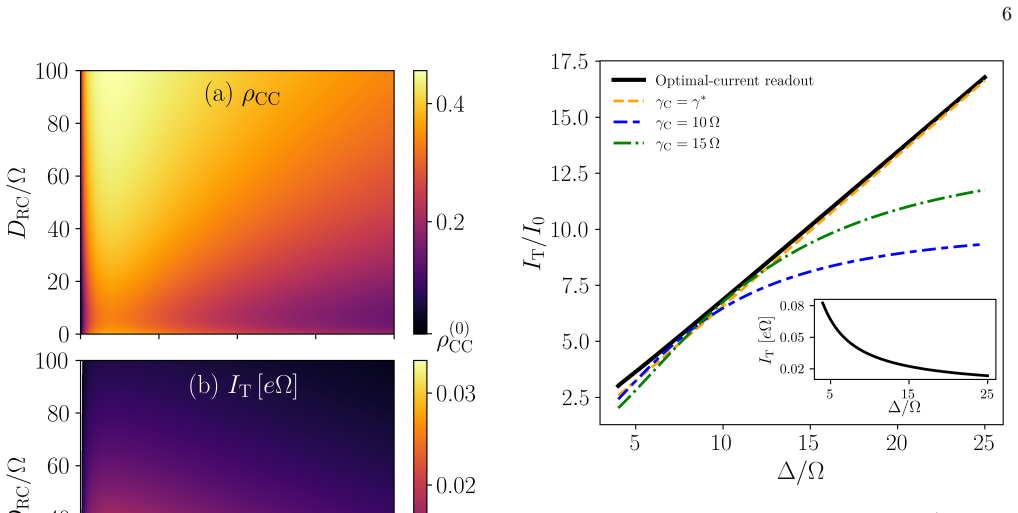
We investigate nonequilibrium transport in a triple-quantum-dot (TQD) system, where the central dot acts as a discrete tunnel barrier, subject to continuous monitoring by a quantum point contact (QPC) that is capacitively coupled to all three dots with independently tunable strengths. We show that this global measurement scheme affects transport in a qualitatively distinct manner from single-site measurement. By engineering structured dephasing, measurement provides a significant improvement in the barrier occupation and tunneling current. In the strong-measurement limit, the steady state becomes independent of the underlying Hamiltonian parameters, and the barrier occupation can approach 1/2 for suitable measurement configurations. We identify an optimal measurement configuration that maximizes the steady-state current and show that near-optimal performance can be achieved with a simple central-dot readout scheme.
Editorial analysis
A structured set of objections, weighed in public.
Referee Report
Summary. The manuscript examines nonequilibrium transport in a triple quantum dot (TQD) system with the central dot acting as a discrete tunnel barrier. A quantum point contact (QPC) is capacitively coupled to all three dots with independently tunable strengths, inducing structured dephasing via a global measurement scheme. The authors show that this collective monitoring affects transport qualitatively differently from single-site measurement, improving barrier occupation and tunneling current. In the strong-measurement limit the steady state becomes independent of Hamiltonian parameters (tunnel couplings and detunings), with barrier occupation approaching 1/2 for suitable configurations; an optimal measurement setup maximizing the steady-state current is identified, and near-optimal performance is reported for a simple central-dot readout.
Significance. If the central claims hold, the work demonstrates a concrete mechanism by which engineered collective dephasing can control transport properties in quantum dot chains, yielding both enhanced current and parameter-independent steady states. This is potentially relevant for mesoscopic device design and open-system quantum transport. The result is grounded in standard Lindblad master-equation modeling with tunable capacitive couplings and is supported by both analytic limits and numerical simulations.
major comments (3)
- [Sec. III, Eq. (5)] Sec. III, Eq. (5) (Lindblad form of the global dephasing superoperator): The claimed independence of the steady state from all Hamiltonian parameters in the strong-measurement limit (Sec. IV) requires that the measurement operators L_i satisfy [L_i, n_barrier] = 0 or project uniquely onto the barrier subspace. The manuscript does not provide an explicit verification or proof of this commutation property for the chosen capacitive-coupling weights, nor does it test robustness against a more general measurement model that includes possible QPC-induced charge fluctuations.
- [Sec. IV and Fig. 4] Sec. IV and Fig. 4 (strong-measurement limit numerics): The barrier occupation approaching 1/2 and current maximization are demonstrated for specific parameter sets. To support the stronger claim of full independence from Hamiltonian parameters, the manuscript should include additional scans in which tunnel couplings and detunings are varied over at least an order of magnitude while keeping the measurement configuration fixed.
- [Sec. II] Sec. II (model assumptions): The treatment assumes the QPC induces purely dephasing effects through capacitive couplings without additional back-action or decoherence channels. A brief discussion or estimate of the regime in which this approximation remains valid would strengthen the applicability of the reported improvement in occupation and current.
minor comments (3)
- [Sec. II] The definition of the barrier occupation operator n_barrier and its relation to the central-dot projector should be stated explicitly in the text (currently only implicit in the abstract and Sec. IV).
- [Figs. 3-5] Figure captions for the current-versus-coupling plots should include the precise values of the fixed Hamiltonian parameters used in each panel.
- [Sec. III] A short paragraph comparing the total integrated measurement strength between the global and single-site cases would clarify the origin of the qualitative difference reported in Sec. III.
Simulated Author's Rebuttal
We thank the referee for the careful reading of our manuscript and the constructive comments, which have helped clarify several points. We address each major comment below and will incorporate revisions to strengthen the presentation.
read point-by-point responses
-
Referee: [Sec. III, Eq. (5)] Sec. III, Eq. (5) (Lindblad form of the global dephasing superoperator): The claimed independence of the steady state from all Hamiltonian parameters in the strong-measurement limit (Sec. IV) requires that the measurement operators L_i satisfy [L_i, n_barrier] = 0 or project uniquely onto the barrier subspace. The manuscript does not provide an explicit verification or proof of this commutation property for the chosen capacitive-coupling weights, nor does it test robustness against a more general measurement model that includes possible QPC-induced charge fluctuations.
Authors: We appreciate the referee's observation regarding the need for explicit verification. In the strong-measurement limit the Lindblad operators L_i = sum_k w_k n_k (with tunable weights w_k) generate dephasing that projects the system onto the eigenspaces of the collective charge operator. The steady-state condition then reduces to the kernel of the dephasing dissipator, which is independent of the coherent Hamiltonian H because the dephasing rate dominates all other timescales. We will add a short analytic derivation in Sec. IV showing that any state satisfying L rho = rho L (i.e., an eigenstate of the collective charge) is invariant under the dissipator and hence becomes the unique steady state irrespective of tunnel couplings or detunings. Regarding robustness, we will note that additional QPC-induced charge-fluctuation terms enter at higher order in the QPC-dot tunneling amplitude and remain perturbative in the regime considered; a brief estimate of this ordering will be included. revision: yes
-
Referee: [Sec. IV and Fig. 4] Sec. IV and Fig. 4 (strong-measurement limit numerics): The barrier occupation approaching 1/2 and current maximization are demonstrated for specific parameter sets. To support the stronger claim of full independence from Hamiltonian parameters, the manuscript should include additional scans in which tunnel couplings and detunings are varied over at least an order of magnitude while keeping the measurement configuration fixed.
Authors: The referee correctly notes that broader numerical scans would better support the parameter-independence claim. We will add new data to Fig. 4 (or a supplementary panel) showing barrier occupation and steady-state current for tunnel couplings varied over [0.1 t_0, 10 t_0] and detunings over [-5 Delta, 5 Delta], with the measurement weights held fixed. These scans confirm that both quantities remain essentially constant in the strong-measurement regime, consistent with the analytic limit. revision: yes
-
Referee: [Sec. II] Sec. II (model assumptions): The treatment assumes the QPC induces purely dephasing effects through capacitive couplings without additional back-action or decoherence channels. A brief discussion or estimate of the regime in which this approximation remains valid would strengthen the applicability of the reported improvement in occupation and current.
Authors: We agree that an explicit statement of the validity regime is useful. The model assumes the QPC operates in the weak-tunneling, high-bias limit where it functions as a charge sensor; back-action and particle-exchange rates are then suppressed by the small QPC-dot tunneling amplitude relative to the capacitive coupling strength. We will insert a short paragraph in Sec. II providing this estimate and referencing typical experimental parameters (e.g., QPC conductance in the linear-response regime) under which the pure-dephasing approximation holds. revision: yes
Circularity Check
No significant circularity in derivation chain
full rationale
The paper's central results on steady-state independence from Hamiltonian parameters in the strong-measurement limit and improved barrier occupation follow from the standard Lindblad master equation with global dephasing superoperators L_i weighted by tunable capacitive couplings. This limit is a direct mathematical consequence of the dephasing terms dominating the coherent evolution when measurement strength → ∞, projecting onto the eigenspaces of the collective charge operator without requiring any fitted parameters, self-citations, or ansatzes that presuppose the target outcome. The model assumptions (purely dephasing backaction, independent tunability) are stated explicitly and the numerics/analytic limits are derived from the master equation itself rather than reducing to input data or prior self-referential claims. No load-bearing step equates a prediction to its own construction.
Axiom & Free-Parameter Ledger
axioms (1)
- domain assumption Capacitive coupling of the QPC to all dots induces structured dephasing that can be tuned independently per dot to control transport.
Lean theorems connected to this paper
-
IndisputableMonolith/Cost/FunctionalEquation.leanwashburn_uniqueness_aczel unclear?
unclearRelation between the paper passage and the cited Recognition theorem.
In the strong-measurement limit, the steady state becomes independent of the underlying Hamiltonian parameters, and the barrier occupation can approach 1/2 for suitable measurement configurations.
-
IndisputableMonolith/Foundation/AlphaCoordinateFixation.leanJ_uniquely_calibrated_via_higher_derivative unclear?
unclearRelation between the paper passage and the cited Recognition theorem.
D_jk = (√γ_j − √γ_k)^2/2 denoting the dephasing rate induced between the dots j and k
What do these tags mean?
- matches
- The paper's claim is directly supported by a theorem in the formal canon.
- supports
- The theorem supports part of the paper's argument, but the paper may add assumptions or extra steps.
- extends
- The paper goes beyond the formal theorem; the theorem is a base layer rather than the whole result.
- uses
- The paper appears to rely on the theorem as machinery.
- contradicts
- The paper's claim conflicts with a theorem or certificate in the canon.
- unclear
- Pith found a possible connection, but the passage is too broad, indirect, or ambiguous to say the theorem truly supports the claim.
Reference graph
Works this paper leans on
-
[1]
+ √γRρRR ,(B7) Re ˙ρRC =−∆ Imρ RC − ΓR 2 Reρ RC + Ω ImρLR − (√γR − √γC)2 2 Reρ RC + 2dW dt Reρ RC √γR(ρRR − 1
-
[2]
+ √γLρLL ,(B8) Im ˙ρLC =−Ω(ρ CC −ρ LL) + ∆ ReρLC + Ω ReρLR − (√γL − √γC)2 2 Imρ LC + 2dW dt Imρ LC √γL(ρLL − 1
-
[3]
+ √γRρRR ,(B9) Im ˙ρRC =−Ω(ρ CC −ρ RR) + ∆ ReρRC − ΓR 2 Imρ RC + Ω ReρLR − (√γR − √γC)2 2 Imρ RC + 2dW dt Imρ RC √γR(ρRR − 1
-
[4]
+ √γLρLL ,(B10) The terms proportional to Ω and ∆ originate from the Hamiltonian and govern coherent oscillations between sites. The contributions proportional to ( √γi − √γj)2 represent measurement-induced dephasing, making it clear that equal monitoring of two sites leaves their mu- tual coherence unaffected once averaged over stochastic realizations of...
-
[5]
+ √γCρCC ,(B11) Im ˙ρLR =−Ω(Reρ RC −Reρ LC)− ΓR 2 Imρ LR − (√γL − √γR)2 2 Imρ LR + 2dW dt Imρ LR √γL(ρLL − 1
-
[6]
+ √γCρCC .(B12) The outer-dots coherence is influenced indirectly by both central-dot tunneling and measurement asymmetry. As in the other coherence equations, the dephasing rate de- pends only on relative measurement strengths, reinforc- ing the central role of spatially structured monitoring in shaping the steady state. The conservation of probabil- ity...
-
[7]
A. N. Jordan and I. A. Siddiqi,Quantum Measurement (Cambridge University Press, Cambridge, England, UK, 2024)
work page 2024
-
[8]
H. van Houten, C. W. J. Beenakker, and B. J. van Wees, Chapter 2: Quantum Point Contacts, inSemiconductors and Semimetals, Vol. 35, edited by M. Reed (Elsevier, M¨ unchen, Germany, 1992) pp. 9–112
work page 1992
- [9]
-
[10]
J. M. Elzerman, R. Hanson, J. S. Greidanus, L. H. Willems van Beveren, S. De Franceschi, L. M. K. Vander- sypen, S. Tarucha, and L. P. Kouwenhoven, Few-electron quantum dot circuit with integrated charge read out, Phys. Rev. B67, 161308 (2003)
work page 2003
-
[11]
R. Schleser, E. Ruh, T. Ihn, K. Ensslin, D. C. Driscoll, and A. C. Gossard, Time-resolved detection of individual electrons in a quantum dot, Appl. Phys. Lett.85, 2005 (2004)
work page 2005
-
[12]
T. Fujisawa, T. Hayashi, R. Tomita, and Y. Hirayama, Bidirectional Counting of Single Electrons, Science312, 1634 (2006)
work page 2006
-
[13]
S. Gustavsson, R. Leturcq, B. Simoviˇ c, R. Schleser, T. Ihn, P. Studerus, K. Ensslin, D. C. Driscoll, and A. C. Gossard, Counting statistics of single electron transport in a quantum dot, Phys. Rev. Lett.96, 076605 (2006)
work page 2006
-
[14]
E. Buks, R. Schuster, M. Heiblum, D. Mahalu, and V. Umansky, Dephasing in electron interference by a ‘which-path’ detector, Nature391, 871 (1998)
work page 1998
-
[15]
J. M. Elzerman, R. Hanson, L. H. Willems van Beveren, B. Witkamp, L. M. K. Vandersypen, and L. P. Kouwen- hoven, Single-shot read-out of an individual electron spin in a quantum dot, Nature430, 431 (2004)
work page 2004
- [16]
- [17]
-
[18]
J. V. Koski, V. F. Maisi, J. P. Pekola, and D. V. Averin, Experimental realization of a Szilard engine with a single electron, Proc. Natl. Acad. Sci. USA111, 13786 (2014)
work page 2014
-
[19]
J. V. Koski, V. F. Maisi, T. Sagawa, and J. P. Pekola, Experimental observation of the role of mutual informa- tion in the nonequilibrium dynamics of a Maxwell demon, Phys. Rev. Lett.113, 030601 (2014)
work page 2014
-
[20]
A. Hofmann, V. F. Maisi, C. Gold, T. Kr¨ ahenmann, C. R¨ ossler, J. Basset, P. M¨ arki, C. Reichl, W. Wegschei- der, K. Ensslin, and T. Ihn, Measuring the Degeneracy of Discrete Energy Levels Using a GaAs/AlGaAs Quantum Dot, Phys. Rev. Lett.117, 206803 (2016)
work page 2016
-
[21]
A. Hofmann, V. F. Maisi, C. R¨ ossler, J. Basset, T. Kr¨ ahenmann, P. M¨ arki, T. Ihn, K. Ensslin, C. Reichl, and W. Wegscheider, Equilibrium free energy measure- ment of a confined electron driven out of equilibrium, Phys. Rev. B93, 035425 (2016)
work page 2016
-
[22]
A. Hofmann, V. F. Maisi, J. Basset, C. Reichl, W. Wegscheider, T. Ihn, K. Ensslin, and C. Jarzynski, Heat dissipation and fluctuations in a driven quantum dot, Phys. Status Solidi B254, 1600546 (2017)
work page 2017
- [23]
- [24]
-
[25]
F. R. Braakman, P. Barthelemy, C. Reichl, W. Wegschei- der, and L. M. K. Vandersypen, Long-distance coherent coupling in a quantum dot array, Nat. Nanotechnol.8, 432 (2013)
work page 2013
-
[26]
S. A. Gurvitz, Measurements with a noninvasive detec- tor and dephasing mechanism, Phys. Rev. B56, 15215 (1997)
work page 1997
-
[27]
A. A. Clerk, M. H. Devoret, S. M. Girvin, F. Marquardt, and R. J. Schoelkopf, Introduction to quantum noise, measurement, and amplification, Rev. Mod. Phys.82, 1155 (2010)
work page 2010
-
[28]
Brandes, Coherent and collective quantum optical ef- fects in mesoscopic systems, Phys
T. Brandes, Coherent and collective quantum optical ef- fects in mesoscopic systems, Phys. Rep.408, 315 (2005)
work page 2005
-
[29]
O. Zilberberg, A. Carmi, and A. Romito, Measuring co- tunneling in its wake, Phys. Rev. B90, 205413 (2014)
work page 2014
-
[30]
G. Granger, L. Gaudreau, A. Kam, M. Pioro-Ladri` ere, S. A. Studenikin, Z. R. Wasilewski, P. Zawadzki, and A. S. Sachrajda, Three-dimensional transport diagram of a triple quantum dot, Phys. Rev. B82, 075304 (2010). 13
work page 2010
-
[31]
C.-Y. Hsieh, Y.-P. Shim, M. Korkusinski, and P. Hawry- lak, Physics of lateral triple quantum-dot molecules with controlled electron numbers, Rep. Prog. Phys.75, 114501 (2012)
work page 2012
-
[32]
M. Busl, G. Granger, L. Gaudreau, R. S´ anchez, A. Kam, M. Pioro-Ladri` ere, S. A. Studenikin, P. Zawadzki, Z. R. Wasilewski, A. S. Sachrajda, and G. Platero, Bipolar spin blockade and coherent state superpositions in a triple quantum dot, Nat. Nanotechnol.8, 261 (2013)
work page 2013
-
[33]
R. S´ anchez, G. Granger, L. Gaudreau, A. Kam, M. Pioro- Ladri` ere, S. A. Studenikin, P. Zawadzki, A. S. Sachrajda, and G. Platero, Long-range spin transfer in triple quan- tum dots, Phys. Rev. Lett.112, 176803 (2014)
work page 2014
-
[34]
R. Tormo-Queralt, C. B. Møller, D. A. Czaplewski, G. Gruber, M. Cagetti, S. Forstner, N. Urgell-Oll´ e, J. A. Sanchez-Naranjo, C. Samanta, C. S. Miller, and A. Bach- told, Novel Nanotube Multiquantum Dot Devices, Nano Lett.22, 8541 (2022)
work page 2022
-
[35]
T. A. Baart, T. Fujita, C. Reichl, W. Wegscheider, and L. M. K. Vandersypen, Coherent spin-exchange via a quantum mediator, Nat. Nanotechnol.12, 26 (2017)
work page 2017
- [36]
-
[37]
P. Facchi and S. Pascazio, Quantum Zeno dynamics: mathematical and physical aspects, Journal of Physics A: Mathematical and Theoretical41, 493001 (2008)
work page 2008
-
[38]
S. Greenfield, A. Kamal, J. Dressel, and E. Levenson- Falk, A unified picture for quantum Zeno and anti-Zeno effects – a review, arXiv:2506.12679 (2025)
-
[39]
T. Brandes and T. Vorrath, Adiabatic transfer of elec- trons in coupled quantum dots, Phys. Rev. B66, 075341 (2002)
work page 2002
-
[40]
R. Hussein and S. Kohler, Capacitively coupled nano con- ductors, Ann. Phys.527, 610 (2015)
work page 2015
-
[41]
M. A. Ratner, Bridge-assisted electron transfer: effective electronic coupling, J. Phys. Chem.94, 4877 (1990)
work page 1990
-
[42]
L. D. Contreras-Pulido, M. Bruderer, S. F. Huelga, and M. B. Plenio, Dephasing-assisted transport in linear triple quantum dots, New J. Phys.16, 113061 (2014)
work page 2014
-
[43]
S. A. Gurvitz and Ya. S. Prager, Microscopic derivation of rate equations for quantum transport, Phys. Rev. B 53, 15932 (1996)
work page 1996
-
[44]
T. Hayashi, T. Fujisawa, H. D. Cheong, Y. H. Jeong, and Y. Hirayama, Coherent Manipulation of Electronic States in a Double Quantum Dot, Phys. Rev. Lett.91, 226804 (2003)
work page 2003
-
[45]
J. R. Petta, A. C. Johnson, J. M. Taylor, E. A. Laird, A. Yacoby, M. D. Lukin, C. M. Marcus, M. P. Hanson, and A. C. Gossard, Coherent manipulation of coupled electron spins in semiconductor quantum dots, Science 309, 2180 (2005)
work page 2005
-
[46]
L. Trigal and R. S´ anchez, Noninvasive and nonadiabatic quantum Maxwell demon, Phys. Rev. B113, L121403 (2026)
work page 2026
-
[47]
C. Elouard and A. N. Jordan, Efficient quantum mea- surement engines, Phys. Rev. Lett.120, 260601 (2018)
work page 2018
-
[48]
L. Bresque, P. A. Camati, S. Rogers, K. Murch, A. N. Jordan, and A. Auff` eves, Two-Qubit Engine Fueled by Entanglement and Local Measurements, Phys. Rev. Lett. 126, 120605 (2021)
work page 2021
-
[49]
J. Ferreira, T. Jin, J. Mannhart, T. Giamarchi, and M. Filippone, Transport and nonreciprocity in monitored quantum devices: An exact study, Phys. Rev. Lett.132, 136301 (2024)
work page 2024
-
[50]
B. Bhandari, R. Czupryniak, P. A. Erdman, and A. N. Jordan, Measurement-Based Quantum Thermal Ma- chines with Feedback Control, Entropy25, 204 (2023)
work page 2023
-
[51]
A. N. Jordan, C. Elouard, and A. Auff` eves, Quantum measurement engines and their relevance for quantum in- terpretations, Quantum Studies: Mathematics and Foun- dations7, 203 (2020)
work page 2020
-
[52]
S. Gherardini, F. Campaioli, F. Caruso, and F. C. Binder, Stabilizing open quantum batteries by sequential mea- surements, Phys. Rev. Res.2, 013095 (2020)
work page 2020
-
[53]
M. T. Mitchison, J. Goold, and J. Prior, Charging a quantum battery with linear feedback control, Quantum 5, 500 (2021)
work page 2021
-
[54]
M. H. Mohammady and J. Anders, A quantum Szilard engine without heat from a thermal reservoir, New J. Phys.19, 113026 (2017)
work page 2017
- [55]
- [56]
-
[57]
R. S´ anchez, A. N. Singh, A. N. Jordan, and B. Bhandari, Making the virtual real: Measurement-powered tunnel- ing engines, Phys. Rev. B113, 125414 (2026)
work page 2026
-
[58]
B¨ uttiker, Quantized transmission of a saddle-point constriction, Phys
M. B¨ uttiker, Quantized transmission of a saddle-point constriction, Phys. Rev. B41, 7906 (1990)
work page 1990
-
[59]
Ya. M. Blanter and M. B¨ uttiker, Shot noise in mesoscopic conductors, Phys. Rep.336, 1 (2000)
work page 2000
discussion (0)
Sign in with ORCID, Apple, or X to comment. Anyone can read and Pith papers without signing in.