Achieving High Filling of an Optical Lattice by Light-Assisted Redistribution of Atoms
Pith reviewed 2026-05-20 07:20 UTC · model grok-4.3
The pith
A blue-detuned optical pumping beam during Raman sideband cooling redistributes atoms to achieve 70-80% filling fractions in optical lattices.
A machine-rendered reading of the paper's core claim, the machinery that carries it, and where it could break.
Core claim
Using a blue-detuned optical pumping beam during degenerate Raman sideband cooling enables a light-assisted redistribution process in which atoms undergo multiple light-assisted collisions over an extended period, diffusing stochastically from multiply occupied lattice sites to vacant sites and yielding single-atom filling fractions of 70-80% while retaining over 50% of the atoms involved in radiative collisions.
What carries the argument
The light-assisted redistribution process driven by a blue-detuned optical pumping beam that promotes stochastic atomic diffusion via repeated light-assisted collisions.
If this is right
- Single-atom filling fractions of 70-80% are achieved in the optical lattice.
- Over 50% of atoms involved in radiative collisions are retained rather than lost.
- The method provides a scalable pathway to near-unity filling without complex atom rearrangement protocols.
- It applies broadly to quantum simulation, precision measurements, and quantum information experiments.
Where Pith is reading between the lines
- The retention of over half the colliding atoms suggests the process could be further optimized to approach even higher fillings by tuning collision rates or cooling parameters.
- This stochastic redistribution might integrate with other cooling techniques to prepare defect-free arrays in larger lattices.
- Similar light-assisted mechanisms could be explored in different atomic species or lattice geometries for broader applicability.
Load-bearing premise
The process assumes that atoms can undergo many light-assisted collisions over an extended time to stochastically diffuse to vacant sites while more than half of the participating atoms are retained in the lattice.
What would settle it
Observing that the single-atom filling fraction stays near 50% despite prolonged application of the blue-detuned pumping beam during cooling, or that retention in collisions falls below 50%, would contradict the redistribution mechanism.
Figures


read the original abstract
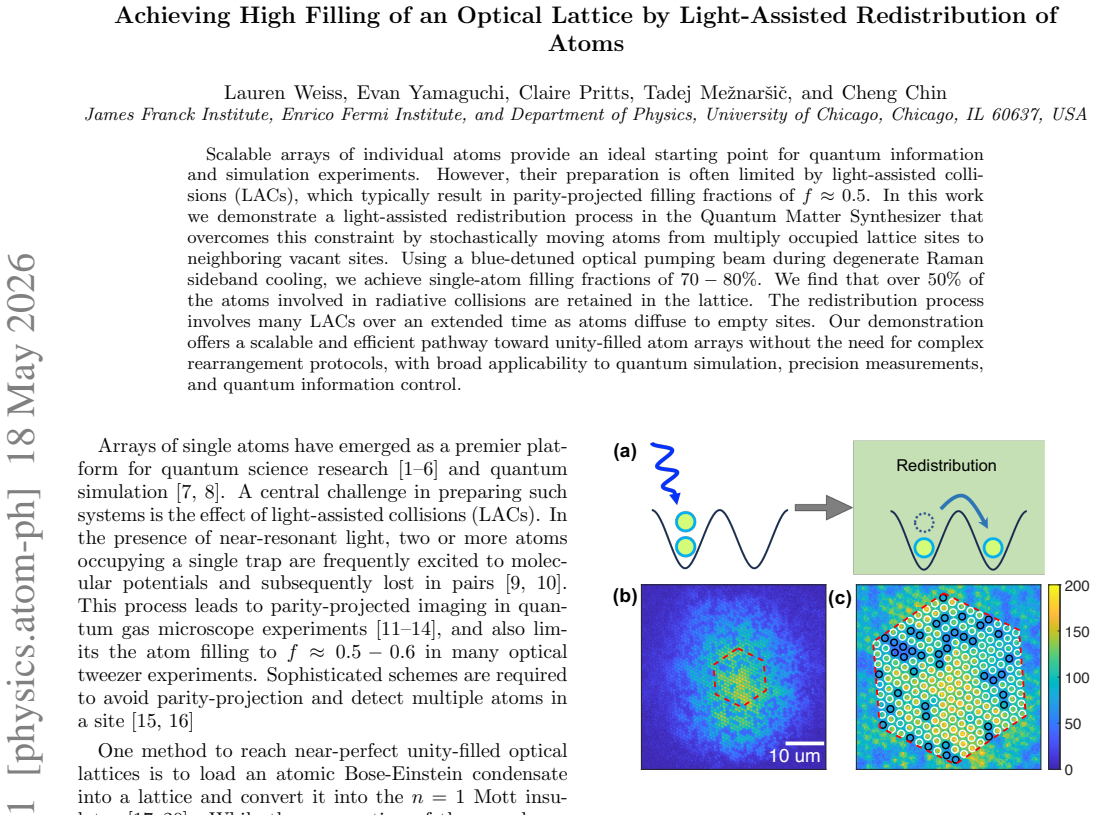
Scalable arrays of individual atoms provide an ideal starting point for quantum information and simulation experiments. However, their preparation is often limited by light-assisted collisions (LACs), which typically result in parity-projected filling fractions of $f \approx 0.5$. In this work we demonstrate a light-assisted redistribution process in the Quantum Matter Synthesizer that overcomes this constraint by stochastically moving atoms from multiply occupied lattice sites to neighboring vacant sites. Using a blue-detuned optical pumping beam during degenerate Raman sideband cooling, we achieve single-atom filling fractions of $70-80\%$. We find that over 50$\%$ of the atoms involved in radiative collisions are retained in the lattice. The redistribution process involves many LACs over an extended time as atoms diffuse to empty sites. Our demonstration offers a scalable and efficient pathway toward unity-filled atom arrays without the need for complex rearrangement protocols, with broad applicability to quantum simulation, precision measurements, and quantum information control.
Editorial analysis
A structured set of objections, weighed in public.
Referee Report
Summary. The manuscript reports an experimental demonstration in the Quantum Matter Synthesizer of a light-assisted redistribution technique that uses a blue-detuned optical pumping beam during degenerate Raman sideband cooling. Atoms from multiply occupied sites undergo radiative collisions and stochastically diffuse to vacant neighboring sites, yielding single-atom filling fractions of 70-80% while retaining over 50% of the atoms that participate in those collisions. The approach is presented as a scalable route to high filling fractions without requiring complex rearrangement protocols.
Significance. If the reported filling fractions and retention rates hold under detailed scrutiny, the result would be significant for quantum simulation and information experiments. It offers a relatively simple optical method to exceed the conventional parity-projected limit of ~50% filling that arises from light-assisted collisions, potentially reducing reliance on more involved site-by-site rearrangement schemes.
major comments (2)
- [Abstract] Abstract: The central numerical claims (70-80% single-atom filling and >50% retention of atoms involved in radiative collisions) are stated without reference to accompanying data, error bars, figures, or tables that would allow independent assessment of statistical significance or systematic uncertainties.
- [Redistribution process description] Redistribution process description: The retention fraction (>50%) is only interpretable if the denominator (number of atoms that participated in radiative collisions) is robustly determined. The manuscript should explicitly state whether this is obtained from direct counting, from the initial occupancy distribution under a Poisson or other model, or from another method, and should quantify possible biases arising from background losses or imaging fidelity over the extended cooling interval.
minor comments (1)
- [Abstract] The abstract would benefit from a brief statement of the atomic species, lattice wavelength, and typical initial filling fraction to provide immediate context for the reported improvements.
Simulated Author's Rebuttal
We thank the referee for their careful reading of the manuscript and for the constructive comments, which will help improve the clarity of our presentation. We address each major comment below.
read point-by-point responses
-
Referee: [Abstract] Abstract: The central numerical claims (70-80% single-atom filling and >50% retention of atoms involved in radiative collisions) are stated without reference to accompanying data, error bars, figures, or tables that would allow independent assessment of statistical significance or systematic uncertainties.
Authors: We agree that the abstract would be strengthened by explicit references to the supporting data. In the revised manuscript we will update the abstract to cite the relevant figures (Figure 2 for the measured filling fractions and Figure 3 for the retention analysis) and to include the typical statistical uncertainties obtained from ensemble averages over multiple experimental runs (approximately ±4% for filling fraction and ±6% for retention). revision: yes
-
Referee: [Redistribution process description] Redistribution process description: The retention fraction (>50%) is only interpretable if the denominator (number of atoms that participated in radiative collisions) is robustly determined. The manuscript should explicitly state whether this is obtained from direct counting, from the initial occupancy distribution under a Poisson or other model, or from another method, and should quantify possible biases arising from background losses or imaging fidelity over the extended cooling interval.
Authors: We thank the referee for highlighting this important clarification. The number of atoms that participated in radiative collisions is obtained by combining direct imaging of initial site occupancies with a Poisson distribution fitted to the measured loading statistics. In the revised manuscript we will add an explicit paragraph in the Results section describing this procedure and will quantify the relevant biases: background losses are measured at <3% over the cooling interval, and imaging fidelity is calibrated at >95% via repeated non-destructive imaging. These additions will allow independent assessment of the retention fraction. revision: yes
Circularity Check
No circularity: experimental measurements with no derivations or self-referential logic
full rationale
The paper is a purely experimental demonstration of light-assisted redistribution during degenerate Raman sideband cooling. Filling fractions (70-80%) and retention (>50%) are reported as direct outcomes of measurements in the Quantum Matter Synthesizer, with no equations, fitted parameters, or derivations present in the provided text. The central claims rest on observed data rather than any reduction to inputs by construction, self-citation chains, or ansatzes. This is the most common honest finding for experimental work that is self-contained against external benchmarks.
Axiom & Free-Parameter Ledger
axioms (1)
- domain assumption Standard behavior of light-assisted collisions and Raman sideband cooling in optical lattices holds under the experimental conditions used.
Reference graph
Works this paper leans on
-
[1]
with the theoretical model [42, 43]. In the weak- field regimeγ LAC ≪Γ, where Γ is the Cs excited state linewidth, scattering atoms are excited to the molecular potential once and stay for 1/Γ = 30ns. The excited state lifetime is much shorter than the time needed for atoms 10 20 30 40 Distance from center r (lattice sites) 0 0.2 0.4 0.6 0.8 1 Filling Fra...
work page 2026
- [2]
-
[3]
K. Barnes, P. Battaglino, B. J. Bloom, K. Cassella, R. Coxe, N. Crisosto, J. P. King, S. S. Kondov, S. Kotru, S. C. Larsen, J. Lauigan, B. J. Lester, M. McDonald, E. Megidish, S. Narayanaswami, C. Nishiguchi, R. Noter- mans, L. S. Peng, A. Ryou, T.-Y. Wu, and M. Yarwood, Assembly and coherent control of a register of nuclear spin qubits, Nature Communicat...
work page 2022
-
[4]
G. Pichard, E. Lim, J. Bloch, J. Vaneecloo, L. Boura- chot, G.-J. Both, G. M´ eriaux, S. Dutartre, R. Hostein, J. Paris, B. Ximenez, A. Signoles, A. Browaeys, T. La- haye, and D. Dreon, Rearrangement of individual atoms in a 2000-site optical-tweezer array at cryogenic temper- atures, Physical Review Applied22, 024073 (2024)
work page 2000
-
[5]
D. Barredo, S. de L´ es´ eleuc, V. Lienhard, T. Lahaye, and A. Browaeys, An atom-by-atom assembler of defect-free arbitrary two-dimensional atomic arrays, Science354, 1021 (2016)
work page 2016
-
[6]
H. J. Manetsch, G. Nomura, E. Bataille, K. H. Leung, X. Lv, and M. Endres, A tweezer array with 6100 highly coherent atomic qubits, Nature647, 60 (2025)
work page 2025
-
[7]
D. Bluvstein, S. J. Evered, A. A. Geim, S. H. Li, H. Zhou, T. Manovitz, S. Ebadi, M. Cain, M. Kali- nowski, D. Hangleiter, J. P. Bonilla Ataides, N. Maskara, I. Cong, X. Gao, P. Sales Rodriguez, T. Karolyshyn, G. Semeghini, M. J. Gullans, M. Greiner, V. Vuleti´ c, and M. D. Lukin, Logical quantum processor based on reconfigurable atom arrays, Nature626, 58 (2024)
work page 2024
-
[8]
J. F. Sherson, C. Weitenberg, M. Endres, M. Cheneau, I. Bloch, and S. Kuhr, Single-atom-resolved fluorescence imaging of an atomic mott insulator, Nature467, 68 (2010)
work page 2010
-
[9]
M. F. Parsons, F. Huber, A. Mazurenko, C. S. Chiu, W. Setiawan, K. Wooley-Brown, S. Blatt, and M. Greiner, Site-resolved imaging of fermionic 6Li in an optical lattice, Physical Review Letters114, 213002 (2015)
work page 2015
-
[10]
S. K. Pampel, M. Marinelli, M. O. Brown, J. P. D’Incao, and C. A. Regal, Quantifying light-assisted collisions in optical tweezers across the hyperfine spectrum, Physical Review Letters134, 013202 (2025)
work page 2025
-
[11]
A. Fuhrmanek, R. Bourgain, Y. R. P. Sortais, and A. Browaeys, Study of light-assisted collisions between a few cold atoms in a microscopic dipole trap, Physical Review A85, 062708 (2012). 6
work page 2012
-
[12]
M. T. DePue, C. McCormick, S. L. Winoto, S. Oliver, and D. S. Weiss, Unity occupation of sites in a 3d optical lattice, Physical Review Letters82, 2262 (1999)
work page 1999
-
[13]
W. S. Bakr, J. I. Gillen, A. Peng, S. F¨ olling, and M. Greiner, A quantum gas microscope for detecting sin- gle atoms in a hubbard-regime optical lattice, Nature 462, 74 (2009)
work page 2009
-
[14]
S. Buob, J. H¨ oschele, V. Makhalov, A. Rubio-Abadal, and L. Tarruell, A strontium quantum-gas microscope, PRX Quantum5, 020316 (2024)
work page 2024
- [15]
-
[16]
L. Su, A. Douglas, M. Szurek, A. H. H´ ebert, A. Krahn, R. Groth, G. A. Phelps, O. Markovi´ c, and M. Greiner, Fast single atom imaging for optical lattice arrays, Nature Communications16, 1017 (2025)
work page 2025
-
[17]
A. M. Muzi Falconi, R. Panza, S. Sbernardori, R. Forti, R. Klemt, O. A. Karim, M. Marinelli, and F. Scazza, Microsecond-scale high-survival and number-resolved de- tection of ytterbium atom arrays, Physical Review Let- ters135(2025)
work page 2025
- [18]
-
[19]
M. Greiner, O. Mandel, T. Esslinger, T. W. H¨ ansch, and I. Bloch, Quantum phase transition from a superfluid to a mott insulator in a gas of ultracold atoms, Nature415, 39 (2002)
work page 2002
-
[20]
W. S. Bakr, A. Peng, M. E. Tai, R. Ma, J. Simon, J. I. Gillen, S. F¨ olling, L. Pollet, and M. Greiner, Probing the superfluid–to–mott insulator transition at the single- atom level, Science329, 547 (2010)
work page 2010
- [21]
- [22]
- [23]
- [24]
-
[25]
T. Gr¨ unzweig, A. Hilliard, M. McGovern, and M. F. An- dersen, Near-deterministic preparation of a single atom in an optical microtrap, Nature Physics6, 951 (2010)
work page 2010
-
[26]
A. V. Carpentier, Y. H. Fung, P. Sompet, A. J. Hilliard, T. G. Walker, and M. F. Andersen, Preparation of a sin- gle atom in an optical microtrap, Laser Physics Letters 10, 125501 (2013)
work page 2013
- [27]
-
[28]
A. Jenkins, J. W. Lis, A. Senoo, W. F. McGrew, and A. M. Kaufman, Ytterbium nuclear-spin qubits in an op- tical tweezer array, Physical Review X12, 021027 (2022)
work page 2022
- [29]
-
[30]
B. J. Lester, N. Luick, A. M. Kaufman, C. M. Reynolds, and C. A. Regal, Rapid production of uniformly-filled arrays of neutral atoms, Physical Review Letters115, 073003 (2015)
work page 2015
-
[31]
J. Trisnadi, M. Zhang, L. Weiss, and C. Chin, Design and construction of a quantum matter synthesizer, Review of Scientific Instruments93, 083203 (2022)
work page 2022
-
[32]
See Supplemental Material for experimental details, atom number versus time model, and collision rate calculation, (2026)
work page 2026
-
[33]
V. Vuleti´ c, C. Chin, A. J. Kerman, and S. Chu, Degener- ate raman sideband cooling of trapped cesium atoms at very high atomic densities, Physical Review Letters81, 5768 (1998)
work page 1998
-
[34]
A. J. Kerman, V. Vuleti´ c, C. Chin, and S. Chu, Beyond optical molasses: 3d raman sideband cooling of atomic cesium to high phase-space density, Physical Review Let- ters84, 439 (2000)
work page 2000
-
[35]
D.-J. Han, S. Wolf, S. Oliver, C. McCormick, M. T. DePue, and D. S. Weiss, 3d raman sideband cooling of cesium atoms at high density, Physical Review Letters 85, 724 (2000)
work page 2000
-
[36]
E. H. Qiu, T. ˇSumarac, P. Niu, S. Tsesses, F. Wassaf, D. C. Spierings, M.-W. Chen, M. T. Uysal, A. Bartlett, A. J. Menssen, M. D. Lukin, and V. Vuleti´ c, Loading and imaging atom arrays via electromagnetically induced transparency (2025), arXiv:2509.12124
work page internal anchor Pith review Pith/arXiv arXiv 2025
-
[37]
L. Khaykovich, N. Friedman, and N. Davidson, Satura- tion of the weak probe amplification in a strongly driven cold and dense atomic cloud, The European Physical Journal D7, 467 (1999)
work page 1999
- [38]
-
[39]
A. T. Gisbert, N. Piovella, and R. Bachelard, Stochastic heating and self-induced cooling in optically bound pairs of atoms, Physical Review A99, 013619 (2019)
work page 2019
-
[40]
Y. H. Fung and M. F. Andersen, Efficient collisional blockade loading of a single atom into a tight microtrap, New Journal of Physics17, 073011 (2015)
work page 2015
-
[41]
N. Schlosser, G. Reymond, and P. Grangier, Collisional blockade in microscopic optical dipole traps, Physical Re- view Letters89, 023005 (2002)
work page 2002
-
[42]
L. F¨ orster, W. Alt, I. Dotsenko, M. Khudaverdyan, D. Meschede, Y. Miroshnychenko, S. Reick, and A. Rauschenbeutel, Number-triggered loading and colli- sional redistribution of neutral atoms in a standing wave dipole trap, New Journal of Physics8, 259 (2006)
work page 2006
-
[43]
K. Burnett, P. S. Julienne, and K.-A. Suominen, Laser- driven collisions between atoms in a bose-einstein con- densed gas, Physical Review Letters77, 1416 (1996)
work page 1996
-
[44]
V. Vuleti´ c, C. Chin, A. J. Kerman, and S. Chu, Suppres- sion of atomic radiative collisions by tuning the ground state scattering length, Physical Review Letters83, 943 (1999)
work page 1999
-
[45]
M. J. Piotrowicz, M. Lichtman, K. Maller, G. Li, S. Zhang, L. Isenhower, and M. Saffman, Two- dimensional lattice of blue-detuned atom traps using a 7 projected gaussian beam array two-dimensional lattice of blue-detuned atom traps using a projected gaussian beam array, Physical Review A88(2013)
work page 2013
-
[46]
N. R. Hutzler, L. R. Liu, Y. Yu, and K.-K. Ni, Eliminat- ing light shifts for single atom trapping, New Journal of Physics19, 023007 (2017)
work page 2017
-
[47]
K. Jooya, N. Musterer, K. W. Madison, and J. L. Booth, Photon-scattering-rate measurement of atoms, Physical Review A88, 063401 (2013). SUPPLEMENT TO ACHIEVING HIGH FILLING OF AN OPTICAL LA TTICE BY LIGHT-ASSISTED REDISTRIBUTION OF A TOMS I. EXPERIMENT AL SETUP AND HARDW ARE The Quantum Matter Synthesizer apparatus consists of two chambers: a stainless st...
work page 2013
discussion (0)
Sign in with ORCID, Apple, or X to comment. Anyone can read and Pith papers without signing in.