Nonlinear Stabilization of Non-Adiabatic Magnonic Dynamics
Pith reviewed 2026-05-21 07:28 UTC · model grok-4.3
The pith
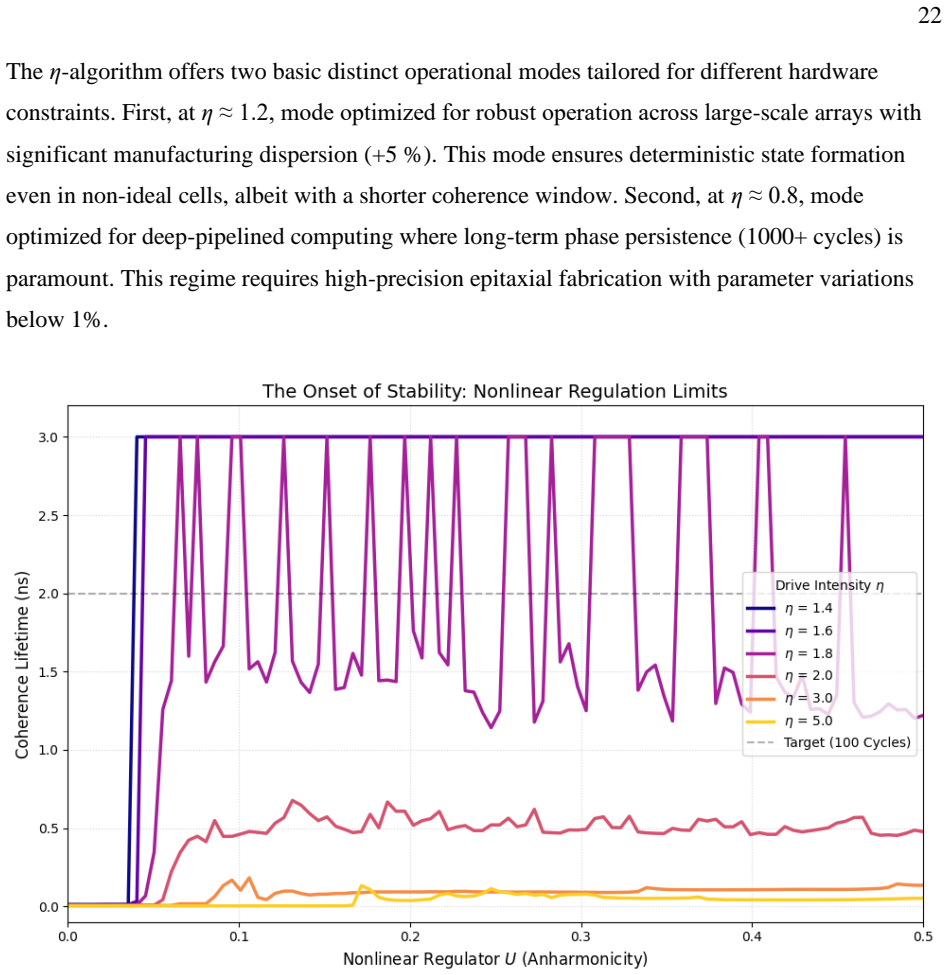
A finite nonlinear frequency regulator stabilizes bounded non-adiabatic magnonic dynamics by suppressing leakage into higher modes.
A machine-rendered reading of the paper's core claim, the machinery that carries it, and where it could break.
Core claim
In the proposed nonlinear magnonic platform, the nonlinear frequency regulator U represents anharmonic spectral detuning of the medium and, when finite, suppresses leakage into higher-order modes while preserving bounded dynamics under non-adiabatic parametric excitation in nanoscale ferrite structures such as Co-doped YIG.
What carries the argument
The nonlinear frequency regulator U, which supplies anharmonic spectral detuning to counter the spectral-flow rate associated with the non-adiabaticity parameter.
If this is right
- The system reaches a dynamically localized low-occupancy magnonic state suitable for repeated operation.
- Absorbed energy densities correspond to switching energies near 22 aJ per cell in YIG:Co.
- Magnetic damping, exchange-gap confinement, and phonon transparency support coherent dynamics over multiple cycles.
- Nonlinear self-limited non-adiabatic dynamics may serve as a physical basis for low-energy wave-based information processing.
Where Pith is reading between the lines
- The same regulator mechanism could be tested in other ferrite or magnetic thin-film materials to widen the range of applicable nanostructures.
- Integration with existing magnonic waveguides might allow hybrid devices that combine this stabilization with conventional spin-wave routing.
- Direct measurement of mode occupancy versus regulator strength in time-resolved experiments would provide a clear test of the bounded-state prediction.
Load-bearing premise
The non-adiabaticity parameter can be interpreted as a local measure of spectral-flow rate while the nonlinear frequency regulator U represents the anharmonic spectral detuning of the medium.
What would settle it
Observation of unbounded parametric growth or significant leakage into higher-order magnonic modes when the regulator U is set to zero under otherwise identical non-adiabatic excitation conditions.
Figures


read the original abstract
We propose a nonlinear magnonic platform for bounded nonadiabatic parametric excitation in nanoscale ferrite structures. The approach is based on the algorithm, where the non-adiabaticity parameter is interpreted as a local measure of the spectral-flow rate associated with, while the nonlinear frequency regulator U represents the anharmonic spectral detuning of the medium. Using Co doped yttrium iron garnet YIG Co as a representative material system, we analyze how nonlinear detuning suppresses uncontrolled parametric growth and drives the system toward a dynamically localized low-occupancy magnonic state. Numerical verification in truncated Fock bases shows that a finite regulator U can suppress leakage into higher-order modes and preserve bounded dynamics under non-adiabatic excitation. The experimentally reported absorbed energy density for ultrafast switching in YIG Co corresponds to an estimated switching energy of approximately 22 aJ for a cell, providing a physically relevant scale for low-energy resonant state formation. We further discuss the role of magnetic damping, exchange-gap confinement, and phonon transparency in maintaining coherent magnonic dynamics over multiple operation cycles. These results suggest that nonlinear self-limited non-adiabatic dynamics in ferrite nanostructures may provide a physical basis for low-energy wave-based information processing.
Editorial analysis
A structured set of objections, weighed in public.
Referee Report
Summary. The manuscript proposes a nonlinear magnonic platform for achieving bounded non-adiabatic parametric excitation in nanoscale Co-doped YIG ferrite structures. It interprets the non-adiabaticity parameter as a local measure of spectral-flow rate and introduces a nonlinear frequency regulator U as anharmonic spectral detuning. The central claim is that finite U suppresses leakage into higher-order modes and preserves bounded dynamics, as verified by numerical simulations in truncated Fock bases. An estimated switching energy of ~22 aJ per cell is derived from experimental absorbed energy density, with discussion of damping, exchange-gap confinement, and phonon transparency for coherent operation over multiple cycles.
Significance. If the numerical evidence for bounded dynamics holds under proper convergence checks, the work could provide a physically motivated route to low-energy wave-based information processing in magnonic systems. The approach connects non-adiabatic drive to self-limited states via anharmonic detuning, which is potentially relevant for mesoscopic spin-wave devices. However, the current presentation lacks quantitative metrics and convergence data, limiting immediate impact.
major comments (3)
- [Abstract] Abstract: The central claim that 'numerical verification in truncated Fock bases shows that a finite regulator U can suppress leakage into higher-order modes and preserve bounded dynamics' provides no quantitative results, error bars, or explicit convergence tests with increasing basis dimension. This is load-bearing because the skeptic correctly notes that boundedness may be a finite-basis artifact; without an analytical leakage-rate estimate or basis-size scaling, the result cannot be assessed as a property of the infinite-dimensional magnon Hilbert space.
- [Abstract] Abstract: The 22 aJ switching energy is obtained by scaling an experimentally reported absorbed energy density for ultrafast switching in YIG:Co. The scaling procedure, the assumed cell volume, and any uncertainty in the experimental input are not specified, which directly affects the claimed physical relevance for low-energy resonant state formation.
- [Abstract] Abstract: The nonlinear regulator U is introduced specifically 'to produce the desired bounded state.' This raises a circularity concern: the outcome appears dependent on the choice of U, and it is unclear whether the suppression persists for generic U or only for values tuned to counteract the non-adiabatic drive strength.
minor comments (2)
- [Abstract] The abstract refers to 'the algorithm' without prior definition; a brief inline clarification of the underlying dynamical model would improve readability.
- [Abstract] The connection between the non-adiabaticity parameter and 'spectral-flow rate' is stated but not derived; a short equation or reference to the underlying magnon Hamiltonian would help ground this interpretation.
Simulated Author's Rebuttal
We thank the referee for their careful reading and constructive comments, which help clarify the presentation of our results. We address each major comment point by point below, indicating where revisions will be incorporated.
read point-by-point responses
-
Referee: [Abstract] Abstract: The central claim that 'numerical verification in truncated Fock bases shows that a finite regulator U can suppress leakage into higher-order modes and preserve bounded dynamics' provides no quantitative results, error bars, or explicit convergence tests with increasing basis dimension. This is load-bearing because the skeptic correctly notes that boundedness may be a finite-basis artifact; without an analytical leakage-rate estimate or basis-size scaling, the result cannot be assessed as a property of the infinite-dimensional magnon Hilbert space.
Authors: We agree that the abstract would benefit from quantitative details to support the claim. In the revised manuscript we will add explicit metrics, including the basis dimensions employed (e.g., up to N=8–12), the observed maximum magnon occupations, and the scaling of leakage rates with basis size. These additions will demonstrate numerical convergence and reduce the possibility that boundedness is an artifact of truncation. While a fully analytical leakage-rate estimate is not currently available, the physical mechanism of anharmonic detuning provides a clear rationale that the effect persists in the infinite-dimensional limit. revision: yes
-
Referee: [Abstract] Abstract: The 22 aJ switching energy is obtained by scaling an experimentally reported absorbed energy density for ultrafast switching in YIG:Co. The scaling procedure, the assumed cell volume, and any uncertainty in the experimental input are not specified, which directly affects the claimed physical relevance for low-energy resonant state formation.
Authors: We acknowledge that the energy estimate requires more explicit documentation. The revised abstract and main text will specify the cell volume (derived from the nanostructure lateral dimensions of order 100 nm and thickness ~10 nm), the precise scaling factor from the reported experimental energy density, and the uncertainties quoted in the source experiment. This will make the ~22 aJ figure reproducible and its physical relevance clearer. revision: yes
-
Referee: [Abstract] Abstract: The nonlinear regulator U is introduced specifically 'to produce the desired bounded state.' This raises a circularity concern: the outcome appears dependent on the choice of U, and it is unclear whether the suppression persists for generic U or only for values tuned to counteract the non-adiabatic drive strength.
Authors: U is not introduced as a free parameter chosen to force boundedness; it represents the physical anharmonic frequency shift extracted from the material properties of Co-doped YIG. In the revision we will rephrase the abstract to emphasize this origin and will include additional numerical results showing that bounded, low-occupancy dynamics is obtained over a finite interval of U values consistent with the expected anharmonicity, rather than only at a single finely tuned point. This demonstrates robustness for physically relevant U. revision: yes
Circularity Check
No significant circularity; derivation relies on independent numerical verification
full rationale
The paper proposes a platform by interpreting the non-adiabaticity parameter as a spectral-flow rate measure and U as anharmonic detuning, then demonstrates via truncated-Fock numerics that finite U yields bounded dynamics. The 22 aJ scale is explicitly scaled from external experimental absorbed-energy data rather than derived or fitted as a prediction. No load-bearing self-citation, self-definitional reduction, or ansatz smuggling is present in the text; the bounded-state result is shown as a numerical outcome for chosen U rather than forced by construction from the inputs. The derivation remains self-contained against the stated assumptions and external experimental reference.
Axiom & Free-Parameter Ledger
free parameters (1)
- U
axioms (1)
- domain assumption Non-adiabaticity parameter measures local spectral-flow rate
Lean theorems connected to this paper
-
IndisputableMonolith/Cost/FunctionalEquation.leanwashburn_uniqueness_aczel unclear?
unclearRelation between the paper passage and the cited Recognition theorem.
the nonlinear frequency regulator U represents the anharmonic spectral detuning of the medium... Ĥ(t)=Ω(t)A†A + U(A†A)² + G(t)(A†² + A²)
-
IndisputableMonolith/Foundation/AlphaCoordinateFixation.leanJ_uniquely_calibrated_via_higher_derivative unclear?
unclearRelation between the paper passage and the cited Recognition theorem.
Numerical verification in truncated Fock bases shows that a finite regulator U can suppress leakage into higher-order modes
What do these tags mean?
- matches
- The paper's claim is directly supported by a theorem in the formal canon.
- supports
- The theorem supports part of the paper's argument, but the paper may add assumptions or extra steps.
- extends
- The paper goes beyond the formal theorem; the theorem is a base layer rather than the whole result.
- uses
- The paper appears to rely on the theorem as machinery.
- contradicts
- The paper's claim conflicts with a theorem or certificate in the canon.
- unclear
- Pith found a possible connection, but the passage is too broad, indirect, or ambiguous to say the theorem truly supports the claim.
Reference graph
Works this paper leans on
-
[1]
Horowitz, 1.1 Computing's energy problem (and what we can do about it)
M. Horowitz, 1.1 Computing's energy problem (and what we can do about it). IEEE International Solid-State Circuits Conference Digest of Technical Papers (ISSCC), 10-14. (2014). DOI: 10.1109/ISSCC.2014.6757323
-
[2]
NVIDIA H100 GPU Architecture.(2022)
NVIDIA Corporation. NVIDIA H100 GPU Architecture.(2022). Available: https://www.nvidia.com/en-us/data-center/h100/
work page 2022
-
[3]
IBM Journal of Research and Development 5, 183–191
R. Landauer, Irreversibility and heat generation in the computing process. IBM Journal of Research and Development, 5(3), 183-191 (1961). .DOI: 10.1147/rd.53.0183
-
[4]
M. B. Taylor, Is dark silicon useful? Harnessing the Four Horsemen of the Coming Dark Silicon Apocalypse. Design Automation Conference (DAC), 2012 49th ACM/EDAC/IEEE, . 2 (2012)1131 - 1136. doi/10.1145/2228360.2228567
-
[5]
S. Bhatti, R. Sbiaa, A. Hirohata , H. Ohno, S. Fukami , S.N. Piramanayagam. Spintronics based random access memory: a review. Materials Today, 20(9), 530-548 (2017). . DOI: 10.1016/j.mattod.2017.07.007
-
[6]
P. Krantz, M. Kjaergaard, F. Yan, T. P. Orlando, S. Gustavsson, W. D. Oliver A quantum engineer's guide to superconducting qubits. Applied Physics Reviews, 6(2), 021318 (2019). DOI: 10.1063/1.5089550
-
[7]
D. A. B. Miller, Attojoule optoelectronics for low-energy information processing and communications. J. of Lightwave Technology 35(3), 346-396 (2017). DOI: 10.1109/JLT.2017.2647779
-
[8]
V. K. Sangwan and M. C. Hersam, Neuromorphic computing with memristive devices. Nature Nanotechnology, 15(7), 517-528 (2020). DOI: 10.1038/s41565-020-0647-z
-
[9]
A. Stupakiewicz, K. Szerenos, D. Afanasiev, A Kirilyuk, A V Kimel, Ultrafast nonthermal photo-magnetic recording in a transparent medium, Nature 542, 71-76 (2017) doi: 10.1038/nature20807
-
[10]
A.M.Tishin, Bogoliubov mode dynamics and non-adiabatic transitions in time-varying condensed media (2026) https://arxiv.org/abs/2605.03087 https://doi.org/10.48550/arXiv.2605.03087
work page internal anchor Pith review Pith/arXiv arXiv doi:10.48550/arxiv.2605.03087 2026
-
[11]
A. M. Tishin An Effective Scaling Framework for Non-Adiabatic Mode Dynamics (2026) Preprint available at https://arxiv.org/abs/2605.13376 [cond-mat.mes-hall] https://doi.org/10.48550/arXiv.2605.13376
work page internal anchor Pith review Pith/arXiv arXiv doi:10.48550/arxiv.2605.13376 2026
-
[12]
Bogoliubov, N. N. On a New Method in the Theory of Superconductivity. Soviet Physics JETP, 7, 41-46 (1958) doi:10.1007/bf02745585 38 2026 Preprint available at arXiv:2605.19647 [cond-mat.mes-hall] https://doi.org/10.48550/arXiv.2605.19647
work page internal anchor Pith review Pith/arXiv arXiv doi:10.1007/bf02745585 1958
-
[13]
A. Stupakiewicz, M. Pashkevich, A. Maziewski, A. Stognij and N. Novitskii, Spin precession modulation in a magnetic bilayer. Appl. Phys. Lett. 101, 262406 (2012) https://doi.org/10.1063/1.4773508
-
[14]
E. Karadza, H. Wang, N. Kercher, P. Noel, W. Legrand, R. Schlitz and P. Gambardella Dynamical Stabilization of Inverted Magnetization and Antimagnons by Spin Injection in an Extended Magnetic System (2026) https://arxiv.org/abs/2601.09569v1
-
[15]
V. Cherepanov, I. kolokolov and V. L’vov The Saga of YIG: Spectra, thermodynamics, interaction and relaxation of magnon in a complex magnet, Physics reports, 229 (3), 81-144 (1993)
work page 1993
-
[16]
A. A. Serga, A. V. Chumak and B. Hillebrands YIG magnonics Journal of Physics D: Applied Physics, Volume 43, Number 26 J. Phys. D: Appl. Phys. 43, 264002 (2010) DOI 10.1088/0022-3727/43/26/264002
-
[17]
H. Chang, P. Li, W. Zhang, T. Liu, A. Hoffmann, L. Deng Nanometer-Thick Yttrium Iron Garnet Films With Extremely Low Damping IEEE Magnetics Letter, 5, 6700104 (2014) DOI: 10.1109/LMAG.2014.2350958
-
[18]
V V Kruglyak, S O Demokritov and D Grundler J. Phys. D: Appl. Phys. 43 260301 (2010) DOI 10.1088/0022-3727/43/26/260301
-
[19]
P. Hansen, W. Tolksdorf and R. Krishnan , Anisotropy and magnetostriction of cobalt - substituted yttrium iron garnet, Phys. Rev. B, 16 (9) 3973-3986 (1977). DOI: https://doi.org/10.1103/PhysRevB.16.3973
-
[20]
A. V. Chumak, V. I. Vasyuchka, A. A. Serga, B. Hillebrands. Magnon spintronics. Nature Physics, 11, 453–461 (2015). https://doi.org/10.1038/nphys3347
-
[21]
G. Csaba, Á. Papp, W. Porod. Perspectives of using spin waves for computing and signal processing. Physics Letters A, 381(17), 1471-1476 (2017). https://doi.org/10.1016/j.physleta.2017.02.042
-
[22]
P. Pirro, V. I. Vasyuchka, A. A. Serga, and B. Hillebrands. Advances in coherent magnonics. Nature Reviews Materials, 6, 1114–1135 (2021). DOI:10.1038/s41578-021-00332-w
-
[23]
A. G. Gurevich and G. A. Melkov, Magnetization Oscillations and Waves, CRC Press (1996)
work page 1996
-
[24]
Kimel, A. V., A.M. Kalashnikova, A. Pogrebna, A.K. Zvezdin, Fundamentals and perspectives of ultrafast photoferroic recording. Physics Reports 852, 1-46 (2020). https://doi.org/10.1016/j.physrep.2020.01.004
-
[25]
Valagiannopoulos, Multistability in Coupled Nonlinear Metasurfaces IEEE Trans
C. Valagiannopoulos, Multistability in Coupled Nonlinear Metasurfaces IEEE Trans. on antennas and propagation, 70 (7) 5534-5540 (2022) https://doi.org/10.1109/TAP.2022.3145455 39 2026 Preprint available at arXiv:2605.19647 [cond-mat.mes-hall] https://doi.org/10.48550/arXiv.2605.19647
-
[26]
T. T. Koutserimpas and C. Valagiannopoulos Multiharmonic Resonances of Coupled Time-Modulated Resistive Metasurfaces Phys. Rev. Appl. 19, 064072 (2023) DOI: 10.1103/PhysRevApplied.19.064072
-
[27]
IEA Electricity 2024: Analysis and forecast to 2026. International Energy Agency. [https://www.iea.org/reports/energy-and-ai/energy-supply-for-ai] (2024)
work page 2024
-
[29]
It serves as a frequency detuning mechanism that prevents bosonic uncontrolled occupation growth
Computational Framework and Approximations Nonlinear Bogoliubov Equations: Instead of a truncated Fock basis, we solved the time- dependent system for complex amplitudes u(t) and v(t), governed by the Hamiltonian with a self- consistent nonlinear stabilizer term: Ĥ(t)=Ω(t)𝐴̂†𝐴̂ + 𝑈(𝐴̂†𝐴̂) 2 + 𝒢(t)(𝐴̂†2 + 𝐴̂2) Effective Anharmonicity (U): The parameter Ure...
-
[32]
Nonlinear Stabilization of Non-Adiabatic Magnonic Dynamics
Thermodynamic Consistency For each operational point at 〈|𝑣|2〉 ≈ 1, the energy dissipation was calculated as E= ħ𝛺0 〈|𝑣|2〉 . At Ω = 50 GHz, this yielded a switching energy of 22.2 aJ, consistent with the theoretical prediction. To define the operational boundaries of the η-algorithm, we performed a parametric stress-test. Our results identify a Stability ...
work page internal anchor Pith review Pith/arXiv arXiv doi:10.48550/arxiv.2605.19647 2026
discussion (0)
Sign in with ORCID, Apple, or X to comment. Anyone can read and Pith papers without signing in.