The first IXPE view of the eclipsing ADC source 4U 1822-37
Pith reviewed 2026-05-20 04:12 UTC · model grok-4.3
pith:EHBLEKMD Add to your LaTeX paper
What is a Pith Number?\usepackage{pith}
\pithnumber{EHBLEKMD}
Prints a linked pith:EHBLEKMD badge after your title and writes the identifier into PDF metadata. Compiles on arXiv with no extra files. Learn more
The pith
X-ray polarimetry of 4U 1822-37 shows an 8 percent polarisation degree that rises with energy and drops during eclipse, indicating scattering in an extended corona at high inclination.
A machine-rendered reading of the paper's core claim, the machinery that carries it, and where it could break.
Core claim
IXPE measures a polarisation degree of 7.9 plus or minus 0.6 percent and angle of minus 24 degrees plus or minus 2 degrees in the 2-8 keV band. The degree increases with energy while the angle remains roughly constant; during eclipse the degree drops to 5.5 plus or minus 1.7 percent with no clear angle change. The 0.1-100 keV luminosity of about 6 times 10 to the 36 erg per second is far below the intrinsic value expected from orbital evolution. These polarisation and spectral properties support an extreme high-inclination, scattering-dominated geometry in which an extended, optically thin corona is the dominant structure shaping both the observed emission and its polarisation.
What carries the argument
An extended, optically thin corona that scatters only a small fraction of the intrinsic emission into the observer's line of sight while producing the measured polarisation signature.
If this is right
- The corona must be spatially extended so that the companion can occult its most polarised portions during eclipse.
- The system is viewed at such high inclination that direct radiation from the inner disc is blocked and only scattered light is seen.
- The energy dependence of the polarisation degree arises from the Compton-scattering properties within the corona.
- The stable polarisation angle reflects a fixed orientation of the extended scattering structure relative to the binary orbit.
Where Pith is reading between the lines
- The same high-inclination scattering geometry may produce detectable polarimetric signals in other ADC sources.
- Phase-resolved polarimetry could map the radial extent of the corona by tracking how the polarisation changes through the orbit.
- Similar observations of additional eclipsing LMXBs would test whether extended coronae are a general feature of edge-on systems.
Load-bearing premise
The observed luminosity being much lower than expected from orbital evolution means that most of the intrinsic emission is hidden and only a small part is scattered toward us by the corona.
What would settle it
A direct measurement of the intrinsic source luminosity matching the orbital-evolution prediction, or polarisation that fails to drop during eclipse, would contradict the extended-corona scattering picture.
Figures


read the original abstract
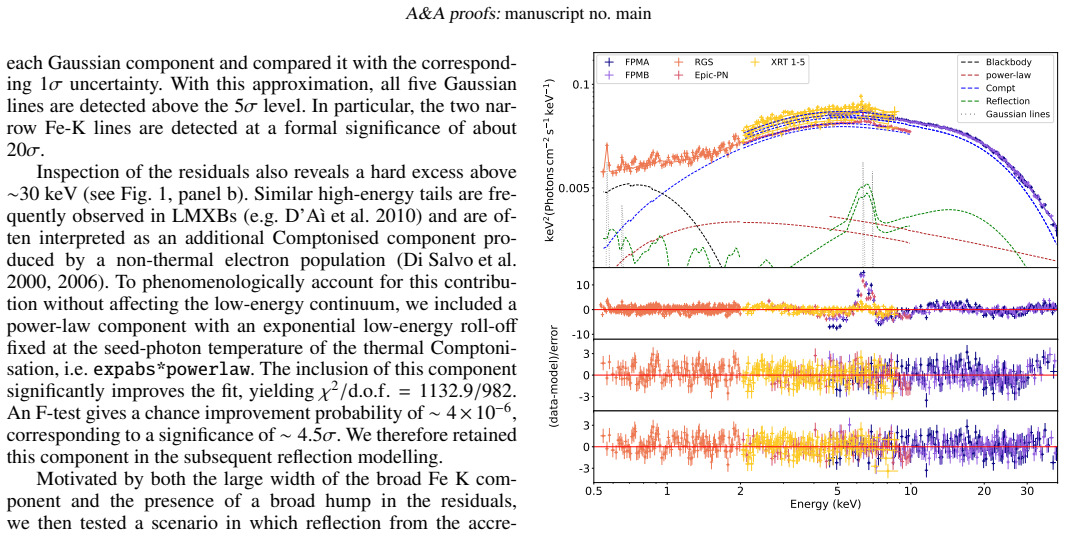
Accretion-disc corona sources are high-inclination low-mass X-ray binaries in which the innermost regions are hidden and the observed X-ray emission is dominated by radiation scattered above the disc. 4U 1822-37 is a key binary system of this class, but its geometry is still debated. X-ray polarimetry offers a direct probe of the scattering structure. We present the first X-ray spectro-polarimetric study of 4U 1822-37 and test whether its spectrum and polarisation can be explained within the accretion-disc-corona scenario. We analysed a coordinated campaign with IXPE, XMM-Newton, NuSTAR, and Swift. We performed broadband spectral modelling and model-independent, energy-resolved, and orbital-phase-resolved polarimetric analyses. The broadband spectrum requires a soft thermal component, a Comptonised continuum, a hard power-law tail, and relativistically blurred reflection. The observed 0.1-100 keV luminosity, $L_{\rm obs}\simeq6.1\times10^{36}\ {\rm erg\,s^{-1}}$, is far below the intrinsic luminosity expected from the orbital evolution, supporting a geometry in which only a small fraction of the intrinsic emission is scattered into the line of sight by an extended, optically thin corona. In the 2-8 keV band, IXPE measures ${\rm PD}=7.9\pm0.6\%$ and ${\rm PA}=-24^\circ\pm2^\circ$. The PD increases with energy, while the PA remains approximately constant. During eclipse, the PD decreases to ${\rm PD}=5.5\pm1.7\%$, with no significant PA variation. This behaviour is consistent with the companion occulting the most polarimetrically efficient part of the extended corona. The high PD, stable PA, energy-dependent polarisation, and eclipse behaviour support a picture in which 4U 1822-37 is observed in an extreme high-inclination, scattering-dominated regime. The extended corona is the main structure shaping both the observed X-ray emission and its polarisation.
Editorial analysis
A structured set of objections, weighed in public.
Referee Report
Summary. The manuscript presents the first IXPE spectro-polarimetric observations of the eclipsing ADC source 4U 1822-37, coordinated with XMM-Newton, NuSTAR and Swift. It reports a 2-8 keV polarization degree of 7.9±0.6% with position angle -24°±2°, an increase of PD with energy, stable PA, and a drop to PD=5.5±1.7% during eclipse. Broadband spectral modeling requires a soft thermal component, Comptonised continuum, hard tail and blurred reflection; the observed 0.1-100 keV luminosity of ~6.1×10^36 erg s^{-1} is stated to lie far below the value expected from orbital evolution, supporting an extreme high-inclination geometry in which an extended, optically thin corona scatters only a small fraction of the intrinsic emission into the line of sight. The authors conclude that the polarization properties and eclipse behaviour are consistent with this scattering-dominated ADC picture.
Significance. If the central interpretation holds, the work is significant as the first X-ray polarimetry of an ADC source, supplying direct geometric constraints on the extended corona that are independent of spectral modeling alone. The energy-dependent PD, stable PA and eclipse-induced change provide falsifiable tests of the scattering geometry. The multi-instrument campaign and phase-resolved analysis are clear strengths that enhance the robustness of the observational results.
major comments (1)
- [Abstract and discussion section] Abstract and discussion section: the claim that L_obs ≃ 6.1×10^36 erg s^{-1} lies far below the intrinsic luminosity expected from orbital evolution (invoked to justify the high-inclination, scattering-dominated geometry with an extended optically thin corona) lacks any explicit derivation. No values or references are given for the mass-transfer rate, accretion efficiency, distance, or conversion from binary parameters (orbital period, mass ratio) to expected L; without these the factor-of-~100 suppression remains an assertion rather than a quantified constraint and directly underpins the interpretation of the measured PD, PA stability and eclipse behaviour.
minor comments (3)
- [Data-reduction and analysis section] Data-reduction and analysis section: full details on IXPE background subtraction, systematic error budgets, and the precise definition of the orbital-phase bins used for the eclipse-resolved polarimetry should be supplied to permit independent verification of the reported PD values and their uncertainties.
- [Spectral modeling section] Spectral modeling section: the best-fit parameters, χ²/dof, and null-hypothesis probabilities for the broadband (0.1-100 keV) model (thermal + Comptonisation + hard tail + blurred reflection) must be tabulated so that the statistical quality of the continuum decomposition can be assessed.
- [Figure captions and text] Figure captions and text: ensure that all polarization spectra and light-curve panels explicitly label the energy ranges, number of bins, and whether the plotted uncertainties are statistical only or include systematics.
Simulated Author's Rebuttal
We thank the referee for their positive assessment of the significance of our work and for the constructive major comment. We address the point below and have revised the manuscript to provide the requested explicit derivation.
read point-by-point responses
-
Referee: [Abstract and discussion section] Abstract and discussion section: the claim that L_obs ≃ 6.1×10^36 erg s^{-1} lies far below the intrinsic luminosity expected from orbital evolution (invoked to justify the high-inclination, scattering-dominated geometry with an extended optically thin corona) lacks any explicit derivation. No values or references are given for the mass-transfer rate, accretion efficiency, distance, or conversion from binary parameters (orbital period, mass ratio) to expected L; without these the factor-of-~100 suppression remains an assertion rather than a quantified constraint and directly underpins the interpretation of the measured PD, PA stability and eclipse behaviour.
Authors: We agree that the manuscript is improved by making this comparison quantitative rather than qualitative. In the revised version we have added a new paragraph in the Discussion section that derives the expected intrinsic luminosity from the binary parameters. Using the orbital period of 5.57 h, mass ratio q ≈ 0.2, neutron-star mass 1.4 M_⊙ and standard angular-momentum-loss prescriptions (gravitational radiation plus magnetic braking; Rappaport et al. 1983; Verbunt & Zwaan 1981), we obtain a mass-transfer rate that, for an accretion efficiency of 0.1, corresponds to an intrinsic luminosity of order 5 × 10^37 – 10^38 erg s^{-1}. This yields a suppression factor of ~10–100 relative to the observed 0.1–100 keV luminosity of 6.1 × 10^36 erg s^{-1}, consistent with an extended, optically thin corona scattering only a small fraction of the central emission into the line of sight at high inclination. The relevant equations, numerical inputs and references have been included so that the geometric argument is now fully quantified. revision: yes
Circularity Check
No significant circularity; claims rest on direct observations compared to external orbital-evolution benchmark
full rationale
The paper's key inferences (high-inclination scattering-dominated geometry, extended corona as dominant structure) are drawn from measured quantities: observed PD = 7.9 ± 0.6 %, energy-dependent PD increase, stable PA, eclipse PD drop, and L_obs ≃ 6.1 × 10^36 erg s^{-1}. These are compared against an external expectation of intrinsic luminosity from orbital evolution, which is not derived or fitted inside the paper's equations. No step equates a reported prediction to a parameter adjusted to produce it, nor does any load-bearing premise reduce to a self-citation chain or self-definition. The derivation chain therefore remains self-contained against external benchmarks.
Axiom & Free-Parameter Ledger
axioms (1)
- domain assumption The intrinsic luminosity expected from the orbital evolution is much higher than the observed 0.1-100 keV luminosity of 6.1e36 erg/s.
Lean theorems connected to this paper
-
IndisputableMonolith/Foundation/Cost/FunctionalEquation.leanwashburn_uniqueness_aczel unclear?
unclearRelation between the paper passage and the cited Recognition theorem.
The observed 0.1-100 keV luminosity, L_obs ≃ 6.1×10^36 erg s^{-1}, is far below the intrinsic luminosity expected from the orbital evolution, supporting a geometry in which only a small fraction of the intrinsic emission is scattered into the line of sight by an extended, optically thin corona.
What do these tags mean?
- matches
- The paper's claim is directly supported by a theorem in the formal canon.
- supports
- The theorem supports part of the paper's argument, but the paper may add assumptions or extra steps.
- extends
- The paper goes beyond the formal theorem; the theorem is a base layer rather than the whole result.
- uses
- The paper appears to rely on the theorem as machinery.
- contradicts
- The paper's claim conflicts with a theorem or certificate in the canon.
- unclear
- Pith found a possible connection, but the passage is too broad, indirect, or ambiguous to say the theorem truly supports the claim.
Reference graph
Works this paper leans on
-
[1]
Confirmation of the presence of a CRSF in the NICER spectrum of X 1822-371. , keywords =. doi:10.1051/0004-6361/202345888 , archivePrefix =. 2401.03698 , primaryClass =
-
[2]
The detection of high X-ray polarization from an accretion disc corona source and its modelling via Monte Carlo radiation transfer simulation. , keywords =. doi:10.1093/mnras/stag498 , adsurl =
-
[3]
X-ray polarization from accretion disk winds. , keywords =. doi:10.1051/0004-6361/202453188 , archivePrefix =. 2411.18299 , primaryClass =
-
[4]
The Astrophysical Journal , author =
Aproximations to the radii of Roche lobes. , keywords =. doi:10.1086/160960 , adsurl =
-
[5]
The ``K-Correction'' for Irradiated Emission Lines in LMXBs: Evidence for a Massive Neutron Star in X1822-371 (V691 CrA). , keywords =. doi:10.1086/497420 , archivePrefix =. astro-ph/0508547 , primaryClass =
work page internal anchor Pith review Pith/arXiv arXiv doi:10.1086/497420
-
[6]
X-Ray Dips and Polarization Angle Swings in GX 13+1. , keywords =. doi:10.3847/2041-8213/ada7f8 , archivePrefix =. 2501.05511 , primaryClass =
-
[7]
2025, arXiv e-prints, arXiv:2512.13182
The First X-Ray Polarimetry of an Eclipsing Low-Mass X-Ray Binary: Serendipitous IXPE Observation of AX J1745.6-2901. arXiv e-prints , keywords =. doi:10.48550/arXiv.2512.13182 , archivePrefix =. 2512.13182 , primaryClass =
-
[8]
Astronomische Nachrichten , volume =
Di Marco, Alessandro and IXPE Science Team , title =. Astronomische Nachrichten , volume =. doi:https://doi.org/10.1002/asna.20240126 , url =. https://onlinelibrary.wiley.com/doi/pdf/10.1002/asna.20240126 , abstract =
-
[9]
Discovery of strongly variable X-ray polarization in the neutron star low-mass X-ray binary transient XTE J1701‒462. , keywords =. doi:10.1051/0004-6361/202346275 , archivePrefix =. 2306.10965 , primaryClass =
-
[10]
, year = 1976, month = apr, volume =
Arrival-time analysis for a pulsar in a binary system. , year = 1976, month = apr, volume =. doi:10.1086/154315 , adsurl =
-
[11]
Discovery of a variable energy-dependent X-ray polarization in the accreting neutron star GX 5 - 1. , keywords =. doi:10.1051/0004-6361/202347374 , archivePrefix =. 2310.06788 , primaryClass =
-
[12]
X-ray Polarimetry of X-ray Pulsars. Galaxies , keywords =. doi:10.3390/galaxies12040046 , archivePrefix =. 2408.04431 , primaryClass =
-
[13]
Journal of Astronomical Telescopes, Instruments, and Systems , keywords =
The Imaging X-Ray Polarimetry Explorer (IXPE): Pre-Launch. Journal of Astronomical Telescopes, Instruments, and Systems , keywords =. doi:10.1117/1.JATIS.8.2.026002 , archivePrefix =. 2112.01269 , primaryClass =
-
[14]
2023, arXiv e-prints, arXiv:2311.12516
Low Magnetic-Field Neutron Stars in X-ray Binaries. arXiv e-prints , keywords =. doi:10.48550/arXiv.2311.12516 , archivePrefix =. 2311.12516 , primaryClass =
-
[15]
Compton heated winds and coronae above accretion disks. I. Dynamics. , keywords =. doi:10.1086/161178 , adsurl =
-
[16]
Positions and identifications for galactic X-ray sources 2A 1822-371 and 2S 1254-690. , keywords =. doi:10.1038/276247a0 , adsurl =
-
[17]
The emission regions in X-ray binaries: dipping as a diagnostic
The emission regions in X-ray binaries: dipping as a diagnostic. Advances in Space Research , keywords =. doi:10.1016/S0273-1177(01)00415-X , archivePrefix =. astro-ph/0012411 , primaryClass =
work page internal anchor Pith review Pith/arXiv arXiv doi:10.1016/s0273-1177(01)00415-x
-
[18]
The European Photon Imaging Camera on XMM-Newton: The pn-CCD camera. , keywords =. doi:10.1051/0004-6361:20000066 , adsurl =
-
[19]
The Reflection Grating Spectrometer on board XMM-Newton. , keywords =. doi:10.1051/0004-6361:20000058 , adsurl =
-
[20]
XMM-Newton observatory. I. The spacecraft and operations. , keywords =. doi:10.1051/0004-6361:20000036 , adsurl =
-
[21]
, archivePrefix = "arXiv", eprint =
New ephemeris of the ADC source 2A 1822-371: a stable orbital-period derivative over 30 years. , archivePrefix = "arXiv", eprint =. doi:10.1051/0004-6361/200912881 , adsurl =
-
[22]
, archivePrefix = "arXiv", eprint =
Detailed study of the X-ray and optical/UV orbital ephemeris of X1822-371. , archivePrefix = "arXiv", eprint =. doi:10.1051/0004-6361/201117334 , adsurl =
-
[23]
Broad-band BeppoSAX observation of the low-mass X-ray binary X 1822-371. , eprint =
-
[24]
Orbital period variability in the eclipsing pulsar binary PSR B1957+20: Evidence for a tidally powered star. , keywords =. doi:10.1086/174906 , adsurl =
-
[25]
A mechanism for orbital period modulation in close binaries. , keywords =. doi:10.1086/170967 , adsurl =
-
[26]
The Evolution of X-ray Binariese , year = 1994, series =
An Ephemeris Update for X 1822-371. The Evolution of X-ray Binariese , year = 1994, series =. doi:10.1063/1.46038 , adsurl =
-
[27]
EXOSAT observations of X1822-371 - Modelling of the accretion disc rim. , keywords =. doi:10.1093/mnras/239.3.715 , adsurl =
-
[28]
Discovery of an X-Ray Pulsar in the Low-Mass X-Ray Binary 2A 1822-371. , eprint =. doi:10.1086/320510 , adsurl =
-
[29]
Detection of the X-ray-heated companion of X1822-371. , keywords =. doi:10.1093/mnras/285.4.673 , adsurl =
-
[30]
Infrared photometry of the X-ray binary 2A 1822-371 - A model for the ultraviolet, optical, and infrared light curve. , keywords =. doi:10.1086/160416 , adsurl =
-
[31]
, archivePrefix = "arXiv", eprint =
Phase-resolved optical and X-ray spectroscopy of low-mass X-ray binary X1822-371. , archivePrefix = "arXiv", eprint =. doi:10.1051/0004-6361/201118439 , adsurl =
-
[32]
The mass of the neutron star in the low-mass X-ray binary 2A 1822 - 371. , eprint =. doi:10.1046/j.1365-8711.2003.06193.x , adsurl =
-
[33]
, archivePrefix = "arXiv", eprint =
The X-ray pulsar 2A 1822-371 as a super-Eddington source. , archivePrefix = "arXiv", eprint =. doi:10.1093/mnras/stx491 , adsurl =
-
[34]
Accretion disk coronae. , keywords =. doi:10.1086/159991 , adsurl =
-
[35]
, archivePrefix = "arXiv", eprint =
Suzaku view of the neutron star in the dipping source 4U 1822-37. , archivePrefix = "arXiv", eprint =. doi:10.1093/pasj/psu002 , adsurl =
-
[36]
, archivePrefix = "arXiv", eprint =
A possible cyclotron resonance scattering feature near 0.7 keV in X1822-371. , archivePrefix = "arXiv", eprint =. doi:10.1051/0004-6361/201423402 , adsurl =
-
[37]
, archivePrefix = "arXiv", eprint =
The Structure of the Accretion Disk in the Accretion Disk Corona X-ray Binary 4U 1822-371 at Optical and Ultraviolet Wavelengths. , archivePrefix = "arXiv", eprint =. doi:10.1088/0004-637X/709/1/251 , adsurl =
-
[38]
Partially Absorbed Comptonization Spectrum from the Nearly Edge-on Source X1822-371. , eprint =. doi:10.1086/321645 , adsurl =
-
[39]
The Flared Disc Project: RXTE and ASCA observations of X 1822-371. , eprint =. doi:10.1046/j.1365-8711.2001.03946.x , adsurl =
-
[40]
Annual Review of Astronomy and Astrophysics , author =
Evolutionary Processes in Close Binary Systems. , year = 1971, volume = 9, pages =. doi:10.1146/annurev.aa.09.090171.001151 , adsurl =
-
[41]
Evolution of stars and stellar populations , author=. 2005 , publisher=
work page 2005
-
[42]
, archivePrefix = "arXiv", eprint =
A possible solution of the puzzling variation of the orbital period of MXB 1659-298. , archivePrefix = "arXiv", eprint =. doi:10.1093/mnras/stx2529 , adsurl =
-
[43]
Orbital and Spin Parameter Variations of Partial Eclipsing Low Mass X-Ray Binary X 1822-371. , keywords =. doi:10.3847/0004-637X/831/1/29 , adsurl =
-
[44]
, archivePrefix = "arXiv", eprint =
X-ray spectroscopy of the ADC source X1822-371 with Chandra and XMM-Newton. , archivePrefix = "arXiv", eprint =. doi:10.1051/0004-6361/201015305 , adsurl =
-
[45]
, archivePrefix = "arXiv", eprint =
On the timing properties of SAX J1808.4-3658 during its 2015 outburst. , archivePrefix = "arXiv", eprint =. doi:10.1093/mnras/stx1588 , adsurl =
-
[46]
The case of SAX J1808.4 - 3658
Evolutionary paths of binaries with a neutron star - I. The case of SAX J1808.4 - 3658. , archivePrefix = "arXiv", eprint =. doi:10.1093/mnras/sty1637 , adsurl =
-
[47]
Galactic Centre region, longitudes 345 to 6
New measurement of orbital and spin period evolution of the accretion disc corona source 4U 1822-37. , keywords =. doi:10.1111/j.1365-2966.2010.17336.x , adsurl =
-
[48]
An Empirical Background Model for the NICER X-Ray Timing Instrument. , keywords =. doi:10.3847/1538-3881/ac4ae6 , archivePrefix =. 2105.09901 , primaryClass =
-
[49]
On the Absorption of X-rays in the Interstellar Medium
On the Absorption of X-Rays in the Interstellar Medium. , keywords =. doi:10.1086/317016 , archivePrefix =. astro-ph/0008425 , primaryClass =
work page internal anchor Pith review Pith/arXiv arXiv doi:10.1086/317016
-
[50]
Space Telescopes and Instrumentation 2016: Ultraviolet to Gamma Ray , year = 2016, editor =
The Neutron star Interior Composition Explorer (NICER): design and development. Space Telescopes and Instrumentation 2016: Ultraviolet to Gamma Ray , year = 2016, editor =. doi:10.1117/12.2231304 , adsurl =
-
[51]
Updated orbital ephemeris of the ADC source X 1822-371: a stable orbital expansion over 40 years
Updated orbital ephemeris of the ADC source X 1822-371: a stable orbital expansion over 40 years. , keywords =. doi:10.1051/0004-6361/201935665 , archivePrefix =. 1905.03149 , primaryClass =
work page internal anchor Pith review Pith/arXiv arXiv doi:10.1051/0004-6361/201935665 1905
-
[52]
Comptonization of X-Rays in Plasma Clouds - Typical Radiation Spectra. , keywords =
-
[53]
Optimal binning of X-ray spectra and response matrix design
Optimal binning of X-ray spectra and response matrix design. , keywords =. doi:10.1051/0004-6361/201527395 , archivePrefix =. 1601.05309 , primaryClass =
work page internal anchor Pith review Pith/arXiv arXiv doi:10.1051/0004-6361/201527395
-
[54]
Atomic Data for Astrophysics. II. New Analytic FITS for Photoionization Cross Sections of Atoms and Ions. , keywords =. doi:10.1086/177435 , archivePrefix =. astro-ph/9601009 , primaryClass =
work page internal anchor Pith review Pith/arXiv arXiv doi:10.1086/177435
-
[55]
New observations of the cyclotron absorption feature in Hercules X-1. , keywords =. doi:10.1038/346250a0 , adsurl =
-
[56]
Accretion by rotating magnetic neutron stars. III. Accretion torques and period changes in pulsating X-ray sources. , keywords =. doi:10.1086/157498 , adsurl =
-
[57]
High-energy radiation from magnetized neutron stars
-
[58]
X-ray pulsar models. I. Angle-dependent cyclotron line formation and comptonization. , keywords =. doi:10.1086/163594 , adsurl =
-
[59]
Relativistic Iron Emission Lines in Neutron Star Low-Mass X-Ray Binaries as Probes of Neutron Star Radii. , keywords =. doi:10.1086/524936 , archivePrefix =. 0708.3615 , primaryClass =
work page internal anchor Pith review Pith/arXiv arXiv doi:10.1086/524936
-
[60]
Relativistic Lines and Reflection from the Inner Accretion Disks Around Neutron Stars
Relativistic Lines and Reflection from the Inner Accretion Disks Around Neutron Stars. , keywords =. doi:10.1088/0004-637X/720/1/205 , archivePrefix =. 0908.1098 , primaryClass =
work page internal anchor Pith review Pith/arXiv arXiv doi:10.1088/0004-637x/720/1/205
-
[61]
Hubble Space Telescope Photometry of the Metal-rich Globular Clusters NGC 6624 and NGC 6637. , keywords =. doi:10.1086/301461 , adsurl =
-
[62]
Astronomical Data Analysis Software and Systems V , year = 1996, editor =
XSPEC: The First Ten Years. Astronomical Data Analysis Software and Systems V , year = 1996, editor =
work page 1996
-
[63]
Generalized Comptonization Models and Application to the Recent High-Energy Observations. , keywords =. doi:10.1086/174760 , adsurl =
-
[64]
The Two-Phase Pair Corona Model for Active Galactic Nuclei and X-Ray Binaries: How to Obtain Exact Solutions. , keywords =. doi:10.1086/177865 , archivePrefix =. astro-ph/9605073 , primaryClass =
work page internal anchor Pith review Pith/arXiv arXiv doi:10.1086/177865
-
[65]
The Swift Gamma-Ray Burst Mission
The Swift Gamma-Ray Burst Mission. , keywords =. doi:10.1086/422091 , archivePrefix =. astro-ph/0405233 , primaryClass =
work page internal anchor Pith review Pith/arXiv arXiv doi:10.1086/422091
-
[66]
X-ray spectropolarimetry of the bright atoll Serpens X-1. , keywords =. doi:10.1051/0004-6361/202451584 , archivePrefix =. 2408.16713 , primaryClass =
-
[67]
On the disc reflection spectroscopy of NS LMXB Serpens X-1: analysis of a recent NuSTAR observation. , keywords =. doi:10.1093/mnras/staa1001 , archivePrefix =. 1907.08625 , primaryClass =
-
[68]
Multiple populations in globular clusters. Lessons learned from the Milky Way globular clusters
Multiple populations in globular clusters. Lessons learned from the Milky Way globular clusters. , keywords =. doi:10.1007/s00159-012-0050-3 , archivePrefix =. 1201.6526 , primaryClass =
work page internal anchor Pith review Pith/arXiv arXiv doi:10.1007/s00159-012-0050-3
-
[69]
The Evolutionary Status of 4U 1820-30. , keywords =. doi:10.1086/165778 , adsurl =
-
[70]
Next-generation Accretion Disk Reflection Model: High-density Plasma Effects. , keywords =. doi:10.3847/1538-4357/ad76a1 , archivePrefix =. 2409.00253 , primaryClass =
-
[71]
Photospheric radius expansion X-ray bursts as standard candles
Photospheric radius expansion X-ray bursts as standard candles. , keywords =. doi:10.1051/0004-6361:20021781 , archivePrefix =. astro-ph/0212028 , primaryClass =
work page internal anchor Pith review Pith/arXiv arXiv doi:10.1051/0004-6361:20021781
-
[72]
The Discovery of 15--30 Hertz Quasi-periodic Oscillations in the X-Ray flux of 4U 1820-30. , keywords =. doi:10.1086/184859 , adsurl =
-
[73]
A self-consistent approach to the hard and soft states of 4U 1705-44
A self-consistent approach to the hard and soft states of 4U 1705-44. , keywords =. doi:10.1051/0004-6361/200913758 , archivePrefix =. 1004.1963 , primaryClass =
work page internal anchor Pith review Pith/arXiv arXiv doi:10.1051/0004-6361/200913758 1963
-
[74]
INTEGRAL spectral variability study of the atoll 4U 1820-30: first detection of hard X-ray emission
INTEGRAL Spectral Variability Study of the Atoll 4U 1820-30: First Detection of Hard X-Ray Emission. , keywords =. doi:10.1086/508744 , archivePrefix =. astro-ph/0608599 , primaryClass =
work page internal anchor Pith review Pith/arXiv arXiv doi:10.1086/508744
-
[75]
The accretion/ejection link in the neutron star X-ray binary 4U 1820-30 I: a boundary layer-jet coupling?. , keywords =. doi:10.1093/mnras/stad2386 , archivePrefix =. 2307.16566 , primaryClass =
-
[76]
Advances in Space Research , keywords =
Ultra-compact and X-ray binaries in globular clusters. Advances in Space Research , keywords =. doi:10.1016/0273-1177(88)90455-3 , adsurl =
-
[77]
Broad-band -ray and X-ray spectra of NGC 4151 and their implications for physical processes and geometry. , keywords =. doi:10.1093/mnras/283.1.193 , archivePrefix =. astro-ph/9607015 , primaryClass =
work page internal anchor Pith review Pith/arXiv arXiv doi:10.1093/mnras/283.1.193
-
[78]
Broad-band Spectral Evolution of Scorpius X-1 along its Color-Color Diagram
Broadband Spectral Evolution of Scorpius X-1 along Its Color-Color Diagram. , keywords =. doi:10.1086/519944 , archivePrefix =. 0705.4172 , primaryClass =
work page internal anchor Pith review Pith/arXiv arXiv doi:10.1086/519944
-
[79]
Fabian, A. C. and Iwasawa, K. and Reynolds, C. S. and Young, A. J. , year=. Broad Iron Lines in Active Galactic Nuclei , volume=. Publications of the Astronomical Society of the Pacific , publisher=. doi:10.1086/316610 , number=
-
[80]
On the Spectral Hardening Factor of the X-Ray Emission from Accretion Disks in Black Hole Candidates. , keywords =. doi:10.1086/175740 , adsurl =
discussion (0)
Sign in with ORCID, Apple, or X to comment. Anyone can read and Pith papers without signing in.