Geometry-Dependent Crack Interaction and Toughening in Graphene
Pith reviewed 2026-05-20 03:51 UTC · model grok-4.3
The pith
Wider parallel cracks in graphene can more than double toughness and fracture strain by controlling spacing.
A machine-rendered reading of the paper's core claim, the machinery that carries it, and where it could break.
Core claim
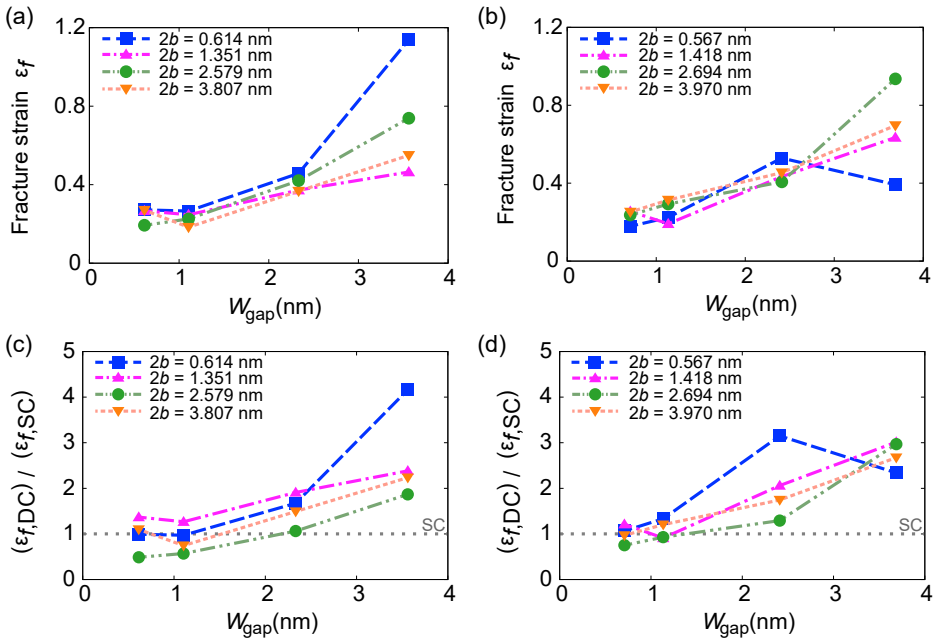
Increasing crack width amplifies the sensitivity of mechanical properties to crack spacing, leading to significant enhancement of peak stress, fracture strain, and toughness at sufficiently large W_gap. For narrow cracks, crack coalescence dominates and causes brittle failure. In contrast, wider cracks promote delayed ligament rupture, increased energy absorption and ductile-like fracture behavior. The normalized toughness and fracture strain exceed those of equivalent single-crack systems by more than twofold. A crack-geometry design map is proposed to identify regimes of crack coalescence, independent propagation, and enhanced toughness.
What carries the argument
The geometry-dependent interaction between crack width and inter-crack spacing that controls whether cracks coalesce, propagate independently, or enhance toughness through delayed ligament rupture.
If this is right
- Mechanical properties show greater sensitivity to spacing with increasing crack width.
- Significant enhancement of peak stress, fracture strain, and toughness occurs at large W_gap for wider cracks.
- Normalized toughness and fracture strain exceed single-crack systems by more than twofold.
- Wider cracks lead to ductile-like fracture via delayed ligament rupture instead of brittle coalescence.
Where Pith is reading between the lines
- This suggests that deliberate introduction of specific crack patterns could be a route to tougher graphene structures without changing chemistry.
- Similar principles might apply to designing fracture behavior in other layered or 2D materials.
- The design map offers a way to predict and avoid unwanted brittle failure in defective graphene sheets.
Load-bearing premise
The computer simulations used faithfully represent the actual atomic-scale crack behavior and energy dissipation mechanisms present in real graphene samples.
What would settle it
Tensile testing of graphene with lithographically defined parallel cracks of different widths and spacings, verifying if the toughness is more than twice as high as single-crack samples when spacing is large.
Figures


read the original abstract
The interaction between neighboring cracks has been shown to strongly influence the fracture behavior of graphene. While previous studies focused primarily on crack spacing, the role of crack width remains poorly understood. Here, computational simulations are performed to investigate the coupled effects of crack width and inter-crack spacing $(W_\text{gap})$ on the tensile response of graphene containing parallel cracks. The results show that increasing crack width amplifies the sensitivity of mechanical properties to crack spacing, leading to significant enhancement of peak stress, fracture strain, and toughness at sufficiently large $W_\text{gap}$. For narrow cracks, crack coalescence dominates and causes brittle failure. In contrast, wider cracks promote delayed ligament rupture, increased energy absorption and ductile-like fracture behavior. The normalized toughness and fracture strain exceed those of equivalent single-crack systems by more than twofold. A crack-geometry design map is proposed to identify regimes of crack coalescence, independent propagation, and enhanced toughness.
Editorial analysis
A structured set of objections, weighed in public.
Referee Report
Summary. The paper uses computational simulations to examine how crack width and inter-crack spacing (W_gap) jointly control the tensile response of graphene sheets containing parallel cracks. It reports that wider cracks heighten sensitivity to spacing, producing regimes of crack coalescence (brittle failure for narrow cracks) versus delayed ligament rupture (ductile-like behavior and higher energy absorption for wider cracks). At sufficiently large W_gap the normalized toughness and fracture strain are stated to exceed those of equivalent single-crack systems by more than a factor of two; a crack-geometry design map is proposed to delineate coalescence, independent propagation, and toughening regimes.
Significance. If the reported geometry-driven toughening is robust, the work supplies a concrete design rule for engineering defect patterns that can more than double fracture strain and toughness in graphene without changing material chemistry. The proposed design map could be useful for guiding defect placement in 2D-material membranes or composites. The study is grounded in direct simulation outputs rather than fitted parameters.
major comments (3)
- [Methods] Methods section: the interatomic potential, thermostat, strain rate, and periodic-boundary treatment are not specified, nor are any sensitivity or convergence tests with respect to these choices reported. Because the headline twofold toughness enhancement and the coalescence-to-ligament-rupture transition are known to vary with potential (AIREBO vs. ReaxFF) and loading protocol, this omission directly affects the reliability of the quantitative claims.
- [Results] Results, toughness and fracture-strain plots: no error bars, ensemble averages, or system-size scaling data are shown for the reported >2× normalized values. Without these, it is impossible to judge whether the enhancement is statistically significant or an artifact of finite-size or rate effects.
- [Discussion] Discussion of ductile-like behavior: the attribution of increased energy absorption to delayed ligament rupture is presented without explicit checks against single-crack reference simulations performed under identical boundary conditions and loading rates. This comparison is load-bearing for the claim that the enhancement is geometry-induced rather than simulation-protocol-induced.
minor comments (2)
- [Abstract and Figures] Notation for W_gap is introduced in the abstract but the precise geometric definition (edge-to-edge distance, center-to-center, etc.) is not restated in the figure captions or methods, which could confuse readers.
- [Conclusion] The design map is described qualitatively; adding a quantitative boundary (e.g., critical W_gap/W_crack ratio) would make the map more immediately usable.
Simulated Author's Rebuttal
We thank the referee for their careful and constructive review. The comments highlight important aspects of clarity and robustness that we will address in the revision. Below we respond point by point to the major comments.
read point-by-point responses
-
Referee: [Methods] Methods section: the interatomic potential, thermostat, strain rate, and periodic-boundary treatment are not specified, nor are any sensitivity or convergence tests with respect to these choices reported. Because the headline twofold toughness enhancement and the coalescence-to-ligament-rupture transition are known to vary with potential (AIREBO vs. ReaxFF) and loading protocol, this omission directly affects the reliability of the quantitative claims.
Authors: We agree that the Methods section in the submitted manuscript was insufficiently detailed. In the revised version we will add an explicit Methods subsection specifying the interatomic potential (AIREBO), thermostat, strain rate, and periodic-boundary implementation. We will also include convergence and sensitivity tests with respect to these parameters to confirm that the reported toughness values and the coalescence-to-rupture transition remain robust. revision: yes
-
Referee: [Results] Results, toughness and fracture-strain plots: no error bars, ensemble averages, or system-size scaling data are shown for the reported >2× normalized values. Without these, it is impossible to judge whether the enhancement is statistically significant or an artifact of finite-size or rate effects.
Authors: We acknowledge the absence of statistical measures in the original plots. In the revision we will perform additional independent simulations to compute ensemble averages and will add error bars to the toughness and fracture-strain data. A brief discussion of system-size scaling will also be included to address possible finite-size or rate artifacts. revision: yes
-
Referee: [Discussion] Discussion of ductile-like behavior: the attribution of increased energy absorption to delayed ligament rupture is presented without explicit checks against single-crack reference simulations performed under identical boundary conditions and loading rates. This comparison is load-bearing for the claim that the enhancement is geometry-induced rather than simulation-protocol-induced.
Authors: The manuscript already contains comparisons to single-crack reference cases, but we accept that these were not presented with sufficient explicitness regarding identical protocols. In the revised manuscript we will add a dedicated paragraph and, if space permits, a supplementary figure that directly overlays multi-crack and single-crack results obtained under the same boundary conditions and loading rates, thereby confirming that the observed toughening is geometry-driven. revision: yes
Circularity Check
No significant circularity in simulation-based results
full rationale
The paper reports results exclusively from computational simulations of crack interactions in graphene, with claims about normalized toughness exceeding single-crack baselines by more than twofold presented as direct outputs of those simulations. No mathematical derivation chain, equations, parameter fits, or self-citations are invoked that would reduce the reported enhancements or design map to inputs by construction. The central findings rest on the modeling assumptions rather than any self-referential logic, rendering the work self-contained against external benchmarks.
Axiom & Free-Parameter Ledger
axioms (1)
- domain assumption The chosen computational model (interatomic potential and simulation protocol) accurately captures the physics of crack interaction and energy dissipation in graphene.
Lean theorems connected to this paper
-
IndisputableMonolith/Cost/FunctionalEquation.leanwashburn_uniqueness_aczel unclear?
unclearRelation between the paper passage and the cited Recognition theorem.
molecular dynamics simulations based on the reactive force field (ReaxFF) are performed to investigate the coupled effects of crack width (2b) and inter-crack spacing (W_gap) on the fracture behavior of graphene containing parallel cracks
-
IndisputableMonolith/Foundation/AlexanderDuality.leanalexander_duality_circle_linking unclear?
unclearRelation between the paper passage and the cited Recognition theorem.
The normalized toughness and fracture strain exceed those of equivalent single-crack systems by more than twofold
What do these tags mean?
- matches
- The paper's claim is directly supported by a theorem in the formal canon.
- supports
- The theorem supports part of the paper's argument, but the paper may add assumptions or extra steps.
- extends
- The paper goes beyond the formal theorem; the theorem is a base layer rather than the whole result.
- uses
- The paper appears to rely on the theorem as machinery.
- contradicts
- The paper's claim conflicts with a theorem or certificate in the canon.
- unclear
- Pith found a possible connection, but the passage is too broad, indirect, or ambiguous to say the theorem truly supports the claim.
Reference graph
Works this paper leans on
-
[1]
E. Quesnel, F. Roux, F. Emieux, P. Faucherand, E. Kymakis, G. Volonakis, F. Giustino, B. Martín-García, I. Moreels, S. A. Gürsel, et al., Graphene-based technologies for energy applications, challenges and perspectives, 2D Materials 2 (3) (2015) 030204. doi:https://doi.org/10.1088/2053-1583/2/3/030204
-
[2]
T.-H. Han, H. Kim, S.-J. Kwon, T.-W. Lee, Graphene-based flexible electronic devices, Materials Science and Engineering: R: Reports 118 (2017) 1–43.doi:https://doi. org/10.1016/j.mser.2017.05.001
-
[3]
V. Dhinakaran, M. Lavanya, K. Vigneswari, M. Ravichandran, M. Vijayakumar, Review on exploration of graphene in diverse applications and its future horizon, Materials To- day: Proceedings 27 (2020) 824–828.doi:https://doi.org/10.1016/j.matpr.2019. 12.369
-
[4]
L. Lin, J. Zhang, H. Su, J. Li, L. Sun, Z. Wang, F. Xu, C. Liu, S. Lopatin, Y. Zhu, K. Jia, S. Chen, D. Rui, J. Sun, R. Xue, P. Gao, N. Kang, Y. Han, H. Q. Xu, Y. Cao, K. S. Novoselov, Z. Tian, B. Ren, H. Peng, Z. Liu, Towards super-clean graphene, Nature Communications 10 (1) (2019) 1912.doi:https://doi.org/10. 1038/s41467-019-09565-4
work page 2019
-
[5]
P. Bøggild, Research on scalable graphene faces a reproducibility gap, Nature Commu- nications 14 (1) (2023) 1126.doi:https://doi.org/10.1038/s41467-023-36891-5
-
[6]
P. V. Pham, T.-H. Mai, S. P. Dash, V. Biju, Y.-L. Chueh, D. Jariwala, V. Tung, Transfer of 2d films: From imperfection to perfection, ACS Nano 18 (23) (2024) 14841–14876. doi:https://doi.org/10.1021/acsnano.4c00590. 22
-
[7]
M. D. Bhatt, H. Kim, G. Kim, Various defects in graphene: a review, RSC Adv. 12 (2022) 21520–21547.doi:https://doi.org/10.1039/D2RA01436J
-
[8]
D. Li, Y. Zhang, J. Guo, J. Zhu, Q. Liu, N. Ni, J. Yan, Fracture behavior of graphene with intrinsic defects and externally introduced defects, Engineering Fracture Mechanics 303 (2024) 110130.doi:https://doi.org/10.1016/j.engfracmech.2024.110130
-
[9]
L. Hu, S. Wyant, A. R. Muniz, A. Ramasubramaniam, D. Maroudas, Mechanical be- havior and fracture of graphene nanomeshes, Journal of Applied Physics 117 (2) (2015) 024302.doi:https://doi.org/10.1063/1.4905583
-
[10]
M. Dewapriya, S. Meguid, Atomistic simulations of nanoscale crack-vacancy interaction in graphene, Carbon 125 (2017) 113–131.doi:https://doi.org/10.1016/j.carbon. 2017.09.015
-
[11]
M. Dewapriya, S. Meguid, R. Rajapakse, Atomistic modelling of crack-inclusion inter- action in graphene, Engineering Fracture Mechanics 195 (2018) 92–103.doi:https: //doi.org/10.1016/j.engfracmech.2018.04.003
-
[12]
M.Dewapriya, S.Meguid, Tailoringfracturestrengthofgraphene, ComputationalMate- rialsScience141(2018)114–121.doi:https://doi.org/10.1016/j.commatsci.2017. 09.005
- [13]
-
[14]
M. Chen, A. M. Christmann, A. R. Muniz, A. Ramasubramaniam, D. Maroudas, Molecular-dynamics analysis of nanoindentation of graphene nanomeshes: Implications for 2d mechanical metamaterials, ACS Applied Nano Materials 3 (4) (2020) 3613–3624. doi:https://doi.org/10.1021/acsanm.0c00327
-
[15]
N. R. Brodnik, S. Brach, C. M. Long, G. Ravichandran, B. Bourdin, K. T. Faber, K. Bhattacharya, Fracture diodes: Directional asymmetry of fracture toughness, Phys. 23 Rev. Lett. 126 (2021) 025503.doi:https://doi.org/10.1103/PhysRevLett.126. 025503
-
[16]
L. C. Felix, D. S. Galvao, Guided fractures in graphene mechanical diode-like structures, Phys. Chem. Chem. Phys. 24 (2022) 13905–13910.doi:https://doi.org/10.1039/ D2CP01207C
work page 2022
-
[17]
Y. I. Jhon, Y. M. Jhon, G. Y. Yeom, M. S. Jhon, Orientation dependence of the fracture behavior of graphene, Carbon 66 (2014) 619–628.doi:https://doi.org/10.1016/j. carbon.2013.09.051
work page doi:10.1016/j 2014
-
[18]
M. Fujihara, R. Inoue, R. Kurita, T. Taniuchi, Y. Motoyui, S. Shin, F. Komori, Y. Maniwa, H. Shinohara, Y. Miyata, Selective formation of zigzag edges in graphene cracks, ACS Nano 9 (9) (2015) 9027–9033.doi:https://doi.org/10.1021/acsnano. 5b03079
-
[19]
A. Zandiatashbar, G.-H. Lee, S. J. An, S. Lee, N. Mathew, M. Terrones, T. Hayashi, C. R. Picu, J. Hone, N. Koratkar, Effect of defects on the intrinsic strength and stiffness of graphene, Nature Communications 5 (1) (2014) 3186.doi:https://doi.org/10. 1038/ncomms4186
work page 2014
-
[20]
Y. Liu, J.-G. Guo, Z.-N. Zhao, Effect and regulation of pore defects on mechanical properties of graphene, Journal of Physics and Chemistry of Solids 206 (2025) 112870. doi:https://doi.org/10.1016/j.jpcs.2025.112870
- [21]
-
[22]
G. López-Polín, J. Gómez-Herrero, C. Gómez-Navarro, Confining crack propagation in defective graphene, Nano Lett. 15 (3) (2015) 2050–2054.doi:https://doi.org/10. 1021/nl504936q
work page 2015
-
[23]
F. Meng, C. Chen, J. Song, Dislocation shielding of a nanocrack in graphene: Atomistic 24 simulations and continuum modeling, J. Phys. Chem. Lett. 6 (20) (2015) 4038–4042. doi:https://doi.org/10.1021/acs.jpclett.5b01815
-
[24]
S. Jin, J.-W. Hong, C. Daraio, A. F. Fonseca, Abnormal crack coalescence and ductility in graphene, International Journal of Mechanical Sciences 309 (2026) 111025.doi: https://doi.org/10.1016/j.ijmecsci.2025.111025
-
[25]
A. C. T. van Duin, S. Dasgupta, F. Lorant, W. A. Goddard, Reaxff: A reactive force field for hydrocarbons, The Journal of Physical Chemistry A 105 (41) (2001) 9396–9409. doi:https://doi.org/10.1021/jp004368u
-
[26]
A. P. Thompson, H. M. Aktulga, R. Berger, D. S. Bolintineanu, W. M. Brown, P. S. Crozier, P. J. in ’t Veld, A. Kohlmeyer, S. G. Moore, T. D. Nguyen, R. Shan, M. J. Stevens, J. Tranchida, C. Trott, S. J. Plimpton, Lammps - a flexible simulation tool for particle-based materials modeling at the atomic, meso, and continuum scales, Computer Physics Communicat...
-
[27]
K. Chenoweth, A. C. T. van Duin, W. A. Goddard, Reaxff reactive force field for molec- ular dynamics simulations of hydrocarbon oxidation, The Journal of Physical Chemistry A 112 (5) (2008) 1040–1053.doi:https://doi.org/10.1021/jp709896w. Author contributions Suyeong Jin: Conceptualization, Visualization, Methodology, Investigation, Formal analysis, Data ...
discussion (0)
Sign in with ORCID, Apple, or X to comment. Anyone can read and Pith papers without signing in.