Non-equilibrium quantum dynamics of interacting integrable models by Monte Carlo sampling Lehmann representations
Pith reviewed 2026-05-20 03:47 UTC · model grok-4.3
The pith
A Monte Carlo sampling scheme evaluates the Lehmann representation to compute time-dependent local observables after quantum quenches in integrable models.
A machine-rendered reading of the paper's core claim, the machinery that carries it, and where it could break.
Core claim
We present a Monte Carlo sampling scheme that numerically evaluates the Lehmann representation for time-dependent expectation values of local operators, allowing us to access system sizes and times significantly beyond the reach of existing methods. The approach accommodates both the full Lehmann sum and the Quench Action formalism. We benchmark against exact results for non-interacting lattice and continuum models and short-time results at weak interactions, finding excellent agreement. We apply the method to quantum quenches from a Bose-Einstein condensate in the repulsive Lieb-Liniger model and determine the time evolution of the order parameter for a wide range of interaction strengths.
What carries the argument
Monte Carlo sampling of the Lehmann sum (or Quench Action) applied to local observables
If this is right
- The method extends the reachable scales for computing local operator dynamics after quenches in integrable models.
- It yields the order-parameter time evolution in the Lieb-Liniger gas for arbitrary interaction strengths.
- It identifies regimes where a sign problem appears for broader classes of dynamical correlators.
- The same sampling framework can be applied to both full Lehmann sums and Quench Action calculations.
Where Pith is reading between the lines
- The technique could be used to test predictions for relaxation toward generalized Gibbs ensembles in systems too large for exact diagonalization.
- Similar sampling ideas might be adapted to track local observables in quenches that break integrability weakly.
- Efficiency gains could allow systematic studies of finite-size effects on prethermalization plateaus.
Load-bearing premise
The Monte Carlo sampling of the Lehmann sum remains efficient and sign-problem free for the local observables and interaction regimes studied.
What would settle it
Numerical evidence that the Monte Carlo estimator variance grows exponentially with system size or time for local operators in the Lieb-Liniger model at moderate interactions would falsify the claimed efficiency and scalability.
Figures
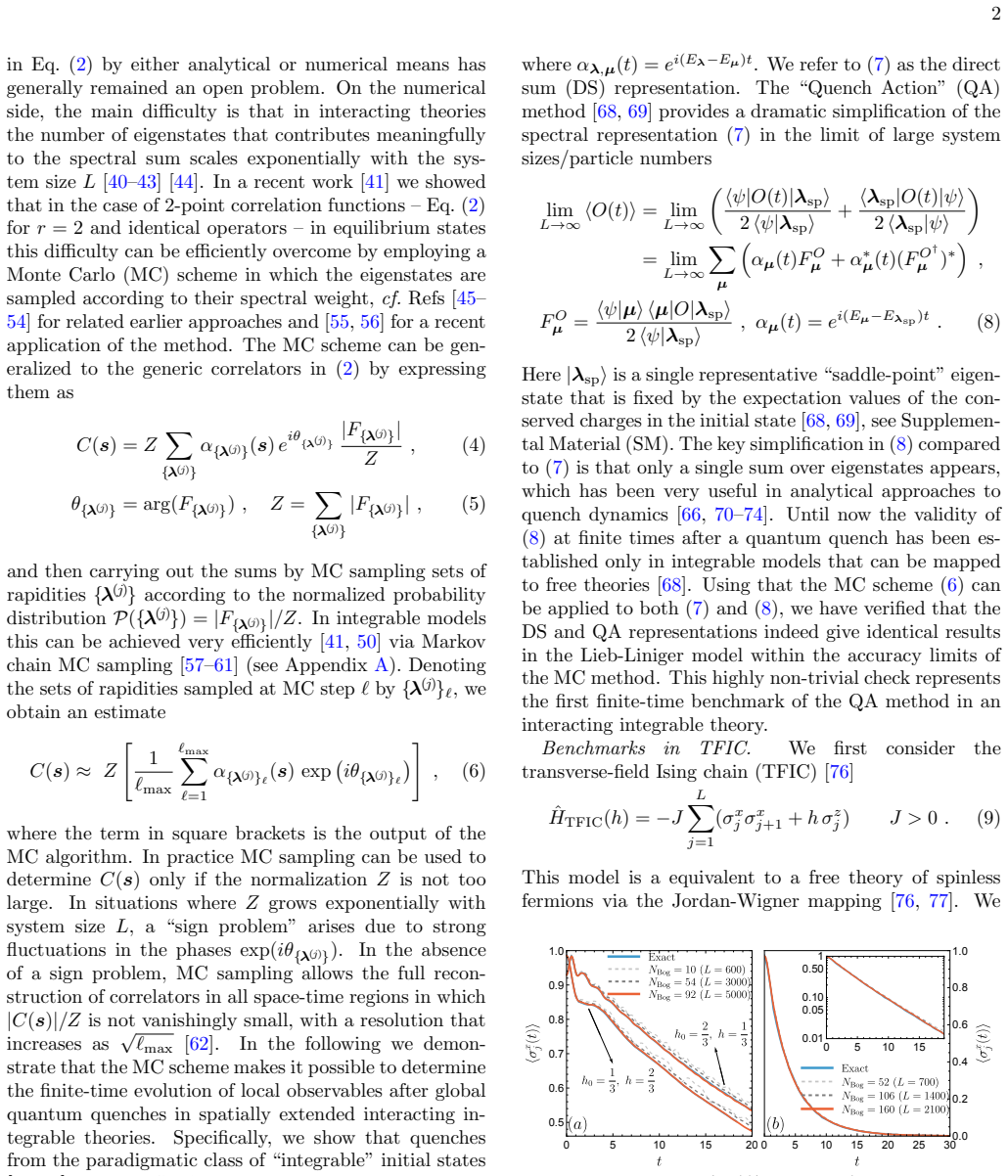


read the original abstract
Determining the dynamics of interacting integrable many-particle quantum systems at finite times after homogeneous quantum quenches is a long-standing challenge. We present a Monte Carlo sampling scheme that numerically evaluates the Lehmann representation for time-dependent expectation values of local operators, allowing us to access system sizes and times significantly beyond the reach of existing methods. The approach accommodates both the full Lehmann sum and the Quench Action formalism. We benchmark against exact results for non-interacting lattice and continuum models and short-time results at weak interactions, finding excellent agreement. We apply the method to quantum quenches from a Bose-Einstein condensate in the repulsive Lieb-Liniger model and determine the time evolution of the order parameter for a wide range of interaction strengths. We discuss the emergence of a "sign problem" for more general dynamical correlators and setups.
Editorial analysis
A structured set of objections, weighed in public.
Referee Report
Summary. The manuscript introduces a Monte Carlo sampling scheme to numerically evaluate the Lehmann representation (and Quench Action formalism) for time-dependent expectation values of local operators after homogeneous quenches in interacting integrable models. It reports benchmarks showing excellent agreement with exact results for non-interacting lattice and continuum models as well as short-time weak-interaction regimes, followed by an application to the order-parameter dynamics in the repulsive Lieb-Liniger model after a quench from a Bose-Einstein condensate. Limitations such as the emergence of a sign problem for more general dynamical correlators are explicitly discussed.
Significance. If the central numerical method holds, the work provides a practical route to system sizes and evolution times beyond the reach of existing techniques for local observables in integrable systems. The parameter-free benchmarks against independent exact solutions and the transparent treatment of the sign-problem limitation constitute clear strengths that support the method's utility for the targeted class of problems.
minor comments (2)
- The relation between the full Lehmann sum and the Quench Action implementation could be stated more explicitly in the methods section to aid readers unfamiliar with the latter formalism.
- Figure captions for the Lieb-Liniger results should include the precise range of interaction strengths and the number of Monte Carlo samples used to allow direct reproducibility assessment.
Simulated Author's Rebuttal
We thank the referee for their positive assessment of the manuscript, recognition of its strengths in benchmarks and transparent discussion of limitations, and recommendation to accept.
Circularity Check
No significant circularity identified
full rationale
The paper introduces a Monte Carlo sampling algorithm to evaluate the Lehmann representation (or Quench Action) for time-dependent local operator expectations after quenches in integrable models. Its central claim is the existence and efficiency of this numerical scheme for the targeted class of observables, which is directly benchmarked against independent exact solutions for non-interacting lattice and continuum cases plus short-time weak-interaction analytics. No load-bearing step reduces by construction to a fitted parameter, self-citation chain, or ansatz smuggled from prior work by the same authors; the reported quantities are obtained from the sampling procedure itself and cross-validated externally rather than being equivalent to the inputs by definition.
Axiom & Free-Parameter Ledger
axioms (2)
- standard math The Lehmann representation converges to the correct time-dependent expectation value when summed over the complete basis of eigenstates.
- domain assumption Integrability permits an efficient representation of the post-quench state via the Quench Action formalism.
Lean theorems connected to this paper
-
IndisputableMonolith/Cost/FunctionalEquation.leanwashburn_uniqueness_aczel unclear?
unclearRelation between the paper passage and the cited Recognition theorem.
We present a Monte Carlo sampling scheme that numerically evaluates the Lehmann representation for time-dependent expectation values of local operators
What do these tags mean?
- matches
- The paper's claim is directly supported by a theorem in the formal canon.
- supports
- The theorem supports part of the paper's argument, but the paper may add assumptions or extra steps.
- extends
- The paper goes beyond the formal theorem; the theorem is a base layer rather than the whole result.
- uses
- The paper appears to rely on the theorem as machinery.
- contradicts
- The paper's claim conflicts with a theorem or certificate in the canon.
- unclear
- Pith found a possible connection, but the passage is too broad, indirect, or ambiguous to say the theorem truly supports the claim.
Reference graph
Works this paper leans on
-
[1]
Tuned the values of the free parameters in the MC schemes such to always have an average acceptance rate close to or higher than 10%. In particular, settingQ∈[2,10] (relevant for both QA and DS), ∆∈[2,6] (DS) andp ph = [0.7,0.9] (DS) always leads to accurate sampling of the stationary distributionP({λ (j)}) =|F {λ(j)}|/Z
-
[2]
Verified convergence with the choices of UV cutoffs (needed in LL because it is a field theory) on the maximal allowed (half-odd) integers in the sampling. For example, we verified that the cutoffs chosen were sufficiently high that integers in the sampling never reach them
-
[3]
Once reached, the distribution appears to be stationary
Verified that irrespective of the initial sets{λ (j)}1 chosen, the Markov chain always converges towards the same distribution after a sufficiently large number of stepsℓ. Once reached, the distribution appears to be stationary. These checks were achieved by monitoring the sampled values ofg {λ(j) } like in Fig. 4 (main text) and Fig. S5, or those for the...
-
[4]
We setℓ burn-in to be 1/11 of the total number of MC stepsℓ burn-in +ℓ max
Always discarded a “burn-in” number of initial MC stepsℓ, to allow time for the Markov chain to reach the stationary distribution. We setℓ burn-in to be 1/11 of the total number of MC stepsℓ burn-in +ℓ max. 18
-
[5]
Extracted the statistical uncertainty on the MC results by computing the standard error on the mean (at each timet) associated with the output ofCMarkov chains run in parallel (we verified that the statistical fluctuations are well fitted by normal distributions). Usually we setC∈[50,200]. The uncertainties obtained were negligible in all regimes of physi...
-
[6]
We need to separate the contribution of diagonal matrix elements (⟨λsp|ϕ†(x)ϕ(0)|λsp⟩) from that of off-diagonal ones (⟨µ|ϕ †(x)ϕ(0)|λsp⟩for|µ⟩ ̸=|λ sp⟩). This is achieved by settingP(µ=λ sp) = 0 in the Metropolis acceptance step, and estimating the correlator as ⟨ψ(t)|ϕ†(x)ϕ(0)|ψ(t)⟩ − →e −2|x| + N L −e −2|x| YMC(t) ,(S114) whereY MC(t) indicates the out...
-
[7]
This is very similar to the caseh 0 > hof TFIC, see Section IV.B
We observe that even thoughf µ,λ(x) can be either positive or negative, it is positive for the vast majority of the eigenstates sampled (no sign problem). This is very similar to the caseh 0 > hof TFIC, see Section IV.B
-
[8]
The saddle-point eigenstate|λ sp⟩is constructed as in Section V.A. However, due to the very slow∼λ −2 decay of the QA saddle-point root density atc=∞(see Section V.A), which must be contrasted with the∼λ −4 decay of the interacting case 0< c <∞, the set of positive integers{J j}defining|λ sp⟩for largeLincludes very large integers. We find that this enhanc...
-
[9]
The eact result for (S112) of Ref. [63] in terms of a difference of Fredholm determinants can be evaluated by standard numerical methods based on quadrature rules [67]. Fixingx= 5, we employ a Gauss-Legendre quadrature grid with several thousands of point to reach convergence (up ton= 8000). The cutoff is varied in the rangeλ max ∈[200,600] to check conve...
-
[10]
V. E. Korepin, N. M. Bogoliubov, and A. G. Izergin,Quantum Inverse Scattering Method and Correlation Functions, 1st ed. (Cambridge University Press, 1993)
work page 1993
-
[11]
Takahashi,Thermodynamics of One-Dimensional Solvable Models, 1st ed
M. Takahashi,Thermodynamics of One-Dimensional Solvable Models, 1st ed. (Cambridge University Press, 1999)
work page 1999
-
[12]
This represents the integrable analogue of the diagonal ETH
-
[13]
C. N. Yang and C. P. Yang, Journal of Mathematical Physics10, 1115 (1969)
work page 1969
-
[14]
J. Mossel and J.-S. Caux, Journal of Physics A: Mathematical and Theoretical45, 255001 (2012)
work page 2012
- [15]
-
[16]
Caux, Journal of Statistical Mechanics: Theory and Experiment2016, 064006 (2016)
J.-S. Caux, Journal of Statistical Mechanics: Theory and Experiment2016, 064006 (2016)
work page 2016
-
[17]
M. Brockmann, J. De Nardis, B. Wouters, and J.-S. Caux, Journal of Physics A: Mathematical and Theoretical47, 145003 (2014)
work page 2014
-
[18]
J. De Nardis, B. Wouters, M. Brockmann, and J.-S. Caux, Physical Review A89, 033601 (2014)
work page 2014
-
[19]
B. Pozsgay, M. Mesty´ an, M. Werner, M. Kormos, G. Zar´ and, and G. Tak´ acs, Physical Review Letters113, 117203 (2014)
work page 2014
-
[20]
B. Wouters, J. De Nardis, M. Brockmann, D. Fioretto, M. Rigol, and J.-S. Caux, Physical Review Letters113, 117202 (2014)
work page 2014
-
[21]
B. Bertini, E. Tartaglia, and P. Calabrese, Journal of Statistical Mechanics: Theory and Experiment2017, 103107 (2017)
work page 2017
-
[22]
B. Bertini, E. Tartaglia, and P. Calabrese, Journal of Statistical Mechanics: Theory and Experiment2018, 063104 (2018)
work page 2018
-
[23]
F. H. L. Essler and A. J. J. M. De Klerk, Physical Review X14, 031048 (2024)
work page 2024
-
[24]
Kubo, Journal of the Physical Society of Japan12, 570 (1957)
R. Kubo, Journal of the Physical Society of Japan12, 570 (1957)
work page 1957
-
[25]
J. Maldacena, S. H. Shenker, and D. Stanford, Journal of High Energy Physics2016, 106 (2016)
work page 2016
- [26]
-
[27]
C. W. Von Keyserlingk, T. Rakovszky, F. Pollmann, and S. L. Sondhi, Physical Review X8, 021013 (2018)
work page 2018
-
[28]
V. Khemani, A. Vishwanath, and D. A. Huse, Physical Review X8, 031057 (2018)
work page 2018
-
[29]
T. Rakovszky, F. Pollmann, and C. Von Keyserlingk, Physical Review X8, 031058 (2018)
work page 2018
-
[30]
A. Chan, A. De Luca, and J. Chalker, Physical Review X8, 041019 (2018)
work page 2018
-
[31]
D. E. Parker, X. Cao, A. Avdoshkin, T. Scaffidi, and E. Altman, Physical Review X9, 041017 (2019)
work page 2019
- [32]
- [33]
-
[34]
Despite the absence of a strict, state-independent Lieb-Robinson bound [26] for operator spreading in theories with un- bounded spectra and momenta, the restriction to a finite energy density—imposed by the state ˆρin (S6)—acts as an effective ultraviolet regulator. Consequently, the high-energy modes are suppressed, and contributions to expectation value...
-
[35]
E. H. Lieb and D. W. Robinson, Communications in Mathematical Physics28, 251 (1972)
work page 1972
- [36]
-
[37]
L. D’Alessio, Y. Kafri, A. Polkovnikov, and M. Rigol, Advances in Physics65, 239 (2016)
work page 2016
-
[38]
S. Pappalardi, L. Foini, and J. Kurchan, Physical Review Letters129, 170603 (2022)
work page 2022
- [39]
-
[40]
Multiscale Structure of Eigenstate Thermalization
P. Orlov, R. Sharipov, and E. Ilievski, arXiv preprint arXiv:2605.08079 (2026)
work page internal anchor Pith review Pith/arXiv arXiv 2026
- [41]
-
[42]
This is because many of the eigenstates|n 2⟩are expected to be further (in rapidity space) from|n⟩than the eigenstates |n1⟩are
- [43]
-
[44]
M. Hartmann, G. Mahler, and O. Hess, Letters in Mathematical Physics68, 103 (2004)
work page 2004
-
[45]
L. F. Santos, A. Polkovnikov, and M. Rigol, Physical Review Letters107, 040601 (2011)
work page 2011
-
[46]
Srednicki, Journal of Physics A: Mathematical and General32, 1163 (1999)
M. Srednicki, Journal of Physics A: Mathematical and General32, 1163 (1999)
work page 1999
-
[47]
R. Patil and M. Rigol, arXiv preprint arXiv:2604.11872 (2026)
work page internal anchor Pith review Pith/arXiv arXiv 2026
-
[48]
For MFIC with OBC, this is chosen to be on the site just to the left of the center of the chain
-
[49]
P. Calabrese, F. H. L. Essler, and M. Fagotti, Journal of Statistical Mechanics: Theory and Experiment2012, P07016 (2012)
work page 2012
-
[50]
G. B. Mbeng, A. Russomanno, and G. E. Santoro, SciPost Physics Lecture Notes , 82 (2024)
work page 2024
-
[51]
E. Lieb, T. Schultz, and D. Mattis, Annals of Physics16, 407 (1961)
work page 1961
-
[52]
S. Ghoshal and A. Zamolodchikov, International Journal of Modern Physics A09, 3841 (1994)
work page 1994
- [53]
-
[54]
S. Sotiriadis, D. Fioretto, and G. Mussardo, Journal of Statistical Mechanics: Theory and Experiment2012, P02017 (2012)
work page 2012
-
[55]
B. Bertini, D. Schuricht, and F. H. L. Essler, Journal of Statistical Mechanics: Theory and Experiment2014, P10035 (2014)
work page 2014
-
[56]
G. V. Gehlen, N. Iorgov, S. Pakuliak, V. Shadura, and Y. Tykhyy, Journal of Physics A: Mathematical and Theoretical 41, 095003 (2008)
work page 2008
- [57]
- [58]
-
[59]
N. Metropolis, A. W. Rosenbluth, M. N. Rosenbluth, A. H. Teller, and E. Teller, The Journal of Chemical Physics21, 26 1087 (1953)
work page 1953
-
[60]
W. K. Hastings, Biometrika57, 97 (1970)
work page 1970
-
[61]
R. Y. Rubinstein and D. P. Kroese,Simulation and the Monte Carlo Method(Wiley, 2016)
work page 2016
- [62]
-
[63]
< p M chosen in (S47) is arbitrary
We stress that the orderingp 1 < p 2 < . . . < p M chosen in (S47) is arbitrary. Indeed, swapping two pairs (p i,−p i) and (pj,−p j) fori̸=jin the representation (S38) of|p, h⟩ R leads to no sign changes, and therefore the QA sum (S47) is invariant under permutations in the ordering ofp 1, . . . , pM. This implies that in the MC sampling no time should be...
-
[64]
Brockmann, Journal of Statistical Mechanics: Theory and Experiment2014, P05006 (2014)
M. Brockmann, Journal of Statistical Mechanics: Theory and Experiment2014, P05006 (2014)
work page 2014
-
[65]
M. Brockmann, J. De Nardis, B. Wouters, and J.-S. Caux, Journal of Physics A: Mathematical and Theoretical47, 345003 (2014)
work page 2014
- [66]
-
[67]
J.-S. Caux, P. Calabrese, and N. A. Slavnov, Journal of Statistical Mechanics: Theory and Experiment2007, P01008 (2007)
work page 2007
-
[68]
L. Piroli and P. Calabrese, Journal of Physics A: Mathematical and Theoretical48, 454002 (2015)
work page 2015
-
[69]
D. B. Creamer, H. Thacker, and D. Wilkinson, Physics Letters B92, 144 (1980)
work page 1980
-
[70]
J. R. Weaver, The American Mathematical Monthly92, 711 (1985)
work page 1985
- [71]
-
[72]
J. De Nardis and J.-S. Caux, Journal of Statistical Mechanics: Theory and Experiment2014, P12012 (2014)
work page 2014
- [73]
-
[74]
Caux, Journal of Mathematical Physics50, 095214 (2009)
J.-S. Caux, Journal of Mathematical Physics50, 095214 (2009)
work page 2009
- [75]
-
[76]
Bornemann, Mathematics of Computation79, 871 (2009)
F. Bornemann, Mathematics of Computation79, 871 (2009)
work page 2009
- [77]
discussion (0)
Sign in with ORCID, Apple, or X to comment. Anyone can read and Pith papers without signing in.