INSHAPE: Instance-Level Shapelets for Interpretable Time-Series Classification
Pith reviewed 2026-05-20 06:58 UTC · model grok-4.3
The pith
Instance-level shapelets improve time-series classification by capturing patterns unique to each series.
A machine-rendered reading of the paper's core claim, the machinery that carries it, and where it could break.
Core claim
INSHAPE discovers variable-length, discriminative temporal patterns specific to each time series as non-overlapping segments, models their temporal dependencies, and aggregates instance-level shapelets into prototypical population-level shapelets, consistently outperforming state-of-the-art shapelet-based methods on 128 UCR and 30 UEA benchmarks while providing more intuitive interpretations.
What carries the argument
Instance-level shapelet discovery that extracts non-overlapping variable-length segments from each series and models the temporal order among them, followed by bottom-up aggregation into population prototypes.
If this is right
- Higher classification accuracy on datasets where class-discriminating features vary in length and position across instances.
- Explanations that point to concrete segments inside the input series rather than abstract global patterns.
- A direct path from local per-series decisions to global prototype summaries without separate post-hoc analysis.
- Reduced risk of misleading interpretations caused by misalignment between population shapelets and any single series.
Where Pith is reading between the lines
- The same per-instance extraction idea could be tested on other sequential data such as sensor streams or medical waveforms where individual recordings differ markedly.
- Combining the aggregation step with attention mechanisms might let users trace which instance segments contribute most to a population prototype.
- If the non-overlapping assumption holds, similar segment-based modeling could replace sliding-window approaches in related tasks like anomaly detection.
Load-bearing premise
That non-overlapping segments plus modeled temporal dependencies are enough to capture the key information in each series without losing important overlapping patterns or higher-order interactions.
What would settle it
A benchmark dataset on which forcing non-overlapping segments causes accuracy to drop below that of a population-level shapelet method, or where the resulting instance-level explanations contradict domain-expert inspection of the same series.
Figures




read the original abstract
Discovering shapelets -- i.e., discriminative temporal patterns within time series -- has been widely studied to address the inherent complexity of time-series classification (TSC) and to make model decision-making processes more transparent. However, existing methods primarily focus on population-level shapelets optimized across the entire dataset, which leads to two fundamental limitations: (i) population-level patterns often misalign with instance-specific features, resulting in suboptimal performance and potentially misleading interpretations, and (ii) most methods treat shapelets as independent entities, overlooking important temporal dependencies and interactions among multiple patterns. To address these limitations, we propose INSHAPE, an interpretable TSC framework that discovers variable-length, discriminative temporal patterns specific to each time series. INSHAPE identifies these patterns as non-overlapping segments and models their temporal dependencies, thereby providing clear instance-level interpretations while achieving strong predictive performance. Furthermore, INSHAPE bridges local and global interpretability through a bottom-up approach, aggregating instance-level shapelets into prototypical (population-level) shapelets. Extensive experiments on 128 UCR and 30 UEA benchmark datasets show that INSHAPE consistently outperforms state-of-the-art shapelet-based methods while providing more intuitive and interpretable insights.
Editorial analysis
A structured set of objections, weighed in public.
Referee Report
Summary. The paper proposes INSHAPE, a framework for interpretable time-series classification that discovers variable-length discriminative temporal patterns specific to each instance as non-overlapping segments, models their sequential dependencies, and aggregates these instance-level shapelets bottom-up into prototypical population-level shapelets. It claims consistent outperformance over state-of-the-art shapelet-based methods on 128 UCR and 30 UEA benchmarks while providing more intuitive instance-level and global interpretations.
Significance. If validated, the instance-to-population aggregation and explicit modeling of temporal dependencies among shapelets would address two longstanding limitations in shapelet-based TSC (misalignment with instance features and independence assumptions). The scale of the evaluation (158 datasets total) is a clear strength that supports broad claims of superiority when accompanied by proper statistical controls.
major comments (2)
- [Abstract and Experiments] Abstract and experimental results section: the claim of 'consistent outperformance' on 128 UCR + 30 UEA benchmarks is presented without any mention of statistical significance testing, exact baseline re-implementations, hyper-parameter search protocols, or safeguards against post-hoc dataset selection. These details are load-bearing for the central performance claim.
- [Method (instance-level shapelet identification)] Method section describing instance-level shapelet extraction: shapelets are defined strictly as non-overlapping segments whose only interactions are first-order sequential dependencies. No ablation or theoretical argument is supplied showing that boundary-spanning or partially overlapping discriminative motifs (common under phase shifts in UCR/UEA data) are not materially lost; this directly affects both the accuracy and the fidelity of the subsequent bottom-up aggregation to population prototypes.
minor comments (2)
- [Figures and Algorithms] Figure captions and algorithm pseudocode should explicitly state the stopping criterion used when selecting the number of non-overlapping segments per instance.
- [Aggregation subsection] The aggregation step from instance-level to population-level prototypes would benefit from a small illustrative example showing how a single population prototype is constructed from multiple instance shapelets.
Simulated Author's Rebuttal
We thank the referee for the constructive and detailed feedback on our manuscript. We address each major comment below and indicate the changes we will incorporate in the revised version.
read point-by-point responses
-
Referee: [Abstract and Experiments] Abstract and experimental results section: the claim of 'consistent outperformance' on 128 UCR + 30 UEA benchmarks is presented without any mention of statistical significance testing, exact baseline re-implementations, hyper-parameter search protocols, or safeguards against post-hoc dataset selection. These details are load-bearing for the central performance claim.
Authors: We agree that these experimental details are essential to support the performance claims. The manuscript reports results on the complete set of 128 UCR and 30 UEA datasets using baselines re-implemented from official repositories with hyperparameters as described in the original works. In the revision we will (i) add Wilcoxon signed-rank tests with Holm correction to the experimental section and abstract, (ii) explicitly document the hyper-parameter search protocol and computational budget, and (iii) state that all standard benchmark datasets were evaluated without post-hoc selection. These additions will be placed in a dedicated experimental protocol subsection. revision: yes
-
Referee: [Method (instance-level shapelet identification)] Method section describing instance-level shapelet extraction: shapelets are defined strictly as non-overlapping segments whose only interactions are first-order sequential dependencies. No ablation or theoretical argument is supplied showing that boundary-spanning or partially overlapping discriminative motifs (common under phase shifts in UCR/UEA data) are not materially lost; this directly affects both the accuracy and the fidelity of the subsequent bottom-up aggregation to population prototypes.
Authors: The non-overlapping constraint is a deliberate design decision that enables per-instance interpretability, eliminates redundant coverage, and permits explicit first-order sequential dependency modeling before bottom-up aggregation. We acknowledge that the original submission does not contain an ablation on overlapping or boundary-spanning variants. In the revision we will add a short theoretical paragraph in the method section explaining why non-overlapping segments suffice for the targeted instance-to-prototype aggregation, together with an ablation study on a representative subset of UCR/UEA datasets that compares accuracy and prototype fidelity when allowing limited overlap. revision: yes
Circularity Check
No circularity: INSHAPE is a novel construction with independent derivation
full rationale
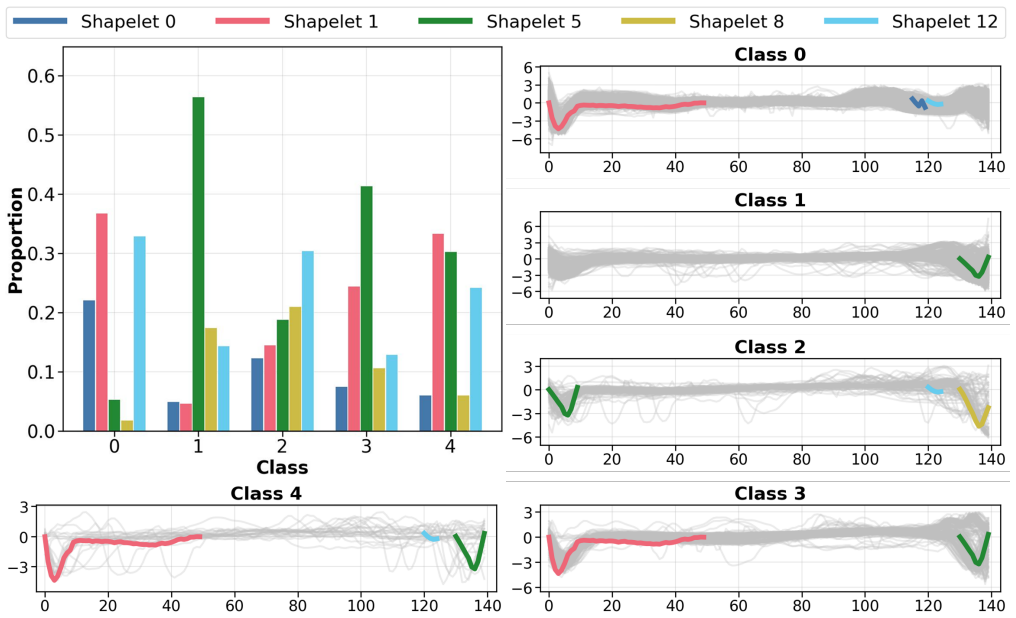
The paper introduces INSHAPE as a new framework that extracts instance-level shapelets as non-overlapping segments from each time series, models their sequential dependencies, and performs bottom-up aggregation to population-level prototypes. The abstract and description present this as an original algorithmic construction addressing limitations of prior population-level shapelet methods, with performance claims grounded in empirical results on UCR/UEA benchmarks rather than any reduction to pre-fitted parameters or self-citations. No load-bearing step equates outputs to inputs by definition, and the derivation chain remains self-contained without invoking uniqueness theorems or ansatzes from the authors' prior work.
Axiom & Free-Parameter Ledger
free parameters (1)
- per-instance shapelet lengths and counts
Lean theorems connected to this paper
-
IndisputableMonolith/Cost/FunctionalEquation.leanwashburn_uniqueness_aczel unclear?
unclearRelation between the paper passage and the cited Recognition theorem.
INSHAPE identifies these patterns as non-overlapping segments and models their temporal dependencies... bottom-up approach, aggregating instance-level shapelets into prototypical (population-level) shapelets
-
IndisputableMonolith/Foundation/ArithmeticFromLogic.leanLogicNat recovery unclear?
unclearRelation between the paper passage and the cited Recognition theorem.
we adopt PELT... transition points... statistically coherent segments
What do these tags mean?
- matches
- The paper's claim is directly supported by a theorem in the formal canon.
- supports
- The theorem supports part of the paper's argument, but the paper may add assumptions or extra steps.
- extends
- The paper goes beyond the formal theorem; the theorem is a base layer rather than the whole result.
- uses
- The paper appears to rely on the theorem as machinery.
- contradicts
- The paper's claim conflicts with a theorem or certificate in the canon.
- unclear
- Pith found a possible connection, but the passage is too broad, indirect, or ambiguous to say the theorem truly supports the claim.
Reference graph
Works this paper leans on
-
[1]
Differential diagnosis of wide qrs tachycardia: A review.Journal of arrhythmia, 37(5):1162–1172,
[Abedin, 2021] Zainul Abedin. Differential diagnosis of wide qrs tachycardia: A review.Journal of arrhythmia, 37(5):1162–1172,
work page 2021
-
[2]
The UEA multivariate time series classification archive, 2018
[Bagnallet al., 2018 ] Anthony Bagnall, Hoang Anh Dau, Ja- son Lines, Michael Flynn, James Large, Aaron Bostrom, Paul Southam, and Eamonn Keogh. The uea multivari- ate time series classification archive, 2018.arXiv preprint arXiv:1811.00075,
work page internal anchor Pith review Pith/arXiv arXiv 2018
-
[3]
Estimating or Propagating Gradients Through Stochastic Neurons for Conditional Computation
[Bengioet al., 2013 ] Yoshua Bengio, Nicholas L´eonard, and Aaron Courville. Estimating or propagating gradients through stochastic neurons for conditional computation. arXiv preprint arXiv:1308.3432,
work page internal anchor Pith review Pith/arXiv arXiv 2013
-
[4]
The ucr time series archive.IEEE/CAA Journal of Automatica Sinica, 6(6):1293–1305,
[Dauet al., 2019 ] Hoang Anh Dau, Anthony Bagnall, Kaveh Kamgar, Chin-Chia Michael Yeh, Yan Zhu, Shaghayegh Gharghabi, Chotirat Ann Ratanamahatana, and Eamonn Keogh. The ucr time series archive.IEEE/CAA Journal of Automatica Sinica, 6(6):1293–1305,
work page 2019
-
[5]
A fast algorithm for smooth- ing data on a rectangular grid while using spline functions
[Dierckx, 1982] Paul Dierckx. A fast algorithm for smooth- ing data on a rectangular grid while using spline functions. SIAM Journal on Numerical Analysis, 19(6):1286–1304,
work page 1982
-
[6]
Tslanet: Rethink- ing transformers for time series representation learning
[Eldeleet al., 2024 ] Emadeldeen Eldele, Mohamed Ragab, Zhenghua Chen, Min Wu, and Xiaoli Li. Tslanet: Rethink- ing transformers for time series representation learning. International Conference on Machine Learning,
work page 2024
-
[7]
Learning time- series shapelets
[Grabockaet al., 2014 ] Josif Grabocka, Nicolas Schilling, Martin Wistuba, and Lars Schmidt-Thieme. Learning time- series shapelets. InProceedings of the 20th ACM SIGKDD international conference on Knowledge discovery and data mining, pages 392–401,
work page 2014
-
[8]
Scalable Discovery of Time-Series Shapelets
[Grabockaet al., 2015 ] Josif Grabocka, Martin Wistuba, and Lars Schmidt-Thieme. Scalable discovery of time-series shapelets.arXiv preprint arXiv:1503.03238,
work page internal anchor Pith review Pith/arXiv arXiv 2015
-
[9]
[Gumbschet al., 2020 ] Thomas Gumbsch, Christian Bock, Michael Moor, Bastian Rieck, and Karsten Borgwardt. En- hancing statistical power in temporal biomarker discovery through representative shapelet mining.Bioinformatics, 36(Supplement 2):i840–i848,
work page 2020
-
[10]
Delving deep into rectifiers: Surpassing human-level performance on imagenet classification
[Heet al., 2015 ] Kaiming He, Xiangyu Zhang, Shaoqing Ren, and Jian Sun. Delving deep into rectifiers: Surpassing human-level performance on imagenet classification. In Proceedings of the IEEE international conference on com- puter vision, pages 1026–1034,
work page 2015
-
[11]
Classification of time series by shapelet transformation
[Hillset al., 2014 ] Jon Hills, Jason Lines, Edgaras Baranauskas, James Mapp, and Anthony Bagnall. Classification of time series by shapelet transformation. Data mining and knowledge discovery, 28(4):851–881,
work page 2014
-
[12]
[Hylandet al., 2020 ] Stephanie L Hyland, Martin Faltys, Matthias H¨user, Xinrui Lyu, Thomas Gumbsch, Crist´obal Esteban, Christian Bock, Max Horn, Michael Moor, Bas- tian Rieck, et al. Early prediction of circulatory failure in the intensive care unit using machine learning.Nature medicine, 26(3):364–373,
work page 2020
-
[13]
Inceptiontime: Finding alexnet for time series classification
[Ismail Fawazet al., 2020 ] Hassan Ismail Fawaz, Benjamin Lucas, Germain Forestier, Charlotte Pelletier, Daniel F Schmidt, Jonathan Weber, Geoffrey I Webb, Lhassane Idoumghar, Pierre-Alain Muller, and Fran c ¸ois Petitjean. Inceptiontime: Finding alexnet for time series classification. Data Mining and Knowledge Discovery, 34(6):1936–1962,
work page 2020
-
[14]
Categorical Reparameterization with Gumbel-Softmax
[Janget al., 2016 ] Eric Jang, Shixiang Gu, and Ben Poole. Categorical reparameterization with gumbel-softmax. arXiv preprint arXiv:1611.01144,
work page internal anchor Pith review Pith/arXiv arXiv 2016
-
[15]
Towards transparent time series forecasting
[Kacprzyket al., 2024 ] Krzysztof Kacprzyk, Tennison Liu, and Mihaela van der Schaar. Towards transparent time series forecasting. InThe Twelfth International Conference on Learning Representations,
work page 2024
-
[16]
[Killicket al., 2012 ] Rebecca Killick, Paul Fearnhead, and Idris A Eckley. Optimal detection of changepoints with a linear computational cost.Journal of the American Statisti- cal Association, 107(500):1590–1598,
work page 2012
-
[17]
Discovering features with synergistic in- teractions in multiple views
[Kimet al., 2024 ] Chohee Kim, Mihaela Van Der Schaar, and Changhee Lee. Discovering features with synergistic in- teractions in multiple views. InForty-first International Conference on Machine Learning,
work page 2024
-
[18]
Adam: A Method for Stochastic Optimization
[Kingma and Ba, 2014] Diederik P Kingma and Jimmy Ba. Adam: A method for stochastic optimization.arXiv preprint arXiv:1412.6980,
work page internal anchor Pith review Pith/arXiv arXiv 2014
-
[19]
Self-supervision enhanced feature selec- tion with correlated gates
[Leeet al., 2022 ] Changhee Lee, Fergus Imrie, and Mihaela van der Schaar. Self-supervision enhanced feature selec- tion with correlated gates. InInternational conference on learning representations,
work page 2022
-
[20]
Patient- specific warning of epileptic seizure upon shapelets features
[Li and Zhao, 2023] Yingxiang Li and Xuejing Zhao. Patient- specific warning of epileptic seizure upon shapelets features. Heliyon, 9(11),
work page 2023
-
[21]
Shapenet: A shapelet-neural network ap- proach for multivariate time series classification
[Liet al., 2021 ] Guozhong Li, Byron Choi, Jianliang Xu, Sourav S Bhowmick, Kwok-Pan Chun, and Grace Lai- Hung Wong. Shapenet: A shapelet-neural network ap- proach for multivariate time series classification. InPro- ceedings of the AAAI conference on artificial intelligence, volume 35, pages 8375–8383,
work page 2021
-
[22]
[Linet al., 2007 ] Jessica Lin, Eamonn Keogh, Li Wei, and Stefano Lonardi. Experiencing sax: a novel symbolic rep- resentation of time series.Data Mining and knowledge discovery, 15(2):107–144,
work page 2007
-
[23]
A shapelet transform for time series classification
[Lineset al., 2012 ] Jason Lines, Luke M Davis, Jon Hills, and Anthony Bagnall. A shapelet transform for time series classification. InProceedings of the 18th ACM SIGKDD international conference on Knowledge discovery and data mining, pages 289–297,
work page 2012
-
[24]
[Liuet al., 2023 ] Liyuan Liu, Chengyu Dong, Xiaodong Liu, Bin Yu, and Jianfeng Gao. Bridging discrete and backprop- agation: Straight-through and beyond.Advances in Neural Information Processing Systems, 36:12291–12311,
work page 2023
-
[25]
Learning soft sparse shapes for efficient time-series classification
[Liuet al., 2025 ] Zhen Liu, Yicheng Luo, Boyuan Li, Emadeldeen Eldele, Min Wu, and Qianli Ma. Learning soft sparse shapes for efficient time-series classification. International Conference on Machine Learning,
work page 2025
-
[26]
Mod- erntcn: A modern pure convolution structure for general time series analysis
[Luo and Wang, 2024] Donghao Luo and Xue Wang. Mod- erntcn: A modern pure convolution structure for general time series analysis. InThe twelfth international conference on learning representations, pages 1–43,
work page 2024
-
[27]
The Concrete Distribution: A Continuous Relaxation of Discrete Random Variables
[Maddisonet al., 2016 ] Chris J Maddison, Andriy Mnih, and Yee Whye Teh. The concrete distribution: A continuous relaxation of discrete random variables.arXiv preprint arXiv:1611.00712,
work page internal anchor Pith review Pith/arXiv arXiv 2016
-
[28]
[Middlehurstet al., 2024 ] Matthew Middlehurst, Patrick Sch¨afer, and Anthony Bagnall. Bake off redux: a review and experimental evaluation of recent time series classifica- tion algorithms.Data Mining and Knowledge Discovery, 38(4):1958–2031,
work page 2024
-
[29]
[Mohammadi Foumaniet al., 2024 ] Navid Moham- madi Foumani, Lynn Miller, Chang Wei Tan, Geoffrey I Webb, Germain Forestier, and Mahsa Salehi. Deep learning for time series classification and extrinsic regression: A current survey.ACM Computing Surveys, 56(9):1–45,
work page 2024
-
[30]
Logical-shapelets: an expressive primitive for time series classification
[Mueenet al., 2011 ] Abdullah Mueen, Eamonn Keogh, and Neal Young. Logical-shapelets: an expressive primitive for time series classification. InProceedings of the 17th ACM SIGKDD international conference on Knowledge discovery and data mining, pages 1154–1162,
work page 2011
-
[31]
[Neveset al., 2021 ] Inˆes Neves, Duarte Folgado, Sara Santos, Mar´ılia Barandas, Andrea Campagner, Luca Ronzio, Fed- erico Cabitza, and Hugo Gamboa. Interpretable heartbeat classification using local model-agnostic explanations on ecgs.Computers in biology and medicine, 133:104393,
work page 2021
-
[32]
U-sleep: resilient high-frequency sleep staging
[Perslevet al., 2021 ] Mathias Perslev, Sune Darkner, Lykke Kempfner, Miki Nikolic, Poul Jørgen Jennum, and Chris- tian Igel. U-sleep: resilient high-frequency sleep staging. NPJ digital medicine, 4(1):72,
work page 2021
-
[33]
[Qinet al., 2025 ] Xuewei Qin, Yi Sun, Jiemin Ji, and Jun Li. Fetalet: interpretable fetal heart rate anomaly detection via shapelet learning.Complex & Intelligent Systems, 11(11):1– 16,
work page 2025
-
[34]
Cnn kernels can be the best shapelets
[Quet al., 2024 ] Eric Qu, Yansen Wang, Xufang Luo, Wen- qiang He, Kan Ren, and Dongsheng Li. Cnn kernels can be the best shapelets. InThe Twelfth International Conference on Learning Representations,
work page 2024
-
[35]
Fast shapelets: A scalable algorithm for discovering time series shapelets
[Rakthanmanon and Keogh, 2013] Thanawin Rakthanmanon and Eamonn Keogh. Fast shapelets: A scalable algorithm for discovering time series shapelets. Inproceedings of the 2013 SIAM International Conference on Data Mining, pages 668–676. SIAM,
work page 2013
-
[36]
The legacy of gestalt psychology.Scientific American, 263(6):84–91,
[Rock and Palmer, 1990] Irvin Rock and Stephen Palmer. The legacy of gestalt psychology.Scientific American, 263(6):84–91,
work page 1990
-
[37]
[Salvador and Chan, 2007] Stan Salvador and Philip Chan. Toward accurate dynamic time warping in linear time and space.Intelligent data analysis, 11(5):561–580,
work page 2007
-
[38]
Attention is all you need.Advances in neural information processing systems, 30,
[Vaswaniet al., 2017 ] Ashish Vaswani, Noam Shazeer, Niki Parmar, Jakob Uszkoreit, Llion Jones, Aidan N Gomez, Łukasz Kaiser, and Illia Polosukhin. Attention is all you need.Advances in neural information processing systems, 30,
work page 2017
-
[39]
Shedding light on time series classification using interpretability gated networks
[Wenet al., 2025 ] Yunshi Wen, Tengfei Ma, Ronny Luss, De- barun Bhattacharjya, Achille Fokoue, and Anak Agung Julius. Shedding light on time series classification using interpretability gated networks. InThe Thirteenth Interna- tional Conference on Learning Representations,
work page 2025
-
[40]
[Williams, 1992] Ronald J Williams. Simple statistical gradient-following algorithms for connectionist reinforce- ment learning.Machine learning, 8(3):229–256,
work page 1992
-
[41]
[Wuet al., 2022 ] Haixu Wu, Tengge Hu, Yong Liu, Hang Zhou, Jianmin Wang, and Mingsheng Long. Timesnet: Temporal 2d-variation modeling for general time series analysis.International Conference on Learning Represen- tations,
work page 2022
-
[42]
Time series shapelets: a new primitive for data mining
[Ye and Keogh, 2009] Lexiang Ye and Eamonn Keogh. Time series shapelets: a new primitive for data mining. InPro- ceedings of the 15th ACM SIGKDD international confer- ence on Knowledge discovery and data mining, pages 947– 956,
work page 2009
-
[43]
Invase: Instance-wise variable selection using neural networks
[Yoonet al., 2018 ] Jinsung Yoon, James Jordon, and Mihaela Van der Schaar. Invase: Instance-wise variable selection using neural networks. InInternational conference on learning representations,
work page 2018
-
[44]
Svp-t: A shape-level variable-position transformer for multivariate time series classification
[Zuoet al., 2023 ] Rundong Zuo, Guozhong Li, Byron Choi, Sourav S Bhowmick, Daphne Ngar-yin Mah, and Grace LH Wong. Svp-t: A shape-level variable-position transformer for multivariate time series classification. InProceedings of the AAAI Conference on Artificial Intelligence, volume 37, pages 11497–11505,
work page 2023
-
[45]
A Synthetic: Latent Problem of Modern Shapelet Transform Approaches Review of Shapelet Transform.Shapelets are discrim- inative subsequences that are representative of a class in time-series classification. The shapelet transform (ST) method [Hillset al., 2014; Lineset al., 2012 ] converts a raw time-series input x∈R T into an interpretable feature rep- r...
work page 2014
-
[46]
Despite the simplicity of the datasets, shapelet transform-based methods exhibit near- random performance, indicating their inability to capture the temporal dependencies required for correct classification. Although these methods can attain perfect accuracy by using longer shapelets that span multiple peaks, this degrades inter- pretability, as they fail...
work page 2014
-
[47]
Metric UCR 128 InterpGN SoftShape Ours Avg. Acc 0.7988 0.84000.8405 Table 8: Comparison with full versions of InterpGN and SoftShape on UCR 128 datasets. Despite using deep learning modules that process the entire time series, INSHAPE achieves comparable or superior per- formance. This demonstrates the effectiveness of identifying statistically coherent r...
-
[48]
Here, we pro- vide the full results across all five classes. Figure 9 shows the class-wise proportion of each population-level shapelet (Left) and their overlay on representative instances per class (Right). Class 1 is predominantly characterized by Shapelet 5, which consistently appears in the tail region across in- stances. In contrast, Class 2 exhibits...
work page 2009
-
[49]
These results suggest that IN- Metric Value Average inference time (s) 0.4913 Peak GPU memory (MB) 19.85 Table 11: Average per-sample inference time and peak GPU memory usage of INSHAPE on the EEG dataset, where each sample consists of a 30-second segment sampled at 128 Hz. SHAPE is computationally feasible for practical deployment scenarios, including fr...
discussion (0)
Sign in with ORCID, Apple, or X to comment. Anyone can read and Pith papers without signing in.