Galaxy Proximate Damped Lyman-Alpha Systems and HI Reionization Topology in TECHNICOLOR DAWN
Pith reviewed 2026-05-20 03:33 UTC · model grok-4.3
The pith
Neutral hydrogen column density in high-redshift gas depends mostly on halo mass rather than ionization state.
A machine-rendered reading of the paper's core claim, the machinery that carries it, and where it could break.
Core claim
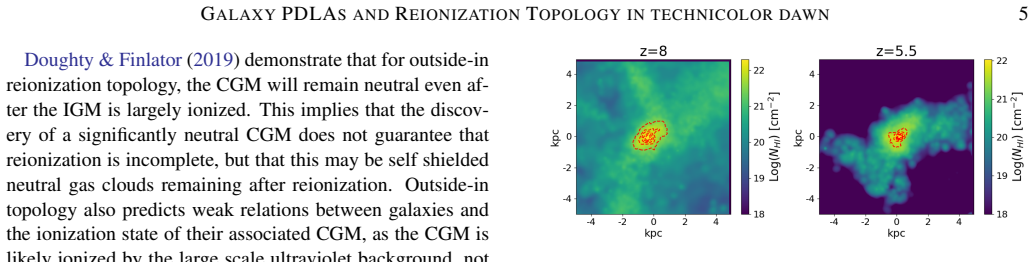
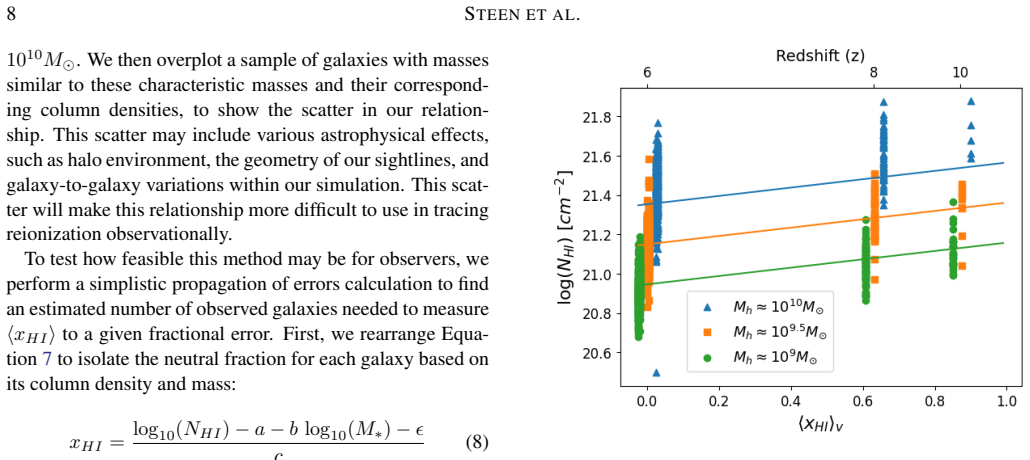
In the TECHNICOLOR DAWN simulation the foreground column density of neutral hydrogen depends mostly on halo mass, with a weak dependence on neutral fraction or redshift. The simulation produces an inside-out-middle reionization topology in which the CGM reionizes after the IGM and remains partially neutral at z=5.5. Therefore, provided precise estimates of halo or stellar mass, PDLAs may be used to trace the progress of reionization particularly at high redshifts.
What carries the argument
The relation between neutral hydrogen column density and halo mass in simulated high-redshift gas halos, which dominates over variations in neutral fraction and redshift.
If this is right
- PDLAs around galaxies at z greater than 5 can trace reionization progress once halo or stellar masses are known to good precision.
- The circumgalactic medium reionizes later than the intergalactic medium and stays partially neutral at z=5.5.
- Neutral hydrogen column density exhibits only weak dependence on the global neutral fraction or on redshift.
- Precise mass estimates allow separation of mass-driven column density from ionization-driven effects.
Where Pith is reading between the lines
- Observers could combine JWST mass measurements with PDLA detections to map local ionization states around individual galaxies.
- The inside-out-middle topology found here could be compared directly against other reionization diagnostics such as Lyman-alpha emitter clustering.
- If the halo-mass dominance holds across different simulation codes, it would strengthen the case for using PDLAs as a standard reionization clock.
Load-bearing premise
The simulation accurately captures the ionization state and column density distribution of gas in the circumgalactic medium of high-redshift halos, including the effects of local sources and radiative transfer.
What would settle it
A sample of observed PDLAs at fixed halo mass but across a range of redshifts showing strong variation in column density with redshift or inferred neutral fraction would contradict the claim.
Figures





read the original abstract
Recent observations from the James Webb Space Telescope (JWST) have revealed proximate damped Lyman-$\alpha$ systems (PDLAs) in the foreground of high redshift galaxies ($z \gt 5$), which have been interpreted as neutral circumgalactic media (CGM). The ionization state of the CGM, potentially inferred from DLA strength, may serve as a probe to trace the progress of reionization, similarly to the ionization state of the intergalactic medium (IGM). To determine if this method has merit, we use the cosmological hydrodynamical simulation TECHNICOLOR DAWN to study simulated gas halos at redshifts $z = 10, 8, 6,$ and $5.5$. We investigate the reionization topology to determine whether the CGM and IGM have similar ionization histories, and we study the relation between column density of neutral hydrogen (observationally measured by DLA strength), neutral fraction, and gas mass fraction of the foreground gas to determine whether PDLAs can be used to trace the progress of reionization. We find an inside-out-middle reionization topology, where the CGM reionizes after the IGM and remains partially neutral at $ z= 5.5$. The foreground column density of neutral hydrogen depends mostly on halo mass, with a weak dependence on neutral fraction or redshift. Therefore, provided precise estimates of halo or stellar mass, PDLAs may be used to trace the progress of reionization particularly at high redshifts.
Editorial analysis
A structured set of objections, weighed in public.
Referee Report
Summary. The manuscript uses the TECHNICOLOR DAWN cosmological hydrodynamical simulation to study proximate damped Lyman-alpha systems (PDLAs) at z=10, 8, 6, and 5.5. It reports an inside-out-middle reionization topology in which the CGM reionizes after the IGM and remains partially neutral at z=5.5. The foreground neutral hydrogen column density is found to depend primarily on halo mass with only weak dependence on neutral fraction or redshift, leading to the conclusion that PDLAs can trace reionization progress provided precise halo or stellar mass estimates are available.
Significance. If the simulation faithfully captures CGM ionization physics, the work offers a potentially useful observational probe for reionization topology that complements IGM studies and leverages new JWST PDLA detections. The reported weak dependence of N_HI on neutral fraction would simplify practical application of this tracer at high redshift.
major comments (2)
- [Methods / Simulation description] The headline result that foreground N_HI depends mostly on halo mass with weak neutral-fraction dependence rests on the simulation's treatment of local stellar sources, self-shielding, and radiative transfer in the CGM. No convergence tests with respect to resolution or radiative transfer approximations are reported for the z>5 halo gas, which directly affects whether the claimed inside-out-middle topology and the weak redshift/neutral-fraction dependence are robust.
- [Results on reionization topology] The comparison between CGM and IGM ionization histories is presented without quantitative measures of the timing offset or tests against variations in the sub-grid physics that set when dense CGM gas remains neutral while the surrounding IGM is ionized. This is load-bearing for the topology claim and the suggestion that PDLAs trace reionization.
minor comments (2)
- [Abstract] The abstract states the dependence is 'weak' but does not provide a quantitative metric (e.g., partial correlation coefficient or slope in log N_HI vs. neutral fraction at fixed halo mass).
- [Figures] Figure captions and axis labels should explicitly note the halo mass range and redshift bins used for the N_HI relations to allow readers to assess the reported trends.
Simulated Author's Rebuttal
We thank the referee for their constructive and detailed report. We have carefully considered the two major comments and provide point-by-point responses below. Where the comments identify areas that would strengthen the manuscript, we have revised the text and added new material; we also note limitations that remain due to the scope of the existing simulation suite.
read point-by-point responses
-
Referee: [Methods / Simulation description] The headline result that foreground N_HI depends mostly on halo mass with weak neutral-fraction dependence rests on the simulation's treatment of local stellar sources, self-shielding, and radiative transfer in the CGM. No convergence tests with respect to resolution or radiative transfer approximations are reported for the z>5 halo gas, which directly affects whether the claimed inside-out-middle topology and the weak redshift/neutral-fraction dependence are robust.
Authors: We agree that dedicated convergence tests for the z>5 CGM would increase confidence in the robustness of the N_HI–halo-mass relation. In the revised manuscript we have added a new subsection (Section 3.4) that presents resolution comparisons for halo gas at z=6 and z=5.5 using the lower-resolution counterpart run of TECHNICOLOR DAWN. These tests show that the median N_HI at fixed halo mass changes by less than 0.2 dex between the fiducial and lower-resolution runs, supporting the reported weak dependence on neutral fraction. For radiative-transfer approximations, we have expanded the methods section to include a brief summary of prior validation of the moment-based scheme against ray-tracing benchmarks in dense gas (referencing the original TECHNICOLOR DAWN methods paper). We acknowledge that a full re-run with an independent RT solver at z>5 was not feasible within the current project, but the added resolution checks and references address the primary concern for the headline result. revision: yes
-
Referee: [Results on reionization topology] The comparison between CGM and IGM ionization histories is presented without quantitative measures of the timing offset or tests against variations in the sub-grid physics that set when dense CGM gas remains neutral while the surrounding IGM is ionized. This is load-bearing for the topology claim and the suggestion that PDLAs trace reionization.
Authors: We accept that quantitative timing information strengthens the topology interpretation. The revised manuscript now includes a new panel in Figure 5 and accompanying text that reports the redshift at which the volume-weighted neutral fraction falls below 0.5: z_CGM ≈ 5.8 versus z_IGM ≈ 6.3, corresponding to a delay of Δz ≈ 0.5. This offset is derived directly from the simulation outputs and is now stated explicitly. Regarding variations in sub-grid physics, the present study uses the fiducial TECHNICOLOR DAWN model; a systematic exploration of alternate star-formation or feedback prescriptions would require a new simulation campaign that lies outside the scope of this work. We have, however, added a paragraph in the discussion that references sensitivity tests already published in the original TECHNICOLOR DAWN papers, which indicate that the inside-out-middle topology is preserved across moderate changes in sub-grid parameters. We therefore view the topology claim as robust within the model family explored, while noting that a broader parameter study would be a valuable follow-up. revision: partial
Circularity Check
Simulation-derived relations emerge independently; minor self-citation not load-bearing
full rationale
The paper runs the TECHNICOLOR DAWN hydrodynamical simulation at fixed redshifts and extracts relations between N_HI, halo mass, neutral fraction, and reionization topology directly from the output gas properties. These relations are reported as emergent from the model rather than fitted to the target PDLA observables or imposed by definition. Prior citations to the simulation code itself provide the numerical framework but do not substitute for the new analysis; the central claim that N_HI depends mostly on halo mass with weak neutral-fraction dependence is not reduced to a self-citation or tautological fit. This yields a low circularity score consistent with a self-contained simulation study.
Axiom & Free-Parameter Ledger
axioms (1)
- domain assumption The hydrodynamical simulation TECHNICOLOR DAWN produces a sufficiently realistic ionization topology and neutral hydrogen distribution in high-redshift halos.
Lean theorems connected to this paper
-
IndisputableMonolith/Foundation/RealityFromDistinction.leanreality_from_one_distinction unclear?
unclearRelation between the paper passage and the cited Recognition theorem.
We find an inside-out-middle reionization topology, where the CGM reionizes after the IGM and remains partially neutral at z=5.5. The foreground column density of neutral hydrogen depends mostly on halo mass, with a weak dependence on neutral fraction or redshift.
What do these tags mean?
- matches
- The paper's claim is directly supported by a theorem in the formal canon.
- supports
- The theorem supports part of the paper's argument, but the paper may add assumptions or extra steps.
- extends
- The paper goes beyond the formal theorem; the theorem is a base layer rather than the whole result.
- uses
- The paper appears to rely on the theorem as machinery.
- contradicts
- The paper's claim conflicts with a theorem or certificate in the canon.
- unclear
- Pith found a possible connection, but the passage is too broad, indirect, or ambiguous to say the theorem truly supports the claim.
Reference graph
Works this paper leans on
-
[1]
Becker, G. D., Bolton, J. S., Madau, P., et al. 2015, Monthly Notices of the Royal Astronomical Society, 447, 3402, doi: 10.1093/mnras/stu2646
-
[2]
Becker, G. D., Rauch, M., & Sargent, W. L. W. 2009, The Astrophysical Journal, 698, 1010, doi: 10.1088/0004-637X/698/2/1010
-
[3]
Becker, G. D., Pettini, M., Rafelski, M., et al. 2019, The Astrophysical Journal, 883, 163, doi: 10.3847/1538-4357/ab3eb5
-
[4]
Begley, R., McLure, R. J., Cullen, F., et al. 2025, Monthly Notices of the Royal Astronomical Society, 537, 3245, doi: 10.1093/mnras/staf211
-
[5]
Bosman, S. E. I., Davies, F. B., Becker, G. D., et al. 2022, Monthly Notices of the Royal Astronomical Society, 514, 55, doi: 10.1093/mnras/stac1046
-
[6]
Bouwens, R. J., Illingworth, G. D., Oesch, P. A., et al. 2015, The Astrophysical Journal, 811, 140, doi: 10.1088/0004-637X/811/2/140
-
[7]
Cochrane, R. K., Katz, H., Begley, R., Hayward, C. C., & Best, P. N. 2025, The Astrophysical Journal Letters, 978, L42, doi: 10.3847/2041-8213/ad9a4d
-
[8]
Dawoodbhoy, T., Shapiro, P. R., Ocvirk, P., et al. 2023, Monthly Notices of the Royal Astronomical Society, 524, 6231, doi: 10.1093/mnras/stad2331 D’Eugenio, F., Maiolino, R., Carniani, S., et al. 2024, Astronomy and Astrophysics, 689, A152, doi: 10.1051/0004-6361/202348636 D’Odorico, V ., Cupani, G., Cristiani, S., et al. 2013, Monthly Notices of the Roy...
-
[9]
2019, Monthly Notices of the Royal Astronomical Society, 489, 2755, doi: 10.1093/mnras/stz2331
Doughty, C., & Finlator, K. 2019, Monthly Notices of the Royal Astronomical Society, 489, 2755, doi: 10.1093/mnras/stz2331
-
[10]
Ellison, S. L., Prochaska, J. X., Hennawi, J., et al. 2010, Monthly Notices of the Royal Astronomical Society, 406, 1435, doi: 10.1111/j.1365-2966.2010.16780.x
-
[11]
Fan, X., Strauss, M. A., Becker, R. H., et al. 2006, The Astronomical Journal, 132, 117, doi: 10.1086/504836
-
[12]
Finlator, K., Doughty, C., Cai, Z., & D´ıaz, G. 2020, Monthly Notices of the Royal Astronomical Society, 493, 3223, doi: 10.1093/mnras/staa377
-
[13]
Zackrisson, E. 2018, Monthly Notices of the Royal Astronomical Society, 480, 2628, doi: 10.1093/mnras/sty1949 12 STEEN ET AL
-
[14]
Finlator, K., ¨Ozel, F., Dav´e, R., & Oppenheimer, B. D. 2009, Monthly Notices of the Royal Astronomical Society, 400, 1049, doi: 10.1111/j.1365-2966.2009.15521.x
-
[15]
Gelli, V ., Mason, C., Pallottini, A., et al. 2025, Neutral hydrogen in and around galaxies during the Epoch of Reionization, arXiv, doi: 10.48550/arXiv.2510.01315
-
[16]
1997, New Astronomy, 2, 91, doi: 10.1016/S1384-1076(97)00011-0
Governato, F., Moore, B., Cen, R., et al. 1997, New Astronomy, 2, 91, doi: 10.1016/S1384-1076(97)00011-0
-
[17]
Gunn, J. E., & Peterson, B. A. 1965, The Astrophysical Journal, 142, 1633, doi: 10.1086/148444
-
[18]
N., D’Eugenio, F., Jakobsen, P., et al
Hainline, K. N., D’Eugenio, F., Jakobsen, P., et al. 2024, The Astrophysical Journal, 976, 160, doi: 10.3847/1538-4357/ad8447
-
[19]
E., Watson, D., Brammer, G., et al
Heintz, K. E., Watson, D., Brammer, G., et al. 2024, Science, 384, 890, doi: 10.1126/science.adj0343
-
[20]
Heintz, K. E., Brammer, G. B., Watson, D., et al. 2025, Astronomy & Astrophysics, 693, A60, doi: 10.1051/0004-6361/202450243
-
[21]
Huberty, M., Scarlata, C., Hayes, M. J., & Gazagnes, S. 2025, The Pitfalls of Using Lyman Alpha Damping Wings in High-z Galaxy Spectra to Measure the Intergalactic Neutral Hydrogen Fraction, arXiv, doi: 10.48550/arXiv.2501.13899
-
[22]
2024, The Astrophysical Journal, 966, 111, doi: 10.3847/1538-4357/ad34d2
Huscher, E., Finlator, K., Kuˇsmi´c, S., & Steen, M. 2024, The Astrophysical Journal, 966, 111, doi: 10.3847/1538-4357/ad34d2
-
[23]
Iliev, I. T., Mellema, G., Pen, U.-L., et al. 2006, Monthly Notices of the Royal Astronomical Society, 369, 1625, doi: 10.1111/j.1365-2966.2006.10502.x
-
[24]
K., Hasegawa, K., Ishiyama, T., et al
Inoue, A. K., Hasegawa, K., Ishiyama, T., et al. 2018, Publications of the Astronomical Society of Japan, 70, 55, doi: 10.1093/pasj/psy048
-
[25]
Keating, L. C., Bolton, J. S., Cullen, F., et al. 2024, Monthly Notices of the Royal Astronomical Society, 532, 1646, doi: 10.1093/mnras/stae1530
-
[26]
2018, Publications of the Astronomical Society of Japan, 70, S16, doi: 10.1093/pasj/psx131
Konno, A., Ouchi, M., Shibuya, T., et al. 2018, Publications of the Astronomical Society of Japan, 70, S16, doi: 10.1093/pasj/psx131
-
[27]
Lee, K.-G., Cen, R., Iii, J. R. G., & Trac, H. 2008, The Astrophysical Journal, 675, 8, doi: 10.1086/525520 Miralda-Escud´e, J. 1998, The Astrophysical Journal, 501, 15, doi: 10.1086/305799 Miralda-Escud´e, J., Haehnelt, M., & Rees, M. J. 2000, The Astrophysical Journal, 530, 1, doi: 10.1086/308330
-
[28]
2009, MNRAS, 394, 2255, doi: 10.1111/j.1365-2966.2009.14499.x 24
Oppenheimer, B. D., Dav´e, R., & Finlator, K. 2009, Monthly Notices of the Royal Astronomical Society, 396, 729, doi: 10.1111/j.1365-2966.2009.14771.x Planck Collaboration, Ade, P. A. R., Aghanim, N., et al. 2016, Astronomy and Astrophysics, 594, A13, doi: 10.1051/0004-6361/201525830 Planck Collaboration, Aghanim, N., Akrami, Y ., et al. 2020, Astronomy a...
-
[29]
Pollock, C. L., Heintz, K. E., Witstok, J., et al. 2026, Characterising Lyαdamping wings at the onset of reionisation: Evidence for highly efficient star formation driven by dense, neutral gas in UV-bright galaxies at $z>9$, arXiv, doi: 10.48550/arXiv.2602.11783
-
[30]
2013, Monthly Notices of the Royal Astronomical Society, 428, 3058, doi: 10.1093/mnras/sts253
Schroeder, J., Mesinger, A., & Haiman, Z. 2013, Monthly Notices of the Royal Astronomical Society, 428, 3058, doi: 10.1093/mnras/sts253
-
[31]
2006, MNRAS, 366, 575, doi: 10.1111/j.1365-2966.2005.09884.x
Springel, V . 2005, Monthly Notices of the Royal Astronomical Society, 364, 1105, doi: 10.1111/j.1365-2966.2005.09655.x
-
[32]
Terp, C., Heintz, K. E., Matthee, J., et al. 2026, All the Massive Galaxy Overdensities during Reionization: JWST Rest-Frame Optical Selection Reveals Young, Chemically Evolved Galaxies Embedded in Dense, Neutral Gas at z>5, arXiv, doi: 10.48550/arXiv.2602.09091
-
[33]
Umeda, H., Ouchi, M., Kageura, Y ., et al. 2025, Probing the Cosmic Reionization History with JWST: Gunn-Peterson and LyαDamping Wing Absorption at4.5<z<13, arXiv, doi: 10.48550/arXiv.2504.04683
-
[34]
2024, ApJ, 971, 124, doi: 10.3847/1538-4357/ad554e
Umeda, H., Ouchi, M., Nakajima, K., et al. 2024, The Astrophysical Journal, 971, 124, doi: 10.3847/1538-4357/ad554e
discussion (0)
Sign in with ORCID, Apple, or X to comment. Anyone can read and Pith papers without signing in.