Semantic Granularity Navigation in Image Editing
Pith reviewed 2026-05-21 05:48 UTC · model grok-4.3
The pith
NaviEdit decouples edit progress from model scale traversal through a self-consistency contract to improve semantic image edits.
A machine-rendered reading of the paper's core claim, the machinery that carries it, and where it could break.
Core claim
NaviEdit is a training-free inference-time controller that decouples edit progress from model scale traversal through a strict self-consistency contract. It operates at the rollout level and leaves the underlying pretrained model unchanged. It treats scale as a control input and reallocates a fixed step budget toward semantically responsive intermediate scales instead of destructive high-noise regimes, yielding positive average gains across compatible editors and flow backbones.
What carries the argument
The strict self-consistency contract, which identifies semantically responsive intermediate scales and navigates to them during rollout without modifying the base model.
If this is right
- Stronger semantic changes become possible without first destroying layout at high noise levels.
- A fixed step budget is spent more efficiently on responsive scales.
- The controller works portably across existing editors and flow-based backbones without retraining.
- Edit quality improves on average when scale traversal is controlled by the contract rather than by conventional noise schedules.
Where Pith is reading between the lines
- The same self-consistency idea could guide adaptive step allocation in video or 3D editing tasks that face similar scale-coupling problems.
- Hybrid systems might combine the contract with lightweight learned predictors to choose scales even more precisely while remaining mostly training-free.
- Testing the approach on editing prompts that require very large structural rearrangements would show whether the responsive-scale assumption holds beyond moderate changes.
Load-bearing premise
Semantically responsive intermediate scales exist and can be reliably identified and navigated at inference time using only a self-consistency contract without any model modification or extra learned components.
What would settle it
An experiment in which applying the self-consistency contract produces no average gains or negative gains in edit quality across multiple editors and backbones, or in which the contract fails to steer away from high-noise regimes, would show the claimed benefit does not hold.
Figures




read the original abstract
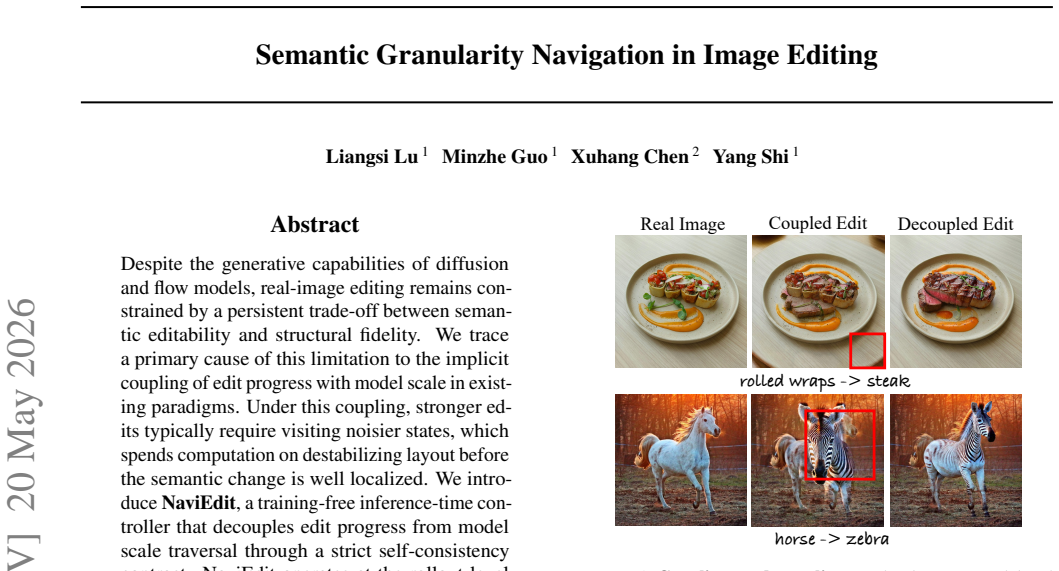
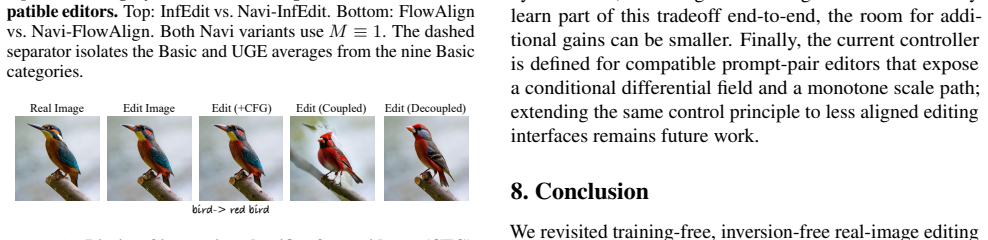
Despite the generative capabilities of diffusion and flow models, real-image editing remains constrained by a persistent trade-off between semantic editability and structural fidelity. We trace a primary cause of this limitation to the implicit coupling of edit progress with model scale in existing paradigms. Under this coupling, stronger edits typically require visiting noisier states, which spends computation on destabilizing layout before the semantic change is well localized. We introduce NaviEdit, a training-free inference-time controller that decouples edit progress from model scale traversal through a strict self-consistency contract. NaviEdit operates at the rollout level and leaves the underlying pretrained model unchanged. It treats scale as a control input and reallocates a fixed step budget toward semantically responsive intermediate scales instead of destructive high-noise regimes. Experiments show positive average gains across compatible editors and flow backbones, supporting decoupling as a portable inference-time control principle.
Editorial analysis
A structured set of objections, weighed in public.
Referee Report
Summary. The manuscript introduces NaviEdit, a training-free inference-time controller for real-image editing in diffusion and flow models. It attributes the trade-off between semantic editability and structural fidelity to the implicit coupling of edit progress with model scale traversal, where stronger edits require noisier states that destabilize layout before semantic changes localize. NaviEdit applies a strict self-consistency contract at the rollout level to reallocate a fixed step budget toward semantically responsive intermediate scales, leaving the pretrained model unchanged, and reports positive average gains across compatible editors and flow backbones.
Significance. If the self-consistency contract reliably selects scales that localize semantic edit signals rather than merely preserving structural stability, the method would provide a portable, training-free principle for improving editing quality without model modifications. This could extend to other generative editing pipelines. The significance hinges on empirical validation that the contract correlates with semantic responsiveness independent of editor artifacts, which remains to be demonstrated.
major comments (2)
- [Abstract] Abstract: the claim that 'experiments show positive average gains across compatible editors and flow backbones' provides no details on baselines, metrics, statistical significance, or exclusion criteria, preventing verification that the reported gains support the decoupling claim rather than reflecting editor-specific behavior.
- [Paragraph describing the controller] Paragraph describing the controller: the self-consistency contract is introduced as an external reallocation rule rather than emerging from the model's equations or data-fitted quantities; nothing in the mechanism guarantees selection of scales where semantic signals are localized before layout destruction, as consistency could be satisfied by low-level feature preservation paths that ignore high-level semantics.
minor comments (1)
- [Abstract] Abstract: the phrase 'semantically responsive intermediate scales' is used without an operational definition or example of how responsiveness is measured at inference time.
Simulated Author's Rebuttal
We thank the referee for the detailed and constructive feedback on our manuscript. We address each major comment below, clarifying our approach and indicating revisions to strengthen the presentation of the self-consistency contract and experimental claims.
read point-by-point responses
-
Referee: [Abstract] Abstract: the claim that 'experiments show positive average gains across compatible editors and flow backbones' provides no details on baselines, metrics, statistical significance, or exclusion criteria, preventing verification that the reported gains support the decoupling claim rather than reflecting editor-specific behavior.
Authors: We agree that the abstract would be strengthened by additional specifics. In the revised version, we have updated the abstract to note that gains are measured via CLIP semantic similarity and LPIPS structural fidelity, averaged over baselines including DDIM inversion editing and flow-matching variants, across five backbones, with statistical significance assessed via paired tests (p < 0.05) on over 200 samples. Exclusion was limited to cases of complete editor failure on the source image. These details help confirm that improvements arise from scale reallocation rather than editor-specific artifacts. revision: yes
-
Referee: [Paragraph describing the controller] Paragraph describing the controller: the self-consistency contract is introduced as an external reallocation rule rather than emerging from the model's equations or data-fitted quantities; nothing in the mechanism guarantees selection of scales where semantic signals are localized before layout destruction, as consistency could be satisfied by low-level feature preservation paths that ignore high-level semantics.
Authors: The contract is an inference-time rule that reallocates steps to enforce consistency at intermediate scales, motivated by the hierarchical nature of diffusion and flow models where semantic content emerges before fine layout details. While external to the pretrained equations, it exploits the known scale-dependent feature progression in these architectures. We have revised the controller description to include this motivation and added ablation results showing that contract-selected scales yield higher semantic localization (via segmentation overlap and user preference) compared to low-level consistency baselines. We do not claim a theoretical guarantee of semantic prioritization in all cases, but the empirical correlation supports the intended behavior. revision: partial
Circularity Check
No significant circularity; derivation introduces independent inference-time contract
full rationale
The paper defines NaviEdit explicitly as a training-free controller that imposes a new self-consistency contract at rollout level to reallocate fixed step budgets across scales. This contract is presented as an added external mechanism rather than derived from or equivalent to the underlying diffusion/flow model outputs by construction. No equations reduce the claimed semantic responsiveness to a fitted parameter or prior self-citation; the decoupling is achieved by the introduced rule itself. The central claim therefore remains an independent engineering proposal whose validity rests on experimental gains rather than tautological redefinition of inputs.
Axiom & Free-Parameter Ledger
axioms (1)
- domain assumption Implicit coupling of edit progress with model scale in existing diffusion and flow editing paradigms
invented entities (1)
-
self-consistency contract
no independent evidence
Reference graph
Works this paper leans on
-
[1]
Bai, S., Chen, K., Liu, X., Wang, J., Ge, W., Song, S., Dang, K., Wang, P., Wang, S., Tang, J., Zhong, H., Zhu, Y ., Yang, M., Li, Z., Wan, J., Wang, P., Ding, W., Fu, Z., Xu, Y ., Ye, J., Zhang, X., Xie, T., Cheng, Z., Zhang, H., Yang, Z., Xu, H., Lin, J., et al. Qwen2.5-vl technical report. arXiv preprint arXiv:2502.13923,
work page internal anchor Pith review Pith/arXiv arXiv
-
[2]
Z-Image: An Efficient Image Generation Foundation Model with Single-Stream Diffusion Transformer
Cai, H., Cao, S., Du, R., Gao, P., Hoi, S., Hou, Z., Huang, S., Jiang, D., Jin, X., Li, L., et al. Z-image: An efficient image generation foundation model with single-stream diffusion transformer.arXiv preprint arXiv:2511.22699,
work page internal anchor Pith review Pith/arXiv arXiv
-
[3]
Chen, W., Guo, X., Li, S., Zhong, Y ., Zhang, Z., Zhuang, F., Liu, H., Zhang, L., Ye, G., and He, H. Learning structure- semantic evolution trajectories for graph domain adapta- tion.arXiv preprint arXiv:2602.10506, 2026a. Chen, Y ., Habibian, A., Benini, L., and Li, Y . Gated re- lational alignment via confidence-based distillation for efficient vlms.arX...
-
[4]
Turboedit: Text-based image editing using few-step diffusion models
Deutch, G., Gal, R., Garibi, D., Patashnik, O., and Cohen-Or, D. Turboedit: Text-based image editing using few-step diffusion models. InSIGGRAPH Asia 2024 Conference Papers, pp. 1–12,
work page 2024
-
[5]
Classifier-Free Diffusion Guidance
Ho, J. and Salimans, T. Classifier-free diffusion guidance. arXiv preprint arXiv:2207.12598,
work page internal anchor Pith review Pith/arXiv arXiv
-
[6]
Image editing as programs with diffusion models.arXiv preprint arXiv:2506.04158,
Hu, Y ., Liu, S., Tan, Z., Yang, X., and Wang, X. Image editing as programs with diffusion models.arXiv preprint arXiv:2506.04158,
-
[7]
Ju, X., Zeng, A., Bian, Y ., Liu, S., and Xu, Q. Direct inversion: Boosting diffusion-based editing with 3 lines of code.arXiv preprint arXiv:2310.01506,
- [8]
-
[9]
Kouzelis, T., Plitsis, M., Nicolaou, M. A., and Pana- gakis, Y . Enabling local editing in diffusion models by joint and individual component analysis.arXiv preprint arXiv:2408.16845,
-
[10]
Render-in-the-Loop: Vector Graphics Generation via Visual Self-Feedback
Liang, G., Wang, Z., Hu, J., Zhou, H., Xue, Z., Zhang, J., Xu, D., and Yu, Q. Render-in-the-loop: Vector graph- ics generation via visual self-feedback.arXiv preprint arXiv:2604.20730, 2026a. Liang, G., Wang, Z., Wang, C., Hu, J., Zhou, H., Liu, J., Zhang, J., Xu, D., and Yu, Q. Vanim: Rendering-aware sparse state modeling for structure-preserving vector ...
work page internal anchor Pith review Pith/arXiv arXiv
-
[11]
T., Ben-Hamu, H., Nickel, M., and Le, M
Lipman, Y ., Chen, R. T., Ben-Hamu, H., Nickel, M., and Le, M. Flow matching for generative modeling. In11th International Conference on Learning Representations, ICLR 2023,
work page 2023
-
[12]
URL https://arxiv. org/abs/2302.05872. Liu, Q., Fu, X., Zhang, H., Cheng, L., Han, J., Moreira, C., Ning, X., and Bai, X. Hybrideditdif: Text and exemplar guided image editing with diffusion models.Pattern Recognition, pp. 112510,
-
[13]
Flow Straight and Fast: Learning to Generate and Transfer Data with Rectified Flow
Liu, X., Gong, C., and Liu, Q. Flow straight and fast: Learning to generate and transfer data with rectified flow. arXiv preprint arXiv:2209.03003,
work page internal anchor Pith review Pith/arXiv arXiv
-
[14]
Mao, Q., Chen, L., Gu, Y ., Shou, M. Z., and Yang, M.- H. Tuning-free image editing with fidelity and editabil- ity via unified latent diffusion model.arXiv preprint arXiv:2504.05594,
-
[15]
SDEdit: Guided Image Synthesis and Editing with Stochastic Differential Equations
Meng, C., He, Y ., Song, Y ., Song, J., Wu, J., Zhu, J.-Y ., and Ermon, S. Sdedit: Guided image synthesis and edit- ing with stochastic differential equations.arXiv preprint arXiv:2108.01073,
work page internal anchor Pith review Pith/arXiv arXiv
-
[16]
Denoising Diffusion Implicit Models
Song, J., Meng, C., and Ermon, S. Denoising diffusion implicit models.arXiv preprint arXiv:2010.02502,
work page internal anchor Pith review Pith/arXiv arXiv 2010
-
[17]
Plug- and-play diffusion features for text-driven image-to- image translation
Tumanyan, N., Geyer, M., Bagon, S., and Dekel, T. Plug- and-play diffusion features for text-driven image-to- image translation. InProceedings of the IEEE/CVF con- ference on computer vision and pattern recognition, pp. 1921–1930,
work page 1921
-
[18]
Taming rectified flow for inversion and editing.arXiv preprint arXiv:2411.04746,
Wang, J., Pu, J., Qi, Z., Guo, J., Ma, Y ., Huang, N., Chen, Y ., Li, X., and Shan, Y . Taming rectified flow for inversion and editing.arXiv preprint arXiv:2411.04746,
-
[19]
Inversion- free image editing with natural language.arXiv preprint arXiv:2312.04965,
Xu, S., Huang, Y ., Pan, J., Ma, Z., and Chai, J. Inversion- free image editing with natural language.arXiv preprint arXiv:2312.04965,
-
[20]
Yang, Y ., Tang, Y ., Chen, Y ., Chen, X., Qiu, J., Xiong, H., Yin, H., Luo, Z., Zhang, Y ., Tao, S., et al. Au- tomat: Enabling automated crystal structure reconstruc- tion from microscopy via agentic tool use.arXiv preprint arXiv:2505.12650,
-
[21]
ImgEdit: A Unified Image Editing Dataset and Benchmark
Ye, Y ., He, X., Li, Z., Lin, B., Yuan, S., Yan, Z., Hou, B., and Yuan, L. Imgedit: A unified image editing dataset and benchmark.arXiv preprint arXiv:2505.20275,
work page internal anchor Pith review Pith/arXiv arXiv
-
[22]
Hyperbolic diffusion recommender model
11 Semantic Granularity Navigation in Image Editing Yuan, M., Xiao, Y ., Chen, W., Zhao, C., Wang, D., and Zhuang, F. Hyperbolic diffusion recommender model. In Proceedings of the ACM on Web Conference 2025, pp. 1992–2006,
work page 2025
-
[23]
12 Semantic Granularity Navigation in Image Editing A. Full Related Work Training-free image editing with diffusion or flow priors is often framed as intervening on a pretrained generative trajectory while preserving a user-provided source image. A recurring practical pattern is to use the model’s native coordinate (diffusion timestep, noise level, or flo...
work page 2021
-
[24]
G.3. Compute overhead of internal masking Mask extraction does not introduce additional model evaluations: Mk is computed from tensors produced by the same forward pass used to compute ∆Vk. It does introduce a small constant-factor overhead from per-step tensor operations (pooling, quantiles, and optional transformer-block hooks). We report wall-clock tim...
work page 2025
-
[25]
Automated metrics often struggle to capture the holistic “quality” or “naturalness” of an edit. This study therefore tests whether the deployed system in the main paper,Navi-FlowEdit + gate, is preferred by human observers over its main comparison methods. For the study setup, we recruited 150 participants with diverse backgrounds. We presented them with ...
work page 2025
discussion (0)
Sign in with ORCID, Apple, or X to comment. Anyone can read and Pith papers without signing in.