Comprehensive study of hidden charm pentaquarks with an improved unitarization method
Pith reviewed 2026-05-21 04:07 UTC · model grok-4.3
The pith
A hybrid loop function scheme in unitarized meson-baryon scattering reproduces the six known hidden-charm pentaquarks and predicts new states while removing unphysical poles.
A machine-rendered reading of the paper's core claim, the machinery that carries it, and where it could break.
Core claim
Using t-channel vector meson exchange within the local hidden gauge formalism and unitarizing the amplitudes through the Bethe-Salpeter equation, the introduction of a hybrid loop function scheme eliminates unphysical poles from the amplitude. This results in the reproduction of six experimentally known hidden-charm pentaquarks and consistency with prior theoretical findings, along with the prediction of new states in the S=-1, I=1 sector.
What carries the argument
The hybrid loop function scheme that merges cutoff and dimensional regularization to cancel unphysical poles while leaving the positions and couplings of physical resonances unchanged.
Load-bearing premise
The chosen combination of regularization procedures in the hybrid loop function removes artifacts without shifting or distorting the physical resonance predictions across the relevant energy range and channels.
What would settle it
Experimental observation or non-observation of the predicted new states in the S=-1, I=1 sector, or the continued appearance of unphysical poles when the hybrid loop function is applied to the amplitudes.
Figures




read the original abstract
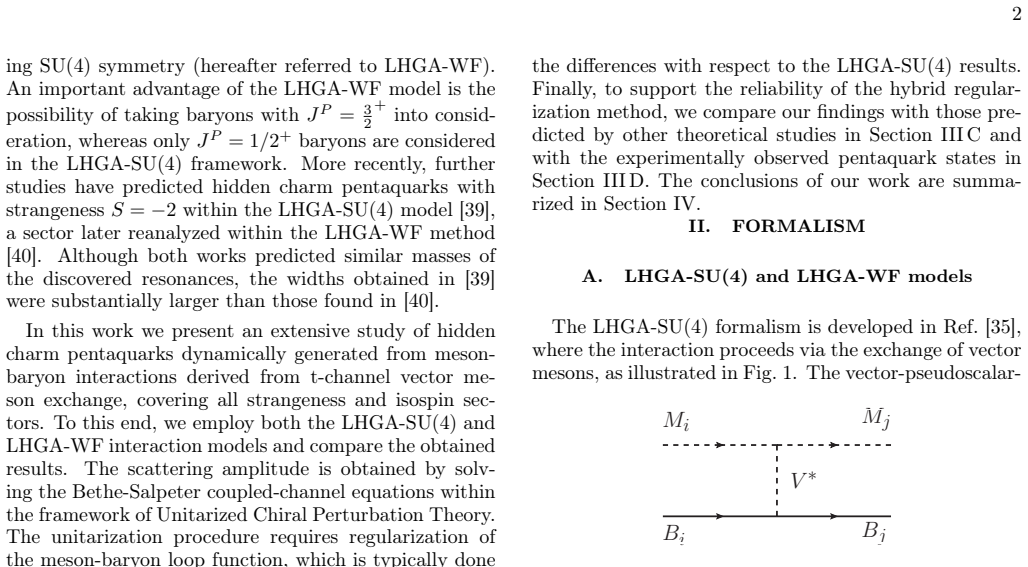
This work investigates dynamically generated hidden-charm baryon resonances arising from meson-baryon interactions. Using the local hidden gauge formalism, we model the interaction via t-channel vector meson exchange and unitarize the amplitude using the Bethe-Salpeter equation. To address regularization issues, we propose a novel ``hybrid loop function'' scheme that eliminates the unphysical poles -- common artifacts in cutoff or dimensional regularization -- while keeping the predictions of physical states. Consequently, the model successfully reproduces six experimentally known hidden-charm pentaquarks as well as earlier theoretical results, and predicts new states in the S=-1, I=1 sector.
Editorial analysis
A structured set of objections, weighed in public.
Referee Report
Summary. The manuscript investigates dynamically generated hidden-charm pentaquarks arising from meson-baryon interactions in the local hidden gauge formalism with t-channel vector-meson exchange. The scattering amplitude is unitarized via the Bethe-Salpeter equation. A novel hybrid loop function is introduced that combines cutoff regularization with dimensional regularization at a chosen matching scale in order to remove unphysical poles while preserving physical resonance predictions. The model is reported to reproduce six experimentally known hidden-charm pentaquarks, to agree with earlier theoretical results, and to predict additional states in the S = −1, I = 1 sector.
Significance. If the hybrid regularization procedure can be shown to preserve the correct analytic properties and to leave physical pole positions and residues stable, the work would supply a practical improvement over standard cutoff or dimensional schemes commonly used in coupled-channel unitarization studies of exotic hadrons. The reproduction of known states together with new predictions in an unexplored strangeness sector would be of direct interest to ongoing experimental programs at LHCb and Belle II. At present, however, the absence of quantitative fit metrics and explicit verification of the hybrid construction limits the strength of these claims.
major comments (2)
- Hybrid loop function section: The central claim that the hybrid construction removes only unphysical poles while leaving the positions and residues of the six reproduced hidden-charm resonances unchanged rests on the unproven assumption that the matching between cutoff and dimensional regularization preserves the correct imaginary part of the loop function on the physical sheet and introduces no spurious channel dependence when the same parameters are applied to both S = 0 and S = −1 sectors. No explicit derivation demonstrating that the hybrid function satisfies the dispersion relation, nor any numerical test of pole stability under reasonable variations of the matching scale, is provided. This issue is load-bearing for both the reproduction of known states and the new predictions.
- Results section on reproduction of known states: The abstract asserts that the model successfully reproduces six experimentally known hidden-charm pentaquarks, yet the manuscript supplies no quantitative details on pole positions, widths, couplings, or goodness-of-fit measures, nor any explicit verification that the hybrid scheme leaves these quantities unchanged relative to a pure cutoff or dimensional calculation. Without such metrics it is impossible to assess whether the central claim of improved unitarization holds.
minor comments (2)
- The notation used for the loop function in the hybrid scheme versus the pure regularization schemes should be defined more explicitly, preferably with a compact summary table or appendix equation.
- Figure captions and axis labels should clearly indicate which curves correspond to the hybrid function, the cutoff result, and the dimensional-regularization result for each channel.
Simulated Author's Rebuttal
We thank the referee for the careful reading and constructive comments on our manuscript. The points raised highlight areas where additional rigor and quantitative detail will strengthen the presentation. We address each major comment below and will incorporate the necessary revisions in the updated version.
read point-by-point responses
-
Referee: [—] Hybrid loop function section: The central claim that the hybrid construction removes only unphysical poles while leaving the positions and residues of the six reproduced hidden-charm resonances unchanged rests on the unproven assumption that the matching between cutoff and dimensional regularization preserves the correct imaginary part of the loop function on the physical sheet and introduces no spurious channel dependence when the same parameters are applied to both S = 0 and S = −1 sectors. No explicit derivation demonstrating that the hybrid function satisfies the dispersion relation, nor any numerical test of pole stability under reasonable variations of the matching scale, is provided. This issue is load-bearing for both the reproduction of known states and the new predictions.
Authors: We agree that a more explicit justification of the hybrid construction is warranted. The scheme matches the imaginary part of the dimensionally regularized loop at a chosen scale while retaining the cutoff-regularized real part to suppress unphysical poles. Although numerical results in the manuscript indicate that physical resonance positions and residues are preserved, we did not provide a formal derivation of the dispersion relation or systematic stability tests. In the revised manuscript we will add a dedicated subsection deriving the analytic properties of the hybrid loop function and include numerical tests that vary the matching scale, confirming that pole positions and residues remain stable. We will also verify consistency across the S = 0 and S = −1 sectors by applying the identical matching procedure and parameter set. revision: yes
-
Referee: [—] Results section on reproduction of known states: The abstract asserts that the model successfully reproduces six experimentally known hidden-charm pentaquarks, yet the manuscript supplies no quantitative details on pole positions, widths, couplings, or goodness-of-fit measures, nor any explicit verification that the hybrid scheme leaves these quantities unchanged relative to a pure cutoff or dimensional calculation. Without such metrics it is impossible to assess whether the central claim of improved unitarization holds.
Authors: We acknowledge the need for more quantitative support. The present text focuses on the qualitative reproduction of the six states and consistency with earlier calculations, but does not tabulate explicit pole positions, widths, or couplings, nor does it directly compare the hybrid results with pure regularization schemes. In the revised manuscript we will add tables listing these quantities for the reproduced resonances and provide side-by-side comparisons demonstrating that the hybrid scheme yields essentially unchanged physical results. Because the model is parameter-driven rather than fitted to data, we will discuss parameter sensitivity instead of conventional goodness-of-fit statistics. revision: yes
Circularity Check
No significant circularity in the derivation chain
full rationale
The paper proposes a novel hybrid loop function scheme within the local hidden gauge formalism and Bethe-Salpeter unitarization to remove unphysical poles while preserving physical resonance predictions. It validates by reproducing six known hidden-charm pentaquarks and extends to predict new states in the S=-1, I=1 sector. No quoted equations or self-citations reduce any load-bearing step to fitted inputs by construction, self-definition, or ansatz smuggling. The hybrid regularization is presented as an independent methodological improvement over standard cutoff or dimensional schemes, keeping the overall derivation self-contained.
Axiom & Free-Parameter Ledger
axioms (1)
- domain assumption Local hidden gauge formalism with t-channel vector meson exchange correctly models the meson-baryon interaction kernel.
Reference graph
Works this paper leans on
-
[1]
SectorS= 0, I= 1/2 We start discussing the results for the PB interaction in the sector with strangeness 0 and isospin1/2, where three channels are coupled:η cN, ¯DΛc and ¯DΣc. In Fig. 4 we representP j|Tij|for all differentichannels in different colors as functions of √swithin the range√s∈[2500,5500]MeV. The vertical black dashed lines indicate the thres...
-
[2]
SectorS=−1, I= 0 The PB interaction in theS=−1, I= 0sector in- volves four heavy channels:η cΛ, ¯DsΛc, ¯DΞc and ¯DΞ′ c. When using theG HY prescription, two resonances are found in the scattering amplitude, as can be seen in the right panel of Fig. 6. The number of structures is larger when we useGDR (left panel) orGCO (midle panel), and an additional stu...
-
[3]
The corresponding T-matrix, shown in Fig
SectorS=−1, I= 1 The PB interaction in theS=−1, I= 1sector has four coupled-channels:η cΣ, ¯DΞc, ¯DsΣc and ¯DΞ′ c. The corresponding T-matrix, shown in Fig. 9, has five struc- tures when employing theGDR loop (left panel), three 11 Figure 9: From left to right, the panels illustrate the scattering amplitude results obtained withGDR,G CO andG HY for the PB...
-
[4]
SectorS=−2, I= 1/2 The coupled channels of the PB interaction in the S=−2, I= 1/2sector areη cΞ, ¯DsΞc, ¯DsΞ′ c, and ¯DΩc. The corresponding T-matrix with the HY prescription presents a single structure, as seen in the right panel of Fig. 12, while the shapes of the scattering amplitudes with the DR (left panel) and CO schemes (middle panel) PB interactio...
-
[5]
15 the po- sitions in the complex plane of all physical poles found with PB interactions
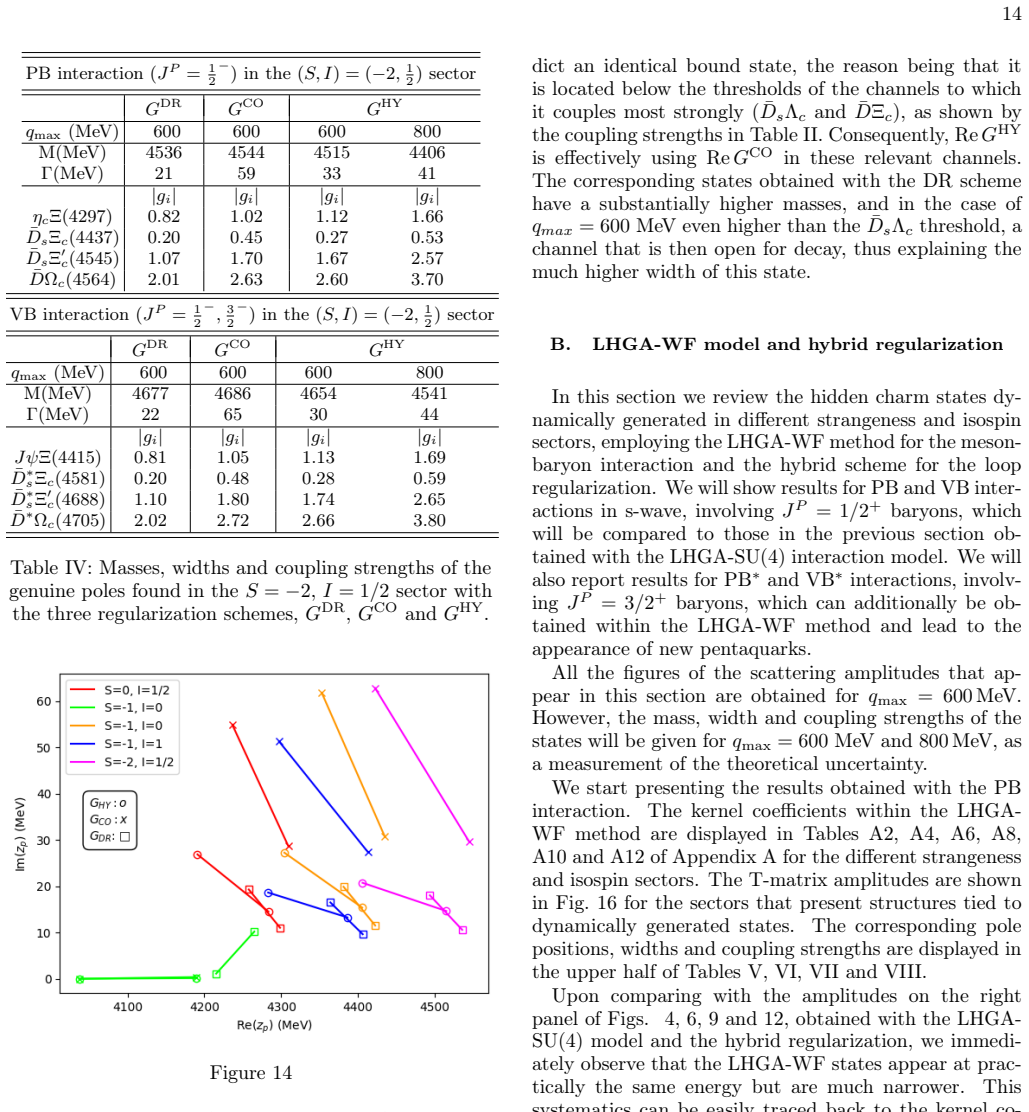
Summary of all sectors We end Section IIIA by collecting in Fig. 15 the po- sitions in the complex plane of all physical poles found with PB interactions. We present the results obtained with three different markers, which are related to the scheme that was used to regularize the loop function: GHY (circles),G CO (crosses) andG DR (squares). The poles are...
-
[6]
Vertical black dashed lines indicate the thresholds of the lightest and heaviest channels
The 15 (a) S=0, I=1/2 (b) S=-1,I=0 (c) S=-1,I=1 (d) S=-2,I=1/2 Figure 16: PB scattering amplitudes for different strange and isospin sectors within the LHGA-WF method. Vertical black dashed lines indicate the thresholds of the lightest and heaviest channels. PB interaction (JP = 1 2 − ) in the(S, I) = (0,1/2)sector qmax (MeV) 600 800 M(MeV) 4286 4211 Γ(Me...
work page 2005
-
[7]
R. H. Dalitz and S. F. Tuan, A possible resonant state in pion-hyperon scattering, Phys. Rev. Lett.2, 425 (1959)
work page 1959
-
[8]
M. H. Alston, L. W. Alvarez, P. Eberhard, M. L. Good, W. Graziano, H. K. Ticho, and S. G. Wojcicki, Study of Resonances of the Sigma-pi System, Phys. Rev. Lett.6, 698 (1961)
work page 1961
-
[9]
N. Isgur and G. Karl, P Wave Baryons in the Quark Model, Phys. Rev. D18, 4187 (1978)
work page 1978
-
[10]
S. Capstick and N. Isgur, Baryons in a relativized quark model with chromodynamics, Phys. Rev. D34, 2809 (1986)
work page 1986
-
[11]
P. N. Dobson and R. Mcelhaney, Interpretation of the y*0(1405) resonance, Phys. Rev. D6, 3256 (1972)
work page 1972
-
[12]
P. B. Siegel and W. Weise, Low-energyK− Nucleon Po- tentials and the Nature of theΛ(1405), Phys. Rev. C 38, 2221 (1988)
work page 1988
-
[13]
A. Mueller-Groeling, K. Holinde, and J. Speth, K- N in- teraction in the meson exchange framework, Nucl. Phys. A513, 557 (1990)
work page 1990
-
[14]
L. Y. Glozman and D. O. Riska, The Spectrum of the nucleons and the strange hyperons and chiral dynamics, Phys. Rept.268, 263 (1996), arXiv:hep-ph/9505422
work page internal anchor Pith review Pith/arXiv arXiv 1996
-
[15]
Nakamuraet al.(Particle Data Group), Review of particle physics, J
K. Nakamuraet al.(Particle Data Group), Review of particle physics, J. Phys. G37, 075021 (2010)
work page 2010
-
[16]
J. Gasser and H. Leutwyler, Chiral Perturbation Theory to One Loop, Annals Phys.158, 142 (1984)
work page 1984
-
[17]
Weinberg, Effective chiral Lagrangians for nucleon - pion interactions and nuclear forces, Nucl
S. Weinberg, Effective chiral Lagrangians for nucleon - pion interactions and nuclear forces, Nucl. Phys. B363, 3 (1991)
work page 1991
-
[18]
Chiral Dynamics and the Low Energy Kaon-Nucleon Interaction
N. Kaiser, P. B. Siegel, and W. Weise, Chiral dynam- ics and the low-energy kaon - nucleon interaction, Nucl. Phys. A594, 325 (1995), arXiv:nucl-th/9505043
work page internal anchor Pith review Pith/arXiv arXiv 1995
-
[19]
Non perturbative chiral approach to s-wave \bar{K}N interactions
E. Oset and A. Ramos, Nonperturbative chiral approach to s wave anti-K N interactions, Nucl. Phys. A635, 99 (1998), arXiv:nucl-th/9711022
work page internal anchor Pith review Pith/arXiv arXiv 1998
-
[20]
J. A. Oller, E. Oset, and A. Ramos, Chiral unitary ap- proach to meson meson and meson - baryon interactions and nuclear applications, Prog. Part. Nucl. Phys.45, 157 (2000), arXiv:hep-ph/0002193
work page internal anchor Pith review Pith/arXiv arXiv 2000
-
[21]
The nature of the Lambda(1405) resonance in chiral dynamics
T. Hyodo and D. Jido, The nature of the Lambda(1405) resonance in chiral dynamics, Prog. Part. Nucl. Phys.67, 55 (2012), arXiv:1104.4474 [nucl-th]
work page internal anchor Pith review Pith/arXiv arXiv 2012
-
[22]
A.Feijoo, V.Magas,andA.Ramos,S=−1meson-baryon interaction and the role of isospin filtering processes, Phys. Rev. C99, 035211 (2019), arXiv:1810.07600 [hep- ph]
work page internal anchor Pith review Pith/arXiv arXiv 2019
- [23]
-
[24]
D. Jido, J. A. Oller, E. Oset, A. Ramos, and U. G. Meiss- ner, Chiral dynamics of the two Lambda(1405) states, Nucl. Phys. A725, 181 (2003), arXiv:nucl-th/0303062
work page internal anchor Pith review Pith/arXiv arXiv 2003
-
[25]
V. K. Magas, E. Oset, and A. Ramos, Evidence for the two pole structure of the Lambda(1405) resonance, Phys. Rev. Lett.95, 052301 (2005), arXiv:hep-ph/0503043
work page internal anchor Pith review Pith/arXiv arXiv 2005
-
[26]
Patrignaniet al.(Particle Data Group), Review of Particle Physics, Chin
C. Patrignaniet al.(Particle Data Group), Review of Particle Physics, Chin. Phys. C40, 100001 (2016)
work page 2016
-
[27]
Mai, Review of theΛ(1405) A curious case of a strangeness resonance, Eur
M. Mai, Review of theΛ(1405) A curious case of a strangeness resonance, Eur. Phys. J. ST230, 1593 25 (2021), arXiv:2010.00056 [nucl-th]
- [28]
-
[29]
R. Aaijet al.(LHCb), Observation of an exotic narrow doublycharmedtetraquark,NaturePhys.18,751(2022), arXiv:2109.01038 [hep-ex]
-
[30]
R. Aaijet al.(LHCb), Study of the doubly charmed tetraquarkT + cc, Nature Commun.13, 3351 (2022), arXiv:2109.01056 [hep-ex]
- [31]
- [32]
-
[33]
L. Meng, G.-J. Wang, B. Wang, and S.-L. Zhu, Prob- ing the long-range structure of the Tcc+ with the strong and electromagnetic decays, Phys. Rev. D104, 051502 (2021), arXiv:2107.14784 [hep-ph]
-
[34]
Albaladejo, Tcc+ coupled channel analysis and predictions, Phys
M. Albaladejo, Tcc+ coupled channel analysis and predictions, Phys. Lett. B829, 137052 (2022), arXiv:2110.02944 [hep-ph]
-
[35]
R. Aaijet al.(LHCb), Observation ofJ/ψpReso- nances Consistent with Pentaquark States inΛ 0 b → J/ψK −pDecays, Phys. Rev. Lett.115, 072001 (2015), arXiv:1507.03414 [hep-ex]
work page internal anchor Pith review Pith/arXiv arXiv 2015
-
[36]
R. Aaijet al.(LHCb), Observation of a narrow pen- taquark state,P c(4312)+, and of two-peak structure of theP c(4450)+, Phys. Rev. Lett.122, 222001 (2019), arXiv:1904.03947 [hep-ex]
work page internal anchor Pith review Pith/arXiv arXiv 2019
-
[37]
R. Aaijet al.(LHCb), Evidence of aJ/ψΛstructure and observation of excitedΞ− states in theΞ − b →J/ψΛK − decay, Sci. Bull.66, 1278 (2021), arXiv:2012.10380 [hep- ex]
-
[38]
R. Aaijet al.(LHCb), Observation of a J/ψΛResonance Consistent with a Strange Pentaquark Candidate in B- →J/ψΛp¯Decays, Phys. Rev. Lett.131, 031901 (2023), arXiv:2210.10346 [hep-ex]
-
[39]
I. Adachiet al.(Belle, Belle II), Search for Pcs(4459) and Pcs(4338) in Upsilon(1S,2S) inclusive decays at Belle, (2025), arXiv:2502.09951 [hep-ex]
-
[40]
R. Aaijet al.(LHCb), Evidence for a new structure in the J/ψpandJ/ψ¯psystems inB 0 s →J/ψp¯pdecays, Phys. Rev. Lett.128, 062001 (2022), arXiv:2108.04720 [hep- ex]
-
[41]
Coupled-channel study of crypto-exotic baryons with charm
J. Hofmann and M. F. M. Lutz, Coupled-channel study of crypto-exotic baryons with charm, Nucl. Phys. A763, 90 (2005), arXiv:hep-ph/0507071
work page internal anchor Pith review Pith/arXiv arXiv 2005
-
[42]
J.-J. Wu, R. Molina, E. Oset, and B. S. Zou, Dynamically generatedN ∗ andΛ ∗ resonances in the hidden charm sector around 4.3 GeV, Phys. Rev. C84, 015202 (2011), arXiv:1011.2399 [nucl-th]
work page internal anchor Pith review Pith/arXiv arXiv 2011
-
[43]
A meson-baryon molecular interpretation for some $\Omega_c$ excited baryons
G. Montaña, A. Feijoo, and A. Ramos, A meson-baryon molecular interpretation for someΩc excited states, Eur. Phys. J. A54, 64 (2018), arXiv:1709.08737 [hep-ph]
work page internal anchor Pith review Pith/arXiv arXiv 2018
-
[44]
V. R. Debastiani, J. M. Dias, W. H. Liang, and E. Oset, MolecularΩ c states generated from coupled meson-baryon channels, Phys. Rev. D97, 094035 (2018), arXiv:1710.04231 [hep-ph]
work page internal anchor Pith review Pith/arXiv arXiv 2018
- [45]
- [46]
-
[47]
Q. X. Yu, R. Pavao, V. R. Debastiani, and E. Oset, De- scription of theΞc andΞ b states as molecular states, Eur. Phys. J. C79, 167 (2019), arXiv:1811.11738 [hep-ph]
work page internal anchor Pith review Pith/arXiv arXiv 2019
- [48]
-
[49]
Dynamically generated resonances from the vector octet-baryon octet interaction
E. Oset and A. Ramos, Dynamically generated reso- nances from the vector octet-baryon octet interaction, Eur. Phys. J. A44, 445 (2010), arXiv:0905.0973 [hep- ph]
work page internal anchor Pith review Pith/arXiv arXiv 2010
-
[50]
J. A. Oller and E. Oset, Chiral symmetry amplitudes in the S wave isoscalar and isovector channels and the σ, f0(980), a0(980) scalar mesons, Nucl. Phys. A620, 438 (1997), [Erratum: Nucl.Phys.A 652, 407–409 (1999)], arXiv:hep-ph/9702314
work page internal anchor Pith review Pith/arXiv arXiv 1997
-
[51]
L. Roca, E. Oset, and J. Singh, Low lying axial-vector mesons as dynamically generated resonances, Phys. Rev. D72, 014002 (2005), arXiv:hep-ph/0503273
work page internal anchor Pith review Pith/arXiv arXiv 2005
-
[52]
J. A. Oller, E. Oset, and J. R. Pelaez, Meson meson interaction in a nonperturbative chiral approach, Phys. Rev. D59, 074001 (1999), [Erratum: Phys.Rev.D 60, 099906 (1999), Erratum: Phys.Rev.D 75, 099903 (2007)], arXiv:hep-ph/9804209
work page internal anchor Pith review Pith/arXiv arXiv 1999
- [53]
-
[54]
C. W. Xiao, J. Nieves, and E. Oset, Heavy quark spin symmetric molecular states from ¯D(∗)Σ(∗) c and other coupled channels in the light of the recent LHCb pentaquarks, Phys. Rev. D100, 014021 (2019), arXiv:1904.01296 [hep-ph]
work page internal anchor Pith review Pith/arXiv arXiv 2019
- [55]
-
[56]
A. Feijoo, W.-F. Wang, C.-W. Xiao, J.-J. Wu, E. Oset, J. Nieves, and B.-S. Zou, A new look at the Pcs states from a molecular perspective, Phys. Lett. B839, 137760 (2023), arXiv:2212.12223 [hep-ph]
-
[57]
Navaset al.(Particle Data Group), Review of particle physics, Phys
S. Navaset al.(Particle Data Group), Review of particle physics, Phys. Rev. D110, 030001 (2024)
work page 2024
- [58]
-
[59]
M. H. M. Merk and N. Tuning, The LHCb Experiment, (2026), arXiv:2605.03745 [hep-ex]
work page internal anchor Pith review Pith/arXiv arXiv 2026
-
[60]
S. M. Flatte, Coupled - Channel Analysis of the pi eta and K anti-K Systems Near K anti-K Threshold, Phys. Lett. B63, 224 (1976)
work page 1976
-
[61]
On the spin, parity and nature of the $\Xi(1620)$ resonance
A. Ramos, E. Oset, and C. Bennhold, On the spin, parity and nature of the Xi(1620) resonance, Phys. Rev. Lett. 89, 252001 (2002), arXiv:nucl-th/0204044
work page internal anchor Pith review Pith/arXiv arXiv 2002
discussion (0)
Sign in with ORCID, Apple, or X to comment. Anyone can read and Pith papers without signing in.