Precision physics at the muon collider: m_W and CKM matrix elements
Pith reviewed 2026-05-22 09:00 UTC · model grok-4.3
The pith
A 10 TeV lepton collider can improve W boson mass precision beyond current 10 MeV levels and extract CKM matrix elements for heavy quarks more accurately by using hadronic decays.
A machine-rendered reading of the paper's core claim, the machinery that carries it, and where it could break.
Core claim
At a 10 TeV lepton collider the effective γW → W process dominates W production. The hadronic decay channel, supported by high-precision hadronic energy measurements and flavor tagging, can improve the current ≃10 MeV precision on the W mass while also determining CKM matrix elements involving heavy quarks at precisions that surpass current extractions limited by poorly known hadronic matrix elements.
What carries the argument
The effective γW → W process, which is the dominant W production mechanism at 10 TeV and enables measurements through hadronic decays with high energy resolution and flavor tagging.
If this is right
- High-precision hadronic calorimetry and flavor tagging become design priorities for future lepton colliders.
- CKM elements such as V_cb can be extracted independently of low-energy hadronic matrix element uncertainties.
- Both opposite-sign and same-sign lepton colliders gain access to the same precision program via the effective γW → W channel.
- The overall precision physics reach of a 10 TeV lepton collider expands into flavor physics through hadronic final states.
Where Pith is reading between the lines
- This method could reduce dependence on lattice QCD calculations for CKM phenomenology involving heavy quarks.
- Detector R&D focused on hadronic response would need to be validated against realistic beam and pile-up conditions.
- If the projections hold, the same techniques might be applied to other precision measurements at high-energy lepton colliders.
Load-bearing premise
The detector can achieve the needed hadronic energy resolution and flavor tagging performance without introducing systematic uncertainties large enough to cancel the expected gains.
What would settle it
A full detector simulation or test-beam study that shows the hadronic energy resolution or flavor-tagging efficiency falls short of the level required to beat 10 MeV on m_W or to improve on current CKM precisions for heavy quarks.
Figures


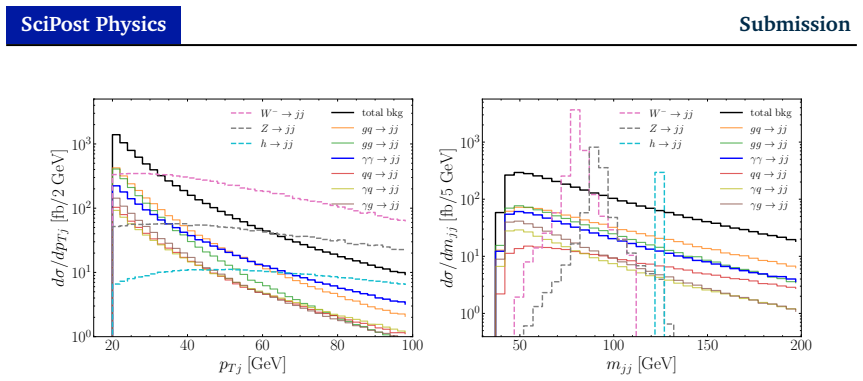


read the original abstract
We examine the potential for a 10~TeV lepton collider to carry out precision measurements of the W boson mass and W boson couplings strength, i.e. the CKM matrix elements. We consider the several W boson production mechanisms and focus on the most copious at 10~TeV, that is effective $\gamma W \to W$, a process viable at both opposite sign and same-sign leptonic colliders. We find that the leptonic W decay channel can hardly be competitive with present determinations, due to lack of rate. The hadronic channel has potential to improve over the current $\simeq$10~MeV from measurements at hadron colliders, motivating detector developments towards high-precision hadronic energy measurements. We find that the precision understanding of the detector response to hadrons can also lead to a determination of the CKM matrix elements. We expect determination of CKM matrix elements surpassing by far the present precision for couplings involving heavy quarks, notably $V_{cb}$, avoiding the present bottle-necks due to poor knowledge of hadronic matrix elements needed in low energy extractions of CKM matrix elements. Our findings motivate detector developments towards high-precision hadronic energy measurements and flavor tagging.
Editorial analysis
A structured set of objections, weighed in public.
Referee Report
Summary. The manuscript examines the potential for a 10 TeV lepton collider to perform precision measurements of the W boson mass and CKM matrix elements. It identifies the effective γW → W process as the dominant production mechanism at this energy and argues that the hadronic decay channel, enabled by high-precision hadronic energy measurements and flavor tagging, could improve upon the current ≃10 MeV precision on m_W from hadron colliders and yield superior determinations of CKM elements involving heavy quarks (e.g., V_cb) by circumventing uncertainties from hadronic matrix elements in low-energy extractions.
Significance. If the required detector performance can be realized, the projections would provide an important alternative pathway for electroweak and flavor precision physics at future lepton colliders, reducing dependence on hadronic uncertainties that currently limit CKM extractions. The work usefully highlights the physics case for advancing hadronic calorimetry and flavor-tagging capabilities, which could benefit broader programs at muon or other high-energy lepton colliders.
major comments (2)
- Abstract (and the corresponding discussion of the hadronic channel): the claim that this channel 'has potential to improve over the current ≃10 MeV' precision on m_W is load-bearing for the central result, yet no explicit calculation, error budget, or simulation is provided for the required jet-energy resolution, background rejection factors, or the size of new systematics (e.g., from high-energy hadronization modeling or pile-up) that must be controlled to realize the gain.
- Abstract (and the discussion of CKM determinations): the assertion that flavor tagging plus hadronic energy measurements will allow CKM elements involving heavy quarks to surpass present extractions is presented without quantitative estimates of achievable tagging efficiencies, their systematic uncertainties, or direct comparison to current V_cb etc. precisions, leaving the superiority as an unquantified projection rather than a demonstrated result.
minor comments (2)
- The abstract and main text would benefit from a brief table or paragraph summarizing the assumed detector performance parameters (energy resolution, tagging efficiency) used to reach the stated conclusions.
- Clarify whether the effective γW → W process is treated at leading order only or includes higher-order corrections that could affect rate and kinematics at 10 TeV.
Simulated Author's Rebuttal
We thank the referee for their careful reading of the manuscript and for the constructive comments, which help clarify the scope and limitations of our projections. We address each major comment below and indicate the revisions made to the manuscript.
read point-by-point responses
-
Referee: Abstract (and the corresponding discussion of the hadronic channel): the claim that this channel 'has potential to improve over the current ≃10 MeV' precision on m_W is load-bearing for the central result, yet no explicit calculation, error budget, or simulation is provided for the required jet-energy resolution, background rejection factors, or the size of new systematics (e.g., from high-energy hadronization modeling or pile-up) that must be controlled to realize the gain.
Authors: We agree that the original text presented the improvement as a qualitative projection based on the high rate of the effective γW → W process and the kinematic advantages at 10 TeV, without a full detector simulation or detailed error budget. This is a fair observation. In the revised manuscript we have added a dedicated paragraph in the hadronic channel section that specifies target jet-energy resolutions (scaling from current LHC performance to the multi-TeV regime), discusses the dominant potential systematics (high-energy hadronization modeling, pile-up at the muon collider, and background rejection via missing-energy and flavor-tagging requirements), and outlines how these could be controlled with future detector R&D. We explicitly state that a complete Monte Carlo study lies beyond the scope of the present work but is now clearly motivated as a follow-up. The claim is therefore softened from a guaranteed improvement to a well-motivated potential that depends on achieving the stated detector performance. revision: partial
-
Referee: Abstract (and the discussion of CKM determinations): the assertion that flavor tagging plus hadronic energy measurements will allow CKM elements involving heavy quarks to surpass present extractions is presented without quantitative estimates of achievable tagging efficiencies, their systematic uncertainties, or direct comparison to current V_cb etc. precisions, leaving the superiority as an unquantified projection rather than a demonstrated result.
Authors: We accept that the original discussion was largely qualitative and lacked explicit numbers for tagging performance or direct precision comparisons. The revised manuscript now includes a short subsection with order-of-magnitude estimates for b- and c-tagging efficiencies at 10 TeV, extrapolated from existing LHCb and ATLAS/CMS studies at lower energies, together with a table comparing the projected uncertainty on V_cb (and V_ub) to the current world averages from exclusive and inclusive B decays. We emphasize that the principal advantage remains the avoidance of hadronic matrix-element uncertainties that dominate low-energy extractions, while acknowledging that tagging systematics at these energies will require dedicated study. These additions make the superiority claim quantitative rather than purely projective. revision: yes
Circularity Check
No circularity: forward-looking collider projections are independent of fitted inputs
full rationale
The paper's central claims consist of phenomenological projections for m_W precision and CKM extractions via the hadronic channel at a 10 TeV lepton collider, based on the dominance of the effective γW → W process and assumptions about achievable detector resolution and flavor tagging. No equations or steps reduce a claimed result to its own inputs by construction, nor do any predictions arise from fitting parameters to a subset of the target data. The analysis remains self-contained against external benchmarks such as current ~10 MeV m_W uncertainties and existing CKM determinations, without load-bearing self-citations, ansatz smuggling, or renaming of known results. The findings are presented as motivating future detector work rather than as tautological derivations.
Axiom & Free-Parameter Ledger
axioms (2)
- domain assumption The effective γW → W process is the dominant W production mechanism at 10 TeV.
- standard math Current m_W precision from hadron colliders is ≃10 MeV.
Reference graph
Works this paper leans on
-
[1]
R. Franceschini, A. Strumia and A. Wulzer, The collider landscape: which collider for establishing the SM instability? , JHEP 08, 229 (2022), doi:10.1007/JHEP08(2022)229, [Erratum: JHEP 03, 167 (2023)], 2203.17197
-
[2]
High-precision measurement of the W boson mass with the CMS experiment
V. Chekhovsky et al., High-precision measurement of the W boson mass with the CMS experiment at the LHC (2024), 2412.13872
work page internal anchor Pith review Pith/arXiv arXiv 2024
- [3]
-
[4]
J. Alwall, R. Frederix, S. Frixione, V. Hirschi, F. Maltoni, O. Mattelaer, H. S. Shao, T. Stelzer, P. Torrielli and M. Zaro, The automated computation of tree-level and next-to-leading order differential cross sections, and their matching to parton shower simulations , JHEP 07, 079 (2014), doi:10.1007/JHEP07(2014)079, 1405.0301
work page internal anchor Pith review Pith/arXiv arXiv doi:10.1007/jhep07(2014)079 2014
-
[5]
Accettura et al., The Muon Collider (2025), 2504.21417
C. Accettura et al., The Muon Collider (2025), 2504.21417
-
[6]
Y. Hamada, R. Kitano, R. Matsudo, H. Takaura and M. Yoshida, TRISTAN , PTEP 2022(5), 053B02 (2022), doi:10.1093/ptep/ptac059, 2201.06664
-
[7]
S. Chigusa, S. Knapen, T. Opferkuch, I. Savoray, C. Scherb and W. L. Xu, Searches for electroweak states at future plasma wakefield colliders (2025), 2512.09995
-
[8]
CDF Collaboration and D0 Collaboration , Combination of CDF and D0 W-Boson Mass Measurements (2013), 1307.7627v2
work page internal anchor Pith review Pith/arXiv arXiv 2013
-
[9]
A. V. Kotwal, Model for the curvature response of the CDF II drift chamber , Phys. Rev. Res. 7(1), 013128 (2025), doi:10.1103/PhysRevResearch.7.013128
-
[10]
High-precision measurement of the W boson mass with the CDF II detector
T. Aaltonen et al., High-precision measurement of the W boson mass with the CDF II detector , Science 376(6589), 170 (2022), doi:10.1126/science.abk1781
-
[11]
ATLAS Collaboration , Improved \(W\) boson Mass Measurement using \( s = 7\, TeV \) Proton--Proton Collisions with the ATLAS Detector , ATLAS-CONF-2023-004 (2023)
work page 2023
-
[12]
ATLAS Collaboration , Measurement of the W -boson mass in pp collisions at s =7 TeV with the ATLAS detector , ArXiv e-prints (2017), 1701.07240
work page internal anchor Pith review Pith/arXiv arXiv 2017
-
[13]
P. Andreetto et al., MUSIC: A Multi-Purpose Detector Concept for Physics at the 10 TeV Muon Collider (2025), 2511.23273
-
[14]
Bell et al., MAIA: A new detector concept for a 10 TeV muon collider (2025), 2502.00181
C. Bell et al., MAIA: A new detector concept for a 10 TeV muon collider (2025), 2502.00181
-
[15]
C. F. von Weizsacker, Radiation emitted in collisions of very fast electrons , Z. Phys. 88, 612 (1934), doi:10.1007/BF01333110
-
[16]
E. J. Williams, Nature of the high-energy particles of penetrating radiation and status of ionization and radiation formulae , Phys. Rev. 45, 729 (1934), doi:10.1103/PhysRev.45.729
-
[17]
Improving the Weizs\"acker-Williams Approximation in Electron-Proton Collisions
S. Frixione, M. L. Mangano, P. Nason and G. Ridolfi, Improving the Weizsacker-Williams approximation in electron - proton collisions , Phys. Lett. B 319, 339 (1993), doi:10.1016/0370-2693(93)90823-Z, hep-ph/9310350
work page internal anchor Pith review Pith/arXiv arXiv doi:10.1016/0370-2693(93)90823-z 1993
-
[18]
A simple, yet subtle "invariance" of two-body decay kinematics
K. Agashe, R. Franceschini and D. Kim, Simple invariance of two-body decay kinematics , Phys. Rev. D 88(5), 057701 (2013), doi:10.1103/PhysRevD.88.057701, 1209.0772
work page internal anchor Pith review Pith/arXiv arXiv doi:10.1103/physrevd.88.057701 2013
-
[19]
Energy spectra of massive two-body decay products and mass measurement
K. Agashe, R. Franceschini, S. Hong and D. Kim, Energy spectra of massive two-body decay products and mass measurement , JHEP 04, 151 (2016), doi:10.1007/JHEP04(2016)151, 1512.02265
work page internal anchor Pith review Pith/arXiv arXiv doi:10.1007/jhep04(2016)151 2016
-
[20]
Study of Electroweak Interactions at the Energy Frontier
M. Baak et al., Working Group Report: Precision Study of Electroweak Interactions , In Snowmass 2013 : Snowmass on the Mississippi (2013), 1310.6708
work page internal anchor Pith review Pith/arXiv arXiv 2013
-
[21]
J. Anguiano, Study of WW q q at ILC500 with ILD , In International Workshop on Future Linear Colliders (2020), 2011.12451
-
[22]
G. W. Wilson , Prospects for Precision m_W measurements at future e^+e^- colliders , MW days 2023
work page 2023
-
[23]
J. Podolanski and R. Armenteros, III. Analysis of V-events , Phil. Mag. 45(360), 13 (1954), doi:10.1080/14786440108520416
-
[24]
P. B. Rodr \' guez, V. Chobanova, X. C. Vidal, V. Gligorov, M. L. Mart \' nez, J. Markov, D. M. Santos and M. P. Casas \'u s, Calibration of the momentum scale of a particle physics detector using the Armenteros-Podolanski plot , JINST 16(06), P06036 (2021), doi:10.1088/1748-0221/16/06/P06036, 2012.03620
-
[25]
S. Agostinelli et al., GEANT4 - A Simulation Toolkit , Nucl. Inst. & Meth. A506, 250 (2003), doi:10.1016/S0168-9002(03)01368-8
-
[26]
N. Bartosik et al., Full Detector Simulation with Unprecedented Background Occupancy at a Muon Collider , Comput. Softw. Big Sci. 5(1), 21 (2021), doi:10.1007/s41781-021-00067-x
-
[27]
Accettura et al., Towards a muon collider , Eur
C. Accettura et al., Towards a muon collider , Eur. Phys. J. C 83(9), 864 (2023), doi:10.1140/epjc/s10052-023-11889-x, [Erratum: Eur.Phys.J.C 84, 36 (2024)], 2303.08533
-
[28]
P. Fernandez Declara et al., The Key4hep turnkey software stack for future colliders , PoS EPS-HEP2021, 844 (2022), doi:10.22323/1.398.0844
- [29]
-
[30]
M. Frank, F. Gaede, C. Grefe and P. Mato, DD4hep: A Detector Description Toolkit for High Energy Physics Experiments , J. Phys. Conf. Ser. 513(2), 022010 (2013), doi:10.1088/1742-6596/513/2/022010
-
[31]
M. Petric, M. Frank, F. Gaede, S. Lu, N. Nikiforou and A. Sailer, Detector simulations with dd4hep, J. Phys. Conf. Ser. 898(4), 042015 (2016), doi:10.1088/1742-6596/898/4/042015
-
[32]
G. Battistoni, T. Boehlen, F. Cerutti, P. W. Chin, L. S. Esposito, A. Fassò, A. Ferrari, A. Lechner, A. Empl, A. Mairani, A. Mereghetti, P. G. Ortega et al., Overview of the fluka code, Annals of Nuclear Energy 82, 10 (2015), doi:https://doi.org/10.1016/j.anucene.2014.11.007, Joint International Conference on Supercomputing in Nuclear Applications and Mon...
-
[33]
C. Ahdida, D. Bozzato, D. Calzolari, F. Cerutti, N. Charitonidis, A. Cimmino, A. Coronetti, G. L. D’Alessandro, A. Donadon Servelle, L. S. Esposito, R. Froeschl, R. García Alía et al., New capabilities of the fluka multi-purpose code, Frontiers in Physics 9 (2022), doi:10.3389/fphy.2021.788253
-
[34]
D. Schulte, Study of Electromagnetic and Hadronic Background in the Interaction Region of the TESLA Collider , Ph.D. thesis, Hamburg U. (1997)
work page 1997
-
[35]
Ai et al., A Common Tracking Software Project , Comput
X. Ai et al., A Common Tracking Software Project , Comput. Softw. Big Sci. 6(1), 8 (2022), doi:10.1007/s41781-021-00078-8, 2106.13593
-
[36]
A new jet reconstruction algorithm for lepton colliders
M. Boronat, J. Fuster, I. Garcia, E. Ros and M. Vos, A robust jet reconstruction algorithm for high-energy lepton colliders , Phys. Lett. B 750, 95 (2015), doi:10.1016/j.physletb.2015.08.055, 1404.4294
work page internal anchor Pith review Pith/arXiv arXiv doi:10.1016/j.physletb.2015.08.055 2015
-
[37]
M. Cacciari, G. P. Salam and G. Soyez, FastJet User Manual , Eur. Phys. J. C 72, 1896 (2012), doi:10.1140/epjc/s10052-012-1896-2, 1111.6097
work page internal anchor Pith review Pith/arXiv arXiv doi:10.1140/epjc/s10052-012-1896-2 2012
-
[38]
J. S. Marshall, A. M \"u nnich and M. A. Thomson, Performance of Particle Flow Calorimetry at CLIC , Nucl. Instrum. Meth. A 700, 153 (2013), doi:10.1016/j.nima.2012.10.038, 1209.4039
work page internal anchor Pith review Pith/arXiv arXiv doi:10.1016/j.nima.2012.10.038 2013
-
[39]
J. S. Marshall and M. A. Thomson, The pandora software development kit for particle flow calorimetry, Journal of Physics: Conference Series 396(2), 022034 (2012), doi:10.1088/1742-6596/396/2/022034
-
[40]
A comprehensive guide to the physics and usage of PYTHIA 8.3
C. Bierlich et al., A comprehensive guide to the physics and usage of PYTHIA 8.3 , SciPost Phys. Codeb. 2022, 8 (2022), doi:10.21468/SciPostPhysCodeb.8, 2203.11601
work page internal anchor Pith review Pith/arXiv arXiv doi:10.21468/scipostphyscodeb.8 2022
-
[41]
F. Garosi, D. Marzocca and S. Trifinopoulos, LePDF: Standard Model PDFs for high-energy lepton colliders , JHEP 09, 107 (2023), doi:10.1007/JHEP09(2023)107, 2303.16964
-
[42]
LHAPDF6: parton density access in the LHC precision era
A. Buckley, J. Ferrando, S. Lloyd, K. Nordstr \"o m, B. Page, M. R \"u fenacht, M. Sch \"o nherr and G. Watt, LHAPDF6: parton density access in the LHC precision era , Eur. Phys. J. C 75, 132 (2015), doi:10.1140/epjc/s10052-015-3318-8, 1412.7420
work page internal anchor Pith review Pith/arXiv arXiv doi:10.1140/epjc/s10052-015-3318-8 2015
-
[43]
C. W. Bauer, N. Ferland and B. R. Webber, Standard Model Parton Distributions at Very High Energies , JHEP 08, 036 (2017), doi:10.1007/JHEP08(2017)036, 1703.08562
work page internal anchor Pith review Pith/arXiv arXiv doi:10.1007/jhep08(2017)036 2017
-
[44]
T. Han, Y. Ma and K. Xie, High energy leptonic collisions and electroweak parton distribution functions , Phys. Rev. D 103(3), L031301 (2021), doi:10.1103/PhysRevD.103.L031301, 2007.14300
-
[45]
T. Han, Y. Ma and K. Xie, Quark and gluon contents of a lepton at high energies , JHEP 02, 154 (2022), doi:10.1007/JHEP02(2022)154, 2103.09844
-
[46]
S. Frixione and G. Stagnitto, The muon parton distribution functions , JHEP 12, 170 (2023), doi:10.1007/JHEP12(2023)170, 2309.07516
-
[47]
F. Bedeschi, L. Gouskos and M. Selvaggi, Jet flavour tagging for future colliders with fast simulation , Eur. Phys. J. C 82(7), 646 (2022), doi:10.1140/epjc/s10052-022-10609-1, 2202.03285
-
[48]
de Blas et al., Focus topics for the ECFA study on Higgs / Top / EW factories (2024), 2401.07564
J. de Blas et al., Focus topics for the ECFA study on Higgs / Top / EW factories (2024), 2401.07564
-
[49]
F. Blekman, F. Canelli, A. De Moor, K. Gautam, A. Ilg, A. Macchiolo and E. Ploerer, Tagging more quark jet flavours at FCC-ee at 91 GeV with a transformer-based neural network , Eur. Phys. J. C 85(2), 165 (2025), doi:10.1140/epjc/s10052-025-13785-y, 2406.08590
-
[50]
Abidi et al., ECFA Higgs, electroweak, and top Factory Study , vol
H. Abidi et al., ECFA Higgs, electroweak, and top Factory Study , vol. 5/2025 of CERN Yellow Reports: Monographs, ISBN 978-92-9083-700-8, 978-92-9083-701-5, doi:10.23731/CYRM-2025-005 (2025), 2506.15390
-
[51]
ATLAS Collaboration , ATLAS flavour-tagging algorithms for the LHC Run 2 \(pp\) collision dataset , Eur. Phys. J. C 83, 681 (2023), doi:10.1140/epjc/s10052-023-11699-1, 2211.16345
- [52]
-
[53]
ATLAS Collaboration , Measurement of the \(c\)-jet mistagging efficiency in \(t t \) events using \(pp\) collision data at \( s = 13\, TeV \) collected with the ATLAS detector , Eur. Phys. J. C 82, 95 (2022), doi:10.1140/epjc/s10052-021-09843-w, 2109.10627
-
[54]
H. Qu and L. Gouskos, ParticleNet: Jet Tagging via Particle Clouds , Phys. Rev. D 101(5), 056019 (2020), doi:10.1103/PhysRevD.101.056019, 1902.08570
-
[55]
CMS Collaboration , A unified approach for jet tagging in Run 3 at \( s = 13.6 TeV \) in CMS , CMS‑DP‑2024‑066 (2024)
work page 2024
-
[56]
CMS Collaboration , Performance of heavy-flavour jet identification in boosted topologies in proton-proton collisions at \( s = 13 TeV \) , CMS-PAS-BTV-22-001 (2023)
work page 2023
-
[57]
Averages of $b$-hadron, $c$-hadron, and $\tau$-lepton properties as of 2023
S. Banerjee et al., Averages of b -hadron, c -hadron, and -lepton properties as of 2023 (2024), 2411.18639
work page internal anchor Pith review Pith/arXiv arXiv 2023
-
[58]
The $V_{cb}$ puzzle: an update
P. Gambino, M. Jung and S. Schacht, The V_ cb puzzle: An update , Phys. Lett. B 795, 386 (2019), doi:10.1016/j.physletb.2019.06.039, 1905.08209
work page internal anchor Pith review Pith/arXiv arXiv doi:10.1016/j.physletb.2019.06.039 2019
-
[59]
F. U. Bernlochner, Z. Ligeti and D. J. Robinson, N = 5, 6, 7, 8: Nested hypothesis tests and truncation dependence of |V_ cb | , Phys. Rev. D 100(1), 013005 (2019), doi:10.1103/PhysRevD.100.013005, 1902.09553
-
[60]
D. Marzocca, M. Szewc and M. Tammaro, Direct CKM determination from W decays at future lepton colliders , JHEP 11, 017 (2024), doi:10.1007/JHEP11(2024)017, 2405.08880
-
[61]
H. Liang, L. Li, Y. Zhu, X. Shen and M. Ruan, Measurement of CKM element |V _ cb | from W boson decays at the future Higgs factories , JHEP 12, 071 (2024), doi:10.1007/JHEP12(2024)071, 2406.01675
-
[62]
Navas, et al., Review of particle physics, Phys
S. Navas et al., Review of particle physics , Phys. Rev. D 110(3), 030001 (2024), doi:10.1103/PhysRevD.110.030001
-
[63]
D. Marzocca, F. Montagno, M. Morales-Alvarado and A. Wulzer, Quark mixing from muon collider neutrinos (2025), 2511.23288
-
[64]
K. Agashe, S. Airen, R. Franceschini, D. Kim, A. V. Kotwal, L. Ricci and D. Sathyan, A new purpose for the W-boson mass measurement: Searching for New Physics in lepton+MET , Phys. Lett. B 855, 138774 (2024), doi:10.1016/j.physletb.2024.138774, 2310.13687
-
[65]
K. Agashe, S. Airen, R. Franceschini, D. Kim, A. V. Kotwal, L. Ricci and D. Sathyan, Unification of BSM searches and SM measurements: the case of lepton+[inline-graphic not available: see fulltext] and m _ W , JHEP 02, 139 (2025), doi:10.1007/JHEP02(2025)139, 2404.17574
- [66]
discussion (0)
Sign in with ORCID, Apple, or X to comment. Anyone can read and Pith papers without signing in.