Broken Memories: Detecting and Mitigating Memorization in Diffusion Models with Degraded Generations
Pith reviewed 2026-05-25 06:05 UTC · model grok-4.3
The pith
Diffusion models detect memorization through numerical instability shown as broken artifacts during generation.
A machine-rendered reading of the paper's core claim, the machinery that carries it, and where it could break.
Core claim
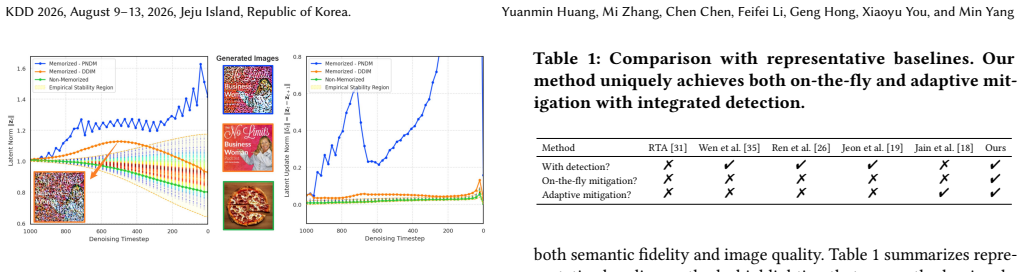
Memorization induces internal numerical instability often manifesting as visually broken artifacts. Inspired by stability analysis in numerical methods, empirical stability regions based on latent update norms quantitatively characterize stable behavior during generation. This supports a principled on-the-fly framework for step-wise detection and adaptive mitigation that suppresses memorization without altering prompts or guidance, preserving semantic fidelity and image quality.
What carries the argument
Empirical stability regions based on latent update norms that detect instability caused by memorization during the denoising steps.
If this is right
- Stable Diffusion 1.4 achieves AUC greater than 0.999 for detecting memorized generations.
- Mitigation brings the memorization rate down to 0.0 percent after application.
- The process adds only about 0.01 seconds per image in overhead.
- Image quality and adherence to the prompt remain unchanged by the mitigation.
- The detection and mitigation happen during generation without any model retraining.
Where Pith is reading between the lines
- Similar instability checks could apply to other iterative generative processes like those in video or audio models.
- Deployed systems might use this to log and filter outputs that show signs of memorization in real time.
- Future work could explore whether adjusting the stability thresholds improves performance across different datasets.
- This approach suggests that monitoring internal dynamics can reveal overfitting without needing access to the training set.
Load-bearing premise
Memorization in the model causes measurable numerical instability during generation that reliably produces broken visual artifacts detectable by latent update norms.
What would settle it
Observe a set of images that are clearly memorized from the training data but generated without broken artifacts or exceeding the stability thresholds, or find that applying the mitigation still produces some memorized outputs.
Figures


read the original abstract
While diffusion models excel at generating high-quality images, their tendency to memorize training data poses significant privacy and copyright risks. In this work, we for the first time identify that memorization induces internal numerical instability, often manifesting as visually ``broken'' artifacts. Inspired by stability analysis in numerical methods, we introduce empirical stability regions based on latent update norms to quantitatively characterize stable behavior during generation. Leveraging this, we propose a principled, on-the-fly framework for step-wise detection and adaptive mitigation. Our approach suppresses memorization without altering prompts or guidance, thereby preserving semantic fidelity and image quality. Extensive experiments on Stable Diffusion 1.4 demonstrate that our method achieves an AUC $>0.999$ detection performance and a $0.0\%$ memorization rate after mitigation with negligible overhead ($\approx0.01$s per image).
Editorial analysis
A structured set of objections, weighed in public.
Referee Report
Summary. The paper claims that memorization in diffusion models induces internal numerical instability, often visible as 'broken' artifacts during generation. It introduces empirical stability regions based on latent update norms to characterize stable behavior, and proposes an on-the-fly step-wise detection and adaptive mitigation framework that suppresses memorization without altering prompts or guidance. Experiments on Stable Diffusion 1.4 report AUC >0.999 for detection, 0.0% post-mitigation memorization rate, and negligible overhead of ≈0.01s per image while preserving semantic fidelity and image quality.
Significance. If the reported empirical correlation between memorization and elevated latent update norms holds under broader validation, the work offers a practical, prompt-preserving approach to mitigating privacy and copyright risks in diffusion models. The on-the-fly nature, high detection AUC, zero post-mitigation memorization rate, and low overhead are strengths that could aid ethical deployment of generative models.
minor comments (4)
- The experimental section should explicitly state the dataset(s) used for training the base model and for evaluating memorization (including number of prompts and images), as these details are needed to interpret the AUC >0.999 and 0.0% rates.
- Clarify the precise definition and threshold used to label a generation as 'memorized' (e.g., exact pixel match, perceptual similarity, or membership inference), since this metric is central to the mitigation claims.
- Figure captions or the method section should include an example of a 'broken' artifact alongside the corresponding latent update norm trace to illustrate the stability-region concept.
- The overhead measurement (≈0.01s per image) should specify the hardware and implementation details for reproducibility.
Simulated Author's Rebuttal
We thank the referee for the positive summary, significance assessment, and recommendation of minor revision. No specific major comments were provided in the report.
Circularity Check
No significant circularity detected
full rationale
The paper presents an empirical framework that correlates memorization with elevated latent update norms during diffusion generation, using stability-region analysis for detection and mitigation on Stable Diffusion 1.4. No equations, fitted parameters renamed as predictions, or self-citation chains are shown that reduce the core claims (AUC >0.999 detection, 0% post-mitigation memorization) to inputs by construction. The stability regions are introduced as an empirical characterization inspired by numerical methods, without self-definitional loops, uniqueness theorems from the authors, or ansatzes smuggled via prior self-citations. The derivation remains self-contained against external benchmarks.
Axiom & Free-Parameter Ledger
Lean theorems connected to this paper
-
IndisputableMonolith/Cost/FunctionalEquation.leanwashburn_uniqueness_aczel unclear?
unclearRelation between the paper passage and the cited Recognition theorem.
We introduce empirical stability regions based on latent update norms... R^(t)_δ := [μ_t − γσ_t, μ_t + γσ_t]... Theorem 1 (Normal Trajectories Stability)... sub-Gaussian tail bound
-
IndisputableMonolith/Foundation/AlexanderDuality.leanalexander_duality_circle_linking unclear?
unclearRelation between the paper passage and the cited Recognition theorem.
PNDM... AB4... stability region RAB... scaled eigenvalues ν := λΔt
What do these tags mean?
- matches
- The paper's claim is directly supported by a theorem in the formal canon.
- supports
- The theorem supports part of the paper's argument, but the paper may add assumptions or extra steps.
- extends
- The paper goes beyond the formal theorem; the theorem is a base layer rather than the whole result.
- uses
- The paper appears to rely on the theorem as machinery.
- contradicts
- The paper's claim conflicts with a theorem or certificate in the canon.
- unclear
- Pith found a possible connection, but the passage is too broad, indirect, or ambiguous to say the theorem truly supports the claim.
Reference graph
Works this paper leans on
-
[1]
Josh Achiam, Steven Adler, Sandhini Agarwal, Lama Ahmad, Ilge Akkaya, Floren- cia Leoni Aleman, Diogo Almeida, Janko Altenschmidt, Sam Altman, Shyamal Anadkat, et al. 2023. Gpt-4 technical report.arXiv preprint arXiv:2303.08774 (2023)
work page internal anchor Pith review Pith/arXiv arXiv 2023
- [3]
-
[4]
Jonathan Brokman, Itay Gershon, Omer Hofman, Guy Gilboa, and Roman Vain- shtein. 2025. Tracking memorization geometry throughout the diffusion model generative process. InNeurIPS 2025 Workshop on Symmetry and Geometry in Neural Representations
work page 2025
-
[5]
J.C. Butcher. 1996. A history of Runge-Kutta methods.Applied Numerical Mathe- matics20, 3 (1996), 247–260. doi:10.1016/0168-9274(95)00108-5
-
[6]
Nicolas Carlini, Jamie Hayes, Milad Nasr, Matthew Jagielski, Vikash Sehwag, Florian Tramer, Borja Balle, Daphne Ippolito, and Eric Wallace. 2023. Extracting training data from diffusion models. In32nd USENIX security symposium (USENIX Security 23). 5253–5270
work page 2023
-
[7]
Ruchika Chavhan, Ondrej Bohdal, Yongshuo Zong, Da Li, and Timothy Hospedales. 2024. Memorized Images in Diffusion Models share a Subspace that can be Located and Deleted. arXiv:2406.18566 [cs.CV] https://arxiv.org/abs/ 2406.18566 KDD 2026, August 9–13, 2026, Jeju Island, Republic of Korea. Yuanmin Huang, Mi Zhang, Chen Chen, Feifei Li, Geng Hong, Xiaoyu Y...
-
[8]
Chen Chen, Daochang Liu, Mubarak Shah, and Chang Xu. 2025. En- hancing Privacy-Utility Trade-offs to Mitigate Memorization in Diffu- sion Models. InProceedings of the IEEE/CVF Conference on Computer Vision and Pattern Recognition. 8182–8191. https://openaccess.thecvf. com/content/CVPR2025/html/Chen_Enhancing_Privacy-Utility_Trade- offs_to_Mitigate_Memoriz...
work page 2025
- [9]
-
[10]
Chen Chen, Daochang Liu, and Chang Xu. 2024. Towards memorization-free diffusion models. InProceedings of the IEEE/CVF Conference on Computer Vision and Pattern Recognition. 8425–8434
work page 2024
-
[11]
Dale R Durran. 1991. The third-order Adams-Bashforth method: An attractive alternative to leapfrog time differencing.Monthly weather review119, 3 (1991), 702–720
work page 1991
- [12]
-
[13]
1993.Solving ordinary differential equations I: Nonstiff problems
Ernst Hairer, Gerhard Wanner, and Syvert P Nørsett. 1993.Solving ordinary differential equations I: Nonstiff problems. Springer
work page 1993
-
[14]
Jack Hessel, Ari Holtzman, Maxwell Forbes, Ronan Le Bras, and Yejin Choi
-
[15]
CLIPScore: A Reference-free Evaluation Metric for Image Captioning
CLIPScore: A Reference-free Evaluation Metric for Image Captioning. arXiv:2104.08718 [cs.CV] https://arxiv.org/abs/2104.08718
work page internal anchor Pith review Pith/arXiv arXiv
-
[16]
Martin Heusel, Hubert Ramsauer, Thomas Unterthiner, Bernhard Nessler, and Sepp Hochreiter. 2018. GANs Trained by a Two Time-Scale Update Rule Converge to a Local Nash Equilibrium. arXiv:1706.08500 [cs.LG] https://arxiv.org/abs/1706. 08500
work page internal anchor Pith review Pith/arXiv arXiv 2018
-
[17]
Jonathan Ho, Ajay Jain, and Pieter Abbeel. 2020. Denoising diffusion probabilistic models.Advances in neural information processing systems33 (2020), 6840–6851
work page 2020
-
[18]
Jonathan Ho and Tim Salimans. 2022. Classifier-Free Diffusion Guidance. arXiv:2207.12598 [cs.LG] https://arxiv.org/abs/2207.12598
work page internal anchor Pith review Pith/arXiv arXiv 2022
-
[19]
Anubhav Jain, Yuya Kobayashi, Takashi Shibuya, Yuhta Takida, Nasir Memon, Julian Togelius, and Yuki Mitsufuji. 2025. Classifier-free guidance inside the attraction basin may cause memorization. InProceedings of the Computer Vision and Pattern Recognition Conference. 12871–12879
work page 2025
-
[20]
Dongjae Jeon, Dueun Kim, and Albert No. 2025. Understanding and Mitigating Memorization in Generative Models via Sharpness of Probability Landscapes. Proceedings of the 42nd International Conference on Machine Learning(2025)
work page 2025
-
[21]
Yue Jiang, Haokun Lin, Yang Bai, Bo Peng, Zhili Liu, Yueming Lyu, Yong Yang, Xing Zheng, and Jing Dong. 2025. Image-Level Memorization Detection Via Inversion-Based Inference Perturbation.The Thirteenth International Conference on Learning Representations(2025)
work page 2025
-
[22]
Diederik P. Kingma and Max Welling. 2019. An Introduction to Variational Autoencoders.Foundations and Trends®in Machine Learning12, 4 (2019), 307–392. doi:10.1561/2200000056
- [23]
- [24]
-
[25]
Ed Pizzi, Sreya Dutta Roy, Sugosh Nagavara Ravindra, Priya Goyal, and Matthijs Douze. 2022. A self-supervised descriptor for image copy detection. InProceedings of the IEEE/CVF Conference on Computer Vision and Pattern Recognition. 14532– 14542
work page 2022
-
[26]
Alec Radford, Jong Wook Kim, Chris Hallacy, Aditya Ramesh, Gabriel Goh, Sandhini Agarwal, Girish Sastry, Amanda Askell, Pamela Mishkin, Jack Clark, Gretchen Krueger, and Ilya Sutskever. 2021. Learning Transferable Visual Models From Natural Language Supervision. arXiv:2103.00020 [cs.CV] https://arxiv.org/ abs/2103.00020
work page internal anchor Pith review Pith/arXiv arXiv 2021
-
[27]
Jie Ren, Yaxin Li, Shenglai Zeng, Han Xu, Lingjuan Lyu, Yue Xing, and Jiliang Tang. 2024. Unveiling and mitigating memorization in text-to-image diffusion models through cross attention. InEuropean Conference on Computer Vision. Springer, 340–356
work page 2024
-
[28]
Robin Rombach, Andreas Blattmann, Dominik Lorenz, Patrick Esser, and Björn Ommer. 2022. High-Resolution Image Synthesis with Latent Diffusion Models. arXiv:2112.10752 [cs.CV] https://arxiv.org/abs/2112.10752
work page internal anchor Pith review Pith/arXiv arXiv 2022
-
[29]
Christoph Schuhmann, Romain Beaumont, Richard Vencu, Cade Gordon, Ross Wightman, Mehdi Cherti, Theo Coombes, Aarush Katta, Clayton Mullis, Mitchell Wortsman, et al. 2022. Laion-5b: An open large-scale dataset for training next generation image-text models.Advances in neural information processing systems 35 (2022), 25278–25294
work page 2022
-
[30]
Christoph Schuhmann, Richard Vencu, Romain Beaumont, Robert Kaczmarczyk, Clayton Mullis, Aarush Katta, Theo Coombes, Jenia Jitsev, and Aran Komatsuzaki
-
[31]
Laion-400m: Open dataset of clip-filtered 400 million image-text pairs.arXiv preprint arXiv:2111.02114(2021)
work page internal anchor Pith review Pith/arXiv arXiv 2021
-
[32]
1985.Numerical solution of partial differential equations: finite difference methods
Gordon D Smith. 1985.Numerical solution of partial differential equations: finite difference methods. Oxford university press
work page 1985
-
[33]
Gowthami Somepalli, Vasu Singla, Micah Goldblum, Jonas Geiping, and Tom Goldstein. 2023. Understanding and mitigating copying in diffusion models. Advances in Neural Information Processing Systems36 (2023), 47783–47803
work page 2023
-
[34]
Jiaming Song, Chenlin Meng, and Stefano Ermon. 2022. Denoising Diffusion Implicit Models. arXiv:2010.02502 [cs.LG] https://arxiv.org/abs/2010.02502
work page internal anchor Pith review Pith/arXiv arXiv 2022
-
[35]
Yang Song, Jascha Sohl-Dickstein, Diederik P Kingma, Abhishek Kumar, Stefano Ermon, and Ben Poole. 2020. Score-based generative modeling through stochastic differential equations.arXiv preprint arXiv:2011.13456(2020)
work page internal anchor Pith review Pith/arXiv arXiv 2020
- [36]
-
[37]
Yuxin Wen, Yuchen Liu, Chen Chen, and Lingjuan Lyu. 2024. Detecting, explain- ing, and mitigating memorization in diffusion models. InThe Twelfth International Conference on Learning Representations. A Detailed Proofs In this section, we provide detailed proofs for Theorem 1 and 3 presented in the main text. Theorem 1 (Normal Trajectories Stability).Let 𝛿...
discussion (0)
Sign in with ORCID, Apple, or X to comment. Anyone can read and Pith papers without signing in.