Spectra as Language: Large Language Models for Scalable Stellar Parameter and Abundance Inference
Pith reviewed 2026-05-25 02:49 UTC · model grok-4.3
The pith
A two-stage large language model framework infers stellar parameters and chemical abundances by treating spectra as sequential signals.
A machine-rendered reading of the paper's core claim, the machinery that carries it, and where it could break.
Core claim
The central claim is that a two-stage large language model framework, by modeling stellar spectra directly as sequential signals, achieves accurate estimation of effective temperature, surface gravity, metallicity, and abundances of roughly twenty chemical elements, with performance following scaling laws that improve systematically with more data.
What carries the argument
Two-stage large language model framework that processes stellar spectra as continuous sequential signals
If this is right
- Accurate estimates of effective temperature, surface gravity, metallicity, and abundances of ~20 elements become feasible on high-dimensional survey data.
- Performance on parameter inference improves in a predictable way as the quantity of training spectra grows.
- The framework supplies a scalable route for processing data from forthcoming large spectroscopic surveys.
Where Pith is reading between the lines
- The same sequential modeling approach could be tested on other ordered scientific signals such as time-series photometry or radial-velocity curves.
- If the scaling continues, the method might reduce the need for per-spectrum manual feature engineering in future surveys.
- Cross-survey generalization could be checked by training on one instrument's spectra and evaluating on another's without retraining.
Load-bearing premise
Stellar spectra act as continuous sequential signals that can adopt language-model architectures and training methods without losing the physical links between wavelength bins and stellar parameters.
What would settle it
Training the model on successively larger spectral datasets produces no measurable gain in accuracy for effective temperature, surface gravity, metallicity, or element abundances on held-out test spectra.
Figures


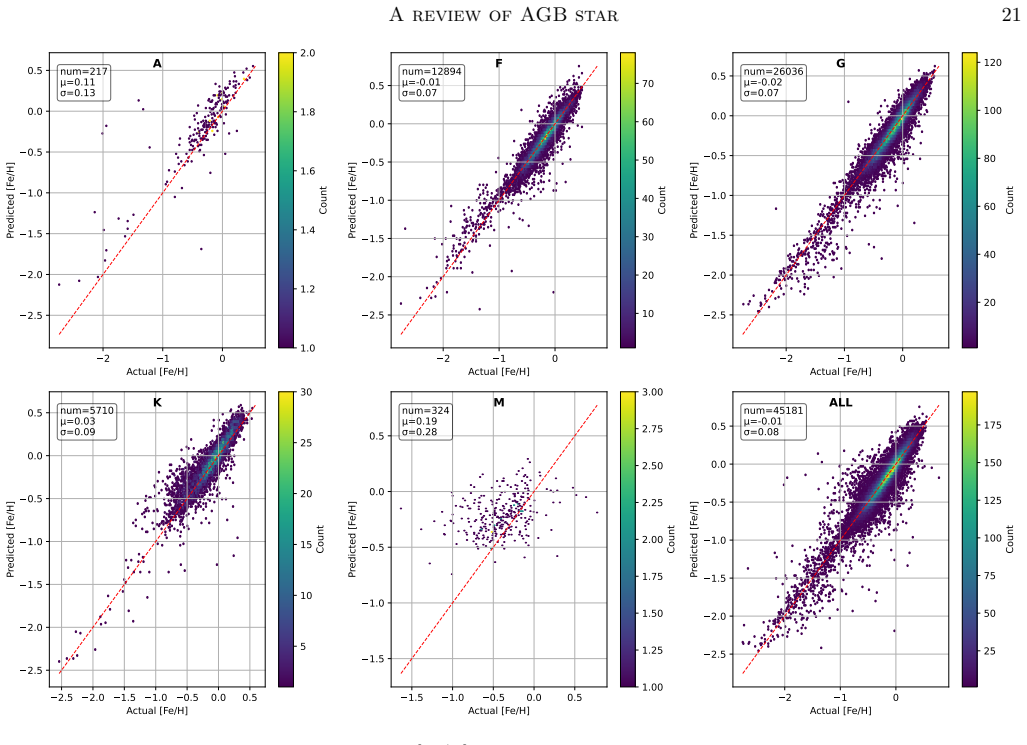


read the original abstract
Stellar spectra encode key information on the physical properties and chemical compositions of stars. Accurate stellar parameter determination is essential for addressing major questions such as galaxy and stellar evolution. Large-scale spectroscopic surveys have accumulated unprecedented spectral data. Traditional feature extraction or model-fitting approaches struggle with high-dimensional, massive datasets, limited generalization, and computational inefficiency. Recent advances in large language models demonstrate strong generalization and feature-learning in tasks like natural language processing, DNA/RNA sequence analysis, and protein/chemical parsing. Stellar spectra are continuous sequential signals, enabling the transfer of language models to stellar spectroscopy. Here, we propose a two-stage large language model framework for stellar parameter inference, achieving accurate estimation of effective temperature, surface gravity, metallicity, and abundances of ~20 chemical elements. Scaling-law analyses show systematic performance improvements with increasing data, providing a scalable framework for forthcoming large-scale surveys.
Editorial analysis
A structured set of objections, weighed in public.
Referee Report
Summary. The manuscript proposes a two-stage large language model framework that treats stellar spectra as continuous sequential signals to infer effective temperature, surface gravity, metallicity, and abundances for ~20 chemical elements. It claims accurate estimation is achieved and that scaling-law analyses demonstrate systematic performance gains with increasing data volume, offering a scalable alternative to traditional methods for large spectroscopic surveys.
Significance. If the accuracy claims and scaling behavior are substantiated with rigorous validation, the work could provide a data-efficient, generalizable pipeline for processing the high-volume outputs of forthcoming surveys, complementing physics-based fitting approaches in stellar and galactic archaeology.
major comments (2)
- [Abstract] Abstract: the central claim of 'accurate estimation' of Teff, log g, [M/H] and ~20 abundances is unsupported by any reported quantitative metrics, error budgets, cross-validation procedures, or baseline comparisons, rendering the performance assertions unevaluable from the given information.
- [Introduction/Methods] Introduction/Methods (assumed §2): the load-bearing assumption that next-token-prediction inductive biases and positional embeddings transfer to stellar spectra without material loss of wavelength-specific physical correlations (radiative transfer, line profiles, continuum opacity) is stated but not tested; the manuscript must demonstrate generalization across resolutions or instruments, as failure here would invalidate the scaling-law results for new surveys.
Simulated Author's Rebuttal
We thank the referee for their constructive comments, which help clarify the presentation of our results. We respond point-by-point to the major comments below.
read point-by-point responses
-
Referee: [Abstract] Abstract: the central claim of 'accurate estimation' of Teff, log g, [M/H] and ~20 abundances is unsupported by any reported quantitative metrics, error budgets, cross-validation procedures, or baseline comparisons, rendering the performance assertions unevaluable from the given information.
Authors: The abstract provides a concise overview; the manuscript reports quantitative metrics (MAE, RMSE, and cross-validation results), error budgets, and baseline comparisons in Sections 3 and 4. To improve self-containment, we will revise the abstract to include representative numerical performance values. revision: yes
-
Referee: [Introduction/Methods] Introduction/Methods (assumed §2): the load-bearing assumption that next-token-prediction inductive biases and positional embeddings transfer to stellar spectra without material loss of wavelength-specific physical correlations (radiative transfer, line profiles, continuum opacity) is stated but not tested; the manuscript must demonstrate generalization across resolutions or instruments, as failure here would invalidate the scaling-law results for new surveys.
Authors: We agree that explicit tests of generalization across resolutions and instruments are required to substantiate transferability. The present manuscript uses a single homogeneous dataset to establish scaling behavior. We will add experiments evaluating performance on spectra at varied resolutions and, where data permit, across instruments. revision: yes
Circularity Check
No circularity: empirical framework with independent performance claims
full rationale
The manuscript proposes a two-stage LLM architecture for inferring stellar parameters and abundances by treating spectra as sequential signals, then reports empirical accuracy and scaling-law improvements with data volume. No equations, parameter fits, or self-citations are shown that would make any reported prediction equivalent to its inputs by construction. The central claims rest on observed model performance rather than definitional or self-referential reductions, satisfying the default expectation of non-circularity for an empirical methods paper.
Axiom & Free-Parameter Ledger
Reference graph
Works this paper leans on
-
[1]
Abdurro'uf , Accetta , K., Aerts , C., et al. 2022, , 259, 35, 10.3847/1538-4365/ac4414
-
[2]
Bialek , S., Fabbro , S., Venn , K. A., et al. 2020, , 498, 3817, 10.1093/mnras/staa2582
-
[3]
Buder , S., Kos , J., Wang , X. E., et al. 2025, , 42, e051, 10.1017/pasa.2025.26
- [4]
-
[5]
Chen, T., & Guestrin, C. 2016, in Proceedings of the 22nd ACM SIGKDD International Conference on Knowledge Discovery and Data Mining, KDD ’16 (ACM), 785–794, 10.1145/2939672.2939785
-
[6]
Empirical Evaluation of Gated Recurrent Neural Networks on Sequence Modeling
Chung, J., Gulcehre, C., Cho, K., & Bengio, Y. 2014, Empirical Evaluation of Gated Recurrent Neural Networks on Sequence Modeling. 1412.3555
work page internal anchor Pith review Pith/arXiv arXiv 2014
-
[7]
Research in Astronomy and Astrophysics , year = 2012, month = sep, volume =
Cui , X.-Q., Zhao , Y.-H., Chu , Y.-Q., et al. 2012, Research in Astronomy and Astrophysics, 12, 1197, 10.1088/1674-4527/12/9/003
-
[8]
E., Allende Prieto , C., Holtzman , J
Garc \' a P \'e rez , A. E., Allende Prieto , C., Holtzman , J. A., et al. 2016, , 151, 144, 10.3847/0004-6256/151/6/144
-
[9]
2025, RAS Techniques and Instruments, 4, rzaf048, 10.1093/rasti/rzaf048
Gilda , S. 2025, RAS Techniques and Instruments, 4, rzaf048, 10.1093/rasti/rzaf048
-
[10]
Group, N. L. C. 2017, in Proceedings of ... https://www.microsoft.com/en-us/research/publication/mcr/
2017
-
[11]
Sunae So and Trevon Badloe and Jaebum Noh and Jorge Bravo-Abad and Junsuk Rho
He, K., Zhang, X., Ren, S., & Sun, J. 2016, in 2016 IEEE Conference on Computer Vision and Pattern Recognition (CVPR), 770--778, 10.1109/CVPR.2016.90
-
[12]
1997, Neural Computation, 9, 1735, 10.1162/neco.1997.9.8.1735
Hochreiter, S., & Schmidhuber, J. 1997, Neural Computation, 9, 1735, 10.1162/neco.1997.9.8.1735
-
[13]
2024, arXiv e-prints, arXiv:2402.03182, 10.48550/arXiv.2402.03182
Jiang , Y., Pan , Z., Zhang , X., et al. 2024, arXiv e-prints, arXiv:2402.03182, 10.48550/arXiv.2402.03182
-
[14]
2017, in Proceedings of the 31st International Conference on Neural Information Processing Systems, NIPS'17 (Red Hook, NY, USA: Curran Associates Inc.), 3149–3157
Ke, G., Meng, Q., Finley, T., et al. 2017, in Proceedings of the 31st International Conference on Neural Information Processing Systems, NIPS'17 (Red Hook, NY, USA: Curran Associates Inc.), 3149–3157
2017
-
[15]
Lee , Y. S., Beers , T. C., Sivarani , T., et al. 2008, , 136, 2022, 10.1088/0004-6256/136/5/2022
-
[16]
2025, , 281, 58, 10.3847/1538-4365/ae1586
Li , S., Li , Y.-B., Luo , A.-L., et al. 2025, , 281, 58, 10.3847/1538-4365/ae1586
-
[17]
2024, arXiv e-prints, arXiv:2404.10757, 10.48550/arXiv.2404.10757
Li , Y.-Y., Bai , Y., Wang , C., et al. 2024, arXiv e-prints, arXiv:2404.10757, 10.48550/arXiv.2404.10757
-
[18]
2022, , 517, 4875, 10.1093/mnras/stac1959
Li , Z., Zhao , G., Chen , Y., Liang , X., & Zhao , J. 2022, , 517, 4875, 10.1093/mnras/stac1959
-
[19]
2022, The Astronomical Journal, 163, 153, 10.3847/1538-3881/ac4d97
Liang, J., Bu, Y., Tan, K., et al. 2022, The Astronomical Journal, 163, 153, 10.3847/1538-3881/ac4d97
-
[20]
Luo , A. L., Zhao , Y.-H., Zhao , G., et al. 2015, Research in Astronomy and Astrophysics, 15, 1095, 10.1088/1674-4527/15/8/002
-
[21]
2016, in Proceedings of the 30th International Conference on Neural Information Processing Systems, NIPS'16 (Red Hook, NY, USA: Curran Associates Inc.), 1279–1287
Meng, Q., Ke, G., Wang, T., et al. 2016, in Proceedings of the 30th International Conference on Neural Information Processing Systems, NIPS'16 (Red Hook, NY, USA: Curran Associates Inc.), 1279–1287
2016
-
[22]
Q., & Wilson, A
Nate Gruver, Marc Finzi, S. Q., & Wilson, A. G. 2023, in Advances in Neural Information Processing Systems
2023
-
[23]
Ness , M., Hogg , D. W., Rix , H.-W., Ho , A. Y. Q., & Zasowski , G. 2015, , 808, 16, 10.1088/0004-637X/808/1/16
-
[24]
2021, , 906, 130, 10.3847/1538-4357/abca96
O'Briain , T., Ting , Y.-S., Fabbro , S., et al. 2021, , 906, 130, 10.3847/1538-4357/abca96
-
[25]
2025, arXiv e-prints, arXiv:2510.17960, 10.48550/arXiv.2510.17960
Parker , L., Lanusse , F., Shen , J., et al. 2025, arXiv e-prints, arXiv:2510.17960, 10.48550/arXiv.2510.17960
-
[26]
2025, arXiv e-prints, arXiv:2508.10075, 10.48550/arXiv.2508.10075
Ramachandra , N., Ting , Y.-S., Sun , Z., Wells , A., & Habib , S. 2025, arXiv e-prints, arXiv:2508.10075, 10.48550/arXiv.2508.10075
-
[27]
2025, arXiv e-prints, arXiv:2511.08970, 10.48550/arXiv.2511.08970
Shao , M., Wang , H., Li , Y., et al. 2025, arXiv e-prints, arXiv:2511.08970, 10.48550/arXiv.2511.08970
-
[28]
Shetrone , M., Beaton , R. L., Hayes , C. R., et al. 2025, arXiv e-prints, arXiv:2511.04365, 10.48550/arXiv.2511.04365
-
[29]
Smolinski , J. P., Lee , Y. S., Beers , T. C., et al. 2011, , 141, 89, 10.1088/0004-6256/141/3/89
-
[30]
Steinmetz , M., Guiglion , G., McMillan , P. J., et al. 2020, , 160, 83, 10.3847/1538-3881/ab9ab8
-
[31]
2025, Nature Astronomy, 9, 1869, 10.1038/s41550-025-02670-z
Stoppa , F., Bulmus , T., Bloemen , S., et al. 2025, Nature Astronomy, 9, 1869, 10.1038/s41550-025-02670-z
-
[32]
2019, , 879, 69, 10.3847/1538-4357/ab2331
Ting , Y.-S., Conroy , C., Rix , H.-W., & Cargile , P. 2019, , 879, 69, 10.3847/1538-4357/ab2331
-
[33]
2017, in Advances in Neural Information Processing Systems, ed
Vaswani, A., Shazeer, N., Parmar, N., et al. 2017, in Advances in Neural Information Processing Systems, ed. I. Guyon, U. V. Luxburg, S. Bengio, H. Wallach, R. Fergus, S. Vishwanathan, & R. Garnett, Vol. 30 (Curran Associates, Inc.). https://proceedings.neurips.cc/paper_files/paper/2017/file/3f5ee243547dee91fbd053c1c4a845aa-Paper.pdf
2017
-
[34]
2024, arXiv e-prints, arXiv:2404.10019, 10.48550/arXiv.2404.10019
Wang , Y., Zhang , S.-R., Momtaz , A., et al. 2024, arXiv e-prints, arXiv:2404.10019, 10.48550/arXiv.2404.10019
-
[35]
2019, , 245, 34, 10.3847/1538-4365/ab5364
Xiang , M., Ting , Y.-S., Rix , H.-W., et al. 2019, , 245, 34, 10.3847/1538-4365/ab5364
-
[36]
2017, , 464, 3657, 10.1093/mnras/stw2523
Xiang , M.-S., Liu , X.-W., Shi , J.-R., et al. 2017, , 464, 3657, 10.1093/mnras/stw2523
-
[37]
2023, arXiv e-prints, arXiv:2308.13565, 10.48550/arXiv.2308.13565
Xie , T., Wan , Y., Huang , W., et al. 2023, arXiv e-prints, arXiv:2308.13565, 10.48550/arXiv.2308.13565
-
[38]
2024 a , arXiv e-prints, arXiv:2401.14656, 10.48550/arXiv.2401.14656
Zhang , Q., Ding , K., Lyv , T., et al. 2024 a , arXiv e-prints, arXiv:2401.14656, 10.48550/arXiv.2401.14656
-
[39]
Zhang , X., Chowdhury , R. R., Gupta , R. K., & Shang , J. 2024 b , arXiv e-prints, arXiv:2402.01801, 10.48550/arXiv.2402.01801
-
[40]
2025, Machine Learning: Science and Technology, 6, 045005, 10.1088/2632-2153/ae0c56
Zhao , F., Li , Y., Liu , Z., et al. 2025, Machine Learning: Science and Technology, 6, 045005, 10.1088/2632-2153/ae0c56
-
[41]
2026, , 998, 189, 10.3847/1538-4357/ae2c7e
Zhao , X., Huang , Y., Xue , G., et al. 2026, , 998, 189, 10.3847/1538-4357/ae2c7e
-
[42]
Zheng , Z.-P., Qiu , B., Luo , A. L., & Li , Y.-B. 2020, , 132, 024504, 10.1088/1538-3873/ab5ed7
discussion (0)
Sign in with ORCID, Apple, or X to comment. Anyone can read and Pith papers without signing in.