Weakly nonlinear interaction of capillary waves in a finite system: leading interaction process and scales' range of direct energy cascade
Pith reviewed 2026-05-25 05:07 UTC · model grok-4.3
The pith
Resonant four-wave processes dominate capillary wave dynamics and produce the Zakharov-Filonenko spectrum over a finite range of scales in bounded domains.
A machine-rendered reading of the paper's core claim, the machinery that carries it, and where it could break.
Core claim
Resonant interactions consisting of two-wave coalescence and isotropic ring expansion in Fourier space constitute the leading processes in the weakly nonlinear regime of capillary waves. These resonances drive the long-time dynamics and produce the Zakharov-Filonenko spectrum of wave turbulence, which in finite domains is confined to a finite interval of scales whose extent is set by the discreteness of the wavenumber grid and scales with average steepness and system size.
What carries the argument
Resonant four-wave interaction processes consisting of two-wave merging and ring-to-ring transfer in wavenumber space
If this is right
- Resonant four-wave processes are the leading interactions and other processes are at least weaker.
- Resonant processes are the major contributors to long-time dynamics.
- The Zakharov-Filonenko spectrum forms in isotropic turbulence of capillary waves.
- This spectrum has a finite range of scales in finite systems due to wavenumber discreteness.
- The range scales analytically with average steepness and characteristic system size.
Where Pith is reading between the lines
- The direct energy cascade arrests at small scales once resonant conditions cannot be met on the discrete grid.
- Larger domains or finer wavenumber resolution would extend the observable portion of the spectrum.
- The scaling relation supplies a practical estimate for the inertial-range width in any given numerical or laboratory setup.
Load-bearing premise
Numerical simulations correctly isolate resonant four-wave interactions as dominant without contamination from non-resonant processes, higher-order terms, or boundary effects.
What would settle it
Direct measurement showing that non-resonant interaction channels carry energy flux comparable to or larger than resonant channels inside the predicted Zakharov-Filonenko range.
Figures




read the original abstract
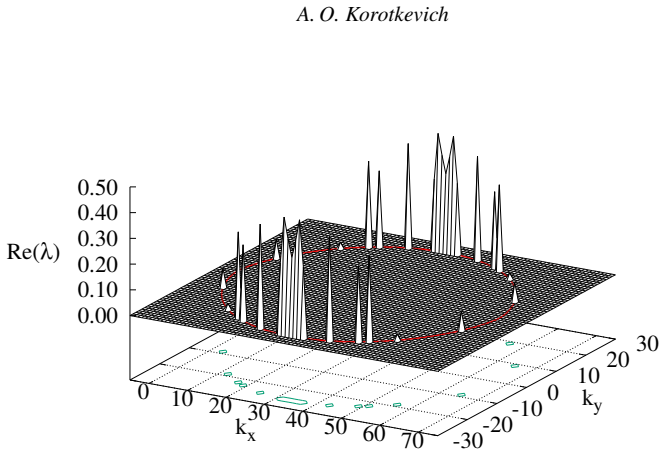
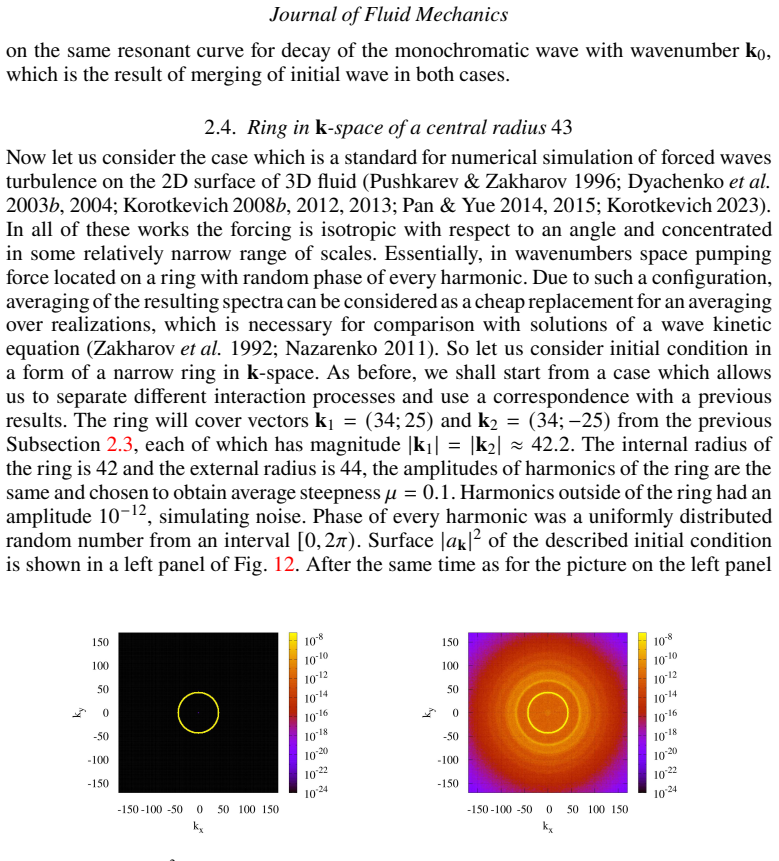
During comprehensive study of weakly nonlinear interaction of surface capillary waves, processes of resonant and non-resonant interactions were considered both numerically and analytically: merging of two waves into one and waves on the ring (in Fourier space, isotropic spectrum) into larger diameter ring. It was shown numerically, that these resonant processes are the leading ones and other processes with respect to them are at least weaker if manifest themselves at all. It was confirmed, that resonant the processes are the major ones which contribute to the long time dynamics. In the case of isotropic turbulence of capillary waves the formation of wave turbulence's Zakharov-Filonenko spectrum is demonstrated. It was also shown, that this spectrum in finite systems has a finite range of scales. Due to finiteness of the numerical simulation or experimental area the discreteness of the wavenumbers grid arrest local in Fourier space resonant interaction when smaller scales are considered. Scaling of the range of realization of the Zakharov-Filonenko spectrum, depending on main parameters of the numerical or experimental setup (average steepness and characteristic size), is derived analytically and partially confirmed numerically.
Editorial analysis
A structured set of objections, weighed in public.
Referee Report
Summary. The manuscript studies weakly nonlinear resonant and non-resonant interactions of capillary waves in finite systems. It claims that resonant processes (two-wave merging and ring-to-ring transfer in Fourier space) dominate long-time dynamics, as confirmed numerically, while non-resonant processes are weaker or absent. For isotropic turbulence, the Zakharov-Filonenko spectrum forms but is limited to a finite range of scales due to wavenumber discreteness in finite domains; an analytic scaling for this range (depending on average steepness and system size) is derived and partially confirmed numerically.
Significance. If the numerical isolation of resonant four-wave interactions holds, the work would strengthen the foundations of wave turbulence theory by demonstrating how finite-system discreteness truncates the direct cascade and by supplying an explicit scaling for the observable range of the Zakharov-Filonenko spectrum. The combination of analytic derivation with numerical evidence could directly inform the design of both simulations and laboratory experiments on capillary waves.
major comments (2)
- [Numerical results] The central numerical claim that resonant processes are leading and produce the ZF spectrum rests on simulations whose details (grid resolution, time-step criterion, forcing/dissipation implementation, and convergence tests) are not reported. Without these, it is impossible to verify that the observed spectrum arises from the claimed resonant channels rather than numerical truncation or artificial damping (see abstract and the numerical-results section).
- [Analytic derivation] The analytic derivation of the finite range scaling is stated to depend on average steepness and characteristic size, yet the abstract supplies neither the key expressions nor the assumptions under which the range is obtained directly from discreteness; this leaves open whether the reported scaling is parameter-free or contains hidden fitting (see abstract).
minor comments (2)
- [Abstract] Typo in abstract: 'resonant the processes' should read 'resonant processes'.
- [Abstract] Grammatical issue in abstract: 'wavenumbers grid' should be 'wavenumber grid'.
Simulated Author's Rebuttal
We thank the referee for the careful reading and constructive feedback. We address each major comment below and have revised the manuscript to improve clarity and completeness on the numerical methods and analytic derivation.
read point-by-point responses
-
Referee: [Numerical results] The central numerical claim that resonant processes are leading and produce the ZF spectrum rests on simulations whose details (grid resolution, time-step criterion, forcing/dissipation implementation, and convergence tests) are not reported. Without these, it is impossible to verify that the observed spectrum arises from the claimed resonant channels rather than numerical truncation or artificial damping (see abstract and the numerical-results section).
Authors: We agree that the original manuscript lacked sufficient detail on the numerical setup. In the revised version we have added an expanded numerical-methods subsection reporting: a 1024×1024 Fourier grid with periodic domain of size L, fourth-order Runge–Kutta time stepping with adaptive CFL < 0.2, narrow-band random-phase forcing at low wavenumbers, and hyperviscous dissipation at high k. Convergence was verified by repeating runs at 512×512 and 2048×2048 resolutions and by varying the dissipation coefficient over an order of magnitude; the ZF spectrum and resonant ring-to-ring transfers remain unchanged. These additions confirm that the observed dynamics are not numerical artifacts. revision: yes
-
Referee: [Analytic derivation] The analytic derivation of the finite range scaling is stated to depend on average steepness and characteristic size, yet the abstract supplies neither the key expressions nor the assumptions under which the range is obtained directly from discreteness; this leaves open whether the reported scaling is parameter-free or contains hidden fitting (see abstract).
Authors: The derivation (Section 4) is parameter-free and follows directly from the four-wave resonance condition together with the discrete k-grid spacing Δk = 2π/L. The nonlinear frequency broadening δω ∼ ε²ω must exceed Δk for local interactions to remain possible, yielding the explicit upper wavenumber bound k_max ∼ (ε / L)^{1/2} (with ε the average steepness). No adjustable constants appear. We have now inserted the scaling formula and the underlying assumptions into the abstract for immediate visibility. revision: yes
Circularity Check
No significant circularity; analytic scaling and numerical claims are independent of fitted inputs or self-citation chains.
full rationale
The abstract and reader's summary describe an analytic derivation of the finite range of the Zakharov-Filonenko spectrum set by wavenumber discreteness, depending on steepness and system size, plus numerical confirmation that resonant four-wave processes dominate. No equations, self-citations, or fitted parameters are quoted that reduce the scaling result to its own inputs by construction (e.g., no parameter fitted to data then renamed as prediction, no uniqueness theorem imported from prior self-work, no ansatz smuggled via citation). The derivation is presented as first-principles analytic work on discreteness effects, with numerics as separate verification; this is self-contained against external benchmarks and receives the default non-finding.
Axiom & Free-Parameter Ledger
Reference graph
Works this paper leans on
-
[1]
Annenkov, Sergei Yu. & Shrira, Victor I. 2006 Role of non-resonant interactions in the evolution of nonlinear random water wave fields . Journal of Fluid Mechanics 561 , 181–207
work page 2006
-
[2]
, Buckmaster, Tristan , Korotkevich, Alexander O
Banks, Jeff W. , Buckmaster, Tristan , Korotkevich, Alexander O. , Kova c i c , Gregor & Shatah, Jalal 2022 Direct verification of the kinetic description of wave turbulence for finite-size systems dominated by interactions among groups of six waves . Phys. Rev. Lett. 129 , 034101
work page 2022
-
[3]
Berhanu, M. , Falcon, E. , Michel, G. , Gissinger, C. & Fauve, S. 2020 Capillary wave turbulence experiments in microgravity . Europhysics Letters 128 (3), 34001 , arXiv:arXiv: https://iopscience.iop.org/article/10.1209/0295-5075/128/34001
-
[4]
Connaughton, Colm , Nazarenko, Sergey & Pushkarev, Andrei 2001 Discreteness and quasiresonances in weak turbulence of capillary waves . Phys. Rev. E 63 , 046306
work page 2001
-
[5]
Theory of weakly damped free-surface flows: a new formulation based on potential flow solutions
Dias, Frederic , Dyachenko, Alexander I. & Zakharov, Vladimir E. 2008 Theory of weakly damped free-surface flows: A new formulation based on potential flow solutions . Phys.\,Lett.\,A 372 (8), 1297--1302 , arXiv:arXiv: 0704.3352
work page internal anchor Pith review Pith/arXiv arXiv 2008
-
[6]
Dyachenko, Alexander I. , Korotkevich, Alexander O. & Zakharov, Vladimir E. 2003 a\/ Decay of the monochromatic capillary wave . JETP Lett. 77 (9), 477--481
work page 2003
-
[7]
Dyachenko, Alexander I. , Korotkevich, Alexander O. & Zakharov, Vladimir E. 2003 b\/ Weak turbulence of gravity waves . JETP Lett. 77 (10), 546--550
work page 2003
-
[8]
Dyachenko, Alexander I. , Korotkevich, Alexander O. & Zakharov, Vladimir E. 2004 Weak turbulent kolmogorov spectrum for surface gravity waves . Phys.\,Rev.\,Lett. 92 (13), 134501
work page 2004
-
[9]
Dyachenko, Alexander I. , Newell, Alan C. , Pushkarev, Andrei & Zakharov, Vladimir E. 1992 Optical turbulence: weak turbulence, condensates and collapsing fragments in the nonlinear schroedinger equation . Physica\,D 57 , 96--160
work page 1992
-
[10]
Annual Review of Fluid Mechanics 54 (1), 1--25
Falcon, Eric & Mordant, Nicolas 2022 Experiments in surface gravity–capillary wave turbulence . Annual Review of Fluid Mechanics 54 (1), 1--25
work page 2022
-
[11]
Physics of Fluids 6 (4), 1411--1414
Falkovich, Gregory 1994 Bottleneck phenomenon in developed turbulence . Physics of Fluids 6 (4), 1411--1414
work page 1994
-
[12]
2005 The design and implementation of fftw 3, http://fftw.org
Frigo, Mateo & Johnson, Steven G. 2005 The design and implementation of fftw 3, http://fftw.org . Proc.\,IEEE 93 (2), 216--231
work page 2005
-
[13]
Galtier, S\' e bastien 2021 Wave turbulence: the case of capillary waves . Geophysical & Astrophysical Fluid Dynamics 115 (3), 234--257 , arXiv:arXiv: https://doi.org/10.1080/03091929.2020.1715966
-
[14]
GNU Project 1984-2022 http://gnu.org
work page 1984
-
[15]
Gnuplot, command-driven interactive function plotting program 1986-2022 http://gnuplot.info
work page 1986
-
[16]
Hwang, Paul A. , Wang, David W. , Walsh, Edward J. , Krabill, William B. & Swift, Robert N. 2000 Airborne measurements of the wavenumber spectra of ocean surface waves. Part I : Spectral slope and dimensionless spectral coefficient . J.\,Phys.\,Oceanogr. 30 , 2753--2767
work page 2000
-
[17]
Kartashova, Elena 1990 Resonant Interactions of Rossby waves in Bounded Domains . PhD thesis, P.\,P. Shirshov Institute for Oceanology, USSR Academy of Sciences, Moscow
work page 1990
-
[18]
Resonant interactions of nonlinear water waves in a finite basin
Kartashova, Elena , Nazarenko, Sergei V. & Rudenko, Oleksii 2008 Resonant interactions of nonlinear water waves in a finite basin . Phys.\,Rev.\,E 78 , 016304 , arXiv:arXiv: 0803.3308
work page internal anchor Pith review Pith/arXiv arXiv 2008
-
[19]
1991 On properties of weakly nonlinear wave interactions in resonators
Kartashova, Elena A. 1991 On properties of weakly nonlinear wave interactions in resonators . Physica D: Nonlinear Phenomena 54 (1), 125--134
work page 1991
-
[20]
Kochurin, E.A. & Russkikh, P.A. 2025 Plane-symmetric capillary turbulence: Five-wave interactions . Physica D: Nonlinear Phenomena 481 , 134763 , arXiv:arXiv: https://www.sciencedirect.com/science/article/pii/S0167278925002404
work page 2025
-
[21]
2008 a\/ On the Doppler distortion of the sea-wave spectra
Korotkevich, Alexander O. 2008 a\/ On the Doppler distortion of the sea-wave spectra . Physica D: Nonlinear Phenomena 237 (21), 2767--2776
work page 2008
-
[22]
Simultaneous numerical simulation of direct and inverse cascades in wave turbulence
Korotkevich, Alexander O. 2008 b\/ Simultaneous numerical simulation of direct and inverse cascades in wave turbulence . Phys.\,Rev.\,Lett. 101 (7), 074504 , arXiv:arXiv: 0805.0445
work page internal anchor Pith review Pith/arXiv arXiv 2008
-
[23]
Influence of the condensate and inverse cascade on the direct cascade in wave turbulence
Korotkevich, Alexander O. 2012 Influence of the condensate and inverse cascade on the direct cascade in wave turbulence . Math.\,Comput.\,Simul. 82 (7), 1228--1238 , arXiv:arXiv: 0911.0741
work page internal anchor Pith review Pith/arXiv arXiv 2012
-
[24]
Korotkevich, Alexander O. 2013 Direct numerical experiment on measurement of the dispersion relation for gravity waves in the presence of the condensate . JETP\,Lett. 97 (3), 126--130
work page 2013
-
[25]
Korotkevich, Alexander O. 2023 Inverse cascade spectrum of gravity waves in the presence of a condensate: A direct numerical simulation . Phys. Rev. Lett. 130 , 264002 , arXiv:arXiv: https://link.aps.org/doi/10.1103/PhysRevLett.130.264002
-
[26]
Korotkevich, Alexander O. , Dyachenko, Alexander I. & Zakharov, Vladimir E. 2016 Numerical simulation of surface waves instability on a homogeneous grid . Physica D: Nonlinear Phenomena 321-322 , 51--66 , arXiv:arXiv: https://www.sciencedirect.com/science/article/pii/S0167278915301147
work page 2016
-
[27]
Korotkevich, Alexander O. , Nazarenko, Sergey V. , Pan, Yulin & Shatah, Jalal 2024 Non-local gravity wave turbulence in presence of condensate . Journal of Fluid Mechanics 992 , A1
work page 2024
-
[28]
Korotkevich, Alexander O. , Prokofiev, Alexander O. & Zakharov, Vladimir E. 2019 On the dissipation rate of ocean waves due to white capping . JETP Lett. 109 (5), 309--315
work page 2019
-
[29]
, Pushkarev, Andrei , Resio, Donald & Zakharov, Vladimir E
Korotkevich, Alexander O. , Pushkarev, Andrei , Resio, Donald & Zakharov, Vladimir E. 2008 Numerical verification of the weak turbulent model for swell evolution . European Journal of Mechanics - B/Fluids 27 (4), 361--387
work page 2008
-
[30]
Korotkevich, Alexander O. & Zakharov, Vladimir E. 2015 Evaluation of a spectral line width for the phillips spectrum by means of numerical simulation . Nonlinear Processes in Geophysics 22 (3), 325--335
work page 2015
-
[31]
2004 On phillips' theory of equilibrium range in the spectra of wind-generated gravity waves
Kuznetsov, Evgenii A. 2004 On phillips' theory of equilibrium range in the spectra of wind-generated gravity waves . JETP\,Letters 80 , 83
work page 2004
-
[32]
Nazarenko, Sergey V. 2011 Wave Turbulence\/ . Berlin Heidelberg: Springer-Verlag
work page 2011
-
[33]
Newell, Alan C. & Zakharov, Vladimir E. 2008 The role of the generalized phillips' spectrum in wave turbulence . Phys.\,Lett.\,A 372 , 4230--4233
work page 2008
-
[34]
Onorato, Miguel , Osborne, A. R. , Serio, M. , Resio, D. , Pushkarev, A. , Zakharov, Vladimir E. & Brandini, C. 2002 Freely decaying weak turbulence for sea surface gravity waves . Phys.\,Rev.\,Lett. 89 , 144501
work page 2002
-
[35]
PhD thesis, Massachusetts Institute of Technology
Pan, Yulin 2017 Understanding of weak turbulence of capillary waves . PhD thesis, Massachusetts Institute of Technology
work page 2017
-
[36]
Pan, Yulin & Yue, Dick K. P. 2014 Direct numerical investigation of turbulence of capillary waves . Phys. Rev. Lett. 113 , 094501
work page 2014
-
[37]
Pan, Yulin & Yue, Dick K. P. 2015 Decaying capillary wave turbulence under broad-scale dissipation . Journal of Fluid Mechanics 780 , R1
work page 2015
-
[38]
1958 The equilibrium range in the spectrum of wind-generated ocean waves
Phillips, Oliver M. 1958 The equilibrium range in the spectrum of wind-generated ocean waves . J.\,Fluid Mech. 4 , 426--434
work page 1958
-
[39]
1967 Theoretical and experimental studies of gravity waves interactions
Phillips, Oliver M. 1967 Theoretical and experimental studies of gravity waves interactions . Proc.\,Roy.\,Soc.\,London A.299 , 104--119
work page 1967
-
[40]
1999 On the kolmogorov and frozen turbulence in numerical simulation of capillary waves
Pushkarev, Andrei N. 1999 On the kolmogorov and frozen turbulence in numerical simulation of capillary waves . European Journal of Mechanics - B/Fluids 18 (3), 345--351 , arXiv:arXiv: https://www.sciencedirect.com/science/article/pii/S0997754699800326
work page 1999
-
[41]
Pushkarev, Andrei N. & Zakharov, Vladimir E. 1996 Turbulence of capillary waves . Phys. Rev. Lett. 76 , 3320--3323
work page 1996
-
[42]
Pushkarev, Andrei N. & Zakharov, Vladimir E. 2000 Turbulence of capillary waves — theory and numerical simulation . Physica D: Nonlinear Phenomena 135 (1), 98--116 , arXiv:arXiv: https://www.sciencedirect.com/science/article/pii/S016727899900069X
work page 2000
-
[43]
Ricard, Guillaume & Falcon, Eric 2021 Experimental quasi-1d capillary-wave turbulence . Europhysics Letters 135 (6), ac2751 , arXiv:arXiv: https://iopscience.iop.org/article/10.1209/0295-5075/ac2751
-
[44]
Semenova, Anastassiya , Dyachenko, Sergey A. , Korotkevich, Alexander O. & Lushnikov, Pavel M. 2021 Comparison of split-step and hamiltonian integration methods for simulation of the nonlinear schr\: o dinger type equations . Journal of Computational Physics 427 , 110061 , arXiv:arXiv: https://www.sciencedirect.com/science/article/pii/S00721999120308354
work page 2021
-
[45]
1966 Some problems of nonlinear theory of surface waves
Zakharov, Vladimir E. 1966 Some problems of nonlinear theory of surface waves . PhD thesis, Budker Institute for Nuclear Physics, Novosibirsk, USSR, available at https://zakharov.itp.ac.ru/pub/data/Zakharov_PhD_thesis.pdf (in Russian)
work page 1966
-
[46]
1967 The instability of waves in nonlinear dispersive media
Zakharov, Vladimir E. 1967 The instability of waves in nonlinear dispersive media . J.\,Exp.\,Teor.\,Phys. 24 (4), 740--744
work page 1967
-
[47]
Zakharov, Vladimir E. & Filonenko, Natalia N. 1967 Energy spectrum for stochastic oscillations of the surface of a liquid . Sov.\,Phys.\,Dokl. 11 , 881--884
work page 1967
-
[48]
Zakharov, Vladimir E. , Korotkevich, Alexander O. & Prokofiev, Alexander O. 2009 On dissipation function of ocean waves due to whitecapping . AIP Proceedings 1168 (1), 1229--1231 , arXiv:arXiv: https://pubs.aip.org/aip/acp/article-pdf/1168/1/1229/11880027/1229\_1\_online.pdf
work page 2009
-
[49]
Zakharov, Vladimir E. , Korotkevich, Alexander O. , Pushkarev, Andrei & Dyachenko, Alexander I. 2005 Mesoscopic wave turbulence . JETP\,Lett. 82 (8), 487--491
work page 2005
-
[50]
Zakharov, Vladimir E. , Korotkevich, Alexander O. , Pushkarev, Andrei & Resio, Donald 2007 Coexistence of weak and strong wave turbulence in a swell propagation . Phys.\,Rev.\,Lett. 99 (16), 164501
work page 2007
-
[51]
Zakharov, Vladimir E. , Lvov, Victor S. & Falkovich, Grisha 1992 Kolmogorov Spectra of Turbulence I\/ . Berlin: Springer-Verlag
work page 1992
-
[52]
Zhang, Zhou & Pan, Yulin 2022 Forward and inverse cascades by exact resonances in surface gravity waves . Phys. Rev. E 106 , 044213
work page 2022
discussion (0)
Sign in with ORCID, Apple, or X to comment. Anyone can read and Pith papers without signing in.