Multi-flux Aharonov-Bohm caging with tunable couplings
Pith reviewed 2026-05-25 04:37 UTC · model grok-4.3
The pith
A scalable protocol derives universal conditions for complete wavefunction localization via multi-flux Aharonov-Bohm caging.
A machine-rendered reading of the paper's core claim, the machinery that carries it, and where it could break.
Core claim
The central claim is that a scalable protocol can extract universal conditions for Aharonov-Bohm caging under multi-flux configurations with tunable couplings, such that complete destructive phase interference localizes the wavefunction in any translational-invariant lattice; the conditions are validated by direct numerical observation of the caging and by showing its breakage under onsite detuning.
What carries the argument
Multi-flux configurations together with tunable couplings that produce complete destructive interference across lattice paths.
If this is right
- Complete Aharonov-Bohm caging occurs under the derived multi-flux conditions.
- The caging effect is destroyed by the introduction of onsite detuning.
- The same conditions apply across multiple lattice geometries.
- The protocol can be implemented and tested in several quantum many-body platforms.
Where Pith is reading between the lines
- The universal conditions may reduce the experimental overhead of realizing topological states that rely on gauge-field interference.
- Similar protocols could be adapted to derive caging conditions in non-lattice geometries or with time-dependent fluxes.
- Breakage under detuning suggests a way to controllably switch localization on and off in quantum simulators.
Load-bearing premise
Tunable couplings and multi-flux setups permit a single set of conditions for perfect destructive interference that works across different lattice geometries without further adjustments.
What would settle it
Numerical or experimental observation of wavefunction spreading (instead of localization) when the derived multi-flux conditions and tunable couplings are implemented in a chosen lattice.
Figures


read the original abstract
Aharonov-Bohm (AB) caging is the complete wavefunction localization effect in translational-invariant lattices induced by destructive phase interference. These phases originate from the gauge fields such as the penetrated magnetic fields, which are directly related to several novel topological quantum states of matter. Recently, this effect has demonstrated significant potential for applications in quantum simulation and topological quantum computation. Here, we propose a scalable protocol to derive universal conditions for AB caging with multi-flux. The numerical simulations validate the theoretical predictions by directly observing AB caging phenomena. We also investigate the breakage of the caging effect with onsite detuning. Our protocol can be directly tested in several quantum many-body platforms and provides an alternative approach for advancing quantum simulation of exotic state matter.
Editorial analysis
A structured set of objections, weighed in public.
Referee Report
Summary. The manuscript proposes a scalable protocol to derive universal conditions for multi-flux Aharonov-Bohm caging in translational-invariant lattices with tunable couplings. It asserts that numerical simulations directly observe the caging phenomena to validate the predictions and examines how onsite detuning breaks the effect. The protocol is presented as directly testable in quantum many-body platforms and as an alternative route to simulating exotic topological states.
Significance. A protocol that genuinely yields geometry-independent conditions for complete destructive interference would strengthen tools for quantum simulation of topological matter. The emphasis on scalability and experimental accessibility is a positive feature if the derivations and cross-geometry checks are supplied.
major comments (1)
- [Abstract] Abstract: the central claim of 'universal conditions' for multi-flux AB caging rests on a scalable protocol whose equations, derivation steps, and explicit demonstration across distinct lattice geometries (e.g., square versus triangular) are not supplied. Without these, it cannot be verified whether the interference conditions are independent of coordination number or plaquette structure or whether they implicitly encode geometry-specific phase relations, directly affecting the universality and scalability assertions.
minor comments (1)
- [Abstract] Abstract: the statement that 'numerical simulations validate the theoretical predictions by directly observing AB caging phenomena' lacks any reference to the specific lattice models, flux values, coupling tunings, or error metrics employed, which would be needed to assess the strength of the numerical support.
Simulated Author's Rebuttal
We thank the referee for their valuable feedback. We address the major comment point by point below and have revised the manuscript to incorporate the suggested improvements.
read point-by-point responses
-
Referee: [Abstract] Abstract: the central claim of 'universal conditions' for multi-flux AB caging rests on a scalable protocol whose equations, derivation steps, and explicit demonstration across distinct lattice geometries (e.g., square versus triangular) are not supplied. Without these, it cannot be verified whether the interference conditions are independent of coordination number or plaquette structure or whether they implicitly encode geometry-specific phase relations, directly affecting the universality and scalability assertions.
Authors: We agree that the abstract, being concise, does not include the detailed equations or derivations. The scalable protocol is introduced in the main text, but we acknowledge that explicit step-by-step derivations and demonstrations across different geometries were not sufficiently detailed. In the revised manuscript, we have expanded Section II to include the full derivation steps leading to the universal conditions, the explicit equations, and added a new subsection with calculations for both square and triangular lattices. This shows that the interference conditions are indeed independent of the specific lattice structure, supporting the universality claim. The numerical simulations have also been extended to include the triangular lattice case. revision: yes
Circularity Check
No circularity; derivation chain not reducible to inputs from available text
full rationale
The abstract proposes a scalable protocol for universal multi-flux AB caging conditions and states that numerics validate predictions, but supplies no equations, ansatze, fitted parameters, or self-citations that could be inspected. No load-bearing step reduces by construction to a prior result or definition within the paper. The universality claim is presented as derived rather than assumed or fitted, and the validation is described as direct observation, leaving the chain self-contained on the evidence given.
Axiom & Free-Parameter Ledger
Lean theorems connected to this paper
-
IndisputableMonolith/Cost/FunctionalEquation.leanwashburn_uniqueness_aczel unclear?
unclearRelation between the paper passage and the cited Recognition theorem.
AB caging arises from a flat band with E_k constant for any k, achieved under ∑cos ϕ_i=0 and ∑sin ϕ_i=0 (Eq. 6).
-
IndisputableMonolith/Foundation/RealityFromDistinction.leanreality_from_one_distinction unclear?
unclearRelation between the paper passage and the cited Recognition theorem.
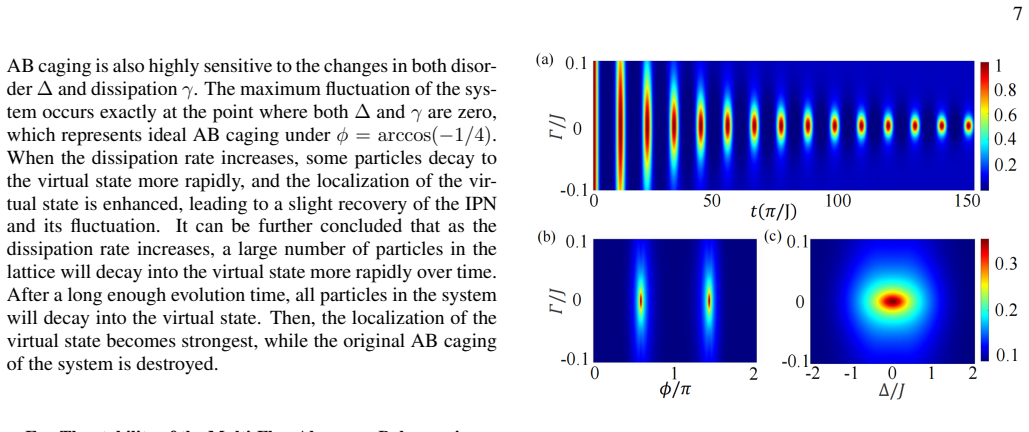
Numerical IPN dynamics and disorder breaking on 9-cell chain (N=5, ϕ=arccos(−1/4)).
What do these tags mean?
- matches
- The paper's claim is directly supported by a theorem in the formal canon.
- supports
- The theorem supports part of the paper's argument, but the paper may add assumptions or extra steps.
- extends
- The paper goes beyond the formal theorem; the theorem is a base layer rather than the whole result.
- uses
- The paper appears to rely on the theorem as machinery.
- contradicts
- The paper's claim conflicts with a theorem or certificate in the canon.
- unclear
- Pith found a possible connection, but the passage is too broad, indirect, or ambiguous to say the theorem truly supports the claim.
Reference graph
Works this paper leans on
-
[1]
with parametric tunable couplings. Starting from a one- dimensional (1D) translational-invariant lattice with multi- flux, we first establish flux-localization relationships and give a special example with numerical verifications. We further investigate the robustness of the caging effect by introducing on-site potentials and decoherence effect. At last w...
work page internal anchor Pith review Pith/arXiv arXiv 2026
-
[2]
P. W. Anderson, Absence of diffusion in certain random lattices, Phys. Rev.109, 1492 (1958)
work page 1958
-
[3]
D.-W. Zhang, L.-Z. Tang, L.-J. Lang, H. Yan, and S.-L. Zhu, Non-Hermitian topological Anderson insulators, Sci. China- Phys. Mech. Astron.63, 267062 (2020)
work page 2020
-
[4]
Q. Guo, C. Cheng, Z.-H. Sun, Z.-X. Song, H.-K. Li, Z. Wang, W.-H. Ren, H. Dong, D.-N. Zheng, Y .-R. Zhang, R. Mondaini, H. Fan, and H. Wang, Observation of energy-resolved many- body localization, Nat. Phys.17, 234 (2021)
work page 2021
-
[5]
P. Sierant and J. Zakrzewski, Challenges to observation of many-body localization, Phys. Rev. B105, 224203 (2022)
work page 2022
-
[6]
R.-C. Ge, S. R. Koshkaki, and M. H. Kolodrubetz, Cavity induced many-body localization, Phys. Rev. B111, 155416 (2025)
work page 2025
-
[7]
D. J. Thouless, M. Kohmoto, M. P. Nightingale, and M. den Nijs, Quantized Hall conductance in a two-dimensional peri- odic potential, Phys. Rev. Lett.49, 405 (1982)
work page 1982
-
[8]
S. Longhi, Aharonov–Bohm photonic cages in waveguide and coupled resonator lattices by synthetic magnetic fields, Opt. Lett.39, 5892 (2014)
work page 2014
-
[9]
S. Mukherjee, M. Di Liberto, P. ¨Ohberg, R. R. Thomson, and N. Goldman, Experimental observation of Aharonov-Bohm cages in photonic lattices, Phys. Rev. Lett.121, 075502 (2018)
work page 2018
-
[10]
M. Aidelsburger, M. Atala, S. Nascimb `ene, S. Trotzky, Y .-A. Chen, and I. Bloch, Experimental realization of strong effec- tive magnetic fields in an optical lattice, Phys. Rev. Lett.107, 255301 (2011)
work page 2011
- [11]
-
[12]
M. Schmidt, S. Kessler, V . Peano, O. Painter, and F. Marquardt, Optomechanical creation of magnetic fields for photons on a lattice, Optica2, 635 (2015)
work page 2015
-
[13]
M. Z. Hasan and C. L. Kane, Topological insulators, Rev. Mod. Phys.82, 3045 (2010)
work page 2010
- [14]
-
[15]
J.-J. Zhang, W.-H. Huang, J. Chu, J.-W. Qiu, X.-D. Sun, Z.- Y . Tao, J.-W. Zhang, L.-B. Zhang, and Y .-X. Zhou, Synthetic multidimensional Aharonov-Bohm cages in fock state lattices, Phys. Rev. Lett.134, 070601 (2025)
work page 2025
- [16]
- [17]
-
[18]
M. Goda, S. Nishino, and H. Matsuda, Inverse Anderson tran- sition caused by flatbands, Phys. Rev. Lett.96, 126401 (2006)
work page 2006
-
[19]
J. T. Chalker, T. S. Pickles, and P. Shukla, Anderson localiza- tion in tight-binding models with flat bands, Phys. Rev. B82, 104209 (2010)
work page 2010
-
[20]
J. D. Bodyfelt, D. Leykam, C. Danieli, X.-Q. Yu, and S. Flach, Flatbands under correlated perturbations, Phys. Rev. Lett.113, 236403 (2014)
work page 2014
- [21]
- [22]
-
[23]
C. Gneiting, Z. Li, and F. Nori, Lifetime of flatband states, Phys. Rev. B98, 134203 (2018)
work page 2018
- [24]
- [25]
-
[26]
L.-M. Duan, J. I. Cirac, and P. Zoller, Geometric manipulation of trapped ions for quantum computation, Science292, 1695 (2001)
work page 2001
-
[27]
M.-Z. Ai, S. Li, Z.-B. Hou, R. He, Z.-H. Qian, Z. Y . Xue, J.-M. Cui, Y .-F. Huang, C.-F. Li, and G.-C. Guo, Experimen- tal realization of nonadiabatic holonomic single-qubit quantum gates with optimal control in a trapped ion, Phys. Rev. Appl. 14, 054062 (2020)
work page 2020
- [28]
- [29]
- [30]
- [31]
-
[32]
Hase, Recent Progress in the Theory of Flat Bands and Their Realization, Condens
I. Hase, Recent Progress in the Theory of Flat Bands and Their Realization, Condens. Matter10, 64 (2025)
work page 2025
- [33]
- [34]
-
[35]
D. N. Christodoulides, F. Lederer, and Y . Silberberg, Discretiz- ing light behaviour in linear and nonlinear waveguide lattices, Nature(London)424, 817 (2003)
work page 2003
-
[36]
B. Deissler, M. Zaccanti, G. Roati, C. D ′Errico, M. Fattori, M. Modugno, G. Modugno, and M. Inguscio, Delocalization of a disordered bosonic system by repulsive interactions, Nat. Phys. 6, 354 (2010)
work page 2010
-
[37]
C. M. Bender, S. Boettcher, Real Spectra in Non-Hermitian Hamiltonians HavingPTSymmetry, Phys. Rev. Lett.80, 5243 (1998)
work page 1998
-
[38]
S.-M. Zhang, H.-S. Xu, and L. Jin, Tunable Aharonov-Bohm cages through anti-PT-symmetric imaginary couplings, Phys. Rev. A108, 023518 (2023)
work page 2023
-
[39]
K.-L. Zhou, B.-W. Zeng, and Y . Hu, Non-Hermitian Aharonov- Bohm cage in bosonic Bogoliubov-de Gennes systems, Phys. Rev. B111, 224308 (2025)
work page 2025
discussion (0)
Sign in with ORCID, Apple, or X to comment. Anyone can read and Pith papers without signing in.