Fuzzy, Neutrosophic, and Uncertain Graph Theory: Properties and Applications
Pith reviewed 2026-07-04 15:18 UTC · model glm-5.2
The pith
One framework unifies 30+ uncertain graph types under a single parameter
A machine-rendered reading of the paper's core claim, the machinery that carries it, and where it could break.
Core claim
The central object is the Uncertain Graph GM = (V, E, σM, ηM), where M is an uncertain model with degree-domain Dom(M) ⊆ [0,1]^k and auxiliary operators. The key mechanism is that graph-theoretic definitions (path strength, cycle weakest-edge, tree spanning condition, clique completeness, distance, degree, etc.) are formulated entirely in terms of model-dependent operators (Ψ_M, Λ_M, Δ_M, Γ_M, ⪯_M) rather than in terms of any specific degree representation. This means a single definition simultaneously covers fuzzy graphs (k=1), intuitionistic fuzzy graphs (k=2), neutrosophic graphs (k=3), plithogenic graphs (k=s+t), and all higher-dimensional partitions. The well-definedness theorems verify
What carries the argument
Uncertain model M with degree-domain Dom(M) ⊆ [0,1]^k; auxiliary operators: zero degree 0_M, path-strength operators Ψ_M^(n), evaluation map Δ_M, edge-length map Λ_M, complete-edge operator Γ_M, cycle/strength orders ⪯_M; support graph construction; well-definedness theorems
If this is right
- A researcher who has defined a new graph class (e.g., 'neutrosophic threshold graph') can check whether their definition is an instance of the corresponding uncertain graph definition, and if so, inherit structural results automatically.
- Algorithmic results (shortest-path, spanning-tree, coloring heuristics) developed for the general uncertain graph framework would apply simultaneously to every uncertainty model, avoiding re-derivation for each variant.
- New uncertainty models (e.g., a future 10-component partitioned set) can be immediately plugged into all existing graph-theoretic definitions without redefining paths, trees, cliques, etc.
- Cross-model comparisons become possible: one can ask whether a property that holds for fuzzy graphs also holds for neutrosophic graphs, and answer by checking the model-independent definition.
Where Pith is reading between the lines
- The framework's value as a unification depends on whether non-trivial theorems (structural, extremal, or algorithmic) can be proven at the model-independent level. The well-definedness proofs verify consistency but do not themselves produce such theorems. The framework would gain substantially from a single result that holds across all models simultaneously and is not obvious in any specific insta
- The auxiliary operators (Ψ_M, Λ_M, Δ_M, Γ_M) are not determined by the degree-domain alone — they must be specified separately for each model. This means the 'unification' is partial: the framework provides a template for definitions, but each model still requires its own operator choices, and different choices can yield different graph theories for the same degree-domain.
- The support-graph reduction (defining uncertain paths, cycles, trees via the crisp support graph) means that many structural properties of uncertain graphs reduce to properties of ordinary graphs decorated with degree information. This suggests that the framework's main contribution is organizational (a common language) rather than structural (new theorems about uncertainty-aware connectivity).
Load-bearing premise
The framework assumes that equipping an uncertain model M with a set of auxiliary operators and then defining graph concepts via those operators constitutes a substantive unification, rather than a re-coordinatization of existing definitions under a common template. The well-definedness proofs confirm that the definitions are consistent, but do not demonstrate that the framework produces non-trivial theorems holding across all models simultaneously.
What would settle it
Find a graph-theoretic property that is meaningful for at least two specific uncertainty models (e.g., fuzzy and neutrosophic) but cannot be expressed through the model-dependent operators the framework provides — showing the unification is incomplete.
Figures





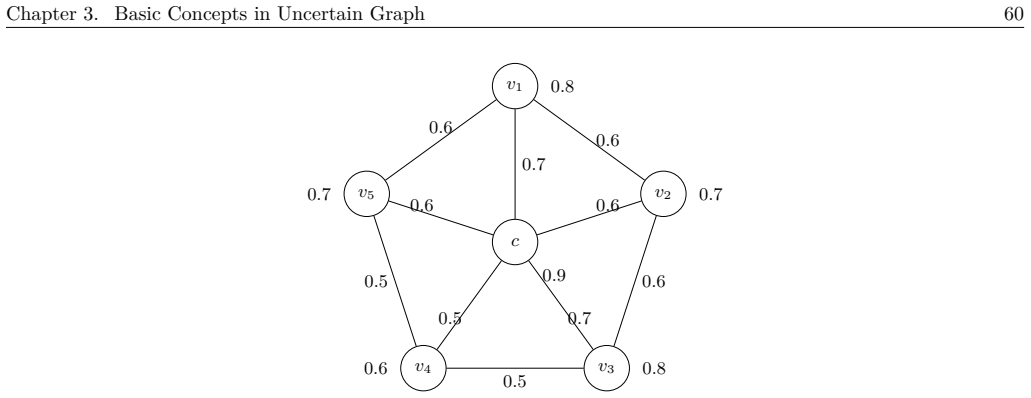
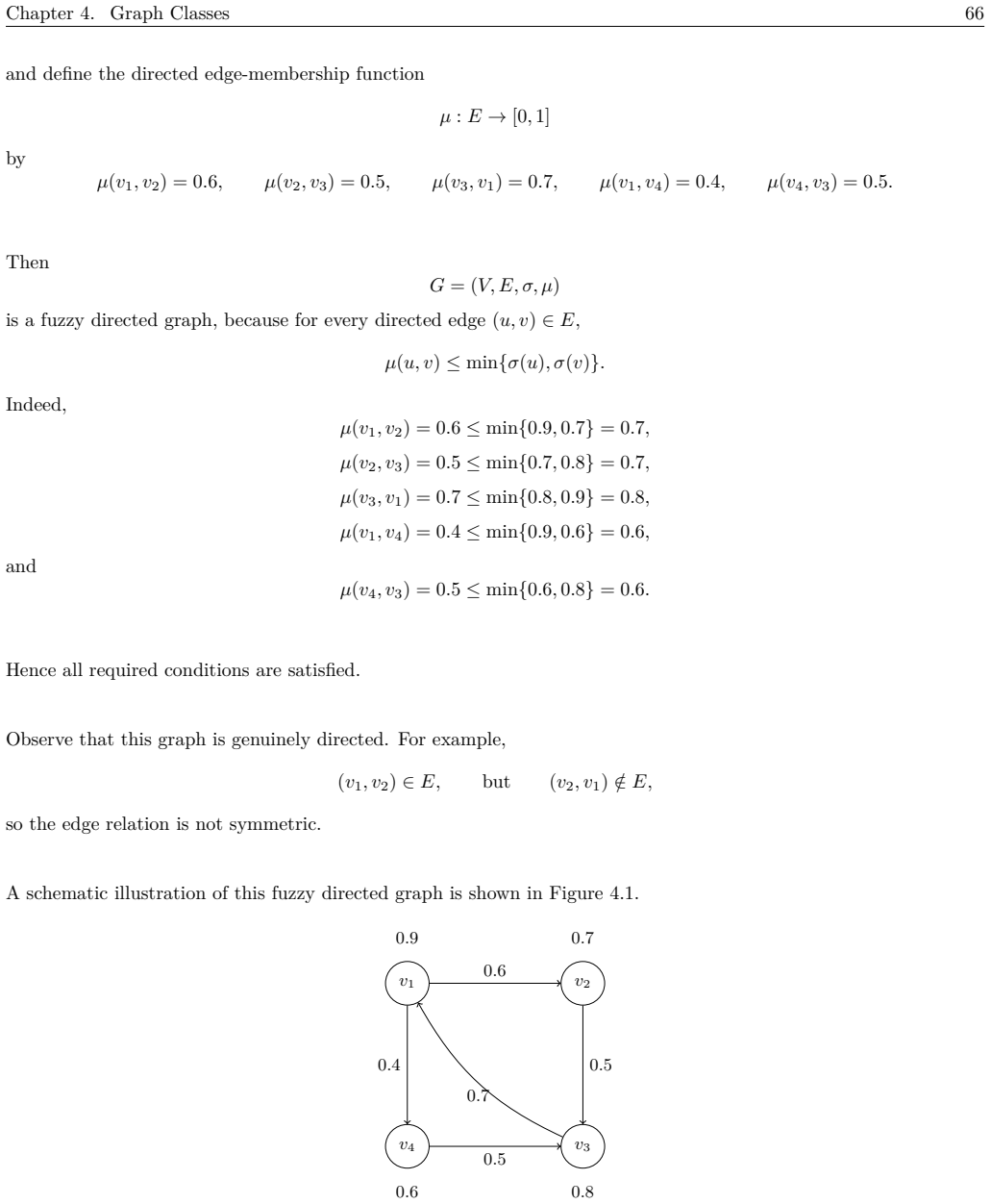


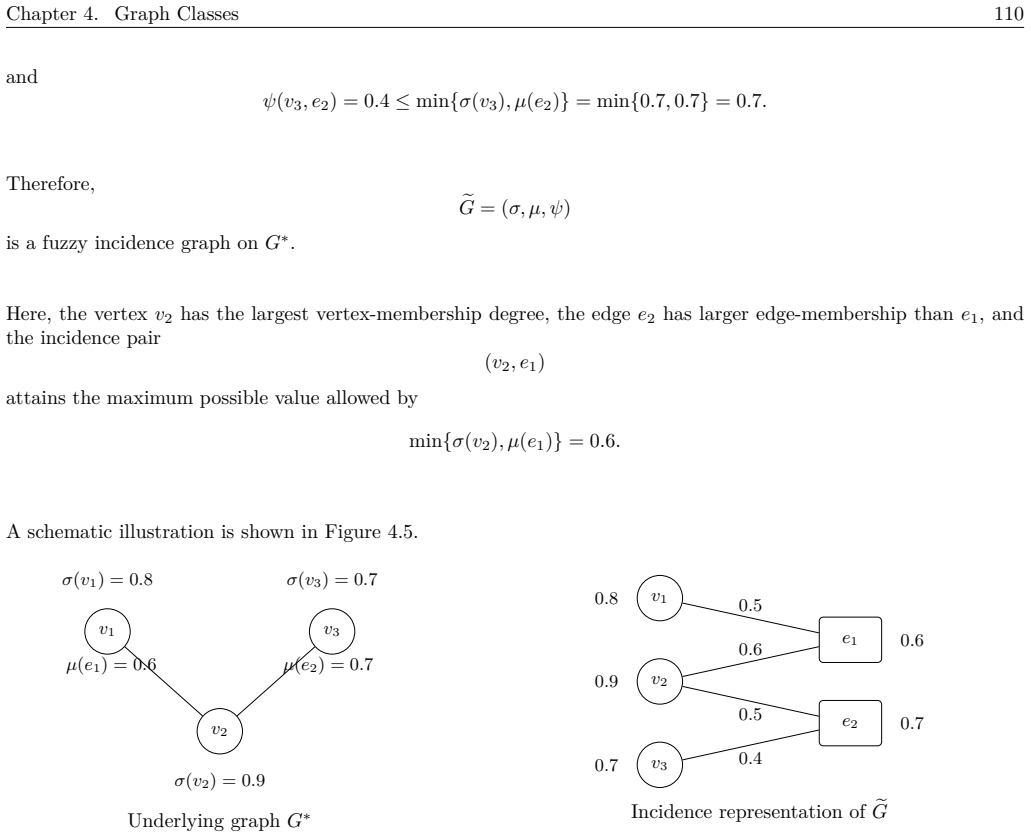
read the original abstract
This book presents a comprehensive and systematic survey of graph theory under uncertainty, with particular emphasis on the unifying role of the uncertain graph framework. It reviews fundamental concepts, structural properties, graph classes, and graph parameters within fuzzy, neutrosophic, and related models, while also introducing a wide range of extensions such as uncertain digraphs, hypergraphs, superhypergraphs, and dynamic graphs. In addition to theoretical developments, the book explores practical applications, including uncertain molecular graphs, decision-making systems, graph neural networks, knowledge graphs, and cognitive maps. By organizing diverse uncertainty-aware graph models within a common perspective, this work provides a coherent framework for understanding their relationships, capabilities, and applications in complex systems.
Editorial analysis
A structured set of objections, weighed in public.
Referee Report
Summary. This manuscript presents a survey of graph-theoretic concepts—paths, cycles, trees, cliques, stars, wheels, distances, and 30+ graph classes—under a unified “Uncertain Graph” framework parameterized by an uncertain model M with degree-domain Dom(M) ⊆ [0,1]^k. The framework subsumes fuzzy, intuitionistic fuzzy, neutrosophic, and plithogenic graphs as special cases by replacing scalar membership degrees with tuples from Dom(M). For each concept, the authors define model-dependent auxiliary operators (path-strength Ψ_M, evaluation Δ_M, edge-length Λ_M, complete-edge Γ_M, total orders ⪯_M, etc.) and prove that the resulting definitions are well-defined. The manuscript also surveys applications including molecular graphs, decision-making, graph neural networks, knowledge graphs, and cognitive maps.
Significance. The manuscript provides a systematic and encyclopedic organization of a large and fragmented literature on uncertainty-aware graph models. The Uncertain Graph framework (Def. 2.5.4) offers a legitimate common language for fuzzy, neutrosophic, and plithogenic graphs, and the catalogue tables (Tables 1.1, 1.2, 2.1, 2.2) are useful reference material. The well-definedness proofs are technically correct in verifying that support sets, compositions of functions, and finite minima/maxima yield unambiguous objects. The breadth of coverage across graph classes and parameters is a strength as a reference work.
major comments (3)
- §2.5, Def. 2.5.4 and Remark 2.5.5: The central claim that the Uncertain Graph framework 'subsumes fuzzy, intuitionistic fuzzy, neutrosophic, and plithogenic graph variants as special cases' is asserted but never verified beyond the scalar case Dom(M)=[0,1]. For this claim to be load-bearing, the manuscript must show that when a specific model M (e.g., neutrosophic with Dom(M)=[0,1]^3) is plugged into the uncertain-graph definitions, the result matches the corresponding published definition (e.g., neutrosophic cycle, neutrosophic tree). No such verification is performed for any multi-dimensional model. This is the central gap: the framework defines a family of possible definitions parameterized by auxiliary operator choices, but does not demonstrate that any specific choice recovers existing published definitions.
- §3.2, Def. 3.2.2 and §3.3, Def. 3.3.2: The auxiliary operators (total order ⪯_M, path-strength Ψ_M^(n), evaluation Δ_M, edge-length Λ_M, complete-edge Γ_M) are non-canonical for each model M. For the neutrosophic domain [0,1]^3, there is no canonical total order; the literature uses score functions, lexicographic orders, or componentwise comparisons, each yielding a different notion of 'weakest edge' and hence a different 'neutrosophic cycle.' The framework says 'equip M with a total order' but does not specify which one, so 'the' neutrosophic cycle in this framework is actually a family of definitions parameterized by the choice of ⪯_M. This underdetermination affects every concept requiring auxiliary operators (cycle, tree, distance, clique, etc.) and should be explicitly acknowledged, with at least one worked example showing that a specific operator choice recovers a known published定义
- §3.1–§3.9, Theorems 3.1.5, 3.2.4, 3.3.5, 3.5.5, 3.6.4, 3.7.5, 3.8.4, 3.9.5: The well-definedness proofs are tautological—they verify that functions compose, finite nonempty subsets of ℝ have minima/maxima, and set-theoretic constructions yield well-defined subsets. While technically correct, these proofs do not establish substantive mathematical content. The load-bearing question is whether the framework produces non-trivial theorems that hold across all models simultaneously (e.g., a relationship between uncertain radius and uncertain diameter, or between uncertain trees and uncertain cycles). The manuscript contains no such theorems. The authors should either (a) reframe these as remarks rather than theorems, or (b) add at least one non-trivial result demonstrating the framework's unifying power.
minor comments (8)
- §3.3: Definition 3.3.2 (Tree-Evaluable Uncertain Model) is stated twice—once as Def. 3.3.2 and again as Def. 3.3.3 with identical content. One should be removed.
- §3.4: Definition 3.4.3 (Measure-Evaluable Uncertain Model) is duplicated as Definition 3.4.5, and Definition 3.4.4 (Degree, Order, Size) is duplicated as Definition 3.4.6. These redundancies should be eliminated.
- §4.8: Definition 4.8.3 (Complete-Edge-Evaluable Uncertain Model) is duplicated as Definition 4.8.4 with identical content.
- §4.14, Def. 4.14.2: The 'Support-Evaluable Uncertain Model' is defined identically to Def. 3.7.3 and Def. 3.9.3. Consider defining it once and referencing it.
- The manuscript would benefit from a notation table listing all auxiliary operators (0_M, Ψ_M^(n), Δ_M, Λ_M, Γ_M, ⪯_M, ≺_M) and the concepts that require each.
- Several tables (e.g., Table 3.3, 3.4, 4.5) list concepts with '—' in the reference column for fuzzy variants, suggesting these are well-known but uncited. References should be provided or the entry removed.
- §1.4: The section titled 'Our Contributions' does not clearly distinguish between novel results and survey material. A sentence clarifying which definitions and theorems are new versus collected from prior work would help.
- The title page lists peer-reviewers by name. This is unusual for a manuscript submitted to a journal and should be removed for double-blind review.
Simulated Author's Rebuttal
We thank the referee for a careful and constructive report. The referee identifies three major concerns: (1) the subsumption claim for multi-dimensional models is asserted but not verified, (2) the auxiliary operators are non-canonical and the resulting underdetermination is not acknowledged, and (3) the well-definedness proofs are tautological and no non-trivial cross-model theorems are provided. We address each below.
read point-by-point responses
-
Referee: §2.5, Def. 2.5.4 and Remark 2.5.5: The central claim that the Uncertain Graph framework 'subsumes fuzzy, intuitionistic fuzzy, neutrosophic, and plithogenic graph variants as special cases' is asserted but never verified beyond the scalar case Dom(M)=[0,1]. For this claim to be load-bearing, the manuscript must show that when a specific model M (e.g., neutrosophic with Dom(M)=[0,1]^3) is plugged into the uncertain-graph definitions, the result matches the corresponding published definition (e.g., neutrosophic cycle, neutrosophic tree). No such verification is performed for any multi-dimensional model. This is the central gap: the framework defines a family of possible definitions parameterized by auxiliary operator choices, but does not demonstrate that any specific choice recovers existing published definitions.
Authors: The referee is correct that the manuscript verifies the subsumption claim only at the level of the graph definition (Def. 2.5.4) and not at the level of derived concepts (cycle, tree, distance, etc.) for any multi-dimensional model. We acknowledge this gap. In the revised manuscript, we will add a new section (or a series of worked examples) demonstrating concretely that, for at least two multi-dimensional models—specifically the intuitionistic fuzzy model (Dom(M) = {(μ,ν) ∈ [0,1]^2 : μ+ν ≤ 1}) and the single-valued neutrosophic model (Dom(M) = [0,1]^3)—specific choices of the auxiliary operators recover published definitions of neutrosophic cycle, neutrosophic tree, and neutrosophic distance from the literature. For example, for the neutrosophic model, we will specify a score-function-based total order ⪯_M, a componentwise min path-strength operator Ψ_M^(n), and a reciprocal-sum edge-length map Λ_M, and then verify that the resulting 'uncertain cycle' coincides with the standard neutrosophic cycle definition (e.g., from Broumi et al.). We agree that without these worked examples, the subsumption claim is incomplete. revision: yes
-
Referee: §3.2, Def. 3.2.2 and §3.3, Def. 3.3.2: The auxiliary operators (total order ⪯_M, path-strength Ψ_M^(n), evaluation Δ_M, edge-length Λ_M, complete-edge Γ_M) are non-canonical for each model M. For the neutrosophic domain [0,1]^3, there is no canonical total order; the literature uses score functions, lexicographic orders, or componentwise comparisons, each yielding a different notion of 'weakest edge' and hence a different 'neutrosophic cycle.' The framework says 'equip M with a total order' but does not specify which one, so 'the' neutrosophic cycle in this framework is actually a family of definitions parameterized by the choice of ⪯_M. This underdetermination affects every concept requiring auxiliary operators (cycle, tree, distance, clique, etc.) and should be explicitly acknowledged, with at least one worked example showing that a specific operator choice recovers a known published定义
Authors: The referee's observation is mathematically accurate. There is indeed no canonical total order on [0,1]^3, and different choices of ⪯_M yield different notions of 'neutrosophic cycle.' We agree that this underdetermination should be explicitly acknowledged rather than left implicit. In the revision, we will: (a) add a remark after Def. 3.2.2 explicitly stating that the choice of auxiliary operators (⪯_M, Ψ_M, Δ_M, Λ_M, Γ_M) is model-dependent and non-unique, and that each choice yields a potentially different instantiation of the concept; (b) note that this is a feature of the framework's generality, not a defect, but that it places a burden on the user to specify operators when applying the framework to a concrete model; and (c) provide at least one fully worked example for the neutrosophic model, specifying a particular score-function-based order and verifying that the resulting 'uncertain cycle' matches a published neutrosophic cycle definition. We will also add analogous remarks for the other concepts (tree, distance, clique) where auxiliary operators appear. revision: yes
-
Referee: §3.1–§3.9, Theorems 3.1.5, 3.2.4, 3.3.5, 3.5.5, 3.6.4, 3.7.5, 3.8.4, 3.9.5: The well-definedness proofs are tautological—they verify that functions compose, finite nonempty subsets of ℝ have minima/maxima, and set-theoretic constructions yield well-defined subsets. While technically correct, these proofs do not establish substantive mathematical content. The load-bearing question is whether the framework produces non-trivial theorems that hold across all models simultaneously (e.g., a relationship between uncertain radius and uncertain diameter, or between uncertain trees and uncertain cycles). The manuscript contains no such theorems. The authors should either (a) reframe these as remarks rather than theorems, or (b) add at least one non-trivial result demonstrating the framework's unifying power.
Authors: We partially agree. The referee is correct that the well-definedness proofs, as they stand, verify basic set-theoretic and order-theoretic facts and do not establish substantive mathematical content in the sense of non-trivial cross-model theorems. We accept option (a): in the revision, we will reframe the well-definedness results as Propositions or Remarks rather than Theorems, to accurately reflect their logical status. However, we also believe option (b) has merit and will partially pursue it. Specifically, we will add at least one non-trivial result that holds across all models: for instance, the inequality r_M(G) ≤ D_M(G) ≤ 2·r_M(G) for uncertain radius and diameter (analogous to the classical graph-theoretic bound), which holds for any distance-evaluable model M whenever the uncertain distance satisfies the triangle inequality. We note that the triangle inequality for d_M does hold when the edge-length map Λ_M produces positive real values and path lengths are defined as sums, which is the case in our framework. This result, while not deep, demonstrates that the framework supports cross-model theorems. We will also add a result relating uncertain trees and uncertain cycles (e.g., that an uncertain tree contains no uncertain cycle in its support graph), which holds across all models. We cannot, within the scope of a survey, provide a large body of such theorems, but we agree that at least one is needed to justify the framework's unifying ambition. revision: partial
Circularity Check
Self-citation to [97] for foundational definitions is load-bearing but not circular; the 'unification' is definitional but transparently so.
full rationale
The paper's central claim—that the Uncertain Graph framework subsumes fuzzy, neutrosophic, and plithogenic graphs as special cases—is true by construction of Definition 2.5.4 (choosing Dom(M)=[0,1] yields a fuzzy graph), and the paper is transparent about this in Remark 2.5.5. This is a definitional inclusion, not a theorem claiming non-trivial derivation. The self-citation to [97] for Definitions 2.5.1 (Uncertain Model) and 2.5.2 (Uncertain Set) is load-bearing—the entire framework depends on these definitions—but [97] provides foundational set-theoretic definitions that do not themselves depend on the current paper's graph-theoretic conclusions, so the citation is not circular. The well-definedness theorems (3.1.5, 3.2.4, 3.3.5, etc.) are trivially true (verifying that functions compose and finite sets have minima), which is a shallowness concern but not circularity. No fitted parameters are renamed as predictions, no uniqueness theorem is invoked to forbid alternatives, and no ansatz is smuggled through self-citation. The auxiliary operators (Ψ_M, ⪯_M, Δ_M, Λ_M, Γ_M) are acknowledged as model-dependent additional structure rather than being hidden. The score of 2 reflects the load-bearing self-citation to [97] for core definitions, which is normal academic practice and does not reduce the paper's claims to its own inputs.
Axiom & Free-Parameter Ledger
free parameters (6)
- Uncertain model M
- Zero degree 0_M
- Path-strength operator Ψ_M^(n)
- Evaluation map Δ_M
- Edge-length map Λ_M
- Complete-edge operator Γ_M
axioms (3)
- domain assumption All sets are finite (stated §2, Preliminaries)
- ad hoc to paper Uncertain model M with degree-domain Dom(M) ⊆ [0,1]^k exists and is well-defined (Def. 2.5.1, citing [97])
- ad hoc to paper Each model M can be equipped with auxiliary operators (Ψ, Δ, Λ, Γ) as needed
invented entities (2)
-
Uncertain Graph (type M)
no independent evidence
-
Path-evaluable / cycle-comparable / tree-evaluable / measure-evaluable / distance-evaluable / support-evaluable / complete-edge-evaluable / label-comparable / intersection-evaluable / threshold-evalua
no independent evidence
Reference graph
Works this paper leans on
-
[1]
Reinhard Diestel. Graph theory. Springer (print edition); Reinhard Diestel (eBooks), 2024
work page 2024
-
[2]
Graph theory and its applications
Jonathan L Gross, Jay Yellen, and Mark Anderson. Graph theory and its applications . Chapman and Hall/CRC, 2018
work page 2018
-
[3]
Using graph theory to analyze biological networks
Georgios A Pavlopoulos, Maria Secrier, Charalampos N Moschopoulos, Theodoros G Soldatos, Sophia Kossida, Jan Aerts, Reinhard Schneider, and Pantelis G Bagos. Using graph theory to analyze biological networks. BioData mining , 4:1–27, 2011
work page 2011
- [4]
-
[5]
You are allset: A multiset function framework for hypergraph neural networks
Eli Chien, Chao Pan, Jianhao Peng, and Olgica Milenkovic. You are allset: A multiset function framework for hypergraph neural networks. ArXiv, abs/2106.13264, 2021
-
[6]
Yifan Feng, Haoxuan You, Zizhao Zhang, Rongrong Ji, and Yue Gao. Hypergraph neural networks. In Proceedings of the AAAI conference on artificial intelligence , 2019
work page 2019
-
[7]
Hgnn+: General hypergraph neural networks
Yue Gao, Yifan Feng, Shuyi Ji, and Rongrong Ji. Hgnn+: General hypergraph neural networks. IEEE Transactions on Pattern Analysis and Machine Intelligence , 45(3):3181–3199, 2022
work page 2022
-
[8]
Multi-superhypergraph neural networks: A generalization of multi-hypergraph neural networks
Takaaki Fujita. Multi-superhypergraph neural networks: A generalization of multi-hypergraph neural networks. Neutrosophic Computing and Machine Learning , 39:328–347, 2025
work page 2025
-
[9]
Superhypergraph attention networks
Takaaki Fujita and Arif Mehmood. Superhypergraph attention networks. Neutrosophic Computing and Machine Learning , 40(1):10–27, 2025
work page 2025
-
[10]
Hamilton circuits in tree graphs
Richard Cummins. Hamilton circuits in tree graphs. IEEE Transactions on Circuit Theory , 13(1):82–90, 1966
work page 1966
-
[11]
Quantum tree graphs and the schwarzschild solution
Michael J Duff. Quantum tree graphs and the schwarzschild solution. Physical Review D , 7(8):2317, 1973
work page 1973
-
[12]
Haitze J Broersma and Cornelis Hoede. Path graphs. Journal of graph theory , 13(4):427–444, 1989
work page 1989
-
[13]
Vida Dujmović and David R Wood. On linear layouts of graphs. Discrete Mathematics & Theoretical Computer Science , 6, 2004
work page 2004
-
[14]
Mixed linear layouts: Complexity, heuristics, and experiments
Philipp de Col, Fabian Klute, and Martin Nöllenburg. Mixed linear layouts: Complexity, heuristics, and experiments. InInternational Symposium on Graph Drawing and Network Visualization , pages 460–467. Springer, 2019
work page 2019
-
[15]
Andreas Brandstädt, Van Bang Le, and Jeremy P Spinrad. Graph classes: a survey . SIAM, 1999
work page 1999
- [16]
-
[17]
On intuitionistic fuzzy sets theory , volume 283
Krassimir T Atanassov. On intuitionistic fuzzy sets theory , volume 283. Springer, 2012
work page 2012
-
[18]
Neutrosophic sets: An overview
Said Broumi, Assia Bakali, and Ayoub Bahnasse. Neutrosophic sets: An overview. Infinite Study, 2018
work page 2018
-
[19]
Single valued neutrosophic graphs.Journal of New theory , 10:86–101, 2016
Said Broumi, Mohamed Talea, Assia Bakali, and Florentin Smarandache. Single valued neutrosophic graphs.Journal of New theory , 10:86–101, 2016
work page 2016
-
[20]
Vague sets are intuitionistic fuzzy sets
Humberto Bustince and P Burillo. Vague sets are intuitionistic fuzzy sets. Fuzzy sets and systems , 79(3):403–405, 1996
work page 1996
-
[21]
On hesitant fuzzy sets and decision
Vicenç Torra and Yasuo Narukawa. On hesitant fuzzy sets and decision. In 2009 IEEE international conference on fuzzy systems , pages 1378–1382. IEEE, 2009
work page 2009
-
[22]
Bui Cong Cuong. Picture fuzzy sets. Journal of Computer Science and Cybernetics , 30:409, 2015
work page 2015
-
[23]
Quadripartitioned neutrosophic pythagorean soft set
R Radha, A Stanis Arul Mary, and Florentin Smarandache. Quadripartitioned neutrosophic pythagorean soft set. International Journal of Neutrosophic Science (IJNS) Volume 14, 2021 , page 11, 2021
work page 2021
-
[24]
Pentapartitioned neutrosophic soft set with interval membership
Mithun Datta, Kalyani Debnath, and Surapati Pramanik. Pentapartitioned neutrosophic soft set with interval membership. Neu- trosophic Sets and Systems , 79(1):37, 2025
work page 2025
-
[25]
Plithogeny, plithogenic set, logic, probability, and statistics
Florentin Smarandache. Plithogeny, plithogenic set, logic, probability, and statistics . Infinite Study, 2017
work page 2017
-
[26]
Hyperfuzzy sets and hyperfuzzy group
Jayanta Ghosh and Tapas Kumar Samanta. Hyperfuzzy sets and hyperfuzzy group. Int. J. Adv. Sci. Technol , 41:27–37, 2012
work page 2012
-
[27]
Takaaki Fujita. Advancing Uncertain Combinatorics through Graphization, Hyperization, and Uncertainization: Fuzzy, Neutro- sophic, Soft, Rough, and Beyond . Biblio Publishing, 2025
work page 2025
-
[28]
A Review and Introduction to Neutrosophic Applications across Various Scientific Fields
Takaaki Fujita and Smarandache Florentin. A Review and Introduction to Neutrosophic Applications across Various Scientific Fields. Neutrosophic Science International Association (NSIA) Publishing House, 2025
work page 2025
-
[29]
Generalization of the intuitionistic fuzzy set to the neutrosophic set
Florentin Smarandache and NM Gallup. Generalization of the intuitionistic fuzzy set to the neutrosophic set. In International Conference on Granular Computing , pages 8–42. Citeseer, 2006
work page 2006
-
[30]
An Overview of Neutrosophic and Plithogenic Theories and Applications
Florentin Smarandache and Maissam Jdid. An Overview of Neutrosophic and Plithogenic Theories and Applications . Infinite Study, 2023
work page 2023
-
[31]
A review of the hierarchy of plithogenic, neutrosophic, and fuzzy graphs: Survey and ap- plications
Takaaki Fujita and Florentin Smarandache. A review of the hierarchy of plithogenic, neutrosophic, and fuzzy graphs: Survey and ap- plications. In Advancing Uncertain Combinatorics through Graphization, Hyperization, and Uncertainization: Fuzzy, Neutrosophic, Soft, Rough, and Beyond (Second Volume) . Biblio Publishing, 2024
work page 2024
-
[32]
Plithogenic set, an extension of crisp, fuzzy, intuitionistic fuzzy, and neutrosophic sets-revisited
Florentin Smarandache. Plithogenic set, an extension of crisp, fuzzy, intuitionistic fuzzy, and neutrosophic sets-revisited . Infinite study, 2018. 301 Bibliography 302
work page 2018
-
[33]
Florentin Smarandache and Nivetha Martin.Plithogenic n-super hypergraph in novel multi-attribute decision making . Infinite Study, 2020
work page 2020
-
[34]
Generalized plithogenic sets in multi-attribute decision making
Nivetha Martin, R Priya, and Florentin Smarandache. Generalized plithogenic sets in multi-attribute decision making. In Neutro- sophic and Plithogenic Inventory Models for Applied Mathematics , pages 519–546. IGI Global Scientific Publishing, 2025
work page 2025
-
[35]
Azriel Rosenfeld. Fuzzy graphs. In Fuzzy sets and their applications to cognitive and decision processes , pages 77–95. Elsevier, 1975
work page 1975
-
[36]
Fuzzy graphs and fuzzy hypergraphs , volume 46
John N Mordeson and Premchand S Nair. Fuzzy graphs and fuzzy hypergraphs , volume 46. Physica, 2012
work page 2012
-
[37]
Fuzzy sets and fuzzy decision-making
Hongxing Li and Vincent C Yen. Fuzzy sets and fuzzy decision-making . CRC press, 1995
work page 1995
-
[38]
Fundamentals of fuzzy sets , volume 7
Didier Dubois and Henri Prade. Fundamentals of fuzzy sets , volume 7. Springer Science & Business Media, 2012
work page 2012
-
[39]
R Parvathi and MG Karunambigai. Intuitionistic fuzzy graphs. In Computational Intelligence, Theory and Applications: Interna- tional Conference 9th Fuzzy Days in Dortmund, Germany, Sept. 18–20, 2006 Proceedings , pages 139–150. Springer, 2006
work page 2006
-
[40]
Muhammad Akram. Bipolar fuzzy graphs. Information sciences, 181(24):5548–5564, 2011
work page 2011
-
[41]
Sovan Samanta and Madhumangal Pal. Fuzzy planar graphs. IEEE Transactions on Fuzzy Systems , 23(6):1936–1942, 2015
work page 1936
-
[42]
Irregular Bipolar Fuzzy Graphs
Sovan Samanta and Madhumangal Pal. Irregular bipolar fuzzy graphs. arXiv preprint arXiv:1209.1682 , 2012
work page internal anchor Pith review Pith/arXiv arXiv 2012
-
[43]
Takaaki Fujita and Florentin Smarandache. General, general weak, anti, balanced, and semi-neutrosophic graph.Neutrosophic Sets and Systems , 85(1):23, 2025
work page 2025
-
[44]
TM Nishad, Talal Ali Al-Hawary, and B Mohamed Harif. General fuzzy graphs. Ratio Mathematica, 47, 2023
work page 2023
-
[45]
Eman A AbuHijleh. Complex hesitant fuzzy graph. Fuzzy Information and Engineering , 15(2):149–161, 2023
work page 2023
-
[46]
Vague graphs and strengths.Journal of Intelligent & Fuzzy Systems , 30(6):3675–3680, 2016
Sovan Samanta, Madhumangal Pal, Hossein Rashmanlou, and Rajab Ali Borzooei. Vague graphs and strengths.Journal of Intelligent & Fuzzy Systems , 30(6):3675–3680, 2016
work page 2016
-
[47]
Hossein Rashmanlou and Rajab Ali Borzooei. Vague graphs with application. Journal of Intelligent & Fuzzy Systems , 30(6):3291–3299, 2016
work page 2016
-
[48]
Rajab Ali Borzooei and Hossein Rashmanlou. New concepts of vague graphs. International Journal of Machine Learning and Cybernetics, 8:1081–1092, 2017
work page 2017
-
[49]
Plithogeny, Plithogenic Set, Logic, Probability, and Statistics
Florentin Smarandache. Plithogeny, plithogenic set, logic, probability, and statistics. arXiv preprint arXiv:1808.03948 , 2018
work page internal anchor Pith review Pith/arXiv arXiv 2018
-
[50]
Study for general plithogenic soft expert graphs
Takaaki Fujita and Florentin Smarandache. Study for general plithogenic soft expert graphs. Plithogenic Logic and Computation , 2:107–121, 2024
work page 2024
-
[51]
Intuitionistic Plithogenic Graph
Prem Kumar Singh. Intuitionistic Plithogenic Graph . Infinite Study, 2022
work page 2022
-
[52]
Clustering large probabilistic graphs
George Kollios, Michalis Potamias, and Evimaria Terzi. Clustering large probabilistic graphs. IEEE Transactions on Knowledge and Data Engineering , 25(2):325–336, 2011
work page 2011
-
[53]
Shortest paths in probabilistic graphs
Harary Frank. Shortest paths in probabilistic graphs. operations research, 17(4):583–599, 1969
work page 1969
-
[54]
An indexing framework for queries on probabilistic graphs
Silviu Maniu, Reynold Cheng, and Pierre Senellart. An indexing framework for queries on probabilistic graphs. ACM Transactions on Database Systems (TODS) , 42(2):1–34, 2017
work page 2017
-
[55]
Muhammad Akram, A Nagoor Gani, and A Borumand Saeid. Vague hypergraphs. Journal of Intelligent & Fuzzy Systems , 26(2):647–653, 2014
work page 2014
-
[56]
M. Akram and K. H. Dar. On n-graphs. Southeast Asian Bulletin of Mathematics , 38:35–49, 2014
work page 2014
-
[57]
On n-hypergraphs.Journal of Intelligent & Fuzzy Systems , 26(6):2937–2944, 2014
Muhammad Akram, Wenjuan Chen, and Bijan Davvaz. On n-hypergraphs.Journal of Intelligent & Fuzzy Systems , 26(6):2937–2944, 2014
work page 2014
-
[58]
Sergiy Kozerenko. On markov graphs. Algebra and discrete mathematics , 16(1), 2018
work page 2018
-
[59]
Q-neutrosophic soft graphs in operations management and communication network
Vakkas Uluçay. Q-neutrosophic soft graphs in operations management and communication network. Soft Computing , 25(13):8441–8459, 2021
work page 2021
-
[60]
Operations on neutrosophic vague soft graphs.Neutrosophic Sets and Systems , 51:254, 2022
S Satham Hussain, R Jahir Hussain, Ghulam Muhiuddin, and P Anitha. Operations on neutrosophic vague soft graphs.Neutrosophic Sets and Systems , 51:254, 2022
work page 2022
-
[61]
A novel approach to neutrosophic hypersoft graphs with properties
Muhammad Saeed, Atiqe Ur Rahman, Muhammad Arshad, and Alok Dhital. A novel approach to neutrosophic hypersoft graphs with properties. Neutrosophic Sets and Systems , 46:336–355, 2021
work page 2021
-
[62]
A short note for hypersoft rough graphs.HyperSoft Set Methods in Engineering , 3:1–25, 2024
Takaaki Fujita and Florentin Smarandache. A short note for hypersoft rough graphs.HyperSoft Set Methods in Engineering , 3:1–25, 2024
work page 2024
-
[63]
Construction of rough graph to handle uncertain pattern from an information system
R Aruna Devi and K Anitha. Construction of rough graph to handle uncertain pattern from an information system. arXiv preprint arXiv:2205.10127, 2022
-
[64]
Domination in rough fuzzy digraphs with application
Uzma Ahmad and Tahira Batool. Domination in rough fuzzy digraphs with application. Soft Computing , 27(5):2425–2442, 2023
work page 2023
-
[66]
Neutrosophic triplet group (revisited)
Florentin Smarandache and Mumtaz Ali. Neutrosophic triplet group (revisited). Neutrosophic sets and Systems , 26(1):2, 2019
work page 2019
-
[67]
Complex neutrosophic hypergraphs: new social network models
Anam Luqman, Muhammad Akram, and Florentin Smarandache. Complex neutrosophic hypergraphs: new social network models. Algorithms, 12(11):234, 2019
work page 2019
-
[68]
Bipolar neutrosophic planar graphs
Muhammad Akram and KP Shum. Bipolar neutrosophic planar graphs . Infinite Study, 2017
work page 2017
-
[69]
Shawkat Alkhazaleh. Neutrosophic vague set theory. Critical Review, 10:29–39, 2015
work page 2015
-
[70]
Neutrosophic set theory applied to UP-algebras
Metawee Songsaeng and Aiyared Iampan. Neutrosophic set theory applied to UP-algebras . Infinite Study, 2019
work page 2019
-
[71]
Revisiting bipolar neutrosophic graph and interval-valued neutrosophic graph
Takaaki Fujita. Revisiting bipolar neutrosophic graph and interval-valued neutrosophic graph. Neutrosophic Systems with Applica- tions, 25, 2025
work page 2025
-
[72]
On dominating energy in bipolar single-valued neutrosophic graph
Siti Nurul Fitriah Mohamad, Roslan Hasni, and Binyamin Yusoff. On dominating energy in bipolar single-valued neutrosophic graph. Neutrosophic Sets and Systems , 56(1):10, 2023. 303 Bibliography
work page 2023
-
[73]
Elvir Akhmetshin, Ilyos Abdullayev, Aleksey Ilyin, Denis Shakhov, and Tatyana Khorolskaya. Towards sustainable economy: Boosting financial credit risk forecasting using bipolar single-valued neutrosophic graph sets approach. International Journal of Neutrosophic Science (IJNS) , 26(2), 2025
work page 2025
-
[74]
Note for neutrosophic incidence and threshold graph
Takaaki Fujita. Note for neutrosophic incidence and threshold graph. SciNexuses, 1:97–125, 2024
work page 2024
-
[75]
Application of bipolar neutrosophic sets to incidence graphs
Muhammad Akram, Nabeela Ishfaq, Florentin Smarandache, and Said Broumi. Application of bipolar neutrosophic sets to incidence graphs. Infinite Study, 2019
work page 2019
-
[76]
Novel concept of energy in bipolar single-valued neutrosophic graphs with applications
Siti Nurul Fitriah Mohamad, Roslan Hasni, Florentin Smarandache, and Binyamin Yusoff. Novel concept of energy in bipolar single-valued neutrosophic graphs with applications. Axioms, 10(3):172, 2021
work page 2021
-
[77]
Novel concepts on domination in neutrosophic incidence graphs with some applications
Siti Nurul Fitriah Mohamad, Roslan Hasni, and Florentin Smarandache. Novel concepts on domination in neutrosophic incidence graphs with some applications. Journal of Advanced Computational Intelligence and Intelligent Informatics , 27(5):837–847, 2023
work page 2023
-
[78]
Single valued neutrosophic signed graphs
Seema Mehra and Manjeet Singh. Single valued neutrosophic signed graphs . Infinite Study, 2017
work page 2017
-
[79]
WB Vasantha Kandasamy, K Ilanthenral, and Florentin Smarandache.Strong neutrosophic graphs and subgraph topological subspaces. Infinite Study, 2016
work page 2016
-
[80]
Basavaraj V Hiremath, Durga Nagarajan, Satham Hussain, Hossein Rashmanlou, and Farshid Mofidnakhaei. m-polar quadripar- titioned neutrosophic graphs with applications in decision-making for mobile network selection. Neutrosophic Sets and Systems , 82:458–477, 2025
work page 2025
-
[81]
S Satham Hussain, Durga Nagarajan, Hossein Rashmanlou, and Farshid Mofidnakhaei. Novel supply chain decision making model under m-polar quadripartitioned neutrosophic environment.Journal of Applied Mathematics and Computing , 71(1):1051–1076, 2025
work page 2025
discussion (0)
Sign in with ORCID, Apple, or X to comment. Anyone can read and Pith papers without signing in.