REVIEW 2 major objections 2 minor 3 references
Residual Drift Dominates Contradiction in Multi-Turn Constraint Reasoning
T0 review · 2 major / 2 minor · reviewed 2026-07-01 · grok-4.3
Pith's one-line read Satisfiable drift, not logical contradiction, dominates failure in multi-turn constraint reasoning.
desk verdict The paper's main result is that residual errors after repair are 98-100% satisfiable drift rather than contradiction, measured via their new solver-instrumented DRIFT-Bench. read the letter →
The pith
A machine-rendered reading of the paper's core claim, the machinery that carries it, and where it could break.
The reading
What carries the argument
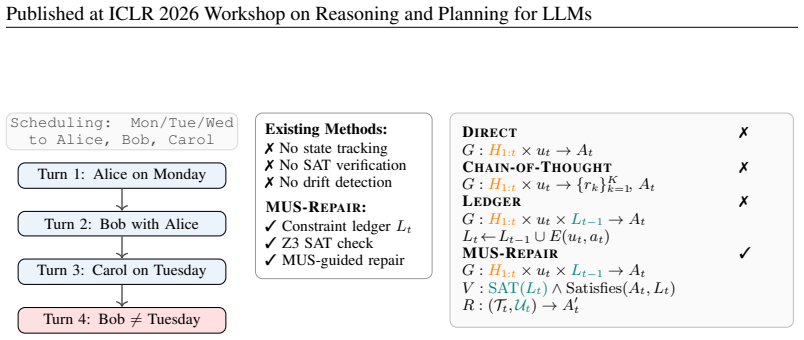
Satisfiable drift, the mode in which the maintained state stays satisfiable while the answer silently violates prior commitments.
What would settle it
A re-evaluation of the same problems and models where more than a small fraction of residual errors after MUS-Repair are classified as contradictions rather than drift would falsify the dominance result.
Extended reading notes
Core claim
The central claim is that residual errors after structured feedback consist of 98-100% satisfiable drift across all settings and models, while contradiction drops to near zero. MUS-Repair, which supplies minimal unsatisfiable subsets to the generator, improves accuracy over baselines by 1.8 to 15 percentage points yet still produces almost exclusively drift-type failures rather than contradictions.
Load-bearing premise
The solver-instrumented benchmark accurately classifies model outputs as satisfiable drift versus contradiction without mislabeling internal states or responses.
Editorial extensions
If this is right
- MUS-Repair reduces contradictions to near zero but leaves drift as the primary residual failure mode.
- Models forget prior commitments more often than they create internal inconsistencies after receiving feedback.
- Reliable multi-turn constraint systems require an additional validation step that checks whether the final answer respects the maintained state.
- The pattern holds across three constraint domains and model sizes from 8B to 120B parameters.
Reading between the lines
- State-tracking alone inside the model is insufficient to guarantee answer fidelity over multiple turns.
- External verifiers that compare generated answers against stored commitments could address the dominant failure mode.
- The same drift-versus-contradiction distinction may apply to other multi-turn tasks such as planning or long-form dialogue.
Signed reviews
Editorial analysis
A structured set of objections, weighed in public.
Referee Report
Summary. The paper claims that multi-turn constraint reasoning failures are dominated by satisfiable drift (internal state remains consistent but answer violates prior commitments) rather than logical contradiction. It introduces DRIFT-Bench, a solver-instrumented benchmark of 816 problems across three domains, evaluates four methods (including MUS-Repair) on four open-weight models (8B-120B), and reports that after repair, residual errors are 98-100% drift while contradiction falls to near zero. The work concludes that reliable systems require separate validation of answer-state consistency. Code is released.
Significance. If the error classification is accurate, the result usefully redirects attention from contradiction detection to answer-state fidelity in multi-turn systems and demonstrates the value of MUS-based feedback. The release of code and the multi-model, multi-domain empirical design are strengths that support reproducibility and generality if the core measurement pipeline holds.
major comments (2)
- [§3] §3 (Benchmark Construction): the central 98-100% drift claim rests on the solver-instrumented state tracker correctly labeling every residual error as satisfiable drift. The manuscript provides no independent validation (e.g., inter-annotator agreement, manual audit of extracted constraints, or soundness argument for the extraction pipeline) that LLM outputs are parsed without dropping implicit constraints, mishandling negation, or misclassifying variables.
- [Results section] Results section (post-repair tables): the reported near-zero contradiction and 98-100% drift percentages are direct outputs of the unvalidated labeling procedure; any systematic extraction error would inflate the drift dominance and undermine the claim that contradiction is no longer the dominant residual mode.
minor comments (2)
- [Methods] The abstract states four methods are evaluated but the methods section would benefit from an explicit enumeration and brief description of each baseline for quick reference.
- [Figures] Figure captions could more explicitly note the number of problems per domain and the exact definition of 'residual error' used in the percentages.
Simulated Author's Rebuttal
We thank the referee for the careful reading and for identifying the lack of independent validation for the constraint extraction and labeling pipeline. We agree this is a substantive gap that weakens confidence in the 98-100% drift result and will add the requested validation in revision.
read point-by-point responses
-
Referee: [§3] §3 (Benchmark Construction): the central 98-100% drift claim rests on the solver-instrumented state tracker correctly labeling every residual error as satisfiable drift. The manuscript provides no independent validation (e.g., inter-annotator agreement, manual audit of extracted constraints, or soundness argument for the extraction pipeline) that LLM outputs are parsed without dropping implicit constraints, mishandling negation, or misclassifying variables.
Authors: We agree the manuscript currently lacks independent validation of the extraction pipeline. While the downstream classification uses an exact solver (satisfiable state + answer violates constraints = drift; unsatisfiable state = contradiction), errors in parsing LLM text into constraints could bias the counts. In the revised manuscript we will add (1) a manual audit of 100 randomly sampled extractions per domain with inter-annotator agreement statistics and (2) an explicit soundness argument for the parsing rules. If the audit reveals non-negligible error, we will report adjusted figures. revision: yes
-
Referee: [Results section] Results section (post-repair tables): the reported near-zero contradiction and 98-100% drift percentages are direct outputs of the unvalidated labeling procedure; any systematic extraction error would inflate the drift dominance and undermine the claim that contradiction is no longer the dominant residual mode.
Authors: The percentages are indeed produced by the current labeling procedure. We acknowledge that unvalidated systematic parsing errors could overstate drift. The planned manual audit and soundness section will directly address this; we will either confirm the dominance result or qualify it with measured extraction error rates in the revision. revision: yes
Circularity Check
No circularity: direct empirical measurements from benchmark
full rationale
The paper is a self-contained empirical benchmark study. It introduces DRIFT-Bench, runs evaluations on models, and reports measured percentages (98-100% drift) as direct outputs of the solver-instrumented pipeline. No equations, fitted parameters, predictions, or self-citations appear in the derivation chain that reduce the central claim to its own inputs by construction. The result is externally falsifiable via the released code and benchmark.
Assumptions & free parameters
assumptions (1)
- domain assumption The internal state of the model can be accurately represented and checked for satisfiability using external solvers to distinguish drift from contradiction.
invented entities (1)
-
satisfiable drift
Cite this review
Pith. "Pith review of Residual Drift Dominates Contradiction in Multi-Turn Constraint Reasoning." pith.science (2026). https://pith.science/paper/JUMKHUQU
@misc{pith2026260523940,
  author       = {Pith},
  title        = {Pith review of: Residual Drift Dominates Contradiction in Multi-Turn Constraint Reasoning},
  year         = {2026},
  howpublished = {\url{https://pith.science/paper/JUMKHUQU}},
  note         = {Machine review of arXiv:2605.23940}
}
read the original abstract
How do multi-turn reasoning systems fail? The expected answer is logical contradiction, in which the system's maintained state becomes unsatisfiable. We show that the dominant mode is instead satisfiable drift, where the internal state stays consistent while the returned answer silently violates prior commitments. We build DRIFT-Bench (Decomposing Reasoning Into Failure Types), a solver-instrumented benchmark of 816 test problems across three constraint domains, and evaluate four methods on it across four open-weight models (8B-120B parameters). MUS-Repair, which feeds minimal unsatisfiable subsets back to the generator, is strongest in every setting (+1.8 to +15.0 pp over the best non-MUS baseline). But the central finding is what repair leaves behind. After structured feedback, models rarely contradict themselves. They forget. Residual errors are 98-100% satisfiable drift across all settings, while contradiction drops to near zero. Reliable multi-turn systems must separately validate that the returned answer respects the maintained state. Code is available at https://github.com/kaons-research/drift-bench.
Figures


Reference graph
Works this paper leans on
-
[1]
Training Verifiers to Solve Math Word Problems
URLhttps://arxiv.org/abs/2110.14168. Leonardo de Moura and Nikolaj Bjørner. Z3: An efficient SMT solver. InTools and Algorithms for the Construction and Analysis of Systems, volume 4963 ofLecture Notes in Computer Science, pp. 337–
-
[2]
Springer, 2008. URLhttps://doi.org/10.1007/978-3-540-78800-3_24. Luyu Gao, Aman Madaan, Shuyan Zhou, Uri Alon, Pengfei Liu, Yiming Yang, Jamie Callan, and Graham Neubig. PAL: Program-aided language models. InProceedings of the 40th International Conference on Machine Learning, volume 202 ofProceedings of Machine Learning Research, pp. 10764–10799. PMLR, 2...
-
[3]
Efficient memory management for large language model serving with pagedattention,
URLhttps://aclanthology.org/2025.acl-long.1575/. Takeshi Kojima, Shixiang Shane Gu, Machel Reid, Yutaka Matsuo, and Yusuke Iwasawa. Large language models are zero-shot reasoners. InAdvances in Neural Information Processing Systems, volume 35, pp. 22199–22213. Curran Associates, Inc., 2022. URL https://proceedings. neurips.cc/paper_files/paper/2022/hash/8b...
Reviewed July 1, 2026 · model on record in the stance chip above.
Discussion (0). Continue with ORCID to comment.