Spacetime Formation under Requirements: Contextual Realization and Form-Dependent Probability
Pith reviewed 2026-07-01 07:22 UTC · model grok-4.3
The pith
Quantum probability is the fixed-spacetime projection of contextual spacetime formation under finite-state requirements.
A machine-rendered reading of the paper's core claim, the machinery that carries it, and where it could break.
Core claim
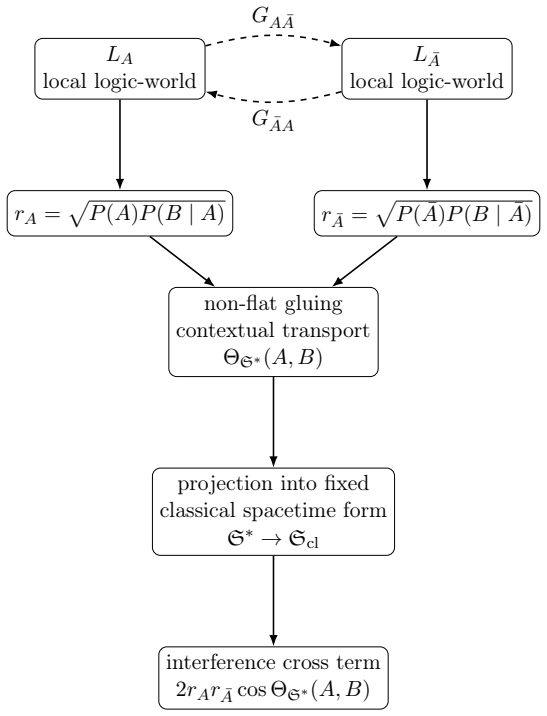
Quantum probability is the fixed-spacetime projection of contextual spacetime formation under finite-state requirements. When these requirements cannot be realized within a single global Boolean event structure, the mismatch appears under projection as noncommutativity, interference, and quantum-like probability. Auxiliary memory or context labels in classical representations correspond to holonomy-like mismatch among locally Boolean logic-worlds. The interference term is the cross term from gluing locally classical realizations. Objectivity consists of invariants preserved across observer- and history-dependent spacetime formations.
What carries the argument
Contextual spacetime formation under requirements: the process of building locally Boolean logic-worlds that must be glued with mismatches when a single global Boolean structure is impossible, then projected back into fixed spacetime.
If this is right
- Classical contextual bookkeeping costs appear as the fixed-spacetime shadow of contextual spacetime formation.
- Order effects and total-probability violations emerge directly from the projection of glued local realizations.
- Auxiliary memory in classical models maps to holonomy-like mismatches among local logic-worlds.
- Objecthood and probability become forms of realization under requirements rather than fixed primitives.
- A transcendental-operational realist account follows in which spacetime itself is one such form.
Where Pith is reading between the lines
- Physical quantum mechanics might itself be interpretable as such a projection if similar finite-state requirements apply at the operational level.
- Systems supplied with explicit context labels should reduce to classical probability without residual interference.
- AI architectures that enforce the same requirements without global Boolean structures should exhibit order effects as a direct consequence.
- The framework suggests testable distinctions between requirement-driven contextuality and structure-driven quantum models.
Load-bearing premise
The listed requirements cannot be realized inside one global Boolean event structure.
What would settle it
A concrete construction or simulation that satisfies all the listed requirements (finite capacity, single-state stability, no explicit labels) using only a single global Boolean event structure and produces no noncommutativity or interference upon projection.
Figures
read the original abstract
Quantum cognition often explains order effects, contextuality, and violations of the law of total probability by replacing classical probability with quantum probability on a fixed event structure. This paper proposes a different interpretation: quantum probability is the fixed-spacetime projection of contextual spacetime formation under finite-state requirements. The framework begins not with time, space, objects, or probabilities, but with requirements such as finite representational capacity, single-state semantic stability, context-sensitive intervention, avoidance of explicit context labels, coherent world-formation, and intersubjective transformability. When these requirements cannot be realized within a single global Boolean event structure, the mismatch appears, under fixed-spacetime projection, as noncommutativity, interference, and quantum-like probability. Building on prior single-state approaches to contextuality, we reinterpret classical contextual bookkeeping cost as the fixed-spacetime shadow of contextual spacetime formation. Auxiliary memory or context labels in a classical representation correspond, in this account, to holonomy-like mismatch among locally Boolean logic-worlds. The interference term is the cross term generated when locally classical realization contributions are nontrivially glued and projected back into a fixed classical spacetime form. The result is a transcendental-operational realist account: objecthood, eventhood, probability, and spacetime are treated as forms of realization under requirements, while objectivity is defined by invariants preserved across observer- and history-dependent spacetime formations.
Editorial analysis
A structured set of objections, weighed in public.
Referee Report
Summary. The paper claims that quantum probability is the fixed-spacetime projection of contextual spacetime formation under requirements including finite representational capacity, single-state semantic stability, context-sensitive intervention, avoidance of explicit context labels, coherent world-formation, and intersubjective transformability; when these cannot be realized in a single global Boolean event structure, the mismatch manifests as noncommutativity, interference, and quantum-like probabilities upon projection, offering a transcendental-operational realist reinterpretation of contextuality in cognition.
Significance. If the central mapping were derived rather than postulated, the work could provide a novel foundational link between cognitive contextuality and spacetime formation constraints, extending single-state contextuality approaches by treating objecthood and probability as realization forms under requirements. The manuscript supplies no such derivation, equations, or falsifiable predictions, so the significance remains prospective.
major comments (3)
- Abstract (second paragraph): The assertion that the listed requirements 'cannot be realized within a single global Boolean event structure' is presented without an axiomatic formulation of the requirements or a proof that they are jointly unsatisfiable in any Boolean algebra or sigma-algebra; this is load-bearing for the claim that the mismatch necessarily appears as noncommutativity upon projection.
- Abstract (third paragraph): No explicit construction is given showing how the interference term or Born-rule probabilities are generated from the requirements alone when locally Boolean logic-worlds are glued and projected; the account therefore reduces to re-description rather than derivation of the quantum features.
- Abstract (final paragraph): The claim that auxiliary memory or context labels correspond to holonomy-like mismatch among locally Boolean logic-worlds is interpretive and lacks a formal mapping or example that extracts the cross term from the requirements without additional assumptions.
minor comments (2)
- The manuscript would benefit from an explicit section defining the requirements formally (e.g., as predicates on event structures) before asserting their incompatibility.
- Notation for 'contextual spacetime formation' and 'locally Boolean logic-worlds' is introduced without prior definition or reference to how these differ from standard contextuality frameworks.
Simulated Author's Rebuttal
We thank the referee for their careful reading and insightful comments. We address each major comment below, clarifying the interpretive scope of the work while committing to revisions that strengthen the presentation.
read point-by-point responses
-
Referee: Abstract (second paragraph): The assertion that the listed requirements 'cannot be realized within a single global Boolean event structure' is presented without an axiomatic formulation of the requirements or a proof that they are jointly unsatisfiable in any Boolean algebra or sigma-algebra; this is load-bearing for the claim that the mismatch necessarily appears as noncommutativity upon projection.
Authors: We accept the observation that the manuscript presents the claim conceptually without a formal axiomatic system or mathematical proof of joint unsatisfiability. The requirements are introduced as a set of operational constraints drawn from cognitive contextuality literature, with the incompatibility asserted on that basis. In the revised version we will add a structured subsection that enumerates the requirements explicitly and discusses their incompatibility at the level of known contextuality results, while stating that a complete formal proof lies outside the present scope. revision: yes
-
Referee: Abstract (third paragraph): No explicit construction is given showing how the interference term or Born-rule probabilities are generated from the requirements alone when locally Boolean logic-worlds are glued and projected; the account therefore reduces to re-description rather than derivation of the quantum features.
Authors: The manuscript frames the emergence of interference and quantum-like probabilities as a consequence of projection under the stated requirements rather than as a mathematical derivation from them. No explicit construction or equation set is supplied. We will revise the abstract and main text to emphasize this interpretive character and to include a qualitative description of the gluing-and-projection process, together with a note on the need for future formal work to connect the requirements directly to the cross term. revision: yes
-
Referee: Abstract (final paragraph): The claim that auxiliary memory or context labels correspond to holonomy-like mismatch among locally Boolean logic-worlds is interpretive and lacks a formal mapping or example that extracts the cross term from the requirements without additional assumptions.
Authors: The holonomy analogy is offered as an interpretive bridge between classical bookkeeping costs and the proposed spacetime-formation account; no formal mapping or worked example is present. We will expand the relevant discussion with a brief illustrative scenario that makes the intended correspondence more concrete, while preserving the primarily conceptual nature of the contribution. revision: yes
Circularity Check
Quantum probability defined as projection of contextual spacetime formation under requirements, with no independent derivation shown
specific steps
-
self definitional
[Abstract]
"This paper proposes a different interpretation: quantum probability is the fixed-spacetime projection of contextual spacetime formation under finite-state requirements."
The paper defines quantum probability as identical to the projection of contextual spacetime formation under the requirements, so the claimed explanation of quantum probability reduces to the input assumptions with no additional derivation.
-
self definitional
[Abstract]
"When these requirements cannot be realized within a single global Boolean event structure, the mismatch appears, under fixed-spacetime projection, as noncommutativity, interference, and quantum-like probability."
The text asserts without proof or construction that the mismatch necessarily manifests as quantum features upon projection, making the appearance of noncommutativity and interference equivalent to the premise rather than a derived consequence.
full rationale
The manuscript's core claim equates quantum features directly to the fixed-spacetime projection of contextual formation under the listed requirements. The provided text supplies only the interpretive assertion that mismatch with Boolean structure 'appears as' noncommutativity and interference, without axiomatic formulation, proof of unsatisfiability, or explicit construction extracting Born-rule terms. This reduces the central result to a re-description of the input assumptions by construction. The reference to 'prior single-state approaches' is noted but does not alter the definitional character of the mapping itself.
Axiom & Free-Parameter Ledger
axioms (6)
- domain assumption finite representational capacity
- domain assumption single-state semantic stability
- domain assumption context-sensitive intervention
- domain assumption avoidance of explicit context labels
- domain assumption coherent world-formation
- domain assumption intersubjective transformability
invented entities (2)
-
contextual spacetime formation
no independent evidence
-
locally Boolean logic-worlds
no independent evidence
Reference graph
Works this paper leans on
-
[1]
Busemeyer, J. R., & Bruza, P. D. (2012).Quantum Models of Cognition and Decision. Cambridge University Press.https://doi.org/10.1017/CBO9780511997716
-
[2]
Blutner, R., & beim Graben, P. (2016). Quantum cognition and bounded rationality.Syn- these, 193(10), 3239–3291.https://doi.org/10.1007/s11229-015-0928-5
-
[3]
Aerts, D., & Aerts, S. (1995). Applications of quantum statistics in psychological stud- ies of decision processes.Foundations of Science, 1, 85–97.https://doi.org/10.1007/ BF00208726
1995
-
[4]
Pothos, E. M., & Busemeyer, J. R. (2013). Can quantum probability provide a new direction for cognitive modeling?Behavioral and Brain Sciences, 36(3), 255–274.https://doi.org/ 10.1017/S0140525X12001525
-
[5]
Bruza, P. D., Wang, Z., & Busemeyer, J. R. (2015). Quantum cognition: A new theoretical approach to psychology.Trends in Cognitive Sciences, 19(7), 383–393.https://doi.org/ 10.1016/j.tics.2015.05.001
-
[6]
Khrennikov, A. Y. (2010).Ubiquitous Quantum Structure: From Psychology to Finance. Springer, Berlin, Heidelberg.https://doi.org/10.1007/978-3-642-05101-2
-
[7]
(1998).Critique of Pure Reason
Kant, I. (1998).Critique of Pure Reason. Translated and edited by P. Guyer and A. W. Wood. Cambridge University Press. Original work published 1781/1787
1998
- [8]
-
[9]
Kim, S.-J. (2026). Contextuality as an external bookkeeping cost under fixed shared-state semantics.arXiv:2601.20167.https://arxiv.org/abs/2601.20167
work page internal anchor Pith review Pith/arXiv arXiv 2026
-
[10]
Kim, S.-J. (2026). Contextuality from single-state ontological models: An information- theoretic obstruction.arXiv:2602.16716.https://arxiv.org/abs/2602.16716
work page internal anchor Pith review Pith/arXiv arXiv 2026
-
[11]
Dzhafarov, E. N., & Kujala, J. V. (2016). Context–content systems of random variables: The Contextuality-by-Default theory.Journal of Mathematical Psychology, 74, 11–33.https: //doi.org/10.1016/j.jmp.2016.04.010
-
[12]
Abramsky, S., & Brandenburger, A. (2011). The sheaf-theoretic structure of non-locality and contextuality.New Journal of Physics, 13, 113036.https://doi.org/10.1088/1367-2630/ 13/11/113036
-
[13]
Wang, Z., & Busemeyer, J. R. (2013). A quantum question order model supported by empirical tests of an a priori and precise prediction.Topics in Cognitive Science, 5(4), 689– 710.https://doi.org/10.1111/tops.12040
-
[14]
Bell, J. S. (1964). On the Einstein Podolsky Rosen paradox.Physics Physique Fizika, 1, 195–200.https://doi.org/10.1103/PhysicsPhysiqueFizika.1.195
-
[15]
Gödel, K. (1931). Über formal unentscheidbare Sätze der Principia Mathematica und ver- wandter Systeme I.Monatshefte für Mathematik und Physik, 38, 173–198.https://doi. org/10.1007/BF01700692
-
[16]
Gunji, Y.-P., Adamatzky, A., Mougkogiannis, P., & Khrennikov, A. (2026). Quantum- like coherence derived from the interaction between chemical reaction and its en- vironment.Discover Artificial Intelligence, 6, Article 96.https://doi.org/10.1007/ s44163-025-00773-0 18
2026
-
[17]
Atmanspacher, H., Filk, T., & Römer, H. (2004). Quantum Zeno features of bistable percep- tion.Biological Cybernetics, 90, 33–40.https://doi.org/10.1007/s00422-003-0436-4 19
discussion (0)
Sign in with ORCID, Apple, or X to comment. Anyone can read and Pith papers without signing in.