Task-Aligned Self-Supervised Learning for Medical Image Analysis: A Task-Oriented Review with Practical Design Guidelines
Pith reviewed 2026-07-01 07:22 UTC · model grok-4.3
The pith
No single SSL strategy is optimal for all medical imaging tasks; alignment between pretext and downstream objective determines performance.
A machine-rendered reading of the paper's core claim, the machinery that carries it, and where it could break.
Core claim
The evidence suggests that no SSL strategy is universally optimal. Contrastive objectives generally encourage global discriminative representations and are well aligned with classification, but may underrepresent subtle or localized pathology. Spatial prediction, masked modeling, and reconstruction-based objectives better preserve anatomical structure and are often more suitable for segmentation and dense prediction. Hybrid methods can provide balanced representations, although they increase training complexity.
What carries the argument
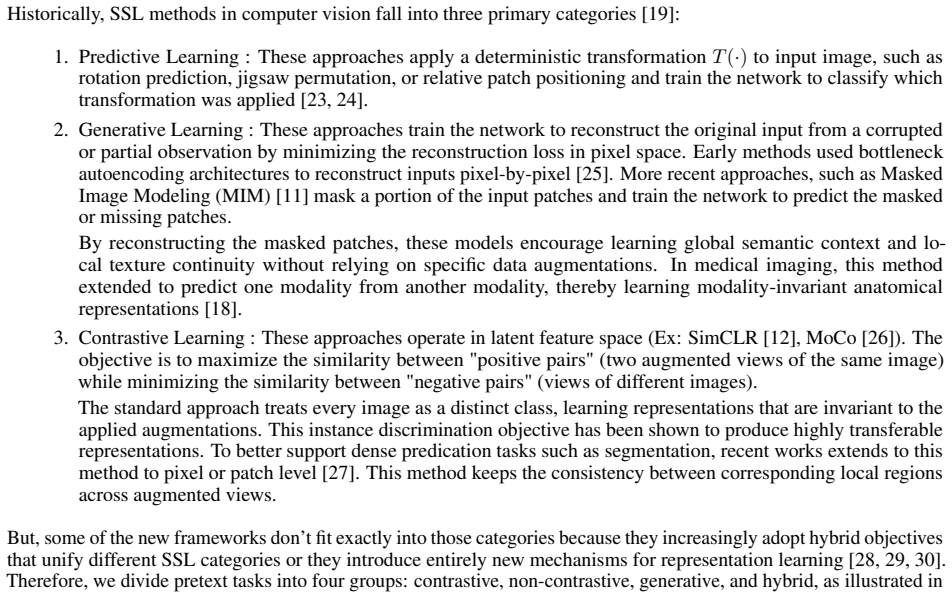
The four-paradigm categorization (contrastive, non-contrastive/predictive, generative/reconstruction-based, hybrid) that links each paradigm to specific downstream tasks, modalities, and label regimes.
If this is right
- Contrastive SSL is the default choice when the downstream task is image-level classification.
- Reconstruction or masked modeling SSL is preferred when the downstream task requires pixel-level or dense predictions.
- Hybrid SSL is useful only when training compute can absorb the added complexity.
- SSL yields the largest gains in few-shot and low-label regimes provided the augmentations avoid erasing pathology.
Where Pith is reading between the lines
- Pathology-aware corruption strategies could further improve detection of subtle lesions that current generic augmentations may destroy.
- Standardized cross-task benchmarks would make it possible to quantify the claimed task-alignment effect rather than relying on study-by-study comparisons.
- Resource-efficient variants of the hybrid paradigm are needed before high-resolution 3D volumes can be routinely pre-trained without prohibitive cost.
Load-bearing premise
The 75 selected studies are representative of the field and the four-paradigm split adequately captures how pretext design interacts with modality, label count, and task performance.
What would settle it
A controlled experiment that trains one model from each of the four paradigms on identical medical datasets for both a classification task and a segmentation task, then measures whether the performance ordering reverses or remains stable across tasks.
Figures


read the original abstract
Self-supervised learning (SSL) is increasingly used in medical image analysis to reduce dependence on costly expert annotations by learning transferable representations from unlabeled data. However, SSL performance depends not only on model architecture, but also on whether the pretext task preserves information required by the downstream clinical objective. This review presents a task-oriented synthesis of SSL methods for medical imaging, focusing on how pretext-task design interacts with imaging modality, label availability, and downstream performance. We analyze 75 studies published from 2017 to 2025 and organize them into four paradigms: contrastive learning, non-contrastive and predictive learning, generative and reconstruction-based learning, and hybrid learning. Rather than cataloging methods chronologically, we examine how these paradigms support classification, segmentation, detection, reconstruction, and regression. The evidence suggests that no SSL strategy is universally optimal. Contrastive objectives generally encourage global discriminative representations and are well aligned with classification, but may underrepresent subtle or localized pathology. Spatial prediction, masked modeling, and reconstruction-based objectives better preserve anatomical structure and are often more suitable for segmentation and dense prediction. Hybrid methods can provide balanced representations, although they increase training complexity. Across modalities, SSL is most beneficial in low-label and few-shot regimes, but its effectiveness depends on modality-aware augmentation, pathology-preserving corruption, and clinically meaningful evaluation. We conclude with practical design guidelines and identify open challenges, including pathology-aware pretext tasks, resource-efficient training for high-dimensional data, and standardized evaluation protocols.
Editorial analysis
A structured set of objections, weighed in public.
Referee Report
Summary. This paper is a task-oriented literature review synthesizing 75 SSL studies (2017–2025) in medical image analysis. It categorizes methods into four paradigms (contrastive, non-contrastive/predictive, generative/reconstruction-based, hybrid) and argues that pretext-task design must align with downstream clinical objectives, imaging modality, and label regime. No SSL approach is universally optimal: contrastive methods favor global classification but may miss localized pathology, while spatial/masked/reconstruction objectives better support segmentation and dense prediction; hybrids balance representations at higher complexity. The review emphasizes benefits in low-label regimes and ends with design guidelines plus open challenges.
Significance. If the synthesis is representative, the review supplies actionable, task-specific guidance for choosing SSL pretext tasks in medical imaging, a domain where annotation costs are high. It usefully distinguishes paradigm-task alignments and flags the need for pathology-aware augmentations and standardized evaluation, which could reduce trial-and-error in future work.
major comments (2)
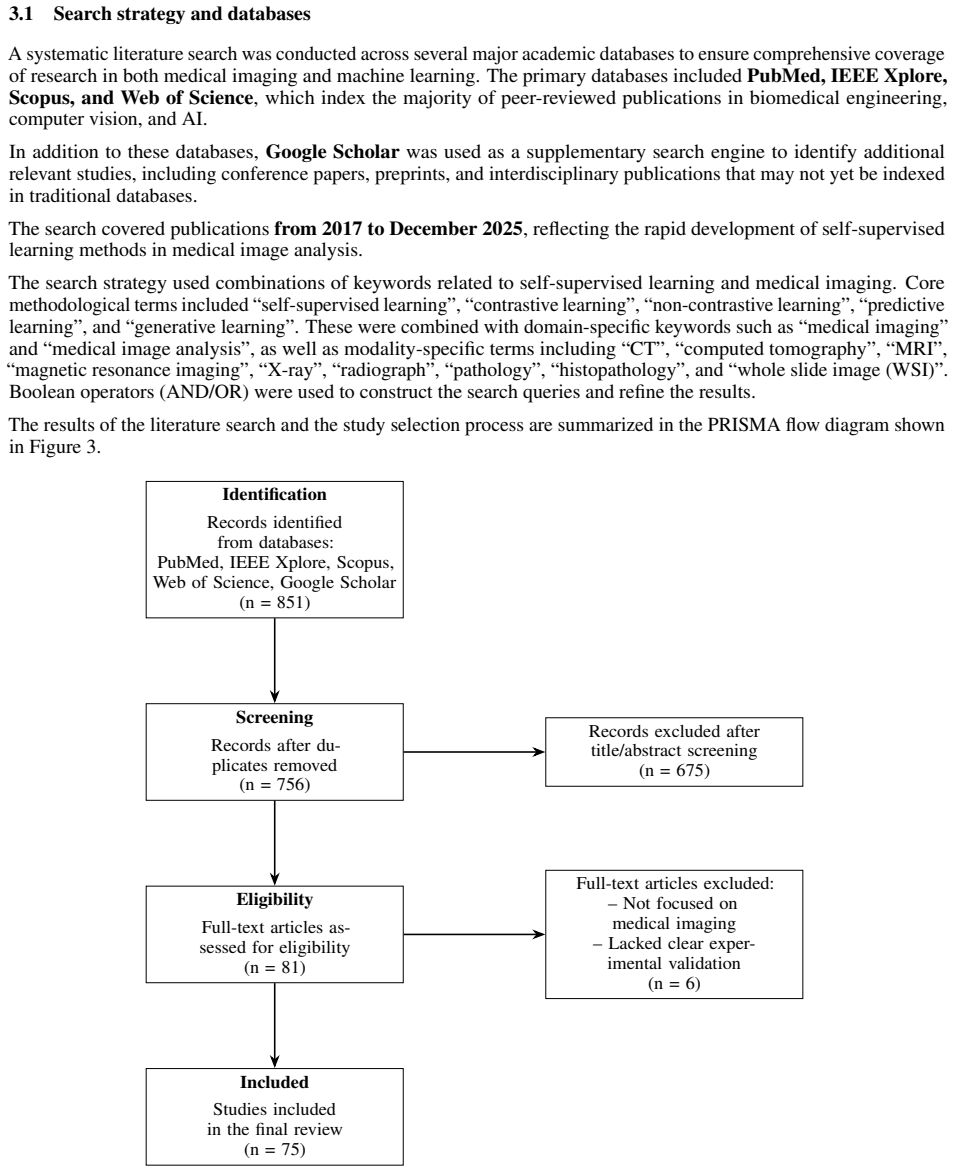
- [Abstract] Abstract and (presumed) Methods section: the synthesis rests on 75 studies yet supplies no search strategy, inclusion/exclusion criteria, database sources, or quantitative aggregation of performance deltas. Without these, the representativeness of the sample and the claimed paradigm-task alignments cannot be verified and risk selection bias.
- [Introduction] Introduction / Paradigm organization: the four-paradigm taxonomy is asserted without explicit justification of why these categories (rather than, e.g., a modality- or loss-based taxonomy) best capture interactions with label availability and downstream task performance; the central claim that alignments are evidence-based therefore depends on an unexamined organizational choice.
minor comments (2)
- [Abstract] Abstract: the date range ends in 2025; clarify whether this includes in-press or early-access papers and how the cutoff was applied.
- [Abstract] The abstract states that hybrid methods “increase training complexity” but offers no concrete metrics (parameters, epochs, GPU hours) from the reviewed studies to support the claim.
Simulated Author's Rebuttal
We thank the referee for the constructive feedback on our task-oriented review. We address each major comment below, indicating planned revisions to enhance transparency and justification while preserving the manuscript's focus on paradigm-task alignments.
read point-by-point responses
-
Referee: [Abstract] Abstract and (presumed) Methods section: the synthesis rests on 75 studies yet supplies no search strategy, inclusion/exclusion criteria, database sources, or quantitative aggregation of performance deltas. Without these, the representativeness of the sample and the claimed paradigm-task alignments cannot be verified and risk selection bias.
Authors: We agree that explicit documentation of the selection process would improve verifiability. In the revised manuscript we will add a dedicated 'Literature Search and Selection' subsection describing the databases consulted (PubMed, arXiv, IEEE Xplore, Google Scholar), search keywords and time window (2017–2025), inclusion criteria (peer-reviewed or preprint works applying SSL to medical images with downstream clinical-task evaluation), and exclusion criteria (purely theoretical works or non-medical applications). Because the synthesis is qualitative rather than a formal meta-analysis, we will include a supplementary table summarizing reported performance trends in low-label regimes, accompanied by explicit caveats on experimental heterogeneity that preclude direct delta aggregation. revision: yes
-
Referee: [Introduction] Introduction / Paradigm organization: the four-paradigm taxonomy is asserted without explicit justification of why these categories (rather than, e.g., a modality- or loss-based taxonomy) best capture interactions with label availability and downstream task performance; the central claim that alignments are evidence-based therefore depends on an unexamined organizational choice.
Authors: The four paradigms were chosen precisely because they map onto distinct representation-learning mechanisms (global discrimination, local prediction, structural reconstruction, and their combinations) whose differential effects on global versus localized features are directly observable across the collected studies and align with clinical task requirements. We will expand the Introduction with a new paragraph that (i) contrasts this objective-based taxonomy against modality- or loss-centric alternatives, (ii) explains why the latter obscure the label-regime and task-type interactions that constitute the review's central contribution, and (iii) anchors the justification in concrete examples drawn from the 75 papers. revision: yes
Circularity Check
No circularity: literature review synthesis of external studies
full rationale
This is a qualitative literature review that synthesizes findings from 75 external papers across four paradigms. The central claims (no universal SSL optimum; paradigm-task alignments) are presented as conclusions drawn from the cited body of work rather than derived via equations, parameter fitting, or self-referential prediction. No self-definitional steps, fitted inputs renamed as predictions, or load-bearing self-citations appear in the provided text. The selection of studies and taxonomy are acknowledged as assumptions in the skeptic note, but these are standard review limitations rather than circular reductions of the sort defined in the analysis criteria. The derivation chain is therefore self-contained against external benchmarks.
Axiom & Free-Parameter Ledger
Reference graph
Works this paper leans on
-
[1]
A guide to deep learning in healthcare.Nature medicine, 25(1):24–29, 2019
Andre Esteva, Alexandre Robicquet, Bharath Ramsundar, V olodymyr Kuleshov, Mark DePristo, Katherine Chou, Claire Cui, Greg Corrado, Sebastian Thrun, and Jeff Dean. A guide to deep learning in healthcare.Nature medicine, 25(1):24–29, 2019
2019
-
[2]
Xiaoxuan Liu, Livia Faes, Aditya U Kale, Siegfried K Wagner, Dun Jack Fu, Alice Bruynseels, Thushika Mahendiran, Gabriella Moraes, Mohith Shamdas, Christoph Kern, et al. A comparison of deep learning performance against health-care professionals in detecting diseases from medical imaging: a systematic review and meta-analysis.The lancet digital health, 1(...
2019
-
[3]
Preparing medical imaging data for machine learning.Radiology, 295(1):4–15, 2020
Martin J Willemink, Wojciech A Koszek, Cailin Hardell, Jie Wu, Dominik Fleischmann, Hugh Harvey, Les R Folio, Ronald M Summers, Daniel L Rubin, and Matthew P Lungren. Preparing medical imaging data for machine learning.Radiology, 295(1):4–15, 2020
2020
-
[4]
Embracing imperfect datasets: A review of deep learning solutions for medical image segmentation.Medical image analysis, 63:101693, 2020
Nima Tajbakhsh, Laura Jeyaseelan, Qian Li, Jeffrey N Chiang, Zhihao Wu, and Xiaowei Ding. Embracing imperfect datasets: A review of deep learning solutions for medical image segmentation.Medical image analysis, 63:101693, 2020
2020
-
[5]
Chexpert: A large chest radiograph dataset with uncertainty labels and expert comparison
Jeremy Irvin, Pranav Rajpurkar, Michael Ko, Yifan Yu, Silviana Ciurea-Ilcus, Chris Chute, Henrik Marklund, Behzad Haghgoo, Robyn Ball, Katie Shpanskaya, et al. Chexpert: A large chest radiograph dataset with uncertainty labels and expert comparison. InProceedings of the AAAI conference on artificial intelligence, volume 33, pages 590–597, 2019
2019
-
[6]
Transfusion: Understanding transfer learning for medical imaging.Advances in neural information processing systems, 32, 2019
Maithra Raghu, Chiyuan Zhang, Jon Kleinberg, and Samy Bengio. Transfusion: Understanding transfer learning for medical imaging.Advances in neural information processing systems, 32, 2019
2019
-
[7]
Big self-supervised models advance medical image classification
Shekoofeh Azizi, Basil Mustafa, Fiona Ryan, Zachary Beaver, Jan Freyberg, Jonathan Deaton, Aaron Loh, Alan Karthikesalingam, Simon Kornblith, Ting Chen, et al. Big self-supervised models advance medical image classification. InProceedings of the IEEE/CVF international conference on computer vision, pages 3478–3488, 2021
2021
-
[8]
Self-supervised learning in medicine and healthcare
Rayan Krishnan, Pranav Rajpurkar, and Eric J Topol. Self-supervised learning in medicine and healthcare. Nature Biomedical Engineering, 6(12):1346–1352, 2022
2022
-
[9]
Self-supervised visual feature learning with deep neural networks: A survey
Longlong Jing and Yingli Tian. Self-supervised visual feature learning with deep neural networks: A survey. IEEE transactions on pattern analysis and machine intelligence, 43(11):4037–4058, 2020
2020
-
[10]
S Kevin Zhou, Hayit Greenspan, Christos Davatzikos, James S Duncan, Bram Van Ginneken, Anant Madabhushi, Jerry L Prince, Daniel Rueckert, and Ronald M Summers. A review of deep learning in medical imaging: Imaging traits, technology trends, case studies with progress highlights, and future promises.Proceedings of the IEEE, 109(5):820–838, 2021
2021
-
[11]
Masked autoencoders are scalable vision learners
Kaiming He, Xinlei Chen, Saining Xie, Yanghao Li, Piotr Dollár, and Ross Girshick. Masked autoencoders are scalable vision learners. InProceedings of the IEEE/CVF conference on computer vision and pattern recognition, pages 16000–16009, 2022
2022
-
[12]
A simple framework for contrastive learning of visual representations
Ting Chen, Simon Kornblith, Mohammad Norouzi, and Geoffrey Hinton. A simple framework for contrastive learning of visual representations. InInternational conference on machine learning, pages 1597–1607. PmLR, 2020
2020
-
[13]
Unsupervised Representation Learning by Predicting Image Rotations
Spyros Gidaris, Praveer Singh, and Nikos Komodakis. Unsupervised representation learning by predicting image rotations.arXiv preprint arXiv:1803.07728, 2018
work page internal anchor Pith review Pith/arXiv arXiv 2018
-
[14]
Unsupervised learning of visual representations by solving jigsaw puzzles
Mehdi Noroozi and Paolo Favaro. Unsupervised learning of visual representations by solving jigsaw puzzles. In European conference on computer vision, pages 69–84. Springer, 2016
2016
-
[15]
Contrastive learning of global and local features for medical image segmentation with limited annotations.Advances in neural information processing systems, 33:12546–12558, 2020
Krishna Chaitanya, Ertunc Erdil, Neerav Karani, and Ender Konukoglu. Contrastive learning of global and local features for medical image segmentation with limited annotations.Advances in neural information processing systems, 33:12546–12558, 2020
2020
-
[16]
Demystifying contrastive self-supervised learning: Invariances, augmentations and dataset biases.Advances in Neural Information Processing Systems, 33:3407–3418, 2020
Senthil Purushwalkam and Abhinav Gupta. Demystifying contrastive self-supervised learning: Invariances, augmentations and dataset biases.Advances in Neural Information Processing Systems, 33:3407–3418, 2020. 26
2020
-
[17]
Multimodal mr synthesis via modality-invariant latent representation.IEEE transactions on medical imaging, 37(3):803–814, 2017
Agisilaos Chartsias, Thomas Joyce, Mario Valerio Giuffrida, and Sotirios A Tsaftaris. Multimodal mr synthesis via modality-invariant latent representation.IEEE transactions on medical imaging, 37(3):803–814, 2017
2017
-
[18]
Medgan: Medical image translation using gans.Computerized medical imaging and graphics, 79:101684, 2020
Karim Armanious, Chenming Jiang, Marc Fischer, Thomas Küstner, Tobias Hepp, Konstantin Nikolaou, Sergios Gatidis, and Bin Yang. Medgan: Medical image translation using gans.Computerized medical imaging and graphics, 79:101684, 2020
2020
-
[19]
Self-supervised learning methods and applications in medical imaging analysis: A survey.PeerJ Computer Science, 8:e1045, 2022
Saeed Shurrab and Rehab Duwairi. Self-supervised learning methods and applications in medical imaging analysis: A survey.PeerJ Computer Science, 8:e1045, 2022
2022
-
[20]
Self-supervised learning for medical image classification: a systematic review and implementation guidelines
Shih-Cheng Huang, Anuj Pareek, Malte Jensen, Matthew P Lungren, Serena Yeung, and Akshay S Chaudhari. Self-supervised learning for medical image classification: a systematic review and implementation guidelines. NPJ Digital Medicine, 6(1):74, 2023
2023
-
[21]
A survey of the impact of self-supervised pretraining for diagnostic tasks in medical x-ray, ct, mri, and ultrasound.BMC medical imaging, 24(1):79, 2024
Blake VanBerlo, Jesse Hoey, and Alexander Wong. A survey of the impact of self-supervised pretraining for diagnostic tasks in medical x-ray, ct, mri, and ultrasound.BMC medical imaging, 24(1):79, 2024
2024
-
[22]
Self-supervised visual representation learning for medical image analysis: A comprehensive survey.Transactions on Machine Learning Research, 2024
Siladittya Manna, Saumik Bhattacharya, and Umapada Pal. Self-supervised visual representation learning for medical image analysis: A comprehensive survey.Transactions on Machine Learning Research, 2024
2024
-
[23]
3d self-supervised methods for medical imaging.Advances in neural information processing systems, 33:18158–18172, 2020
Aiham Taleb, Winfried Loetzsch, Noel Danz, Julius Severin, Thomas Gaertner, Benjamin Bergner, and Christoph Lippert. 3d self-supervised methods for medical imaging.Advances in neural information processing systems, 33:18158–18172, 2020
2020
-
[24]
Rubik’s cube+: A self-supervised feature learning framework for 3d medical image analysis.Medical image analysis, 64:101746, 2020
Jiuwen Zhu, Yuexiang Li, Yifan Hu, Kai Ma, S Kevin Zhou, and Yefeng Zheng. Rubik’s cube+: A self-supervised feature learning framework for 3d medical image analysis.Medical image analysis, 64:101746, 2020
2020
-
[25]
Extracting and composing robust features with denoising autoencoders
Pascal Vincent, Hugo Larochelle, Yoshua Bengio, and Pierre-Antoine Manzagol. Extracting and composing robust features with denoising autoencoders. InProceedings of the 25th international conference on Machine learning, pages 1096–1103, 2008
2008
-
[26]
Momentum contrast for unsupervised visual representation learning
Kaiming He, Haoqi Fan, Yuxin Wu, Saining Xie, and Ross Girshick. Momentum contrast for unsupervised visual representation learning. InProceedings of the IEEE/CVF conference on computer vision and pattern recognition, pages 9729–9738, 2020
2020
-
[27]
Dense contrastive learning for self- supervised visual pre-training
Xinlong Wang, Rufeng Zhang, Chunhua Shen, Tao Kong, and Lei Li. Dense contrastive learning for self- supervised visual pre-training. InProceedings of the IEEE/CVF conference on computer vision and pattern recognition, pages 3024–3033, 2021
2021
-
[28]
A survey on self-supervised learning: Recent advances and open problems.Neurocomputing, page 131409, 2025
Jianping Zhang, Lei Yang, Seyed Mahmoud Sajjadi Mohammadabadi, and Feng Yan. A survey on self-supervised learning: Recent advances and open problems.Neurocomputing, page 131409, 2025
2025
-
[29]
Nikolaos Giakoumoglou, Tania Stathaki, and Athanasios Gkelias. A review on discriminative self-supervised learning methods in computer vision.arXiv preprint arXiv:2405.04969, 2024
-
[30]
Maemc-net: a hybrid self-supervised learning method for predicting the malignancy of solitary pulmonary nodules from ct images.Frontiers in medicine, 12:1507258, 2025
Tianhu Zhao, Yong Yue, Hang Sun, Jingxu Li, Yanhua Wen, Yudong Yao, Wei Qian, Yubao Guan, and Shouliang Qi. Maemc-net: a hybrid self-supervised learning method for predicting the malignancy of solitary pulmonary nodules from ct images.Frontiers in medicine, 12:1507258, 2025
2025
-
[31]
The prisma 2020 statement: an updated guideline for reporting systematic reviews.bmj, 372, 2021
Matthew J Page, Joanne E McKenzie, Patrick M Bossuyt, Isabelle Boutron, Tammy C Hoffmann, Cynthia D Mulrow, Larissa Shamseer, Jennifer M Tetzlaff, Elie A Akl, Sue E Brennan, et al. The prisma 2020 statement: an updated guideline for reporting systematic reviews.bmj, 372, 2021
2020
-
[32]
Self supervised contrastive learning for digital histopathology
Ozan Ciga, Tony Xu, and Anne Louise Martel. Self supervised contrastive learning for digital histopathology. Machine learning with applications, 7:100198, 2022
2022
-
[33]
Self-supervised learning for accurate liver view classifica- tion in ultrasound images with minimal labeled data
Abder-Rahman Ali, Anthony E Samir, and Peng Guo. Self-supervised learning for accurate liver view classifica- tion in ultrasound images with minimal labeled data. Inproceedings of the IEEE/CVF Conference on Computer Vision and Pattern Recognition, pages 3087–3093, 2023
2023
-
[34]
Self-supervised learning leads to improved performance in biparametric prostate mri classification.Computers in Biology and Medicine, 198:111262, 2025
José Guilherme de Almeida, Ana Sofia Castro Verde, Ana Mascarenhas Gaivão, Carlos Bilreiro, Inês Santiago, Joana Ip, Sara Belião, Celso Matos, Manolis Tsiknakis, Kostas Marias, et al. Self-supervised learning leads to improved performance in biparametric prostate mri classification.Computers in Biology and Medicine, 198:111262, 2025
2025
-
[35]
Lingmiao Meng, Liwei Zhao, Xin Yi, and Qingming Yu. Self-supervised contrastive learning for automated segmentation of brain tumor mri images in schizophrenia.International Journal of Computational Intelligence Systems, 17(1):196, 2024
2024
-
[36]
Anuroop Sriram, Matthew Muckley, Koustuv Sinha, Farah Shamout, Joelle Pineau, Krzysztof J Geras, Lea Azour, Yindalon Aphinyanaphongs, Nafissa Yakubova, and William Moore. Covid-19 prognosis via self-supervised representation learning and multi-image prediction.arXiv preprint arXiv:2101.04909, 2021. 27
-
[37]
Momentum contrastive learning for few-shot covid-19 diagnosis from chest ct images.Pattern recognition, 113:107826, 2021
Xiaocong Chen, Lina Yao, Tao Zhou, Jinming Dong, and Yu Zhang. Momentum contrastive learning for few-shot covid-19 diagnosis from chest ct images.Pattern recognition, 113:107826, 2021
2021
-
[38]
Chess: Chest x-ray pre-trained model via self-supervised contrastive learning.Journal of Digital Imaging, 36(3):902–910, 2023
Kyungjin Cho, Ki Duk Kim, Yujin Nam, Jiheon Jeong, Jeeyoung Kim, Changyong Choi, Soyoung Lee, Jun Soo Lee, Seoyeon Woo, Gil-Sun Hong, et al. Chess: Chest x-ray pre-trained model via self-supervised contrastive learning.Journal of Digital Imaging, 36(3):902–910, 2023
2023
-
[39]
Contrastive self-supervised learning for neurodegenerative disorder classification.Frontiers in Neuroinformatics, 19:1527582, 2025
Vadym Gryshchuk, Devesh Singh, Stefan Teipel, Martin Dyrba, and FTLDNI study groups ADNI, AIBL. Contrastive self-supervised learning for neurodegenerative disorder classification.Frontiers in Neuroinformatics, 19:1527582, 2025
2025
-
[40]
Parcl: Pathology-aware representation contrastive learning for glaucoma classification on fundus images
Junyan Yi, Ying Zheng, Dayong Ding, Jianchun Zhao, and Gang Yang. Parcl: Pathology-aware representation contrastive learning for glaucoma classification on fundus images. In2024 IEEE International Conference on Bioinformatics and Biomedicine (BIBM), pages 3912–3917. IEEE, 2024
2024
-
[41]
Self-fi: self-supervised learning for disease diagnosis in fundus images.Bioengineering, 10(9):1089, 2023
Toan Duc Nguyen, Duc-Tai Le, Junghyun Bum, Seongho Kim, Su Jeong Song, and Hyunseung Choo. Self-fi: self-supervised learning for disease diagnosis in fundus images.Bioengineering, 10(9):1089, 2023
2023
-
[42]
Self-supervised learning for spinal mris
Amir Jamaludin, Timor Kadir, and Andrew Zisserman. Self-supervised learning for spinal mris. InInternational Workshop on Deep Learning in Medical Image Analysis, pages 294–302. Springer, 2017
2017
-
[43]
Self-supervised feature learning via exploiting multi-modal data for retinal disease diagnosis.IEEE Transactions on Medical Imaging, 39(12):4023– 4033, 2020
Xiaomeng Li, Mengyu Jia, Md Tauhidul Islam, Lequan Yu, and Lei Xing. Self-supervised feature learning via exploiting multi-modal data for retinal disease diagnosis.IEEE Transactions on Medical Imaging, 39(12):4023– 4033, 2020
2020
-
[44]
vox2vec: A framework for self-supervised contrastive learning of voxel-level representations in medical images
Mikhail Goncharov, Vera Soboleva, Anvar Kurmukov, Maxim Pisov, and Mikhail Belyaev. vox2vec: A framework for self-supervised contrastive learning of voxel-level representations in medical images. InInternational Conference on Medical Image Computing and Computer-Assisted Intervention, pages 605–614. Springer, 2023
2023
-
[45]
Multi-encoding contrastive learning for dual-stream self-supervised 3d dental segmentation network.Technologies, 13(9):419, 2025
Tian Ma, Xiaoyuan Wei, Jiechen Zhai, Ziang Zhang, Yawen Li, and Yuancheng Li. Multi-encoding contrastive learning for dual-stream self-supervised 3d dental segmentation network.Technologies, 13(9):419, 2025
2025
-
[46]
3d segmentation of necrotic lung lesions in ct images using self-supervised contrastive learning.IEEE Access, 12:32859–32869, 2024
Yiqiao Liu, Sarah Halek, Randolph Crawford, Keith Persson, Michal Tomaszewski, Shubing Wang, Richard Baumgartner, Jianda Yuan, Gregory Goldmacher, and Antong Chen. 3d segmentation of necrotic lung lesions in ct images using self-supervised contrastive learning.IEEE Access, 12:32859–32869, 2024
2024
-
[47]
Deep contrastive learning based tissue clustering for annotation-free histopathology image analysis.Computerized Medical Imaging and Graphics, 97:102053, 2022
Jiangpeng Yan, Hanbo Chen, Xiu Li, and Jianhua Yao. Deep contrastive learning based tissue clustering for annotation-free histopathology image analysis.Computerized Medical Imaging and Graphics, 97:102053, 2022
2022
-
[48]
Multi-modal representation learning in retinal imaging using self-supervised learning for enhanced clinical predictions.Scientific Reports, 14(1):26802, 2024
Emese Suekei, Elisabeth Rumetshofer, Niklas Schmidinger, Andreas Mayr, Ursula Schmidt-Erfurth, Guenter Klambauer, and Hrvoje Bogunovi´c. Multi-modal representation learning in retinal imaging using self-supervised learning for enhanced clinical predictions.Scientific Reports, 14(1):26802, 2024
2024
-
[49]
Exploring the utility of self- supervised pretraining strategies for the detection of absent lung sliding in m-mode lung ultrasound
Blake VanBerlo, Brian Li, Alexander Wong, Jesse Hoey, and Robert Arntfield. Exploring the utility of self- supervised pretraining strategies for the detection of absent lung sliding in m-mode lung ultrasound. In Proceedings of the IEEE/CVF Conference on Computer Vision and Pattern Recognition, pages 3077–3086, 2023
2023
-
[50]
Duy MH Nguyen, Hoang Nguyen, Nghiem Diep, Tan Ngoc Pham, Tri Cao, Binh Nguyen, Paul Swoboda, Nhat Ho, Shadi Albarqouni, Pengtao Xie, et al. Lvm-med: Learning large-scale self-supervised vision models for medical imaging via second-order graph matching.Advances in Neural Information Processing Systems, 36:27922–27950, 2023
2023
-
[51]
Cl-mri: Self-supervised contrastive learning to improve the accuracy of undersampled mri reconstruction.Biomedical Signal Processing and Control, 100:107185, 2025
Mevan Ekanayake, Zhifeng Chen, Mehrtash Harandi, Gary Egan, and Zhaolin Chen. Cl-mri: Self-supervised contrastive learning to improve the accuracy of undersampled mri reconstruction.Biomedical Signal Processing and Control, 100:107185, 2025
2025
-
[52]
Artificial intelligence for detection of external cervical resorption using label-efficient self-supervised learning method.Journal of Endodontics, 50(2):144–153, 2024
Hossein Mohammad-Rahimi, Omid Dianat, Reza Abbasi, Samira Zahedrozegar, Ali Ashkan, Saeed Reza Motamedian, Mohammad Hossein Rohban, and Ali Nosrat. Artificial intelligence for detection of external cervical resorption using label-efficient self-supervised learning method.Journal of Endodontics, 50(2):144–153, 2024
2024
-
[53]
Self-supervised learning enhances periapical films segmentation with limited labeled data.Journal of Dentistry, page 106150, 2025
Meiyu Hu, Qianli Zhang, Zhenyang Wei, Pingyi Jia, Mu Yuan, Huajie Yu, Xu-Cheng Yin, and Junran Peng. Self-supervised learning enhances periapical films segmentation with limited labeled data.Journal of Dentistry, page 106150, 2025
2025
-
[54]
Yutong Xie, Jianpeng Zhang, Zehui Liao, Yong Xia, and Chunhua Shen. Pgl: Prior-guided local self-supervised learning for 3d medical image segmentation.arXiv preprint arXiv:2011.12640, 2020
-
[55]
Self-supervised learning for endoscopic video analysis
Roy Hirsch, Mathilde Caron, Regev Cohen, Amir Livne, Ron Shapiro, Tomer Golany, Roman Goldenberg, Daniel Freedman, and Ehud Rivlin. Self-supervised learning for endoscopic video analysis. InInternational conference on medical image Computing and computer-assisted intervention, pages 569–578. Springer, 2023. 28
2023
-
[56]
Vim4path: Self-supervised vision mamba for histopathology images
Ali Nasiri-Sarvi, Vincent Quoc-Huy Trinh, Hassan Rivaz, and Mahdi S Hosseini. Vim4path: Self-supervised vision mamba for histopathology images. InProceedings of the IEEE/CVF conference on computer vision and pattern recognition, pages 6894–6903, 2024
2024
-
[57]
Cads: A self-supervised learner via cross-modal alignment and deep self-distillation for ct volume segmentation.IEEE Transactions on Medical Imaging, 44(1):118–129, 2024
Yiwen Ye, Jianpeng Zhang, Ziyang Chen, and Yong Xia. Cads: A self-supervised learner via cross-modal alignment and deep self-distillation for ct volume segmentation.IEEE Transactions on Medical Imaging, 44(1):118–129, 2024
2024
-
[58]
Self-supervised learning methods for label-efficient dental caries classification.Diagnostics, 12(5):1237, 2022
Aiham Taleb, Csaba Rohrer, Benjamin Bergner, Guilherme De Leon, Jonas Almeida Rodrigues, Falk Schwen- dicke, Christoph Lippert, and Joachim Krois. Self-supervised learning methods for label-efficient dental caries classification.Diagnostics, 12(5):1237, 2022
2022
-
[59]
Swssl: Sliding window-based self-supervised learning for anomaly detection in high-resolution images.IEEE Transactions on Medical Imaging, 42(12):3860–3870, 2023
Haoyu Dong, Yifan Zhang, Hanxue Gu, Nicholas Konz, Yixin Zhang, and Maciej A Mazurowski. Swssl: Sliding window-based self-supervised learning for anomaly detection in high-resolution images.IEEE Transactions on Medical Imaging, 42(12):3860–3870, 2023
2023
-
[60]
Self-supervised feature learning for 3d medical images by playing a rubik’s cube
Xinrui Zhuang, Yuexiang Li, Yifan Hu, Kai Ma, Yujiu Yang, and Yefeng Zheng. Self-supervised feature learning for 3d medical images by playing a rubik’s cube. InInternational conference on medical image computing and computer-assisted intervention, pages 420–428. Springer, 2019
2019
-
[61]
Revisiting rubik’s cube: Self-supervised learning with volume-wise transformation for 3d medical image segmentation
Xing Tao, Yuexiang Li, Wenhui Zhou, Kai Ma, and Yefeng Zheng. Revisiting rubik’s cube: Self-supervised learning with volume-wise transformation for 3d medical image segmentation. InInternational conference on medical image computing and computer-assisted intervention, pages 238–248. Springer, 2020
2020
-
[62]
Self supervised deep representation learning for fine-grained body part recognition
Pengyue Zhang, Fusheng Wang, and Yefeng Zheng. Self supervised deep representation learning for fine-grained body part recognition. In2017 IEEE 14th international symposium on biomedical imaging (ISBI 2017), pages 578–582. IEEE, 2017
2017
-
[63]
Self-supervised learning based on spatial awareness for medical image analysis.IEEE access, 8:162973–162981, 2020
Xuan-Bac Nguyen, Guee Sang Lee, Soo Hyung Kim, and Hyung Jeong Yang. Self-supervised learning based on spatial awareness for medical image analysis.IEEE access, 8:162973–162981, 2020
2020
-
[64]
Self-supervised learning for cardiac mr image segmentation by anatomical position prediction
Wenjia Bai, Chen Chen, Giacomo Tarroni, Jinming Duan, Florian Guitton, Steffen E Petersen, Yike Guo, Paul M Matthews, and Daniel Rueckert. Self-supervised learning for cardiac mr image segmentation by anatomical position prediction. InInternational conference on medical image computing and computer-assisted intervention, pages 541–549. Springer, 2019
2019
-
[65]
Improving cytoarchitec- tonic segmentation of human brain areas with self-supervised siamese networks
Hannah Spitzer, Kai Kiwitz, Katrin Amunts, Stefan Harmeling, and Timo Dickscheid. Improving cytoarchitec- tonic segmentation of human brain areas with self-supervised siamese networks. InInternational conference on medical image computing and computer-assisted intervention, pages 663–671. Springer, 2018
2018
-
[66]
Med-seam: medical context aware self-supervised learning framework for anomaly classification in knee mri
Akshay Daydar, Ajay Kumar Reddy, Sonal Kumar, Arijit Sur, and Hanif Laskar. Med-seam: medical context aware self-supervised learning framework for anomaly classification in knee mri. InProceedings of the Fifteenth Indian Conference on Computer Vision Graphics and Image Processing, pages 1–8, 2024
2024
-
[67]
Self-supervised learning for stroke lesion segmentation on ct: a new pretext task for neuroimaging
Juliette Moreau, Laura Mechtouff, David Rousseau, Tae-Hee Cho, Omer Eker, Yves Berthezéne, and Carole Frindel. Self-supervised learning for stroke lesion segmentation on ct: a new pretext task for neuroimaging. In 2025 47th Annual International Conference of the IEEE Engineering in Medicine and Biology Society (EMBC), pages 1–6. IEEE, 2025
2025
-
[68]
Self-supervised representation learning for ultrasound video
Jianbo Jiao, Richard Droste, Lior Drukker, Aris T Papageorghiou, and J Alison Noble. Self-supervised representation learning for ultrasound video. In2020 IEEE 17th international symposium on biomedical imaging (ISBI), pages 1847–1850. IEEE, 2020
2020
-
[69]
Self-supervised representation learning for knee injury diagnosis from magnetic resonance data.IEEE Transactions on Artificial Intelligence, 5(4):1613–1623, 2023
Siladittya Manna, Saumik Bhattacharya, and Umapada Pal. Self-supervised representation learning for knee injury diagnosis from magnetic resonance data.IEEE Transactions on Artificial Intelligence, 5(4):1613–1623, 2023
2023
-
[70]
Multimodal self-supervised learning for medical image analysis
Aiham Taleb, Christoph Lippert, Tassilo Klein, and Moin Nabi. Multimodal self-supervised learning for medical image analysis. InInternational conference on information processing in medical imaging, pages 661–673. Springer, 2021
2021
-
[71]
Self-supervised learning application on covid-19 chest x-ray image classification using masked autoencoder.Bioengineering, 10(8):901, 2023
Xin Xing, Gongbo Liang, Chris Wang, Nathan Jacobs, and Ai-Ling Lin. Self-supervised learning application on covid-19 chest x-ray image classification using masked autoencoder.Bioengineering, 10(8):901, 2023
2023
-
[72]
Self-supervised learning with masked image modeling for teeth numbering, detection of dental restorations, and instance segmentation in dental panoramic radiographs
Amani Almalki and Longin Jan Latecki. Self-supervised learning with masked image modeling for teeth numbering, detection of dental restorations, and instance segmentation in dental panoramic radiographs. In Proceedings of the IEEE/CVF winter conference on applications of computer vision, pages 5594–5603, 2023
2023
-
[73]
Pyramid-based self-supervised learning for histopathological image classification.Computers in Biology and Medicine, 165:107336, 2023
Junjie Wang, Hao Quan, Chengguang Wang, and Genke Yang. Pyramid-based self-supervised learning for histopathological image classification.Computers in Biology and Medicine, 165:107336, 2023. 29
2023
-
[74]
Daniel Wolf, Tristan Payer, Catharina Silvia Lisson, Christoph Gerhard Lisson, Meinrad Beer, Michael Götz, and Timo Ropinski. Self-supervised pre-training with contrastive and masked autoencoder methods for dealing with small datasets in deep learning for medical imaging.Scientific Reports, 13(1):20260, 2023
2023
-
[75]
Self-supervised learning with masked autoencoders for teeth segmenta- tion from intra-oral 3d scans
Amani Almalki and Longin Jan Latecki. Self-supervised learning with masked autoencoders for teeth segmenta- tion from intra-oral 3d scans. InProceedings of the IEEE/CVF Winter Conference on Applications of Computer Vision, pages 7820–7830, 2024
2024
-
[76]
Kidney tumor classification on ct images using self-supervised learning.Computers in Biology and Medicine, 176:108554, 2024
Erdal Özbay, Feyza Altunbey Özbay, and Farhad Soleimanian Gharehchopogh. Kidney tumor classification on ct images using self-supervised learning.Computers in Biology and Medicine, 176:108554, 2024
2024
-
[77]
Models genesis: Generic autodidactic models for 3d medical image analysis
Zongwei Zhou, Vatsal Sodha, Md Mahfuzur Rahman Siddiquee, Ruibin Feng, Nima Tajbakhsh, Michael B Gotway, and Jianming Liang. Models genesis: Generic autodidactic models for 3d medical image analysis. InInternational conference on medical image computing and computer-assisted intervention, pages 384–393. Springer, 2019
2019
-
[78]
Yi-Kuan Liu, Jorge Cisneros, Girish Nair, Craig Stevens, Richard Castillo, Yevgeniy Vinogradskiy, and Edward Castillo. Perfusion estimation from dynamic non-contrast computed tomography using self-supervised learning and a physics-inspired u-net transformer architecture.International Journal of Computer Assisted Radiology and Surgery, 20(5):959–970, 2025
2025
-
[79]
Self- supervised learning for medical image analysis using image context restoration.Medical image analysis, 58:101539, 2019
Liang Chen, Paul Bentley, Kensaku Mori, Kazunari Misawa, Michitaka Fujiwara, and Daniel Rueckert. Self- supervised learning for medical image analysis using image context restoration.Medical image analysis, 58:101539, 2019
2019
-
[80]
Improving data-efficiency and robustness of medical imaging segmentation using inpainting-based self-supervised learning.Bioengineering, 10(2):207, 2023
Jeffrey Dominic, Nandita Bhaskhar, Arjun D Desai, Andrew Schmidt, Elka Rubin, Beliz Gunel, Garry E Gold, Brian A Hargreaves, Leon Lenchik, Robert Boutin, et al. Improving data-efficiency and robustness of medical imaging segmentation using inpainting-based self-supervised learning.Bioengineering, 10(2):207, 2023
2023
discussion (0)
Sign in with ORCID, Apple, or X to comment. Anyone can read and Pith papers without signing in.