Modelling the photocatalytic oxidation of methane and other air pollutants for applications in ventilation systems
Pith reviewed 2026-06-30 18:23 UTC · model grok-4.3
The pith
TiO2-based photocatalytic oxidation in ventilation can produce net-negative CO2e emissions by removing methane when removal exceeds production and operating emissions.
A machine-rendered reading of the paper's core claim, the machinery that carries it, and where it could break.
Core claim
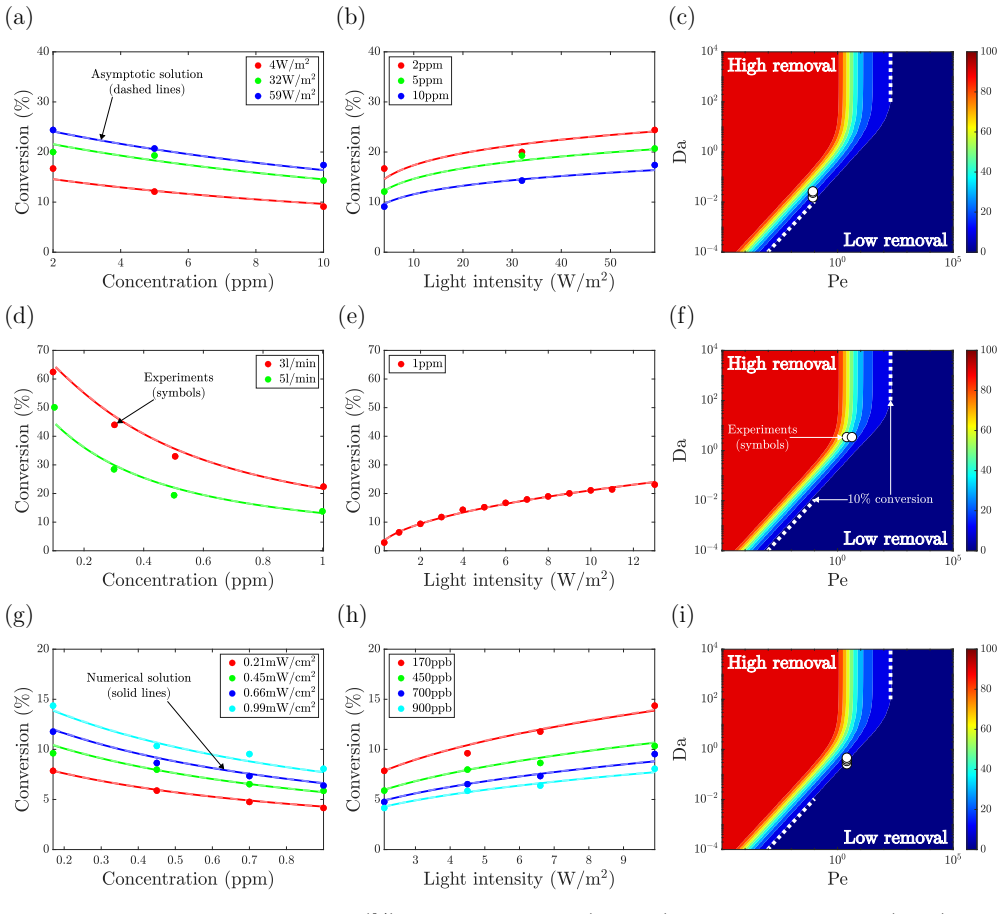
The central claim is that TiO2-based photocatalytic oxidation of methane and other air pollutants in ventilation applications can yield a net climate benefit, expressed as a net-negative CO2e emissions rate, when the modelled CO2e removal rate exceeds the emissions from catalyst material production and UV operation, particularly when pre-existing UV-C irradiation is leveraged. Laboratory conversions reach 24.4 percent for methane, but the validated model shows ventilation-scale performance drops to around 0.017 percent due to thin concentration boundary layers and short residence times.
What carries the argument
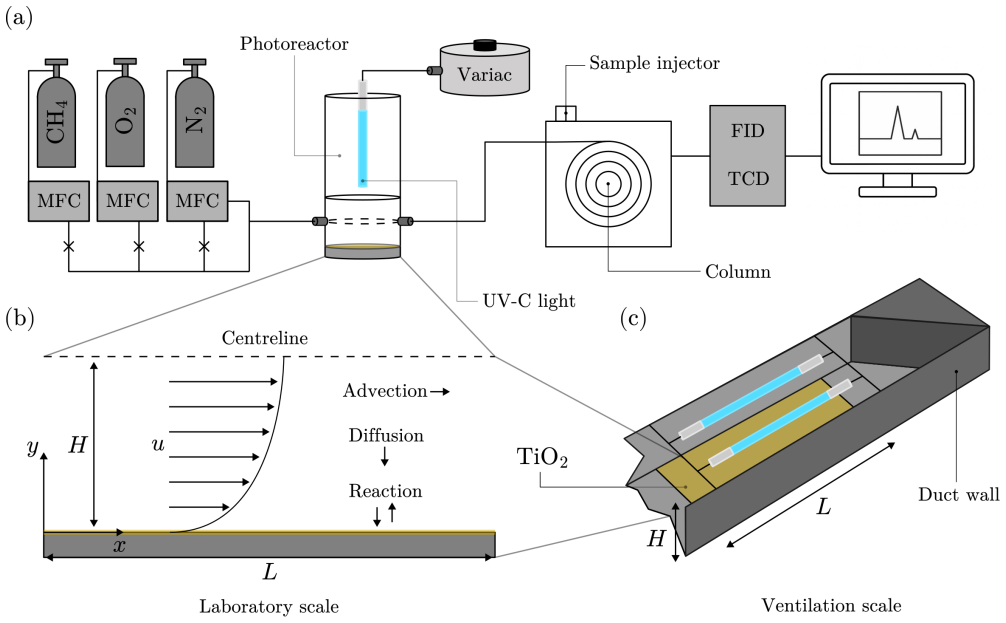
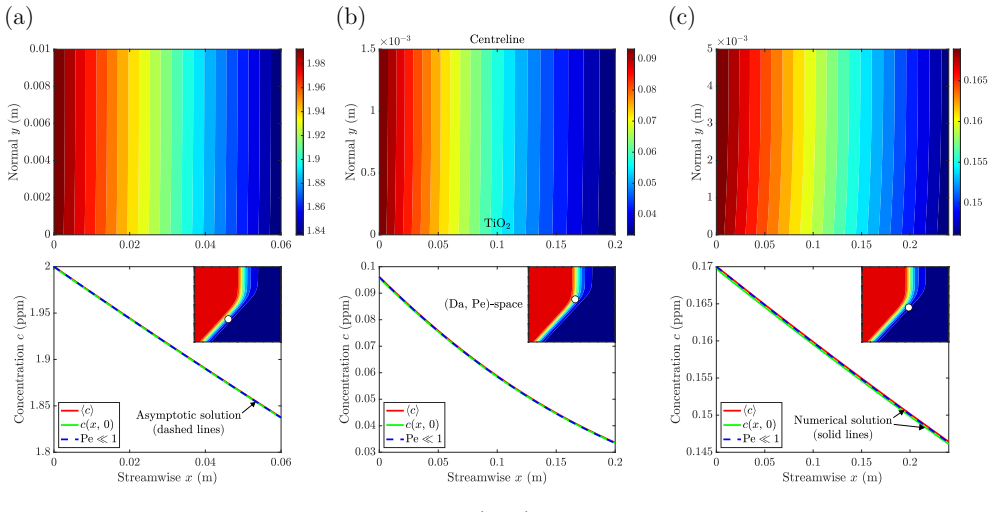
A scaling model of photocatalytic oxidation that incorporates concentration boundary layers and residence times to translate lab kinetics into ventilation-system performance and CO2e balance.
If this is right
- Conversion efficiencies of 24.4 percent in laboratory setups fall to around 0.017 percent once thin boundary layers and short residence times are accounted for at ventilation scale.
- A net-negative CO2e emissions rate is possible when methane removal outweighs emissions from catalyst production and UV operation.
- The net benefit increases when pre-existing UV-C irradiation is used rather than dedicated lamps.
- The same model framework applies to formaldehyde and NOx once validated against literature results.
Where Pith is reading between the lines
- Real ventilation ducts may require surface texturing or flow baffles to thicken the reaction zone and raise the 0.017 percent ceiling.
- Buildings already equipped with UV-C for disinfection could add TiO2 coatings at low marginal cost.
- The low single-pass conversion implies that PCO would work best as one stage in a multi-technology air-treatment train rather than a standalone solution.
- Extending the model to outdoor air flows would need new residence-time and boundary-layer estimates because duct geometry changes.
Load-bearing premise
The model assumptions about thin concentration boundary layers and short residence times that limit ventilation-scale conversion to around 0.017 percent are accurate and representative of real systems.
What would settle it
Measurement of actual methane conversion percentage inside an operating ventilation duct coated with TiO2 and illuminated by UV-C, compared directly against the predicted 0.017 percent value.
Figures
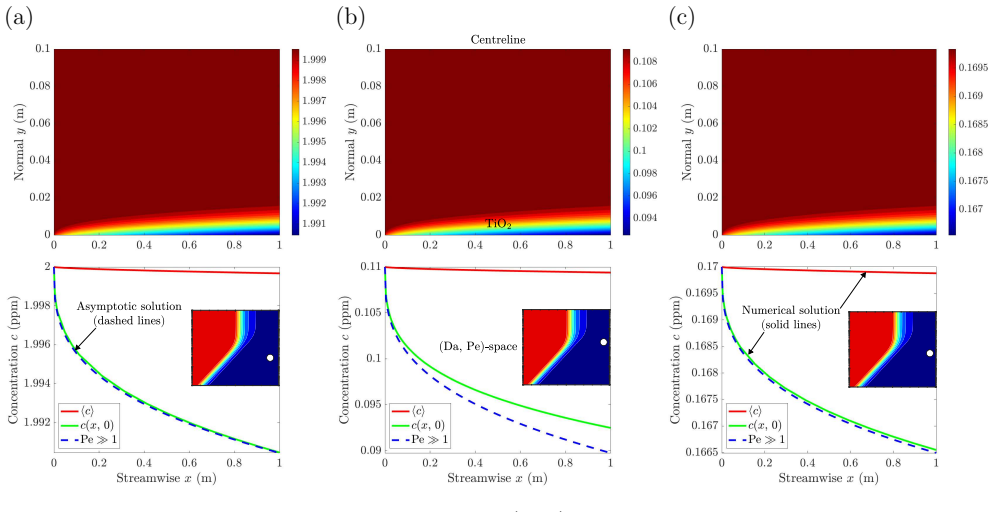
read the original abstract
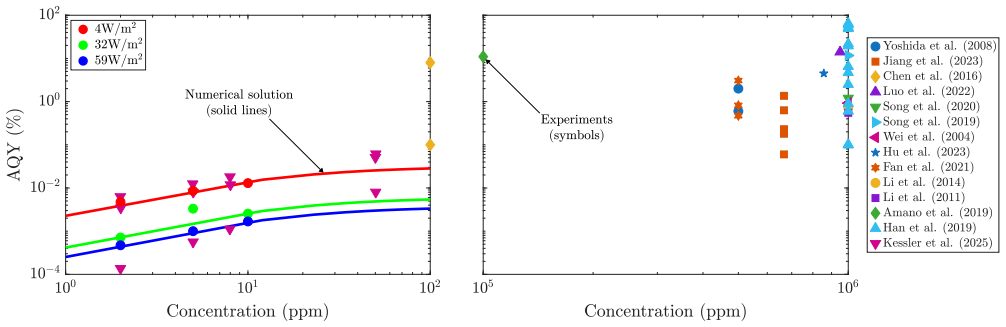
Photocatalytic oxidation (PCO) is a promising strategy for indoor air purification and outdoor pollutant abatement, potentially offering treatment for climate- and health-relevant pollutants such as methane (CH$_4$), nitrogen oxides (NO$_\text{x}$) and volatile organic compounds (VOCs). In this work, we present experiments evaluating the PCO of CH$_4$ (2 to 10 ppm) under varying UV-C light intensities (4 to 59 W/m$^2$), using titanium dioxide (TiO$_2$) as the photocatalyst. At 2 ppm CH$_4$, TiO$_2$ achieves a maximum conversion efficiency of 24.4% and a maximum apparent quantum yield of $0.013$\% over the tested UV-C light intensities, demonstrating activity at environmentally relevant concentrations. We develop a model to interpret the experimental results and assess the potential of PCO for ventilation applications. The model is validated against our CH$_4$ data and literature results for formaldehyde (HCHO) and NO$_\text{x}$. While laboratory-scale configurations achieve high conversions (e.g., 24.4% for CH$_4$), ventilation-scale performance is predicted to be limited by thin concentration boundary layers and short residence times, with conversion efficiencies dropping to around $0.017$%. Finally, we estimate the climate impact of CH$_4$ removal in terms of CO$_2$e emission rates, demonstrating that TiO$_2$-based PCO in ventilation applications can yield a net climate benefit (i.e., a net-negative CO$_2$e emissions rate) when the modelled CO$_2$e removal rate exceeds the emissions from catalyst material production and UV operation, particularly when pre-existing UV-C irradiation is leveraged.
Editorial analysis
A structured set of objections, weighed in public.
Referee Report
Summary. The paper reports lab experiments on TiO2 photocatalytic oxidation of CH4 (2-10 ppm) under UV-C (4-59 W/m²), achieving up to 24.4% conversion and 0.013% apparent quantum yield at 2 ppm. A kinetic model is developed, validated against the CH4 data and literature values for HCHO and NOx, then extrapolated to ventilation systems where conversion falls to ~0.017% due to thin boundary layers and short residence times. The work concludes that TiO2 PCO can produce net-negative CO2e emissions in ventilation applications when removal rates exceed catalyst production and UV energy emissions, especially with pre-existing UV-C.
Significance. If the ventilation-scale extrapolation holds, the work indicates a pathway for PCO to deliver combined air-quality and climate benefits in buildings. The low-concentration CH4 activity data and cross-pollutant model validation are positive elements; the net-climate-benefit framing is novel for this application.
major comments (1)
- [model application to ventilation systems (as described in abstract and model-validation paragraphs)] The ventilation-scale conversion of ~0.017% (and the resulting CO2e removal rate that underpins the net-benefit claim) is obtained by scaling the lab kinetics using boundary-layer thickness and residence-time assumptions. No duct-scale or ventilation-system validation data are presented to test these assumptions, yet an error of even a factor of ~3 would reverse the sign of the net CO2e balance. This step is load-bearing for the central climate-impact conclusion.
minor comments (2)
- [Abstract] Abstract and results sections should report uncertainties or error bars on the stated 24.4% conversion, 0.013% quantum yield, and 0.017% ventilation efficiency.
- The full set of model equations, boundary-layer parameters, and residence-time distribution used for the ventilation extrapolation should be provided explicitly (main text or SI) to allow independent checking.
Simulated Author's Rebuttal
We thank the referee for their constructive and detailed review. We address the major comment below and outline planned revisions to strengthen the manuscript.
read point-by-point responses
-
Referee: The ventilation-scale conversion of ~0.017% (and the resulting CO2e removal rate that underpins the net-benefit claim) is obtained by scaling the lab kinetics using boundary-layer thickness and residence-time assumptions. No duct-scale or ventilation-system validation data are presented to test these assumptions, yet an error of even a factor of ~3 would reverse the sign of the net CO2e balance. This step is load-bearing for the central climate-impact conclusion.
Authors: We appreciate the referee's emphasis on the load-bearing nature of the ventilation-scale extrapolation. The kinetic parameters are obtained directly from our laboratory CH4 oxidation experiments (2-10 ppm, UV-C intensities 4-59 W/m²) and the mass-transfer component employs standard boundary-layer theory for internal duct flows, with residence times and boundary-layer thicknesses calculated from representative ventilation parameters (flow velocities and duct geometries drawn from building-services literature). The same modeling framework reproduces our CH4 data and matches independent literature results for HCHO and NOx. We agree that the absence of duct-scale experimental validation introduces uncertainty and that a factor-of-three error in the scaling could affect the sign of the net CO2e balance. In the revised manuscript we will add an explicit sensitivity analysis in which boundary-layer thickness and residence time are each varied by factors of up to five; the resulting range of CO2e removal rates will be reported together with the conditions under which the net-negative outcome remains robust. This addition will make the limitations and uncertainties of the extrapolation transparent while preserving the physical basis of the model. revision: partial
Circularity Check
No circularity: model validated on lab data and literature; ventilation extrapolation is derived, not fitted by construction
full rationale
The paper develops a kinetic model fitted/validated to CH4 conversion data (24.4% at 2 ppm) and literature HCHO/NOx results, then applies the same model to predict lower ventilation-scale conversion (~0.017%) via boundary-layer and residence-time scaling. This extrapolation step is a forward calculation from the validated equations, not a re-use of fitted parameters as the target output. No self-citation is invoked as load-bearing for the central claim, and the net-climate-benefit comparison uses the modeled removal rate against independently estimated production/UV emissions. The derivation chain therefore remains self-contained against external benchmarks.
Axiom & Free-Parameter Ledger
Reference graph
Works this paper leans on
-
[1]
Environmental and health impacts of air pollutio n: A review
I. Manisalidis et al. “Environmental and health impacts of air pollutio n: A review”. In: Front. Public Health 8 (2020), p. 14. 20
2020
-
[2]
WHO global air quality guidelines: particulate matter (PM2.5 and PM10), ozone, nitrogen dioxide, sulfur dioxide a nd carbon monoxide
World Health Organization et al. WHO global air quality guidelines: particulate matter (PM2.5 and PM10), ozone, nitrogen dioxide, sulfur dioxide a nd carbon monoxide . World Health Organization, 2021
2021
-
[3]
Human health risk due to variations in PM10–PM2.5 and associated PAHs levels
B. S. Sosa et al. “Human health risk due to variations in PM10–PM2.5 and associated PAHs levels”. In: Atmos. Environ. 160 (2017), pp. 27–35
2017
-
[4]
Climate change and cities: Challenges ahead
P. Kumar. “Climate change and cities: Challenges ahead”. In: Front. Sustain. Cities 3 (2021), p. 645613
2021
-
[5]
National contributions to climate change due t o historical emissions of carbon dioxide, methane, and nitrous oxide since 1850
M. W. Jones et al. “National contributions to climate change due t o historical emissions of carbon dioxide, methane, and nitrous oxide since 1850”. In: Sci. Data 10.1 (2023), p. 155
2023
-
[6]
Modeling of volatile orga nic compounds degra- dation by photocatalytic oxidation reactor in indoor air: A review
M. Malayeri, F. Haghighat, and C.-S. Lee. “Modeling of volatile orga nic compounds degra- dation by photocatalytic oxidation reactor in indoor air: A review”. I n: Build. Environ. 154 (2019), pp. 309–323
2019
-
[7]
The carbon cycle and atmospheric carbon d ioxide
I. C. Prentice et al. “The carbon cycle and atmospheric carbon d ioxide”. In: Climate Change 2001: The Scientific Basis, Intergovernmental Panel on Clim ate Change (2001)
2001
-
[8]
Impact of nitrogen oxides on t he environment and human health: Mn-based materials for the NO x abatement
T. Boningari and P. G. Smirniotis. “Impact of nitrogen oxides on t he environment and human health: Mn-based materials for the NO x abatement”. In: Curr. Opin. Chem. Eng. 13 (2016), pp. 133–141
2016
-
[9]
Ozone pollution: A major health ha zard worldwide
J. Zhang, Y. Wei, and Z. Fang. “Ozone pollution: A major health ha zard worldwide”. In: Front. Immunol. 10 (2019), p. 2518
2019
-
[10]
Cost modeling of p hotocatalytic decom- position of atmospheric methane and nitrous oxide
R. Randall, R. B. Jackson, and A. Majumdar. “Cost modeling of p hotocatalytic decom- position of atmospheric methane and nitrous oxide”. In: Environ. Res. Lett. 19.6 (2024), p. 064015
2024
-
[11]
Harnessing natural and mechanical airflows for surface-based atmospheric pollutant removal
S. D. Tomlinson et al. “Harnessing natural and mechanical airflo ws for surface-based atmo- spheric pollutant removal”. In: arXiv (2025), arXiv:2503.11803
work page internal anchor Pith review Pith/arXiv arXiv 2025
-
[12]
Environmental catalytic city: New engine for air pollu tion control
J. Ma et al. “Environmental catalytic city: New engine for air pollu tion control”. In: J. Environ. Sci. 156 (2025), pp. 576–583
2025
-
[13]
Multivariate modeling of intrinsic kinetics for gas- solid heterogeneous pho- tocatalytic reaction: A general method for different pollutant-ph otocatalyst systems
G. Zhang et al. “Multivariate modeling of intrinsic kinetics for gas- solid heterogeneous pho- tocatalytic reaction: A general method for different pollutant-ph otocatalyst systems”. In: Chem. Eng. J. 479 (2024), p. 147651
2024
-
[14]
Conn ecting experimental degradation kinetics to theoretical models for photocatalytic rea ctors: The influence of mass transport limitations
N. A. B. Timmerhuis, J. A. Wood, and R. G. H. Lammertink. “Conn ecting experimental degradation kinetics to theoretical models for photocatalytic rea ctors: The influence of mass transport limitations”. In: Chem. Eng. Sci. 245 (2021), p. 116835
2021
-
[15]
Experiments and kinetics of solar PCO for indoor air p urification in PCO/TW system
B. Yu et al. “Experiments and kinetics of solar PCO for indoor air p urification in PCO/TW system”. In: Build. Environ. 115 (2017), pp. 130–146
2017
-
[16]
A review of photocatalytic materials for urb an NOx remediation
H. S. Russell et al. “A review of photocatalytic materials for urb an NOx remediation”. In: Catalysts 11.6 (2021), p. 675
2021
-
[17]
Modelling and experimental study of the NOx p hotocatalytic degrada- tion employing concrete pavement with titanium dioxide
M. M. Ballari et al. “Modelling and experimental study of the NOx p hotocatalytic degrada- tion employing concrete pavement with titanium dioxide”. In: Catal. Today 151.1–2 (2010), pp. 71–76
2010
-
[18]
Physical and practical constraints on at mospheric methane removal technologies
L. Pennacchio et al. “Physical and practical constraints on at mospheric methane removal technologies”. In: Environmental Research Letters 19.10 (2024), p. 104058. doi: 10.1088/1748-9326/ad7041 21
-
[19]
Economics of Enhanced Methane Oxidatio n Relative to Carbon Dioxide Removal
C. Hickey and M. Allen. “Economics of Enhanced Methane Oxidatio n Relative to Carbon Dioxide Removal”. In: Environ. Res. Lett. 19.6 (2024), p. 064043
2024
-
[20]
Assessing t he potential benefits of methane oxidation technologies using a concentration-based framework
S. Abernethy, M. I. Kessler, and R. B. Jackson. “Assessing t he potential benefits of methane oxidation technologies using a concentration-based framework”. In: Environ. Res. Lett. 18.9 (2023), p. 094064
2023
-
[21]
Efficient mitigation of dilute methane, ammonia , and odor in ventilation air from cow and pig barns and a biogas plant: photoreactor field dem onstration
M. Krogsbøll et al. “Efficient mitigation of dilute methane, ammonia , and odor in ventilation air from cow and pig barns and a biogas plant: photoreactor field dem onstration”. In: ACS ES&T Air 2.8 (2025), pp. 1648–1655
2025
-
[22]
New method of destroying waste anesth etic gases using gas-phase photochemistry
V. Rauchenwald et al. “New method of destroying waste anesth etic gases using gas-phase photochemistry”. In: Anesthesia & Analgesia 131.1 (2020), pp. 288–297
2020
-
[23]
Exploring the bounds of methane cataly sis in the context of atmo- spheric methane removal
A. M. Tsopelakou et al. “Exploring the bounds of methane cataly sis in the context of atmo- spheric methane removal”. In: Environ. Res. Lett. 19.5 (2024), p. 054020
2024
-
[24]
Evaluating the potential of thermal ca talysis for environmental methane mitigation
A. M. Tsopelakou et al. “Evaluating the potential of thermal ca talysis for environmental methane mitigation”. In: Sustain. Sci. Technol. 3.2 (2026), p. 024002
2026
-
[25]
Physical and practical constraints on at mospheric methane removal technologies
L. Pennacchio et al. “Physical and practical constraints on at mospheric methane removal technologies”. In: Environ. Res. Lett. 19.10 (2024), p. 104058
2024
-
[26]
Mitigation of atmospheric and elevat ed methane by photochemical oxidation at ambient conditions
N. Iversen and P. Roslev. “Mitigation of atmospheric and elevat ed methane by photochemical oxidation at ambient conditions”. In: Sci. Total Environ. 976 (2025), p. 179338
2025
-
[27]
Unlocking catalytic longevity: a c ritical review of catalyst deactivation pathways and regeneration technologies
I. M. S. Anekwe and Y. M. Isa. “Unlocking catalytic longevity: a c ritical review of catalyst deactivation pathways and regeneration technologies”. In: Energy Adv. 4.9 (2025), pp. 1075– 1113
2025
-
[28]
Partial oxidation of methane to carbon m onoxide and hydrogen over a Ni/Al2O3 catalyst
D. Dissanayake et al. “Partial oxidation of methane to carbon m onoxide and hydrogen over a Ni/Al2O3 catalyst”. In: J. Catal. 132.1 (1991), pp. 117–127
1991
-
[29]
The MathWorks, Inc
MATLAB. The MathWorks, Inc. Natick, Massachusetts, 2025
2025
-
[30]
A Humidity-Tolerant Photocatalyst for Met hane Removal
M. I. Kessler et al. “A Humidity-Tolerant Photocatalyst for Met hane Removal”. In: Environ. Sci. Technol. 60.7 (2026), pp. 5442–5452
2026
-
[31]
A thermo-photo hybrid process for steam refor ming of methane: highly efficient visible light photocatalysis
B. Han et al. “A thermo-photo hybrid process for steam refor ming of methane: highly efficient visible light photocatalysis”. In: Chem. Commun. 55.54 (2019), pp. 7816–7819
2019
-
[32]
Binary Au–Cu reaction sites decorated ZnO for se lective methane oxidation to C1 oxygenates with nearly 100% selectivity at room temperature
L. Luo et al. “Binary Au–Cu reaction sites decorated ZnO for se lective methane oxidation to C1 oxygenates with nearly 100% selectivity at room temperature ”. In: J. Am. Chem. Soc. 144.2 (2021), pp. 740–750
2021
-
[33]
Selective photocatalytic oxidation of methane by q uantum-sized bismuth vanadate
Y. Fan et al. “Selective photocatalytic oxidation of methane by q uantum-sized bismuth vanadate”. In: Nat. Sustain. 4.6 (2021), pp. 509–515
2021
-
[34]
Hydrogen production from methane and wate r on platinum loaded tita- nium oxide photocatalysts
H. Yoshida et al. “Hydrogen production from methane and wate r on platinum loaded tita- nium oxide photocatalysts”. In: J. Phys. Chem. C 112.14 (2008), pp. 5542–5551
2008
-
[35]
Enabling specific photocatalytic methane oxidatio n by controlling free radical type
Y. Jiang et al. “Enabling specific photocatalytic methane oxidatio n by controlling free radical type”. In: J. Am. Chem. Soc. 145.4 (2023), pp. 2698–2707
2023
-
[36]
Selective photo-oxidation of methane to methan ol with oxygen over dual- cocatalyst-modified titanium dioxide
H. Song et al. “Selective photo-oxidation of methane to methan ol with oxygen over dual- cocatalyst-modified titanium dioxide”. In: ACS Catal. 10.23 (2020), pp. 14318–14326
2020
-
[37]
Thermocatalysis enables photocatalytic oxidation o f methane to formic acid at room temperature beyond the selectivity limits
D. Hu et al. “Thermocatalysis enables photocatalytic oxidation o f methane to formic acid at room temperature beyond the selectivity limits”. In: Cell Rep. Phys. Sci. 4.2 (2023). 22
2023
-
[38]
Photocatalytic degradation of lignin on synthesized Ag–AgCl/ZnO nanorods under solar light and preliminary trials for methane fermentation
H. Li et al. “Photocatalytic degradation of lignin on synthesized Ag–AgCl/ZnO nanorods under solar light and preliminary trials for methane fermentation”. I n: Bioresour. Technol. 175 (2015), pp. 494–501
2015
-
[39]
Visible-light-mediated methane activation for ste am methane reforming under mild conditions: a case study of Rh/TiO 2 catalysts
H. Song et al. “Visible-light-mediated methane activation for ste am methane reforming under mild conditions: a case study of Rh/TiO 2 catalysts”. In: ACS Catal. 8.8 (2018), pp. 7556– 7565
2018
-
[40]
Photocatalytic oxidation of methane over silver d ecorated zinc oxide nanocat- alysts
X. Chen et al. “Photocatalytic oxidation of methane over silver d ecorated zinc oxide nanocat- alysts”. In: Nat. Commun. 7.1 (2016), p. 12273
2016
-
[41]
Reaction pathways and site requirement s for the activation and chemical conversion of methane on Ru-based catalysts
J. Wei and E. Iglesia. “Reaction pathways and site requirement s for the activation and chemical conversion of methane on Ru-based catalysts”. In: J. Phys. Chem. B 108.22 (2004), pp. 7253–7262
2004
-
[42]
Mechanism and site requirements for act ivation and chemical con- version of methane on supported Pt clusters and turnover rate c omparisons among noble metals
J. Wei and E. Iglesia. “Mechanism and site requirements for act ivation and chemical con- version of methane on supported Pt clusters and turnover rate c omparisons among noble metals”. In: J. Phys. Chem. B 108.13 (2004), pp. 4094–4103
2004
-
[43]
Efficient Sunlight-Driven Dehydrogenative Coupling o f Methane to Ethane over a Zn+-Modified Zeolite
L. Li et al. “Efficient Sunlight-Driven Dehydrogenative Coupling o f Methane to Ethane over a Zn+-Modified Zeolite”. In: Angew. Chem. 123.36 (2011)
2011
-
[44]
Our approach to climate change: 2020 Climate Change Report
Rio Tinto. Our approach to climate change: 2020 Climate Change Report . Accessed: 2025-08-
2020
-
[45]
url: https://www.riotinto.com/-/media/Content/Documents/Invest/Reports/Climate-
2020. url: https://www.riotinto.com/-/media/Content/Documents/Invest/Reports/Climate-
2020
-
[46]
Effect of sulfur poisoning during worldwide harmon ized light vehicles test cycle on NO x reduction performance and active sites of selective catalytic redu ction filter
Z. Zhou et al. “Effect of sulfur poisoning during worldwide harmon ized light vehicles test cycle on NO x reduction performance and active sites of selective catalytic redu ction filter”. In: Catalysts 15.7 (2025), p. 682
2025
-
[47]
Partial oxidation of methane
R. Pitchai and K. Klier. “Partial oxidation of methane”. In: Catal. Rev. Sci. Eng. 28.1 (1986), pp. 13–88
1986
-
[48]
Modelling laminar flow in V-shaped filters integ rated with catalyst technologies for atmospheric pollutant removal
S. D. Tomlinson et al. “Modelling laminar flow in V-shaped filters integ rated with catalyst technologies for atmospheric pollutant removal”. In: Int. J. Heat Mass Transfer 257 (2026), p. 128206
2026
-
[49]
Photocatalysis for air treatmen t processes: Current technolo- gies and future applications for the removal of organic pollutants a nd viruses
S. Escobedo and H. de Lasa. “Photocatalysis for air treatmen t processes: Current technolo- gies and future applications for the removal of organic pollutants a nd viruses”. In: Catalysts 10.9 (2020), p. 966
2020
-
[50]
Greenhouse Gas Emission Intensity of Electricity Gener- ation (g CO 2e/kWh)
European Environment Agency. Greenhouse Gas Emission Intensity of Electricity Gener- ation (g CO 2e/kWh). European Environment Agency, European Topic Centre on Climate Change Mitigation and Energy. Chart and country-level data, EU a verage emission intensity. June 2024. url: https://www.eea.europa.eu/en/analysis/maps-and-charts/co2-emission-inten
2024
-
[51]
SCR Catalyst
Johnson Matthey Catalysts Ltd. SCR Catalyst. U.S. Patent Application No. US2020/0108376
- [52]
-
[53]
Impa ct of SO 2-poisoning over the lifetime of a Cu-CHA catalyst for NH 3-SCR
P. S. Hammershøi, A. D. Jensen, and T. V. W. Janssens. “Impa ct of SO 2-poisoning over the lifetime of a Cu-CHA catalyst for NH 3-SCR”. In: Appl. Catal. B 238 (2018), pp. 104–110. 23
2018
discussion (0)
Sign in with ORCID, Apple, or X to comment. Anyone can read and Pith papers without signing in.