REVIEW 1 minor 69 references
Biochemically informed neural ODEs recover trajectories and process structure by mapping neural network outputs through a known stoichiometric matrix.
Reviewed by Pith at T0; open to challenge. T0 means a machine referee read the full paper against a public rubric. the ladder, T0–T4 →
T0 review · grok-4.3
2026-06-30 14:24 UTC pith:O56VQMG3
load-bearing objection BINODEs embed neural nets for unknown rates inside a fixed stoichiometric structure, which is a clean hybrid for biochemical ODEs when the network is known.
Learning dynamical systems with biochemically informed neural ordinary differential equations
The pith
A machine-rendered reading of the paper's core claim, the machinery that carries it, and where it could break.
Core claim
By representing each process with a neural network and mapping its outputs to state derivatives via a linear layer analogous to a stoichiometric matrix, BINODEs recover both the observed trajectories and the underlying process-level structure in biochemical dynamical systems while permitting the inclusion of biological constraints.
What carries the argument
Neural network processes (NNPs) whose outputs are mapped through a stoichiometric matrix to obtain the state derivatives, with optional constraints for sign and monotonicity.
Load-bearing premise
The stoichiometric structure of the system is known in advance and neural networks can be constrained to respect biological assumptions without losing their ability to approximate the true process rates.
What would settle it
Applying the method to a biochemical system with known true rates and stoichiometry but finding that the learned neural processes do not match the true rates or that trajectory predictions fail to improve over unconstrained models.
If this is right
- Standard biochemical rate laws can be approximated by the constrained neural networks.
- The model identifies individual process functions from trajectory data.
- Known stoichiometric structure is preserved while allowing flexibility in rate forms.
- Side information like monotonicity can be enforced without loss of approximation power in the tested cases.
Where Pith is reading between the lines
- Extending to systems where only part of the stoichiometry is known could allow partial mechanistic models.
- Similar architectures might apply to other networked dynamical systems with known interaction graphs.
- Using the learned processes for prediction in new conditions or for intervention design would be a natural next step.
- The approach may improve upon pure black-box neural ODEs in interpretability for biological applications.
Editorial analysis
A structured set of objections, weighed in public.
Referee Report
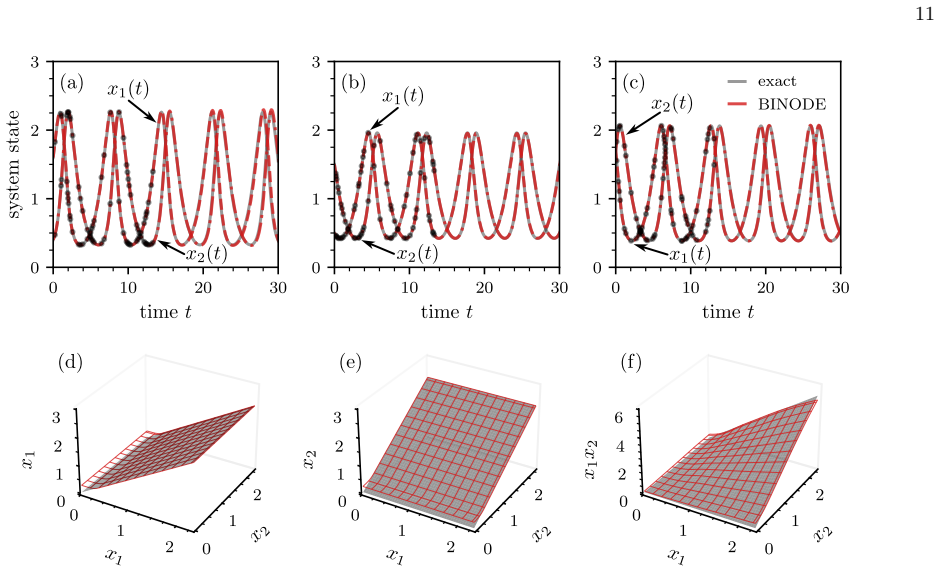
Summary. The paper introduces biochemically informed neural ordinary differential equations (BINODEs), a neural-ODE architecture that preserves a known stoichiometric matrix while representing individual biochemical processes via neural network processes (NNPs). Biological side information such as process-specific inputs, sign constraints, and monotonicity assumptions can be incorporated directly. The work characterizes approximation properties of NNPs for standard biochemical rate laws and reports recovery of both trajectories and process-level structure on Monod, Lotka–Volterra, pharmacokinetic, and ultradian endocrine models.
Significance. If the empirical results and approximation characterizations hold, BINODEs supply a principled hybrid between fully mechanistic and black-box dynamical models for biochemical systems. The explicit retention of stoichiometry together with the stated characterization of NNP approximation power for relevant rate laws constitute concrete strengths that could support interpretability and generalization in systems biology applications.
minor comments (1)
- The term 'process-level structure' is used in the abstract and introduction; a concise definition or pointer to the precise metric used to assess recovery of this structure would improve clarity.
Simulated Author's Rebuttal
We thank the referee for their positive summary, significance assessment, and recommendation to accept the manuscript. No major comments were raised in the report.
Circularity Check
No significant circularity
full rationale
The BINODE architecture is defined directly as a composition of a known stoichiometric matrix with independently parameterized neural network processes (NNPs) subject to explicit sign/monotonicity constraints; the approximation properties are characterized for standard rate laws and the recovery of trajectories and structure is demonstrated on concrete models. No step reduces a claimed prediction or uniqueness result to a fitted parameter or self-citation by construction, and the central claims rest on the explicit architectural choices rather than on any re-derivation of inputs.
Axiom & Free-Parameter Ledger
axioms (1)
- domain assumption The stoichiometric structure of the biochemical system is known and can be represented by a matrix.
invented entities (1)
-
Neural network processes (NNPs)
no independent evidence
read the original abstract
Ordinary differential equation models of biochemical reactions are often formulated as stoichiometric systems in which the dynamics arise from a collection of interacting processes. A central challenge is that the functional form of each process is rarely known a priori and may be difficult to infer from data. We propose biochemically informed neural ordinary differential equations (BINODEs), a neural-ODE framework that retains the stoichiometric structure of mechanistic models while representing individual processes by neural networks. In BINODEs, the outputs of neural network processes (NNPs) are mapped to state derivatives through a linear layer analogous to a stoichiometric matrix. This architecture allows biological side information, such as process-specific inputs, sign constraints, and monotonicity assumptions, to be built directly into the model. We characterize the approximation properties of NNPs for several standard biochemical rate laws and show that the proposed framework recovers both trajectories and process-level structure in Monod, Lotka--Volterra, pharmacokinetic, and ultradian endocrine models. These results suggest that BINODEs offer a useful compromise between mechanistic interpretability and data-driven flexibility for modeling partially known biochemical or biological dynamical systems.
Figures




Reference graph
Works this paper leans on
-
[1]
Die Kinetik der Invertinwirkung,
L. Michaelis and M. L. Menten, “Die Kinetik der Invertinwirkung,” Biochemische Zeitschrift, vol. 49, no. 333-369, p. 352, 1913
work page 1913
-
[2]
Henri, Lois g´ en´ erales de l’action des diastases
V. Henri, Lois g´ en´ erales de l’action des diastases. Librairie Scientifique A. Hermann, 1903
work page 1903
-
[3]
V. Henri, “Th´ eorie g´ en´ erale de l’action de quelques diastases par Victor Henri [CR Acad. Sci. Paris 135 (1902) 916-919],” Comptes Rendus Biologies, vol. 329, no. 1, pp. 47–50, 2006
work page 1902
-
[4]
One hundred years of michaelis–menten kinetics,
A. Cornish-Bowden, “One hundred years of michaelis–menten kinetics,” Perspectives in Science, vol. 4, pp. 3–9, 2015
work page 2015
-
[5]
P. Waage and C. Guldberg, “Studier over affiniteten,” Forhandlinger i Videnskabs-selskabet i Christiania , vol. 1, pp. 35–45, 1864
-
[6]
150 years of the mass action law,
E. O. Voit, H. A. Martens, and S. W. Omholt, “150 years of the mass action law,” PLOS Computational Biology , vol. 11, no. 1, p. e1004012, 2015
work page 2015
-
[7]
A. J. Lotka, Elements of physical biology . Williams & Wilkins, 1925
work page 1925
-
[8]
Volterra, Variazioni e fluttuazioni del numero d’individui in specie animali conviventi , vol
V. Volterra, Variazioni e fluttuazioni del numero d’individui in specie animali conviventi , vol. 2. Societ´ a anonima tipografica” Leonardo da Vinci”, 1927
work page 1927
-
[9]
A contribution to the mathematical theory of epidemics,
W. O. Kermack and A. G. McKendrick, “A contribution to the mathematical theory of epidemics,” Proceedings of the Royal Society of London. Series A, Containing Papers of a Mathematical and Physical Character , vol. 115, no. 772, pp. 700–721, 1927
work page 1927
-
[10]
J. Wylie and T. Chou, “Uniformly accurate nonlinear transmission rate models arising from disease spread through pair contacts,” Physical Review E, vol. 103, no. 3, p. 032306, 2021
work page 2021
-
[11]
M. A. Savageau, “Biochemical systems analysis: I. Some mathematical properties of the rate law for the component enzymatic reactions,” Journal of Theoretical Biology, vol. 25, no. 3, pp. 365–369, 1969
work page 1969
-
[12]
Biochemical systems analysis: III. Dynamic solutions using a power-law approximation,
M. A. Savageau, “Biochemical systems analysis: III. Dynamic solutions using a power-law approximation,” Journal of Theoretical Biology, vol. 26, no. 2, pp. 215–226, 1970
work page 1970
-
[13]
Biochemical Systems Theory: A Review,
E. O. Voit, “Biochemical Systems Theory: A Review,” ISRN Biomathematics, vol. 2013, 2013
work page 2013
-
[14]
Dynamic simulation and metabolic re-design of a branched pathway using linlog kinetics,
D. Visser and J. J. Heijnen, “Dynamic simulation and metabolic re-design of a branched pathway using linlog kinetics,” Metabolic engineering, vol. 5, no. 3, pp. 164–176, 2003
work page 2003
-
[15]
Myc dosage compensation is mediated by mirna-transcription factor interactions in aneuploid cancer,
M. Ac´ on, C. Geiß, J. Torres-Calvo, D. Bravo-Estupi˜ nan, G. Oviedo, J. L. Arias-Arias, L. A. Rojas-Matey, B. Edwin, G. V´ asquez-Vargas, Y. Oses-Vargas,et al., “Myc dosage compensation is mediated by mirna-transcription factor interactions in aneuploid cancer,” IScience, vol. 24, no. 12, 2021
work page 2021
-
[16]
Partition analysis and concept of net rate constants as tools in enzyme kinetics,
W. Cleland, “Partition analysis and concept of net rate constants as tools in enzyme kinetics,” Biochemistry, vol. 14, no. 14, pp. 3220–3224, 1975
work page 1975
-
[17]
A schematic method of deriving the rate laws for enzyme-catalyzed reactions,
E. L. King and C. Altman, “A schematic method of deriving the rate laws for enzyme-catalyzed reactions,” The Journal of Physical Chemistry, vol. 60, no. 10, pp. 1375–1378, 1956
work page 1956
-
[18]
A note on the kinetics of enzyme action,
G. E. Briggs and J. B. S. Haldane, “A note on the kinetics of enzyme action,” Biochemical Journal, vol. 19, no. 2, p. 338, 1925
work page 1925
-
[19]
The possible effects of the aggregation of the molecules of hemoglobin on its dissociation curves,
A. V. Hill, “The possible effects of the aggregation of the molecules of hemoglobin on its dissociation curves,” The Journal of Physiology, vol. 40, pp. iv–vii, 1910
work page 1910
-
[20]
The Hill equation and the origin of quantitative pharmacology,
R. Gesztelyi, J. Zsuga, A. Kemeny-Beke, B. Varga, B. Juhasz, and A. Tosaki, “The Hill equation and the origin of quantitative pharmacology,” Archive for history of exact sciences , vol. 66, pp. 427–438, 2012
work page 2012
-
[21]
H. Kacser, “The control of flux,” in Symp Soc Exp Biol , vol. 27, p. 65, 1973
work page 1973
-
[22]
R. Heinrich and T. A. Rapoport, “A linear steady-state treatment of enzymatic chains: general properties, control and effector strength,” European Journal of Biochemistry, vol. 42, no. 1, pp. 89–95, 1974
work page 1974
-
[23]
Bringing metabolic networks to life: convenience rate law and thermodynamic constraints,
W. Liebermeister and E. Klipp, “Bringing metabolic networks to life: convenience rate law and thermodynamic constraints,” Theoretical Biology and Medical Modelling, vol. 3, pp. 1–13, 2006
work page 2006
-
[24]
Modular rate laws for enzymatic reactions: thermodynamics, elasticities and implementation,
W. Liebermeister, J. Uhlendorf, and E. Klipp, “Modular rate laws for enzymatic reactions: thermodynamics, elasticities and implementation,” Bioinformatics, vol. 26, no. 12, pp. 1528–1534, 2010
work page 2010
-
[25]
A. Sorribas, B. Hern´ andez-Bermejo, E. Vilaprinyo, and R. Alves, “Cooperativity and saturation in biochemical networks: a saturable formalism using Taylor series approximations,” Biotechnology and Bioengineering, vol. 97, no. 5, pp. 1259–1277, 2007
work page 2007
-
[26]
Comparison of unstructured kinetic bacterial growth models,
M. Muloiwa, S. Nyende-Byakika, and M. Dinka, “Comparison of unstructured kinetic bacterial growth models,” South African Journal of Chemical Engineering , vol. 33, pp. 141–150, 2020
work page 2020
-
[27]
Monod, Recherches sur la croissance des cultures bact´ eriennes
J. Monod, Recherches sur la croissance des cultures bact´ eriennes. PhD thesis, Universit´ e de Paris, 1941
work page 1941
-
[28]
La technique de culture continue, th {´ e} orie et applications,
J. Monod, “La technique de culture continue, th {´ e} orie et applications,” in Annales de l’Institut Pasteur , vol. 79, pp. 390–410, 1950
work page 1950
- [29]
-
[30]
A mathematical model for the continuous culture of microorganisms utilizing inhibitory substrates,
J. F. Andrews, “A mathematical model for the continuous culture of microorganisms utilizing inhibitory substrates,” Biotechnology and Bioengineering, vol. 10, no. 6, pp. 707–723, 1968
work page 1968
-
[31]
Moser, The dynamics of bacterial populations maintained in the chemostat
H. Moser, The dynamics of bacterial populations maintained in the chemostat. Carnegie Institution of Washington, 1958
work page 1958
-
[32]
C. S. Holling, “The components of predation as revealed by a study of small mammal predation of the European pine sawfly,” The Canadian Entomologist , vol. 91, pp. 293–320, 1959
work page 1959
-
[33]
Some characteristics of simple types of predation and parasitism,
C. S. Holling, “Some characteristics of simple types of predation and parasitism,” The Canadian Entomologist , vol. 91, no. 7, pp. 385–398, 1959. 22
work page 1959
-
[34]
A derivation of Holling’s type I, II and III functional responses in predator–prey systems,
J. Dawes and M. Souza, “A derivation of Holling’s type I, II and III functional responses in predator–prey systems,” Journal of Theoretical Biology, vol. 327, pp. 11–22, 2013
work page 2013
-
[35]
Biologically informed NeuralODEs for genome-wide regulatory dynamics,
I. Hossain, V. Fanfani, J. Fischer, J. Quackenbush, and R. Burkholz, “Biologically informed NeuralODEs for genome-wide regulatory dynamics,” Genome Biology, vol. 25, no. 1, p. 127, 2024
work page 2024
-
[36]
Universal differential equations for systems biology: Current state and open problems,
M. Philipps, N. Schmid, and J. Hasenauer, “Universal differential equations for systems biology: Current state and open problems,” bioRxiv, pp. 2024–11, 2024
work page 2024
-
[37]
M. de Rooij, B. Erd˝ os, N. A. van Riel, and S. D. O’Donovan, “Physiology-informed regularisation enables training of universal differential equation systems for biological applications,” PLOS Computational Biology , vol. 21, no. 1, p. e1012198, 2025
work page 2025
-
[38]
A hybrid neural ordinary differential equation model of the cardiovascular system,
G. Grigorian, S. V. George, S. Lishak, R. J. Shipley, and S. Arridge, “A hybrid neural ordinary differential equation model of the cardiovascular system,” Journal of the Royal Society Interface , vol. 21, no. 212, p. 20230710, 2024
work page 2024
-
[39]
Modeling chemical reaction networks using neural ordinary differential equations,
A. C. Th¨ oni, W. E. Robinson, Y. Bachrach, W. T. Huck, and T. Kachman, “Modeling chemical reaction networks using neural ordinary differential equations,” Journal of Chemical Information and Modeling , 2025
work page 2025
-
[40]
Control of dynamical systems with neural networks,
L. B¨ ottcher, “Control of dynamical systems with neural networks,”Nonlinear Dynamics, vol. 114, no. 2, p. 79, 2026
work page 2026
-
[41]
Learning dynamical systems with side information,
A. A. Ahmadi and B. E. Khadir, “Learning dynamical systems with side information,” in Proceedings of the 2nd Annual Conference on Learning for Dynamics and Control, L4DC 2020, Online Event, Berkeley, CA, USA, 11-12 June 2020 (A. M. Bayen, A. Jadbabaie, G. J. Pappas, P. A. Parrilo, B. Recht, C. J. Tomlin, and M. N. Zeilinger, eds.), vol. 120 of Proceedings...
work page 2020
-
[42]
Learning dynamical systems with side information,
A. A. Ahmadi and B. E. Khadir, “Learning dynamical systems with side information,” SIAM Review, vol. 65, no. 1, pp. 183–223, 2023
work page 2023
-
[43]
Optimal control of agent-based models via surrogate modeling,
L. L. Fonseca, L. B¨ ottcher, B. Mehrad, and R. C. Laubenbacher, “Optimal control of agent-based models via surrogate modeling,” PLOS Computational Biology , vol. 21, no. 1, p. e1012138, 2025
work page 2025
-
[44]
Interpretable polynomial neural ordinary differential equations,
C. Fronk and L. Petzold, “Interpretable polynomial neural ordinary differential equations,” Chaos: An Interdisciplinary Journal of Nonlinear Science , vol. 33, no. 4, 2023
work page 2023
-
[45]
Control of medical digital twins with artificial neural networks,
L. B¨ ottcher, L. L. Fonseca, and R. C. Laubenbacher, “Control of medical digital twins with artificial neural networks,” Philosophical Transactions A, vol. 383, no. 2292, p. 20240228, 2025
work page 2025
-
[46]
F. Dietrich, A. Makeev, G. Kevrekidis, N. Evangelou, T. Bertalan, S. Reich, and I. G. Kevrekidis, “Learning effective stochastic differential equations from microscopic simulations: Linking stochastic numerics to deep learning,” Chaos: An Interdisciplinary Journal of Nonlinear Science , vol. 33, no. 2, 2023
work page 2023
-
[47]
J. Zhang, X. Li, X. Guo, Z. You, L. B¨ ottcher, A. Mogilner, A. Hoffmann, T. Chou, and M. Xia, “Reconstructing noisy gene regulation dynamics using extrinsic-noise-driven neural stochastic differential equations,” PLOS Computational Biology , vol. 21, no. 9, p. e1013462, 2025
work page 2025
-
[48]
AI-Aristotle: A physics-informed framework for systems biology gray-box identification,
N. Ahmadi Daryakenari, M. De Florio, K. Shukla, and G. E. Karniadakis, “AI-Aristotle: A physics-informed framework for systems biology gray-box identification,” PLOS Computational Biology , vol. 20, pp. 1–33, 03 2024
work page 2024
-
[49]
Why RELU units sometimes die: Analysis of single-unit error backpropagation in neural networks,
S. C. Douglas and J. Yu, “Why RELU units sometimes die: Analysis of single-unit error backpropagation in neural networks,” in 52nd Asilomar Conference on Signals, Systems, and Computers, ACSSC 2018, Pacific Grove, CA, USA, October 28-31, 2018 (M. B. Matthews, ed.), pp. 864–868, IEEE, 2018
work page 2018
-
[50]
Multilayer feedforward networks are universal approximators,
K. Hornik, M. Stinchcombe, and H. White, “Multilayer feedforward networks are universal approximators,” Neural networks, vol. 2, no. 5, pp. 359–366, 1989
work page 1989
-
[51]
The expressive power of neural networks: A view from the width,
Z. Lu, H. Pu, F. Wang, Z. Hu, and L. Wang, “The expressive power of neural networks: A view from the width,” in Advances in Neural Information Processing Systems 30: Annual Conference on Neural Information Processing Systems 2017, December 4-9, 2017, Long Beach, CA, USA (I. Guyon, U. von Luxburg, S. Bengio, H. M. Wallach, R. Fergus, S. V. N. Vishwanathan,...
work page 2017
-
[52]
Benefits of depth in neural networks,
M. Telgarsky, “Benefits of depth in neural networks,” in Proceedings of the 29th Conference on Learning Theory, COLT 2016, New York, USA, June 23-26, 2016 (V. Feldman, A. Rakhlin, and O. Shamir, eds.), vol. 49 of JMLR Workshop and Conference Proceedings, pp. 1517–1539, JMLR.org, 2016
work page 2016
-
[53]
M. A. Savageau, “Biochemical systems analysis: II. The steady-state solutions for an n-pool system using a power-law approximation,” Journal of Theoretical Biology, vol. 25, no. 3, pp. 370–379, 1969
work page 1969
-
[54]
B. Amos, L. Xu, and J. Z. Kolter, “Input convex neural networks,” in Proceedings of the 34th International Conference on Machine Learning, ICML 2017, Sydney, NSW, Australia, 6-11 August 2017 (D. Precup and Y. W. Teh, eds.), vol. 70 of Proceedings of Machine Learning Research, pp. 146–155, PMLR, 2017
work page 2017
-
[55]
PySINDy: A Python package for the sparse identification of nonlinear dynamical systems from data,
B. de Silva, K. Champion, M. Quade, J.-C. Loiseau, J. Kutz, and S. Brunton, “PySINDy: A Python package for the sparse identification of nonlinear dynamical systems from data,” Journal of Open Source Software , vol. 5, no. 49, p. 2104, 2020
work page 2020
-
[56]
PySINDy: A comprehensive python package for robust sparse system identification,
A. A. Kaptanoglu, B. M. de Silva, U. Fasel, K. Kaheman, A. J. Goldschmidt, J. Callaham, C. B. Delahunt, Z. G. Nicolaou, K. Champion, J.-C. Loiseau, J. N. Kutz, and S. L. Brunton, “PySINDy: A comprehensive python package for robust sparse system identification,” Journal of Open Source Software , vol. 7, no. 69, p. 3994, 2022
work page 2022
-
[57]
Discovering governing equations from data by sparse identification of nonlinear dynamical systems,
S. L. Brunton, J. L. Proctor, and J. N. Kutz, “Discovering governing equations from data by sparse identification of nonlinear dynamical systems,” Proceedings of the National Academy of Sciences , vol. 113, no. 15, pp. 3932–3937, 2016
work page 2016
- [58]
-
[59]
E. Schiassi, R. Furfaro, C. Leake, M. De Florio, H. Johnston, and D. Mortari, “Extreme theory of functional connections: A fast physics-informed neural network method for solving ordinary and partial differential equations,” Neurocomputing, vol. 457, pp. 334–356, 2021
work page 2021
-
[60]
Physics-informed neural networks and functional interpolation for stiff chemical kinetics,
M. De Florio, E. Schiassi, and R. Furfaro, “Physics-informed neural networks and functional interpolation for stiff chemical kinetics,” Chaos: An Interdisciplinary Journal of Nonlinear Science , vol. 32, no. 6, 2022. 23
work page 2022
-
[61]
M. Virgolin and S. P. Pissis, “Symbolic regression is NP-hard,” arXiv preprint arXiv:2207.01018 , 2022
-
[62]
gplearn: Genetic programming in python with a scikit-learn inspired and compatible api,
T. Stephens, “gplearn: Genetic programming in python with a scikit-learn inspired and compatible api,” 2026. Version 0.4.3
work page 2026
-
[63]
B. Barnes and G. R. Fulford, Mathematical modelling with case studies: a differential equations approach using Maple and MATLAB. Chapman and Hall/CRC, 2011
work page 2011
-
[64]
Computer model for mechanisms underlying ultradian oscillations of insulin and glucose,
J. Sturis, K. S. Polonsky, E. Mosekilde, and E. Van Cauter, “Computer model for mechanisms underlying ultradian oscillations of insulin and glucose,” American Journal of Physiology-Endocrinology and Metabolism , vol. 260, no. 5, pp. E801–E809, 1991
work page 1991
-
[65]
Complex coordination of multi-scale cellular responses to environmental stress,
L. L. Fonseca, C. Sanchez, H. Santos, and E. O. Voit, “Complex coordination of multi-scale cellular responses to environmental stress,” Molecular BioSystems, vol. 7, no. 3, pp. 731–741, 2011
work page 2011
-
[66]
The origins of enzyme kinetics,
A. Cornish-Bowden, “The origins of enzyme kinetics,” FEBS letters, vol. 587, no. 17, pp. 2725–2730, 2013
work page 2013
- [67]
-
[68]
The reversible Hill equation: how to incorporate cooperative enzymes into metabolic models,
J.-H. S. Hofmeyr and H. Cornish-Bowden, “The reversible Hill equation: how to incorporate cooperative enzymes into metabolic models,” Bioinformatics, vol. 13, no. 4, pp. 377–385, 1997
work page 1997
-
[69]
K. F. Reardon, D. C. Mosteller, and J. D. Bull Rogers, “Biodegradation kinetics of benzene, toluene, and phenol as single and mixed substrates for Pseudomonas putida F1,” Biotechnology and Bioengineering, vol. 69, no. 4, pp. 385–400, 2000
work page 2000
discussion (0)
Sign in with ORCID, Apple, or X to comment. Anyone can read and Pith papers without signing in.