The Sensitivity of Substructure Lensing to SIDM Core-collapse Model Variation
Pith reviewed 2026-06-30 14:04 UTC · model grok-4.3
The pith
Variations in modeling SIDM subhalo core collapse alter the two-point correlation function of lensing deflection fields at small scales.
A machine-rendered reading of the paper's core claim, the machinery that carries it, and where it could break.
Core claim
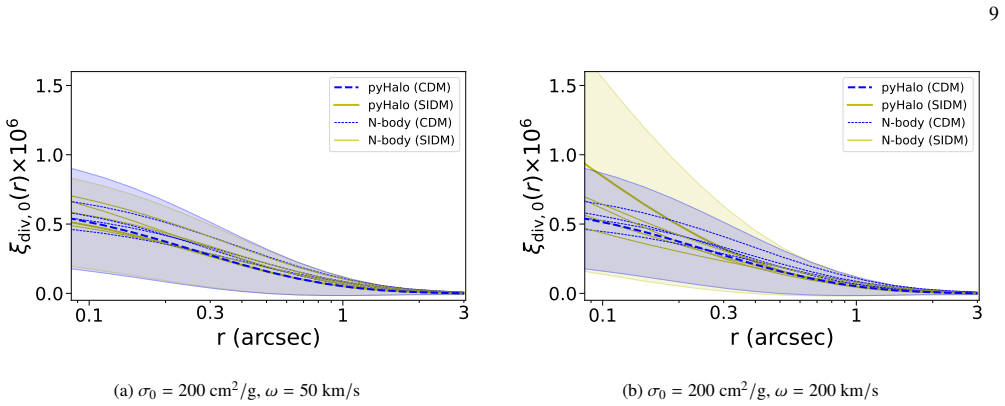
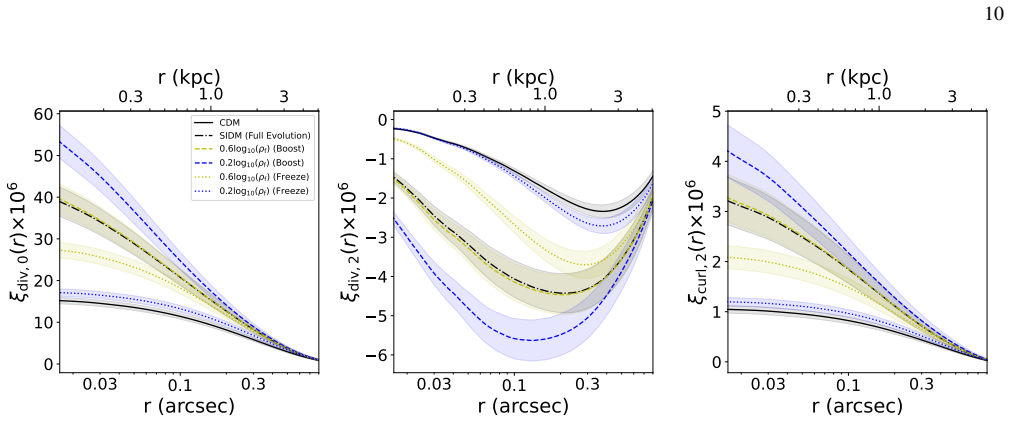
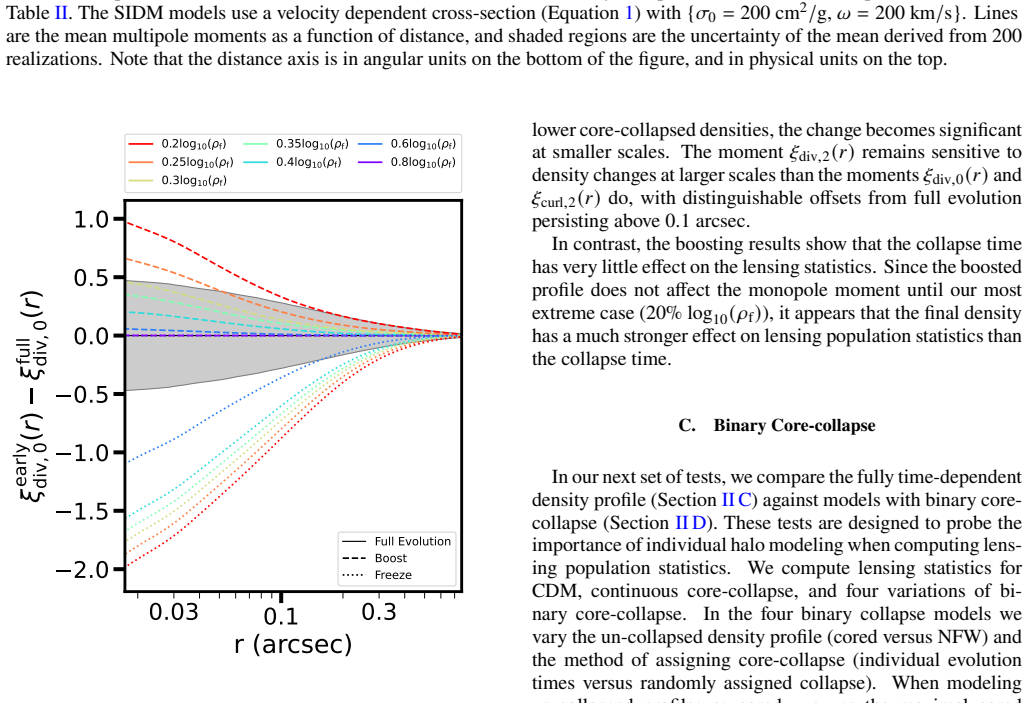
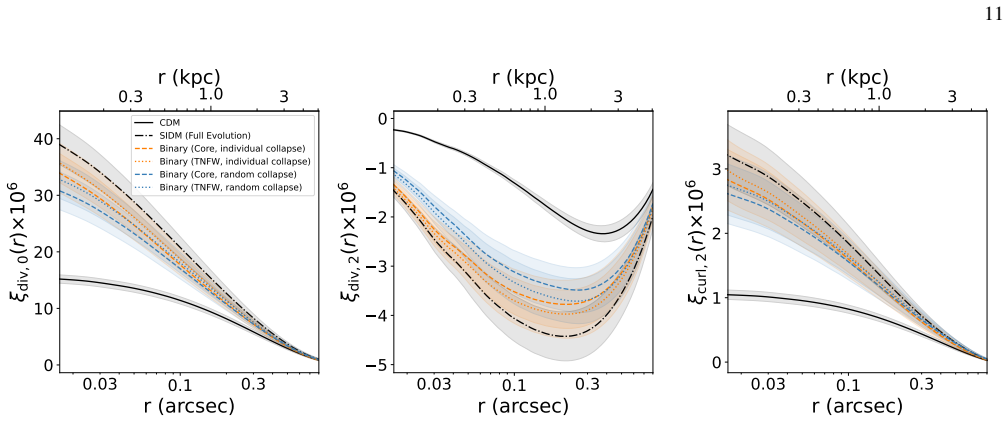
The paper tests methods of modeling core-collapsing halos and shows the effect of each variation on the two-point correlation function of the effective deflection field's divergence and curl. The tests cover smoothly evolving density profiles versus instantaneously collapsing halos, probabilistic collapse versus individual halo evolution, and variation of the initial and final density profile parameters. The two-point correlation function is sensitive to most of these variations at small length scales, but the detectability of these differences will depend on the observational probe.
What carries the argument
The two-point correlation function of the divergence and curl of the effective deflection field, which registers how choices in SIDM subhalo core-collapse modeling change lensing observables.
If this is right
- The correlation function registers differences between smooth density evolution and instantaneous collapse.
- Probabilistic population-level collapse versus tracking individual halos produces distinguishable effects at small scales.
- Altering the initial and final density profile parameters changes the correlation function.
- Whether these modeling differences can be observed depends on the chosen lensing probe.
Where Pith is reading between the lines
- Analyses that aim to constrain SIDM parameters from lensing data may need to marginalize over these core-collapse modeling choices to avoid systematic bias.
- Cross-checks with other substructure observables such as stellar streams could test whether the same modeling sensitivities appear in independent data.
- Extending the comparison to three-point statistics or to different SIDM interaction strengths would show whether the small-scale sensitivity persists.
Load-bearing premise
The tested modeling variations such as smooth versus instantaneous collapse and changes to density profile parameters capture the main physical uncertainties in the core-collapse timeline.
What would settle it
A measurement of the two-point correlation function at small scales that remains identical across all the tested core-collapse modeling choices would falsify the claimed sensitivity.
Figures
read the original abstract
Strong gravitational lensing has emerged as a powerful probe of dark matter substructure, and shows particularly strong promise as a test of self-interacting dark matter (SIDM). The compact halos produced by SIDM can leave distinct imprints on lensing observations, but the core-collapse timeline for subhalos is difficult to model accurately. This difficulty is an obstacle to accurate substructure lensing predictions, where small variations in core-collapsing subhalos can lead to significant differences in the lensing power. To quantify this problem and inform future lensing analyses, we test various methods of modeling core-collapsing halos and show the effect of each variation on the two-point correlation function of the effective deflection field's divergence and curl. Our tests include smoothly evolving density profiles versus instantaneously collapsing halos, probabilistic collapse versus individual halo evolution, and variation of the initial and final density profile parameters. We find that the two-point correlation function is sensitive to most of these variations at small length scales, but the detectability of these differences will depend on the observational probe.
Editorial analysis
A structured set of objections, weighed in public.
Referee Report
Summary. The manuscript claims that the two-point correlation function of the effective deflection field's divergence and curl is sensitive to most variations in SIDM subhalo core-collapse modeling—including smooth versus instantaneous collapse, probabilistic versus individual halo evolution, and changes to initial/final density profile parameters—at small length scales, with detectability depending on the observational probe.
Significance. If the central results hold, the work is significant for quantifying how core-collapse modeling choices propagate to lensing observables in SIDM, directly comparing simulation outputs to demonstrate sensitivity and thereby informing the precision required for future substructure lensing analyses.
major comments (3)
- [Abstract] Abstract (paragraph describing the tests performed): the tested modeling variations may not sufficiently capture the relevant physical uncertainties in the core-collapse timeline, as the SIDM cross-section (velocity dependence or magnitude) and subhalo orbital/environmental effects—which set the collapse timescale—are not varied; this limits the strength of the implication that the reported sensitivities bracket the main modeling challenges for lensing predictions.
- [Methods] Methods section: the manuscript provides insufficient detail on simulation setup (number of halos, resolution criteria, data exclusion rules) and the exact computation of the two-point correlation function, preventing verification of the statistical robustness of the sensitivity claims.
- [Results] Results section: the reported correlation functions lack error bars or uncertainty estimates, making it impossible to assess whether the differences between modeling choices are statistically significant rather than consistent with noise.
minor comments (2)
- [Methods] Notation for the effective deflection field divergence and curl could be clarified with an explicit equation in the methods.
- [Figures] Figure captions should include more detail on the length scales shown and the specific model variations plotted.
Simulated Author's Rebuttal
We thank the referee for the constructive comments, which have helped clarify the scope and presentation of our results. We address each major comment below and have revised the manuscript to improve clarity, detail, and statistical rigor where possible.
read point-by-point responses
-
Referee: [Abstract] Abstract (paragraph describing the tests performed): the tested modeling variations may not sufficiently capture the relevant physical uncertainties in the core-collapse timeline, as the SIDM cross-section (velocity dependence or magnitude) and subhalo orbital/environmental effects—which set the collapse timescale—are not varied; this limits the strength of the implication that the reported sensitivities bracket the main modeling challenges for lensing predictions.
Authors: We agree that the tested variations are confined to modeling choices (smooth vs. instantaneous collapse, probabilistic vs. individual evolution, and profile parameter changes) within a fixed core-collapse framework, rather than varying the underlying physical inputs such as the SIDM cross-section or orbital/environmental effects that determine collapse timescales. The manuscript's intent is to quantify sensitivity to these specific modeling decisions, not to claim they encompass all physical uncertainties. We have revised the abstract to explicitly state the scope of the variations considered and to avoid implying that they bracket all modeling challenges. revision: yes
-
Referee: [Methods] Methods section: the manuscript provides insufficient detail on simulation setup (number of halos, resolution criteria, data exclusion rules) and the exact computation of the two-point correlation function, preventing verification of the statistical robustness of the sensitivity claims.
Authors: We acknowledge that additional methodological details are needed for reproducibility. In the revised manuscript we have expanded the Methods section to specify the number of simulated halos, resolution criteria employed, rules for data exclusion, and the precise algorithm used to compute the two-point correlation function of the deflection-field divergence and curl (including binning, normalization, and any averaging procedures). revision: yes
-
Referee: [Results] Results section: the reported correlation functions lack error bars or uncertainty estimates, making it impossible to assess whether the differences between modeling choices are statistically significant rather than consistent with noise.
Authors: We agree that the absence of uncertainty estimates limits assessment of statistical significance. We have added error bars (derived from bootstrap resampling or jackknife estimates across the halo sample) to all correlation-function plots in the revised Results section and have included a brief discussion of how these uncertainties affect the interpretation of differences between modeling variants. revision: yes
Circularity Check
No circularity; direct numerical comparisons of modeling variants
full rationale
The paper's central result is obtained by running SIDM subhalo simulations under discrete modeling choices (smooth vs instantaneous collapse, probabilistic vs per-halo evolution, varied initial/final density parameters) and directly measuring the resulting two-point correlation function of deflection divergence/curl. No parameter is fitted to a subset of the target statistic and then re-labeled as a prediction; no self-citation supplies a uniqueness theorem or ansatz that the present work then treats as external; the derivation chain consists of explicit simulation outputs compared to one another. The tested variations are therefore independent inputs, not tautological re-expressions of the output statistic.
Axiom & Free-Parameter Ledger
free parameters (1)
- initial and final density profile parameters
axioms (1)
- domain assumption Standard assumptions in gravitational lensing and SIDM halo evolution simulations hold without re-derivation.
Forward citations
Cited by 1 Pith paper
-
Gravothermal Collapse: Robust Against Baryonic Feedback
Baryonic feedback mildly delays but does not stall gravothermal collapse in high-concentration SIDM halos and allows resumption in median-concentration cases, yielding feedback-history-dependent central densities.
Reference graph
Works this paper leans on
-
[1]
[71], with the addition of a truncation radius𝑟t (see Appendix A for more detail on the truncated profile)
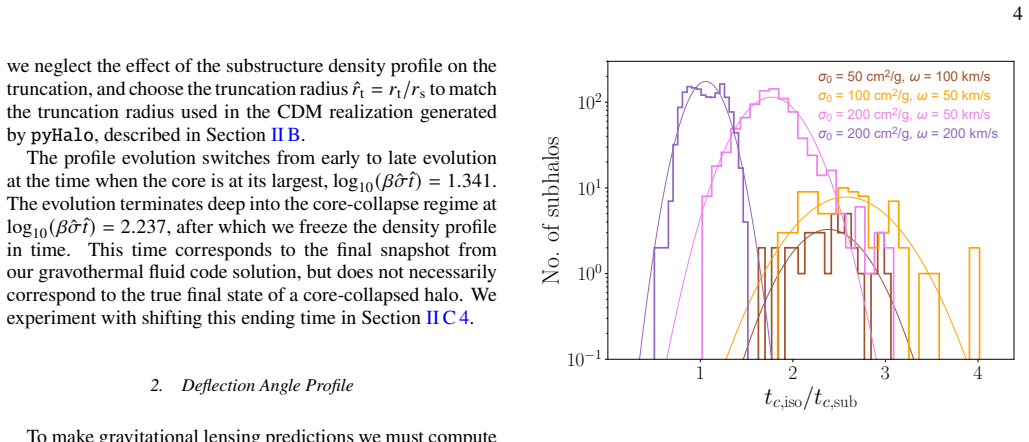
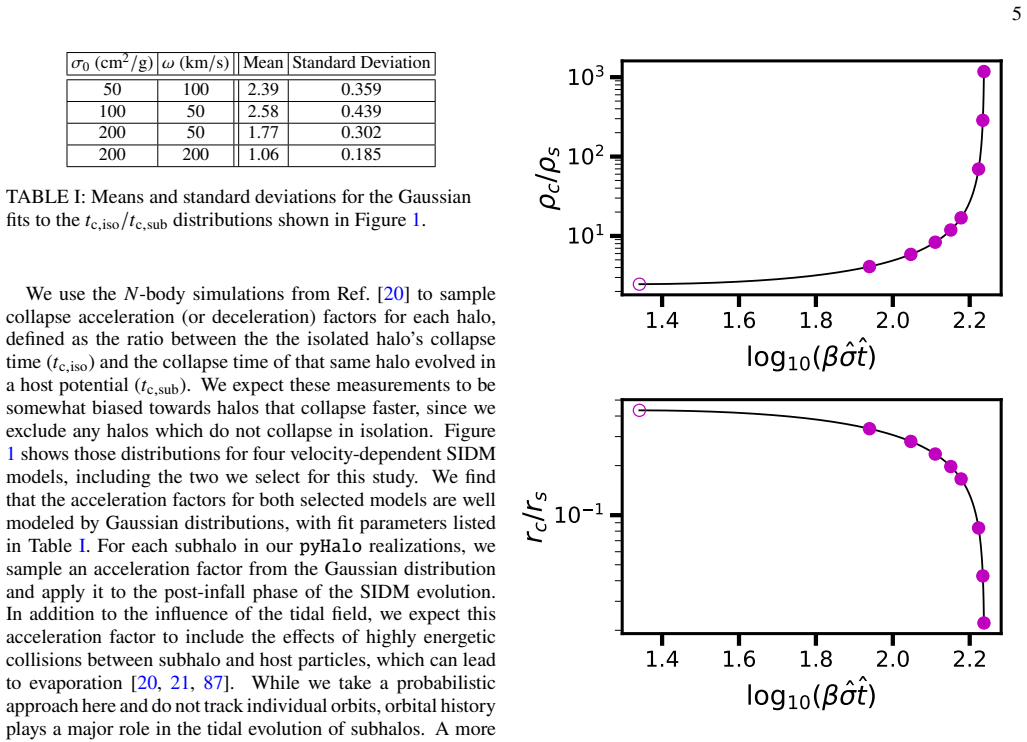
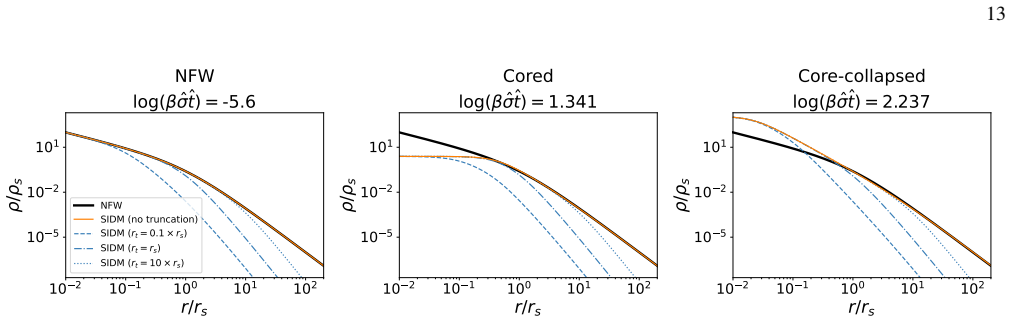
Density Profile We implement smoothly evolving SIDM halo density pro- files using the empirical model presented in Ref. [71], with the addition of a truncation radius𝑟t (see Appendix A for more detail on the truncated profile). This density evolution is piecewise in time, depending on whether the halo is in the early stages of evolution (core-formation) o...
-
[2]
Tocalculatethedeflectionangleasafunctionofradius,𝛽ˆ𝜎 ˆ𝑡, and truncation radius, we create a look-up table for Equation (6)
Deflection Angle Profile Tomakegravitationallensingpredictionswemustcompute the deflection angle profile, which is calculated from the en- closedprojectedmasswithinadistance𝑟fromthehalocenter [39]: 𝛼(𝑟) ∝ 1 𝑟 ∫ 𝑟 0 d𝑟2D 𝑟2D ∫ ∞ −∞ d𝑧 𝜌 √︃ 𝑟2 2D +𝑧 2 .(7) We have not found a closed-form solution to this integral for our density profile, so we proceed numer...
-
[3]
Time evolution To retrieve the deflection angle profile for a particular sub- haloorline-of-sighthalo,wefirstdetermine𝛽ˆ𝜎 ˆ𝑡bycalculating theageandhaloparametersforthatindividualhalo,placingit attheappropriatepositionalongitsuniquecore-collapsetime- line. It is straightforward to calculateˆ𝑡for each halo, using the formation redshift and the redshift of o...
-
[4]
Core-collapse may be halted at some point as the gravothermal evolution is interrupted by other physical processes, such as black hole formation [2, 88–90]
Collapse Threshold Variation Whileourgravothermalsolutionendswithacentraldensity that diverges as the collapse time is approached, the true final stateofacore-collapsedhaloremainsunknown. Core-collapse may be halted at some point as the gravothermal evolution is interrupted by other physical processes, such as black hole formation [2, 88–90]. To test how ...
1974
-
[5]
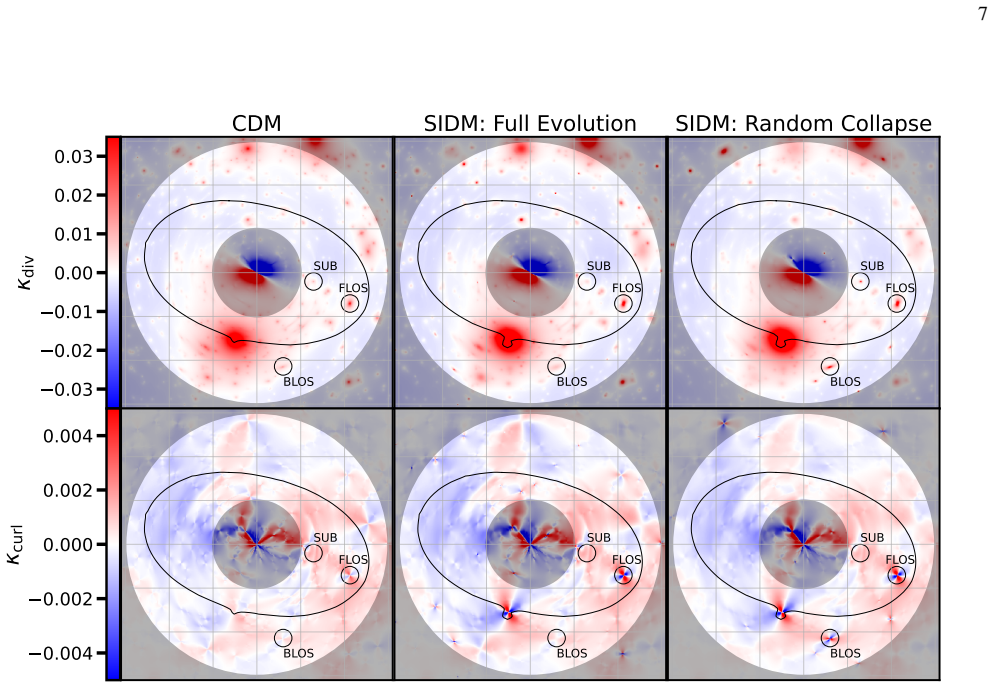
Effective Multi-plane Lensing To quantify the collective contributions of line-of-sight structure to the lensing deflection, we use the effective multi- plane lensing framework detailed in [40]. This approach in- cludes the influence of line-of-sight structure through an ef- fective deflection fieldαeff: αeff(x)=∇𝜙 eff(x) + ∇ ×A eff(x).(8) Unlike in a sin...
-
[6]
In this section we will compute the correlation function for an ef- fective multiplane lens, and use it to disentangle line-of-sight effectsfromtheinfluenceofthemainlensingplane
The Two-point Correlation Function The two-point correlation function is a powerful summary statisticthatencodesinformationaboutthedistributionofsub- structure, as well as their inner deflection angle profiles (and hence their density profiles) [34, 40, 41, 94, 100–105]. In this section we will compute the correlation function for an ef- fective multiplan...
-
[7]
The gravothermal profile includes a two-phase outer profile that transitions at the outer radius𝑟out, while the TNFWC profile does not
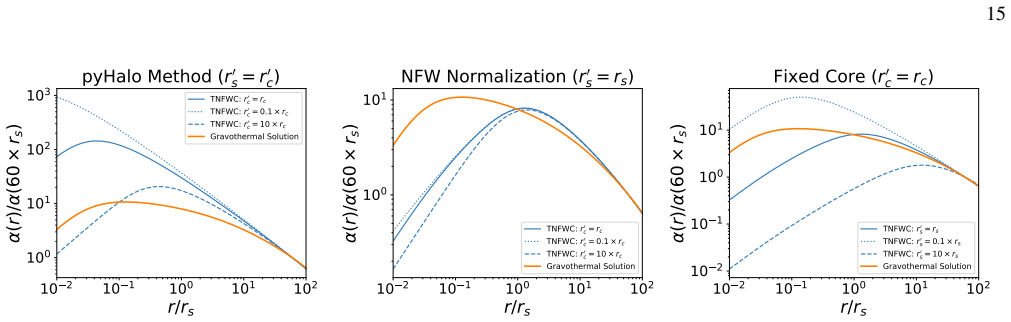
include a constant density core, but they differ in their outer profiles. The gravothermal profile includes a two-phase outer profile that transitions at the outer radius𝑟out, while the TNFWC profile does not. This creates a modeling challenge, as it is not clear if there are TNFWC parameter choices that produce similar deflection angles profiles as the g...
-
[8]
C. S. Kochanek and M. J. White, A Quantitative study of interactingdarkmatterinhalos,Astrophys.J.543,514(2000), arXiv:astro-ph/0003483
work page internal anchor Pith review Pith/arXiv arXiv 2000
-
[9]
Balberg and S
S. Balberg and S. L. Shapiro, Gravothermal collapse of self- interacting dark matter halos and the origin of massive black holes, Phys. Rev. Lett.88, 101301 (2002)
2002
-
[10]
R.K.deNarayandS.S.McGaugh,Theinnerdynamicalmass across galaxy morphology: A weak scaling with total stellar mass, The Astrophysical Journal Letters782, L12 (2014)
2014
-
[11]
K. A. Oman, J. F. Navarro, A. Fattahi, C. S. Frenk, T. Sawala, S.D.M.White,R.Bower,R.A.Crain,M.Furlong,M.Schaller, J. Schaye, and T. Theuns, The unexpected diversity of dwarf galaxy rotation curves, Monthly Notices of the Royal Astro- nomical Society452, 3650 (2015)
2015
-
[12]
Errani, J
R. Errani, J. Peñarrubia, and M. G. Walker, Systematics in virialmassestimatorsforpressure-supportedsystems,Monthly Notices of the Royal Astronomical Society481, 5073 (2018)
2018
-
[13]
J. I. Read, M. G. Walker, and P. Steger, Dark matter heats up indwarfgalaxies,MonthlyNoticesoftheRoyalAstronomical Society484, 1401 (2019)
2019
-
[14]
N. C. Relatores, A. B. Newman, J. D. Simon, R. S. Ellis, P. Truong, L. Blitz, A. Bolatto, C. Martin, M. Matuszewski, P. Morrissey, and J. D. Neill, The dark matter distributions in low-mass disk galaxies. ii. the inner density profiles, The Astrophysical Journal887, 94 (2019)
2019
-
[15]
I.M.E.Santos-Santos,J.F.Navarro,A.Robertson,A.Benítez- Llambay,K.A.Oman,M.R.Lovell,C.S.Frenk,A.D.Ludlow, A.Fattahi,andA.Ritz,Baryoniccluestothepuzzlingdiversity of dwarf galaxy rotation curves, Monthly Notices of the Royal Astronomical Society495, 58 (2020)
2020
-
[16]
K.Hayashi,M.Chiba,andT.Ishiyama,Diversityofdarkmatter density profiles in the galactic dwarf spheroidal satellites, The Astrophysical Journal904, 45 (2020)
2020
-
[17]
P. Li, F. Lelli, S. McGaugh, and J. Schombert, A comprehen- sivecatalogofdarkmatterhalomodelsforsparcgalaxies,The Astrophysical Journal Supplement Series247, 31 (2020)
2020
- [18]
-
[19]
Kaplinghat, S
M. Kaplinghat, S. Tulin, and H.-B. Yu, Dark matter halos as particle colliders: Unified solution to small-scale structure puzzles from dwarfs to clusters, Phys. Rev. Lett.116, 041302 (2016)
2016
-
[20]
Kamada, M
A. Kamada, M. Kaplinghat, A. B. Pace, and H.-B. Yu, Self- interacting dark matter can explain diverse galactic rotation curves, Phys. Rev. Lett.119, 111102 (2017)
2017
-
[21]
Sameie, H.-B
O. Sameie, H.-B. Yu, L. V. Sales, M. Vogelsberger, and J. Zavala, Self-interacting dark matter subhalos in the Milky Way’s tides, Phys. Rev. Lett.124, 141102 (2020)
2020
-
[22]
C.A.Correa,Constrainingvelocity-dependentself-interacting dark matter with the Milky Way’s dwarf spheroidal galaxies, Monthly Notices of the Royal Astronomical Society503, 920 (2021)
2021
-
[23]
Cyr-Racine, and M
Z.C.Zeng,A.H.G.Peter,X.Du,A.Benson,S.Kim,F.Jiang, F.-Y. Cyr-Racine, and M. Vogelsberger, Core-collapse, evapo- ration,andtidaleffects: thelifestoryofaself-interactingdark matter subhalo, Monthly Notices of the Royal Astronomical Society513, 4845 (2022)
2022
-
[24]
C. A. Correa, M. Schaller, S. Ploeckinger, N. Anau Montel, C. Weniger, and S. Ando, TangoSIDM: tantalizing models of self-interactingdarkmatter,MonthlyNoticesoftheRoyalAs- tronomical Society517, 3045 (2022)
2022
-
[25]
E. O. Nadler, D. Yang, and H.-B. Yu, A self-interacting dark mattersolutiontotheextremediversityoflow-masshaloprop- erties, The Astrophysical Journal Letters958, L39 (2023)
2023
-
[27]
Z. C. Zeng, A. H. G. Peter, X. Du, S. Yang, A. Benson, F.-Y. Cyr-Racine, F. Jiang, C. Mace, and R. B. Metcalf, Evolution and properties of self-interacting dark matter subhalos until core collapse, Phys. Rev. D111, 063001 (2025)
2025
- [28]
- [29]
-
[30]
R. A. Flores and J. R. Primack, Observational and Theoretical Constraints on Singular Dark Matter Halos,427, L1 (1994), arXiv:astro-ph/9402004 [astro-ph]
work page internal anchor Pith review Pith/arXiv arXiv 1994
-
[31]
Moore, Evidence against dissipation-less dark matter from observations of galaxy haloes,370, 629 (1994)
B. Moore, Evidence against dissipation-less dark matter from observations of galaxy haloes,370, 629 (1994)
1994
-
[32]
J. F. Navarro, C. S. Frenk, and S. D. M. White, A Universal DensityProfilefromHierarchicalClustering,490,493(1997), arXiv:astro-ph/9611107 [astro-ph]
work page internal anchor Pith review Pith/arXiv arXiv 1997
-
[33]
Moore, T
B. Moore, T. Quinn, F. Governato, J. Stadel, and G. Lake, Coldcollapseandthecorecatastrophe,MonthlyNoticesofthe Royal Astronomical Society310, 1147 (1999)
1999
-
[34]
D. H. Weinberg, J. S. Bullock, F. Governato, R. K. de Naray, and A. H. G. Peter, Cold dark matter: Controversies on small scales,ProceedingsoftheNationalAcademyofSciences112, 12249 (2015)
2015
-
[35]
Gentile, P
G. Gentile, P. Salucci, U. Klein, D. Vergani, and P. Kalberla, The cored distribution of dark matter in spiral galax- ies, Monthly Notices of the Royal Astronomical Soci- ety351, 903 (2004), https://academic.oup.com/mnras/article- pdf/351/3/903/3595222/351-3-903.pdf
2004
-
[36]
Kaplinghat, T
M. Kaplinghat, T. Ren, and H.-B. Yu, Dark matter cores and cuspsinspiralgalaxiesandtheirexplanations,JournalofCos- mology and Astroparticle Physics2020(06), 027
-
[37]
Bhattacharyya, S
J. Bhattacharyya, S. Adhikari, A. Banerjee, S. More, A. Ku- mar, E. O. Nadler, and S. Chatterjee, The signatures of self- interacting dark matter and subhalo disruption on cluster sub- structure, The Astrophysical Journal932, 30 (2022)
2022
-
[38]
Mao and P
S. Mao and P. Schneider, Evidence for substructure in lens galaxies?, Monthly Notices of the Royal Astronomical Soci- ety295, 587 (1998), https://academic.oup.com/mnras/article- pdf/295/3/587/18408388/295-3-587.pdf
1998
-
[39]
Dalal and C
N. Dalal and C. S. Kochanek, Direct detection of cold dark 15 10 2 10 1 100 101 102 r/rs 100 101 102 103 (r)/ (60 × rs) pyHalo Method (r′ s = r′ c) TNFWC: r′ c = rc TNFWC: r′ c = 0.1 × rc TNFWC: r′ c = 10 × rc Gravothermal Solution 10 2 10 1 100 101 102 r/rs 100 101 (r)/ (60 × rs) NFW Normalization (r′ s = rs) TNFWC: r′ c = rc TNFWC: r′ c = 0.1 × rc TNFWC...
2002
-
[40]
A. M. Nierenberg, T. Treu, S. A. Wright, C. D. Fassnacht, and M. W. Auger, Detection of substructure with adaptive optics integral field spectroscopy of the gravitational lens B1422+231,MonthlyNoticesoftheRoyalAstronomicalSoci- ety442,2434(2014),https://academic.oup.com/mnras/article- pdf/442/3/2434/3544969/stu862.pdf
2014
-
[41]
Y. D. Hezaveh, N. Dalal, D. P. Marrone, Y.-Y. Mao, W. Morn- ingstar, D. Wen, R. D. Blandford, J. E. Carlstrom, C. D. Fass- nacht, G. P. Holder, A. Kemball, P. J. Marshall, N. Murray, L. P. Levasseur, J. D. Vieira, and R. H. Wechsler, Detection of lensing substructure using alma observations of the dusty galaxy SDP.81, The Astrophysical Journal823, 37 (2016)
2016
-
[42]
Hezaveh, N
Y. Hezaveh, N. Dalal, G. Holder, T. Kisner, M. Kuhlen, and L. P. Levasseur, Measuring the power spectrum of dark mat- ter substructure using strong gravitational lensing, Journal of Cosmology and Astroparticle Physics2016(11), 048
-
[43]
A. M. Nierenberg, T. Treu, G. Brammer, A. H. G. Peter, C. D. Fassnacht, C. R. Keeton, C. S. Kochanek, K. B. Schmidt, D. Sluse, and S. A. Wright, Probing dark matter substruc- ture in the gravitational lens HE 0435-1223 with the WFC3 grism, Monthly Notices of the Royal Astronomical Soci- ety471,2224(2017),https://academic.oup.com/mnras/article- pdf/471/2/2...
2017
-
[44]
Probing the small-scale structure in strongly lensed systems via transdimensional inference
T. Daylan, F.-Y. Cyr-Racine, A. Diaz Rivero, C. Dvorkin, and D.P.Finkbeiner,ProbingtheSmall-scaleStructureinStrongly Lensed Systems via Transdimensional Inference,854, 141 (2018), arXiv:1706.06111 [astro-ph.CO]
work page internal anchor Pith review Pith/arXiv arXiv 2018
-
[45]
Gilman, S
D. Gilman, S. Birrer, T. Treu, A. Nierenberg, and A. Ben- son, Probing dark matter structure down to 107 solar masses: flux ratio statistics in gravitational lenses with line-of-sight haloes, Monthly Notices of the Royal Astronomical Soci- ety487,5721(2019),https://academic.oup.com/mnras/article- pdf/487/4/5721/28901702/stz1593.pdf
2019
- [46]
-
[47]
Dhanasingham, F.-Y
B. Dhanasingham, F.-Y. Cyr-Racine, A. H. G. Peter, A. Ben- son, and D. Gilman, Interlopers speak out: studying the dark universe using small-scale lensing anisotropies, Monthly Notices of the Royal Astronomical Society 518, 5843 (2022), https://academic.oup.com/mnras/article- pdf/518/4/5843/47852558/stac2993.pdf
2022
-
[48]
Dhanasingham, F.-Y
B. Dhanasingham, F.-Y. Cyr-Racine, C. Mace, A. H. G. Peter, and A. Benson, Anisotropic strong lensing as a probe of dark matter self-interactions, Monthly Notices of the Royal Astronomical Society526, 5455 (2023), https://academic.oup.com/mnras/article- pdf/526/4/5455/53175654/stad3099.pdf
2023
-
[49]
S. Vegetti, S. Birrer, G. Despali, C. D. Fassnacht, D. Gilman, Y.Hezaveh,L.P.Levasseur,J.P.McKean,D.M.Powell,C.M. O’Riordan,andG.Vernardos,Stronggravitationallensingasa probeofdarkmatter(2023),arXiv:2306.11781[astro-ph.CO]
-
[50]
Wagner-Carena, J
S. Wagner-Carena, J. Aalbers, S. Birrer, E. O. Nadler, E. Darragh-Ford, P. J. Marshall, and R. H. Wechsler, From images to dark matter: End-to-end inference of substructure from hundreds of strong gravitational lenses, The Astrophysi- cal Journal942, 75 (2023)
2023
-
[51]
D. Gilman, A. M. Nierenberg, T. Treu, C. Gannon, X. Du, H. Paugnat, S. Birrer, A. J. Benson, P. Mozumdar, K. C. Wong,D.Williams,R.E.Keeley,K.N.Abazajian,T.Anguita, V. N. Bennert, S. G. Djorgovski, S. H. Hoenig, A. Kusenko, M.Malkan,T.Morishita,V.Motta,L.A.Moustakas,W.Sheu, D. Sluse, D. Stern, and M. Stiavelli, JWST lensed quasar dark mattersurveyIV:String...
work page internal anchor Pith review Pith/arXiv arXiv 2025
- [52]
- [53]
-
[54]
Vegetti, O
S. Vegetti, O. Czoske, and L. V. E. Koopmans, Quan- tifying dwarf satellites through gravitational imaging: 16 the case of SDSS J120602.09+514229.5, Monthly Notices of the Royal Astronomical Society407, 225 (2010), https://academic.oup.com/mnras/article- pdf/407/1/225/3073188/mnras0407-0225.pdf
2010
-
[55]
Vegetti, L
S. Vegetti, L. V. E. Koopmans, A. Bolton, T. Treu, and R. Gavazzi, Detection of a dark substruc- ture through gravitational imaging, Monthly No- tices of the Royal Astronomical Society408, 1969 (2010), https://academic.oup.com/mnras/article- pdf/408/4/1969/4219080/mnras0408-1969.pdf
1969
-
[56]
Gravitational detection of a low-mass dark satellite at cosmological distance
S. Vegetti, D. J. Lagattuta, J. P. McKean, M. W. Auger, C. D. Fassnacht,andL.V.E.Koopmans,Gravitationaldetectionofa low-mass dark satellite galaxy at cosmological distance,481, 341 (2012), arXiv:1201.3643 [astro-ph.CO]
work page internal anchor Pith review Pith/arXiv arXiv 2012
-
[57]
S.Vegetti,L.V.E.Koopmans,M.W.Auger,T.Treu,andA.S. Bolton, Inference of the cold dark matter substructure mass functionatz=0.2usingstronggravitationallenses,442,2017 (2014), arXiv:1405.3666 [astro-ph.GA]
work page internal anchor Pith review Pith/arXiv arXiv 2017
-
[58]
littledarkdot
S. Li, R. Li, K. Wang, Z. Jia, X. Cao, C. S. Frenk, F. Jiang, A.Amvrosiadis,S.Cole,Q.He,S.C.Lange,R.Massey,J.W. Nightingale,A.Robertson,M.vonWietersheim-Kramsta,and X.Ma,The“littledarkdot”: Evidenceforself-interactingdark matter in the strong lens SDSS J0946+1006?, The Astrophys- ical Journal994, 201 (2025)
2025
-
[59]
S.Vegetti,S.D.M.White,J.P.McKean,D.M.Powell,C.Sp- ingola, D. Massari, G. Despali, and C. D. Fassnacht, A possi- ble challenge for cold and warm dark matter, Nature Astron- omy10.1038/s41550-025-02746-w(2026),arXiv:2601.02466 [astro-ph.CO]
-
[60]
D. Gilman, S. Birrer, A. Nierenberg, T. Treu, X. Du, and A. Benson, Warm dark matter chills out: constraints on the halomassfunctionandthefree-streaminglengthofdarkmatter with eight quadruple-image strong gravitational lenses,491, 6077 (2020), arXiv:1908.06983 [astro-ph.CO]
-
[61]
Gilman, X
D. Gilman, X. Du, A. Benson, S. Birrer, A. Nierenberg, and T. Treu, Constraints on the mass–concentration relation of cold dark matter haloes with 11 strong gravitational lenses, Monthly Notices of the Royal Astronomical Society: Letters 492, L12 (2019), https://academic.oup.com/mnrasl/article- pdf/492/1/L12/56978865/mnrasl_492_1_l12.pdf
2019
-
[62]
Despali, L
J.-W.Hsueh,W.Enzi,S.Vegetti,M.W.Auger,C.D.Fassnacht, G. Despali, L. V. E. Koopmans, and J. P. McKean, SHARP – VII. new constraints on the dark matter free-streaming prop- erties and substructure abundance from gravitationally lensed quasars, Monthly Notices of the Royal Astronomical Soci- ety492,3047(2020),https://academic.oup.com/mnras/article- pdf/492/2...
2020
-
[63]
E. O. Nadler, S. Birrer, D. Gilman, R. H. Wechsler, X. Du, A. Benson, A. M. Nierenberg, and T. Treu, Dark matter con- straints from a unified analysis of strong gravitational lenses and Milky Way satellite galaxies, The Astrophysical Journal 917, 7 (2021)
2021
-
[64]
Gilman, A
D. Gilman, A. Benson, J. Bovy, S. Birrer, T. Treu, and A. Nierenberg, The primordial matter power spectrum on sub-galactic scales, Monthly No- tices of the Royal Astronomical Society512, 3163 (2022), https://academic.oup.com/mnras/article- pdf/512/3/3163/43221312/stac670.pdf
2022
-
[65]
B. Dhanasingham, F.-Y. Cyr-Racine, and D. Gilman, Neu- ral posterior estimation of the line-of-sight and subhalo populations in galaxy-scale strong lensing systems (2025), arXiv:2511.17732 [astro-ph.CO]
-
[66]
C.Mace,Z.C.Zeng,A.H.G.Peter,X.Du,S.Yang,A.Benson, andM.Vogelsberger,Convergencetestsofself-interactingdark matter simulations, Phys. Rev. D110, 123024 (2024)
2024
-
[67]
Palubski, O
I. Palubski, O. Slone, M. Kaplinghat, M. Lisanti, and F. Jiang, Numerical challenges in modeling gravothermal collapse in self-interacting dark matter halos, Journal of Cosmology and Astroparticle Physics2024(09), 074
-
[68]
M. Kamionkowski, K. Sigurdson, and O. Slone, Numerical evolutionofself-gravitatinghalosofself-interactingdarkmat- ter (2025), arXiv:2506.04334 [astro-ph.CO]
-
[69]
B., Bartolo, N., Basak, S., Battye, R., Benabed, K., Bernard, J.-P., Bersanelli, M., Bielewicz, P., Bock, J
Planck Collaboration, Aghanim, N., Akrami, Y., Ashdown, M.,Aumont,J.,Baccigalupi,C.,Ballardini,M.,Banday,A.J., Barreiro, R. B., Bartolo, N., Basak, S., Battye, R., Benabed, K., Bernard, J.-P., Bersanelli, M., Bielewicz, P., Bock, J. J., Bond, J. R., Borrill, J., Bouchet, F. R., Boulanger, F., Bucher, M., Burigana, C., Butler, R. C., Calabrese, E., Cardoso...
2020
-
[70]
Springel, E pur si muove: Galilean-invariant cosmologi- cal hydrodynamical simulations on a moving mesh, Monthly Notices of the Royal Astronomical Society401, 791 (2010)
V. Springel, E pur si muove: Galilean-invariant cosmologi- cal hydrodynamical simulations on a moving mesh, Monthly Notices of the Royal Astronomical Society401, 791 (2010)
2010
-
[71]
Vogelsberger, J
M. Vogelsberger, J. Zavala, and A. Loeb, Subhaloes in self- interactinggalacticdarkmatterhaloes,MonthlyNoticesofthe Royal Astronomical Society423, 3740 (2012)
2012
-
[72]
Vogelsberger and J
M. Vogelsberger and J. Zavala, Direct detection of self- interacting dark matter, Monthly Notices of the Royal Astro- nomical Society430, 1722 (2013)
2013
-
[73]
M.Vogelsberger,J.Zavala,C.Simpson,andA.Jenkins,Dwarf galaxies in CDM and SIDM with baryons: observational probes of the nature of dark matter, Monthly Notices of the 17 Royal Astronomical Society444, 3684 (2014)
2014
-
[74]
A. J. Benson, Galacticus: A semi-analytic model of galaxy formation, New Astronomy17, 175 (2012)
2012
-
[75]
D. Yang, E. O. Nadler, and H.-B. Yu, Strong dark matter self- interactionsdiversifyhalopopulationswithinandsurrounding the Milky Way, The Astrophysical Journal949, 67 (2023)
2023
-
[76]
Slone, F
O. Slone, F. Jiang, M. Lisanti, and M. Kaplinghat, Orbital evolution of satellite galaxies in self-interacting dark matter models, Phys. Rev. D107, 043014 (2023)
2023
-
[77]
N.J.Outmezguine,K.K.Boddy,S.Gad-Nasr,M.Kaplinghat, and L. Sagunski, Universal gravothermal evolution of isolated self-interactingdarkmatterhalosforvelocity-dependentcross- sections, Monthly Notices of the Royal Astronomical Soci- ety523,4786(2023),https://academic.oup.com/mnras/article- pdf/523/3/4786/50681276/stad1705.pdf
2023
-
[78]
S.Yang,X.Du,Z.C.Zeng,A.Benson,F.Jiang,E.O.Nadler, and A. H. G. Peter, Gravothermal solutions of SIDM halos: Mapping from constant to velocity-dependent cross section, The Astrophysical Journal946, 47 (2023)
2023
-
[79]
Zhong, D
Y.-M. Zhong, D. Yang, and H.-B. Yu, The impact of baryonic potentials on the gravothermal evolu- tion of self-interacting dark matter haloes, Monthly Notices of the Royal Astronomical Society526, 758 (2023), https://academic.oup.com/mnras/article- pdf/526/1/758/51771239/stad2765.pdf
2023
-
[80]
M. W. Auger, T. Treu, A. S. Bolton, R. Gavazzi, L. V. E. Koopmans,P.J.Marshall,L.A.Moustakas,andS.Burles,The Sloan Lens ACS survey. X. stellar, dynamical, and total mass correlations ofmassive early-type galaxies,The Astrophysical Journal724, 511 (2010)
2010
- [81]
discussion (0)
Sign in with ORCID, Apple, or X to comment. Anyone can read and Pith papers without signing in.