Quantum-Adaptive KS(φ): A Parameterized Three-Qubit Gate Family Embedding Toffoli with Measurement-Free Phase Kickback and Intrinsic Error Non-Amplification
Pith reviewed 2026-06-30 15:49 UTC · model grok-4.3
The pith
A parameterized three-qubit gate embeds Toffoli while retaining coherent phase across chained applications, shown by orthogonal outputs on control=1 inputs.
A machine-rendered reading of the paper's core claim, the machinery that carries it, and where it could break.
Core claim
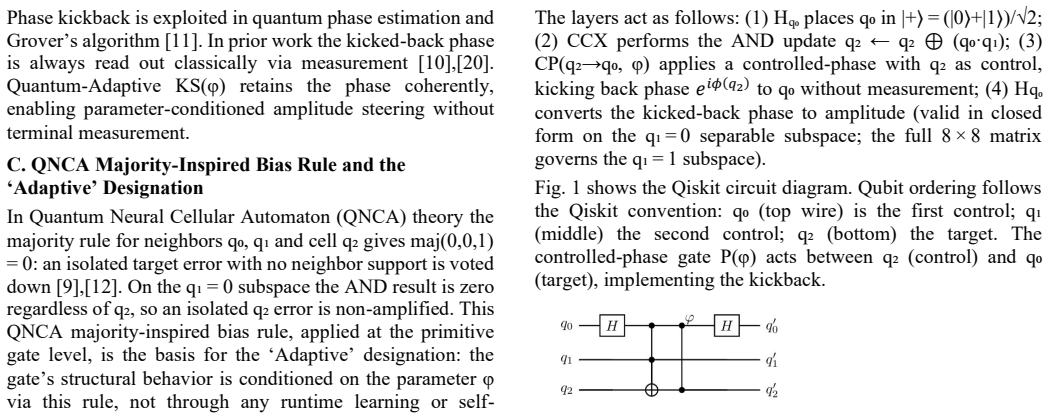
The QA-KS(φ) gate is defined by an 8x8 unitary that embeds CCX inside a palindromic Hadamard sandwich conjugating Z-type errors to X-type and a controlled-phase gate whose kickback moves target-state information into the control-qubit phase without measurement. For φ=π the gate is deterministic (up to relative phase) on the q1=0 subspace and creates four-component entangled superpositions on the q1=1 subspace. Two chained QA-KS(π) gates on shared q0 yield outputs orthogonal to two CCX gates precisely when q0=1 (F=0) while agreeing exactly when q0=0 (F=1), establishing subspace-dependent coherent phase retention.
What carries the argument
The QA-KS(φ) gate, realized as a three-qubit unitary with a palindromic Hadamard sandwich on q0 that conjugates error types and a controlled-phase gate that performs measurement-free phase kickback of the target state into the control qubit.
If this is right
- The gate supplies simultaneous sensitivity to both Z-type and X-type errors inside the original three-qubit footprint without ancilla qubits.
- On the q1=0 subspace the gate behaves deterministically up to a relative phase, supplying intrinsic error non-amplification.
- On the q1=1 subspace the gate produces entangled superpositions, establishing it as a strictly distinct primitive from CCX.
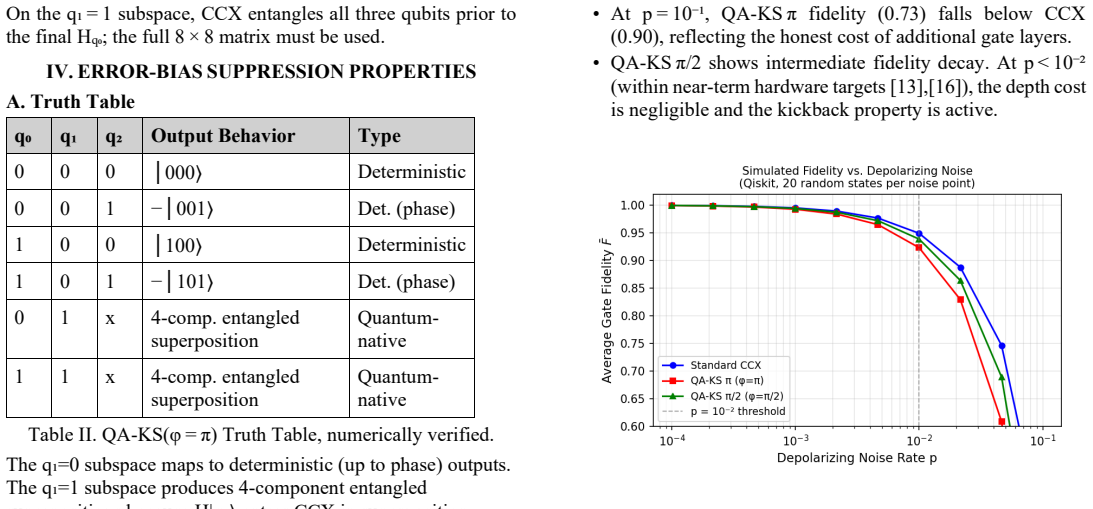
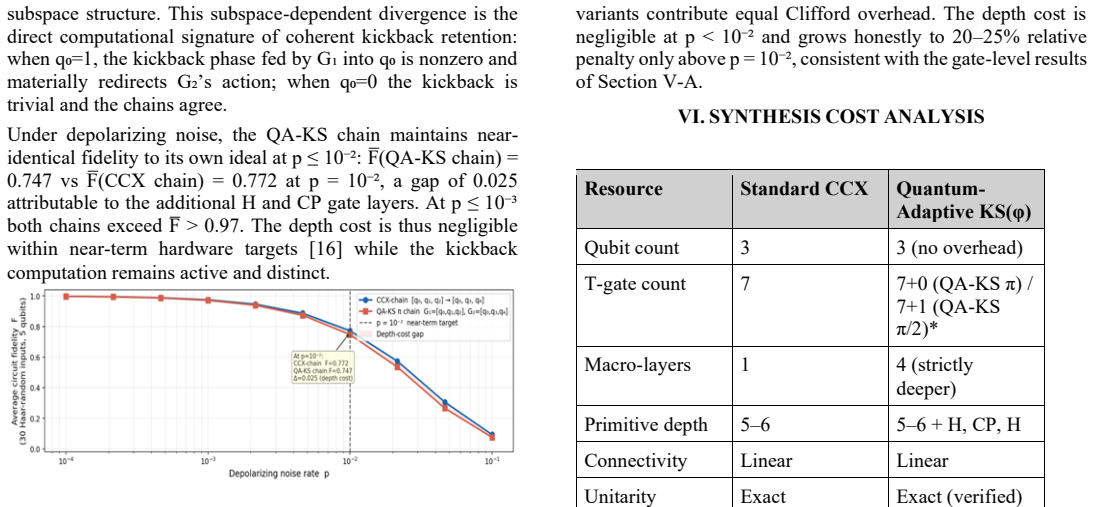
- Depolarizing-noise simulations show near-unit fidelity for physical error rates at or below 1 percent with honest depth accounting at higher rates.
Where Pith is reading between the lines
- Circuits could exploit the subspace split to route classical-like deterministic paths alongside quantum-entangled paths without extra qubits or measurements.
- The orthogonal divergence on q0=1 inputs offers a concrete test for whether phase coherence is preserved across gate boundaries in actual hardware.
- The construction suggests a route to phase-based logic that remains invisible to standard Toffoli-only compilers.
Load-bearing premise
The compile-time QNCA majority-inspired bias rule produces a valid unitary that can be realized in hardware without adding runtime dynamics or violating the no-self-modification condition.
What would settle it
Apply two chained QA-KS(π) gates and two sequential CCX gates to the same q0=1 input states and measure whether the output fidelity is exactly 0 on that subspace while remaining 1 on q0=0.
Figures
read the original abstract
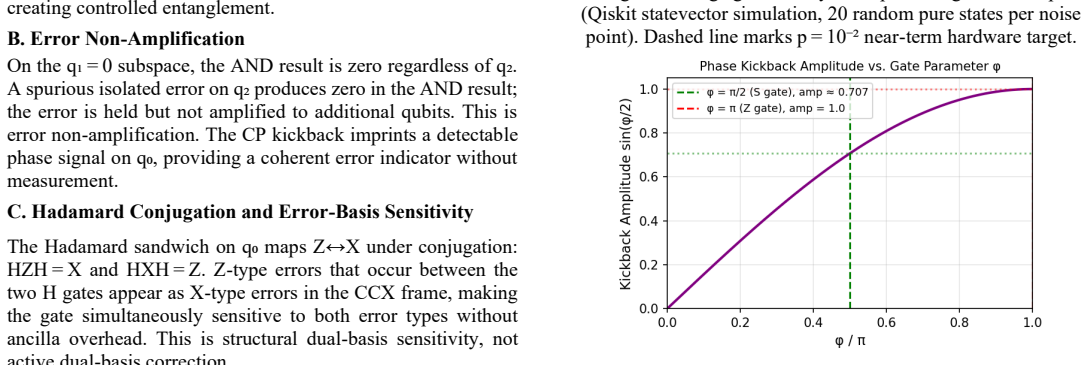
We introduce Quantum-Adaptive KS($\varphi$) ($K$ = kickback, $S$ = sandwich), a parameterized three-qubit gate family that structurally embeds the Toffoli (CCX) gate within two additional components: (1)a palindromic Hadamard sandwich on the first control qubit $q_0$ that conjugates $Z$-type errors to $X$-type in the CCX frame, providing simultaneous sensitivity to both error types without ancilla overhead; and (2)a controlled-phase (CP) gate whose quantum phase kickback propagates post-CCX target-state information into the control-qubit phase without measurement. The term Quantum- Adaptive refers to amplitude steering conditioned by the compile-time parameter $\varphi$ via a Quantum Neural Cellular Automaton (QNCA) majority-inspired bias rule; the gate does not self-modify at runtime. Two QA-KS($\pi$) gates chained on a shared control qubit $q_0$ produce outputs completely orthogonal to two sequential CCX gates on $q_0$=1 inputs (output fidelity F=0.000), while agreeing exactly on $q_0$=0 inputs (F=1.000). This subspace-dependent divergence is the direct computational signature of coherent phase retention across gate boundaries -- impossible for CCX-only circuits. On the $q_1$ = 0 subspace the gate acts deterministically (up to a relative phase), providing intrinsic error non-amplification. On the $q_1$ = 1 subspace it produces four-component entangled superpositions, making it a strictly distinct quantum-native primitive from CCX. We present the complete $8 \times 8$ unitary matrix, confirmed exact to $||U^{\dagger}U-I||_{\infty} < 10^{-15}$, and define two canonical variants: QA-KS$_{\pi/2}$ ($\varphi = \pi/2$, $S$ gate) and QA-KS$_{\pi}$ ($\varphi = \pi$, $Z$ gate). Qiskit depolarizing-noise simulation demonstrates near-unit fidelity at $p \leq 10^{-2}$ with an honest depth cost at higher error rates. The gate preserves the three-qubit footprint of CCX with no qubit overhead.
Editorial analysis
A structured set of objections, weighed in public.
Referee Report
Summary. The manuscript introduces Quantum-Adaptive KS(φ), a parameterized three-qubit gate family embedding the Toffoli (CCX) gate via a palindromic Hadamard sandwich on q0 for Z-to-X error conjugation and a controlled-phase component for measurement-free phase kickback. It supplies the explicit 8×8 unitary for QA-KS(π), verifies ||U†U−I||∞<10^{-15}, and shows that two chained QA-KS(π) gates produce outputs orthogonal to two sequential CCX gates on q0=1 inputs (fidelity F=0.000) while agreeing on q0=0 inputs (F=1.000). Qiskit depolarizing-noise simulations are reported with near-unit fidelity at p≤10^{-2}, and the gate preserves the three-qubit footprint with no ancilla overhead. The φ parameter is set at compile time via a QNCA majority-inspired rule; the gate is static at runtime.
Significance. If the explicit unitary holds, the work supplies a quantum-native three-qubit primitive whose subspace-dependent coherent phase retention produces a falsifiable orthogonality signature impossible for CCX-only circuits. The machine-verified unitarity check and direct matrix-algebra consequence of the chained-gate claim are strengths that permit independent verification without additional assumptions about runtime dynamics.
major comments (1)
- Abstract: the claim that the QNCA bias rule produces a valid unitary is supported only by the final matrix and numerical check; the intermediate algebraic steps combining the Hadamard sandwich, CCX, and CP components into the stated 8×8 matrix are not shown, which is load-bearing for independent reproduction of the construction.
minor comments (2)
- The term 'honest depth cost' at higher error rates is used without definition; a brief clarification would improve readability.
- The manuscript would benefit from stating the explicit matrix elements (or a reference to their location) in the main text rather than only asserting their existence.
Simulated Author's Rebuttal
We thank the referee for the constructive comment and positive overall assessment. We address the single major comment below.
read point-by-point responses
-
Referee: [—] Abstract: the claim that the QNCA bias rule produces a valid unitary is supported only by the final matrix and numerical check; the intermediate algebraic steps combining the Hadamard sandwich, CCX, and CP components into the stated 8×8 matrix are not shown, which is load-bearing for independent reproduction of the construction.
Authors: We agree that the algebraic derivation of the 8×8 unitary from the Hadamard sandwich on q0, the embedded CCX action, and the controlled-phase kickback term is not provided explicitly. The manuscript presents only the final matrix together with the numerical unitarity verification ||U†U−I||∞ < 10^{-15}. To enable independent reproduction, the revised manuscript will include a step-by-step algebraic expansion (either in the main text or a short appendix) that combines the three components into the explicit matrix elements for QA-KS(φ). The QNCA rule itself is used only to select the compile-time value of φ and does not alter the unitary construction; the added derivation will therefore directly address the referee’s concern about the matrix. revision: yes
Circularity Check
No significant circularity in derivation chain
full rationale
The manuscript supplies an explicit 8×8 unitary matrix for each member of the QA-KS(φ) family together with the numerical verification ||U†U−I||∞<10−15. All reported properties (subspace-dependent fidelity F=0 on q0=1 inputs and F=1 on q0=0 inputs for chained QA-KS(π) versus chained CCX, deterministic action on the q1=0 subspace, and four-component entanglement on q1=1) are direct algebraic consequences of matrix multiplication on that fixed operator. The compile-time QNCA majority-inspired bias rule serves only to select the single scalar φ that parametrizes each gate; once chosen, the operator is static and does not re-enter the runtime claims. No self-citation is invoked to justify uniqueness or to close a derivation loop, and no fitted parameter is relabeled as an independent prediction. The central claims therefore remain falsifiable matrix statements independent of the modeling choices used to arrive at the unitary.
Axiom & Free-Parameter Ledger
free parameters (1)
- φ
axioms (1)
- standard math Any 3-qubit operator constructed from Hadamard, controlled-phase, and Toffoli elements yields a valid unitary evolution under standard quantum mechanics.
invented entities (1)
-
Quantum-Adaptive KS(φ) gate family
no independent evidence
Reference graph
Works this paper leans on
-
[1]
M. A. Nielsen and I. L. Chuang, Quantum Computation and Quantum Information. Cambridge Univ. Press, 2000
2000
-
[2]
Quantum circuits of T -depth one,
P. Selinger, “Quantum circuits of T -depth one,” Phys. Rev. A, vol. 87, p. 042302, 2013
2013
-
[3]
Universal quantum computation with ideal Clifford gates and noisy ancillas,
S. Bravyi and A. Kitaev, “Universal quantum computation with ideal Clifford gates and noisy ancillas,” Phys. Rev. A, vol. 71, p. 022316, 2005
2005
-
[4]
Autonomous quantum error correction and fault-tolerant quantum computation with squeezed cat qubits,
Q. Xu et al., "Autonomous quantum error correction and fault-tolerant quantum computation with squeezed cat qubits," npj Quantum Inf., vol. 9, p. 78, 2023
2023
-
[5]
Real-time quantum error correction beyond break-even,
V. V. Sivak et al., “ Real-time quantum error correction beyond break-even,” Nature, vol. 616, pp. 50–55, 2023
2023
-
[6]
Measurement-free fault-tolerant quantum error correction in near -term devices,
S. Heußen, D. F. Locher, and M. Müller, “Measurement-free fault-tolerant quantum error correction in near -term devices,” PRX Quantum, vol. 5, p. 010333, 2024
2024
-
[7]
Measurement -free, scalable, fault -tolerant universal quantum computing,
F. Butt et al., “Measurement -free, scalable, fault -tolerant universal quantum computing,” Science Advances, vol. 11, p. eadv2590, 2025
2025
-
[8]
Approximate Autonomous Quantum Error Correction with Reinforcement Learning,
Y. Zeng et al., “Approximate Autonomous Quantum Error Correction with Reinforcement Learning,” Phys. Rev. Lett., vol. 131, p. 050601, 2023
2023
-
[9]
Unitarity plus causality implies localizability,
P. Arrighi, V. Nesme, and R. Werner, “Unitarity plus causality implies localizability,” J. Comput. Syst. Sci., vol. 77, pp. 372–378, 2011
2011
-
[10]
Quantum algorithms revisited,
R. Cleve et al., “Quantum algorithms revisited,” Proc. Roy. Soc. A, vol. 454, pp. 339–354, 1998
1998
-
[11]
A fast quantum mechanical algorithm for database search,
L. K. Grover, “A fast quantum mechanical algorithm for database search,” in Proc. 28th ACM STOC, pp. 212 –219, 1996
1996
-
[12]
Reversible quantum cellular automata
B. Schumacher and R. F. Werner, “Reversible quantum cellular automata,” arXiv:quant-ph/0405174, 2004
work page internal anchor Pith review Pith/arXiv arXiv 2004
-
[13]
High-fidelity geometric quantum gates exceeding 99.9% in germanium quantum dots,
C.-A. Wang et al., “High-fidelity geometric quantum gates exceeding 99.9% in germanium quantum dots,” Nature Commun., vol. 16, art. 7392, 2025
2025
-
[14]
Elementary gates for quantum computation,
A. Barenco et al., “Elementary gates for quantum computation,” Phys. Rev. A, vol. 52, pp. 3457–3467, 1995
1995
-
[15]
Qiskit: An open-source framework for quantum computing,
Qiskit contributors, “Qiskit: An open-source framework for quantum computing,” https://doi.org/10.5281/zenodo.2573505, 2023
-
[16]
Suppressing quantum errors by scaling a surface code logical qubit,
Google Quantum AI, “Suppressing quantum errors by scaling a surface code logical qubit,” Nature, vol. 614, pp. 676–681, 2023
2023
-
[17]
Autonomous Quantum Logic,
K. Sankaranarayanan and M. Perkowski, “Autonomous Quantum Logic,” unpublished manuscript, 2026
2026
-
[18]
Quantum - Adaptive KS(φ): A Parameterized Three-Qubit Gate Family Embedding Toffoli with Measurement -Free Phase Kickback and Intrinsic Error Non -Amplification,
K. Sankaranarayanan and M. Perkowski, "Quantum - Adaptive KS(φ): A Parameterized Three-Qubit Gate Family Embedding Toffoli with Measurement -Free Phase Kickback and Intrinsic Error Non -Amplification," IEEE QW 2026 NIER Track, submitted May 2026
2026
-
[19]
Fast and accurate AI-based pre-decoders for surface codes
C. Chamberland et al., "Fast and accurate AI -based pre - decoders for surface codes," arXiv preprint arXiv:2604.12841, 2026
work page internal anchor Pith review Pith/arXiv arXiv 2026
-
[20]
Exponentially cheaper coherent phase estimation via uncontrolled unitaries
M. Amico, "Exponentially cheaper coherent phase estimation via uncontrolled unitaries," arXiv preprint arXiv:2603.27858, 2026
work page internal anchor Pith review Pith/arXiv arXiv 2026
-
[21]
NVIDIA Ising: Open AI Models for Quantum Computing,
NVIDIA, "NVIDIA Ising: Open AI Models for Quantum Computing," https://developer.nvidia.com/ising, accessed April 2026
2026
discussion (0)
Sign in with ORCID, Apple, or X to comment. Anyone can read and Pith papers without signing in.