AvalancheBench: Evaluating Enterprise Data Agents Through Latent World Recovery
Pith reviewed 2026-06-30 14:29 UTC · model grok-4.3
The pith
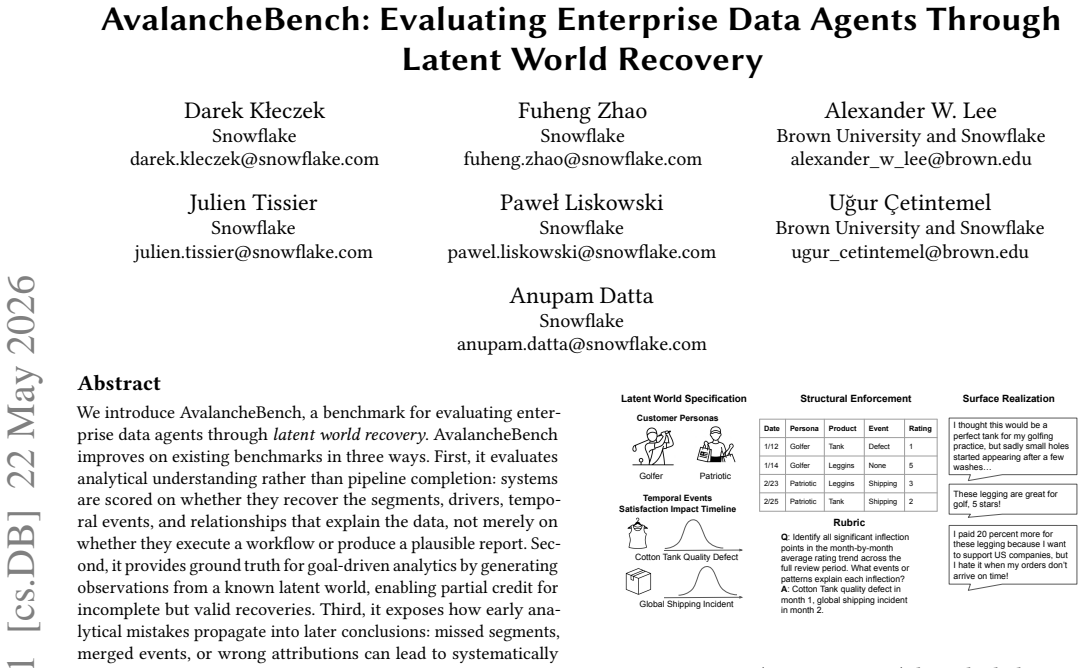
AvalancheBench scores enterprise data agents on how much they recover of a known latent world's segments, drivers, temporal events, and relationships from generated observations.
A machine-rendered reading of the paper's core claim, the machinery that carries it, and where it could break.
Core claim
AvalancheBench evaluates enterprise data agents through latent world recovery by scoring how completely they identify the segments, drivers, temporal events, and relationships that explain observations generated from a known latent world; this setup supplies ground truth for goal-driven analytics, permits partial credit, and reveals propagation of early analytical errors into downstream recommendations.
What carries the argument
Latent world recovery: scoring an agent's reconstruction of the segments, drivers, temporal events, and relationships that generated the supplied observations.
If this is right
- Agents that miss segments or merge events will produce systematically wrong recommendations even if they complete the workflow.
- Partial but valid recoveries receive credit, allowing finer diagnosis than all-or-nothing pipeline metrics.
- Early analytical mistakes propagate into later conclusions, so isolated component scores are insufficient.
- Current leading coding-agent configurations recover only 26 percent of the rubric on the e-commerce case.
Where Pith is reading between the lines
- The same latent-world method could be applied to other enterprise domains such as supply-chain or financial analytics to test transfer of the evaluation approach.
- Improving agent performance on this benchmark would likely require explicit mechanisms for maintaining separate segment and event hypotheses rather than relying on generic code generation.
- The 26 percent ceiling suggests that integration with domain-specific causal models or external knowledge bases may be necessary before agents reach usable analytical fidelity.
Load-bearing premise
Observations generated from a known latent world together with the defined rubric give a valid and generalizable measure of an agent's ability to perform goal-driven analytics on real enterprise data.
What would settle it
An agent that recovers a high fraction of the AvalancheBench rubric on the e-commerce case yet produces systematically incorrect segmentations or event attributions when run on real enterprise data with unknown structure.
Figures
read the original abstract
We introduce AvalancheBench, a benchmark for evaluating enterprise data agents through \emph{latent world recovery}. AvalancheBench improves on existing benchmarks in three ways. First, it evaluates analytical understanding rather than pipeline completion: systems are scored on whether they recover the segments, drivers, temporal events, and relationships that explain the data, not merely on whether they execute a workflow or produce a plausible report. Second, it provides ground truth for goal-driven analytics by generating observations from a known latent world, enabling partial credit for incomplete but valid recoveries. Third, it exposes how early analytical mistakes propagate into later conclusions: missed segments, merged events, or wrong attributions can lead to systematically wrong recommendations. In this sense, AvalancheBench complements real-data benchmarks by providing a controlled setting for diagnosing whether agents recover the analytical structure behind enterprise data. On a first e-commerce use case, the strongest configuration of a leading coding agent recovers only 26\% of the rubric, with failures concentrated in generic customer segmentations and merged temporal events.
Editorial analysis
A structured set of objections, weighed in public.
Referee Report
Summary. The manuscript introduces AvalancheBench, a benchmark for enterprise data agents that scores recovery of latent analytical structures (segments, drivers, temporal events, relationships) from observations generated by a known latent world. It claims three improvements over prior benchmarks—focus on analytical understanding rather than pipeline completion, ground truth for partial credit, and exposure of mistake propagation—and reports that the strongest configuration of a leading coding agent recovers only 26% of the rubric on an e-commerce use case.
Significance. If the synthetic generation and rubric validly proxy real enterprise analytics, the benchmark could offer a controlled diagnostic complement to real-data evaluations by quantifying how early errors compound into flawed recommendations. The 26% result would then indicate a substantive gap in current agents' ability to perform goal-driven recovery.
major comments (2)
- [§3, §5] §3 (Benchmark Design) and §5 (E-commerce Use Case): The claim that observations from a known latent world plus the defined rubric constitute a valid, generalizable measure of goal-driven analytics rests on an unverified mapping; the manuscript supplies no validation that the generation process reproduces production-data characteristics such as noise, missingness, schema heterogeneity, or causal ambiguity, which directly undermines whether the 26% figure diagnoses agent limitations rather than benchmark artifacts.
- [§4] §4 (Rubric and Scoring): The partial-credit mechanism and error-propagation analysis are load-bearing for the three claimed improvements, yet the manuscript provides no concrete definition of rubric items, inter-rater reliability, or how recovery of segments/drivers/events is operationalized, preventing assessment of whether the scoring actually captures analytical understanding.
minor comments (2)
- [Abstract] The abstract and introduction would benefit from an explicit statement of the e-commerce schema size and number of latent entities to allow readers to gauge complexity.
- [Figure 1] Figure 1 (latent-world diagram) uses inconsistent arrow styles for causal vs. temporal links; standardize notation for clarity.
Simulated Author's Rebuttal
We thank the referee for the constructive comments. We respond to each major point below, providing clarification on design intent and committing to revisions that strengthen the presentation without altering the core claims.
read point-by-point responses
-
Referee: [§3, §5] §3 (Benchmark Design) and §5 (E-commerce Use Case): The claim that observations from a known latent world plus the defined rubric constitute a valid, generalizable measure of goal-driven analytics rests on an unverified mapping; the manuscript supplies no validation that the generation process reproduces production-data characteristics such as noise, missingness, schema heterogeneity, or causal ambiguity, which directly undermines whether the 26% figure diagnoses agent limitations rather than benchmark artifacts.
Authors: AvalancheBench is intentionally constructed as a synthetic benchmark with a known latent world to enable ground-truth evaluation of analytical recovery and error propagation—capabilities that real-data benchmarks cannot provide. We do not claim the generated observations replicate all production characteristics such as noise or missingness; the design isolates the goal-driven analytics task in a controlled setting. The 26% result therefore indicates limitations in current agents even under favorable conditions. We will revise §3 to add an explicit discussion of the synthetic design's scope, trade-offs, and positioning as a diagnostic complement to real-data evaluations. revision: partial
-
Referee: [§4] §4 (Rubric and Scoring): The partial-credit mechanism and error-propagation analysis are load-bearing for the three claimed improvements, yet the manuscript provides no concrete definition of rubric items, inter-rater reliability, or how recovery of segments/drivers/events is operationalized, preventing assessment of whether the scoring actually captures analytical understanding.
Authors: Section §4 defines the four rubric categories and the partial-credit approach based on overlap with ground truth. To improve transparency, the revision will expand this section with concrete rubric item examples (e.g., segment definitions via attribute combinations), operational details (e.g., set-overlap metrics for segments and attribution checks for drivers), and a note on author consensus scoring for edge cases. We will also add a limitations statement acknowledging the lack of formal inter-rater reliability computation. revision: yes
Circularity Check
No circularity; benchmark construction is externally defined via latent-world generation and rubric scoring
full rationale
The paper introduces AvalancheBench as a new evaluation framework that generates observations from an explicitly constructed latent world and scores agent outputs against a human-defined rubric for segments, drivers, events, and relationships. This is a standard benchmark-design process with no equations, fitted parameters, or self-referential derivations that reduce the claimed evaluation metric to its own inputs by construction. No self-citation chains, uniqueness theorems, or ansatzes are invoked to justify the core scoring method. The work is self-contained as an external artifact rather than a closed derivation.
Axiom & Free-Parameter Ledger
Reference graph
Works this paper leans on
-
[1]
Lakshya A Agrawal, Shangyin Tan, Dilara Soylu, Noah Ziems, Rishi Khare, Krista Opsahl-Ong, Arnav Singhvi, Herumb Shandilya, Michael J Ryan, Meng Jiang, Christopher Potts, Koushik Sen, Alex Dimakis, Ion Stoica, Dan Klein, Matei Zaharia, and Omar Khattab. 2026. GEPA: Reflective Prompt Evolution Can Outperform Reinforcement Learning. InThe Fourteenth Interna...
2026
-
[2]
Anthropic. 2026. System Card: Claude Opus 4.7. https://cdn.sanity.io/files/ 4zrzovbb/website/037f06850df7fbe871e206dad004c3db5fd50340.pdf. Accessed: 2026-05-14
2026
-
[3]
Martin Jurkovic, Valter Hudovernik, and Erik Štrumbelj. 2025. SyntheRela: A Benchmark For Synthetic Relational Database Generation. InWill Synthetic Data Finally Solve the Data Access Problem?https://openreview.net/forum?id= ZfQofWYn6n
2025
-
[4]
Zabreyko, Chenning Li, Ferdi Kossmann, Jialin Ding, Jun Chen, Markos Markakis, Matthew Russo, Weiyang Wang, Ziniu Wu, Mike Cafarella, Lei Cao, Samuel Madden, and Tim Kraska
Eugenie Lai, Gerardo Vitagliano, Ziyu Zhang, Om Chabra, SIVAPRASAD SUD- HIR, Anna Zeng, Anton A. Zabreyko, Chenning Li, Ferdi Kossmann, Jialin Ding, Jun Chen, Markos Markakis, Matthew Russo, Weiyang Wang, Ziniu Wu, Mike Cafarella, Lei Cao, Samuel Madden, and Tim Kraska. 2026. KRAM- ABENCH: A Benchmark for AI Systems on Data-to-Insight Pipelines over Data ...
2026
-
[5]
Jiale Lao, Andreas Zimmerer, Olga Ovcharenko, Tianji Cong, Matthew Russo, Gerardo Vitagliano, Michael Cochez, Fatma Özcan, Gautam Gupta, Thibaud Hottelier, H. V. Jagadish, Kris Kissel, Sebastian Schelter, Andreas Kipf, and Im- manuel Trummer. 2026. SemBench: A Benchmark for Semantic Query Processing Engines. arXiv:2511.01716 [cs.DB] https://arxiv.org/abs/...
-
[6]
Pawel Liskowski, Bowei Chen, Anupam Datta, Benjamin Han, Boxin Jiang, Nitish Jindal, Zihang Li, Aaron Lin, Paritosh Aggarwal, Jay Tayade, Dimitris Tsirogiannis, Nathan Wiegand, and Weichen Zhao. 2025. Cortex AISQL: A Production SQL Engine for Unstructured Data.ArXivabs/2511.07663 (2025). https://api.semanticscholar.org/CorpusID:282922358
work page internal anchor Pith review Pith/arXiv arXiv 2025
-
[7]
Chunwei Liu, Matthew Russo, Michael Cafarella, Lei Cao, Peter Baile Chen, Zui Chen, Michael Franklin, Tim Kraska, Samuel Madden, Rana Shahout, and Gerardo Vitagliano. 2025. Palimpzest: Optimizing AI-Powered Analytics with Declarative Query Processing. InProceedings of the Conference on Innovative Database Research (CIDR)(2025)
2025
-
[8]
Ruiying Ma, Shreya Shankar, Ruiqi Chen, Yiming Lin, Sepanta Zeighami, Ra- joshi Ghosh, Abhinav Gupta, Anushrut Gupta, Tanmai Gopal, and Aditya G. Parameswaran. 2026. Can AI Agents Answer Your Data Questions? A Benchmark for Data Agents. arXiv:2603.20576 [cs.DB] https://arxiv.org/abs/2603.20576
-
[9]
Liana Patel, Negar Arabzadeh, Harshit Gupta, Ankita Sundar, Ion Stoica, Matei Zaharia, and Carlos Guestrin. 2025. DeepScholar-Bench: A Live Benchmark and Automated Evaluation for Generative Research Synthesis. InNeurIPS 2025 Work- shop on Evaluating the Evolving LLM Lifecycle: Benchmarks, Emergent Abilities, and Scaling. https://openreview.net/forum?id=M4iVZtEDX4
2025
-
[10]
Liana Patel, Siddharth Jha, Melissa Pan, Harshit Gupta, Parth Asawa, Carlos Guestrin, and Matei Zaharia. 2025. Semantic Operators and Their Optimization: Enabling LLM-Based Data Processing with Accuracy Guarantees in LOTUS.Proc. VLDB Endow.18, 11 (July 2025), 4171–4184. doi:10.14778/3749646.3749685
-
[11]
Gaurav Sahu, Abhay Puri, Juan A. Rodriguez, Amirhossein Abaskohi, Mohammad Chegini, Alexandre Drouin, Perouz Taslakian, Valentina Zantedeschi, Alexandre Lacoste, David Vázquez, Nicolas Chapados, Christopher Pal, Sai Rajeswar, and Issam H. Laradji. 2025. InsightBench: Evaluating Business Analytics Agents Through Multi-Step Insight Generation. InICLR. https...
2025
-
[12]
Shreya Shankar, Tristan Chambers, Tarak Shah, Aditya G. Parameswaran, and Eugene Wu. 2025. DocETL: Agentic Query Rewriting and Evaluation for Complex Document Processing.Proc. VLDB Endow.18, 9 (May 2025), 3035–3048. doi:10. 14778/3746405.3746426
-
[13]
Snowflake. 2026. Snowflake Cortex Code. https://www.snowflake.com/en/ product/features/cortex-code/. Accessed: 2026-05-14
2026
- [14]
- [15]
-
[16]
Xing, Hao Zhang, Joseph E
Lianmin Zheng, Wei-Lin Chiang, Ying Sheng, Siyuan Zhuang, Zhanghao Wu, Yonghao Zhuang, Zi Lin, Zhuohan Li, Dacheng Li, Eric P. Xing, Hao Zhang, Joseph E. Gonzalez, and Ion Stoica. 2023. Judging LLM-as-a-Judge with MT- Bench and Chatbot Arena. InAdvances in Neural Information Processing Systems, Vol. 36
2023
-
[17]
Zhenghao Zhu, Yuanfeng Song, Xin Chen, Chengzhong Liu, Yakun Cui, Caleb Chen Cao, Sirui Han, and Yike Guo. 2025. InsightEval: An Expert- Curated Benchmark for Assessing Insight Discovery in LLM-Driven Data Agents. arXiv:2511.22884 [cs.AI] https://arxiv.org/abs/2511.22884 4
work page internal anchor Pith review Pith/arXiv arXiv 2025
discussion (0)
Sign in with ORCID, Apple, or X to comment. Anyone can read and Pith papers without signing in.