High Statistics Measurements of ν_(μ) Charged-Current Single π⁺ Production with Zero Pion Kinetic Energy Threshold in MINERvA
Pith reviewed 2026-06-30 13:59 UTC · model grok-4.3
The pith
Measurements of muon neutrino single-pion production show current models disagree with data by up to 20 percent in central kinematic regions.
A machine-rendered reading of the paper's core claim, the machinery that carries it, and where it could break.
Core claim
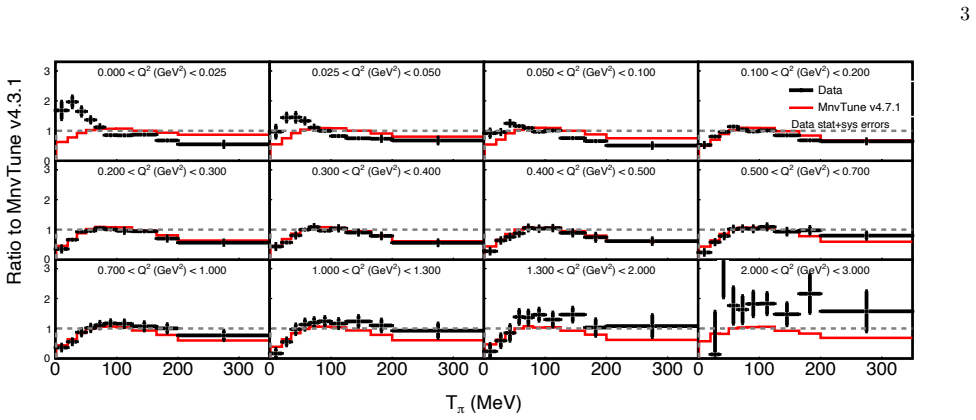
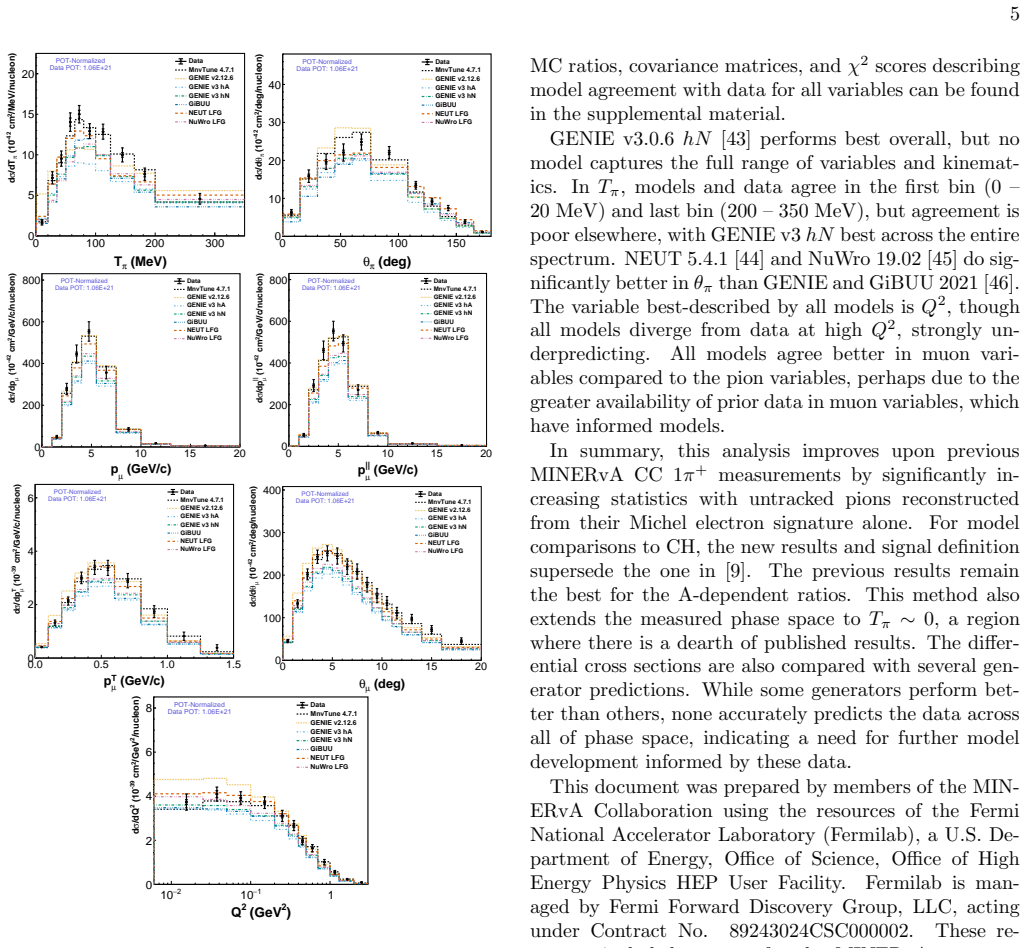
The paper establishes that modern pion production models agree with the measured cross sections at the kinematic extremes but are discrepant with the main regions of phase space by up to 15 percent in muon observables and up to 20 percent in pion observables. No model describes any of the variables well, based on the high-statistics sample of 91,843 events selected with W_exp less than 1.4 GeV per speed of light.
What carries the argument
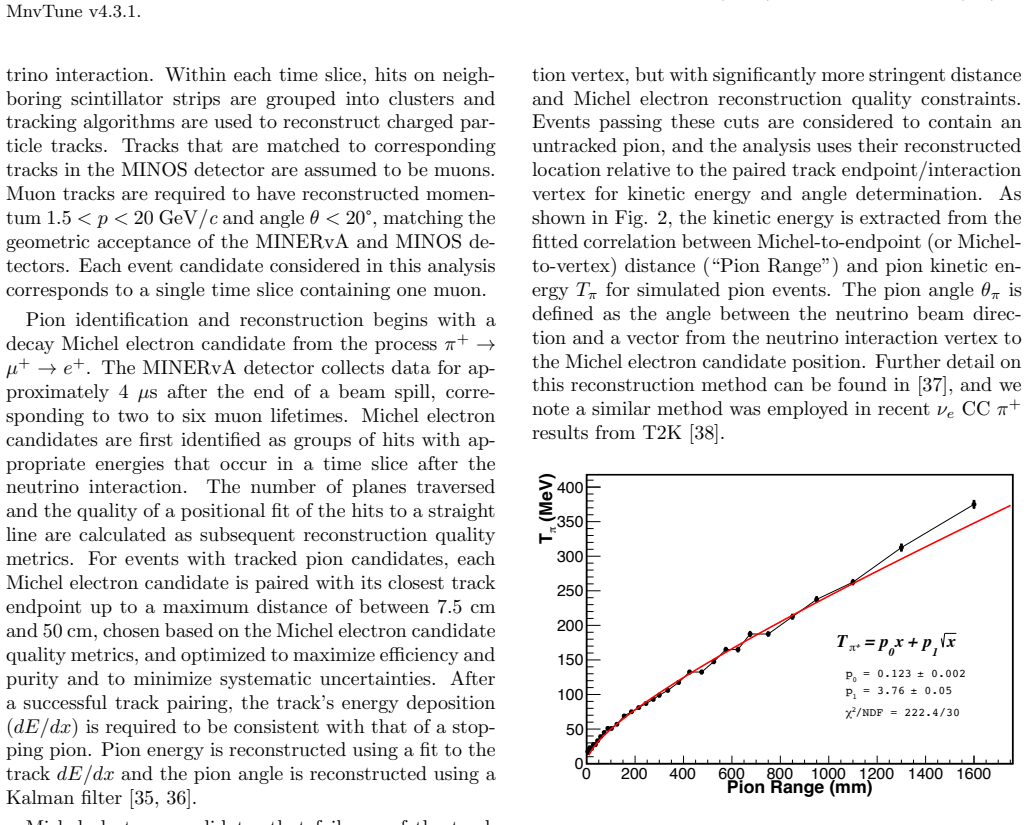
Single-differential cross sections in pion and muon kinematic variables, extracted using both track-based pion reconstruction and Michel electron decay identification to reach zero kinetic energy threshold.
If this is right
- Model refinements are required in the central kinematic regions to reduce discrepancies with data.
- No existing generator fully captures the observed distributions in either muon or pion observables.
- These measurements identify specific shortcomings in pion production modeling for future use.
- Improved models will be needed to support precision in next-generation neutrino oscillation experiments.
Where Pith is reading between the lines
- The observed discrepancies could guide targeted parameter adjustments in resonance and final-state interaction modeling.
- Repeating the analysis with varied nuclear targets would help separate nuclear medium effects from production dynamics.
- These data sets can serve as validation benchmarks when testing updated generator versions before deployment in oscillation analyses.
Load-bearing premise
The event selection with W_exp less than 1.4 GeV per speed of light and the two pion identification methods correctly isolate single-pion production events with negligible bias from backgrounds or reconstruction inefficiencies.
What would settle it
A neutrino event generator that matches all measured differential cross sections within experimental uncertainties across the central phase space regions would falsify the claim that no model describes the variables well.
Figures
read the original abstract
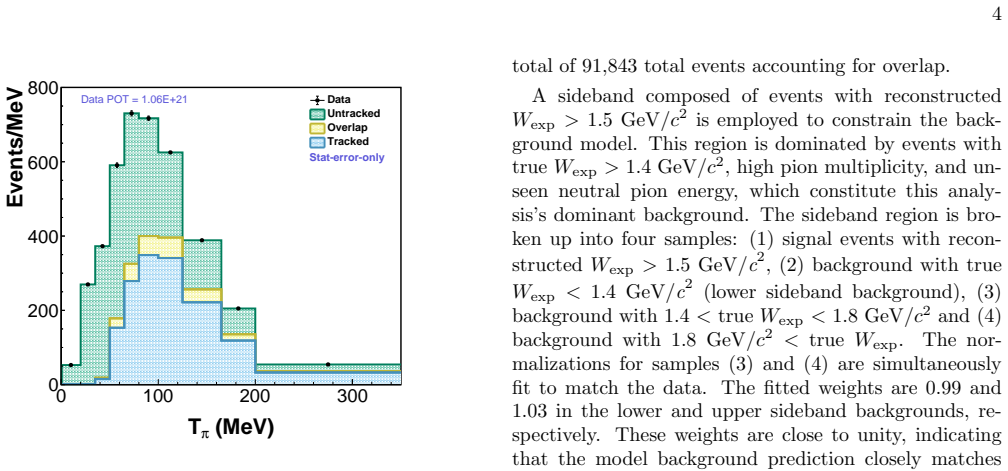
This Letter presents measurements of single-differential cross sections of $\nu_{\mu}$-induced charged-current 1 $\pi^{+}$ production on scintillator using the MINERvA detector at Fermilab. These measurements use traditional track-based pion reconstruction as well as pions identified solely via Michel electron decays, allowing measurement of kinetic energies from 0 to 350 MeV. In total, 91,843 events were selected with $W_{exp}$ $<$ 1.4 GeV/c. Differential cross sections as a function of pion and muon kinematic variables are presented and compared with the predictions of several neutrino event generators. Overall, modern pion production models tend to agree with data at the ends of the kinematic regions probed, but are discrepant with the main regions of the phase space probed by up to 15% in muon observables and up to 20% in pion observables. No model describes any of the variables well, and this result highlights model areas that require improvement for the next generation of neutrino oscillation experiments.
Editorial analysis
A structured set of objections, weighed in public.
Referee Report
Summary. The manuscript reports high-statistics measurements of ν_μ charged-current single π⁺ production cross sections on scintillator in MINERvA. It selects 91,843 events with W_exp < 1.4 GeV/c using both track-based pion reconstruction and Michel-electron identification to reach zero pion kinetic energy threshold, extracts single-differential cross sections in pion and muon kinematic variables, and compares them to several neutrino event generators, finding that modern models agree with data only at the kinematic extremes but disagree by up to 15% in muon observables and 20% in pion observables across the bulk of phase space, with no model describing any variable well.
Significance. If the reported event sample is shown to be a clean CC1π⁺ selection with well-controlled systematics, the result supplies important constraints on pion production modeling for next-generation neutrino oscillation experiments, particularly at low pion energies where data have historically been sparse.
major comments (1)
- [Event Selection and Background Subtraction] The central claim that no generator reproduces the data across the main phase-space regions rests on the purity and unbiased efficiency of the 91,843-event sample after the W_exp < 1.4 GeV/c cut and the combination of the two pion-ID methods. The manuscript must supply quantitative background fractions, sideband or control-region validation, and unfolding details (including any energy-dependent inefficiencies that differ between data and MC) to demonstrate that the quoted 15–20% discrepancies are not artifacts of residual multi-pion contamination or mis-ID.
minor comments (2)
- [Abstract] The abstract states the total event count and discrepancy percentages but does not mention the size of systematic uncertainties or the unfolding procedure; these should be summarized in the abstract for a measurement Letter.
- [Figures] Figure captions and axis labels should explicitly state whether the plotted cross sections are flux-averaged or flux-unfolded and whether they include the full covariance matrix.
Simulated Author's Rebuttal
We thank the referee for their careful review and for emphasizing the importance of demonstrating sample purity and efficiency. We address the single major comment below and will revise the manuscript to incorporate the requested quantitative details.
read point-by-point responses
-
Referee: [Event Selection and Background Subtraction] The central claim that no generator reproduces the data across the main phase-space regions rests on the purity and unbiased efficiency of the 91,843-event sample after the W_exp < 1.4 GeV/c cut and the combination of the two pion-ID methods. The manuscript must supply quantitative background fractions, sideband or control-region validation, and unfolding details (including any energy-dependent inefficiencies that differ between data and MC) to demonstrate that the quoted 15–20% discrepancies are not artifacts of residual multi-pion contamination or mis-ID.
Authors: We agree that quantitative validation of the 91,843-event sample is essential to support the reported discrepancies. The manuscript already describes the W_exp < 1.4 GeV/c cut, the combination of track-based and Michel-electron pion identification to reach zero kinetic energy threshold, and the overall selection. To address the referee's concern directly, the revised manuscript will add explicit background fraction estimates (e.g., multi-pion contamination and mis-ID rates), results from sideband/control-region studies, and expanded unfolding details including data-MC efficiency comparisons as a function of pion energy. These additions will confirm that the 15–20% model-data differences are not artifacts of the selection. revision: yes
Circularity Check
Pure experimental measurement; no derivation reduces to self-inputs
full rationale
The paper reports differential cross sections extracted from 91,843 selected events in MINERvA data, using track-based and Michel-electron pion identification under a W_exp < 1.4 GeV/c cut. These are compared to external neutrino generators. No equations fit parameters to a data subset and then present the same or closely related quantities as predictions; no self-citation chain supplies a uniqueness theorem or ansatz that the central result depends upon; the reported discrepancies (up to 15-20%) are direct data-vs-model comparisons, not quantities defined by the measurement itself. The analysis is therefore self-contained against external benchmarks and receives the default non-circularity finding.
Axiom & Free-Parameter Ledger
axioms (1)
- domain assumption Standard assumptions in neutrino event reconstruction, background estimation, and detector response modeling from prior MINERvA publications
Reference graph
Works this paper leans on
-
[1]
J. A. Formaggio and G. P. Zeller, Rev. Mod. Phys.84, 1307 (2012), arXiv:1305.7513 [hep-ex]
work page internal anchor Pith review Pith/arXiv arXiv 2012
-
[2]
M. A. Acero, Adamson,et al.(The NOvA Collabora- tion), Phys. Rev. D106, 032004 (2022)
2022
-
[3]
K. Abeet al.(T2K), Nucl. Instrum. Meth. A659, 106 (2011), arXiv:1106.1238 [physics.ins-det]
-
[4]
Hyper-Kamiokande Design Report
K. Abeet al.(Hyper-Kamiokande), “Hyper- Kamiokande Design Report,” (2018), (unpublished), arXiv:1805.04163 [physics.ins-det]
work page internal anchor Pith review Pith/arXiv arXiv 2018
-
[5]
R. Acciarriet al.(DUNE), “Long-Baseline Neutrino Fa- cility (LBNF) and Deep Underground Neutrino Exper- iment (DUNE): Conceptual Design Report, Volume 2: The Physics Program for DUNE at LBNF,” (2015), (un- published), arXiv:1512.06148 [physics.ins-det]
-
[6]
Aliagaet al.(MINERvA), Nucl
L. Aliagaet al.(MINERvA), Nucl. Instrum. Meth. A 743, 130 (2014)
2014
-
[7]
Eberlyet al.(MINERvA), Phys
B. Eberlyet al.(MINERvA), Phys. Rev. D92, 092008 (2015)
2015
-
[8]
C. L. McGivernet al.(MINERvA), Phys. Rev. D94, 052005 (2016)
2016
-
[9]
Bercellie, K
A. Bercellie, K. A. Kroma-Wiley,et al.(The MINERvA Collaboration), Phys. Rev. Lett.131, 011801 (2023)
2023
-
[10]
Anderson, B
K. Anderson, B. Bernstein, D. Boehnlein, K. R. Bourk- land, S. Childress,et al.,The NuMI Facility Techni- cal Design Report, FERMILAB-DESIGN-1998-01 (Fer- milab, 1998)
1998
-
[11]
Adamsonet al., Nucl
P. Adamsonet al., Nucl. Instrum. Meth. A806, 279 (2016)
2016
-
[12]
D. G. Michaelet al.(MINOS), Nucl. Instrum. Meth. A 596, 190 (2008)
2008
-
[13]
Allisonet al., Nuclear Science, IEEE Transactions on 53, 270 (2006)
J. Allisonet al., Nuclear Science, IEEE Transactions on 53, 270 (2006)
2006
-
[14]
Agostinelliet al.(GEANT4), Nucl
S. Agostinelliet al.(GEANT4), Nucl. Instrum. Meth. A 506, 250 (2003)
2003
-
[15]
Aliagaet al.(MINERvA), Phys
L. Aliagaet al.(MINERvA), Phys. Rev. D94, 092005 (2016), [Addendum: Phys. Rev. D95, 039903 (2017)]
2016
-
[16]
Ruterborieset al.(MINERvA), Phys
D. Ruterborieset al.(MINERvA), Phys. Rev. D104, 092010 (2021)
2021
-
[17]
Zazueta, Akhter,et al.(MINERνA Collaboration), Phys
L. Zazueta, Akhter,et al.(MINERνA Collaboration), Phys. Rev. D107, 012001 (2023)
2023
-
[18]
Aliagaet al.(MINERvA), Nucl
L. Aliagaet al.(MINERvA), Nucl. Instrum. Meth. A 789, 28 (2015)
2015
-
[19]
Andreopouloset al., Nucl
C. Andreopouloset al., Nucl. Instrum. Meth. A614, 87 (2010), Program version 2.8.4, with private modi- fications, used here
2010
-
[20]
Andreopouloset al.(GENIE), Nucl
C. Andreopouloset al.(GENIE), Nucl. Instrum. Meth. A614, 87 (2010)
2010
-
[21]
Hassanabadi, A
H. Hassanabadi, A. Armat, and L. Naderi, Found. Phys. 44, 1188 (2014)
2014
-
[22]
Bodek and J
A. Bodek and J. L. Ritchie, Phys. Rev. D23, 1070 (1981)
1981
-
[23]
Bodek and J
A. Bodek and J. L. Ritchie, Phys. Rev. D24, 1400 (1981)
1981
-
[24]
Hadronic Shower Energy Scale Uncertainty in the MINOS Experiment
S. Dytman, H. Gallagher, and M. Kordosky, “Hadronic shower energy scale uncertainty in the minos experi- ment,” (2008), arXiv:0806.2119 [hep-ex]
work page internal anchor Pith review Pith/arXiv arXiv 2008
-
[25]
J. Kleykampet al.(MINERvA), Phys. Rev. Lett.130, 161801 (2023), arXiv:2301.02272 [hep-ex]
-
[26]
Bodek, I
A. Bodek, I. Park, and U.-K. Yang, Nucl. Phys. Proc. Suppl.139, 113 (2005)
2005
-
[27]
Rein and L
D. Rein and L. M. Sehgal, Nucl. Phys. B223, 29 (1983)
1983
-
[28]
Rein and L
D. Rein and L. M. Sehgal, Annals Phys.133, 79 (1981)
1981
-
[29]
Rodrigues, C
P. Rodrigues, C. Wilkinson, and K. McFarland, Eur. Phys. J. C76, 474 (2016)
2016
-
[30]
A. Mislivecet al.(MINERvA), Phys. Rev. D97, 032014 (2018), arXiv:1711.01178 [hep-ex]
work page internal anchor Pith review Pith/arXiv arXiv 2018
-
[31]
L. A. Harewood and R. Gran, (2019), arXiv:1906.10576 [hep-ex]
work page internal anchor Pith review Pith/arXiv arXiv 2019
-
[32]
M. A. Ram´ ırez, Akhter,et al.(The MINERvA Collabo- ration), Phys. Rev. Lett.131, 051801 (2023)
2023
-
[33]
B. Z. Kopeliovich, I. Schmidt, and M. Siddikov, Phys. Rev. D85, 073003 (2012)
2012
-
[34]
Hayato, Acta Phys
Y. Hayato, Acta Phys. Polon. B40, 2477 (2009)
2009
-
[35]
Fruhwirth, Nucl
R. Fruhwirth, Nucl. Instrum. Meth. A262, 444 (1987)
1987
-
[36]
Luchsinger and C
R. Luchsinger and C. Grab, Comput. Phys. Commun. 76, 263 (1993)
1993
-
[37]
Sultana,MSemi-inclusive measurement of charged- current [pi]+ production in MINERvA for T[pi]+ ¿ 0 GeV, Ph.D
M. Sultana,MSemi-inclusive measurement of charged- current [pi]+ production in MINERvA for T[pi]+ ¿ 0 GeV, Ph.D. thesis, University of Rochester (2024)
2024
-
[38]
Abeet al.(T2K), Phys
K. Abeet al.(T2K), Phys. Rev. Lett.135, 151802 (2025)
2025
-
[39]
D’Agostini, Nucl
G. D’Agostini, Nucl. Instrum. Meth. A362, 487 (1995)
1995
-
[40]
Improved iterative Bayesian unfolding
G. D’Agostini, inAlliance Workshop on Unfolding and Data Correction(2010) arXiv:1010.0632 [physics.data- an]
work page internal anchor Pith review Pith/arXiv arXiv 2010
-
[41]
Unfolding algorithms and tests using RooUnfold
T. Adye, inPHYSTAT 2011(CERN, Geneva, 2011) pp. 313–318, arXiv:1105.1160 [physics.data-an]
work page internal anchor Pith review Pith/arXiv arXiv 2011
-
[42]
Messerly, R
B. Messerly, R. Fine, and A. Olivier, EPJ Web of Con- ferences251, 03046 (2021)
2021
-
[43]
The GENIE Neutrino Monte Carlo Generator: Physics and User Manual
C. Andreopoulos, C. Barry, S. Dytman, H. Gallagher, T. Golan, R. Hatcher, G. Perdue, and J. Yarba, “The genie neutrino monte carlo generator: Physics and user manual,” (2015), arXiv:1510.05494 [hep-ph]
work page internal anchor Pith review Pith/arXiv arXiv 2015
-
[44]
Hayato and L
Y. Hayato and L. Pickering, The European Physical Journal Special Topics230, 4469–4481 (2021)
2021
-
[45]
Final State Interactions Effects in Neutrino-Nucleus Interactions
T. Golan, C. Juszczak, and J. T. Sobczyk, Phys. Rev. C 86, 015505 (2012), arXiv:1202.4197 [nucl-th]
work page internal anchor Pith review Pith/arXiv arXiv 2012
-
[46]
O. Buss, T. Gaitanos, K. Gallmeister, H. van Hees, M. Kaskulov, O. Lalakulich, A. Larionov, T. Leitner, J. Weil, and U. Mosel, Physics Reports512, 1 (2012), transport-theoretical Description of Nuclear Reactions. 7 SUPPLEMENTAL MATERIAL Error Summary Plots 0 50 100 150 200 250 300 350 (MeV) πT0.0 0.1 0.2 0.3 Fractional Uncertainty Total Uncertainty Statis...
discussion (0)
Sign in with ORCID, Apple, or X to comment. Anyone can read and Pith papers without signing in.