Plume Segmentation from MethaneSAT with Cross-Sensor Transfer Learning and Physics-Informed Postprocessing
Pith reviewed 2026-06-30 15:16 UTC · model grok-4.3
The pith
Mask R-CNN fine-tuned from airborne data segments methane plumes in MethaneSAT images at 0.98 recall.
A machine-rendered reading of the paper's core claim, the machinery that carries it, and where it could break.
Core claim
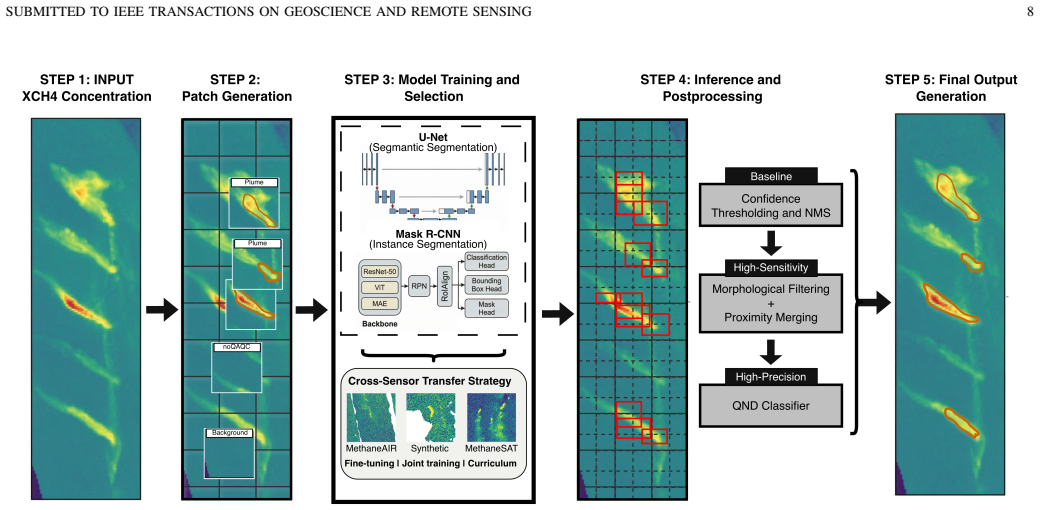
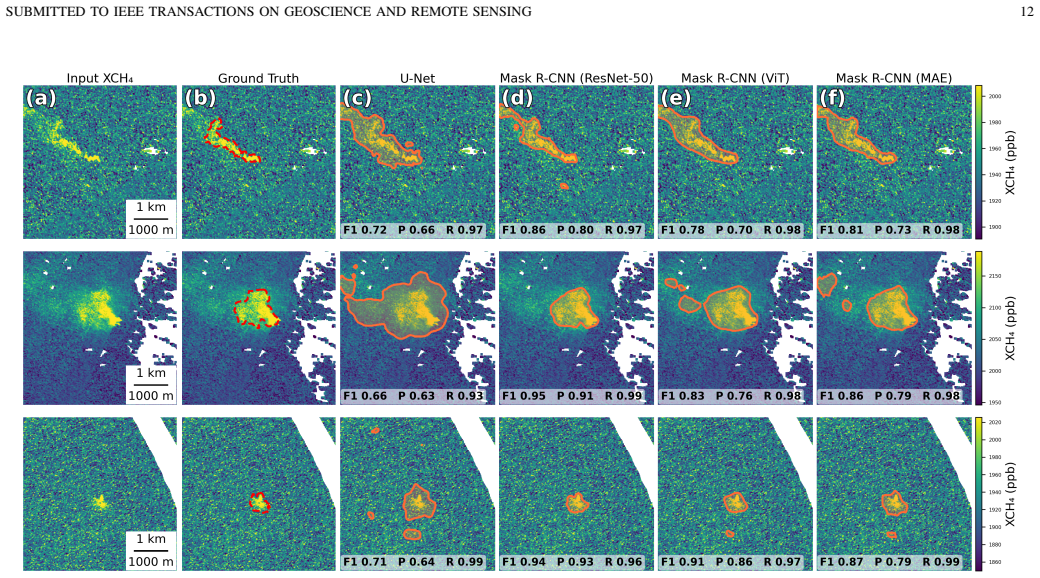
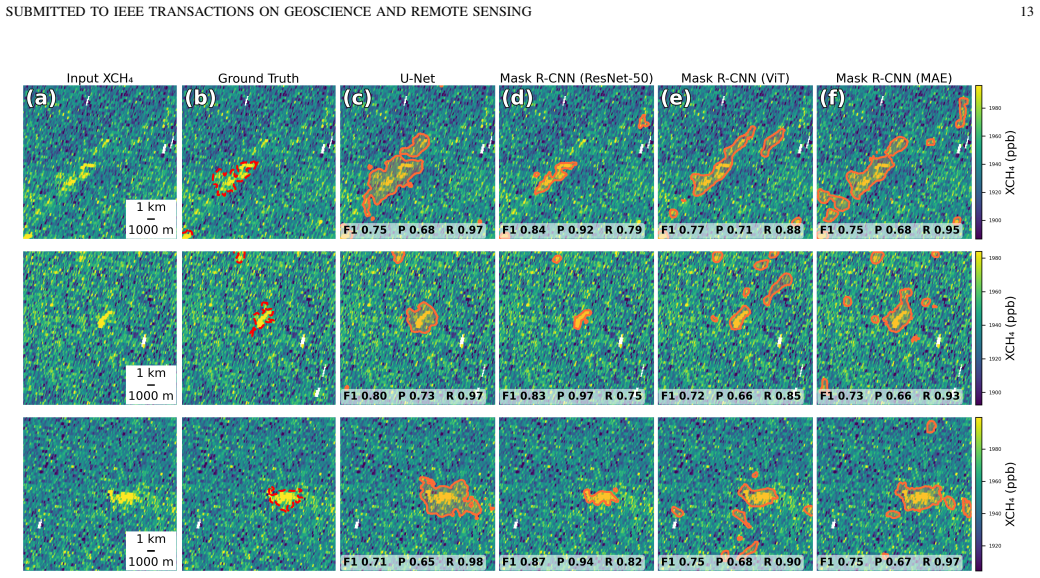
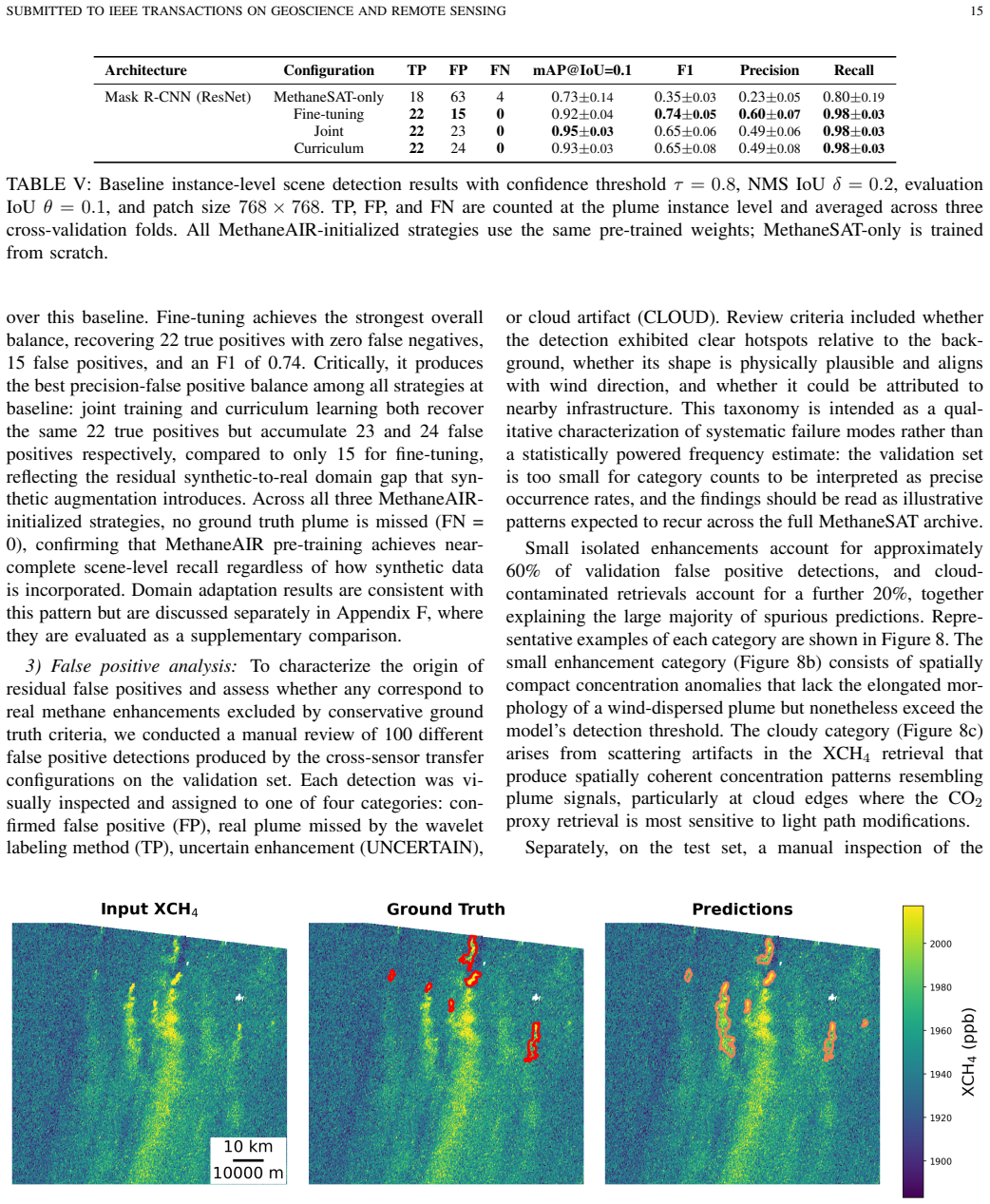
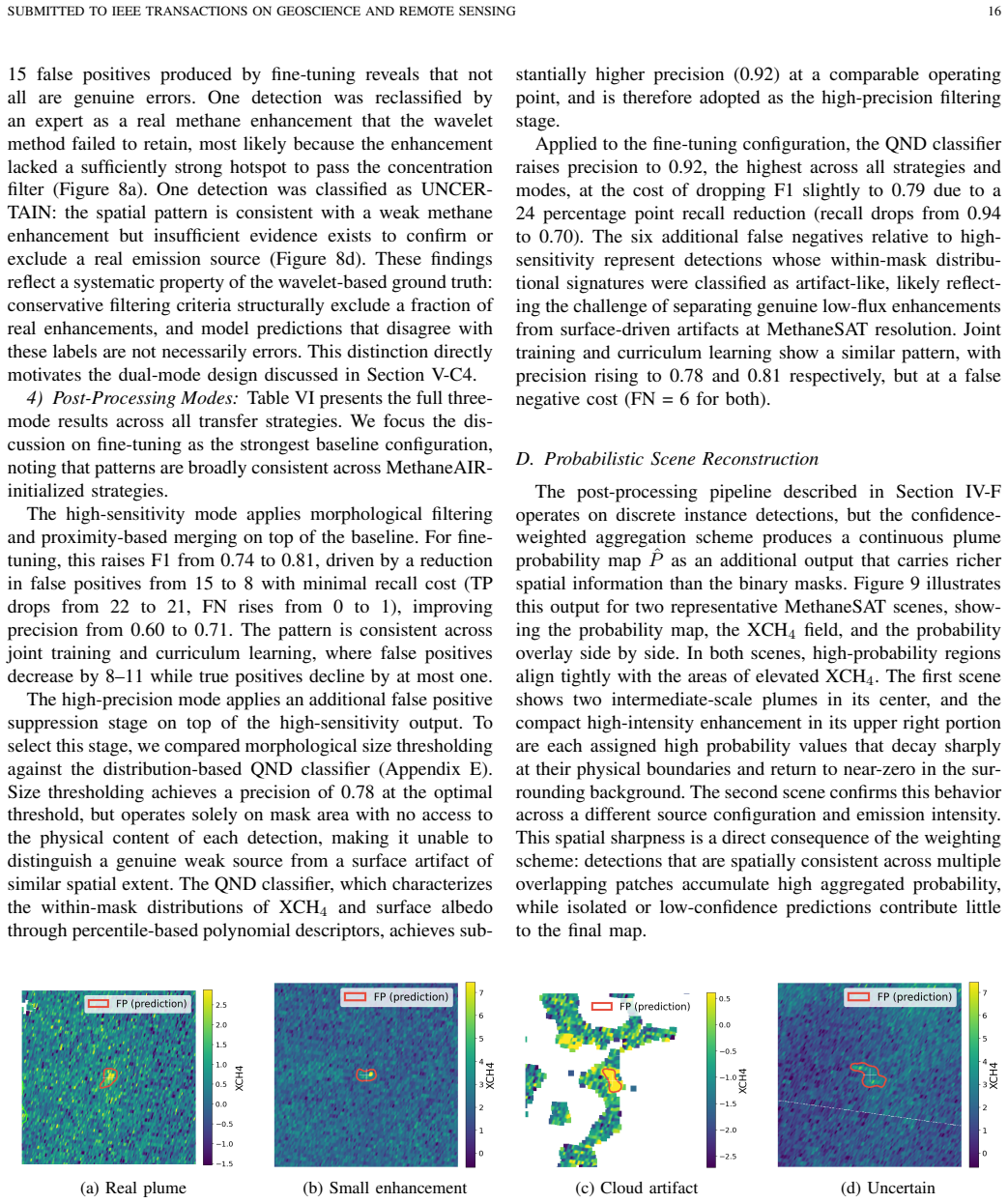
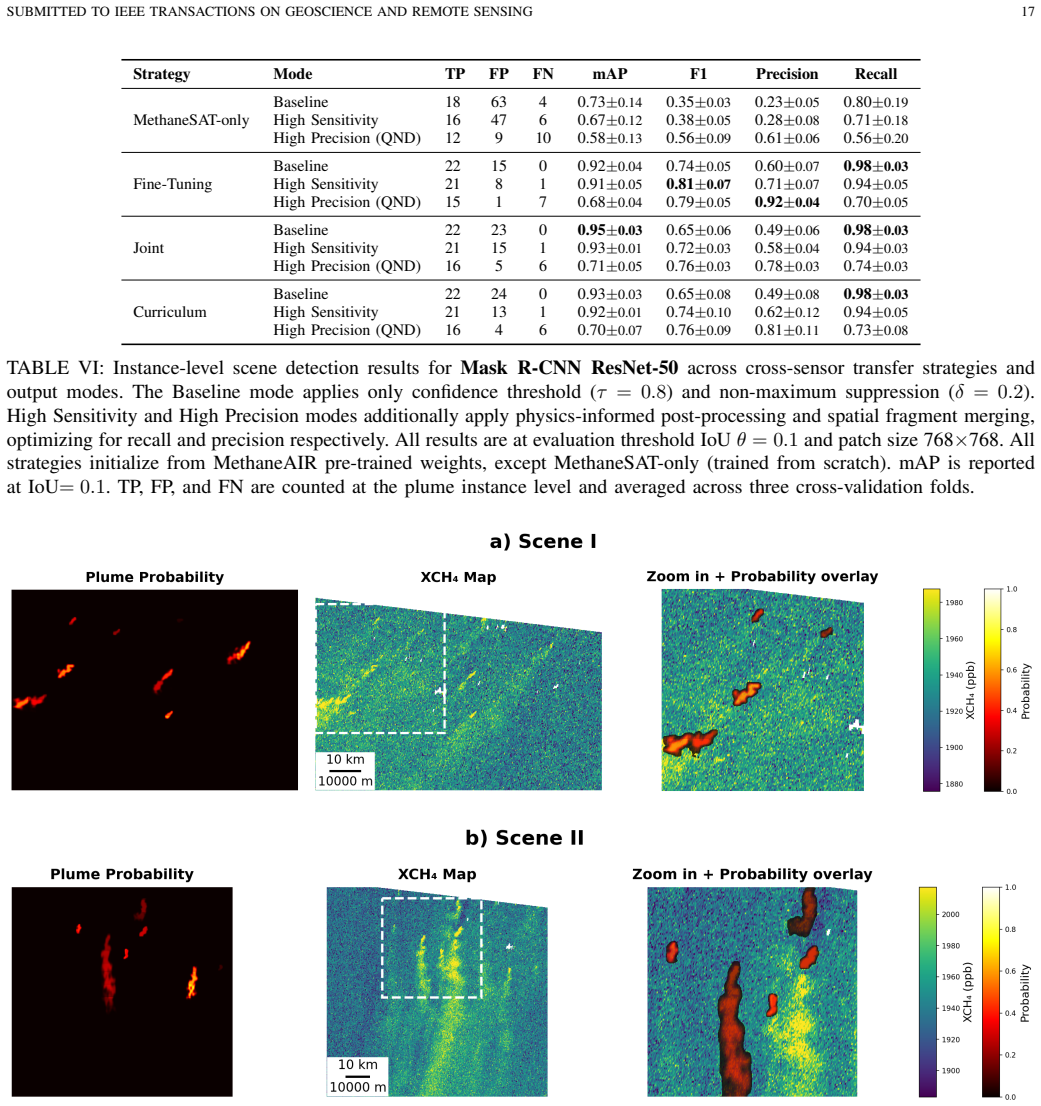
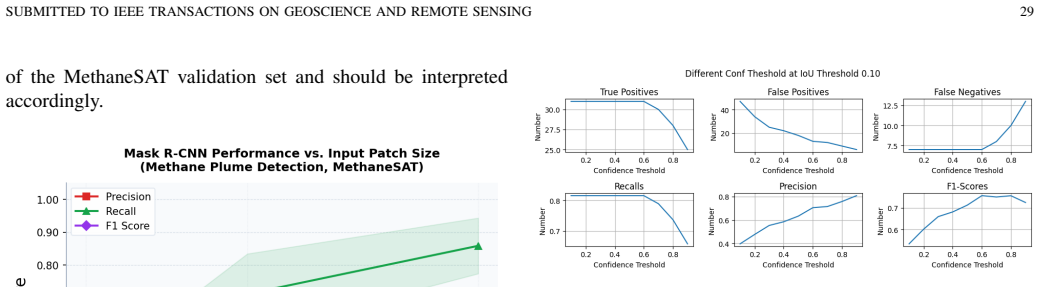
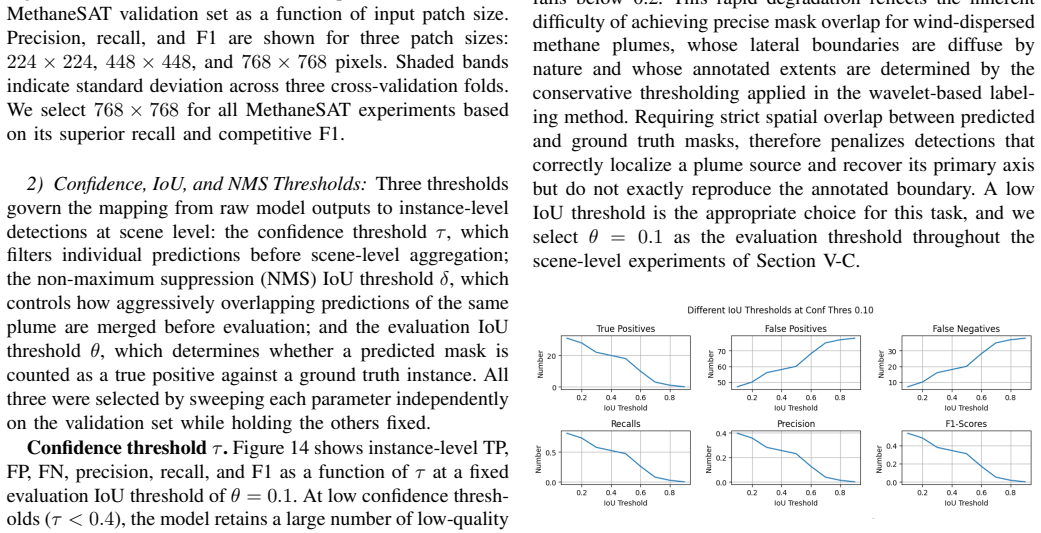
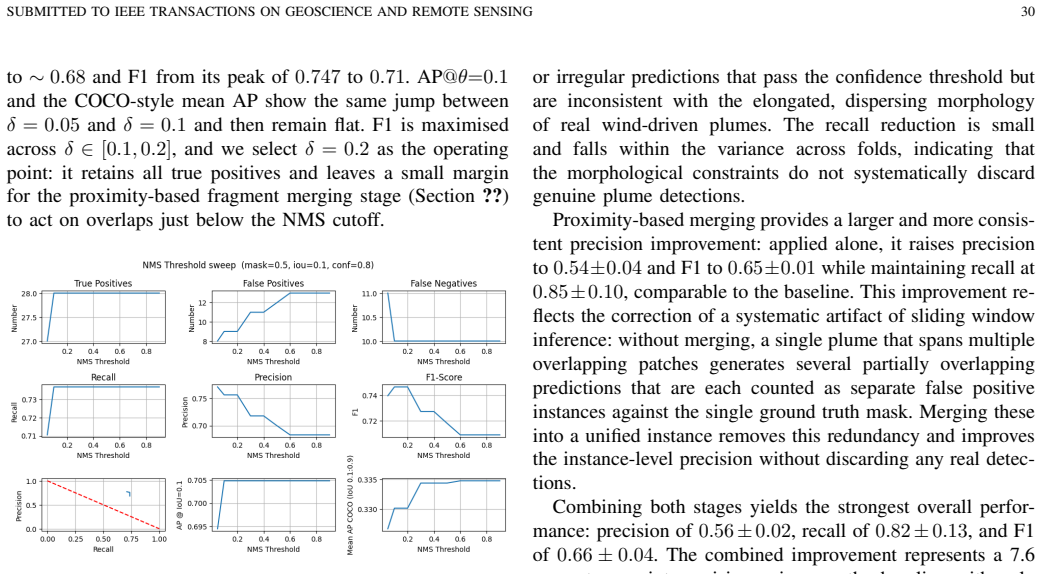
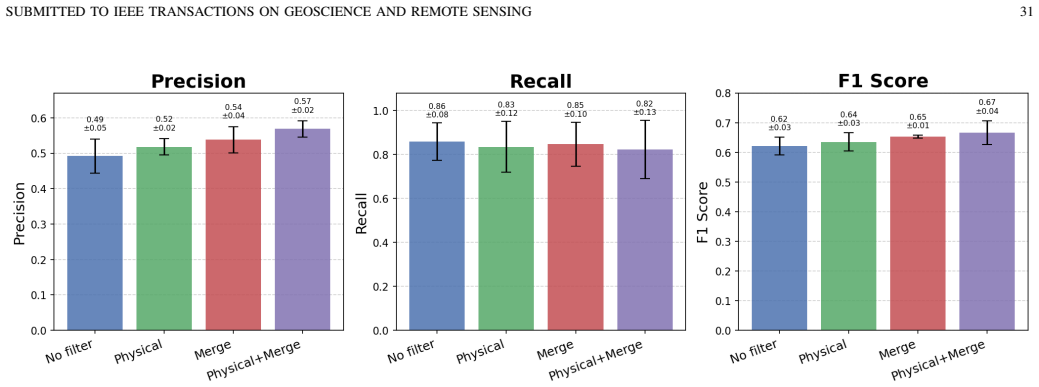
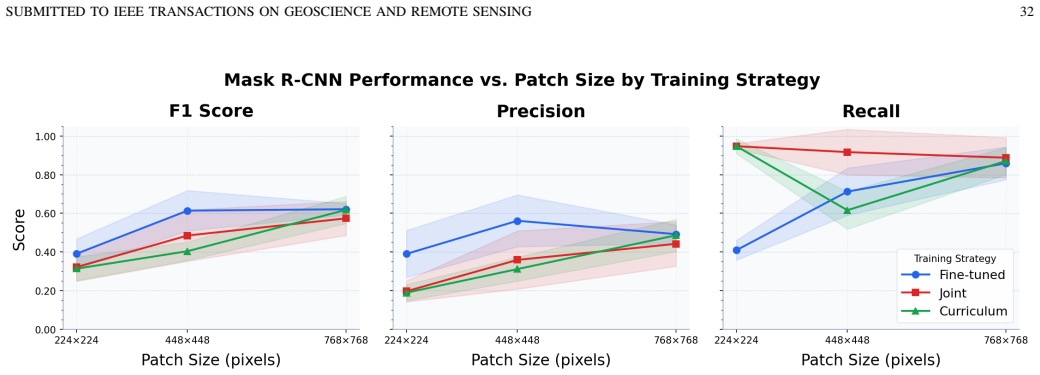
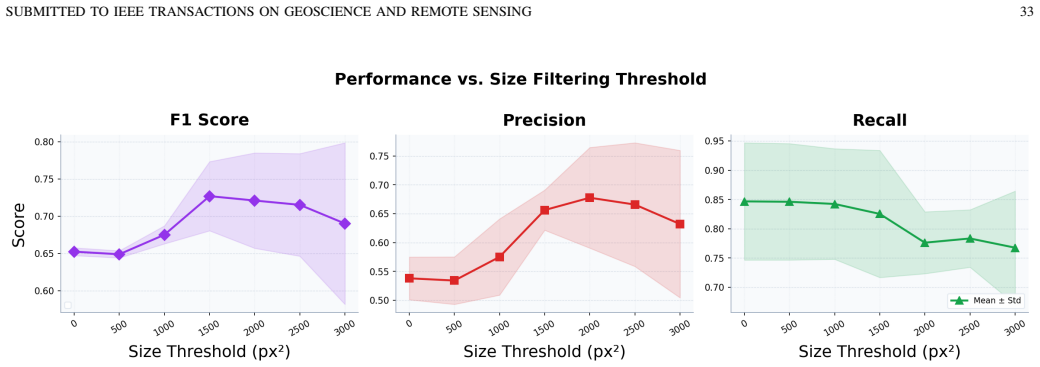
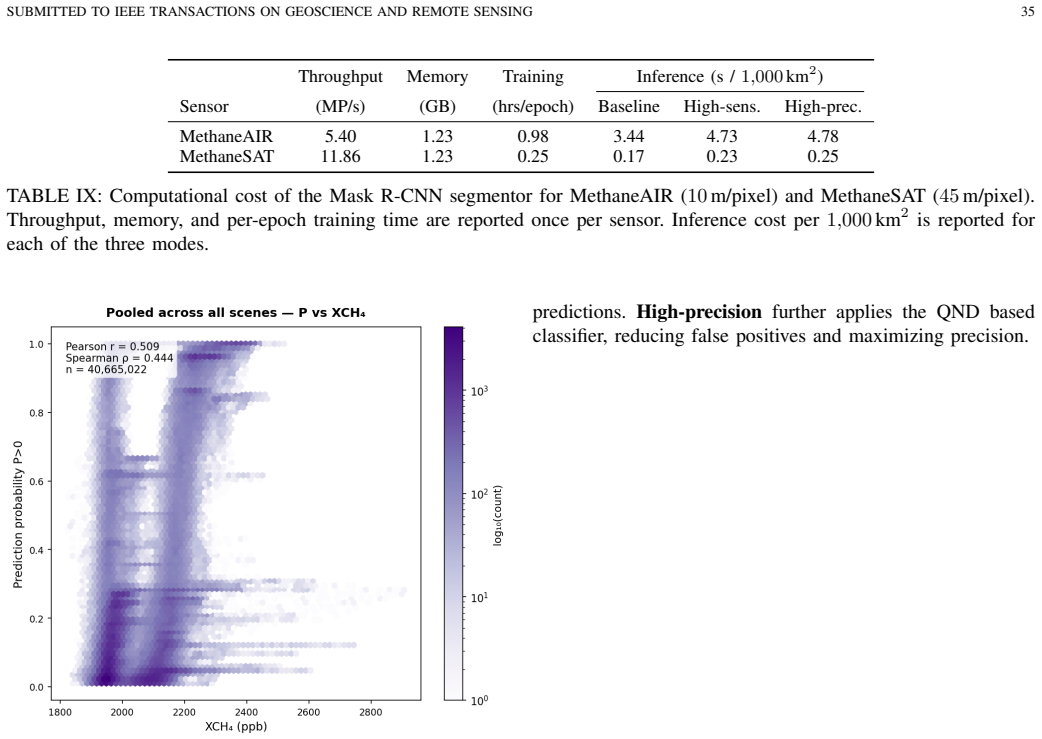
Mask R-CNN with ResNet-50 backbone fine-tuned from MethaneAIR pre-trained weights outperforms U-Net semantic segmentation and other cross-sensor transfer strategies on MethaneSAT data, delivering instance-level precision of 0.60 and recall of 0.98 at the baseline operating point. A physics-informed post-processing pipeline that applies morphological filtering, proximity-based merging, and a distribution-based classifier then converts these detections into a high-sensitivity mode (precision 0.71, recall 0.94) for comprehensive screening and a high-precision mode (precision 0.92, recall 0.70) for confident source attribution. Manual review of false positives against the wavelet-based labels in
What carries the argument
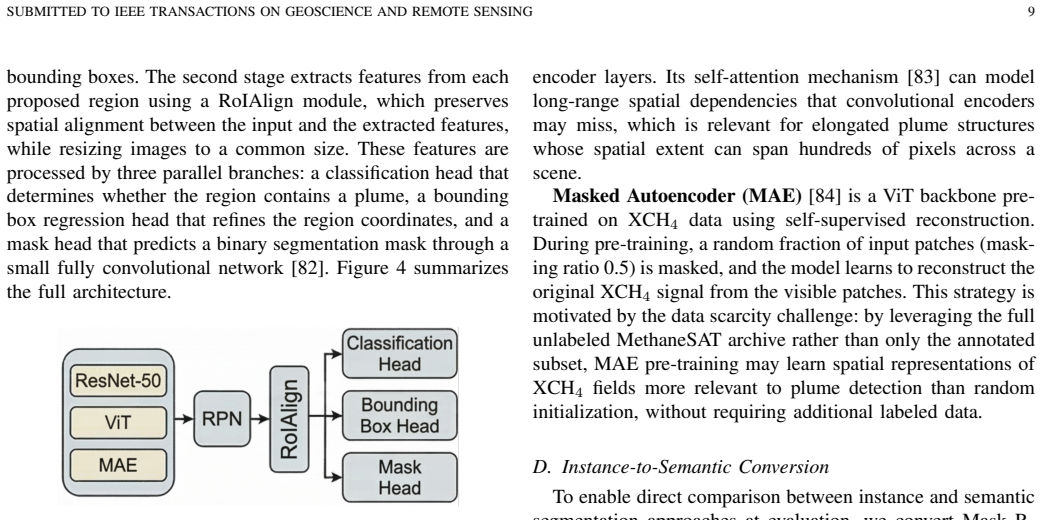
Mask R-CNN instance segmentation model with ResNet-50 backbone, cross-sensor transfer from MethaneAIR pre-trained weights, and physics-informed post-processing pipeline using morphological filtering, proximity merging, and distribution-based classification.
If this is right
- The high-sensitivity mode supports broad emission screening across varied atmospheric and surface conditions.
- The high-precision mode enables confident attribution of emissions to specific sources.
- Transfer learning from airborne to satellite data overcomes scarcity of labeled MethaneSAT examples.
- Instance segmentation outperforms semantic segmentation for separating individual plumes.
- Reported precision values represent lower bounds on true detection performance.
Where Pith is reading between the lines
- The same transfer strategy could be tested on other satellite methane sensors that lack large labeled datasets.
- High-recall detections could feed into atmospheric transport models for improved total emission estimates.
- Future work might replace conservative wavelet labels with multi-sensor or in-situ validation to raise measured precision.
- The two-mode output suggests the framework can be tuned differently for screening versus regulatory attribution tasks.
Load-bearing premise
The wavelet-based ground truth labels accurately capture all real methane plumes even though they are known to be conservative and exclude some enhancements.
What would settle it
Independent aircraft or ground-based methane concentration measurements over a set of model-detected plumes that the wavelet labels marked as false positives, to determine how many are actually real enhancements.
Figures

read the original abstract
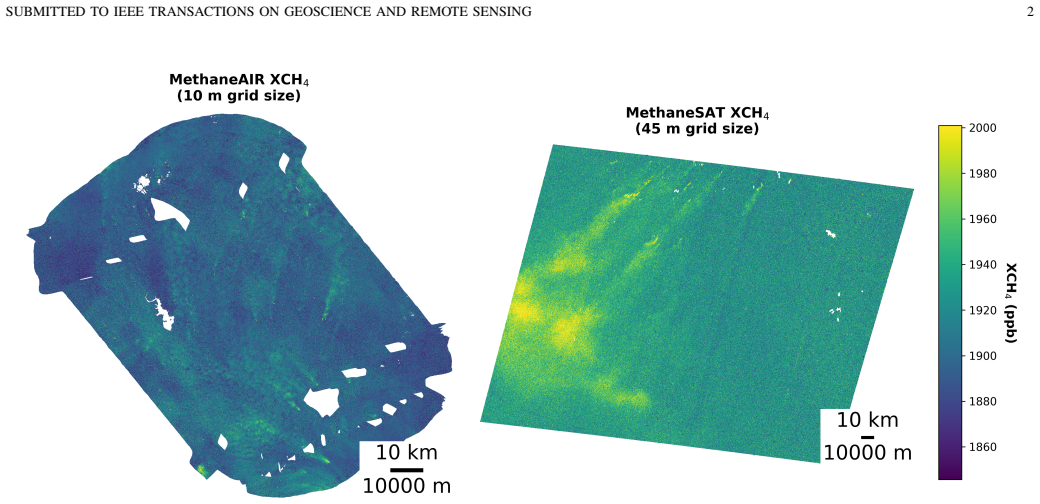
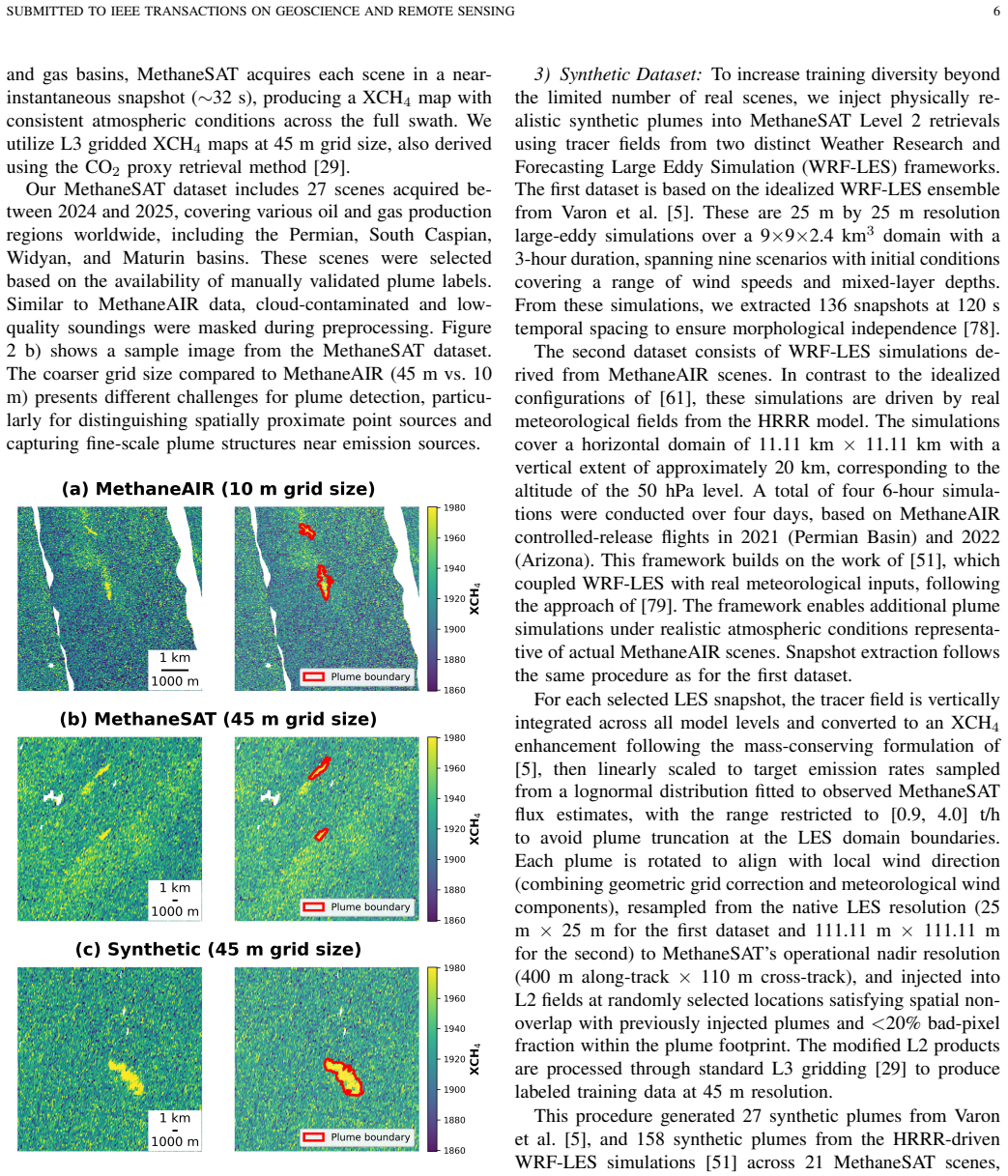
Automated detection and masking of individual methane plumes from satellite imagery is important for operational emission attribution and quantification. We present a machine learning framework for plume detection from MethaneSAT retrieved column-averaged dry-air mole fractions of methane. We address two core challenges: the scarcity of labeled MethaneSAT data and the need for inference reliability across diverse atmospheric and surface conditions. We first demonstrate that Mask R-CNN with a ResNet-50 backbone outperforms U-Net semantic segmentation on both MethaneAIR (an airborne version of MethaneSAT) and MethaneSAT data, with pixel-level F1 score gains of 10.49 and 5.48 respectively. To address MethaneSAT data scarcity, we evaluate three cross-sensor transfer strategies leveraging MethaneAIR flights and synthetic plumes. Mask R-CNN with ResNet-50 fine-tuned from MethaneAIR pre-trained weights is the most effective strategy, achieving instance-level precision of 0.60 and a near-perfect recall of 0.98 at the baseline operating point. A physics-informed post-processing pipeline converts detections into two operationally distinct modes. The first is a high-sensitivity mode that applies morphological filtering and proximity-based merging for comprehensive emission screening, achieving precision of 0.71 and recall of 0.94. The second is a high-precision mode that additionally applies a distribution-based classifier for confident source attribution, achieving precision of 0.92 and recall of 0.70. Manual review of detections classified as false positives against our wavelet-based ground truth labels reveals that a meaningful fraction of cases correspond to real methane enhancements excluded by conservative labeling criteria, indicating that precision values reported are lower bounds on true detection performance... Our data and code are available at: https://doi.org/10.7910/DVN/FR959H
Editorial analysis
A structured set of objections, weighed in public.
Referee Report
Summary. The manuscript presents a machine learning framework for instance-level segmentation of methane plumes in MethaneSAT column-averaged dry-air mole fraction imagery. It shows that Mask R-CNN with ResNet-50 backbone outperforms U-Net, demonstrates the effectiveness of cross-sensor transfer learning from MethaneAIR pre-trained weights over other strategies, and introduces a physics-informed post-processing pipeline that produces two operating modes (high-sensitivity with morphological filtering and proximity merging; high-precision with an added distribution-based classifier). Instance-level metrics are reported as 0.60/0.98 (baseline), 0.71/0.94 (high-sensitivity), and 0.92/0.70 (high-precision). The abstract states that wavelet-based ground-truth labels are conservative and that manual review of false positives indicates a meaningful fraction correspond to real enhancements, so reported precision values are lower bounds on true performance. Data and code are released.
Significance. If the empirical results and the lower-bound interpretation hold after clarification, the work supplies a concrete, transferable pipeline for operational methane plume detection that addresses data scarcity via cross-sensor transfer and offers distinct sensitivity/precision modes. The explicit release of data and code at the cited DOI is a clear strength that supports reproducibility and follow-on work in remote-sensing applications for greenhouse-gas monitoring.
major comments (1)
- [Abstract] Abstract: The claim that 'precision values reported are lower bounds on true detection performance' is grounded solely in the statement that 'a meaningful fraction' of false positives against the wavelet labels correspond to real enhancements upon manual review. No counts of reviewed cases, explicit decision criteria for identifying 'real methane enhancements,' or inter-reviewer consistency metrics are supplied. Because this interpretation directly affects the operational reading of the high-precision mode (0.92 precision), the absence of quantification is load-bearing for the central performance claims.
Simulated Author's Rebuttal
We thank the referee for their constructive review and for recognizing the potential utility of the pipeline for operational methane monitoring. We address the single major comment below and commit to revisions that strengthen the presentation of performance claims.
read point-by-point responses
-
Referee: The claim that 'precision values reported are lower bounds on true detection performance' is grounded solely in the statement that 'a meaningful fraction' of false positives against the wavelet labels correspond to real enhancements upon manual review. No counts of reviewed cases, explicit decision criteria for identifying 'real methane enhancements,' or inter-reviewer consistency metrics are supplied. Because this interpretation directly affects the operational reading of the high-precision mode (0.92 precision), the absence of quantification is load-bearing for the central performance claims.
Authors: We agree that the lower-bound interpretation requires more rigorous support than is currently provided. The manual review was qualitative and intended only as supporting context for the conservative nature of the wavelet labels. In the revised manuscript we will remove the explicit 'lower bounds' phrasing from the abstract (and any corresponding claims in the main text) unless the original review records can supply the requested counts, decision criteria, and consistency metrics. If the latter is possible we will add a short supplementary note with those details; otherwise the claim will be qualified or omitted to ensure the reported metrics are presented without unsubstantiated qualification. revision: yes
Circularity Check
No circularity: empirical metrics on held-out data with independent post-processing
full rationale
The reported instance-level precision and recall values are computed directly from model outputs evaluated against held-out MethaneSAT test imagery using standard detection metrics; they do not reduce by any equation to quantities defined in terms of the model's own fitted parameters or self-referential labels. The physics-informed post-processing (morphological filtering, proximity merging, distribution-based classifier) applies deterministic rules to detections rather than re-deriving performance from the training objective. The lower-bound interpretation of precision rests on an external manual review step whose details are not part of any derivation chain. No self-citations, uniqueness theorems, or ansatzes are invoked to justify core claims. The chain is therefore self-contained against external benchmarks.
Axiom & Free-Parameter Ledger
free parameters (1)
- post-processing thresholds
axioms (2)
- domain assumption MethaneAIR airborne retrievals have sufficiently similar characteristics to MethaneSAT satellite retrievals for effective domain transfer
- domain assumption Wavelet-based labeling produces reliable but conservative ground truth that excludes some real plumes
Reference graph
Works this paper leans on
-
[1]
Global methane tracker 2023
IEA. Global methane tracker 2023. Technical report, International Energy Agency, Paris, 2023. Licence: CC BY 4.0 (report); CC BY NC SA 4.0 (Annex A)
2023
-
[2]
Methane leaks from north american natural gas systems.Science, 343(6172):733–735, 2014
Adam R Brandt, GA Heath, EA Kort, Francis O’Sullivan, Gabrielle P ´etron, Sarah M Jordaan, P Tans, Jennifer Wilcox, AM Gopstein, Doug Arent, et al. Methane leaks from north american natural gas systems.Science, 343(6172):733–735, 2014
2014
-
[3]
Reconciling divergent estimates of oil and gas methane emissions.Proceedings of the National Academy of Sciences, 112(51):15597–15602, 2015
Daniel Zavala-Araiza, David R Lyon, Ram ´on A Alvarez, Kenneth J Davis, Robert Harriss, Scott C Herndon, Anna Karion, Eric Adam Kort, Brian K Lamb, Xin Lan, et al. Reconciling divergent estimates of oil and gas methane emissions.Proceedings of the National Academy of Sciences, 112(51):15597–15602, 2015
2015
-
[4]
Thorpe, David R
Christian Frankenberg, Andrew K. Thorpe, David R. Thompson, Glynn Hulley, Eric Adam Kort, Nick Vance, Jakob Borchardt, Thomas Krings, Konstantin Gerilowski, Colm Sweeney, Stephen Conley, Brian D. Bue, An- drew D. Aubrey, Simon Hook, and Robert O. Green. Airborne methane remote measurements reveal heavy-tail flux distribution in four corners region.Proceed...
2016
-
[5]
D. J. Varon, D. Jervis, J. McKeever, I. Spence, D. Gains, and D. J. Jacob. High-frequency monitoring of anoma- lous methane point sources with multispectral sentinel-2 satellite observations.Atmospheric Measurement Tech- niques, 14(4):2771–2785, 2021
2021
-
[6]
Lyon, Benjamin Hmiel, Katherine A
Mark Omara, Daniel Zavala-Araiza, David R. Lyon, Benjamin Hmiel, Katherine A. Roberts, and Steven P. Hamburg. Methane emissions from US low production oil and natural gas well sites.Nature Communications, 13(1):2085, 2022
2085
-
[7]
J. P. Williams, M. Omara, A. Himmelberger, D. Zavala- Araiza, K. MacKay, J. Benmergui, M. Sargent, S. C. Wofsy, S. P. Hamburg, and R. Gautam. Small emission sources in aggregate disproportionately account for a large majority of total methane emissions from the us oil and gas sector.Atmospheric Chemistry and Physics, 25(3):1513–1532, 2025
2025
-
[8]
Myhre, D
G. Myhre, D. Shindell, F.-M. Br ´eon, W. Collins, J. Fu- glestvedt, J. Huang, D. Koch, J.-F. Lamarque, D. Lee, B. Mendoza, T. Nakajima, A. Robock, G. Stephens, T. Takemura, and H. Zhang.Anthropogenic and natural radiative forcing, pages 659–740. Cambridge University Press, Cambridge, UK, 2013
2013
-
[9]
Highwood, and Keith P
Maryam Etminan, Gunnar Myhre, Eleanor J. Highwood, and Keith P. Shine. Radiative forcing of carbon dioxide, methane, and nitrous oxide: A significant revision of the methane radiative forcing.Geophysical Research Letters, 43:12,614 – 12,623, 2016. SUBMITTED TO IEEE TRANSACTIONS ON GEOSCIENCE AND REMOTE SENSING 21
2016
-
[10]
Global methane pledge: which countries are cutting emissions?World Economic Forum, August 2024
World Economic Forum. Global methane pledge: which countries are cutting emissions?World Economic Forum, August 2024. Accessed: 2025-07-17
2024
-
[11]
Oil & gas decarbonization charter
COP28 UAE. Oil & gas decarbonization charter. https: //www.ogdc.org/, 2023. Launched at COP28, Dubai
2023
-
[12]
D. J. Jacob, A. J. Turner, J. D. Maasakkers, J. Sheng, K. Sun, X. Liu, K. Chance, I. Aben, J. McKeever, and C. Frankenberg. Satellite observations of at- mospheric methane and their value for quantifying methane emissions.Atmospheric Chemistry and Physics, 16(22):14371–14396, 2016
2016
-
[13]
Jervis, J
D. Jervis, J. McKeever, B. O. A. Durak, J. J. Sloan, D. Gains, D. J. Varon, A. Ramier, M. Strupler, and E. Tar- rant. The ghgsat-d imaging spectrometer.Atmospheric Measurement Techniques, 14(3):2127–2140, 2021
2021
-
[14]
Green, A
R. Green, A. Thorpe, P. Brodrick, D. Chadwick, A. Lopez, C. Elder, C. Villanueva-Weeks, J. Fahlen, R. W. Coleman, D. Jensen, H. Bender, Q. Vinckier, C. Xi- ang, W. Olson-Duvall, S. Lundeen, and D. Thompson. EMIT L2B Estimated Methane Plume Complexes 60 m V001, 2023. Date Accessed: 2026-01-29
2023
-
[15]
Tobias Storch, Hans-Peter Honold, Sabine Chabrillat, Martin Habermeyer, Paul Tucker, Maximilian Brell, An- dreas Ohndorf, Katrin Wirth, Matthias Betz, Michael Kuchler, Helmut M¨uhle, Emiliano Carmona, Simon Baur, Martin M ¨ucke, Sebastian L ¨ow, Daniel Schulze, Stef- fen Zimmermann, Christoph Lenzen, Sebastian Wiesner, Saika Aida, Ralph Kahle, Peter Willb...
2023
-
[16]
Cogliati, F
S. Cogliati, F. Sarti, L. Chiarantini, M. Cosi, R. Lorusso, E. Lopinto, F. Miglietta, L. Genesio, L. Guanter, A. Damm, S. P ´erez-L´opez, D. Scheffler, G. Tagliabue, C. Panigada, U. Rascher, T.P.F. Dowling, C. Giardino, and R. Colombo. The prisma imaging spectroscopy mission: overview and first performance analysis.Remote Sensing of Environment, 262:112499, 2021
2021
-
[17]
R. M. Duren, J. Guido, J. Herner, S. Rao, R. O. Green, M. de Belloy, R. Schingler, D. R. Ardila, A. K. Thorpe, D. Cusworth, M. Falk, E. Scheehle, C. Vahlsing, T. Ide, G. Asner, and R. Lawrence. Carbon Mapper: global tracking of methane and CO2 point-sources. InAGU Fall Meeting Abstracts, volume 2020 ofAGU Fall Meeting Abstracts, pages A247–01, December 2020
2020
-
[18]
Duren, D
R. Duren, D. Cusworth, A. Ayasse, K. Howell, A. Di- amond, T. Scarpelli, J. Kim, K. O’neill, J. Lai-Norling, A. Thorpe, S. R. Zandbergen, L. Shaw, M. Keremed- jiev, J. Guido, P. Giuliano, M. Goldstein, R. Nallapu, G. Barentsen, D. R. Thompson, K. Roth, D. Jensen, M. Eastwood, F. Reuland, T. Adams, A. Brandt, E. A. Kort, J. Mason, and R. O. Green. The carb...
2025
-
[19]
Multisatellite imaging of a gas well blowout enables quantification of total methane emissions.Geophysical Research Letters, 48(2):e2020GL090864, 2021
Daniel H Cusworth, Riley M Duren, Andrew K Thorpe, Sudhanshu Pandey, Joannes D Maasakkers, Ilse Aben, Dylan Jervis, Daniel J Varon, Daniel J Jacob, Cyn- thia A Randles, et al. Multisatellite imaging of a gas well blowout enables quantification of total methane emissions.Geophysical Research Letters, 48(2):e2020GL090864, 2021
2021
-
[20]
Zhang, E
Z. Zhang, E. D. Sherwin, D. J. Varon, and A. R. Brandt. Detecting and quantifying methane emissions from oil and gas production: algorithm development with ground- truth calibration based on sentinel-2 satellite imagery.At- mospheric Measurement Techniques, 15(23):7155–7169, 2022
2022
-
[21]
Cusworth, Daniel J
Luis Guanter, Itziar Irakulis-Loitxate, Javier Gorro ˜no, Elena S ´anchez-Garc´ıa, Daniel H. Cusworth, Daniel J. Varon, Sergio Cogliati, and Roberto Colombo. Mapping methane point emissions with the PRISMA spaceborne imaging spectrometer.Remote Sensing of Environment, 265:112671, November 2021
2021
-
[22]
Maasakkers, Daniel Zavala-Araiza, and Ilse Aben
Itziar Irakulis-Loitxate, Luis Guanter, Joannes D. Maasakkers, Daniel Zavala-Araiza, and Ilse Aben. Satel- lites detect abatable super-emissions in one of the world’s largest methane hotspot regions.Environmental Sci- ence & Technology, 56(4):2143–2152, 2022. PMID: 35102741
2022
-
[23]
Veefkind, I
J.P. Veefkind, I. Aben, K. McMullan, H. F ¨orster, J. de Vries, G. Otter, J. Claas, H.J. Eskes, J.F. de Haan, Q. Kleipool, M. van Weele, O. Hasekamp, R. Hoogeveen, J. Landgraf, R. Snel, P. Tol, P. Ingmann, R. V oors, B. Kruizinga, R. Vink, H. Visser, and P.F. Levelt. Tropomi on the esa sentinel-5 precursor: A gmes mission for global observations of the at...
2012
-
[24]
Masahiro Kasuya, Masakatsu Nakajima, and Takashi Hamazaki. Greenhouse gases observing satellite (gosat) program overview and its development status.Transac- tions of the Japan Society for Aeronautical and Space Sciences, Space Technology Japan, 7(ists26):To 4 5– To 4 10, 2009
2009
-
[25]
Varon, Itziar Irakulis- Loitxate, Nicholas Balasus, and Daniel J
Marc Watine-Guiu, Daniel J. Varon, Itziar Irakulis- Loitxate, Nicholas Balasus, and Daniel J. Jacob. Geo- stationary satellite observations of extreme and tran- sient methane emissions from oil and gas infrastruc- ture.Proceedings of the National Academy of Sciences, 120(52):e2310797120, 2023
2023
-
[26]
R Rohrschneider, S
R. R Rohrschneider, S. Wofsy, J. E. Franklin, J. Benmer- gui, J. C Soto, and Spencer B Davis. The methanesat mission.Small Satellite Conference
-
[27]
Frankenberg, U
C. Frankenberg, U. Platt, and T. Wagner. Iterative max- imum a posteriori (imap)-doas for retrieval of strongly SUBMITTED TO IEEE TRANSACTIONS ON GEOSCIENCE AND REMOTE SENSING 22 absorbing trace gases: Model studies for ch 4 and co 2 retrieval from near infrared spectra of sciamachy onboard envisat.Atmospheric Chemistry and Physics, 5(1):9–22, 2005
2005
-
[28]
Krings, K
T. Krings, K. Gerilowski, M. Buchwitz, M. Reuter, A. Tretner, J. Erzinger, D. Heinze, U. Pfl ¨uger, J. P. Bur- rows, and H. Bovensmann. Mamap – a new spectrometer system for column-averaged methane and carbon dioxide observations from aircraft: retrieval algorithm and first inversions for point source emission rates.Atmospheric Measurement Techniques, 4(9...
2011
-
[29]
Chan Miller, S
C. Chan Miller, S. Roche, J. S. Wilzewski, X. Liu, K. Chance, A. H. Souri, E. Conway, B. Luo, J. Samra, J. Hawthorne, K. Sun, C. Staebell, A. Chulakadabba, M. Sargent, J. S. Benmergui, J. E. Franklin, B. C. Daube, Y . Li, J. L. Laughner, B. C. Baier, R. Gautam, M. Omara, and S. C. Wofsy. Methane retrieval from methaneair using the co 2 proxy approach: a d...
2024
-
[30]
K. Sun, L. Zhu, K. Cady-Pereira, C. Chan Miller, K. Chance, L. Clarisse, P.-F. Coheur, G. Gonz ´alez Abad, G. Huang, X. Liu, M. Van Damme, K. Yang, and M. Zondlo. A physics-based approach to oversam- ple multi-satellite, multispecies observations to a com- mon grid.Atmospheric Measurement Techniques, 11(12):6679–6701, 2018
2018
-
[31]
MethaneSAT loses contact with satellite
Environmental Defense Fund. MethaneSAT loses contact with satellite. Press release, July 2025. Accessed: 2026- 03-03
2025
-
[32]
E. K. Conway, A. H. Souri, J. Benmergui, K. Sun, X. Liu, C. Staebell, C. Chan Miller, J. Franklin, J. Samra, J. Wilzewski, S. Roche, B. Luo, A. Chulakadabba, M. Sargent, J. Hohl, B. Daube, I. Gordon, K. Chance, and S. Wofsy. Level0 to level1b processor for methaneair.At- mospheric Measurement Techniques, 17(4):1347–1362, 2024
2024
-
[33]
Zhang, M
Z. Zhang, M. Sargent, J. D. Warren, A. Chulakadabba, M. Russi, S. Ayvazov, J. Benmergui, M. Knapp, E. Kyzi- vat, C. C. Miller, S. Roche, B. Luo, D. J. Miller, M. Nasr, K. Sun, J. P. Williams, K. MacKay, M. Omara, L. Guan- ter, R. Gautam, J. Franklin, X. Liu, and S. C. Wofsy. Automatic methane plume masking based on wavelet transform image processing: Appl...
2026
-
[34]
Thorpe, Geor- gios Matheou, and Christian Frankenberg
Siraput Jongaramrungruang, Andrew K. Thorpe, Geor- gios Matheou, and Christian Frankenberg. Methanet – an ai-driven approach to quantifying methane point- source emission from high-resolution 2-d plume imagery. Remote Sensing of Environment, 269:112809, 2022
2022
-
[35]
Automatic detection of methane emissions in multispectral satellite imagery using a vision transformer.Nature Communica- tions, 15(1):3801, 2024
Bertrand Rouet-Leduc and Claudia Hulbert. Automatic detection of methane emissions in multispectral satellite imagery using a vision transformer.Nature Communica- tions, 15(1):3801, 2024
2024
-
[36]
Semantic segmentation of methane plumes with hyperspectral machine learning models.Scientific Reports, 13(1), 2023
V R ˚uˇziˇcka, G Mateo-Garcia, L G ´omez-Chova, A Vaughan, L Guanter, and A Markham. Semantic segmentation of methane plumes with hyperspectral machine learning models.Scientific Reports, 13(1), 2023
2023
-
[37]
Towards Operational Automated Greenhouse Gas Plume Detection and Delineation
Brian D. Bue, Jake H. Lee, Andrew K. Thorpe, Philip G. Brodrick, Daniel H. Cusworth, Alana K. Ayasse, Vassiliki Mancoridis, Anagha Satish, Shujun Xiong, and Riley M. Duren. Towards operational automated greenhouse gas plume detection.ArXiv, abs/2505.21806, 2025
work page internal anchor Pith review Pith/arXiv arXiv 2025
-
[38]
A machine learning approach to methane emissions mitigation in the oil and gas industry, 11 2020
Jiayang Wang, Selvaprabu Nadarajah, Jingfan Wang, and Arvind Ravikumar. A machine learning approach to methane emissions mitigation in the oil and gas industry, 11 2020
2020
-
[39]
B. J. Schuit, J. D. Maasakkers, P. Bijl, G. Mahapatra, A.- W. van den Berg, S. Pandey, A. Lorente, T. Borsdorff, S. Houweling, D. J. Varon, J. McKeever, D. Jervis, M. Girard, I. Irakulis-Loitxate, J. Gorro ˜no, L. Guanter, D. H. Cusworth, and I. Aben. Automated detection and monitoring of methane super-emitters using satellite data. Atmospheric Chemistry ...
2023
-
[40]
Lee, Andrew K
Vassiliki Mancoridis, Brian Bue, Jake H. Lee, Andrew K. Thorpe, Daniel Cusworth, Alana Ayasse, Philip G. Bro- drick, and Riley Duren. Multiplatform methane plume detection via model and domain adaptation.IEEE Transactions on Geoscience and Remote Sensing, 63:1– 12, 2025
2025
-
[41]
Meqnet: Deep learning for methane point source emission quantification from sentinel-2 observations
Di Xu, Philippa Mason, Jianguo Liu, and Yanghua Wang. Meqnet: Deep learning for methane point source emission quantification from sentinel-2 observations. In NeurIPS 2025 Workshop on Tackling Climate Change with Machine Learning, 2025
2025
-
[42]
U-Net: Convolutional Networks for Biomedical Image Segmentation
Olaf Ronneberger, Philipp Fischer, and Thomas Brox. U-net: Convolutional networks for biomedical image segmentation.ArXiv, abs/1505.04597, 2015
work page internal anchor Pith review Pith/arXiv arXiv 2015
-
[43]
J. H. Bruno, D. Jervis, D. J. Varon, and D. J. Ja- cob. U-plume: automated algorithm for plume de- tection and source quantification by satellite point- source imagers.Atmospheric Measurement Techniques, 17(9):2625–2636, 2024
2024
-
[44]
Vaughan, G
A. Vaughan, G. Mateo-Garc ´ıa, L. G ´omez-Chova, V . R˚uˇziˇcka, L. Guanter, and I. Irakulis-Loitxate. Ch4net: a deep learning model for monitoring methane super- emitters with sentinel-2 imagery.Atmospheric Measure- ment Techniques, 17(9):2583–2593, 2024
2024
-
[45]
Ai for op- erational methane emitter monitoring from space.arXiv preprint arXiv:2408.04745, 2024
Anna Vaughan, Gonzalo Mateo-Garcia, Itziar Irakulis- Loitxate, Marc Watine, Pablo Fernandez-Poblaciones, Richard E Turner, James Requeima, Javier Gorro ˜no, Cynthia Randles, Manfredi Caltagirone, et al. Ai for op- erational methane emitter monitoring from space.arXiv preprint arXiv:2408.04745, 2024
-
[46]
Mask r-cnn
Kaiming He, Georgia Gkioxari, Piotr Doll ´ar, and Ross Girshick. Mask r-cnn. InProceedings of the IEEE in- ternational conference on computer vision, pages 2961– 2969, 2017
2017
-
[47]
Faster r-cnn: Towards real-time object detection with region proposal networks.Advances in neural information processing systems, 28, 2015
Shaoqing Ren, Kaiming He, Ross Girshick, and Jian Sun. Faster r-cnn: Towards real-time object detection with region proposal networks.Advances in neural information processing systems, 28, 2015
2015
-
[48]
Manjunath
Satish Kumar, Carlos Torres, Oytun Ulutan, Alana Ayasse, Dar Roberts, and B.S. Manjunath. Deep remote SUBMITTED TO IEEE TRANSACTIONS ON GEOSCIENCE AND REMOTE SENSING 23 sensing methods for methane detection in overhead hy- perspectral imagery. In2020 IEEE Winter Conference on Applications of Computer Vision (WACV), pages 1765– 1774, 2020
2020
-
[49]
Zhang, Shaoqing Ren, and Jian Sun
Kaiming He, X. Zhang, Shaoqing Ren, and Jian Sun. Deep residual learning for image recognition.2016 IEEE Conference on Computer Vision and Pattern Recognition (CVPR), pages 770–778, 2015
2016
-
[50]
Guoxin Si, Shiliang Fu, and Wei Yao. Unlocking the potential: Multi-task deep learning for spaceborne quan- titative monitoring of fugitive methane plumes.arXiv preprint arXiv:2401.12870, 2024
-
[51]
Chulakadabba, M
A. Chulakadabba, M. Sargent, T. Lauvaux, J. S. Ben- mergui, J. E. Franklin, C. Chan Miller, J. S. Wilzewski, S. Roche, E. Conway, A. H. Souri, K. Sun, B. Luo, J. Hawthrone, J. Samra, B. C. Daube, X. Liu, K. Chance, Y . Li, R. Gautam, M. Omara, J. S. Rutherford, E. D. Sherwin, A. Brandt, and S. C. Wofsy. Methane point source quantification using methaneair...
2023
-
[52]
Pittman, Jenna Samra, Jacob Hawthrone, Eleanor Walker, Apisada Chulakadabba, Ethan Manninen, Jacob Bushey, Bingkun Luo, David J
Raia Ottenheimer, Laine Roper, Zhan Zhang, Maryann Sargent, Jack Warren, S ´ebastien Roche, Christopher Chan Miller, Ethan Kyzivat, Marvin Knapp, Joshua Benmergui, Jasna V . Pittman, Jenna Samra, Jacob Hawthrone, Eleanor Walker, Apisada Chulakadabba, Ethan Manninen, Jacob Bushey, Bingkun Luo, David J. Miller, Maya Nasr, Kang Sun, Jonathan Franklin, Xiong ...
2026
-
[53]
High-resolution methane mapping with the enmap satellite imaging spectroscopy mission.IEEE Transactions on Geoscience and Remote Sensing, PP:1– 1, 01 2024
Javier Roger, Itziar Irakulis-Loitxate, Adriana Valverde, Javier Gorro ˜no, Sabine Chabrillat, Max Brell, and Luis Guanter. High-resolution methane mapping with the enmap satellite imaging spectroscopy mission.IEEE Transactions on Geoscience and Remote Sensing, PP:1– 1, 01 2024
2024
-
[54]
A. K. Thorpe, C. Frankenberg, and D. A. Roberts. Retrieval techniques for airborne imaging of methane concentrations using high spatial and moderate spectral resolution: application to aviris.Atmospheric Measure- ment Techniques, 7(2):491–506, 2014
2014
-
[55]
D. H. Cusworth, D. J. Jacob, J.-X. Sheng, J. Benmergui, A. J. Turner, J. Brandman, L. White, and C. A. Randles. Detecting high-emitting methane sources in oil/gas fields using satellite observations.Atmospheric Chemistry and Physics, 18(23):16885–16896, 2018
2018
-
[56]
Fast and accurate retrieval of methane concentration from imaging spec- trometer data using sparsity prior.IEEE Transactions on Geoscience and Remote Sensing, 58(9):6480–6492, 2020
Markus D Foote, Philip E Dennison, Andrew K Thorpe, David R Thompson, Siraput Jongaramrungruang, Chris- tian Frankenberg, and Sarang C Joshi. Fast and accurate retrieval of methane concentration from imaging spec- trometer data using sparsity prior.IEEE Transactions on Geoscience and Remote Sensing, 58(9):6480–6492, 2020
2020
-
[57]
Guanter, J
L. Guanter, J. Warren, M. Omara, A. Chulakadabba, J. Roger, M. Sargent, J. E. Franklin, S. C. Wofsy, and R. Gautam. Detection and quantification of methane plumes with the methaneair airborne spectrometer.At- mospheric Measurement Techniques, 18(15):3857–3872, 2025
2025
-
[58]
Guanter, J
L. Guanter, J. Roger, J. Warren, M. Sargent, Z. Zhang, S. Roche, C. C. Miller, M. Steiner, H. Hadfield, M. Omara, J. Williams, K. MacKay, J. E. Franklin, B. Luo, S. C. Wofsy, S. P. Hamburg, and R. Gautam. Surveying methane point-source super-emissions across oil and gas basins with methanesat.Atmospheric Chem- istry and Physics, 26(4):2941–2963, 2026
2026
-
[59]
S ´anchez-Garc´ıa, J
E. S ´anchez-Garc´ıa, J. Gorro˜no, I. Irakulis-Loitxate, D. J. Varon, and L. Guanter. Mapping methane plumes at very high spatial resolution with the worldview-3 satellite.At- mospheric Measurement Techniques, 15(6):1657–1674, 2022
2022
-
[60]
D. R. Thompson, A. K. Thorpe, C. Frankenberg, R. O. Green, R. Duren, L. Guanter, A. Hollstein, E. Middleton, L. Ong, and S. Ungar. Space-based remote imaging spectroscopy of the aliso canyon ch4 superemitter.Geo- physical Research Letters, 43(12):6571–6578, 2016
2016
-
[61]
D. J. Varon, D. J. Jacob, J. McKeever, D. Jervis, B. O. A. Durak, Y . Xia, and Y . Huang. Quantifying methane point sources from fine-scale satellite observations of atmospheric methane plumes.Atmospheric Measurement Techniques, 11(10):5673–5686, 2018
2018
-
[62]
J. D. Warren, M. Sargent, J. P. Williams, M. Omara, C. C. Miller, S. Roche, K. MacKay, E. Manninen, A. Chu- lakadabba, A. Himmelberger, J. Benmergui, Z. Zhang, L. Guanter, S. Wofsy, and R. Gautam. Sectoral contribu- tions of high-emitting methane point sources from major us onshore oil and gas producing basins using airborne measurements from methaneair.A...
2025
-
[63]
U-net: Convolutional networks for biomedical image segmentation
Olaf Ronneberger, Philipp Fischer, and Thomas Brox. U-net: Convolutional networks for biomedical image segmentation. In Nassir Navab, Joachim Hornegger, William M. Wells, and Alejandro F. Frangi, editors, Medical Image Computing and Computer-Assisted Inter- vention – MICCAI 2015, pages 234–241, Cham, 2015. Springer International Publishing
2015
-
[64]
Joyce, C
P. Joyce, C. Ruiz Villena, Y . Huang, A. Webb, M. Gloor, F. H. Wagner, M. P. Chipperfield, R. Barrio Guill ´o, C. Wilson, and H. Boesch. Using a deep neural network to detect methane point sources and quantify emissions from prisma hyperspectral satellite images.Atmospheric Measurement Techniques, 16(10):2627–2640, 2023
2023
-
[65]
Rakib Ahsan, MD Shanto, Md Sultanul Arifin, and Tanzima Hashem. Attmetnet: Attention-enhanced deep neural network for methane plume detection in sentinel-2 satellite imagery.arXiv preprint arXiv:2512.02751, 2025
-
[66]
An Image is Worth 16x16 Words: Transformers for Image Recognition at Scale
Alexey Dosovitskiy, Lucas Beyer, Alexander Kolesnikov, Dirk Weissenborn, Xiaohua Zhai, Thomas Unterthiner, Mostafa Dehghani, Matthias Minderer, Georg Heigold, Sylvain Gelly, Jakob Uszkoreit, and Neil Houlsby. An image is worth 16x16 words: Transformers for image SUBMITTED TO IEEE TRANSACTIONS ON GEOSCIENCE AND REMOTE SENSING 24 recognition at scale.ArXiv,...
work page internal anchor Pith review Pith/arXiv arXiv 2010
-
[67]
Segformer: Sim- ple and efficient design for semantic segmentation with transformers.Advances in neural information processing systems, 34:12077–12090, 2021
Enze Xie, Wenhai Wang, Zhiding Yu, Anima Anandku- mar, Jose M Alvarez, and Ping Luo. Segformer: Sim- ple and efficient design for semantic segmentation with transformers.Advances in neural information processing systems, 34:12077–12090, 2021
2021
-
[68]
Efficientvit: Memory efficient vision transformer with cascaded group attention
Xinyu Liu, Houwen Peng, Ningxin Zheng, Yuqing Yang, Han Hu, and Yixuan Yuan. Efficientvit: Memory efficient vision transformer with cascaded group attention. InPro- ceedings of the IEEE/CVF conference on computer vision and pattern recognition, pages 14420–14430, 2023
2023
-
[69]
R˚uˇziˇcka and A
V . R˚uˇziˇcka and A. Markham. Hyperspectralvits: General hyperspectral models for on-board remote sensing.IEEE Journal of Selected Topics in Applied Earth Observations and Remote Sensing, 2025
2025
-
[70]
Vishal V Batchu, Michelangelo Conserva, Alex Wil- son, Anna M Michalak, Varun Gulshan, Philip G Bro- drick, Andrew K Thorpe, and Christopher V Arsdale. Global monitoring of methane point sources using deep learning on hyperspectral radiance measurements from emit.arXiv preprint arXiv:2604.10094, 2026
work page internal anchor Pith review Pith/arXiv arXiv 2026
-
[71]
Varon, and Fariba Mohammadimanesh
Ali Radman, Masoud Mahdianpari, Daniel J. Varon, and Fariba Mohammadimanesh. S2metnet: A novel dataset and deep learning benchmark for methane point source quantification using sentinel-2 satellite imagery.Remote Sensing of Environment, 295:113708, 2023
2023
-
[72]
Unpaired image-to-image translation using cycle- consistent adversarial networks
Jun-Yan Zhu, Taesung Park, Phillip Isola, and Alexei A Efros. Unpaired image-to-image translation using cycle- consistent adversarial networks. InProceedings of the IEEE international conference on computer vision, pages 2223–2232, 2017
2017
-
[73]
Curriculum learning
Yoshua Bengio, J ´erˆome Louradour, Ronan Collobert, and Jason Weston. Curriculum learning. InProceedings of the 26th Annual International Conference on Machine Learning, ICML ’09, page 41–48, New York, NY , USA,
-
[74]
Association for Computing Machinery
-
[75]
How transferable are features in deep neural networks?Advances in neural information processing systems, 27, 2014
Jason Yosinski, Jeff Clune, Yoshua Bengio, and Hod Lipson. How transferable are features in deep neural networks?Advances in neural information processing systems, 27, 2014
2014
-
[76]
Deep learning for clouds and cloud shadow segmentation in methane satellite and airborne imaging spectroscopy.IEEE Trans- actions on Geoscience and Remote Sensing, pages 1–1, 2026
Manuel P ´erez-Carrasco, Maya Nasr, Sebastien Roche, Chris Chan Miller, Zhan Zhang, Core Francisco Park, Eleanor Walker, Cecilia Garraffo, Douglas Finkbeiner, Sasha Ayvazov, Jonathan Franklin, Bingkun Luo, Xiong Liu, Ritesh Gautam, and Steven Wofsy. Deep learning for clouds and cloud shadow segmentation in methane satellite and airborne imaging spectrosco...
2026
-
[77]
The methanesat mission
Reuben R Rohrschneider, Steven Wofsy, Jonathan E Franklin, Joshua Benmergui, Juancarlos Soto, and Spencer B Davis. The methanesat mission. 2021
2021
-
[78]
S. C. Wofsy and S. Hamburg. MethaneSAT - A New Observing Platform For High Resolution Measurements Of Methane and Carbon Dioxide. InAGU Fall Meeting Abstracts, volume 2019 ofAGU Fall Meeting Abstracts, pages A53F–02, December 2019
2019
-
[79]
Ouerghi, T
E. Ouerghi, T. Ehret, G. Facciolo, E. Meinhardt, R. Mar- ion, and J.-M. Morel. Tightening up methane plume source rate estimation in enmap and prisma images.At- mospheric Measurement Techniques, 18(18):4611–4629, 2025
2025
-
[80]
Lauvaux, A
T. Lauvaux, A. E. Schuh, M. Uliasz, S. Richardson, N. Miles, A. E. Andrews, C. Sweeney, L. I. Diaz, D. Mar- tins, P. B. Shepson, and K. J. Davis. Constraining the co2 budget of the corn belt: exploring uncertainties from the assumptions in a mesoscale inverse system.Atmospheric Chemistry and Physics, 12(1):337–354, January 2012
2012
discussion (0)
Sign in with ORCID, Apple, or X to comment. Anyone can read and Pith papers without signing in.