Near UV Stellar Activity and Brightness Fluctuations of the Alpha Centauri AB Star System from Weeks to Decades -- Inputs for Reflected Light Spectroscopy with HWO
Pith reviewed 2026-06-30 14:01 UTC · model grok-4.3
The pith
Alpha Centauri near-UV data show that reflected-light observations of terrestrial planets around early G-type stars will vary 10-20 percent and around early K-type stars 30-40 percent over months to years from stellar changes alone.
A machine-rendered reading of the paper's core claim, the machinery that carries it, and where it could break.
Core claim
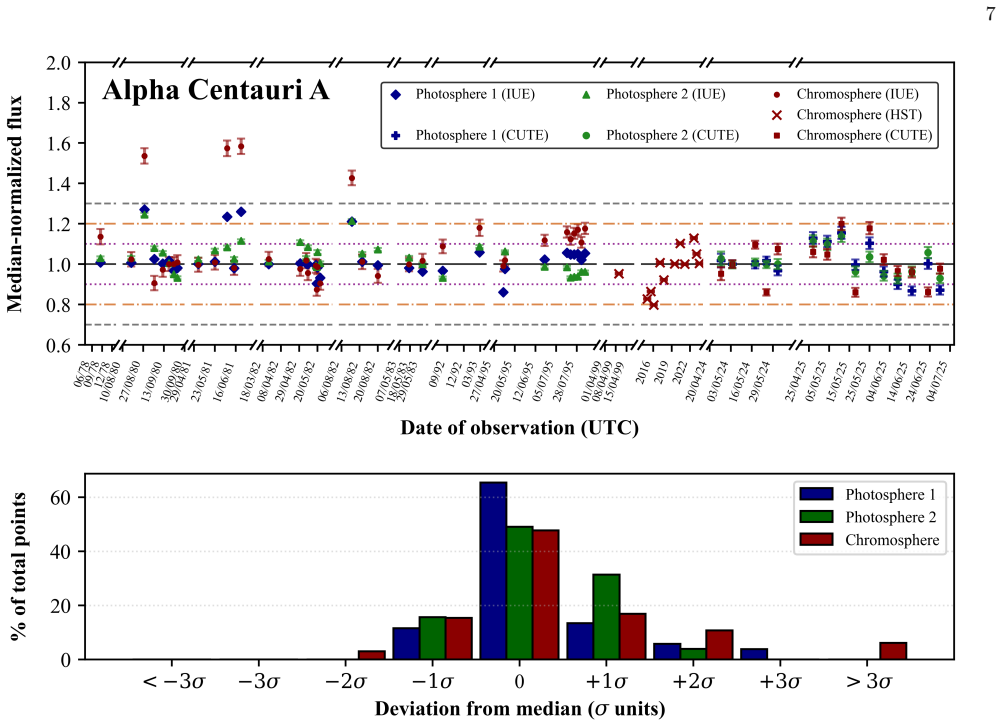
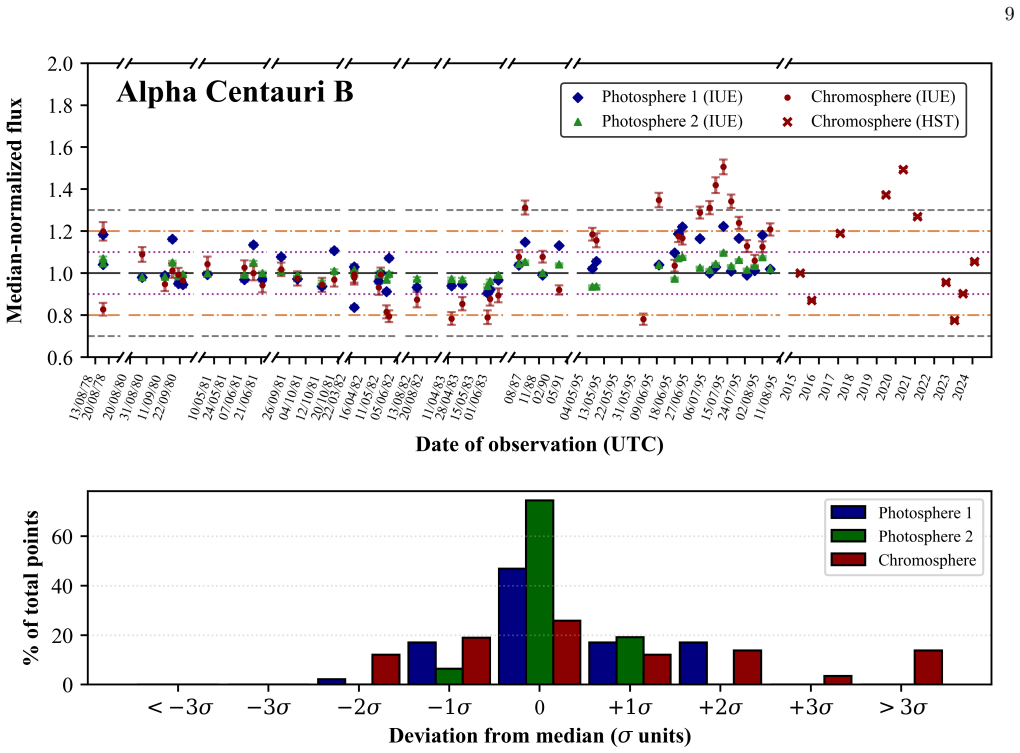
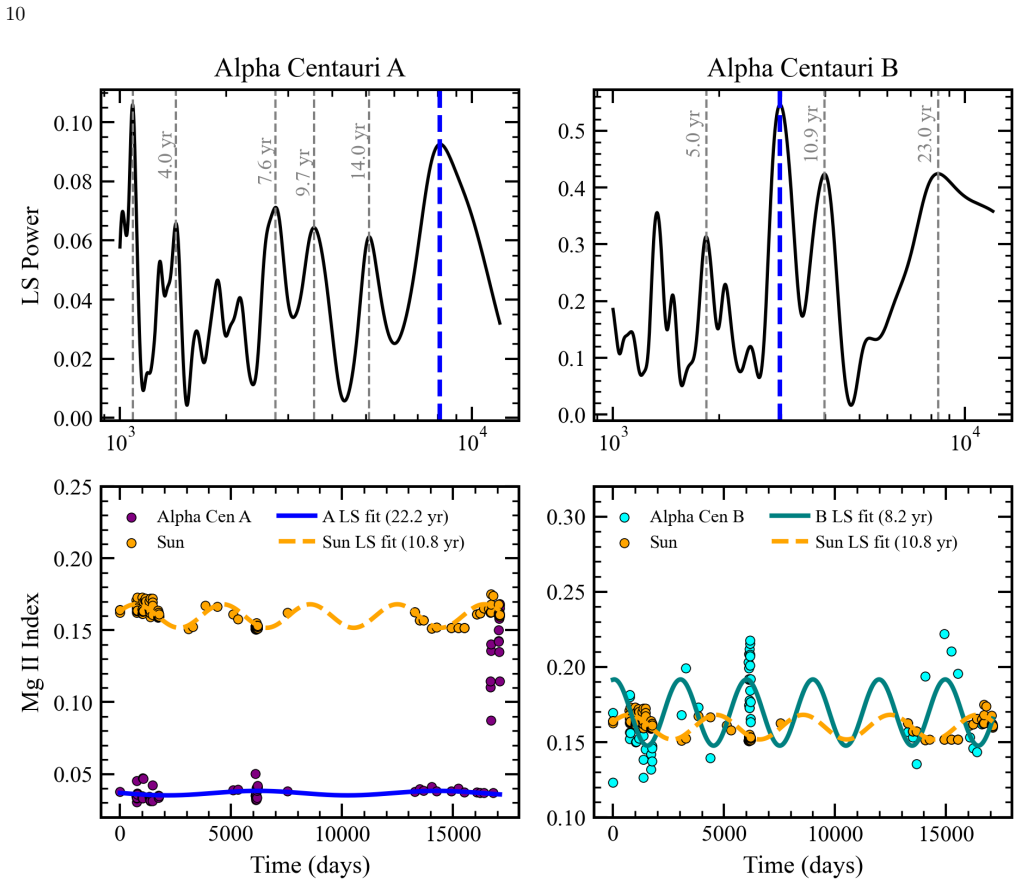
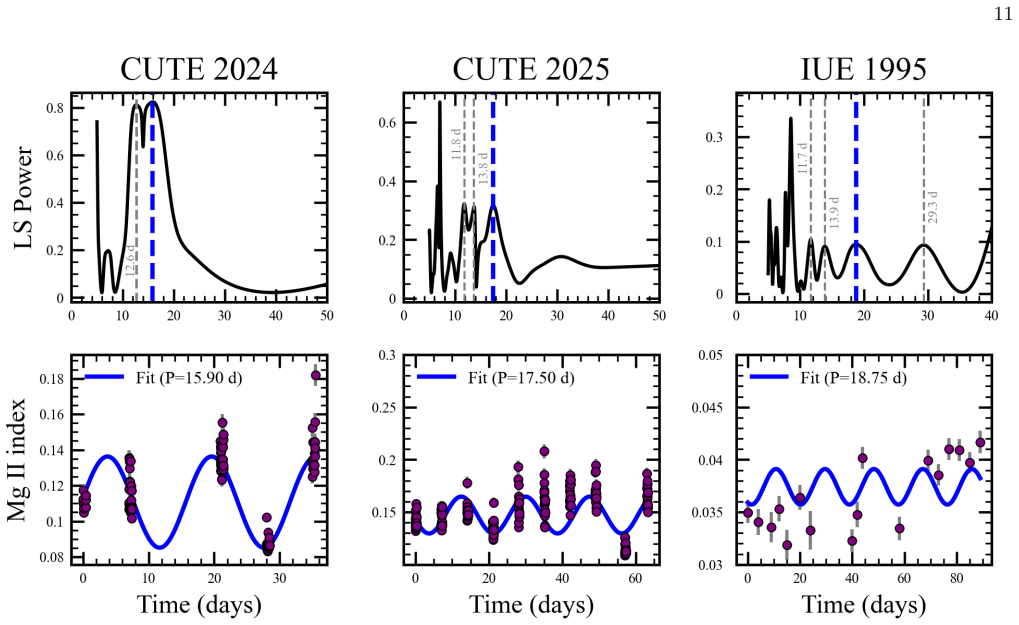
Combining archival and new near-UV measurements spanning five decades reveals that Alpha Centauri A remains within 1 sigma of median flux for most observations with only one flare every 12 years on average, consistent with its weak activity and 19-year cycle, whereas Alpha Centauri B exhibits broader variability that tracks its 8-year cycle; Lomb-Scargle analysis of the Mg II index from CUTE data gives a 15-20 day rotation period for A, and the NUV cycle of B is shown to be coherent with its X-ray cycle.
What carries the argument
The multi-decade near-UV flux time series and activity-cycle tracking for Alpha Centauri AB, which quantifies the amplitude and timescale of stellar brightness changes that will enter reflected-light exoplanet measurements.
If this is right
- Reflected-light photometry and spectroscopy of terrestrial exoplanets around early G-type stars will include 10-20 percent temporal flux variability from the host star over months to years.
- The same observations around early K-type stars will include 30-40 percent temporal flux variability from the host star.
- Detectability of ozone and other biosignature features at NUV wavelengths will be affected by these changing stellar inputs.
- The coherence between NUV and X-ray activity cycles supports using shorter-wavelength data to predict NUV behavior for similar stars.
Where Pith is reading between the lines
- Future exoplanet observations may require simultaneous host-star monitoring at NUV wavelengths to separate stellar from planetary signals.
- The low flare rate on Alpha Centauri A implies that impulsive events will contribute little to the long-term variability budget for G-type hosts.
- If the measured amplitudes hold for the broader population, mission planning for reflected-light spectroscopy should incorporate stellar variability models at the 10-40 percent level.
Load-bearing premise
That the variability patterns measured for Alpha Centauri AB can be applied directly to other early G-type and early K-type stars.
What would settle it
A set of near-UV observations of another magnetically inactive early G-type star that shows flux variability outside the 10-20 percent range over months to years.
Figures
read the original abstract
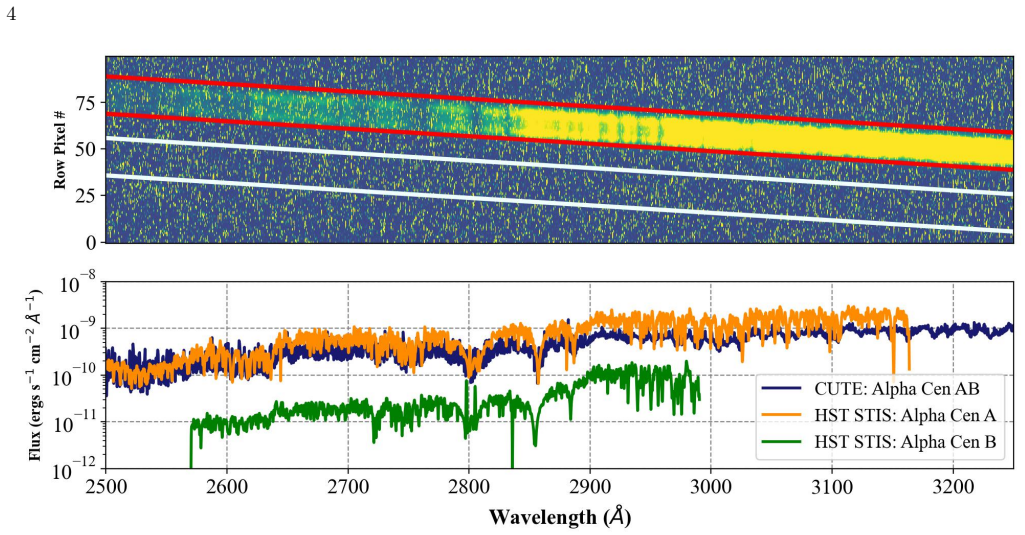
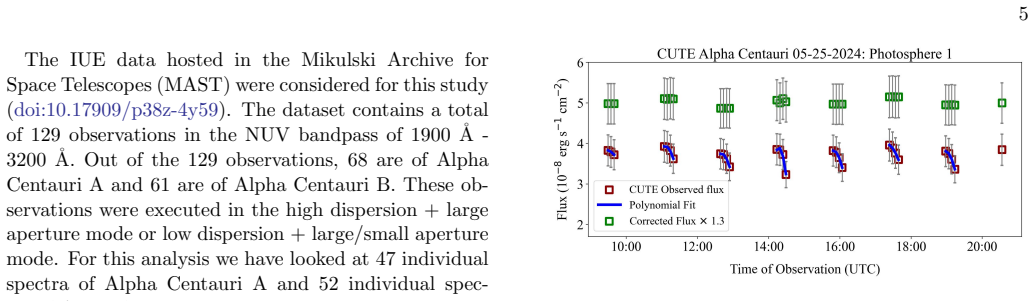
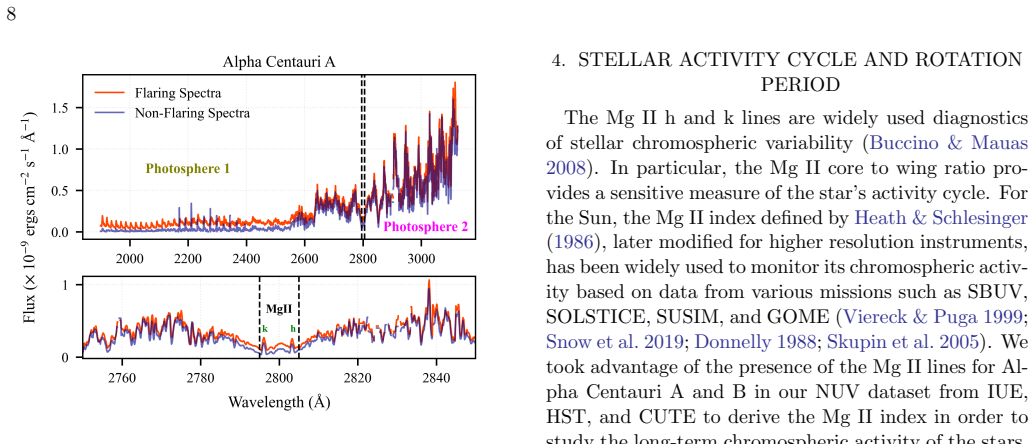
We present the most comprehensive near-ultraviolet (NUV: 2550-3255 Angstrom) activity record to date for the Alpha Centauri AB system, combining archival IUE and HST observations spanning nearly five decades with new high-cadence CUTE measurements. We show that Alpha Centauri A exhibits predominantly quiescent NUV behavior, with the majority of observations remaining within 1 sigma of the median flux and only rare chromospheric flaring events (1 flare every 12 years), consistent with its weak chromospheric activity and 19-year stellar cycle inferred from X-ray and FUV observations. In contrast, Alpha Centauri B displays a broader variability envelope, characterized by more frequent and higher-amplitude chromospheric excursions that track its well-established 8-year magnetic activity cycle. Using Lomb-Scargle analysis on the Mg II index derived from CUTE observations, we estimate the rotational period of Alpha Centauri A to be on timescales of 15-20 days. We also confirm the coherence of the stellar activity cycle of Alpha Centauri B in the NUV with its X-ray activity cycle. These data establish a critical reference framework for interpreting reflected-light observations of terrestrial exoplanets and for assessing the detectability of ozone and other biosignature-related features at NUV wavelengths with future facilities such as the Habitable Worlds Observatory. These results indicate that HWO observations of terrestrial exoplanets in reflected light photometry and spectroscopy around magnetically inactive early G-type stars and early K-type stars may be expected to show 10-20 percent and 30-40 percent temporal flux variability, respectively, over the course of months to years from the changing stellar inputs alone.
Editorial analysis
A structured set of objections, weighed in public.
Referee Report
Summary. The manuscript compiles a nearly five-decade NUV (2550-3255 Å) time series for Alpha Centauri AB by combining archival IUE and HST data with new high-cadence CUTE observations. It reports that A is predominantly quiescent (most points within 1σ of median flux, ~1 flare per 12 yr) while B exhibits larger-amplitude, cycle-modulated excursions that track its known 8-yr activity cycle; Lomb-Scargle analysis of the CUTE Mg II index yields a 15-20 day rotation period for A. The paper positions these results as a reference for reflected-light exoplanet observations and states that HWO photometry/spectroscopy of terrestrial planets around magnetically inactive early G-type and early K-type stars may be expected to show 10-20% and 30-40% temporal flux variability, respectively, over months to years from stellar inputs alone.
Significance. If the representativeness assumption holds, the work supplies a valuable long-baseline NUV benchmark for the nearest solar-type system and quantifies stellar variability as a non-negligible noise term for biosignature searches with the Habitable Worlds Observatory. The multi-facility dataset and standard time-series methods (periodogram, flare counting) constitute a solid observational contribution even if the broader extrapolation is later qualified.
major comments (1)
- [Abstract] Abstract (final sentence): The headline claim that HWO observations 'may be expected to show 10-20 percent and 30-40 percent temporal flux variability' for arbitrary magnetically inactive early G-type and early K-type stars is derived solely from the Alpha Centauri AB measurements. No comparative sample, activity-index distribution, or statistical argument is supplied to demonstrate that the observed variability envelope is typical rather than system-specific; this assumption is load-bearing for the primary application to exoplanet spectroscopy.
Simulated Author's Rebuttal
We thank the referee for their constructive review and for highlighting the need to clarify the scope of our claims. We respond to the single major comment below.
read point-by-point responses
-
Referee: [Abstract] Abstract (final sentence): The headline claim that HWO observations 'may be expected to show 10-20 percent and 30-40 percent temporal flux variability' for arbitrary magnetically inactive early G-type and early K-type stars is derived solely from the Alpha Centauri AB measurements. No comparative sample, activity-index distribution, or statistical argument is supplied to demonstrate that the observed variability envelope is typical rather than system-specific; this assumption is load-bearing for the primary application to exoplanet spectroscopy.
Authors: We agree that the quoted variability percentages are derived exclusively from the Alpha Centauri AB time series and that no comparative sample or statistical distribution across other stars is presented to establish representativeness. Alpha Centauri provides the longest available NUV baseline for solar-type stars and is frequently used as a benchmark, but this does not substitute for a broader ensemble. In revision we will rephrase the final sentence of the abstract to state that the observed 10-20% (G-type) and 30-40% (K-type) NUV variability envelopes are measured for the Alpha Centauri system and supply a reference point for similar magnetically inactive stars, rather than asserting that arbitrary stars may be expected to exhibit these levels. We will add a short qualifying paragraph in the discussion section acknowledging the single-system limitation and the desirability of future multi-star comparisons. revision: yes
Circularity Check
No circularity; percentages derived from direct NUV time-series measurements on Alpha Cen AB via standard methods
full rationale
The paper reports NUV flux time series from archival IUE/HST plus new CUTE data, applies Lomb-Scargle periodogram analysis to derive rotational periods and activity-cycle coherence, and states observed variability envelopes (quiescent for A, cycle-tracked for B). The 10-20% and 30-40% figures are presented as direct implications of those measured amplitudes for the single system; no equation, parameter fit, or claim is shown to reduce to a quantity defined by the paper's own inputs or self-citations. The extrapolation to other G/K stars is an unverified representativeness assumption, but that is a generalizability issue, not a circular derivation. The analysis is self-contained against external benchmarks.
Axiom & Free-Parameter Ledger
axioms (1)
- domain assumption IUE, HST, and CUTE NUV flux measurements are directly comparable after standard instrument calibrations
Reference graph
Works this paper leans on
-
[1]
Arney, G., Domagal-Goldman, S. D., Meadows, V. S., et al. 2016, Astrobiology, 16, 873, doi: 10.1089/ast.2015.1422 Astro2020. 2021, Pathways to Discovery in Astronomy and Astrophysics for the 2020s, doi: 10.17226/26141
-
[3]
2023, AJ, 166, 212, doi: 10.3847/1538-3881/acfef5
Ayres, T. 2023, AJ, 166, 212, doi: 10.3847/1538-3881/acfef5
-
[4]
Ayres, T. R. 2009, The Astrophysical Journal, 696, 1931, doi: 10.1088/0004-637X/696/2/1931
-
[5]
Ayres, T. R. 2014, AJ, 147, 59, doi: 10.1088/0004-6256/147/3/59
-
[6]
Ayres, T. R. 2015, The Astronomical Journal, 149, 58, doi: 10.1088/0004-6256/149/2/58
-
[7]
2007, A&A, 470, 295, doi: 10.1051/0004-6361:20065694
Bazot, M., Bouchy, F., Kjeldsen, H., et al. 2007, A&A, 470, 295, doi: 10.1051/0004-6361:20065694
-
[8]
2025, in
Bhattacharyya, D., France, K., Flynn, S., et al. 2025, in
2025
-
[9]
UV, X-Ray, and Gamma-Ray Space Instrumentation for Astronomy XXIV, ed. O. H. Siegmund & K. Hoadley, Vol. 13625, International Society for Optics and Photonics (SPIE), 136251M, doi: 10.1117/12.3064142
-
[10]
Bhattacharyya, D., France, K., & Wilson, D. 2026, NUV Wavelength Integrated Flux of Alpha Centauri A and B from IUE, HST, and CUTE, Zenodo, doi: 10.5281/zenodo.18498525
-
[11]
Bryson, S., Coughlin, J., Batalha, N. M., et al. 2020, AJ, 159, 279, doi: 10.3847/1538-3881/ab8a30
-
[12]
Buccino, A. P., & Mauas, P. J. D. 2008, A&A, 483, 903, doi: 10.1051/0004-6361:20078925
-
[13]
2023, AJ, 166, 157, doi: 10.3847/1538-3881/acefd3
Damiano, M., Hu, R., & Mennesson, B. 2023, AJ, 166, 157, doi: 10.3847/1538-3881/acefd3
-
[14]
Donnelly, R. F. 1988, Advances in Space Research, 8, 777, doi: 10.1016/0273-1177(88)90174-3
-
[15]
2023, AJ, 165, 64, doi: 10.3847/1538-3881/aca8a3
Egan, A., Nell, N., Suresh, A., et al. 2023, AJ, 165, 64, doi: 10.3847/1538-3881/aca8a3
-
[16]
Egan, A., France, K., Sreejith, A. G., et al. 2024, AJ, 168, 108, doi: 10.3847/1538-3881/ad61e5
-
[17]
Feinberg, L. D., Sitarski, B. N., McElwain, M. W., et al. 2026, arXiv e-prints, arXiv:2601.11803, doi: 10.48550/arXiv.2601.11803
-
[18]
2023, AJ, 165, 63, doi: 10.3847/1538-3881/aca8a2
France, K., Fleming, B., Egan, A., et al. 2023, AJ, 165, 63, doi: 10.3847/1538-3881/aca8a2
-
[19]
Heath, D. F., & Schlesinger, B. M. 1986, J. Geophys. Res., 91, 8672, doi: 10.1029/JD091iD08p08672
-
[20]
1997, in American Astronomical Society Meeting Abstracts, Vol
Jassour, D. 1997, in American Astronomical Society Meeting Abstracts, Vol. 189, American Astronomical Society Meeting Abstracts #189, 120.04
1997
-
[21]
2024, PASP, 136, 024202, doi: 10.1088/1538-3873/ad119f
Kamgar, L., France, K., & Youngblood, A. 2024, PASP, 136, 024202, doi: 10.1088/1538-3873/ad119f
-
[22]
S., Sim˜ oes, P
Kerr, G. S., Sim˜ oes, P. J. A., Qiu, J., & Fletcher, L. 2015, A&A, 582, A50
2015
-
[23]
2016, ApJ, 816, 88
Kleint, L., Heinzel, P., Judge, P., & Krucker, S. 2016, ApJ, 816, 88
2016
-
[24]
Kowalski, A. F., Hawley, S. L., Hilton, E. J., et al. 2009, AJ, 138, 633, doi: 10.1088/0004-6256/138/2/633
-
[25]
Wisniewski, J. P., & Hilton, E. J. 2010, ApJL, 714, L98, doi: 10.1088/2041-8205/714/1/L98
-
[26]
Kowalski, A. F., Wisniewski, J. P., Hawley, S. L., et al. 2019, ApJ, 871, 167, doi: 10.3847/1538-4357/aaf058
-
[27]
Krissansen-Totton, J., Garland, R., Irwin, P., & Catling, D. C. 2018, AJ, 156, 114, doi: 10.3847/1538-3881/aad564
-
[28]
Krissansen-Totton, J., Ulses, A. G., Frissell, M., et al. 2025, arXiv e-prints, arXiv:2507.14771, doi: 10.48550/arXiv.2507.14771
-
[29]
2019, in EGU General Assembly Conference Abstracts, EGU General Assembly Conference Abstracts, 12479
Leise, H., Baltzer, T., Wilson, A., et al. 2019, in EGU General Assembly Conference Abstracts, EGU General Assembly Conference Abstracts, 12479
2019
-
[30]
Lomb, N. R. 1976, Ap&SS, 39, 447, doi: 10.1007/BF00648343
-
[31]
Loyd, R. O. P., France, K., Youngblood, A., et al. 2016, ApJ, 824, 102, doi: 10.3847/0004-637X/824/2/102
-
[32]
Mamajek, E. E., & Hillenbrand, L. A. 2008, ApJ, 687, 1264, doi: 10.1086/591785 14 NASA. 2026, Habitable Worlds Observatory. https://science.nasa.gov/astrophysics/programs/ habitable-worlds-observatory/
-
[33]
2021, in Society of Photo-Optical Instrumentation Engineers (SPIE) Conference Series, Vol
Nell, N., DeCicco, N., Ulrich, S., France, K., & Fleming, B. 2021, in Society of Photo-Optical Instrumentation Engineers (SPIE) Conference Series, Vol. 11821, UV, X-Ray, and Gamma-Ray Space Instrumentation for Astronomy XXII, ed. O. H. Siegmund, 1182117, doi: 10.1117/12.2594743
-
[34]
Peacock, S., Wilson, D. J., Richey-Yowell, T., et al. 2025, arXiv e-prints, arXiv:2509.08999, doi: 10.48550/arXiv.2509.08999
-
[35]
Robrade, J., Schmitt, J. H. M. M., & Favata, F. 2012, A&A, 543, A84, doi: 10.1051/0004-6361/201219046
-
[36]
Salmon, S. J. A. J., Van Grootel, V., Buldgen, G., Dupret, M.-A., & Eggenberger, P. 2021, A&A, 646, A7, doi: 10.1051/0004-6361/201937174
-
[37]
Scargle, J. D. 1982, ApJ, 263, 835, doi: 10.1086/160554
-
[38]
Skupin, J., Weber, M., Bovensmann, H., & Burrows, J. P. 2005, in Proceedings of the ENVISAT I& ERS
2005
-
[39]
2019, Earth and Space Science, 6, 2106, doi: 10.1029/2019EA000652 Space Telescope Science Institute
Snow, M., Machol, J., Viereck, R., et al. 2019, Earth and Space Science, 6, 2106, doi: 10.1029/2019EA000652 Space Telescope Science Institute. 2023, STIS Instrument
-
[40]
G., Fossati, L., Ambily, S., et al
Sreejith, A. G., Fossati, L., Ambily, S., et al. 2022, PASP, 134, 114506, doi: 10.1088/1538-3873/aca17d
-
[41]
G., France, K., Fossati, L., et al
Sreejith, A. G., France, K., Fossati, L., et al. 2023, ApJL, 954, L23, doi: 10.3847/2041-8213/acef1c
-
[42]
Tuchow, N. W., Harada, C. K., Mamajek, E. E., et al. 2025, PASP, 137, 104402, doi: 10.1088/1538-3873/ae0a81
-
[43]
Viereck, R. A., & Puga, L. C. 1999, J. Geophys. Res., 104, 9995, doi: 10.1029/1998JA900163
-
[44]
Wright, J. T., Marcy, G. W., Butler, R. P., & Vogt, S. S. 2004, ApJS, 152, 261, doi: 10.1086/386283
discussion (0)
Sign in with ORCID, Apple, or X to comment. Anyone can read and Pith papers without signing in.