Local Impurity Induced Growth and Scrambling in Clean Free Fermions
Pith reviewed 2026-06-30 13:50 UTC · model grok-4.3
The pith
A single local impurity acts as a branching source that induces sustained growth and scrambling in clean one-dimensional free-fermion systems.
A machine-rendered reading of the paper's core claim, the machinery that carries it, and where it could break.
Core claim
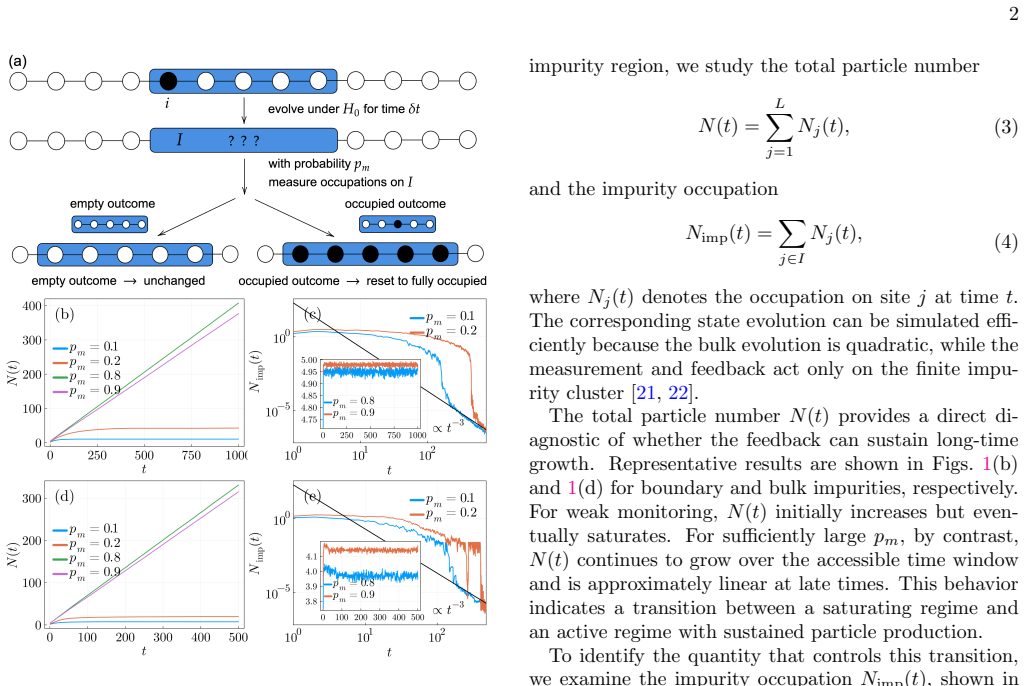
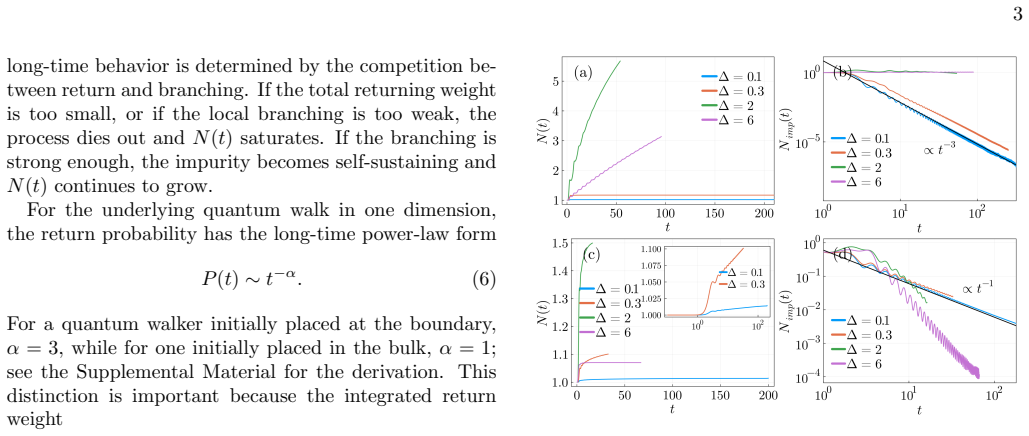
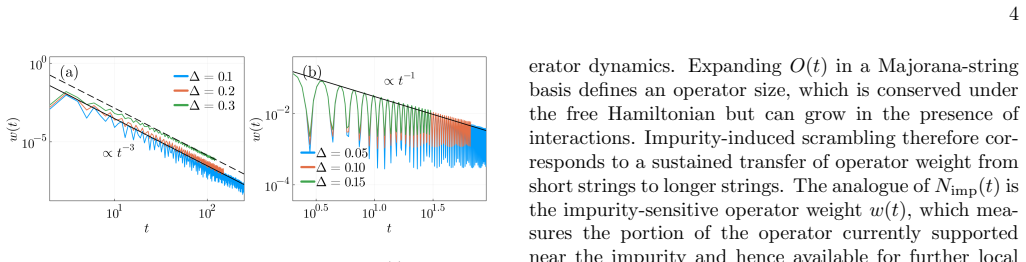
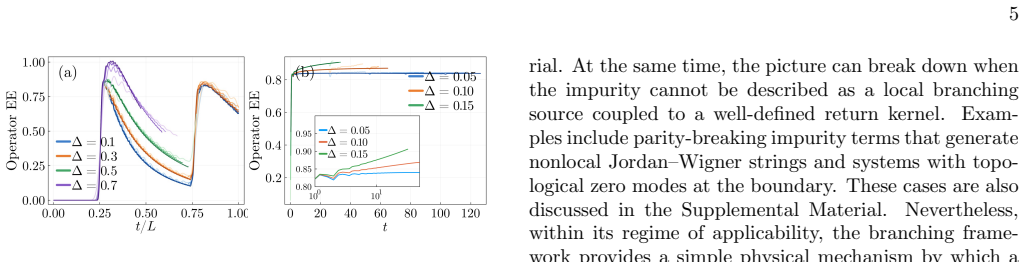
In clean one-dimensional free-fermion systems, a single local impurity acts as a branching source: particle or operator weight propagates coherently into the free bulk, returns to the impurity, and is locally converted into additional degrees of freedom. This branching picture is developed in three complementary settings: a monitored free-fermion model with feedback, a fully unitary interacting particle model, and Heisenberg operator dynamics with an interacting impurity. In the monitored model a feedback-driven transition occurs for both boundary and bulk impurities; in the unitary particle and operator models a boundary impurity produces an analogous transition from saturation to sustained
What carries the argument
The branching source at the impurity site, where coherent propagation into the free bulk combines with local conversion to increase the number of degrees of freedom.
If this is right
- In the monitored model, feedback produces a transition for both boundary and bulk impurities.
- Boundary impurities in the unitary particle and operator models drive a transition from saturation to sustained growth and scrambling.
- Complex many-body dynamics arise from the impurity alone in an otherwise clean and free system.
Where Pith is reading between the lines
- The branching picture may extend to engineered defects in quantum simulators for controlled scrambling.
- Similar impurity-induced growth could appear in two-dimensional free systems or with multiple impurities.
- The mechanism offers a route to study operator growth without requiring bulk interactions.
Load-bearing premise
The impurity can be treated as an isolated local converter whose feedback or interaction rules do not introduce bulk effects that suppress or alter the coherent return-and-branching cycle.
What would settle it
Long-time simulation of the unitary particle model with a boundary impurity, checking whether the total particle number or operator weight at the impurity site saturates or grows without bound.
Figures
read the original abstract
We study impurity-induced particle growth and scrambling in clean one-dimensional free-fermion systems. We show that a single local impurity can act as a branching source: particle or operator weight propagates coherently into the free bulk, returns to the impurity, and is locally converted into additional degrees of freedom. We develop this branching picture in three complementary settings: a monitored free-fermion model with feedback, a fully unitary interacting particle model, and Heisenberg operator dynamics with an interacting impurity. In the monitored model, we find a feedback-driven transition for both boundary and bulk impurities. In the unitary particle and operator models, a boundary impurity gives rise to an analogous transition from saturation to sustained growth and scrambling. These results reveal how a single impurity can generate complex many-body dynamics in an otherwise clean and free quantum system.
Editorial analysis
A structured set of objections, weighed in public.
Referee Report
Summary. The paper claims that a single local impurity in clean 1D free-fermion systems acts as a branching source for particle or operator weight: coherent propagation into the free bulk is followed by return to the impurity and local conversion into additional degrees of freedom. This branching picture is developed in three complementary models—a monitored free-fermion system with feedback, a fully unitary interacting particle model, and Heisenberg operator dynamics with an interacting impurity—yielding a feedback-driven transition (monitored case, boundary and bulk impurities) and an analogous saturation-to-sustained-growth transition (unitary cases, boundary impurity).
Significance. If the results hold, the work is significant for showing that complex many-body growth and scrambling can emerge from a minimal, isolated local perturbation in an otherwise free and clean system. The three-model construction provides internal cross-checks on the branching mechanism, and the reported transitions supply concrete, falsifiable signatures. This offers a controlled route to study impurity-driven dynamics without bulk disorder or interactions.
minor comments (2)
- The abstract and introduction should explicitly state the precise form of the impurity Hamiltonian or feedback rule in each of the three models (e.g., the monitored measurement operator and the unitary interaction term) so that the branching cycle can be reproduced from the text alone.
- Figure captions and axis labels should clarify whether the plotted quantities are particle number, operator weight, or entanglement entropy, and whether the growth is linear, exponential, or power-law in the sustained-growth regime.
Simulated Author's Rebuttal
We thank the referee for the positive assessment of our manuscript, including the summary of the branching mechanism and the significance for impurity-driven dynamics in clean systems. We appreciate the recommendation of minor revision.
Circularity Check
No significant circularity detected
full rationale
The paper's abstract and description present a branching-source mechanism across three models (monitored feedback, unitary particle, and operator dynamics) without any visible equations, fitted parameters, or self-citations that reduce the claimed growth/scrambling transitions to inputs by construction. The central claim is scoped to specific model constructions whose feedback rules are stated as local and isolated; no load-bearing step equates a prediction to a fit or renames a known result via self-citation. The derivation chain is therefore self-contained against external benchmarks.
Axiom & Free-Parameter Ledger
Reference graph
Works this paper leans on
-
[1]
Kondo, Resistance minimum in dilute magnetic alloys, Progress of theoretical physics32, 37 (1964)
J. Kondo, Resistance minimum in dilute magnetic alloys, Progress of theoretical physics32, 37 (1964)
1964
-
[2]
A. C. Hewson,The Kondo problem to heavy fermions, 2 (Cambridge university press, 1997)
1997
-
[3]
Amico, R
L. Amico, R. Fazio, A. Osterloh, and V. Vedral, En- tanglement in many-body systems, Reviews of modern physics80, 517 (2008)
2008
-
[4]
Eisert, M
J. Eisert, M. Friesdorf, and C. Gogolin, Quantum many- body systems out of equilibrium, Nature Physics11, 124 (2015)
2015
-
[5]
Swingle, Unscrambling the physics of out-of-time- order correlators, Nature Physics14, 988 (2018)
B. Swingle, Unscrambling the physics of out-of-time- order correlators, Nature Physics14, 988 (2018)
2018
-
[6]
M. P. Fisher, V. Khemani, A. Nahum, and S. Vijay, Random quantum circuits, Annual Review of Condensed Matter Physics14, 335 (2023)
2023
-
[7]
Q. Gao, P. Zhang, and X. Chen, Information scrambling in free fermion systems with a sole interaction, Physical Review B110, 035137 (2024)
2024
-
[8]
Q. Gao, T. Zhou, P. Zhang, and X. Chen, Scrambling transition in free fermion systems induced by a single impurity, Physical Review B110, 235110 (2024)
2024
-
[9]
Hayden and J
P. Hayden and J. Preskill, Black holes as mirrors: quan- tum information in random subsystems, Journal of high energy physics2007, 120 (2007)
2007
-
[10]
Sekino and L
Y. Sekino and L. Susskind, Fast scramblers, Journal of High Energy Physics2008, 065 (2008)
2008
-
[11]
S. H. Shenker and D. Stanford, Black holes and the but- terfly effect, Journal of High Energy Physics2014, 1 (2014)
2014
-
[12]
D. A. Roberts, D. Stanford, and L. Susskind, Localized shocks, Journal of High Energy Physics2015, 1 (2015)
2015
-
[13]
S. H. Shenker and D. Stanford, Stringy effects in scram- bling, Journal of High Energy Physics2015, 1 (2015)
2015
-
[14]
Maldacena, S
J. Maldacena, S. H. Shenker, and D. Stanford, A bound on chaos, Journal of High Energy Physics2016, 1 (2016)
2016
-
[15]
Hosur, X.-L
P. Hosur, X.-L. Qi, D. A. Roberts, and B. Yoshida, Chaos in quantum channels, Journal of High Energy Physics 2016, 1 (2016)
2016
-
[16]
D. A. Roberts, D. Stanford, and A. Streicher, Operator 6 growth in the syk model, Journal of High Energy Physics 2018, 1 (2018)
2018
-
[17]
Nahum, J
A. Nahum, J. Ruhman, S. Vijay, and J. Haah, Quantum entanglement growth under random unitary dynamics, Physical Review X7, 031016 (2017)
2017
-
[18]
Nahum, S
A. Nahum, S. Vijay, and J. Haah, Operator spreading in random unitary circuits, Physical Review X8, 021014 (2018)
2018
-
[19]
C. W. von Keyserlingk, T. Rakovszky, F. Pollmann, and S. L. Sondhi, Operator hydrodynamics, otocs, and en- tanglement growth in systems without conservation laws, Physical Review X8, 021013 (2018)
2018
-
[20]
Calabrese and J
P. Calabrese and J. Cardy, Evolution of entanglement entropy in one-dimensional systems, Journal of Statisti- cal Mechanics: Theory and Experiment2005, P04010 (2005)
2005
-
[21]
Lagrangian representation for fermionic linear optics
S. Bravyi, Lagrangian representation for fermionic linear optics, arXiv preprint quant-ph/0404180 (2004)
work page internal anchor Pith review Pith/arXiv arXiv 2004
-
[22]
Ravindranath, Z.-C
V. Ravindranath, Z.-C. Yang, and X. Chen, Free fermions under adaptive quantum dynamics, Quantum9, 1685 (2025)
2025
-
[23]
Fishman, S
M. Fishman, S. R. White, and E. M. Stoudenmire, The ITensor Software Library for Tensor Network Calcula- tions, SciPost Phys. Codebases , 4 (2022)
2022
-
[24]
Fishman, S
M. Fishman, S. R. White, and E. M. Stoudenmire, Code- base release 0.3 for ITensor, SciPost Phys. Codebases , 4 (2022)
2022
-
[25]
A. Y. Kitaev, Unpaired majorana fermions in quan- tumwires, Physics-uspekhi44, 131 (2001). S1 Supplemental Material Derivation of the free-fermion exponentsα= 1,3 In this section we derive the power-law exponentsαthat control the long-time decay of the free return probability P(t) near the impurity. This same free return law underlies the decay of the imp...
2001
discussion (0)
Sign in with ORCID, Apple, or X to comment. Anyone can read and Pith papers without signing in.