Distinguishing Right from Wrong in Debates: Attribution Analysis of Chinese Harmful Memes
Pith reviewed 2026-06-30 13:51 UTC · model grok-4.3
The pith
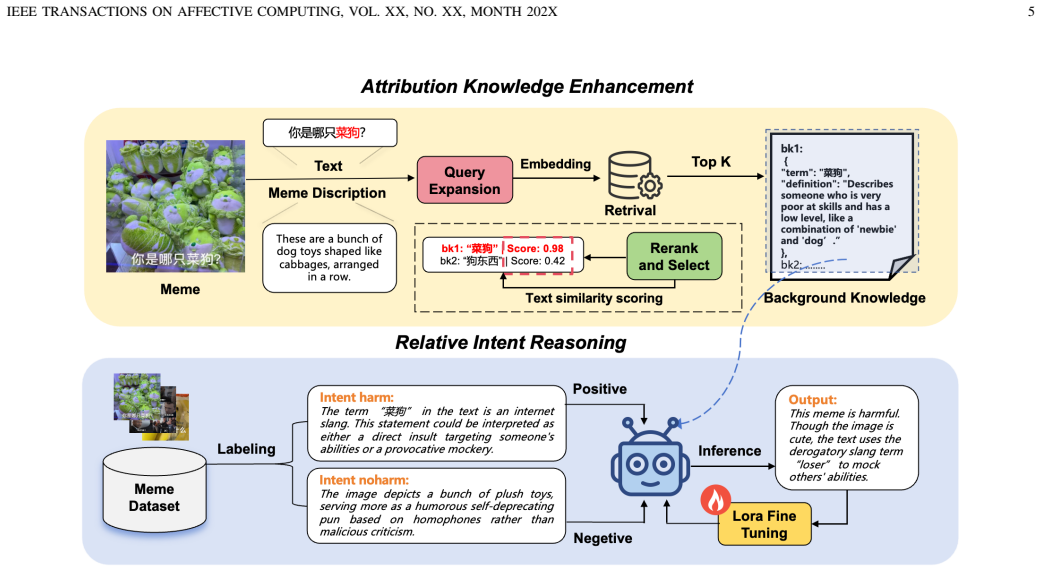
RIKE framework uses cultural knowledge and relative intent reasoning to attribute harm in ambiguous Chinese memes more accurately than baselines.
A machine-rendered reading of the paper's core claim, the machinery that carries it, and where it could break.
Core claim
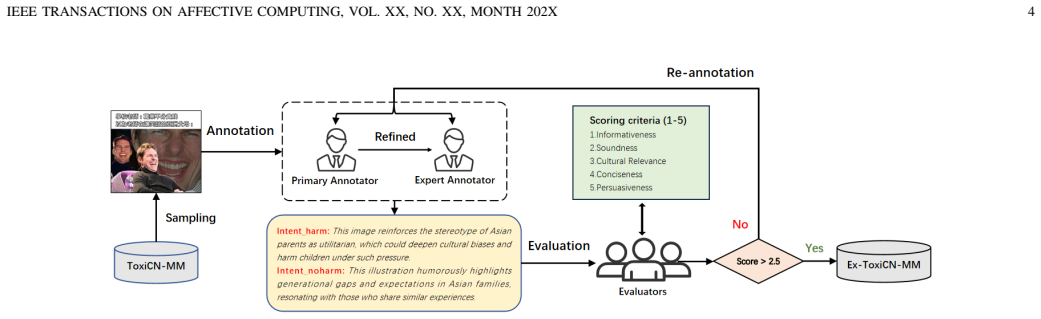
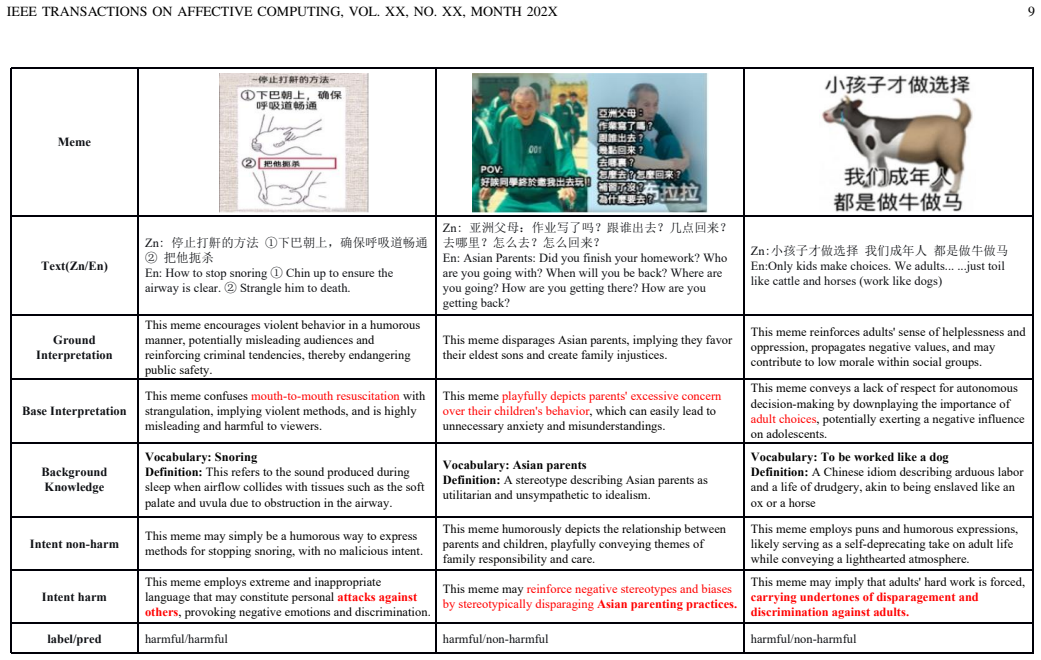
By pairing the Ex-ToxiCN-MM dataset of opposing interpretations with the C-HarmKB knowledge base and the RIKE framework that combines Attribution Knowledge Enhancement with Relative Intent Reasoning, models achieve higher accuracy in distinguishing harmful from non-harmful readings of culturally grounded and semantically ambiguous Chinese memes, outperforming standard baselines on multiple evaluation metrics.
What carries the argument
The RIKE framework, which integrates an Attribution Knowledge Enhancement module (AKE) to inject cultural priors and a Relative Intent Reasoning module (RIR) to compare competing interpretations, supplies the missing background and resolves ambiguity that standard models lack.
If this is right
- Content moderation systems gain an explicit mechanism for surfacing the cultural knowledge and intent comparisons needed for Chinese memes.
- The same opposing-interpretation evaluation design can be reused to test models on other ambiguous social-media content.
- Open release of the dataset and C-HarmKB allows direct replication and extension by other researchers working on culturally specific harm detection.
- The two-module structure separates knowledge injection from intent comparison, making each component easier to ablate or improve independently.
Where Pith is reading between the lines
- The approach may transfer to non-meme debates where two sides offer conflicting readings of the same statement.
- If the knowledge base can be updated incrementally, the framework could track evolving cultural references without full retraining.
- Real-world deployment would require checking whether the performance lift holds when memes appear in live streams rather than curated test sets.
Load-bearing premise
The dataset that assigns each meme two opposing harmful and non-harmful interpretations supplies a rigorous test of whether models can handle culturally grounded ambiguity.
What would settle it
If the RIKE model shows no improvement or underperforms the baselines on accuracy, F1, or other metrics when evaluated on the held-out portion of Ex-ToxiCN-MM, the superiority claim is false.
Figures
read the original abstract
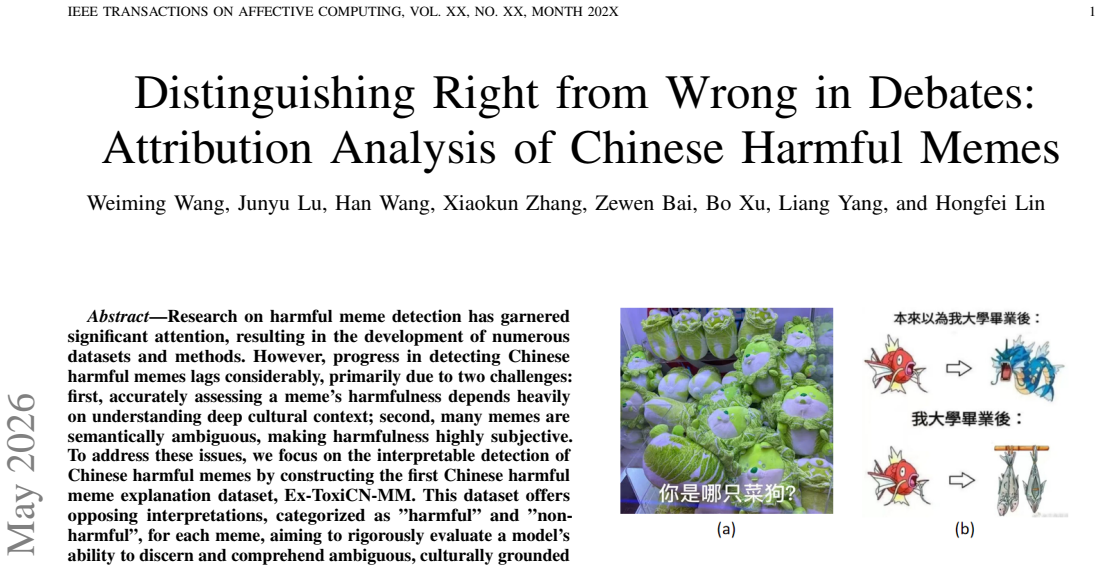
Research on harmful meme detection has garnered significant attention, resulting in the development of numerous datasets and methods. However, progress in detecting Chinese harmful memes lags considerably, primarily due to two challenges: first, accurately assessing a meme's harmfulness depends heavily on understanding deep cultural context; second, many memes are semantically ambiguous, making harmfulness highly subjective. To address these issues, we focus on the interpretable detection of Chinese harmful memes by constructing the first Chinese harmful meme explanation dataset, Ex-ToxiCN-MM. This dataset offers opposing interpretations, categorized as "harmful" and "non-harmful", for each meme, aiming to rigorously evaluate a model's ability to discern and comprehend ambiguous, culturally grounded content. We built a specialized knowledge base of Chinese cultural concepts and offensive vocabulary to supply models with essential prior knowledge (C-HarmKB). To address the ambiguity and lack of background knowledge in meme attribution, we have developed a comprehensive attribution analysis framework, RIKE, which includes an Attribution Knowledge Enhancement module (AKE) and a Relative Intent Reasoning module (RIR). Extensive quantitative and qualitative experiments demonstrate that our method outperforms mainstream baseline models across multiple metrics in the task of attributing harmful memes in Chinese. The code, Ex-ToxiCN-MM dataset, and Chinese Harmful Semantic Knowledge Base (C-HarmKB) involved in this study have been open-sourced at https://github.com/wimiw123/Ex-ToxiCN-MM
Editorial analysis
A structured set of objections, weighed in public.
Referee Report
Summary. The paper introduces Ex-ToxiCN-MM, the first Chinese harmful meme explanation dataset providing opposing 'harmful' and 'non-harmful' interpretations for each meme to test cultural and semantic ambiguity. It constructs C-HarmKB, a knowledge base of Chinese cultural concepts and offensive terms, and proposes the RIKE framework with an Attribution Knowledge Enhancement (AKE) module and Relative Intent Reasoning (RIR) module. The central claim is that RIKE outperforms mainstream baseline models across multiple metrics on the task of attributing harmfulness to Chinese memes, with all artifacts open-sourced.
Significance. If the evaluation holds, the work would fill a documented gap in Chinese-language harmful meme research by supplying a dataset explicitly designed for disambiguation of culturally grounded ambiguity, a supporting knowledge base, and an open-sourced attribution framework. The open-sourcing of code, Ex-ToxiCN-MM, and C-HarmKB constitutes a concrete community contribution that could enable follow-on work on interpretable detection.
major comments (2)
- [§3] §3 (dataset construction): No inter-annotator agreement statistics (e.g., Cohen’s kappa or Fleiss’ kappa) or details on the number of annotators and resolution process are reported for assigning the opposing interpretations as ground-truth harmful/non-harmful labels. Because the central claim rests on RIKE’s ability to handle culturally ambiguous content using these labels, the absence of documented multi-annotator validation makes the reported performance gains difficult to interpret as evidence of genuine disambiguation rather than fit to author-provided framing.
- [Evaluation section] Evaluation section (likely §4 or §5): The abstract and summary assert outperformance on 'multiple metrics' without specifying the exact baselines, data splits, statistical significance tests, or controls for annotation bias in the provided text. If these details are present in the full manuscript, they must be cross-referenced to the dataset construction to confirm that the evaluation is not circular with respect to the authors’ own cultural interpretations.
minor comments (2)
- [Abstract] The abstract and introduction use 'attribution analysis' and 'interpretable detection' interchangeably; a brief clarification of the precise output format (e.g., which interpretation is selected and why) would improve readability.
- [Figure captions] Figure or table captions for the RIKE architecture should explicitly label the AKE and RIR modules and their inputs/outputs to match the textual description.
Simulated Author's Rebuttal
We thank the referee for the constructive feedback on dataset validation and evaluation clarity. We respond point-by-point to the major comments below.
read point-by-point responses
-
Referee: [§3] §3 (dataset construction): No inter-annotator agreement statistics (e.g., Cohen’s kappa or Fleiss’ kappa) or details on the number of annotators and resolution process are reported for assigning the opposing interpretations as ground-truth harmful/non-harmful labels. Because the central claim rests on RIKE’s ability to handle culturally ambiguous content using these labels, the absence of documented multi-annotator validation makes the reported performance gains difficult to interpret as evidence of genuine disambiguation rather than fit to author-provided framing.
Authors: We acknowledge this is a valid concern. The Ex-ToxiCN-MM opposing interpretations were developed by the authors drawing on specialized cultural expertise rather than through a multi-annotator process with independent labelers. Consequently, we do not have inter-annotator agreement statistics to report. In the revised manuscript we will explicitly state this limitation in §3 and note it as an area for future dataset refinement, but we cannot add retrospective agreement metrics. revision: no
-
Referee: [Evaluation section] Evaluation section (likely §4 or §5): The abstract and summary assert outperformance on 'multiple metrics' without specifying the exact baselines, data splits, statistical significance tests, or controls for annotation bias in the provided text. If these details are present in the full manuscript, they must be cross-referenced to the dataset construction to confirm that the evaluation is not circular with respect to the authors’ own cultural interpretations.
Authors: The full manuscript (§4) already specifies the baselines (BERT, RoBERTa, CLIP, VisualBERT and meme-specific models), the 70/15/15 data splits, and statistical significance via paired t-tests (p < 0.05). We will add explicit cross-references from §4 back to §3 and expand the discussion of annotation bias controls (e.g., external sourcing for C-HarmKB entries) to demonstrate that evaluation is not circular with respect to author framing. revision: yes
- Absence of inter-annotator agreement statistics for Ex-ToxiCN-MM labels, as multi-annotator validation was not performed during dataset construction.
Circularity Check
No circularity: empirical ML evaluation on new dataset and framework
full rationale
The paper constructs Ex-ToxiCN-MM and C-HarmKB, proposes the RIKE framework with AKE and RIR modules, and reports that it outperforms baselines on attribution metrics. No equations, derivations, or parameter-fitting steps are described that reduce a claimed prediction to its inputs by construction. No self-citations are used to justify uniqueness theorems or ansatzes that bear on the central result. The work is self-contained as standard empirical ML research introducing artifacts and benchmarking them; the evaluation does not collapse into a re-statement of the authors' own labeling choices.
Axiom & Free-Parameter Ledger
axioms (1)
- domain assumption External cultural knowledge bases can supply essential prior knowledge that improves model performance on ambiguous, culture-specific tasks.
invented entities (1)
-
RIKE framework (Attribution Knowledge Enhancement module + Relative Intent Reasoning module)
no independent evidence
Reference graph
Works this paper leans on
-
[1]
Memes in a digital world: Reconciling with a conceptual troublemaker,
L. Shifman, “Memes in a digital world: Reconciling with a conceptual troublemaker,”Journal of computer-mediated communication, vol. 18, no. 3, pp. 362–377, 2013
2013
-
[2]
A web-scale analysis of the community origins of image memes,
D. Morina and M. S. Bernstein, “A web-scale analysis of the community origins of image memes,”Proceedings of the ACM on Human-Computer Interaction, vol. 6, no. CSCW1, pp. 1–25, 2022
2022
-
[3]
“meme-ing
Y . Zhang, S. Zhao, and K. Merritt, ““meme-ing” across cultures: Understanding how non-eu international students in the uk use internet memes for cultural adaptation and identity,”Behavioral Sciences, vol. 15, no. 5, p. 693, 2025
2025
-
[4]
H. Lin, Z. Luo, J. Ma, and L. Chen, “Beneath the surface: Unveiling harmful memes with multimodal reasoning distilled from large language models,”arXiv preprint arXiv:2312.05434, 2023
-
[5]
Momenta: A multimodal framework for detecting harmful memes and their targets,
S. Pramanick, S. Sharma, D. Dimitrov, M. S. Akhtar, P. Nakov, and T. Chakraborty, “Momenta: A multimodal framework for detecting harmful memes and their targets,”arXiv preprint arXiv:2109.05184, 2021
-
[6]
Beyond (mis) representation: Visuals in covid-19 misinformation,
J. S. Brennen, F. M. Simon, and R. K. Nielsen, “Beyond (mis) representation: Visuals in covid-19 misinformation,”The International Journal of Press/Politics, vol. 26, no. 1, pp. 277–299, 2021
2021
-
[7]
Visual disinformation in a digital age: A literature synthesis and research agenda,
T. Weikmann and S. Lecheler, “Visual disinformation in a digital age: A literature synthesis and research agenda,”New Media & Society, vol. 25, no. 12, pp. 3696–3713, 2023
2023
-
[8]
Emotion-aware multimodal fusion for meme emotion detection,
S. Sharma, R. S., M. S. Akhtar, and T. Chakraborty, “Emotion-aware multimodal fusion for meme emotion detection,”IEEE Trans. Affect. Comput., vol. 15, no. 3, pp. 1800–1811, 2024. [Online]. Available: https://doi.org/10.1109/TAFFC.2024.3378698
-
[9]
SCARE: A novel framework to enhance chinese harmful memes detection,
T. Gu, M. Feng, X. Feng, and X. Wang, “SCARE: A novel framework to enhance chinese harmful memes detection,”IEEE Trans. Affect. Comput., vol. 16, no. 2, pp. 933–945, 2025. [Online]. Available: https://doi.org/10.1109/TAFFC.2024.3481419
-
[10]
Benchmark dataset of memes with text transcriptions for automatic detection of multi-modal misogynistic content,
F. Gasparini, G. Rizzi, A. Saibene, and E. Fersini, “Benchmark dataset of memes with text transcriptions for automatic detection of multi-modal misogynistic content,”Data in brief, vol. 44, p. 108526, 2022
2022
-
[11]
arXiv preprint arXiv:2305.17678 , year=
M. S. Hee, W.-H. Chong, and R. K.-W. Lee, “Decoding the underlying meaning of multimodal hateful memes,”arXiv preprint arXiv:2305.17678, 2023
-
[12]
What do you meme? generating explanations for visual semantic role labelling in memes,
S. Sharma, S. Agarwal, T. Suresh, P. Nakov, M. S. Akhtar, and T. Chakraborty, “What do you meme? generating explanations for visual semantic role labelling in memes,” inProceedings of the AAAI Conference on Artificial Intelligence, vol. 37, no. 8, 2023, pp. 9763–9771
2023
-
[13]
Towards comprehensive detection of chinese harmful memes,
J. Lu, B. Xu, X. Zhang, H. Wang, H. Zhu, D. Zhang, L. Yang, and H. Lin, “Towards comprehensive detection of chinese harmful memes,”Advances in Neural Information Processing Systems, vol. 37, pp. 13 302–13 320, 2024
2024
-
[14]
H. Gu, Q. Yu, S. Hou, Z. Fang, H. Wu, and Z. He, “Mememind: A large- scale multimodal dataset with chain-of-thought reasoning for harmful meme detection,”arXiv preprint arXiv:2506.18919, 2025
-
[15]
X. Yin, Y . Hong, Y . Guo, Y . Tu, W. Wang, G. Liuet al., “Insightvision: A comprehensive, multi-level chinese-based benchmark for evaluating implicit visual semantics in large vision language models,”arXiv preprint arXiv:2502.15812, 2025
-
[16]
Towards detecting chinese harmful memes with fine-grained explanatory augmentation,
X. Chen, D. Wen, and D. Zuo, “Towards detecting chinese harmful memes with fine-grained explanatory augmentation,”Electronics, vol. 14, no. 17, p. 3504, 2025. 10
2025
-
[17]
An overview of the misogyny meme detection shared task for chinese social media,
B. R. Chakravarthi, R. Ponnusamy, P. Du, X. Zhuang, S. Rajiakodi, P. Buitelaar, B. Sivagnanam, A. KA, S. Lavanyaet al., “An overview of the misogyny meme detection shared task for chinese social media,” in Proceedings of the 5th Conference on Language, Data and Knowledge: Fifth Workshop on Language Technology for Equality, Diversity, Inclusion, 2025, pp. 200–208
2025
-
[18]
Computational meme understanding: A survey,
K. Nguyen and V . Ng, “Computational meme understanding: A survey,” inProceedings of the 2024 Conference on Empirical Methods in Natural Language Processing, 2024, pp. 21 251–21 267
2024
-
[19]
Annotators with attitudes: How annotator beliefs and identities bias toxic language detection,
M. Sap, S. Swayamdipta, L. Vianna, X. Zhou, Y . Choi, and N. A. Smith, “Annotators with attitudes: How annotator beliefs and identities bias toxic language detection,”arXiv preprint arXiv:2111.07997, 2021
-
[20]
A Survey on Retrieval-Augmented Text Generation for Large Language Models
Y . Huang and J. Huang, “A survey on retrieval-augmented text generation for large language models,”arXiv preprint arXiv:2404.10981, 2024
work page internal anchor Pith review Pith/arXiv arXiv 2024
-
[21]
R 2ag: Incorporating retrieval information into retrieval augmented generation,
F. Ye, S. Li, Y . Zhang, and L. Chen, “R 2ag: Incorporating retrieval information into retrieval augmented generation,” inEMNLP (Findings), 2024
2024
-
[22]
Self-rag: Learning to retrieve, generate, and critique through self-reflection,
A. Asai, Z. Wu, Y . Wang, A. Sil, and H. Hajishirzi, “Self-rag: Learning to retrieve, generate, and critique through self-reflection,” 2024
2024
-
[23]
Memegraphs: Linking memes to knowledge graphs,
V . Kougia, S. Fetzel, T. Kirchmair, E. C ¸ano, S. M. Baharlou, S. Shar- ifzadeh, and B. Roth, “Memegraphs: Linking memes to knowledge graphs,” inInternational Conference on Document Analysis and Recog- nition. Springer, 2023, pp. 534–551
2023
-
[24]
Kermit: Knowledge- empowered model in harmful meme detection,
B. Grasso, V . La Gatta, V . Moscato, and G. Sperl`ı, “Kermit: Knowledge- empowered model in harmful meme detection,”Information Fusion, vol. 106, p. 102269, 2024
2024
-
[25]
I know what you meme! understanding and detecting harmful memes with multimodal large language models
Y . Zhuang, K. Guo, J. Wang, Y . Jing, X. Xu, W. Yi, M. Yang, B. Zhao, and H. Hu, “I know what you meme! understanding and detecting harmful memes with multimodal large language models.” inNDSS, 2025
2025
-
[26]
Detecting harmful memes with decoupled understanding and guided cot reasoning,
F. Pan, A. T. Luu, and X. Wu, “Detecting harmful memes with decoupled understanding and guided cot reasoning,”arXiv preprint arXiv:2506.08477, 2025
-
[27]
Visual instruction tuning,
H. Liu, C. Li, Q. Wu, and Y . J. Lee, “Visual instruction tuning,”Advances in neural information processing systems, vol. 36, pp. 34 892–34 916, 2023
2023
-
[28]
Lora: Low-rank adaptation of large language models
E. J. Hu, Y . Shen, P. Wallis, Z. Allen-Zhu, Y . Li, S. Wang, L. Wang, W. Chenet al., “Lora: Low-rank adaptation of large language models.” ICLR, vol. 1, no. 2, p. 3, 2022
2022
-
[29]
arXiv preprint arXiv:2102.12060 , year=
S. Wiegreffe and A. Marasovic, “Teach me to explain: A review of datasets for explainable nlp,”arXiv preprint arXiv:2102.12060, vol. 3, 2021
-
[30]
Multimodal fake news video explanation: Dataset, analysis and evaluation,
L. Chen, Z. Qian, P. Li, and Q. Zhu, “Multimodal fake news video explanation: Dataset, analysis and evaluation,”arXiv preprint arXiv:2501.08514, 2025
-
[31]
Analyzing and interpreting data from likert-type scales,
G. M. Sullivan and A. R. Artino Jr, “Analyzing and interpreting data from likert-type scales,”Journal of graduate medical education, vol. 5, no. 4, p. 541, 2013
2013
-
[32]
Hyrr: Hybrid infused reranking for passage retrieval,
J. Lu, K. Hall, J. Ma, and J. Ni, “Hyrr: Hybrid infused reranking for passage retrieval,”arXiv preprint arXiv:2212.10528, 2022
-
[33]
A hybrid approach to information retrieval and answer generation for regulatory texts,
J. Rayo, R. de La Rosa, and M. Garrido, “A hybrid approach to information retrieval and answer generation for regulatory texts,”arXiv preprint arXiv:2502.16767, 2025
-
[34]
ROUGE 2.0: Updated and Improved Measures for Evaluation of Summarization Tasks
K. Ganesan, “Rouge 2.0: Updated and improved measures for evaluation of summarization tasks,”arXiv preprint arXiv:1803.01937, 2018
work page internal anchor Pith review Pith/arXiv arXiv 2018
-
[35]
Out of the bleu: how should we assess quality of the code generation models?
M. Evtikhiev, E. Bogomolov, Y . Sokolov, and T. Bryksin, “Out of the bleu: how should we assess quality of the code generation models?” Journal of Systems and Software, vol. 203, p. 111741, 2023
2023
-
[36]
J. Gu, X. Jiang, Z. Shi, H. Tan, X. Zhai, C. Xu, W. Li, Y . Shen, S. Ma, H. Liuet al., “A survey on llm-as-a-judge,”arXiv preprint arXiv:2411.15594, 2024
work page internal anchor Pith review Pith/arXiv arXiv 2024
-
[37]
S. Bai, K. Chen, X. Liu, J. Wang, W. Ge, S. Song, K. Dang, P. Wang, S. Wang, J. Tanget al., “Qwen2. 5-vl technical report,”arXiv preprint arXiv:2502.13923, 2025
work page internal anchor Pith review Pith/arXiv arXiv 2025
-
[38]
Internvl: Scaling up vision foundation models and aligning for generic visual-linguistic tasks,
Z. Chen, J. Wu, W. Wang, W. Su, G. Chen, S. Xing, M. Zhong, Q. Zhang, X. Zhu, L. Luet al., “Internvl: Scaling up vision foundation models and aligning for generic visual-linguistic tasks,” inProceedings of the IEEE/CVF conference on computer vision and pattern recognition, 2024, pp. 24 185–24 198
2024
-
[39]
Improved baselines with visual instruction tuning,
H. Liu, C. Li, Y . Li, and Y . J. Lee, “Improved baselines with visual instruction tuning,” inProceedings of the IEEE/CVF conference on computer vision and pattern recognition, 2024, pp. 26 296–26 306
2024
discussion (0)
Sign in with ORCID, Apple, or X to comment. Anyone can read and Pith papers without signing in.