Multiple fidelities and joint numerical range
Pith reviewed 2026-06-30 13:45 UTC · model grok-4.3
The pith
When reference states are product states, entanglement detection is effective if some pair has nontrivial local inner-product moduli on both subsystems or the span's orthogonal complement is completely entangled.
A machine-rendered reading of the paper's core claim, the machinery that carries it, and where it could break.
Core claim
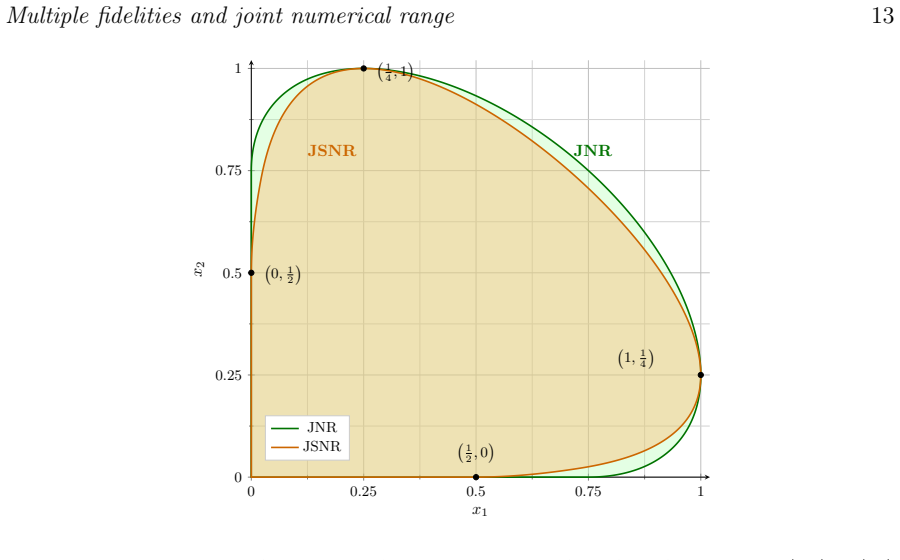
When all reference states are product states, a necessary and sufficient criterion for effective entanglement detection is that either some pair of reference states has nontrivial moduli of the local inner products on both subsystems, or the orthogonal complement of the span of the reference states is completely entangled. There exist sets of reference product states for which no proper subset is effective but the full set is, with unextendible product bases as an example. For any pair of reference product states the joint separable numerical range is determined solely by their local fidelities.
What carries the argument
The geometry of the joint separable numerical range of the product-state references, which decides whether the fidelities separate entangled states from separable ones.
If this is right
- There exist minimal sets of product states where the full collection detects entanglement but no proper subset does, with unextendible product bases providing an example.
- For any pair of reference product states on a bipartite system the joint separable numerical range is fixed solely by the local fidelities.
- The criterion supplies a systematic method for designing effective entanglement witnesses from product references.
- The results lay groundwork for extensions to higher-dimensional and multipartite scenarios.
Where Pith is reading between the lines
- The same geometric test on joint ranges could be adapted to detect other forms of quantum correlation that admit product-state witnesses.
- Laboratory implementations might select minimal product-reference sets to reduce the number of fidelity measurements needed for entanglement verification.
- Links to numerical-range techniques in quantum channel discrimination could yield hybrid detection protocols that combine fidelity data with other observables.
Load-bearing premise
The analysis assumes a bipartite quantum system and that effectiveness of detection is fully captured by the geometry of the joint separable numerical range of the chosen product-state references.
What would settle it
A concrete counter-example would be a collection of product states satisfying neither part of the criterion yet still having a joint separable numerical range that excludes some entangled state, or a collection satisfying the criterion whose range fails to exclude any entangled state.
Figures
read the original abstract
We investigate the effectiveness of entanglement detection based on multiple fidelities via the geometry of the joint separable numerical range. When all reference states are product states, we derive a necessary and sufficient criterion for such detection: either some pair of reference states has nontrivial moduli of the local inner products on both subsystems, or the orthogonal complement of the span of the reference states is completely entangled. We further show that there exist sets of reference product states for which no proper subset is effective for entanglement detection, whereas the full set is. A typical example of this phenomenon is provided by unextendible product bases. Moreover, for a pair of reference product states on a bipartite system with arbitrary local dimensions, we characterize both the joint numerical range and the joint separable numerical range, showing that the joint separable numerical range is determined solely by their local fidelities, as illustrated by a representative two-qubit example. Our results offer a systematic approach to designing effective entanglement witnesses and lay the groundwork for extensions to higher-dimensional and multipartite scenarios.
Editorial analysis
A structured set of objections, weighed in public.
Referee Report
Summary. The manuscript presents an investigation into entanglement detection using multiple fidelities to product reference states, analyzed through the geometry of the joint separable numerical range on bipartite quantum systems. It derives a necessary and sufficient criterion for the effectiveness of such detection when references are product states: either some pair of reference states exhibits nontrivial moduli of the local inner products on both subsystems, or the orthogonal complement of the span of the reference states is completely entangled. Additionally, the paper demonstrates the existence of sets of reference product states, such as unextendible product bases, where the full set is effective for detection but no proper subset is. For a pair of reference product states, it characterizes the joint numerical range and the joint separable numerical range, showing that the latter is determined solely by the local fidelities, with an illustrative two-qubit example. The results aim to provide a systematic approach to designing effective entanglement witnesses and groundwork for higher-dimensional and multipartite scenarios.
Significance. If the central derivations hold, this work contributes a precise geometric criterion linking the structure of product references to their entanglement detection power, which could aid in the design of witnesses. The explicit condition and the unextendible product bases example illustrate cases where collective references are necessary. The pair characterization, consistent with tensor-product structure, offers a practical simplification. These elements strengthen connections between numerical range geometry and entanglement theory and provide a basis for extensions.
minor comments (2)
- [Abstract] The abstract is information-dense; splitting the main criterion and the pair-wise characterization into separate sentences would improve readability.
- Ensure that terms such as 'completely entangled' for the orthogonal complement and 'nontrivial moduli of the local inner products' are defined or referenced to standard definitions upon first use in the main text.
Simulated Author's Rebuttal
We thank the referee for the positive summary, significance assessment, and recommendation of minor revision. No specific major comments appear in the report.
Circularity Check
No significant circularity; derivations rest on standard numerical-range geometry
full rationale
The paper derives its necessary-and-sufficient criterion for effective entanglement detection directly from the geometry of the joint separable numerical range of product-state references on a bipartite system. The stated condition (nontrivial local inner-product moduli for some pair, or completely entangled orthogonal complement) follows from the tensor-product structure and span/orthogonality properties without any reduction to fitted parameters, self-referential definitions, or load-bearing self-citations. The pair-wise characterization that the joint separable range is fixed by local fidelities alone is a direct algebraic consequence of the product form of the references, not a renaming or smuggling of an ansatz. No equations or claims in the abstract or reader summary exhibit the enumerated circularity patterns; the work is self-contained against external benchmarks of numerical-range theory.
Axiom & Free-Parameter Ledger
axioms (2)
- domain assumption The quantum system under consideration is bipartite.
- domain assumption Reference states used for fidelity measurements are product states.
Reference graph
Works this paper leans on
-
[1]
Horodecki R, Horodecki P, Horodecki M and Horodecki K 2009Reviews of Modern Physics81 865–942
-
[2]
Nielsen M A and Chuang I L 2010Quantum computation and quantum information(Cambridge University Press)
-
[3]
Bennett C H, Brassard G, Cr´ epeau C, Jozsa R, Peres A and Wootters W K 1993Physical Review Letters701895–1899
-
[4]
Bennett C H and Wiesner S J 1992Physical Review Letters692881–2884
-
[5]
Bennett C H and Brassard G 2014Theoretical Computer Science5607–11
-
[6]
Peres A 1996Physical Review Letters771413
-
[7]
Chen K and Wu L A 2003 A matrix realignment method for recognizing entanglement (Preprint quant-ph/0205017)
work page internal anchor Pith review Pith/arXiv arXiv 2003
-
[8]
Rudolph O 2003Physical Review A67032312 Multiple fidelities and joint numerical range17
-
[9]
Horodecki P 1997Physics Letters A232333–339
-
[10]
Chru´ sci´ nski D and Sarbicki G 2014Journal of Physics A: Mathematical and Theoretical47483001
-
[11]
G¨ uhne O and T´ oth G 2009Physics Reports4741–75
-
[12]
Terhal B M 2001Linear Algebra and its Applications32361–73
-
[13]
Lewenstein M, Kraus B, Cirac J I and Horodecki P 2000Physical Review A62052310
-
[14]
T´ oth G 2005Physical Review A—Atomic, Molecular, and Optical Physics71010301
-
[15]
Piani M and Mora C E 2007Physical Review A—Atomic, Molecular, and Optical Physics75 012305
-
[16]
Bourennane M, Eibl M, Kurtsiefer C, Gaertner S, Weinfurter H, G¨ uhne O, Hyllus P, Bruß D, Lewenstein M and Sanpera A 2004Physical Review Letters92087902
-
[17]
Weilenmann M, Dive B, Trillo D, Aguilar E A and Navascu´ es M 2020Physical Review Letters124 200502
-
[18]
G¨ uhne O, Mao Y and Yu X D 2021Physical Review Letters126140503
-
[19]
Zhang R and Wei Z 2025Quantum Science and Technology10015061
-
[20]
Gutkin E and ˙Zyczkowski K 2013Linear Algebra and its Applications4382394–2404
-
[21]
Bennett C H, DiVincenzo D P, Mor T, Shor P W, Smolin J A and Terhal B M 1999Physical Review Letters825385
-
[22]
Wu P and Tang R 2020Journal of Physics A: Mathematical and Theoretical53445302
- [23]
-
[24]
Bertsekas D, Nedic A and Ozdaglar A 2003Convex analysis and optimizationvol 1 (Athena Scientific)
- [25]
-
[26]
Bengtsson I and ˙Zyczkowski K 2017Geometry of quantum states: an introduction to quantum entanglement(Cambridge University Press)
discussion (0)
Sign in with ORCID, Apple, or X to comment. Anyone can read and Pith papers without signing in.