Dilute Magnetism and Edge-State Engineering in Monolayer SnO
Pith reviewed 2026-06-30 13:42 UTC · model grok-4.3
The pith
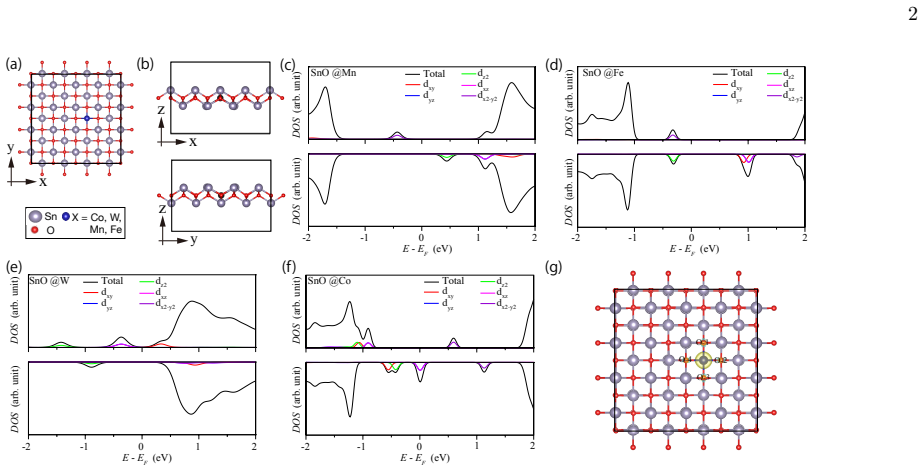
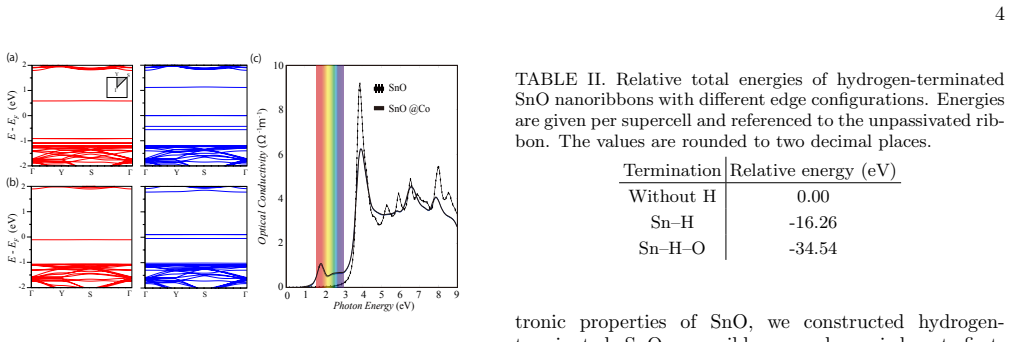
Transition metal doping induces localized magnetic moments from d-orbitals in SnO monolayers, creating dispersionless bands near the Fermi energy.
A machine-rendered reading of the paper's core claim, the machinery that carries it, and where it could break.
Core claim
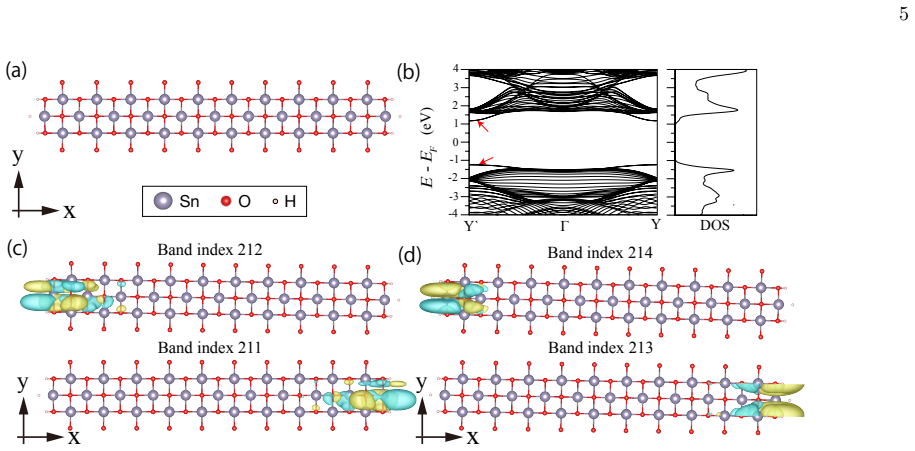
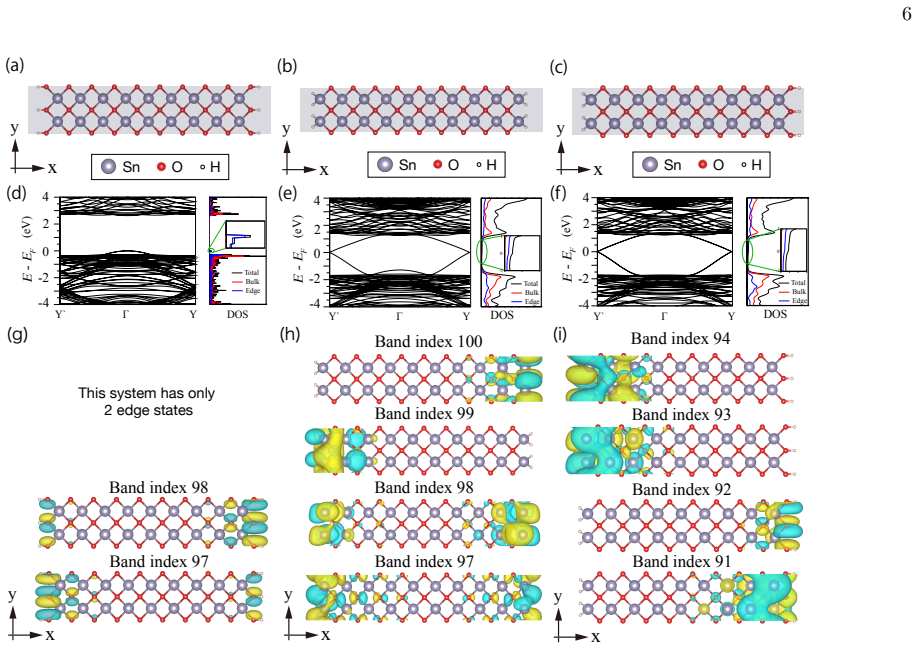
Using density functional theory, all transition-metal dopants in SnO monolayer induce finite localized magnetic moments primarily originating from d-orbitals of the impurity atoms. These localized magnetic states give rise to nearly dispersionless bands in the vicinity of the Fermi energy. In nanoribbon geometries, intrinsic edge-localized states are largely independent of ribbon width; oxygen-rich edges are thermodynamically most stable and remain semiconducting, whereas Sn-terminated edges host metallic one-dimensional conduction channels.
What carries the argument
Density functional theory calculations on transition-metal doped SnO supercells and nanoribbons that track d-orbital magnetic moments and compare thermodynamic stability of oxygen-rich versus tin-terminated edges.
If this is right
- All dopants induce finite localized magnetic moments primarily from d-orbitals of the impurity atoms.
- Localized magnetic states produce nearly dispersionless bands near the Fermi energy.
- Oxygen-rich edges are thermodynamically most stable and remain semiconducting.
- Sn-terminated edges host metallic one-dimensional conduction channels.
- Transition-metal doping and edge engineering provide routes to tailor electronic properties for spintronic and nanoelectronic applications.
Where Pith is reading between the lines
- Pairing specific dopants with chosen edge terminations could produce hybrid regions that are simultaneously magnetic and metallic within one nanoribbon.
- The width independence of the edge states implies they remain usable even when ribbons are narrowed to a few unit cells.
- The flat bands near the Fermi level may support correlated electron phenomena if carrier density is further adjusted.
- Similar doping and edge effects could be tested in other layered oxide monolayers that share the same square lattice symmetry.
Load-bearing premise
Standard density-functional-theory approximations are sufficient to capture the correct magnetic moments, band dispersions, and relative edge stabilities without significant self-interaction errors.
What would settle it
An experimental measurement of the magnetic moment per cobalt dopant in SnO that deviates substantially from the DFT value, or direct transport data showing metallic conduction absent from tin-terminated edges, would falsify the central claims.
Figures
read the original abstract
Tin monoxide (SnO) is a p-type oxide semiconductor whose electronic properties can be widely modified via atomic-scale engineering. Using density functional theory, we investigate the electronic and magnetic properties of transition-metal (TM = Mn, Fe, Co and W) doped SnO monolayer within a large supercell. We find that all dopants induce finite localized magnetic moments, primarily originating from $d$-orbitals of the impurity atoms. We show that these localized magnetic states give rise to nearly dispersionless bands in the vicinity of the Fermi energy (taking Co doped SnO as an example). In addition, we investigate dimensional effects by constructing nanoribbon geometries of SnO monolayer. The ribbons exhibit intrinsic edge-localized states that are largely independent of ribbon width. For chiral nanoribbons oriented along a low-symmetry direction of the square lattice, we find that oxygen-rich edges are thermodynamically most stable and remain semiconducting, whereas Sn-terminated edges host metallic one-dimensional conduction channels. Our results demonstrate that transition-metal doping and edge engineering provide effective routes to tailor the electronic properties of SnO monolayer, making it a promising candidate for future spintronic and nanoelectronic applications.
Editorial analysis
A structured set of objections, weighed in public.
Referee Report
Summary. The manuscript reports density-functional theory calculations on monolayer SnO doped with Mn, Fe, Co and W, claiming that all four dopants produce finite localized magnetic moments arising primarily from impurity d-orbitals and that these states generate nearly dispersionless bands near the Fermi level (illustrated for Co). It further examines SnO nanoribbons, asserting that oxygen-rich edges are thermodynamically most stable and remain semiconducting while Sn-terminated edges support metallic one-dimensional conduction channels independent of ribbon width. The work concludes that TM doping and edge engineering are effective routes to tailor the electronic and magnetic properties of SnO for spintronic and nanoelectronic applications.
Significance. If the reported moments, band dispersions and edge stability ordering prove robust, the study would add to the literature on dilute magnetism and edge-state engineering in 2D p-type oxides. The numerical-experiment character of the work (no free parameters or fitted quantities) is a modest strength, but the absence of any cross-validation against hybrid functionals, GW, or experimental benchmarks limits the immediate impact.
major comments (3)
- [Computational Details] Computational Details (or equivalent section): the exchange-correlation functional, plane-wave cutoff, k-point sampling, supercell size, and any Hubbard U values applied to TM d-states are not reported. Because magnetic moments and edge formation energies in SnO and related oxides are known to be sensitive to self-interaction error, the central claims that all four dopants induce finite localized d-derived moments and that O-rich edges are most stable rest on an unverified approximation.
- [Doped SnO results] Doped-monolayer results: the statement that moments 'primarily originate from d-orbitals' is presented without tabulated moment values, orbital-projected densities of states, or spin-density isosurface figures for each dopant (Mn, Fe, Co, W). Without these data it is impossible to verify the localization and orbital character that underpin the dispersionless-band claim.
- [Nanoribbon geometries] Nanoribbon section: the thermodynamic ordering of O-rich versus Sn-terminated edges is asserted without the explicit formation-energy expression, the choice of Sn and O chemical potentials, or convergence with ribbon width. These quantities directly determine the claimed stability and metallic/semiconducting character of the 1D channels.
minor comments (2)
- [Abstract] The abstract states that the localized states give rise to 'nearly dispersionless bands' but does not quantify the bandwidth or show the band structure for any dopant other than the Co example.
- [Figures] Figure captions and axis labels should explicitly state the functional and any +U values used so that readers can immediately assess the level of theory.
Simulated Author's Rebuttal
We thank the referee for the constructive comments. We agree that several technical details were omitted from the original submission and have revised the manuscript to address each point. Our responses are given below.
read point-by-point responses
-
Referee: [Computational Details] Computational Details (or equivalent section): the exchange-correlation functional, plane-wave cutoff, k-point sampling, supercell size, and any Hubbard U values applied to TM d-states are not reported. Because magnetic moments and edge formation energies in SnO and related oxides are known to be sensitive to self-interaction error, the central claims that all four dopants induce finite localized d-derived moments and that O-rich edges are most stable rest on an unverified approximation.
Authors: We agree that these parameters must be stated explicitly. In the revised manuscript we have inserted a dedicated Computational Methods section reporting the PBE functional, 500 eV plane-wave cutoff, 4×4×1 Γ-centered k-mesh for the 4×4 supercell, and U = 4 eV applied to TM d states. We have also added a brief discussion noting the known sensitivity of oxide magnetic moments to self-interaction error and stating that the reported trends are qualitative. revision: yes
-
Referee: [Doped SnO results] Doped-monolayer results: the statement that moments 'primarily originate from d-orbitals' is presented without tabulated moment values, orbital-projected densities of states, or spin-density isosurface figures for each dopant (Mn, Fe, Co, W). Without these data it is impossible to verify the localization and orbital character that underpin the dispersionless-band claim.
Authors: We accept this criticism. The revised manuscript now contains a new table (Table I) listing the total and orbital-resolved magnetic moments for Mn, Fe, Co and W, together with orbital-projected DOS plots and spin-density isosurface figures (new Figure 3) that confirm the dominant d-orbital character for all four dopants. revision: yes
-
Referee: [Nanoribbon geometries] Nanoribbon section: the thermodynamic ordering of O-rich versus Sn-terminated edges is asserted without the explicit formation-energy expression, the choice of Sn and O chemical potentials, or convergence with ribbon width. These quantities directly determine the claimed stability and metallic/semiconducting character of the 1D channels.
Authors: We have added the explicit formation-energy formula E_form = E_ribbon − n_Sn μ_Sn − n_O μ_O (with μ_Sn and μ_O referenced to bulk Sn and O_{2}, respectively) and a new supplementary figure demonstrating convergence of edge energies with ribbon width up to 12 nm. These additions confirm the reported stability ordering and the width-independent character of the edge states. revision: yes
Circularity Check
No circularity; results are independent DFT outputs
full rationale
The manuscript reports numerical results from standard density-functional-theory calculations on supercell models of TM-doped SnO monolayers and on nanoribbon geometries. Magnetic moments, dispersionless bands, and relative edge formation energies are computed quantities whose values are not defined in terms of themselves, fitted to the target observables, or justified solely by self-citation chains. No equations, ansatzes, or uniqueness theorems are introduced that collapse back to the input definitions or to prior work by the same authors. The derivation chain is therefore self-contained and consists of independent computational experiments.
Axiom & Free-Parameter Ledger
axioms (1)
- domain assumption Density functional theory with typical approximations accurately predicts localized magnetic moments and relative edge stabilities in doped 2D oxides
Reference graph
Works this paper leans on
-
[1]
Fortunato, P
E. Fortunato, P. Barquinha, and R. Martins, Adv. Mater. 24, 2945 (2012)
2012
-
[2]
Kamiya, K
T. Kamiya, K. Nomura, and H. Hosono, Sci. Technol. Adv. Mater.11, 044305 (2010)
2010
-
[3]
Hosono, J Non-Cryst
H. Hosono, J Non-Cryst. Solids352, 851 (2006)
2006
-
[4]
Zhang, Y
Z. Zhang, Y. Guo, and J. Robertson, Chem. Mater.34, 643 (2022)
2022
-
[5]
Z. Wang, P. K. Nayak, J. A. Caraveo-Frescas, and H. N. Alshareef, Adv. Mater.28, 3831 (2016)
2016
-
[6]
J. Du, C. Xia, Y. Liu, X. Li, Y. Peng, and S. Wei, Appl. Surf. Sci.401, 114 (2017)
2017
-
[7]
Shukla and N
A. Shukla and N. K. Gaur, Chem. Phys. Lett.754, 137717 (2020)
2020
-
[8]
Y. Wang, X. Nie, X. Yan, C. Wang, F. Yang, X. Yang, C. Xu, and Y. Chi, Solid State Commun.354, 114884 (2022)
2022
-
[9]
Mitoma, S
N. Mitoma, S. Aikawa, X. Gao, M.-F. Lin, T. Kizu, T. Nabatame, and K. Tsukagoshi, Appl. Phys. Lett.104, 8 102103 (2014)
2014
-
[10]
Aikawa, T
S. Aikawa, T. Nabatame, and K. Tsukagoshi, Appl. Phys. Lett.103, 172105 (2013)
2013
-
[11]
Aikawa, N
S. Aikawa, N. Mitoma, T. Kizu, T. Nabatame, and K. Tsukagoshi, Appl. Phys. Lett.106, 192103 (2015)
2015
-
[12]
Huang, P.-H
C.-H. Huang, P.-H. Chen, Y.-H. Li, Y.-L. Chueh, and K. Nomura, ACS Appl. Mater. Interfaces.13, 52783 (2021)
2021
-
[13]
Albar and U
A. Albar and U. Schwingenschl¨ ogl, J. Mater. Chem. C4, 8947 (2016)
2016
-
[16]
D. Hoat, N. T. Tien, D. K. Nguyen, and J. Guerrero- Sanchez, Phys. Chem. Chem. Phys.26, 18657 (2024)
2024
-
[17]
M. Chen, R. Xue, and P. Wu, J. Phys. Chem. C128, 13568 (2024)
2024
-
[18]
Mubeen and A
A. Mubeen and A. Majid, J. Magn. Magn. Mater.580, 170897 (2023)
2023
-
[19]
Y. R. Wang, S. Li, and J. B. Yi, J. Phys. Chem. C122, 4651 (2018)
2018
-
[20]
Wakabayashi, S
K. Wakabayashi, S. Okada, R. Tomita, S. Fujimoto, and Y. Natsume, J. Phys. Soc. Japan79, 034706 (2010)
2010
-
[21]
Wakabayashi, Y
K. Wakabayashi, Y. Takane, M. Yamamoto, and M. Sigrist, New J. Phys.11, 095016 (2009)
2009
-
[22]
Adhikary and S
S. Adhikary and S. Dutta, RSC Adv.14, 30084 (2024)
2024
-
[23]
Kresse and J
G. Kresse and J. Furthm¨ uller, Phys. Rev. B54, 11169 (1996)
1996
-
[24]
Kresse and J
G. Kresse and J. Furthm¨ uller, Comput. Mater. Sci.6, 15 (1996)
1996
-
[25]
P. E. Bl¨ ochl, Phys. Rev. B50, 17953 (1994)
1994
-
[26]
Kresse and D
G. Kresse and D. Joubert, Phys. Rev. B59, 1758 (1999)
1999
-
[27]
J. P. Perdew, K. Burke, and M. Ernzerhof, Phys. Rev. Lett.77, 3865 (1996)
1996
-
[28]
H. J. Monkhorst and J. D. Pack, Phys. Rev. B13, 5188 (1976)
1976
-
[29]
V. Wang, N. Xu, J.-C. Liu, G. Tang, and W.-T. Geng, Comput. Phys. Commun.267, 108033 (2021)
2021
-
[30]
V. I. Anisimov, J. Zaanen, and O. K. Andersen, Phys. Rev. B44, 943 (1991)
1991
-
[31]
Giannozzi andet al., J
P. Giannozzi andet al., J. Phys.: Condens. Matter21, 395502 (2009)
2009
-
[32]
Giannozzi andet al., J
P. Giannozzi andet al., J. Phys.: Condens. Matter29, 465901 (2017)
2017
-
[33]
Gajdoˇ s, K
M. Gajdoˇ s, K. Hummer, G. Kresse, J. Furthm¨ uller, and F. Bechstedt, Phys. Rev. B73, 045112 (2006)
2006
-
[34]
R. Kubo, J. Phys. Soc. Jpn.12, 570 (1957)
1957
-
[35]
R. Kubo, M. Yokota, and S. Nakajima, J. Phys. Soc. Jpn. 12, 1203 (1957)
1957
-
[36]
D. A. Greenwood, Proc. Phys. Soc.71, 585 (1958)
1958
-
[37]
Dietl, Nat
T. Dietl, Nat. Mater.9, 965 (2010)
2010
-
[38]
Liang, Z
L. Liang, Z. M. Liu, H. Cao, W. Xu, X. L. Sun, H. Luo, and K. Cang, J. Phys. D: Appl. Phys.45, 085101 (2012)
2012
-
[39]
Tao and L
J. Tao and L. Guan, Sci. Rep.7, 44568 (2017)
2017
-
[40]
Mubeen and A
A. Mubeen and A. Majid, J. Supercon. Nov. Magn.35, 2975 (2022)
2022
-
[41]
Mubeen, A
A. Mubeen, A. Majid, S. Haider, and K. Alam, Opt. Quantum Electron.56, 1169 (2024)
2024
-
[42]
Guan and J
L. Guan and J. Tao, Phys. Rev. Appl.8, 064019 (2017)
2017
-
[43]
Robertson and B
J. Robertson and B. Falabretti, J. Appl. Phys.100, 014111 (2006)
2006
-
[44]
Hosono and H
H. Hosono and H. Kawazoe, MRS Bulletin25, 28 (2000)
2000
-
[45]
C. Auth, A. Aliyarukunju, M. Asoro, D. Bergstrom, V. Bhagwat, J. Birdsall,et al., inIEEE International Electron Devices Meeting (IEDM)(2017) pp. 29.1.1– 29.1.4
2017
-
[46]
Fujita, K
M. Fujita, K. Wakabayashi, K. Nakada, and K. Kusak- abe, J. Phys. Soc. Jpn.65, 1920 (1996)
1920
-
[47]
Wassmann, A
T. Wassmann, A. P. Seitsonen, A. M. Saitta, M. Lazzeri, and F. Mauri, Phys. Rev. Lett.101, 096402 (2008)
2008
-
[48]
J. I. Paez-Ornelas, R. Ponce-Perez, H. N. Fernandez- Escamilla, D. M. Hoat, E. A. Murillo-Bracamontes, M. G. Moreno-Armenta, D. H. Galvan, and J. Guerrero- Sanchez, Sci. Rep.11, 21061 (2021)
2021
-
[49]
A. Lino, H. Chacham, and M. Mazzoni, J. Phys. Chem. C115, 18047–18050 (2011)
2011
-
[50]
Topsakal, S
M. Topsakal, S. Cahangirov, and S. Ciraci, Phys. Rev. B 80, 235119 (2009)
2009
-
[51]
A. R. Botello-M´ endez, F. L´ opez-Ur´ ıas, M. Terrones, and H. Terrones, Nano Lett.8, 1562 (2008)
2008
-
[52]
Robertson and Z
J. Robertson and Z. Zhang, MRS Bulletin46, 1037 (2021)
2021
discussion (0)
Sign in with ORCID, Apple, or X to comment. Anyone can read and Pith papers without signing in.