Emergence of Triplet Superconductivity from Cavity Vacuum Fluctuations
Pith reviewed 2026-06-30 12:36 UTC · model grok-4.3
The pith
Cavity vacuum fluctuations switch a superconductor from singlet to triplet pairing above a critical coupling.
A machine-rendered reading of the paper's core claim, the machinery that carries it, and where it could break.
Core claim
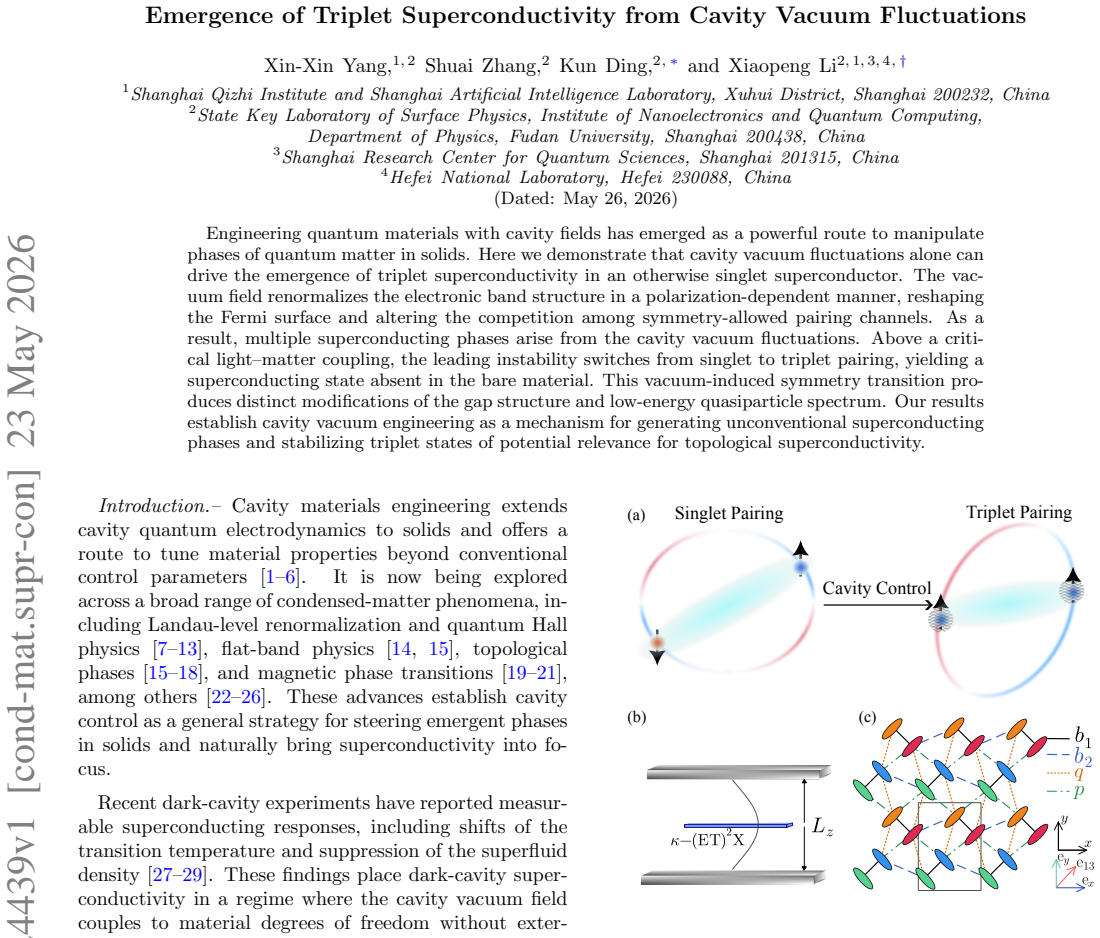
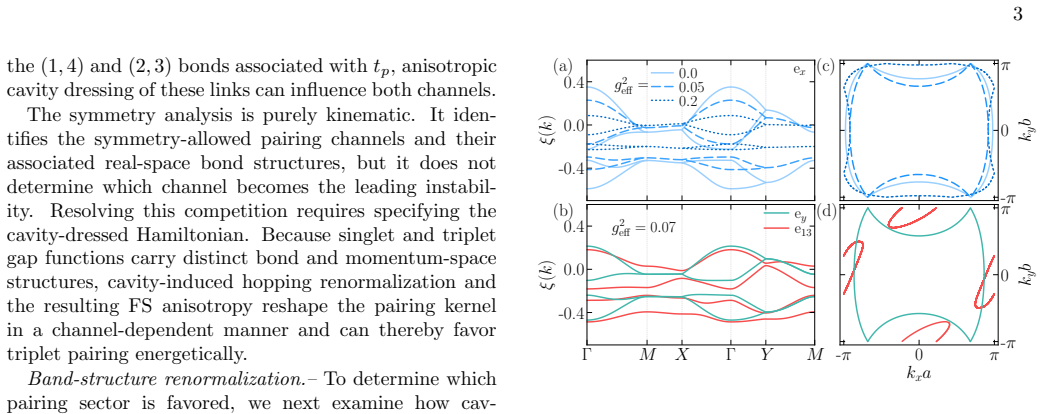
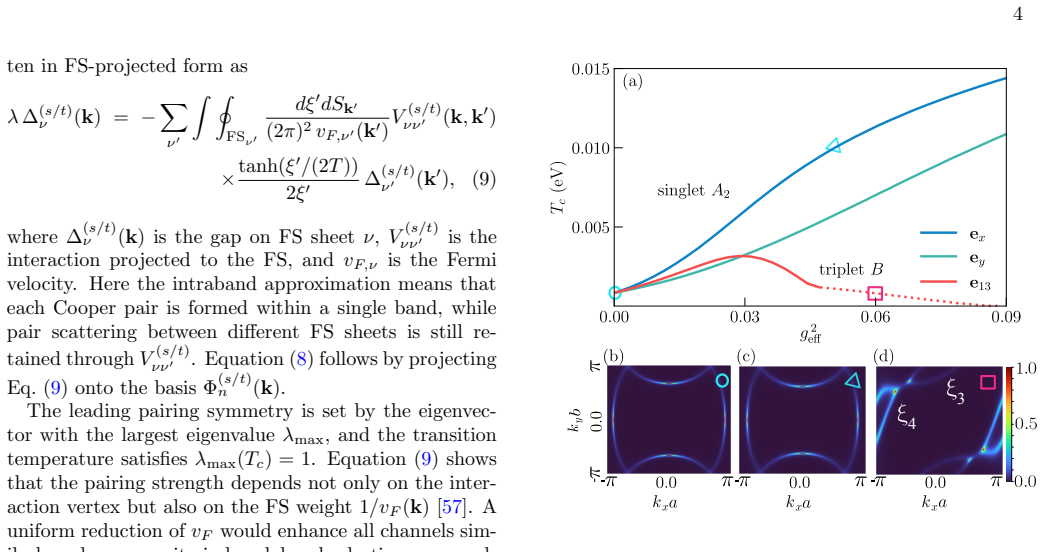
Cavity vacuum fluctuations renormalize the electronic band structure in a polarization-dependent manner, reshaping the Fermi surface and altering the competition among symmetry-allowed pairing channels. Above a critical light-matter coupling, the leading instability switches from singlet to triplet pairing, yielding a superconducting state absent in the bare material. This vacuum-induced symmetry transition produces distinct modifications of the gap structure and low-energy quasiparticle spectrum.
What carries the argument
Polarization-dependent renormalization of the band structure by cavity vacuum fluctuations, which alters the Fermi surface and favors triplet pairing over singlet.
If this is right
- Multiple superconducting phases arise from the cavity vacuum fluctuations.
- The gap structure and low-energy quasiparticle spectrum acquire distinct modifications.
- Triplet states of potential relevance for topological superconductivity become accessible.
- A vacuum-induced symmetry transition occurs between singlet and triplet regimes.
Where Pith is reading between the lines
- The same vacuum-renormalization mechanism could be tested in other materials where singlet and triplet channels compete closely.
- Varying cavity geometry or polarization direction offers an experimental knob to tune the transition point without changing the sample chemistry.
- The approach may extend to stabilizing other unconventional orders if the polarization dependence can be engineered to favor different symmetries.
- A concrete test would be to embed a known singlet superconductor in a high-Q cavity and track the pairing symmetry via tunneling or transport as coupling strength is increased.
Load-bearing premise
The cavity vacuum field couples to the electrons solely through polarization-dependent band renormalization without introducing decoherence, dissipation, or higher-order photon processes.
What would settle it
Measurement showing that triplet pairing never becomes dominant even as light-matter coupling is increased well beyond the predicted critical value, or direct detection of decoherence that suppresses the transition.
Figures
read the original abstract
Engineering quantum materials with cavity fields has emerged as a powerful route to manipulate phases of quantum matter in solids. Here we demonstrate that cavity vacuum fluctuations alone can drive the emergence of triplet superconductivity in an otherwise singlet superconductor. The vacuum field renormalizes the electronic band structure in a polarization dependent manner, reshaping the Fermi surface and altering the competition among symmetry allowed pairing channels. As a result, multiple superconducting phases arise from the cavity vacuum fluctuations. Above a critical light matter coupling, the leading instability switches from singlet to triplet pairing, yielding a superconducting state absent in the bare material. This vacuum induced symmetry transition produces distinct modifications of the gap structure and low energy quasiparticle spectrum. Our results establish cavity vacuum engineering as a mechanism for generating unconventional superconducting phases and stabilizing triplet states of potential relevance for topological superconductivity.
Editorial analysis
A structured set of objections, weighed in public.
Referee Report
Summary. The paper claims that cavity vacuum fluctuations alone can drive the emergence of triplet superconductivity in an otherwise singlet superconductor. The vacuum field is said to renormalize the electronic band structure in a polarization-dependent manner, reshaping the Fermi surface and altering the competition among symmetry-allowed pairing channels. Above a critical light-matter coupling, the leading instability switches from singlet to triplet pairing, producing a superconducting state absent in the bare material, with distinct modifications to the gap structure and low-energy quasiparticle spectrum.
Significance. If the central result holds, the work would establish cavity vacuum engineering as a mechanism for generating unconventional superconducting phases and stabilizing triplet states of potential relevance for topological superconductivity. The approach of using vacuum-induced band reshaping to invert pairing-channel dominance without external fields or doping would be a notable addition to cavity QED control of quantum materials.
major comments (2)
- [Abstract / Model] The load-bearing assumption is that the cavity vacuum couples to electrons solely through polarization-dependent renormalization of the single-particle dispersion while leaving the bare pairing kernel unchanged. This decoupling is stated in the abstract but is not derived from a microscopic light-matter Hamiltonian; the virtual exchange of cavity photons would generically generate an additional retarded interaction whose symmetry content must be shown to be negligible compared with the band-renormalization effect.
- [Results] The reported switch in leading instability from singlet to triplet is asserted to arise from Fermi-surface reshaping alone. Without an explicit calculation of the pairing eigenvalues (e.g., the eigenvalue spectrum of the linearized gap equation before and after renormalization) or a demonstration that the interaction kernel V(k,k') remains fixed, it is unclear whether the claimed inversion survives once the full photon-mediated contribution is included.
minor comments (2)
- Notation for the light-matter coupling strength and the polarization vectors should be defined consistently between the abstract and the main text.
- [Abstract] The abstract refers to 'multiple superconducting phases' arising from the vacuum fluctuations; a brief statement of which additional phases appear (beyond the singlet-triplet switch) would improve clarity.
Simulated Author's Rebuttal
We thank the referee for their careful reading and constructive comments. We address the major points below and indicate the revisions that will be incorporated.
read point-by-point responses
-
Referee: [Abstract / Model] The load-bearing assumption is that the cavity vacuum couples to electrons solely through polarization-dependent renormalization of the single-particle dispersion while leaving the bare pairing kernel unchanged. This decoupling is stated in the abstract but is not derived from a microscopic light-matter Hamiltonian; the virtual exchange of cavity photons would generically generate an additional retarded interaction whose symmetry content must be shown to be negligible compared with the band-renormalization effect.
Authors: We agree that a microscopic derivation is necessary to justify the decoupling. In the revised manuscript we will add a dedicated section deriving the effective Hamiltonian from the full light-matter model (including both paramagnetic and diamagnetic terms) and explicitly estimate the strength of the virtual-photon-mediated retarded interaction. We will show that, in the vacuum-fluctuation regime and for the light-matter couplings considered, this contribution remains subdominant and does not alter the symmetry classification of the dominant pairing channels relative to the band-renormalization effect. revision: yes
-
Referee: [Results] The reported switch in leading instability from singlet to triplet is asserted to arise from Fermi-surface reshaping alone. Without an explicit calculation of the pairing eigenvalues (e.g., the eigenvalue spectrum of the linearized gap equation before and after renormalization) or a demonstration that the interaction kernel V(k,k') remains fixed, it is unclear whether the claimed inversion survives once the full photon-mediated contribution is included.
Authors: The calculations in the manuscript were performed with the linearized gap equation using the cavity-renormalized dispersion while keeping V(k,k') fixed. In the revision we will include explicit plots of the leading eigenvalues (both singlet and triplet channels) as functions of the light-matter coupling strength, before and after renormalization, to demonstrate the crossing. We will also state clearly that V(k,k') is held fixed within the present scope, which isolates the band-renormalization mechanism; a quantitative treatment of the additional photon-mediated terms is left for future work but is not expected to reverse the qualitative inversion on symmetry grounds. revision: yes
Circularity Check
No circularity; band renormalization treated as input to standard pairing eigenvalue problem.
full rationale
The derivation proceeds by taking a light-matter Hamiltonian that produces a polarization-dependent renormalization of the single-particle dispersion, then solving the linearized gap equation for singlet versus triplet channels with an unchanged bare interaction kernel. This is a conventional computational workflow whose output (switch in leading instability) is not identical to the input by construction, nor obtained via fitted parameters renamed as predictions, nor justified solely by self-citation chains. No equations are shown to reduce to each other tautologically, and the central claim retains independent content from the explicit diagonalization step. The modeling choice to omit photon-mediated pairing corrections is an assumption about the Hamiltonian, not a circular reduction.
Axiom & Free-Parameter Ledger
Reference graph
Works this paper leans on
-
[1]
I.-T. Lu, D. Shin, M. Kamper Svendsen, S. Latini, H. H¨ ubener, M. Ruggenthaler, and A. Rubio, Cavity En- gineering of Solid-State Materials without External Driv- ing, Adv. Opt. Photon.17, 441 (2025)
2025
-
[2]
F. J. Garcia-Vidal, C. Ciuti, and T. W. Ebbesen, Ma- nipulating Matter by Strong Coupling to Vacuum Fields, Science373, eabd0336 (2021)
2021
-
[3]
Bloch, A
J. Bloch, A. Cavalleri, V. Galitski, M. Hafezi, and A. Ru- bio, Strongly Correlated Electron-Photon Systems, Na- ture606, 41 (2022)
2022
-
[4]
Schlawin, D
F. Schlawin, D. M. Kennes, and M. A. Sentef, Cavity Quantum Materials, Appl. Phys. Rev.9, 011312 (2022)
2022
-
[5]
H. M. Bretscheret al., Fluctuation Engineering in Cavity Quantum Materials, arXiv:2604.08666v1 (2026)
work page internal anchor Pith review Pith/arXiv arXiv 2026
-
[6]
Baydin, H
A. Baydin, H. Zhu, M. Bamba, K. R. A. Hazzard, and J. Kono, Perspective on Quantum Vacuum in Matter, Opt. Mater. Express15, 1833 (2025)
2025
-
[7]
X. Li, M. Bamba, Q. Zhang, S. Fallahi, G. C. Gard- ner, W. Gao, M. Lou, K. Yoshioka, M. J. Manfra, and J. Kono, Vacuum Bloch-Siegert Shift in Landau Polari- tons with Ultra-High Cooperativity, Nat. Photonics12, 324 (2018)
2018
-
[8]
G. L. Paravicini-Baglianiet al., Magneto-Transport Con- trolled by Landau Polariton States, Nat. Phys.15, 186 (2019)
2019
-
[9]
Enkneret al., Testing the Renormalization of the von Klitzing Constant by Cavity Vacuum Fields, Phys
J. Enkneret al., Testing the Renormalization of the von Klitzing Constant by Cavity Vacuum Fields, Phys. Rev. X14, 021038 (2024)
2024
-
[10]
Enkneret al., Tunable Vacuum-Field Control of Frac- tional and Integer Quantum Hall Phases, Nature641, 884 (2025)
J. Enkneret al., Tunable Vacuum-Field Control of Frac- tional and Integer Quantum Hall Phases, Nature641, 884 (2025)
2025
-
[11]
Appugliese, J
F. Appugliese, J. Enkner, G. L. Paravicini-Bagliani, M. Beck, C. Reichl, W. Wegscheider, G. Scalari, C. Ciuti, and J. Faist, Breakdown of Topological Protection by Cavity Vacuum Fields in the Integer Quantum Hall Ef- fect, Science375, 1030 (2022)
2022
- [12]
-
[13]
X. Wang, E. Ronca, and M. A. Sentef, Cavity Quan- tum Electrodynamical Chern Insulator: Towards Light- Induced Quantized Anomalous Hall Effect in Graphene, Phys. Rev. B99, 235156 (2019)
2019
-
[14]
Jiang, M
C. Jiang, M. Baggioli, and Q.-D. Jiang, Engineering Flat Bands in Twisted-Bilayer Graphene away from the Magic Angle with Chiral Optical Cavities, Phys. Rev. Lett.132, 6 166901 (2024)
2024
-
[15]
H. Liu, F. Troisi, H. H¨ ubener, S. Latini, and A. Rubio, Cavity-Mediated Electron-Electron Interactions: Renor- malizing Dirac States in Graphene, Sci. Adv.11, eadz1855 (2025)
2025
-
[16]
Z. Lin, C. Xiao, D.-P. Nguyen, G. Arwas, C. Ciuti, and W. Yao, Remote Gate Control of Topological Transitions in Moir´ e Superlattices via Cavity Vacuum Fields, Proc. Natl. Acad. Sci. U.S.A.121, e2306584120 (2024)
2024
-
[17]
Nguyen, G
D.-P. Nguyen, G. Arwas, Z. Lin, W. Yao, and C. Ciuti, Electron-Photon Chern Number in Cavity-Embedded 2D Moir´ e Materials, Phys. Rev. Lett.131, 176602 (2023)
2023
-
[18]
C. B. Dag and V. Rokaj, Engineering Topology in Graphene with Chiral Cavities, Phys. Rev. B110, L121101 (2024)
2024
-
[19]
Latini, D
S. Latini, D. Shin, S.-A. Sato, C. Sch¨ afer, U. De Giovan- nini, H. H¨ ubener, and A. Rubio, The Ferroelectric Photo Ground State of SrTiO 3 from Cavity Materials Engi- neering, Proc. Natl. Acad. Sci. U.S.A.118, e2105618118 (2021)
2021
-
[20]
Ashida, A
Y. Ashida, A. ˙Imamo˘ glu, J. Faist, D. Jaksch, A. Caval- leri, and E. Demler, Quantum Electrodynamic Control of Matter: Cavity-Enhanced Ferroelectric Phase Transi- tion, Phys. Rev. X10, 041027 (2020)
2020
-
[21]
J. B. Curtis, M. H. Michael, and E. Demler, Local Fluc- tuations in Cavity Control of Ferroelectricity, Phys. Rev. Res.5, 043118 (2023)
2023
-
[22]
Jarcet al., Cavity-Mediated Thermal Control of Metal-to-Insulator Transition in 1T-TaS 2, Nature622, 487 (2023)
G. Jarcet al., Cavity-Mediated Thermal Control of Metal-to-Insulator Transition in 1T-TaS 2, Nature622, 487 (2023)
2023
-
[23]
Masuki and Y
K. Masuki and Y. Ashida, Cavity Moir´ e Materials: Controlling Magnetic Frustration with Quantum Light- Matter Interaction, Phys. Rev. B109, 195173 (2024)
2024
-
[24]
Chiocchetta, D
A. Chiocchetta, D. Kiese, C. P. Zelle, F. Piazza, and S. Diehl, Cavity-Induced Quantum Spin Liquids, Nat. Commun.12, 5901 (2021)
2021
-
[25]
F. Tay, S. Sanders, A. Baydin, Z. Song, D. M. Welakuh, A. Alabastri, V. Rokaj, C. B. Dag, and J. Kono , Tera- hertz Chiral Photonic-Crystal Cavities for Dirac Gap En- gineering in Graphene, Nat. Commun.16, 5270 (2025)
2025
-
[26]
Riolo, A
R. Riolo, A. Tomadin, G. Mazza, R. Asgari, A. H. Mac- Donald, and M. Polini, Tuning Fermi Liquids with Po- laritonic Cavities, Proc. Natl. Acad. Sci. U.S.A.122 e2407995122 (2025)
2025
-
[27]
Thomas, E
A. Thomas, E. Devaux, K. Nagarajan, G. Rogez, M. Sei- del, F. Richard, C. Genet, M. Drillon, and T. W. Ebbe- sen, Large Enhancement of Ferromagnetism under a Col- lective Strong Coupling of YBCO Nanoparticles, Nano Lett.21, 4365 (2021)
2021
-
[28]
Thomaset al., Exploring Superconductivity un- der Strong Coupling with the Vacuum Electromagnetic Field, J
A. Thomaset al., Exploring Superconductivity un- der Strong Coupling with the Vacuum Electromagnetic Field, J. Chem. Phys.162, 134701 (2025)
2025
-
[29]
Keren, T
I. Keren, T. A. Webb, S. Zhang,et al., Cavity-Altered Superconductivity, Nature650, 864 (2026)
2026
-
[30]
Rokaj, M
V. Rokaj, M. Ruggenthaler, F. G. Eich, and A. Rubio, Free Electron Gas in Cavity Quantum Electrodynamics, Phys. Rev. Res.4, 013012 (2022)
2022
-
[31]
J. Li, L. Schamriß, and M. Eckstein, Effective Theory of Lattice Electrons Strongly Coupled to Quantum Electro- magnetic Fields, Phys. Rev. B105, 165121 (2022)
2022
-
[32]
M. A. Sentef, M. Ruggenthaler, and A. Rubio, Cav- ity Quantum-Electrodynamical Polaritonically Enhanced Electron-Phonon Coupling and Its Influence on Super- conductivity, Sci. Adv.4, eaau6969 (2018)
2018
-
[33]
Hagenm¨ uller, J
D. Hagenm¨ uller, J. Schachenmayer, C. Genet, T. W. Ebbesen, and G. Pupillo, Enhancement of the Electron-Phonon Scattering Induced by Intrinsic Surface Plasmon-Phonon Polaritons, ACS Photonics6, 1073 (2019)
2019
-
[34]
Schlawin, A
F. Schlawin, A. Cavalleri, and D. Jaksch, Cavity- Mediated Electron-Photon Superconductivity, Phys. Rev. Lett.122, 133602 (2019)
2019
-
[35]
G. M. Andolina, A. De Pasquale, F. M. D. Pellegrino, I. Torre, F. H. L. Koppens, and M. Polini, Amperean Superconductivity Cannot Be Induced by Deep Subwave- length Cavities in a Two-Dimensional Material, Phys. Rev. B109, 104513 (2024)
2024
-
[36]
I.-T. Lu, D. Shin, M. K. Svendsen, H. H¨ ubener, U. De Giovannini, S. Latini, M. Ruggenthaler, and A. Ru- bio, Cavity-Enhanced Superconductivity in MgB 2 from First-Principles Quantum Electrodynamics, Proc. Natl. Acad. Sci. U.S.A.121, e2415061121 (2024)
2024
-
[37]
V. K. Kozin, E. Thingstad, D. Loss, and J. Klinovaja, Cavity-Enhanced Superconductivity via Band Engineer- ing, Phys. Rev. B111, 035410 (2025)
2025
-
[38]
Sigrist and K
M. Sigrist and K. Ueda, Phenomenological Theory of Un- conventional Superconductivity, Rev. Mod. Phys.63, 239 (1991)
1991
-
[39]
Sato and Y
M. Sato and Y. Ando, Topological Superconductors: A Review, Rep. Prog. Phys.80, 076501 (2017)
2017
-
[40]
A. M. Clogston, Upper Limit for the Critical Field in Hard Superconductors, Phys. Rev. Lett.9, 266 (1962)
1962
-
[41]
B. S. Chandrasekhar, A Note on the Maximum Critical Field of High-Field Superconductors, Appl. Phys. Lett. 1, 7 (1962)
1962
-
[42]
N. F. Berk and J. R. Schrieffer, Effect of Ferromagnetic Spin Correlations on Superconductivity, Phys. Rev. Lett. 17, 433 (1966)
1966
-
[43]
Fay and J
D. Fay and J. Appel, Coexistence of p-State Supercon- ductivity and Itinerant Ferromagnetism, Phys. Rev. B 22, 3173 (1980)
1980
-
[44]
C. W. Hickset al., Strong Increase ofT c of Sr 2RuO4 under Both Tensile and Compressive Strain, Science344, 283 (2014)
2014
-
[45]
F. S. Bergeret, A. F. Volkov, and K. B. Efetov, Odd Triplet Superconductivity and Related Phenomena in Superconductor-Ferromagnet Structures, Rev. Mod. Phys.77, 1321 (2005)
2005
-
[46]
Linder and J
J. Linder and J. W. A. Robinson, Superconducting Spin- tronics, Nat. Phys.11, 307 (2015)
2015
-
[47]
Mandal, N
M. Mandal, N. C. Drucker, P. Siriviboon, T. Nguyen, A. Boonkird, T. N. Lamichhane, R. Okabe, A. Chotrat- tanapituk, and M. Li, Topological Superconductors from a Materials Perspective, Chem. Mater.35, 6184 (2023)
2023
-
[48]
Kino and H
H. Kino and H. Fukuyama, Phase Diagram of Two- Dimensional Organic Conductors: (BEDT-TTF) 2X, J. Phys. Soc. Jpn.65, 2158 (1996)
1996
-
[49]
Watanabe, H
H. Watanabe, H. Seo, and S. Yunoki, Phase Com- petition and Superconductivity inκ-(BEDT-TTF) 2X: Importance of Intermolecular Coulomb Interactions, J. Phys. Soc. Jpn.86, 033703 (2017)
2017
-
[50]
H. Seo, C. Hotta, and H. Fukuyama, Toward System- atic Understanding of Diversity of Electronic Properties in Low-Dimensional Molecular Solids, Chem. Rev.104, 5005 (2004)
2004
-
[51]
A. U. B. Wolter, R. Feyerherm, E. Dudzik, S. S¨ ullow, C. Strack, M. Lang, and D. Schweitzer, Determin- 7 ing Ethylene Group Disorder Levels inκ-(BEDT- TTF)2Cu[N(CN)2]Br, Phys. Rev. B75, 104512 (2007)
2007
-
[52]
C. Stracket al., Resistivity Studies under Hydrostatic Pressure on a Low-Resistance Variant of the Quasi- Two-Dimensional Organic Superconductorκ-(BEDT- TTF)2Cu[N(CN)2]Br: Search for Intrinsic Scattering Contributions, Phys. Rev. B72, 054511 (2005)
2005
-
[53]
Hayami, Y
S. Hayami, Y. Yanagi, M. Naka, H. Seo, Y. Mo- tome, and H. Kusunose, Multipole Description of Emer- gent Spin-Orbit Interaction in Organic Antiferromag- netκ-(BEDT-TTF) 2Cu[N(CN)2]Cl, JPS Conf. Proc.30, 011149 (2020)
2020
-
[54]
Platt, W
C. Platt, W. Hanke, and R. Thomale, Functional Renor- malization Group for Multi-Orbital Fermi Surface Insta- bilities, Adv. Phys.62, 453 (2013)
2013
-
[55]
See the Supplemental Material for the derivation of the effective Hamiltonian, details of the symmetry analysis, the explicit forms of the basis functions, and the projec- tion of the basis functions onto the band spectrum
-
[56]
B. J. Powell and R. H. McKenzie, Strong Electronic Cor- relations in Superconducting Organic Charge Transfer Salts, J. Phys.: Condens. Matter18, R827 (2006)
2006
-
[57]
D. J. Scalapino, A Common Thread: The Pairing Inter- action for Unconventional Superconductors, Rev. Mod. Phys.84, 1383 (2012)
2012
-
[58]
Seo, Charge ordering in organic ET compounds, J
H. Seo, Charge ordering in organic ET compounds, J. Phys. Soc. Jpn.69, 805 (2000)
2000
-
[59]
Watanabe, H
H. Watanabe, H. Seo, and S. Yunoki, Mechanism of Superconductivity and Electron-Hole Doping Asymme- try inκ-Type Molecular Conductors, Nat. Commun.10, 3167 (2019)
2019
-
[60]
Guterding, M
D. Guterding, M. Altmeyer, H. O. Jeschke, and R. Va- lent´ ı, Near-Degeneracy of Extendeds+d x2−y2 andd xy Order Parameters in Quasi-Two-Dimensional Organic Superconductors, Phys. Rev. B94, 024515 (2016)
2016
-
[61]
Mizukamiet al., Direct Observation of a Su- perconducting Electronic Structure ofκ-(BEDT- TTF)2Cu(NCS)2 by Photoemission Spectroscopy Using a 6-eV Laser, J
K. Mizukamiet al., Direct Observation of a Su- perconducting Electronic Structure ofκ-(BEDT- TTF)2Cu(NCS)2 by Photoemission Spectroscopy Using a 6-eV Laser, J. Phys. Soc. Jpn.94, 073701 (2025)
2025
-
[62]
Malone, O
L. Malone, O. J. Taylor, J. A. Schlueter, and A. Carring- ton, Location of Gap Nodes in the Organic Supercon- ductorsκ-(ET) 2Cu(NCS)2 andκ-(ET) 2Cu[N(CN)2]Br Determined by Magnetocalorimetry, Phys. Rev. B82, 014522 (2010)
2010
-
[63]
Matsuda, K
Y. Matsuda, K. Izawa, and I. Vekhter, Nodal Structure of Unconventional Superconductors Probed by Angle Re- solved Thermal Transport Measurements, J. Phys.: Con- dens. Matter18, R705(2006)
2006
-
[64]
Z. Sun, M. M. Fogler, D. N. Basov, and A. J. Mills, Collective Modes and Terahertz Near-Field Response of Superconductors Phys. Rev. Research2, 023413(2020)
2020
-
[65]
Buzziet al., Photomolecular High-Temperature Su- perconductivity, Phys
M. Buzziet al., Photomolecular High-Temperature Su- perconductivity, Phys. Rev. X10, 031028 (2020)
2020
-
[66]
H. H. Sheinfuxet al., High-quality Nanocavities through Multimodal Confinement of Hyperbolic Polaritons in Hexagonal Boron Nitride, Nat. Mater.23, 499 (2024)
2024
-
[67]
Erkenov, S
S. Erkenov, S. Fust, S. Oberbauer, W. Biberacher, N. D. Kushch, H. M¨ uller, F. L. Pratt, R. Gross, and M. V. Kartsovnik, Electronic Correlations and Spin Frustration in the Molecular Conductorsκ-(BEDT- TTF)2X Probed by Magnetic Quantum Oscillations, Phys. Rev. B110, 205149 (2024)
2024
-
[68]
H. C. Kandpal, I. Opahle, Y.-Z. Zhang, H. O. Jeschke, and R. Valent´ ı, Revision of Model Parameters forκ-Type Charge Transfer Salts: An Ab Initio Study, Phys. Rev. Lett.103, 067004 (2009)
2009
-
[69]
Yonemitsu, High-Frequency Analysis of Effective Interactions and Bandwidth for Transient States af- ter Monocycle Pulse Excitation of Extended Hubbard Model, J
K. Yonemitsu, High-Frequency Analysis of Effective Interactions and Bandwidth for Transient States af- ter Monocycle Pulse Excitation of Extended Hubbard Model, J. Phys. Soc. Jpn.86, 064702 (2017)
2017
-
[70]
Lin, H.-C
Z. Lin, H.-C. Chan, W. Yang, Y. Sha, C. Xiao, S. Zhang, and W. Yao, Spontaneous Symmetry Breaking of Cav- ity Vacuum and Emergent Gyrotropic Effects in Embed- ded Moir´ e Superlattices, Phys. Rev. Lett.136, 046903 (2026)
2026
-
[71]
Koretsune, and C
T. Koretsune, and C. Hotta, Evaluating model parame- ters of theκ- andβ ′-type Mott insulating organic solids, Phys. Rev. B89, 045102 (2014). 8 End Matter Appendix A: Details of the Model In the absence of the cavity, electron motion is de- scribed by nearest-neighbor hoppingst ij on the four dis- tinct bonds (b 1, b2, p, q) of theκ-type geometry [48, 49]...
2014
discussion (0)
Sign in with ORCID, Apple, or X to comment. Anyone can read and Pith papers without signing in.