Balancing Fairness, Privacy, and Accuracy: A Multitask Adversarial Framework for Centralized Data-Driven Systems
Pith reviewed 2026-06-30 13:49 UTC · model grok-4.3
The pith
A multitask adversarial model learns latent representations that hide sensitive attributes while preserving task performance and dynamically balances fairness, privacy, and accuracy with little loss.
A machine-rendered reading of the paper's core claim, the machinery that carries it, and where it could break.
Core claim
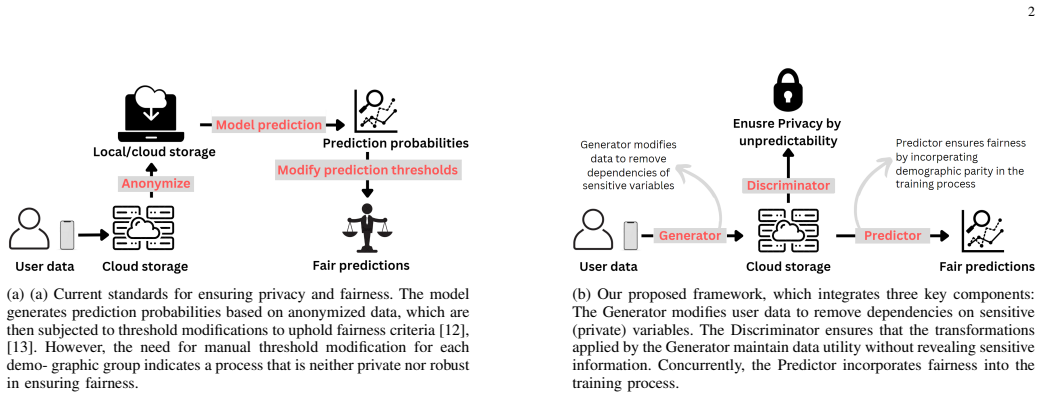
The central claim is that a multitask adversarial model treats fairness and privacy as integral objectives, learns a latent representation that hides sensitive attributes while preserving essential task-related information, and uses an optimized cost function to dynamically balance the three goals, achieving high fairness and privacy standards with minimal performance loss on diverse datasets.
What carries the argument
Multitask adversarial training that separates sensitive attribute information from task-related information in the latent representation via an optimized cost function.
If this is right
- High fairness and privacy standards are reached without significant accuracy sacrifice across diverse datasets.
- The method shows greater robustness when jointly optimizing privacy, fairness, and accuracy than prior approaches.
- The model adapts to various datasets and maintains performance even under strict fairness and privacy conditions.
- Benchmarking demonstrates improved handling of the inherent conflicts among the three objectives.
Where Pith is reading between the lines
- The same separation of information in latent space could support handling several sensitive attributes at once in one model.
- Deployed systems might replace separate fairness and privacy modules with a single training stage using this cost function.
- Real-time applications could use the dynamic balancing to meet changing privacy rules without retraining from scratch.
Load-bearing premise
The multitask adversarial training can separate sensitive attribute information from task-related information in the latent representation without conflicts that the cost function cannot resolve.
What would settle it
A dataset where the model either fails to hide sensitive attributes or suffers large accuracy loss on the main task despite the optimized cost function would disprove the claim.
Figures



read the original abstract
The integration of fairness and privacy in centralized data-driven applications is critical, especially as these systems increasingly influence sectors with significant societal impact. Current methods rarely address privacy, fairness, and accuracy together, which can potentially compromise ethical standards and privacy regulations. However, balancing these three objectives is quite challenging since each of objective often imposes conflicting requirements on the design and training of models, making it difficult to optimize one without compromising the others. This paper introduces a novel multitask adversarial model that treats fairness and privacy as integral objectives rather than afterthoughts, and learns a latent representation that hides sensitive attributes while preserving essential task-related information. Our approach dynamically balances fairness with accuracy and privacy through an optimized cost function with minimal performance loss even under strict conditions. Extensive testing on diverse datasets shows the ability of our model to achieve high standards of fairness and privacy without significant sacrifice to accuracy. Benchmarking against state-of-the-art privacy and fairness standards shows that our method enhances the robustness of privacy, fairness, and accuracy optimization, proving its adaptability across various datasets.
Editorial analysis
A structured set of objections, weighed in public.
Referee Report
Summary. The paper claims to introduce a multitask adversarial framework that treats fairness and privacy as integral objectives in centralized ML systems. It learns a latent representation that hides sensitive attributes while preserving task-related information, dynamically balancing the three goals via an optimized cost function that incurs only minimal performance loss. The approach is asserted to achieve high fairness and privacy standards on diverse datasets without significant accuracy sacrifice and to outperform state-of-the-art benchmarks.
Significance. If the central claims were substantiated with rigorous evidence, the work would address a practically important problem: the joint optimization of fairness, privacy, and accuracy, which are frequently in tension in deployed systems. A validated method could inform ethical ML design in regulated domains.
major comments (2)
- [Abstract] Abstract: the central assertions that the method achieves 'minimal performance loss even under strict conditions' and 'high standards of fairness and privacy without significant sacrifice to accuracy' are stated without any equations, derivations, quantitative results, tables, figures, error bars, or experimental details.
- [Abstract] Abstract: the reference to an 'optimized cost function' that 'dynamically balances' the objectives supplies no mathematical formulation, optimization procedure, or analysis showing how conflicts between attribute hiding and task retention are resolved rather than merely traded off.
Simulated Author's Rebuttal
We thank the referee for the review and the opportunity to respond. The major comments focus on the abstract's high-level claims. We address each point below and propose targeted revisions to the abstract while noting that the full manuscript contains the supporting details in the methodology and experiments sections.
read point-by-point responses
-
Referee: [Abstract] Abstract: the central assertions that the method achieves 'minimal performance loss even under strict conditions' and 'high standards of fairness and privacy without significant sacrifice to accuracy' are stated without any equations, derivations, quantitative results, tables, figures, error bars, or experimental details.
Authors: The abstract is a concise summary and does not contain the quantitative details, which is standard practice. The manuscript's experimental section provides tables, figures with error bars, and results across datasets demonstrating the claimed performance. To strengthen the abstract, we will revise it to incorporate specific quantitative highlights and key metrics from the experiments. revision: yes
-
Referee: [Abstract] Abstract: the reference to an 'optimized cost function' that 'dynamically balances' the objectives supplies no mathematical formulation, optimization procedure, or analysis showing how conflicts between attribute hiding and task retention are resolved rather than merely traded off.
Authors: The mathematical formulation of the multitask adversarial cost function, the optimization procedure, and the analysis of resolving conflicts via adversarial training are detailed in the methodology section of the manuscript. The abstract summarizes this at a high level per convention. We will revise the abstract to include a brief reference to the cost function formulation and balancing mechanism. revision: yes
Circularity Check
No circularity: claims rest on empirical description without exhibited derivation chain
full rationale
The provided abstract and context contain no equations, no explicit cost function formulation, and no derivation steps that could be inspected for self-definition, fitted-input prediction, or self-citation reduction. The central description of a multitask adversarial model and 'optimized cost function' is presented at the level of architectural intent and empirical testing on datasets, with no mathematical reduction shown that would equate outputs to inputs by construction. This is the normal case of a high-level methods claim that cannot be evaluated for circularity absent the actual formalism.
Axiom & Free-Parameter Ledger
Reference graph
Works this paper leans on
-
[1]
A review on fairness in machine learning,
D. Pessach and E. Shmueli, “A review on fairness in machine learning,” ACM Computing Surveys (CSUR), vol. 55, no. 3, pp. 1–44, 2022
2022
-
[2]
Online exam proctoring technologies: Edu- cational innovation or deterioration?,
K. Lee and M. Fanguy, “Online exam proctoring technologies: Edu- cational innovation or deterioration?,”British Journal of Educational Technology, vol. 53, no. 3, pp. 475–490, 2022
2022
-
[3]
A systematic review on ai-based proctoring systems: Past, present and future,
A. Nigam, R. Pasricha, T. Singh, and P. Churi, “A systematic review on ai-based proctoring systems: Past, present and future,”Education and Information Technologies, vol. 26, no. 5, pp. 6421–6445, 2021
2021
-
[4]
Can ai be racist? color-evasiveness in the application of machine learning to science assessments,
T. Cheuk, “Can ai be racist? color-evasiveness in the application of machine learning to science assessments,”Science Education, vol. 105, no. 5, pp. 825–836, 2021
2021
-
[5]
The accuracy, fairness, and limits of predicting recidivism,
J. Dressel and H. Farid, “The accuracy, fairness, and limits of predicting recidivism,”Science advances, vol. 4, no. 1, p. eaao5580, 2018
2018
-
[6]
Trade-offs between fairness and privacy in machine learn- ing,
S. Agarwal, “Trade-offs between fairness and privacy in machine learn- ing,” inIJCAI 2021 Workshop on AI for Social Good, 2021
2021
-
[7]
Differential privacy in distributed optimization with gradient tracking,
L. Huang, J. Wu, D. Shi, S. Dey, and L. Shi, “Differential privacy in distributed optimization with gradient tracking,”IEEE Transactions on Automatic Control, 2024
2024
-
[8]
Securereid: Privacy- preserving anonymization for person re-identification,
M. Ye, W. Shen, J. Zhang, Y . Yang, and B. Du, “Securereid: Privacy- preserving anonymization for person re-identification,”IEEE Transac- tions on Information Forensics and Security, 2024
2024
-
[9]
Enhancing fairness in ai-enabled medical systems with the attribute neutral framework,
L. Hu, D. Li, H. Liu, X. Chen, Y . Gao, S. Huang, X. Peng, X. Zhang, X. Bai, H. Yang,et al., “Enhancing fairness in ai-enabled medical systems with the attribute neutral framework,”Nature Communications, vol. 15, no. 1, p. 8767, 2024
2024
-
[10]
Equalised odds is not equal individual odds: Post-processing for group and individual fairness,
E. Small, K. Sokol, D. Manning, F. D. Salim, and J. Chan, “Equalised odds is not equal individual odds: Post-processing for group and individual fairness,” inProceedings of the 2024 ACM Conference on Fairness, Accountability, and Transparency, pp. 1559–1578, 2024
2024
-
[11]
On responsible machine learning datasets emphasizing fairness, privacy and regulatory norms with examples in biometrics and healthcare,
S. Mittal, K. Thakral, R. Singh, M. Vatsa, T. Glaser, C. Canton Ferrer, and T. Hassner, “On responsible machine learning datasets emphasizing fairness, privacy and regulatory norms with examples in biometrics and healthcare,”Nature Machine Intelligence, vol. 6, no. 8, pp. 936–949, 2024
2024
-
[12]
Differentially private fair learning,
M. Jagielski, M. J. Kearns, J. Mao, A. Oprea, A. Roth, S. Sharifi- Malvajerdi, and J. Ullman, “Differentially private fair learning,” in Proceedings of the 36th International Conference on Machine Learn- ing (ICML), vol. 97 ofProceedings of Machine Learning Research, pp. 3000–3008, PMLR, 2019
2019
-
[13]
Differentially private and fair classification via calibrated functional mechanism,
J. Ding, X. Zhang, X. Li, J. Wang, R. Yu, and M. Pan, “Differentially private and fair classification via calibrated functional mechanism,” CoRR, vol. abs/2001.04958, 2020
-
[14]
Data preprocessing techniques for classification without discrimination,
F. Kamiran, T. Calders, and M. Pechenizkiy, “Data preprocessing techniques for classification without discrimination,”Knowledge and Information Systems, vol. 33, no. 1, pp. 1–33, 2012
2012
-
[15]
Optimized pre-processing for discrimination prevention,
F. P. Calmon, D. Wei, B. Vinzamuri, K. N. Ramamurthy, and K. R. Varshney, “Optimized pre-processing for discrimination prevention,” in Advances in Neural Information Processing Systems, pp. 3992–4001, 2017
2017
-
[16]
Learning fair representations,
R. Zemel, Y . Wu, K. Swersky, T. Pitassi, and C. Dwork, “Learning fair representations,” inInternational Conference on Machine Learning, pp. 325–333, 2013
2013
-
[17]
Equality of opportunity in supervised learning,
M. Hardt, E. Price, and N. Srebro, “Equality of opportunity in supervised learning,” inAdvances in Neural Information Processing Systems 29 (NeurIPS 2016)(D. D. Lee, M. Sugiyama, U. von Luxburg, I. Guyon, and R. Garnett, eds.), pp. 3315–3323, Curran Associates, Inc., 2016. No DOI assigned by the publisher. 13
2016
-
[18]
On fairness and calibration,
G. Pleiss, M. Raghavan, F. Wu, J. Kleinberg, and K. Q. Weinberger, “On fairness and calibration,” inAdvances in Neural Information Processing Systems, pp. 5680–5689, 2017
2017
-
[19]
Fairness and privacy preserving in federated learning: A survey,
T. H. Rafi, F. A. Noor, T. Hussain, and D.-K. Chae, “Fairness and privacy preserving in federated learning: A survey,”Information Fusion, vol. 105, p. 102198, 2024
2024
-
[20]
Retiring $\delta\text{DP}$: New distribution-level metrics for demographic parity,
X. Han, Z. Jiang, H. Jin, Z. Liu, N. Zou, Q. Wang, and X. Hu, “Retiring $\delta\text{DP}$: New distribution-level metrics for demographic parity,”Transactions on Machine Learning Research, 2023
2023
-
[21]
Learning non-discriminatory predictors,
B. E. Woodworth, S. Gunasekar, M. I. Ohannessian, and N. Srebro, “Learning non-discriminatory predictors,” inProceedings of the 2017 Conference on Learning Theory, pp. 1920–1953, 2017
2017
-
[22]
Fair clus- tering through fairlets,
F. Chierichetti, R. Kumar, S. Lattanzi, and S. Vassilvitskii, “Fair clus- tering through fairlets,” inAdvances in Neural Information Processing Systems, pp. 5029–5037, 2017
2017
-
[23]
Fair k-center cluster- ing for data summarization,
M. Kleindessner, P. Awasthi, and J. Morgenstern, “Fair k-center cluster- ing for data summarization,” inProceedings of the 36th International Conference on Machine Learning, pp. 3448–3457, 2019
2019
-
[24]
Censoring representations with an adver- sary,
H. Edwards and A. Storkey, “Censoring representations with an adver- sary,” inInternational Conference on Learning Representations (ICLR), 2015
2015
-
[25]
Counterfactual explanation for fairness in recommendation,
X. Wang, Q. Li, D. Yu, Q. Li, and G. Xu, “Counterfactual explanation for fairness in recommendation,”ACM Trans. Inf. Syst., vol. 42, Mar. 2024
2024
-
[26]
Learning adversarially fair and transferable representations,
D. Madras, E. Creager, T. Pitassi, and R. Zemel, “Learning adversarially fair and transferable representations,” inProceedings of the 35th Inter- national Conference on Machine Learning(J. Dy and A. Krause, eds.), vol. 80 ofProceedings of Machine Learning Research, pp. 3384–3393, PMLR, 2018
2018
-
[27]
Generating fair universal representations using adversarial models,
P. Kairouz, J. Liao, C. Huang, M. Vyas, M. Welfert, and L. Sankar, “Generating fair universal representations using adversarial models,” IEEE Transactions on Information Forensics and Security, vol. 17, pp. 1970–1985, 2022
1970
-
[28]
Dwork and A
C. Dwork and A. Roth,Algorithmic foundations of differential privacy. Foundations and Trends in Theoretical Computer Science, 2014
2014
-
[29]
Deep learning with differential privacy,
M. Abadi, A. Chu, I. Goodfellow, H. B. McMahan, I. Mironov, K. Talwar, and L. Zhang, “Deep learning with differential privacy,” in Proceedings of the 2016 ACM SIGSAC Conference on Computer and Communications Security (CCS ’16), pp. 308–318, ACM, 2016
2016
-
[30]
Achieving differential privacy and fairness in in- formation theoretic private learning,
M. Xu and J. Zhu, “Achieving differential privacy and fairness in in- formation theoretic private learning,”IEEE Transactions on Information Forensics and Security, vol. 14, no. 5, pp. 1243–1255, 2019
2019
-
[31]
Federated learning: Oppor- tunities and challenges,
Q. Yang, Y . Liu, T. Chen, and Y . Tong, “Federated learning: Oppor- tunities and challenges,”ACM Transactions on Intelligent Systems and Technology (TIST), vol. 10, no. 1, pp. 1–19, 2023
2023
-
[32]
Privacy- preserving federated learning for wearable health devices,
N. Truong, K. Sun, S. Wang, M. E. Gursoy, and S. Truex, “Privacy- preserving federated learning for wearable health devices,”Journal of Biomedical Informatics, vol. 113, p. 103621, 2021
2021
-
[33]
Federated learning for healthcare informatics,
J. Xu, B. S. Glicksberg, C. Su, P. Walker, J. Bian, and F. Wang, “Federated learning for healthcare informatics,”Journal of Healthcare Informatics Research, vol. 4, pp. 1–19, 2020
2020
-
[34]
Learning with impartiality to walk on the pareto frontier of fairness, privacy, and utility,
M. Yaghini, P. Liu, F. Boenisch, and N. Papernot, “Learning with impartiality to walk on the pareto frontier of fairness, privacy, and utility,”arXiv preprint arXiv:2302.09183, 2023
-
[36]
Certifying and removing disparate impact,
M. Feldman, S. A. Friedler, J. Moeller, C. Scheidegger, and S. Venkata- subramanian, “Certifying and removing disparate impact,” inProceed- ings of the 21st ACM SIGKDD International Conference on Knowledge Discovery and Data Mining (KDD ’15), pp. 259–268, ACM, 2015
2015
-
[37]
Decision theory for discrimination-aware classification,
F. Kamiran, A. Karim, and X. Zhang, “Decision theory for discrimination-aware classification,” in2012 IEEE 12th International Conference on Data Mining (ICDM), pp. 924–929, IEEE, 2012
2012
-
[38]
Investigating trade-offs in utility, fairness and differential privacy in neural networks,
M. Pannekoek and G. Spigler, “Investigating trade-offs in utility, fairness and differential privacy in neural networks,”arXiv preprint arXiv:2102.05975, 2021
-
[39]
Achieving differential privacy and fairness in logistic regression,
D. Xu, S. Yuan, and X. Wu, “Achieving differential privacy and fairness in logistic regression,” inCompanion Proceedings of The 2019 World Wide Web Conference (WWW ’19 Companion), pp. 594–599, ACM, 2019
2019
-
[40]
Fairdp: Achieving fairness certification with differential privacy,
K. Tran, F. Fioretto, I. Khalil, M. T. Thai, L. T. X. Phan, and N. Phan, “Fairdp: Achieving fairness certification with differential privacy,”arXiv preprint arXiv:2305.16474, 2023
-
[41]
Removing disparate impact on model accuracy in differential privacy,
D. Xu, W. Du, and X. Wu, “Removing disparate impact on model accuracy in differential privacy,” inProceedings of the 27th ACM SIGKDD Conference on Knowledge Discovery and Data Mining (KDD ’21), ACM, 2021
2021
-
[42]
Input-agnostic certified group fairness via gaussian parameter smoothing,
J. Jin, Z. Zhang, Y . Zhou, and L. Wu, “Input-agnostic certified group fairness via gaussian parameter smoothing,” inInternational Conference on Machine Learning (ICML), vol. 162 ofProceedings of Machine Learning Research, pp. 10347–10363, PMLR, 2022
2022
-
[43]
Principled deep learning via distributional generalization,
B. Kulynych, Y .-Y . Yang, Y . Yu, M. Cisse, and R. Hadsell, “Principled deep learning via distributional generalization,” inAdvances in Neural Information Processing Systems (NeurIPS), 2022
2022
-
[44]
Wasserstein differential privacy,
C. Yang, J. Qi, and A. Zhou, “Wasserstein differential privacy,” in Proceedings of the 38th AAAI Conference on Artificial Intelligence, pp. 16299–16307, 2024
2024
-
[45]
The impact of differential privacy on group disparity mitigation,
V . Hansen, A. Neerkaje, R. Sawhney, L. Flek, and A. Søgaard, “The impact of differential privacy on group disparity mitigation,” inFind- ings of the Association for Computational Linguistics: NAACL 2024, pp. 3952–3965, 2024
2024
-
[46]
The limits of differential privacy in online learning,
B. Li, W. Wang, and P. Ye, “The limits of differential privacy in online learning,” inAdvances in Neural Information Processing Systems 37 (NeurIPS 2024), 2024
2024
-
[47]
Differential privacy has bounded impact on fairness in classification,
P. Mangold, M. Perrot, A. Bellet, and M. Tommasi, “Differential privacy has bounded impact on fairness in classification,” inInternational Conference on Machine Learning, pp. 23681–23705, PMLR, 2023
2023
-
[48]
Fairness guarantees in multi-class classification with demographic parity,
C. Denis, R. Elie, M. Hebiri, and F. Hu, “Fairness guarantees in multi-class classification with demographic parity,”Journal of Machine Learning Research, vol. 25, no. 130, pp. 1–46, 2024. SJR Q1, Artificial Intelligence
2024
-
[49]
Fair prediction with disparate impact: A study of bias in recidivism prediction instruments,
A. Chouldechova, “Fair prediction with disparate impact: A study of bias in recidivism prediction instruments,”Big Data, vol. 5, no. 2, pp. 153– 163, 2017
2017
-
[50]
Inherent trade-offs in the fair determination of risk scores,
J. Kleinberg, S. Mullainathan, and M. Raghavan, “Inherent trade-offs in the fair determination of risk scores,” in8th Innovations in Theoretical Computer Science Conference (ITCS 2017)(C. H. Papadimitriou, ed.), vol. 67 ofLeibniz International Proceedings in Informatics (LIPIcs), pp. 43:1–43:23, Schloss Dagstuhl–Leibniz-Zentrum f ¨ur Informatik, 2017
2017
-
[51]
Automated discovery of trade-off between utility, privacy and fairness in machine learning models,
B. Ficiu, N. D. Lawrence, and A. Paleyes, “Automated discovery of trade-off between utility, privacy and fairness in machine learning models,”arXiv preprint arXiv:2311.15691, 2023
discussion (0)
Sign in with ORCID, Apple, or X to comment. Anyone can read and Pith papers without signing in.