Nonunitary triplet superconductivity in the Z2 topological metal SrPd2As2
Pith reviewed 2026-06-30 12:12 UTC · model grok-4.3
The pith
SrPd2As2 realizes a nonunitary triplet superconducting state that breaks time-reversal symmetry while remaining fully gapped.
A machine-rendered reading of the paper's core claim, the machinery that carries it, and where it could break.
Core claim
In SrPd2As2 the interplay of spin-orbit coupling, tetragonal symmetry, and an open Fermi surface topology stabilizes a nonunitary triplet superconducting state whose symmetry-imposed nodes lie in momentum-space regions devoid of electronic states. This yields a fully gapped thermodynamic response while naturally breaking time-reversal symmetry.
What carries the argument
The nonunitary triplet order parameter whose nodes are displaced from the occupied Fermi surface by the material's band topology and symmetry constraints.
If this is right
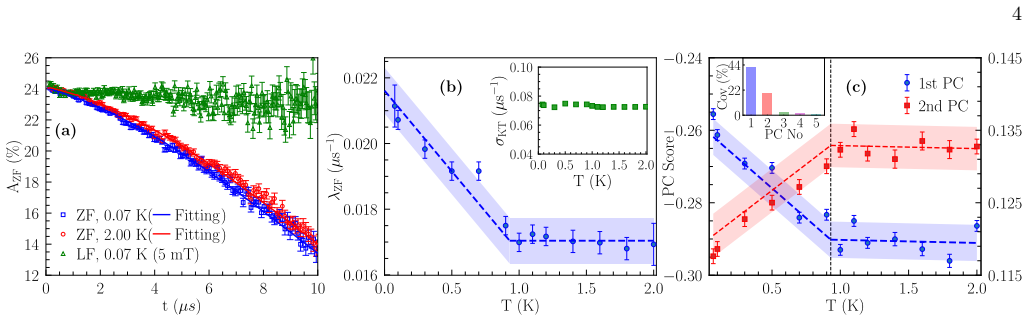
- The superconducting state exhibits spontaneous internal magnetic fields below Tc due to time-reversal symmetry breaking.
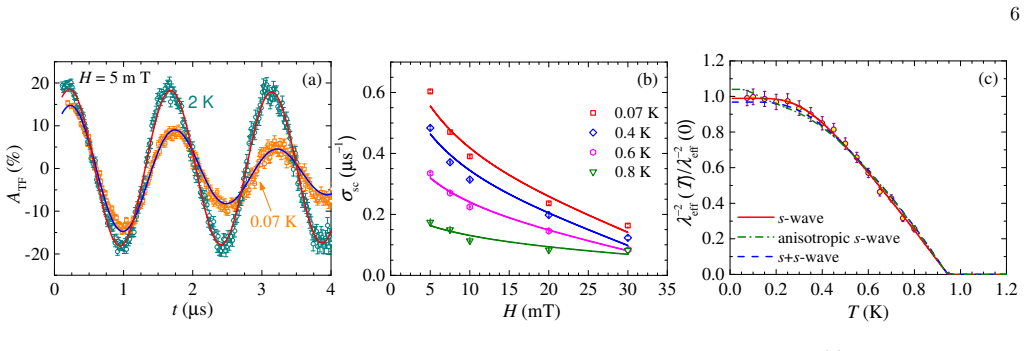
- Thermodynamic and transport probes register a fully gapped response despite the unconventional pairing symmetry.
- Purely phonon-mediated pairing is ruled out because it predicts both nodal gaps and an overestimated Tc.
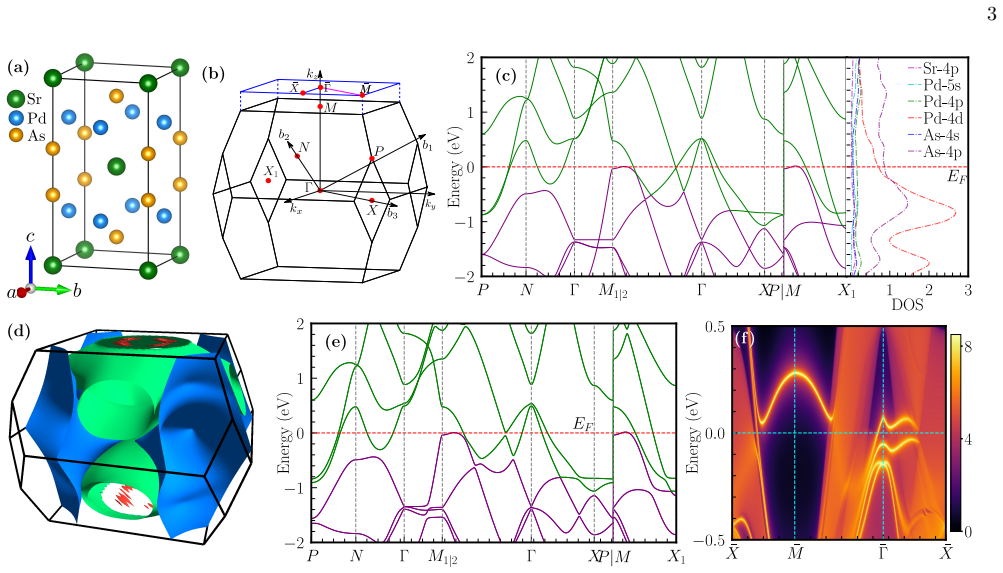
- Surface states cross the Fermi level, consistent with the Z2 band topology.
Where Pith is reading between the lines
- The same symmetry and Fermi-surface conditions could stabilize analogous nonunitary states in other tetragonal Z2 metals.
- The bulk TRS-breaking yet fully gapped state may support protected surface modes detectable by tunneling spectroscopy.
- High-resolution specific-heat or thermal-conductivity measurements under magnetic fields could further test the absence of low-energy excitations.
Load-bearing premise
The spontaneous internal magnetic fields detected by zero-field muSR below Tc originate from the bulk superconducting order parameter breaking time-reversal symmetry rather than from surface states, impurities, or other extrinsic sources.
What would settle it
Angle-resolved photoemission spectroscopy that finds gap nodes or gapless excitations on the Fermi surface below Tc would rule out the proposed fully gapped nonunitary state.
Figures

read the original abstract
In Z2 topological metals, nontrivial band topology and strong spin-orbit coupling (SOC) impose symmetry constraints that can stabilize unconventional superconducting states, even when thermodynamic probes indicate an isotropic gap. Here, we investigate the superconducting ground state of such a material, SrPd2As2, using muon spin rotation and relaxation (muSR), first-principles calculations, and Ginzburg-Landau analysis. Transverse-field muSR indicates a fully gapped superconducting state below Tc = 0.94 K, while zero-field muSR detects spontaneous internal magnetic fields below Tc, establishing time-reversal symmetry (TRS) breaking. Electronic structure calculations identify SrPd2As2 as a Z2 topological metal with surface states crossing the Fermi level. Standard anisotropic Migdal-Eliashberg calculations predict a nodal gap and overestimate Tc, indicating that a purely phonon-mediated pairing mechanism is insufficient. We resolve this apparent contradiction by showing that the interplay of SOC, tetragonal symmetry, and an open Fermi surface topology stabilizes a nonunitary triplet superconducting state whose symmetry-imposed nodes lie in momentum-space regions devoid of electronic states. This yields a fully gapped thermodynamic response while naturally breaking TRS. Our results establish SrPd2As2 as a clean platform for bulk nonunitary triplet pairing and a promising candidate for intrinsic topological superconductivity.
Editorial analysis
A structured set of objections, weighed in public.
Referee Report
Summary. The manuscript investigates the superconducting state of the Z2 topological metal SrPd2As2 using transverse- and zero-field muSR, first-principles electronic structure calculations, and Ginzburg-Landau symmetry analysis. It reports a fully gapped state below Tc = 0.94 K from TF-muSR, spontaneous internal fields below Tc from ZF-muSR indicating TRS breaking, identification as a Z2 metal with surface states crossing EF, and Migdal-Eliashberg calculations that predict nodal gaps and overestimate Tc. These observations are resolved by proposing a nonunitary triplet pairing state stabilized by SOC, tetragonal symmetry, and open Fermi-surface topology, with symmetry-imposed nodes lying in momentum regions devoid of states.
Significance. If the central interpretation holds, the work would establish SrPd2As2 as a platform for bulk nonunitary triplet superconductivity in a topological metal, demonstrating how SOC and band topology can stabilize unconventional pairing that appears fully gapped while breaking TRS. This has potential implications for intrinsic topological superconductivity and would highlight the limitations of purely phonon-mediated mechanisms in such systems.
major comments (3)
- [Abstract (zero-field muSR results)] Abstract, zero-field muSR paragraph: The detection of spontaneous internal magnetic fields below Tc is presented as establishing TRS breaking by the bulk superconducting order parameter, but the text provides no details on controls or analysis excluding extrinsic sources such as surface states crossing EF or dilute impurities; this interpretation is load-bearing for the motivation to invoke a nonunitary triplet state.
- [Ginzburg-Landau analysis] Ginzburg-Landau analysis: The nonunitary triplet state is introduced to simultaneously explain the fully gapped thermodynamics and TRS breaking; without explicit derivation showing that the symmetry constraints follow independently from tetragonal symmetry, SOC, and Fermi-surface topology (rather than being selected to fit the two observations), the central claim risks circularity.
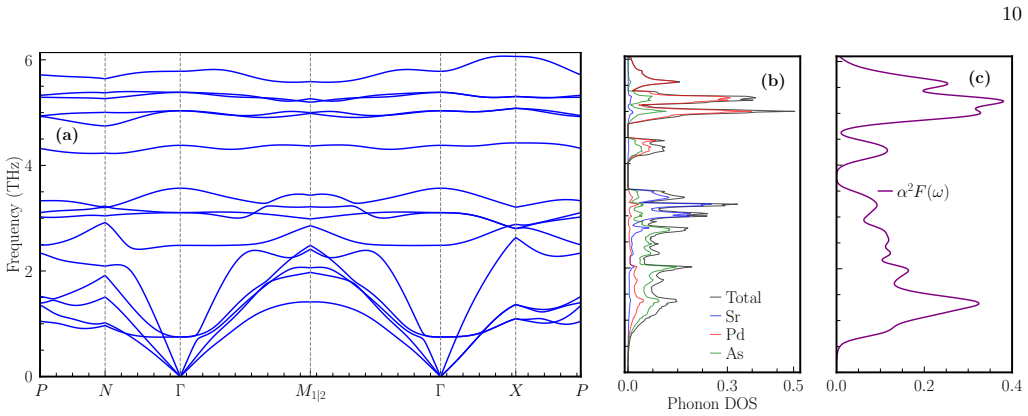
- [Abstract (muSR and calculations)] Abstract (transverse-field muSR and Migdal-Eliashberg calculations): The claims of a fully gapped state and that phonon-mediated pairing is insufficient rest on muSR fits and calculations that overestimate Tc while predicting nodes, but no quantitative details on data analysis, error bars, fitting procedures, or specific Eliashberg parameters are provided, undermining assessment of these load-bearing results.
Simulated Author's Rebuttal
We thank the referee for their careful and constructive review of our manuscript. We address each of the major comments below, providing additional details and clarifications. Where the comments identify areas requiring more explicit information, we have revised the manuscript accordingly.
read point-by-point responses
-
Referee: Abstract (zero-field muSR results)] Abstract, zero-field muSR paragraph: The detection of spontaneous internal magnetic fields below Tc is presented as establishing TRS breaking by the bulk superconducting order parameter, but the text provides no details on controls or analysis excluding extrinsic sources such as surface states crossing EF or dilute impurities; this interpretation is load-bearing for the motivation to invoke a nonunitary triplet state.
Authors: We agree that the original manuscript lacked sufficient detail on the zero-field muSR controls. In the revised version, we have added an expanded methods section and a dedicated paragraph in the results describing the analysis: (i) temperature-dependent measurements above Tc showing no relaxation, (ii) checks for sample purity via magnetization and resistivity, (iii) comparison of the observed field distribution width to expectations for dilute impurities, and (iv) arguments that surface states crossing EF would produce a much smaller and temperature-independent contribution inconsistent with the data. These additions strengthen the case for bulk TRS breaking. revision: yes
-
Referee: Ginzburg-Landau analysis: The nonunitary triplet state is introduced to simultaneously explain the fully gapped thermodynamics and TRS breaking; without explicit derivation showing that the symmetry constraints follow independently from tetragonal symmetry, SOC, and Fermi-surface topology (rather than being selected to fit the two observations), the central claim risks circularity.
Authors: The symmetry analysis begins from the tetragonal point group D4h with SOC included, which restricts the allowed pairing channels to specific irreducible representations before any experimental input. We have now included an explicit, step-by-step derivation in the supplementary material showing the decomposition of the order parameter, the conditions for nonunitary states, and how the open Fermi-surface topology places the symmetry-required nodes in regions without spectral weight. This derivation is independent of the muSR observations and is presented prior to comparing with experiment, removing any appearance of circularity. revision: yes
-
Referee: Abstract (muSR and calculations)] Abstract (transverse-field muSR and Migdal-Eliashberg calculations): The claims of a fully gapped state and that phonon-mediated pairing is insufficient rest on muSR fits and calculations that overestimate Tc while predicting nodes, but no quantitative details on data analysis, error bars, fitting procedures, or specific Eliashberg parameters are provided, undermining assessment of these load-bearing results.
Authors: We acknowledge that the original submission omitted quantitative details on the data analysis. The revised manuscript now provides: (i) the exact fitting functions and Bayesian/Maximum-likelihood procedures used for the TF-muSR spectra, (ii) error bars and covariance matrices for the extracted gap magnitude, superfluid density, and relaxation rates, (iii) the full set of Migdal-Eliashberg parameters (including λ, phonon spectrum moments, and Coulomb pseudopotential), and (iv) direct comparison of calculated versus measured Tc. These additions allow readers to assess the robustness of the fully gapped conclusion and the insufficiency of the phonon-only mechanism. revision: yes
Circularity Check
No significant circularity in derivation chain
full rationale
The paper's chain proceeds from muSR observations of a full gap and TRS breaking, through DFT band-structure results identifying Z2 topology, to a Ginzburg-Landau symmetry analysis that selects a nonunitary triplet state whose nodes fall outside the occupied Fermi surface. No quoted equations, fitted parameters renamed as predictions, or self-citation chains are present that reduce the central claim to its inputs by construction. The symmetry constraints are presented as arising from the material's point-group and Fermi-surface topology rather than being reverse-engineered from the two observations.
Axiom & Free-Parameter Ledger
axioms (2)
- domain assumption Zero-field muSR spontaneous internal fields below Tc originate from the bulk superconducting order parameter breaking time-reversal symmetry.
- domain assumption Anisotropic Migdal-Eliashberg calculations accurately capture the gap structure and Tc for a phonon-mediated mechanism in this material.
Reference graph
Works this paper leans on
-
[1]
N. P. Armitage, E. J. Mele, and A. Vishwanath, Weyl and Dirac semimetals in three-dimensional solids, Rev. Mod. Phys. 90, 015001 (2018)
2018
-
[2]
B. Q. Lv, T. Qian, and H. Ding, Experimental perspec- tive on three-dimensional topological semimetals, Rev. Mod. Phys. 93, 025002 (2021)
2021
-
[3]
S. K. Ghosh, M. Smidman, T. Shang, J. F. Annett, A. D. Hillier, J. Quintanilla, and H. Yuan, Recent progress on superconductors with time-reversal symmetry breaking, J. Phys.: Condens. Matter 33, 033001 (2021)
2021
-
[4]
G. M. Luke, Y. Fudamoto, K. M. Kojima, M. I. Larkin, J. Merrin, B. Nachumi, Y. J. Uemura, Y. Maeno, Z. Q. Mao, Y. Mori, H. Nakamura, and M. Sigrist, Time-reversal symmetry-breaking superconductivity in Sr2RuO4, Nature 394, 558 (1998)
1998
-
[5]
Maeno, S
Y. Maeno, S. Yonezawa, and A. Ramires, Still mystery after all these years – unconventional superconductivity of Sr 2RuO4, J. Phys. Soc. Jpn. 93, 062001 (2024)
2024
-
[6]
P. K. Biswas, S. K. Ghosh, J. Zhao, D. A. Mayoh, N. Zhi- gadlo, X. Xu, C. Baines, A. Hillier, G. Balakrishnan, and M. R. Lees, Chiral singlet superconductivity in the weakly correlated metal LaPt3P, Nat. Commun. 12, 2504 (2021)
2021
-
[7]
P. K. Biswas, H. Luetkens, T. Neupert, T. Stürzer, C. Baines, G. Pascua, A. P. Schnyder, M. H. Fischer, J. Goryo, M. R. Lees, H. Maeter, F. Brückner, H.-H. Klauss, M. Nicklas, P. J. Baker, A. D. Hillier, M. Sigrist, A. Amato, and D. Johrendt, Evidence for supercon- ductivity with broken time-reversal symmetry in locally noncentrosymmetric SrPtAs, Phys. Re...
2013
-
[8]
A. D. Hillier, J. Quintanilla, and R. Cywinski, Evi- dence for time-reversal symmetry breaking in the noncen- trosymmetric superconductor LaNiC 2, Phys. Rev. Lett. 102, 117007 (2009)
2009
-
[9]
A. D. Hillier, J. Quintanilla, B. Mazidian, J. F. Annett, and R. Cywinski, Nonunitary triplet pairing in the cen- trosymmetric superconductor LaNiGa 2, Phys. Rev. Lett. 109, 097001 (2012)
2012
-
[10]
S. K. Ghosh, G. Csire, P. Whittlesea, J. F. Annett, M. Gradhand, B. Újfalussy, and J. Quintanilla, Quan- titative theory of triplet pairing in the unconventional superconductor LaNiGa 2, Phys. Rev. B 101, 100506 (2020)
2020
-
[11]
J. R. Badger, Y. Quan, M. C. Staab, S. Sumita, A. Rossi, K. P. Devlin, K. Neubauer, D. S. Shulman, J. C. Fet- 12 tinger, P. Klavins, M. K. Susan, D. Aoki, I. M. Vishik, W. E. Pickett, and V. Taufour, Dirac lines and loop at the fermi level in the time-reversal symmetry breaking superconductor LaNiGa 2, Commun. Phys 5, 22 (2022)
2022
-
[12]
Bhattacharyya, D
A. Bhattacharyya, D. T. Adroja, N. Kase, A. D. Hillier, A. M. Strydom, and J. Akimitsu, Unconventional su- perconductivity in the cage-type compound Sc5Rh6Sn18, Phys. Rev. B 98, 024511 (2018)
2018
-
[13]
Bhattacharyya, D
A. Bhattacharyya, D. Adroja, N. Kase, A. Hillier, J. Akimitsu, and A. Strydom, Unconventional supercon- ductivity in Y 5Rh6Sn18 probed by muon spin relaxation, Sci. Rep. 5, 12926 (2015)
2015
-
[14]
Bhattacharyya, D
A. Bhattacharyya, D. T. Adroja, J. Quintanilla, A. D. Hillier, N. Kase, A. M. Strydom, and J. Akimitsu, Bro- ken time-reversal symmetry probed by muon spin re- laxation in the caged type superconductor Lu5Rh6Sn18, Phys. Rev. B 91, 060503 (2015)
2015
-
[15]
Singh, M
D. Singh, M. S. Scheurer, A. D. Hillier, D. T. Adroja, and R. P. Singh, Time-reversal-symmetry breaking and unconventional pairing in the noncentrosymmetric super- conductor La7Rh3, Phys. Rev. B 102, 134511 (2020)
2020
-
[16]
D. A. Mayoh, A. D. Hillier, G. Balakrishnan, and M. R. Lees, Evidence for the coexistence of time-reversal sym- metry breaking and bardeen-cooper-schrieffer-like su- perconductivity in La 7Pd3, Phys. Rev. B 103, 024507 (2021)
2021
-
[17]
Barker, D
J. Barker, D. Singh, A. Thamizhavel, A. D. Hillier, M. R. Lees, G. Balakrishnan, D. M. Paul, and R. P. Singh, Unconventional superconductivity in La 7Ir3 re- vealed by muon spin relaxation: introducing a new family of noncentrosymmetric superconductor that breaks time- reversal symmetry, Phys. Rev. Lett. 115, 267001 (2015)
2015
-
[18]
Bhattacharyya, M
A. Bhattacharyya, M. R. Lees, K. Panda, P. P. Fer- reira, T. T. Dorini, E. Gaudry, L. T. F. Eleno, V. K. Anand, J. Sannigrahi, P. K. Biswas, R. Tripathi, and D. T. Adroja, Nodeless time-reversal symmetry break- ing in the centrosymmetric superconductor Sc5Co4Si10 probed by muon-spin spectroscopy, Phys. Rev. Mater. 6, 064802 (2022)
2022
-
[19]
Shang, S
T. Shang, S. K. Ghosh, J. Z. Zhao, L.-J. Chang, C. Baines, M. K. Lee, D. J. Gawryluk, M. Shi, M. Medarde, J. Quintanilla, and T. Shiroka, Time- reversal symmetry breaking in the noncentrosymmetric Zr3Ir superconductor, Phys. Rev. B 102, 020503 (2020)
2020
-
[20]
V. K. Anand, A. Bhattacharyya, D. T. Adroja, K. Panda, P. K. Biswas, A. D. Hillier, and B. Lake, Time-reversal symmetry breaking and s-wave superconductivity in CaPd2Ge2: A µSR study, Phys. Rev. B 108, 224519 (2023)
2023
-
[21]
Panda, D
Aarti, K. Panda, D. T. Adroja, A. Bhattacharyya, P. K. Biswas, A. D. Hillier, B. Lake, S. Layek, and V. K. Anand, Time-reversal symmetry breaking in the s-wave superconductor CaPd 2As2 probed by µSR, Phys. Rev. B 110, 144506 (2024)
2024
-
[22]
P. K. Meena, D. Samanta, S. Jangid, R. K. Kushwaha, R. Stewart, A. D. Hillier, S. K. Ghosh, and R. P. Singh, Superconductivity in hourglass dirac chain metals (Ti, Hf)IrGe, Adv. Sci. , e12434 (2025)
2025
-
[23]
P. K. Meena, D. Samanta, S. Srivastava, P. Manna, S. K. Ghosh, and R. P. Singh, Nonsymmorphic symmetry pro- tected hourglass dirac chain topology and conventional superconductivity in ZrIrGe, Phys. Rev. B 112, 144515 (2025)
2025
-
[24]
C. S. Yadav, S. K. Ghosh, P. Kumar, A. Thamizhavel, and P. L. Paulose, Signature of point nodal superconduc- tivity in the dirac semimetal PdTe, Phys. Rev. B 110, 054515 (2024)
2024
-
[25]
Shang, S
T. Shang, S. K. Ghosh, M. Smidman, D. J. Gawryluk, C. Baines, A. Wang, W. Xie, Y. Chen, M. O. Ajeesh, M. Nicklas, E. Pomjakushina, M. Medarde, M. Shi, J. F. Annett, H. Yuan, J. Quintanilla, and T. Shiroka, Spin- triplet superconductivity in Weyl nodal-line semimetals, npj Quantum Mater. 7, 1 (2022)
2022
-
[26]
K. P. Sajilesh, R. K. Kushwaha, D. Samanta, T. Tula, P. K. Meena, S. Srivastava, D. Singh, P. K. Biswas, A. Kanigel, A. D. Hillier, S. K. Ghosh, and R. P. Singh, Time-reversal symmetry breaking superconductivity in HfRhGe: A noncentrosymmetric weyl semimetal, Adv. Mater. 37, 2415721 (2025)
2025
-
[27]
S. K. Ghosh, P. K. Biswas, C. Xu, B. Li, J. Z. Zhao, A. D. Hillier, and X. Xu, Time-reversal symmetry breaking su- perconductivity in three-dimensional Dirac semimetallic silicides, Phys. Rev. Res. 4, L012031 (2022)
2022
-
[28]
Neupert, M
T. Neupert, M. M. Denner, J.-X. Yin, R. Thomale, and M. Z. Hasan, Charge order and superconductivity in kagome materials, Nat. Phys. 18, 137 (2022)
2022
-
[29]
V. K. Anand, H. Kim, A. Tanatar, Makariy, R. Prozorov, and C. Johnston, David, Superconductivity and physical properties of CaPd 2Ge2 single crystals, J. Phys.: Con- dens. Matter 26, 405702 (2014)
2014
-
[30]
V. K. Anand, H. Kim, M. A. Tanatar, R. Prozorov, and D. C. Johnston, Superconducting and normal-state prop- erties of APd 2As2 (A= Ca, Sr, Ba) single crystals, Phys. Rev. B 87, 224510 (2013)
2013
-
[31]
F. L. Pratt, WIMDA: A muon data analysis program for the windows PC, Physica B: Condens. Matter 289, 710 (2000)
2000
-
[32]
Giannozzi, S
P. Giannozzi, S. Baroni, N. Bonini, M. Calandra, R. Car, C. Cavazzoni, D. Ceresoli, G. L. Chiarotti, M. Cococ- cioni, I. Dabo, A. D. Corso, S. de Gironcoli, S. Fabris, G. Fratesi, R. Gebauer, U. Gerstmann, C. Gougoussis, A. Kokalj, M. Lazzeri, L. Martin-Samos, N. Marzari, F. Mauri, R. Mazzarello, S. Paolini, A. Pasquarello, L. Paulatto, C. Sbraccia, S. Sc...
2009
-
[33]
Giannozzi, O
P. Giannozzi, O. Andreussi, T. Brumme, O. Bunau, M. B. Nardelli, M. Calandra, R. Car, C. Cavazzoni, D. Ceresoli, M. Cococcioni, N. Colonna, I. Carnimeo, A. D. Corso, S. de Gironcoli, P. Delugas, R. A. DiStasio, A. Ferretti, A. Floris, G. Fratesi, G. Fugallo, R. Gebauer, U. Gerstmann, F. Giustino, T. Gorni, J. Jia, M. Kawa- mura, H.-Y. Ko, A. Kokalj, E. Kü...
2017
-
[34]
Giannozzi, O
P. Giannozzi, O. Baseggio, P. Bonfà, D. Brunato, R. Car, I. Carnimeo, C. Cavazzoni, S. de Gironcoli, P. Delugas, F. Ferrari Ruffino, A. Ferretti, N. Marzari, I. Timrov, A. Urru, and S. Baroni, Quantum ESPRESSO toward the exascale, The Journal of Chemical Physics 152, 154105 (2020). 13
2020
-
[35]
J. P. Perdew, K. Burke, and M. Ernzerhof, Generalized gradient approximation made simple, Phys. Rev. Lett. 77, 3865 (1996)
1996
-
[36]
Pizzi, V
G. Pizzi, V. Vitale, R. Arita, S. Blügel, F. Freimuth, G. Géranton, M. Gibertini, D. Gresch, C. Johnson, T. Koretsune, J. Ibañez-Azpiroz, H. Lee, J.-M. Lihm, D. Marchand, A. Marrazzo, Y. Mokrousov, J. I. Mustafa, Y. Nohara, Y. Nomura, L. Paulatto, S. Poncé, T. Pon- weiser, J. Qiao, F. Thöle, S. S. Tsirkin, M. Wierzbowska, N. Marzari, D. Vanderbilt, I. Sou...
2020
-
[37]
Q. Wu, S. Zhang, H.-F. Song, M. Troyer, and A. A. Soluyanov, Wanniertools: An open-source software pack- age for novel topological materials, Computer Physics Communications 224, 405 (2018)
2018
-
[38]
V. K. Anand, P. K. Perera, A. Pandey, R. J. Goetsch, A. Kreyssig, and D. C. Johnston, Crystal growth and physical properties of SrCu 2As2, SrCu 2Sb2, and BaCu2Sb2, Phys. Rev. B 85, 214523 (2012)
2012
-
[39]
Karaca, H
E. Karaca, H. M. Tütüncü, H. Y. Uzunok, G. P. Srivas- tava, and Ş. Uǧur, Theoretical investigation of supercon- ductivity in SrPd2Ge2, SrPd2As2, and CaPd2As2, Phys. Rev. B 93, 054506 (2016)
2016
-
[40]
Shein, S
I. Shein, S. Skornyakov, V. Anisimov, and A. Ivanovskii, Elastic and electronic properties of superconduct- ing CaPd 2As2 and SrPd 2As2 vs. non-superconducting BaPd2As2, J. Superconduct. Nov. Magn. 27, 155 (2014)
2014
-
[41]
L. M. Schoop, L. S. Xie, R. Chen, Q. D. Gibson, S. H. Lapidus, I. Kimchi, M. Hirschberger, N. Hal- dolaarachchige, M. N. Ali, C. A. Belvin, T. Liang, J. B. Neaton, N. P. Ong, A. Vishwanath, and R. J. Cava, Dirac metal to topological metal transition at a structural phase change in Au2Pb and prediction of Z2 topology for the superconductor, Phys. Rev. B 91...
2015
-
[42]
Nayak, S.-C
J. Nayak, S.-C. Wu, N. Kumar, C. Shekhar, S. Singh, J. Fink, E. E. Rienks, G. H. Fecher, S. S. Parkin, B. Yan, et al. , Multiple dirac cones at the surface of the topolog- ical metal LaBi, Nat. commun. 8, 13942 (2017)
2017
-
[43]
B. R. Ortiz, S. M. L. Teicher, Y. Hu, J. L. Zuo, P. M. Sarte, E. C. Schueller, A. M. M. Abeykoon, M. J. Krogstad, S. Rosenkranz, R. Osborn, R. Seshadri, L. Ba- lents, J. He, and S. D. Wilson, CsV3Sb5: A Z2 topolog- ical kagome metal with a superconducting ground state, Phys. Rev. Lett. 125, 247002 (2020)
2020
-
[44]
R. Yu, X. L. Qi, A. Bernevig, Z. Fang, and X. Dai, Equiv- alent expression of 𝟋2 topological invariant for band in- sulators using the non-abelian berry connection, Phys. Rev. B 84, 075119 (2011)
2011
-
[45]
A. A. Soluyanov and D. Vanderbilt, Computing topolog- ical invariants without inversion symmetry, Phys. Rev. B 83, 235401 (2011)
2011
-
[46]
A. D. Hillier, S. J. Blundell, I. McKenzie, I. Umegaki, L. Shu, J. A. Wright, T. Prokscha, F. Bert, K. Shimo- mura, A. Berlie, H. Alberto, and I. Watanabe, Muon spin spectroscopy, Nat. Rev. Methods Primers 2, 4 (2022)
2022
-
[47]
Bhattacharyya, D
A. Bhattacharyya, D. T. Adroja, M. Smidman, and V. K. Anand, A brief review on µSR studies of uncon- ventional Fe-and Cr-based superconductors, Sci. China Phys. Mech. Astron. 61, 127402 (2018)
2018
-
[48]
McKenzie, The positive muon and µSR spectroscopy: powerful tools for investigating the structure and dynam- ics of free radicals and spin probes in complex systems, Annu
I. McKenzie, The positive muon and µSR spectroscopy: powerful tools for investigating the structure and dynam- ics of free radicals and spin probes in complex systems, Annu. Rep. Sect. C Phys. Chem. 109, 65 (2013)
2013
-
[49]
R. S. Hayano, Y. J. Uemura, J. Imazato, N. Nishida, T. Yamazaki, and R. Kubo, Zero-and low-field spin re- laxation studied by positive muons, Phys. Rev. B 20, 850 (1979)
1979
-
[50]
Bhattacharyya, D
A. Bhattacharyya, D. T. Adroja, J. S. Lord, L. Wang, Y. Shi, K. Panda, H. Luo, and A. M. Strydom, Quan- tum fluctuations in the quasi-one-dimensional non-fermi liquid system CeCo2Ga8 investigated using µSR, Phys. Rev. B 101, 214437 (2020)
2020
-
[51]
T. Tula, G. Möller, J. Quintanilla, S. R. Giblin, A. D. Hillier, E. E. McCabe, S. Ramos, D. S. Barker, and S. Gibson, Machine learning approach to muon spec- troscopy analysis, Journal of Physics: Condensed Matter 33, 194002 (2021)
2021
-
[52]
Panda, A
K. Panda, A. Bhattacharyya, P. N. Ferreira, R. Mondal, A. Thamizhavel, D. T. Adroja, C. Heil, L. T. F. Eleno, and A. D. Hillier, Probing the superconducting gap struc- ture of ScRuSi via µSR and first-principles calculations, Phys. Rev. B 109, 224517 (2024)
2024
-
[53]
D. T. Adroja, A. Bhattacharyya, Y. J. Sato, M. R. Lees, P. K. Biswas, K. Panda, V. K. Anand, G. B. G. Stenning, A. D. Hillier, and D. Aoki, Pairing symmetry of an inter- mediate valence superconductor CeIr 3 investigated using µSR measurements, Phys. Rev. B 103, 104514 (2021)
2021
-
[54]
Bhattacharyya, D
A. Bhattacharyya, D. T. Adroja, K. Panda, S. Saha, T. Das, A. J. S. Machado, O. V. Cigarroa, T. W. Grant, Z. Fisk, A. D. Hillier, and P. Manfrinetti, Evidence of a nodal line in the superconducting gap symmetry of non- centrosymmetric ThCoC 2, Phys. Rev. Lett. 122, 147001 (2019)
2019
-
[55]
E. H. Brandt, Magnetic field density of perfect and im- perfect flux line lattices in type - II superconductors - I. application of periodic solutions, J. Low Temp. Phys. 73, 355 (1988)
1988
-
[56]
E. H. Brandt, Properties of the ideal ginzburg-landau vortex lattice, Phys. Rev. B 68, 054506 (2003)
2003
-
[57]
Panda, A
K. Panda, A. Bhattacharyya, D. T. Adroja, N. Kase, P. K. Biswas, S. Saha, T. Das, R. Lees, Martin, and A. D. Hillier, Probing the superconducting ground state of ZrIrSi: A muon spin rotation and relaxation study, Phys. Rev. B 99, 174513 (2019)
2019
-
[58]
Prozorov and R
R. Prozorov and R. W. Giannetta, Magnetic penetra- tion depth in unconventional superconductors, Super- cond. Sci. Technol. 19, R41 (2006)
2006
-
[59]
Bhattacharyya, P
A. Bhattacharyya, P. P. Ferreira, K. Panda, S. H. Masunaga, L. R. de Faria, L. E. Correa, F. B. San- tos, D. T. Adroja, K. Yokoyama, T. T. Dorini, R. F. Jardim, L. T. F. Eleno, and A. J. S. Machado, Electron- phonon superconductivity in C-doped topological nodal- line semimetal Zr 5Pt3: A muon spin rotation and relax- ation (µSR) study, J. Phys.: Condens....
2021
-
[60]
Bhattacharyya, D
A. Bhattacharyya, D. T. Adroja, A. K. Jana, K. Panda, P. P. Ferreira, Y. Zhao, T. Ying, H. Hosono, T. T. Dorini, L. T. F. Eleno, P. K. Biswas, G. Stenning, R. Tripathi, and Y. Qi, Exploring superconductivity in Ba 3Ir4Ge16: Experimental and theoretical insights, J. Alloys Comp. 978, 173374 (2024)
2024
-
[61]
J. F. Annett, Symmetry of the order parameter for high-temperature superconductivity, Adv. Phys. 39, 83 (1990)
1990
-
[62]
G. M. Pang, M. Smidman, W. B. Jiang, J. K. Bao, Z. F. Weng, Y. F. Wang, L. Jiao, J. L. Zhang, G. H. Cao, 14 and H. Q. Yuan, Evidence for nodal superconductivity in quasi-one-dimensional K 2Cr3As3, Phys. Rev. B 91, 220502 (2015)
2015
-
[63]
Carrington and F
A. Carrington and F. Manzano, Magnetic penetration depth of MgB 2, Physica C 385, 205 (2003)
2003
-
[64]
Bhattacharyya, K
A. Bhattacharyya, K. Panda, D. T. Adroja, N. Kase, P. K. Biswas, S. Saha, T. Das, R. Lees, Martin, and A. D. Hillier, Investigation of superconducting gap struc- ture in HfIrSi using muon spin relaxation/rotation, J. Phys.: Condens. Matter 32, 085601 (2019)
2019
-
[65]
A. D. Hillier and R. Cywinski, The classification of super- conductors using muon spin rotation, Appl. Magn. Re- son. 13, 95 (1997)
1997
-
[66]
V. K. Anand, A. D. Hillier, D. T. Adroja, A. M. Strydom, H. Michor, K. A. McEwen, and B. D. Rainford, Specific heat and µSR study on the noncentrosymmetric super- conductor LaRhSi 3, Phys. Rev. B 83, 064522 (2011)
2011
-
[67]
Y. J. Uemura, G. M. Luke, B. J. Sternlieb, J. H. Brewer, J. F. Carolan, W. N. Hardy, R. Kadono, J. R. Kempton, R. F. Kiefl, S. R. Kreitzman, P. Mulhern, T. M. Rise- man, D. L. Williams, B. X. Yang, S. Uchida, H. Takagi, J. Gopalakrishnan, A. W. Sleight, M. A. Subramanian, C. L. Chien, M. Z. Cieplak, G. Xiao, V. Y. Lee, B. W. Statt, C. E. Stronach, W. J. K...
1989
-
[68]
Uemura, Classifying superconductors in a plot of Tc versus fermi temperature TF, Physica C 185-189, 733 (1991)
Y. Uemura, Classifying superconductors in a plot of Tc versus fermi temperature TF, Physica C 185-189, 733 (1991)
1991
-
[69]
Padamsee, J
H. Padamsee, J. E. Neighbor, and C. A. Shiffman, Quasi- particle phenomenology for thermodynamics of strong- coupling superconductors, J. Low Temp. Phys. 12, 387 (1973)
1973
-
[70]
Johnston, David, Elaboration of the α-model derived from the bcs theory of superconductivity, Supercond
C. Johnston, David, Elaboration of the α-model derived from the bcs theory of superconductivity, Supercond. Sci. Technol. 26, 115011 (2013)
2013
-
[71]
P. B. Allen and R. C. Dynes, Transition temperature of strong-coupled superconductors reanalyzed, Phys. Rev. B 12, 905 (1975)
1975
-
[72]
E. R. Margine and F. Giustino, Anisotropic migdal- eliashberg theory using wannier functions, Phys. Rev. B 87, 024505 (2013)
2013
-
[73]
S. K. Ghosh, J. F. Annett, and J. Quintanilla, Time- reversal symmetry breaking in superconductors through loop supercurrent order, New J. Phys. 23, 083018 (2021)
2021
-
[74]
Sigrist and K
M. Sigrist and K. Ueda, Phenomenological theory of un- conventional superconductivity, Rev. Mod. Phys. 63, 239 (1991)
1991
-
[75]
S. K. Ghosh, M. Smidman, T. Shang, J. F. Annett, A. D. Hillier, J. Quintanilla, and H. Yuan, Recent progress on superconductors with time-reversal symmetry breaking, Journal of Physics: Condensed Matter 33, 033001 (2020)
2020
-
[76]
Hao and T
L. Hao and T. K. Lee, Surface spectral function in the superconducting state of a topological insulator, Phys. Rev. B 83, 134516 (2011)
2011
-
[77]
T. H. Hsieh and L. Fu, Majorana fermions and exotic surface andreev bound states in topological superconduc- tors: Application to CuxBi2Se3, Phys. Rev. Lett. 108, 107005 (2012)
2012
-
[78]
N. S. Mehta, B. Patra, M. Garg, G. Mohmad, M. Mon- ish, P. Bhardwaj, P. K. Meena, K. Motla, R. P. Singh, B. Singh, et al. , Topological surface states host super- conductivity induced by the bulk condensate in YRuB 2, Phys. Rev. B 109, L241104 (2024)
2024
-
[79]
X. P. Yang, Y. Zhong, S. Mardanya, T. A. Cochran, R. Chapai, A. Mine, J. Zhang, J. Sánchez-Barriga, Z.-J. Cheng, O. J. Clark, J.-X. Yin, J. Blawat, G. Cheng, I. Be- lopolski, T. Nagashima, S. Najafzadeh, S. Gao, N. Yao, A. Bansil, R. Jin, T.-R. Chang, S. Shin, K. Okazaki, and M. Z. Hasan, Coexistence of bulk-nodal and surface- nodeless cooper pairings in ...
2023
-
[80]
V. K. Anand, A. D. Hillier, D. T. Adroja, R. Stew- art, Aarti, and K. Panda, Probing superconducting gap structure and time reversal symmetry state of SrPd 2As2 and BaPd 2As2 using muon spin relaxation and rotation (2024), doi: 10.5286/ISIS.E/ISIS.E.RB2410594
discussion (0)
Sign in with ORCID, Apple, or X to comment. Anyone can read and Pith papers without signing in.