Beyond Control-Flow: Integrating the Resource Perspective into Multi-Collaborative Process Modeling from Text
Pith reviewed 2026-06-30 13:03 UTC · model grok-4.3
The pith
An intermediate language with mandatory resource details enables LLMs to generate BPMN 2.0 collaboration diagrams from natural language text.
A machine-rendered reading of the paper's core claim, the machinery that carries it, and where it could break.
Core claim
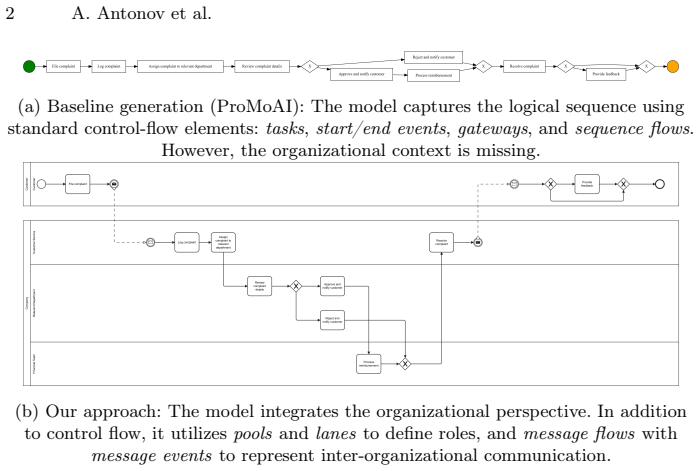
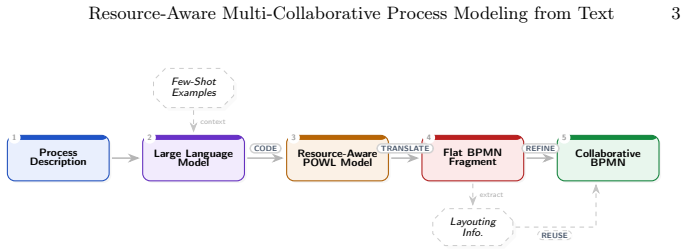
The central claim is that rather than prompting LLMs directly for BPMN XML, using a compact executable intermediate language that requires resource details for pools and lanes allows generation of formal BPMN 2.0 collaboration diagrams from natural-language descriptions, with cross-organization dependencies represented by message events and automatic orthogonal layout.
What carries the argument
The compact, executable intermediate language with mandatory resource details defining both the organization (pool) and the role (lane), which structures the LLM output for conversion to BPMN.
If this is right
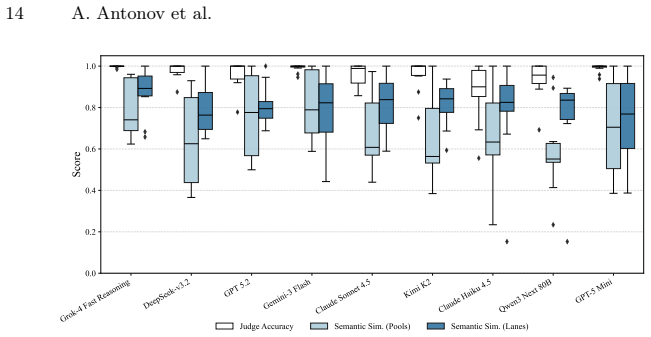
- Resource discovery remains strong across multiple LLMs.
- Control-flow quality from text-to-model is preserved.
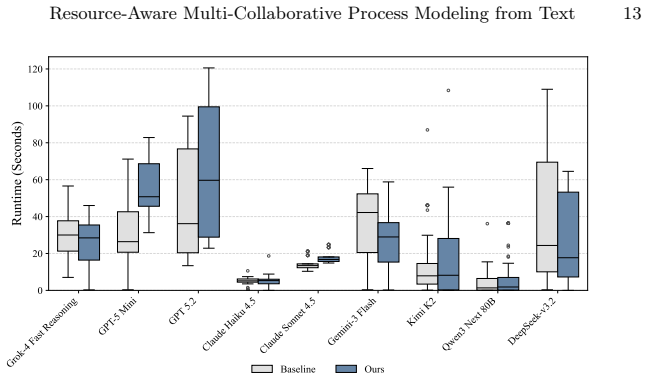
- Runtime overhead stays marginal.
- Cross-organization interactions are materialized using message events in the diagrams.
Where Pith is reading between the lines
- If the method scales, it could support automated generation of models for complex multi-organizational workflows.
- This approach might connect to other areas like automated process simulation by providing richer models.
- Testing on processes with ambiguous resource descriptions could reveal limits of the assumption.
Load-bearing premise
Natural language process descriptions contain sufficient, unambiguous information about organizations and roles that LLMs can reliably extract and that the intermediate language can represent without material loss of collaborative semantics.
What would settle it
A test set of ten processes where using the intermediate language results in significantly lower resource discovery accuracy or degraded control-flow quality compared to direct LLM prompting for BPMN XML.
Figures
read the original abstract
Process modeling is a sub-domain of Business Process Management (BPM) focused on the translation of process artifacts into formal models. This task traditionally requires extensive human input and domain expertise in both BPM notations and the specific business context. While Large Language Models (LLMs) can now automate much of this manual work, current text-to-model approaches focus predominantly on the control-flow perspective-ordering activities without considering the collaborative aspect of the processes. In this paper, we introduce a resource-aware generation pipeline that produces formal BPMN 2.0 collaboration diagrams from natural-language descriptions. Rather than solely prompting an LLM for raw XML, we describe a compact, executable intermediate language with mandatory resource details defining both the organization (pool) and the role (lane). Cross-organization dependencies are materialized using the standard formal notation for such interactions-message events-while an orthogonal layout routine automatically handles the spatial arrangement of elements within pools and lanes. Experiments on ten business processes with nine LLMs show strong resource discovery while preserving control-flow quality and adding only marginal runtime overhead. This approach moves generative modeling toward a more comprehensive, multi-collaborative representation of business operations.
Editorial analysis
A structured set of objections, weighed in public.
Referee Report
Summary. The paper introduces a resource-aware generation pipeline that produces formal BPMN 2.0 collaboration diagrams from natural-language descriptions. Rather than direct LLM prompting for XML, it defines a compact executable intermediate language that mandates resource details (organization as pool, role as lane), materializes cross-organization interactions via message events, and applies an orthogonal layout step. Experiments on ten business processes across nine LLMs report strong resource discovery, preserved control-flow quality, and marginal runtime overhead.
Significance. If the results hold, the work advances text-to-BPMN generation by systematically incorporating the resource perspective for multi-collaborative models, using standard BPMN notation and an intermediate representation that is executable. This pragmatic engineering contribution could support more complete automated modeling tools, though the narrow scope of ten processes limits claims of broad applicability.
major comments (2)
- [Experiments section (abstract and implied evaluation)] The central empirical claim (strong resource discovery while preserving control-flow quality) is load-bearing but unsupported by reported metrics, baselines, quantitative scores, or process details. The abstract and evaluation description provide no precision/recall figures, control-flow similarity measures, or comparison to direct XML prompting, making verification impossible from the given information.
- [Pipeline description (abstract and method overview)] The intermediate language is presented as a core contribution with 'mandatory resource details' and 'executable' properties, yet no syntax definition, semantics, or example mappings to BPMN pools/lanes/message events are supplied; this prevents assessment of whether collaborative semantics are preserved without material loss.
minor comments (1)
- [Abstract] The abstract states results across 'nine LLMs' and 'ten business processes' but does not name the models or processes; adding this list would improve reproducibility without altering the core contribution.
Simulated Author's Rebuttal
We thank the referee for the constructive comments. The points raised correctly identify areas where the current manuscript lacks sufficient detail for independent verification, and we will revise accordingly.
read point-by-point responses
-
Referee: The central empirical claim (strong resource discovery while preserving control-flow quality) is load-bearing but unsupported by reported metrics, baselines, quantitative scores, or process details. The abstract and evaluation description provide no precision/recall figures, control-flow similarity measures, or comparison to direct XML prompting, making verification impossible from the given information.
Authors: We agree the referee's assessment is accurate: the provided abstract and evaluation overview contain no quantitative metrics, baselines, or process details to support the summarized claims. In the revised manuscript we will add precision/recall for resource discovery, control-flow similarity measures, a direct-XML-prompting baseline, and explicit details on the ten processes. revision: yes
-
Referee: The intermediate language is presented as a core contribution with 'mandatory resource details' and 'executable' properties, yet no syntax definition, semantics, or example mappings to BPMN pools/lanes/message events are supplied; this prevents assessment of whether collaborative semantics are preserved without material loss.
Authors: We agree that the current manuscript supplies neither a syntax definition nor semantics nor concrete mappings. The revised version will include a formal syntax (EBNF), semantics, and worked examples demonstrating translation to pools, lanes, and message events. revision: yes
Circularity Check
No significant circularity
full rationale
The paper describes an engineering pipeline that uses LLMs to populate a compact intermediate language (with mandatory pools/lanes) before emitting BPMN 2.0 collaboration diagrams; the central claims rest on empirical results across nine independent LLMs and ten processes rather than on any self-referential definition, fitted parameter renamed as prediction, or load-bearing self-citation. No equations, uniqueness theorems, or ansatzes are introduced that reduce to the authors' own prior outputs. The derivation chain is therefore self-contained against external benchmarks (standard BPMN notation and off-the-shelf LLMs).
Axiom & Free-Parameter Ledger
axioms (1)
- domain assumption Large language models can reliably extract organizational resources and roles from natural-language process descriptions
invented entities (1)
-
compact executable intermediate language
no independent evidence
Reference graph
Works this paper leans on
-
[1]
Chapman and Hall/CRC (2024) 16 A
Casella, G., Berger, R.: Statistical inference. Chapman and Hall/CRC (2024) 16 A. Antonov et al
2024
-
[2]
In: ITBPM@BPM
Corradini, F., Fornari, F., Polini, A., Re, B., Tiezzi, F.: Reprository: a repository platform for sharing business process models and logs. In: ITBPM@BPM. CEUR Workshop Proceedings, vol. 2952, pp. 13–18. CEUR-WS.org (2021)
2021
-
[3]
Ji, Z., Yu, T., Xu, Y., Lee, N., Ishii, E., Fung, P.: Towards mitigating hallucination inlargelanguagemodelsviaself-reflection.CoRRabs/2310.06271(2023).https: //doi.org/10.48550/ARXIV.2310.06271
-
[4]
CEUR Workshop Proceedings 4032, 304–311 (2025)
Klievtsova, N., Ehrendorfer, M., Mangler, J., Rinderle-Ma, S.: AutoBPMN.AI: Conversational Process Modeling and Automation. CEUR Workshop Proceedings 4032, 304–311 (2025)
2025
-
[5]
In: BPM (Demos / Resources Forum)
Köpke, J., Safan, A.: Introducing the BPMN-Chatbot for Efficient LLM-Based Process Modeling. In: BPM (Demos / Resources Forum). CEUR Workshop Pro- ceedings, vol. 3758, pp. 86–90. CEUR-WS.org (2024)
2024
-
[6]
Knowledge-Driven Hallucination in Large Language Models: An Empirical Study on Process Modeling
Kourani, H., Antonov, A., Berti, A., van der Aalst, W.M.P.: Knowledge-Driven Hallucination in Large Language Models: An Empirical Study on Process Model- ing. CoRRabs/2509.15336(2025)
work page internal anchor Pith review Pith/arXiv arXiv 2025
-
[7]
In: BPMDS/EMMSAD@CAiSE
Kourani, H., Berti, A., Schuster, D., van der Aalst, W.M.P.: Process Modeling with Large Language Models. In: BPMDS/EMMSAD@CAiSE. Lecture Notes in Business Information Processing, vol. 511, pp. 229–244. Springer (2024)
2024
-
[8]
In: IJCAI
Kourani, H., Berti, A., Schuster, D., van der Aalst, W.M.P.: ProMoAI: Process Modeling with Generative AI. In: IJCAI. pp. 8708–8712. ijcai.org (2024)
2024
-
[9]
Software and Systems Modeling (2025).https://doi.org/ 10.1007/s10270-025-01318-w
Kourani, H., Berti, A., Schuster, D., van der Aalst, W.M.P.: Evaluating Large Language Models on Business Process Modeling: Framework, Benchmark, and Self- Improvement Analysis. Software and Systems Modeling (2025).https://doi.org/ 10.1007/s10270-025-01318-w
-
[10]
Kourani, H., Park, G., van der Aalst, W.M.P.: Unlocking Non-Block-Structured Decisions: Inductive Mining with Choice Graphs. In: BPM. Lecture Notes in Com- puter Science, vol. 16044, pp. 144–161. Springer (2025)
2025
-
[11]
Licardo, J.T., Tankovic, N., Etinger, D.: BPMN Assistant: An LLM-Based Ap- proach to Business Process Modeling. CoRRabs/2509.24592(2025)
-
[12]
Lin, L., Jin, Y., Zhou, Y., Chen, W., Qian, C.: MAO: A Framework for Pro- cess Model Generation with Multi-Agent Orchestration. CoRRabs/2408.01916 (2024)
-
[13]
In: ICSOC (1)
Nivon, Q., Salaün, G.: Automated Generation of BPMN Processes from Textual Requirements. In: ICSOC (1). Lecture Notes in Computer Science, vol. 15404, pp. 185–201. Springer (2024)
2024
-
[14]
OMG: Business Process Model and Notation (BPMN), Version 2.0. Tech. rep., Object Management Group (January 2011),http://www.omg.org/spec/BPMN/2.0
2011
-
[15]
Recker, J.: Opportunities and constraints: the current struggle with BPMN. Bus. Process. Manag. J.16(1), 181–201 (2010)
2010
-
[16]
Reimers, N., Gurevych, I.: all-minilm-l6-v2 sentence transformer.https:// huggingface.co/sentence-transformers/all-MiniLM-L6-v2(2021), hugging- Face model, accessed December 14, 2025
2021
-
[17]
Rosemann, M.: Potential pitfalls of process modeling: part B. Bus. Process. Manag. J.12(3), 377–384 (2006)
2006
-
[18]
In: Proceedings of the BPM (2025)
Safan, A., Köpke, J.: BPMN-Chatbot++: LLM-Based Modeling of Collaboration Diagrams with Data. In: Proceedings of the BPM (2025)
2025
-
[19]
Sander, G.: A Fast Heuristic for Hierarchical Manhattan Layout. In: GD. Lecture Notes in Computer Science, vol. 1027, pp. 447–458. Springer (1995)
1995
-
[20]
In: ICPM Workshops
Sola, D., Warmuth, C., Schäfer, B., Badakhshan, P., Rehse, J., Kampik, T.: SAP signavio academic models: A large process model dataset. In: ICPM Workshops. Resource-Aware Multi-Collaborative Process Modeling from Text 17 Lecture Notes in Business Information Processing, vol. 468, pp. 453–465. Springer (2022)
2022
discussion (0)
Sign in with ORCID, Apple, or X to comment. Anyone can read and Pith papers without signing in.