Theoretical study of superconductivity in freestanding infinite-layer nickelate membranes under pressure: mitigation of excess correlation enhances T_c
Pith reviewed 2026-06-30 12:08 UTC · model grok-4.3
The pith
Pressure increases the superconducting transition temperature in infinite-layer nickelate membranes by mitigating excessively strong electron correlations.
A machine-rendered reading of the paper's core claim, the machinery that carries it, and where it could break.
Core claim
The seven-orbital model, when treated in the FLEX approximation, accounts for the observed pressure-induced enhancement of superconductivity through the alleviation of strong electron correlations induced by the low Ni valence.
What carries the argument
Seven-orbital effective model from first-principles, solved in the fluctuation exchange (FLEX) approximation, which captures the pressure dependence of electron correlations and superconductivity.
If this is right
- The superconducting Tc rises monotonically with applied pressure.
- Electron correlations weaken as pressure increases due to changes in Ni valence effects.
- The crystal structure of the membrane remains dynamically stable under the pressures studied.
- No additional adjustable parameters are needed to match the experimental Tc trend.
Where Pith is reading between the lines
- Similar correlation-mitigation mechanisms could be explored in other nickelate or cuprate systems under strain or pressure.
- Experimental measurements of the effective mass or spectral function under pressure could test the correlation reduction.
- The model might predict optimal pressures for maximizing Tc in related compounds.
Load-bearing premise
The first-principles derived seven-orbital model solved in the FLEX approximation quantitatively reproduces the pressure dependence of Tc.
What would settle it
A measurement showing that Tc does not increase monotonically with pressure in the freestanding membranes, or that the correlation strength does not decrease as predicted.
Figures
read the original abstract
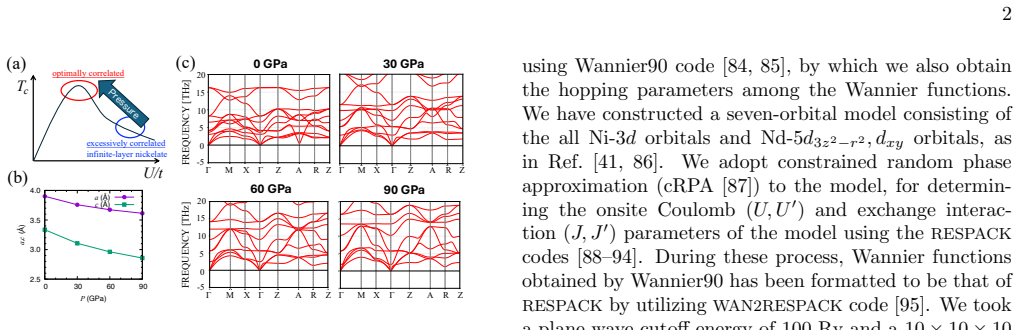
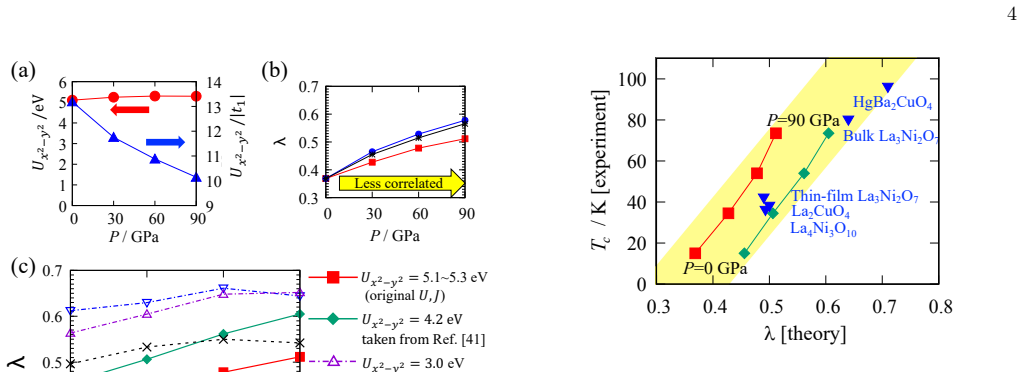
We theoretically investigate a freestanding membrane of infinite-layer nickelate Nd$_{0.85}$Sr$_{0.15}$NiO$_2$ under pressure by constructing a seven-orbital effective model based on first-principles calculations. By performing the fluctuation exchange (FLEX) approximation, we demonstrate that the seven-orbital model explains a monotonic increase in $T_c$ reported in a recent experiment. This enhancement of superconductivity is attributed to the mitigation of excessively strong electron correlations caused by exceptionally low valence of Ni atom. Furthermore, we examine the dynamical stability of the crystal structure under pressure through phonon calculation.
Editorial analysis
A structured set of objections, weighed in public.
Referee Report
Summary. The manuscript constructs a seven-orbital effective model for freestanding infinite-layer Nd_{0.85}Sr_{0.15}NiO_2 membranes under pressure from first-principles DFT calculations. Solving the model in the fluctuation-exchange (FLEX) approximation yields a monotonic increase in superconducting T_c with pressure that matches recent experiments; the enhancement is attributed to mitigation of strong electron correlations arising from the exceptionally low Ni valence. Phonon calculations are also performed to confirm dynamical stability of the structure.
Significance. If the reported FLEX results are shown to emerge without post-hoc tuning of interaction parameters to the experimental T_c(P) trend, the work would provide a useful microscopic account of pressure-enhanced superconductivity in infinite-layer nickelates, linking the effect directly to valence-controlled correlation strength. The first-principles downfolding step is a methodological strength that could be built upon in related systems.
major comments (2)
- [FLEX results] FLEX results (presumably §4 or equivalent): the central claim that the seven-orbital model 'explains' the experimental monotonic T_c increase requires explicit demonstration that the pressure-dependent hoppings and interaction matrix elements (U, J) are taken directly from the first-principles calculation at each pressure with no subsequent adjustment of any parameter to reproduce the observed T_c trend. Without this, the attribution to correlation mitigation from low Ni valence cannot be verified as independent of data selection.
- [Model construction] Model construction (§3 or equivalent, Hamiltonian definition): the downfolding procedure to the seven-orbital model must specify how the interaction matrix elements are computed and whether they remain fixed or vary with pressure in a manner that quantitatively reduces the effective correlation strength; the current presentation leaves open whether the T_c enhancement is a robust prediction or sensitive to the precise choice of interaction parameters relative to bandwidth.
minor comments (2)
- The abstract and introduction should state the pressure range explicitly and report the quantitative level of agreement (e.g., slope of T_c vs P) between FLEX and experiment rather than only the monotonic trend.
- Figure captions for the T_c(P) plots should include the experimental data points for direct visual comparison and note any error bars or uncertainties in the FLEX T_c values.
Simulated Author's Rebuttal
We thank the referee for the careful reading of our manuscript and the constructive comments. We address the major points below and will revise the manuscript to improve clarity on the parameter determination and its pressure dependence.
read point-by-point responses
-
Referee: [FLEX results] FLEX results (presumably §4 or equivalent): the central claim that the seven-orbital model 'explains' the experimental monotonic T_c increase requires explicit demonstration that the pressure-dependent hoppings and interaction matrix elements (U, J) are taken directly from the first-principles calculation at each pressure with no subsequent adjustment of any parameter to reproduce the observed T_c trend. Without this, the attribution to correlation mitigation from low Ni valence cannot be verified as independent of data selection.
Authors: We agree that an explicit demonstration is required for the claim to be fully convincing. All hoppings and interaction matrix elements (U, J) in our calculations are obtained directly from the first-principles DFT calculations performed at each pressure, via Wannier downfolding for the hoppings and a first-principles method for the interactions, with no subsequent adjustment or fitting of any parameter to match the experimental T_c(P) trend. The monotonic rise in T_c emerges as a direct consequence of these pressure-dependent parameters. In the revised manuscript we will add an explicit statement and supporting data (e.g., a table of key parameters versus pressure) confirming the absence of post-hoc tuning. revision: yes
-
Referee: [Model construction] Model construction (§3 or equivalent, Hamiltonian definition): the downfolding procedure to the seven-orbital model must specify how the interaction matrix elements are computed and whether they remain fixed or vary with pressure in a manner that quantitatively reduces the effective correlation strength; the current presentation leaves open whether the T_c enhancement is a robust prediction or sensitive to the precise choice of interaction parameters relative to bandwidth.
Authors: We acknowledge that the presentation in the current version leaves this point insufficiently clear. The interaction matrix elements are computed from the DFT results at each pressure and therefore vary with pressure; this variation, together with the pressure-induced bandwidth increase, quantitatively reduces the effective correlation strength (U/W). In the revised manuscript we will expand the model-construction section to detail the procedure used to obtain the interaction parameters and will add a discussion (with supporting figures if appropriate) of their pressure dependence, thereby demonstrating that the T_c enhancement is a robust outcome of the first-principles parameters. revision: yes
Circularity Check
No significant circularity: first-principles model to FLEX solution is independent of the experimental Tc trend.
full rationale
The derivation proceeds by downfolding DFT to a seven-orbital Hamiltonian (pressure-dependent hoppings and interactions fixed by the first-principles step), then solving that Hamiltonian in the FLEX approximation. The resulting Tc(P) monotonic rise is presented as an explanation of the experimental trend, attributed to reduced Ni correlations from the fixed low valence. No quoted step shows a parameter fitted to Tc data and then relabeled as a prediction, no self-citation chain that supplies the central uniqueness or ansatz, and no self-definitional loop. The match to experiment functions as an external benchmark rather than an input that forces the output by construction. This is the normal, non-circular case for an ab-initio + diagrammatic calculation.
Axiom & Free-Parameter Ledger
axioms (2)
- domain assumption First-principles calculations yield a reliable seven-orbital effective Hamiltonian for the pressurized membrane.
- domain assumption FLEX approximation captures the superconducting instability and its pressure dependence in this correlated system.
Reference graph
Works this paper leans on
-
[1]
#!●𝑑$%!"&!▲𝑑!#■𝑑!%/#%(Nd,Sr): ▼𝑑!#𝑑$%!
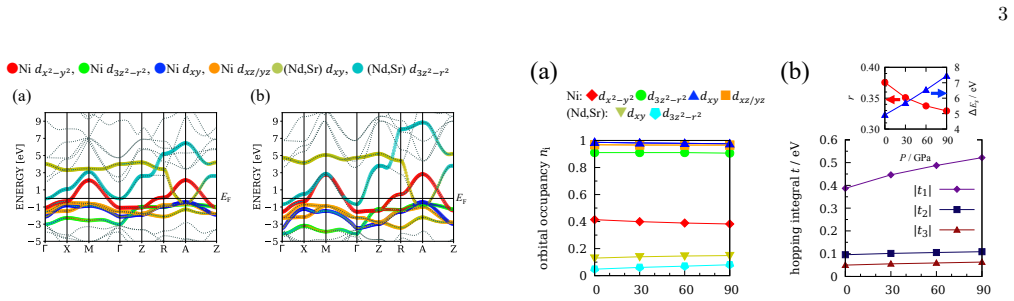
of Nd 0.85Sr0.15NiO2 under pressure for the cases of (a) 0 GPa and (b) 90 GPa. Here, the weight of Wannier orbitals are represented by the thickness of color coded lines. crease of the overall band width as pressure increases, consistent with previous papers [53, 104]. This change is basically interpreted as a consequence of reduction of parametersa, c. E...
-
[2]
H. Sun, M. Huo, X. Hu, J. Li, Z. Liu, Y. Han, L. Tang, Z. Mao, P. Yang, B. Wang, J. Cheng, D.-X. Yao, G.-M. Zhang, and M. Wang, Signatures of superconductivity near 80 K in a nickelate under high pressure, Nature 621, 493 (2023)
2023
-
[3]
Sakakibara, M
H. Sakakibara, M. Ochi, H. Nagata, Y. Ueki, H. Saku- rai, R. Matsumoto, K. Terashima, K. Hirose, H. Ohta, M. Kato, Y. Takano, and K. Kuroki, Theoretical anal- ysis on the possibility of superconductivity in a trilayer ruddlesden-popper nickelate La 4Ni3O10 under pressure and its experimental examination: comparison with La3Ni2O7, Phys. Rev. B109, 144511 (2024)
2024
-
[4]
Nagata, H
H. Nagata, H. Sakurai, Y. Ueki, K. Yamane, R. Mat- sumoto, K. Terashima, K. Hirose, H. Ohta, M. Kato, and Y. Takano, Pressure-induced superconductivity in La4Ni3O10+δ (δ= 0.04 and−0.01), J. Phys. Soc. Jpn. 93, 095003 (2024)
2024
-
[5]
Li, Y.-J
Q. Li, Y.-J. Zhang, Z.-N. Xiang, Y. Zhang, X. Zhu, and H.-H. Wen, Signature of superconductivity in pressur- ized La4Ni3O10, Chin. Phys. Lett.41, 017401 (2024)
2024
-
[6]
Y. Zhu, D. Peng, E. Zhang, B. Pan, X. Chen, L. Chen, H. Ren, F. Liu, Y. Hao, N. Li, Z. Xing, F. Lan, J. Han, J. Wang, D. Jia, H. Wo, Y. Gu, Y. Gu, L. Ji, W. Wang, H. Gou, Y. Shen, T. Ying, X. Chen, W. Yang, H. Cao, C. Zheng, Q. Zeng, J.-G. Guo, and J. Zhao, Super- conductivity in pressurized trilayer La 4Ni3O10−δ single crystals, Nature631, 531 (2024)
2024
-
[7]
Zhang, C
M. Zhang, C. Pei, D. Peng, X. Du, W. Hu, Y. Cao, Q. Wang, J. Wu, Y. Li, H. Liu, C. Wen, J. Song, Y. Zhao, C. Li, W. Cao, S. Zhu, Q. Zhang, N. Yu, P. Cheng, L. Zhang, Z. Li, J. Zhao, Y. Chen, C. Jin, H. Guo, C. Wu, F. Yang, Q. Zeng, S. Yan, L. Yang, and Y. Qi, Superconductivity in trilayer nickelate La4Ni3O10 under pressure, Phys. Rev. X15, 021005 (2025)
2025
-
[8]
E. K. Ko, Y. Yu, Y. Liu, L. Bhatt, J. Li, V. Thampy, C.-T. Kuo, B. Y. Wang, Y. Lee, K. Lee, J.-S. Lee, B. H. Goodge, D. A. Muller, and H. Y. Hwang, Sig- natures of ambient pressure superconductivity in thin film La3Ni2O7, Nature638, 935 (2025)
2025
-
[9]
Yue, J.-J
C. Yue, J.-J. Miao, H. Huang, Y. Hua, P. Li, Y. Li, G. Zhou, W. Lv, Q. Yang, F. Yang, H. Sun, Y.-J. Sun, J. Lin, Q.-K. Xue, Z. Chen, and W.-Q. Chen, Corre- lated electronic structures and unconventional super- conductivity in bilayer nickelate heterostructures, Natl. Sci. Rev.12, nwaf253 (2025)
2025
-
[10]
B. Y. Wang, Y. Zhong, S. Abadi, Y. Liu, Y. Yu, X. Zhang, Y.-M. Wu, R. Wang, J. Li, Y. Tarn, E. K. Ko, V. Thampy, M. Hashimoto, D. Lu, Y. S. Lee, T. P. Devereaux, C. Jia, H. Y. Hwang, and Z.-X. Shen, Electronic structure of compressively strained thin film La2PrNi2O7, arXiv:2504.16372 (2025)
-
[11]
Osada, C
M. Osada, C. Terakura, A. Kikkawa, M. Nakajima, H.- Y. Chen, Y. Nomura, Y. Tokura, and A. Tsukazaki, Strain-tuning for superconductivity in La 3Ni2O7 thin films, Commun. Phys.8, 251 (2025)
2025
-
[12]
M. R. Norman, Entering the nickel age of superconduc- tivity, Physics13, 85 (2020)
2020
-
[13]
D. Li, K. Lee, B. Y. Wang, M. Osada, S. Crossley, H. R. Lee, Y. Cui, Y. Hikita, and H. Y. Hwang, Supercon- ductivity in an infinite-layer nickelate, Nature(London) 572, 624 (2019)
2019
-
[14]
D. Li, B. Y. Wang, K. Lee, S. P. Harvey, M. Osada, B. H. Goodge, L. F. Kourkoutis, and H. Y. Hwang, Superconducting dome in Nd 1−xSrxNiO2 infinite layer films, Phys. Rev. Lett.125, 027001 (2020)
2020
-
[15]
S. Zeng, C. S. Tang, X. Yin, C. Li, M. Li, Z. Huang, J. Hu, W. Liu, G. J. Omar, H. Jani, Z. S. Lim, K. Han, D. Wan, P. Yang, S. J. Pennycook, A. T. S. Wee, and A. Ariando, Phase diagram and superconducting dome of infinite-layer Nd 1−xSrxNiO2 thin films, Phys. Rev. Lett.125, 147003 (2020)
2020
-
[16]
S. Zeng, C. Li, L. E. Chow, Y. Cao, Z. Zhang, C. S. Tang, X. Yin, Z. S. Lim, J. Hu, P. Yang, and A. Ariando, Superconductivity in infinite-layer nickelate La1−xCaxNiO2 thin firms, Sci. Adv.8, eabl9927 (2022)
2022
-
[17]
Osada, B
M. Osada, B. Y. Wang, B. H. Goodge, S. P. Harvey, K. Lee, D. Li, L. F. Kourkoutis, and H. Y. Hwang, Nick- elate superconductivity without rare-earth magnetism: (La,Sr)NiO 2, Adv. Mater.33, 2104083 (2021)
2021
-
[18]
Osada, B
M. Osada, B. Y. Wang, B. H. Goodge, K. Lee, H. Yoon, K. Sakuma, D. Li, M. Miura, L. F. Kourkoutis, and H. Y. Hwang, A superconducting praseodymium nicke- late with infinite layer structure, Nano Letters20, 5735 (2020)
2020
-
[19]
Osada, B
M. Osada, B. Y. Wang, K. Lee, D. Li, and H. Y. Hwang, Phase diagram of infinite layer praseodymium nickelate Pr1−xSrxNiO2 thin films, Phys. Rev. Mater.4, 121801 (2020)
2020
-
[20]
Nomura and R
Y. Nomura and R. Arita, Superconductivity in infinite- layer nickelates, Rep. Prog. Phys.85, 052501 (2022)
2022
-
[21]
Lee and W
K.-W. Lee and W. E. Pickett, Infinite-layer LaNiO 2: Ni1+ is not Cu 2+, Phys. Rev. B70, 165109 (2004)
2004
-
[22]
V. I. Anisimov, D. Bukhvalov, and T. M. Rice, Elec- tronic structure of possible nickelate analogs to the cuprates, Phys. Rev. B59, 7901 (1999)
1999
-
[23]
Hayward and M
M. Hayward and M. Rosseinsky, Synthesis of the infi- nite layer Ni(I) phase NdNiO 2+x by low temperature reduction of NdNiO 3 with sodium hydride, Solid State Sci.5, 839 (2003)
2003
-
[24]
M. A. Hayward, M. A. Green, M. J. Rosseinsky, and J. Sloan, Sodium hydride as a powerful reducing agent for topotactic oxide deintercalation: Synthesis and char- acterization of the nickel(I) oxide LaNiO 2, J. Am. Chem. Soc.121, 8843 (1999)
1999
-
[25]
Q. Li, C. He, J. Si, X. Zhu, Y. Zhang, and H.-H. Wen, Absence of superconductivity in bulk Nd 1−xSrxNiO2, Commun. Mater.1, 16 (2020)
2020
-
[26]
Kaneko, K
D. Kaneko, K. Yamagishi, A. Tsukada, T. Manabe, and M. Naito, Synthesis of infinite-layer LaNiO 2 films by metal organic decomposition, Physica C: Superconduc- tivity469, 936 (2009)
2009
-
[27]
Kawai, S
M. Kawai, S. Inoue, M. Mizumaki, N. Kawamura, N. Ichikawa, and Y. Shimakawa, Reversible changes of epitaxial thin films from perovskite LaNiO 3 to infinite- layer structure LaNiO 2, Applied Physics Letters94, 082102 (2009). 6
2009
-
[28]
Onozuka, A
T. Onozuka, A. Chikamatsu, T. Katayama, T. Fuku- mura, and T. Hasegawa, Formation of defect-fluorite structured NdNiO xHy epitaxial thin films via a soft chemical route from NdNiO 3 precursors, Dalton Trans. 45, 12114 (2016)
2016
-
[29]
Crespin, P
M. Crespin, P. Levitz, and L. Gatineau, Reduced forms of lanio3 perovskite. part 1.—evidence for new phases: La2Ni2O5 and LaNiO 2, J. Chem. Soc., Faraday Trans. 279, 1181 (1983)
1983
-
[30]
Ikeda, Y
A. Ikeda, Y. Krockenberger, H. Irie, M. Naito, and H. Yamamoto, Direct observation of infinite NiO 2 planes in LaNiO 2 films, Appl. Phys. Express9, 061101 (2016)
2016
-
[31]
K. Lee, B. Y. Wang, M. Osada, B. H. Goodge, T. C. Wang, Y. Lee, S. Harvey, W. J. Kim, Y. Yu, C. Murthy, S. Raghu, L. F. Kourkoutis, and H. Y. Hwang, Linear- in-temperature resistivity for optimally superconduct- ing (Nd,Sr)NiO2, Nature619, 288 (2023)
2023
-
[32]
X. Ren, J. Li, W.-C. Chen, Q. Gao, J. J. Sanchez, J. Hales, H. Luo, F. Rodolakis, J. L. McChesney, T. Xi- ang, J. Hu, R. Comin, Y. Wang, X. Zhou, and Z. Zhu, Possible strain-induced enhancement of the supercon- ducting onset transition temperature in infinite-layer nickelates, Commun. Phys.6, 341 (2023)
2023
-
[33]
S. L. E. Chow, Z. Luo, and A. Ariando, Bulk supercon- ductivity near 40 k in hole-doped SmNiO 2 at ambient pressure, Nature642, 58 (2025)
2025
-
[34]
M. Yang, H. Wang, J. Tang, J. Luo, X. Wu, W. Xu, A. Wang, Y. Wu, R. Mao, Z. Wang, Z. Pei, G. Zhou, Z. Dong, B. Feng, L. Shi, W. Meng, C. Xi, L. Pi, Q. Lu, J. Okamoto, H.-Y. Huang, D.-J. Huang, H. Huang, Q. Wang, P. Gao, Z. Chen, and D. Li, Enhanced su- perconductivity and mixed-dimensional behaviour in infinite-layer samarium nickelate thin films, Nat. Co...
2026
-
[35]
S. Yan, W. Mao, W. Sun, Y. Li, H. Sun, J. Yang, B. Hao, W. Guo, L. Nian, Z. Gu, P. Wang, and Y. Nie, Su- perconductivity in freestanding infinite-layer nickelate membranes, Adv. Mater.36, 2402916 (2024)
2024
-
[36]
Y. Lee, X. Wei, Y. Yu, L. Bhatt, K. Lee, B. H. Goodge, S. P. Harvey, B. Y. Wang, D. A. Muller, L. F. Kourk- outis, W.-S. Lee, S. Raghu, and H. Y. Hwang, Synthesis of superconducting freestanding infinite-layer nickelate heterostructures on the millimetre scale, Nat. Synth.4, 573 (2025)
2025
-
[37]
Y. Lee, M. Wang, X. Wei, Y. Yu, W. L. Mao, Y. Lin, and H. Y. Hwang, High-temperature superconductivity in Nd 0.85Sr0.15NiO2 membranes under pressure (2026), arXiv:2604.09525
work page internal anchor Pith review Pith/arXiv arXiv 2026
-
[38]
L. Gao, Y. Y. Xue, F. Chen, Q. Xiong, R. L. Meng, D. Ramirez, C. W. Chu, J. H. Eggert, and H. K. Mao, Superconductivity up to 164 K in HgBa2Cam−1CumO2m+2+δ (m= 1,2,and 3) un- der quasihydrostatic pressures, Phys. Rev. B50, 4260 (1994)
1994
-
[39]
Sadewasser, J
S. Sadewasser, J. S. Schilling, A. P. Paulikas, and B. W. Veal, Pressure dependence ofT c to 17 GPa with and without relaxation effects in superconducting YBa2Cu3Ox, Phys. Rev. B61, 741 (2000)
2000
-
[40]
Nomura, M
Y. Nomura, M. Hirayama, T. Tadano, Y. Yoshimoto, K. Nakamura, and R. Arita, Formation of a two- dimensional single-component correlated electron sys- tem and band engineering in the nickelate superconduc- tor NdNiO2, Phys. Rev. B100, 205138 (2019)
2019
-
[41]
Nomura, T
Y. Nomura, T. Nomoto, M. Hirayama, and R. Arita, Magnetic exchange coupling in cuprate-analogd 9 nick- elates, Phys. Rev. Res.2, 043144 (2020)
2020
-
[42]
Sakakibara, H
H. Sakakibara, H. Usui, K. Suzuki, T. Kotani, H. Aoki, and K. Kuroki, Model construction and a possibility of cupratelike pairing in a newd 9 nickelate superconductor (Nd,Sr)NiO2, Phys. Rev. Lett.125, 077003 (2020)
2020
-
[43]
Higashi, M
K. Higashi, M. Winder, J. Kuneˇ s, and A. Hariki, Core-level x-ray spectroscopy of infinite-layer nickelate: LDA + DMFT study, Phys. Rev. X11, 041009 (2021)
2021
-
[44]
Zhang, L
H. Zhang, L. Jin, S. Wang, B. Xi, X. Shi, F. Ye, and J.-W. Mei, Effective hamiltonian for nickelate oxides Nd1−xSrxNiO2, Phys. Rev. Res.2, 013214 (2020)
2020
-
[45]
Kang and G
C.-J. Kang and G. Kotliar, Optical properties of the infinite-layer La1−xSrxNiO2 and hidden hund’s physics, Phys. Rev. Lett.126, 127401 (2021)
2021
-
[46]
Wang, C.-J
Y. Wang, C.-J. Kang, H. Miao, and G. Kotliar, Hund’s metal physics: From SrNiO 2 to LaNiO 2, Phys. Rev. B 102, 161118 (2020)
2020
-
[47]
X. Wan, V. Ivanov, G. Resta, I. Leonov, and S. Y. Savrasov, Exchange interactions and sensitivity of the ni two-hole spin state to hund’s coupling in doped NdNiO2, Phys. Rev. B103, 075123 (2021)
2021
-
[48]
Jiang, M
M. Jiang, M. Berciu, and G. A. Sawatzky, Critical na- ture of the ni spin state in doped NdNiO 2, Phys. Rev. Lett.124, 207004 (2020)
2020
-
[49]
Wang, G.-M
Z. Wang, G.-M. Zhang, Y.-f. Yang, and F.-C. Zhang, Distinct pairing symmetries of superconductivity in infinite-layer nickelates, Phys. Rev. B102, 220501(R) (2020)
2020
-
[50]
Yang and G.-M
Y.-f. Yang and G.-M. Zhang, Self-doping and the mott- kondo scenario for infinite-layer nickelate superconduc- tors, Front. Phys.9(2022)
2022
-
[51]
Kitatani, L
M. Kitatani, L. Si, O. Janson, R. Arita, Z. Zhong, and K. Held, Nickelate superconductors—a renaissance of the one-band hubbard model, npj Quantum Mater.5, 59 (2020)
2020
-
[52]
Kitatani, L
M. Kitatani, L. Si, P. Worm, J. M. Tomczak, R. Arita, and K. Held, Optimizing superconductivity: From cuprates via nickelates to palladates, Phys. Rev. Lett. 130, 166002 (2023)
2023
-
[53]
X. Wu, D. Di Sante, T. Schwemmer, W. Hanke, H. Y. Hwang, S. Raghu, and R. Thomale, Robustdx2−y2-wave superconductivity of infinite-layer nickelates, Phys. Rev. B101, 060504(R) (2020)
2020
-
[54]
Di Cataldo, P
S. Di Cataldo, P. Worm, J. M. Tomczak, L. Si, and K. Held, Unconventional superconductivity with- out doping in infinite-layer nickelates under pressure, Nat. Commun.15, 3952 (2024)
2024
-
[55]
Q. Gu, Y. Li, S. Wan, H. Li, W. Guo, H. Yang, Q. Li, X. Zhu, X. Pan, Y. Nie, and H.-H. Wen, Single particle tunneling spectrum of superconducting Nd 1−xSrxNiO2 thin films, Nat. Commun.11, 6027 (2020)
2020
-
[56]
Cheng, D
B. Cheng, D. Cheng, K. Lee, L. Luo, Z. Chen, Y. Lee, B. Y. Wang, M. Mootz, I. E. Perakis, Z.-X. Shen, H. Y. Hwang, and J. Wang, Evidence for d-wave superconduc- tivity of infinite-layer nickelates from low-energy elec- trodynamics, Nat. Mater.23, 775 (2024)
2024
-
[57]
S. P. Harvey, B. Y. Wang, J. Fowlie, M. Osada, K. Lee, Y. Lee, D. Li, and H. Y. Hwang, Evidence for nodal su- perconductivity in infinite-layer nickelates, Proc. Natl. Acad. Sci. USA122, e2427243122 (2025)
2025
-
[58]
J. Karp, A. Hampel, M. Zingl, A. S. Botana, H. Park, M. R. Norman, and A. J. Millis, Comparative many- 7 body study of Pr 4Ni3O8 and NdNiO 2, Phys. Rev. B 102, 245130 (2020)
2020
-
[59]
Y. Fu, L. Wang, H. Cheng, S. Pei, X. Zhou, J. Chen, S. Wang, R. Zhao, W. Jiang, C. Liu, M. Huang, X. Wang, Y. Zhao, D. Yu, F. Ye, S. Wang, and J.-W. Mei, Core-level x-ray photoemission and ra- man spectroscopy studies on electronic structures in mott-hubbard type nickelate oxide NdNiO 2 (2024), arXiv:1911.03177
-
[60]
Hepting, D
M. Hepting, D. Li, C. J. Jia, H. Lu, E. Paris, Y. Tseng, X. Feng, M. Osada, E. Been, Y. Hikita, Y.-D. Chuang, Z. Hussain, K. J. Zhou, A. Nag, M. Garcia-Fernandez, M. Rossi, H. Y. Huang, D. J. Huang, Z. X. Shen, T. Schmitt, H. Y. Hwang, B. Moritz, J. Zaanen, T. P. Devereaux, and W. S. Lee, Electronic structure of the parent compound of superconducting infi...
2020
-
[61]
A. S. Botana and M. R. Norman, Similarities and dif- ferences between LaNiO2 and CaCuO2 and implications for superconductivity, Phys. Rev. X10, 011024 (2020)
2020
-
[62]
Y. Gu, S. Zhu, X. Wang, J. Hu, and H. Chen, A sub- stantial hybridization between correlated Ni-dorbital and itinerant electrons in infinite-layer nickelates, Com- mun. Phys.3, 84 (2020)
2020
-
[63]
S. Ryee, H. Yoon, T. J. Kim, M. Y. Jeong, and M. J. Han, Induced magnetic two-dimensionality by hole doping in the superconducting infinite-layer nickelate Nd1−xSrxNiO2, Phys. Rev. B101, 064513 (2020)
2020
-
[64]
J. Karp, A. S. Botana, M. R. Norman, H. Park, M. Zingl, and A. Millis, Many-body electronic struc- ture of NdNiO2 and CaCuO2, Phys. Rev. X10, 021061 (2020)
2020
-
[65]
J. Karp, A. Hampel, and A. J. Millis, Dependence of DFT + DMFT results on the construction of the corre- lated orbitals, Phys. Rev. B103, 195101 (2021)
2021
-
[66]
Lechermann, Doping-dependent character and possi- ble magnetic ordering of NdNiO 2, Phys
F. Lechermann, Doping-dependent character and possi- ble magnetic ordering of NdNiO 2, Phys. Rev. Mater.5, 044803 (2021)
2021
-
[67]
Leonov, S
I. Leonov, S. L. Skornyakov, and S. Y. Savrasov, Lif- shitz transition and frustration of magnetic moments in infinite-layer NdNiO2 upon hole doping, Phys. Rev. B 101, 241108 (2020)
2020
-
[68]
Leonov, Effect of lattice strain on the electronic structure and magnetic correlations in infinite-layer (Nd,Sr)NiO2, Journal of Alloys and Compounds883, 160888 (2021)
I. Leonov, Effect of lattice strain on the electronic structure and magnetic correlations in infinite-layer (Nd,Sr)NiO2, Journal of Alloys and Compounds883, 160888 (2021)
2021
-
[69]
Z. Liu, Z. Ren, W. Zhu, Z. Wang, and J. Yang, Elec- tronic and magnetic structure of infinite-layer NdNiO 2: trace of antiferromagnetic metal, npj Quantum Mater. 5, 31 (2020)
2020
-
[70]
Z.-J. Lang, R. Jiang, and W. Ku, Strongly corre- lated doped hole carriers in the superconducting nick- elates: Their location, local many-body state, and low-energy effective hamiltonian, Phys. Rev. B103, L180502 (2021)
2021
-
[71]
M.-Y. Choi, W. E. Pickett, and K.-W. Lee, Fluctuation- frustrated flat band instabilities in NdNiO 2, Phys. Rev. Res.2, 033445 (2020)
2020
-
[72]
Kitatani, T
M. Kitatani, T. Sch¨ afer, H. Aoki, and K. Held, Why the critical temperature of high-Tc cuprate superconductors is so low: The importance of the dynamical vertex struc- ture, Phys. Rev. B99, 041115(R) (2019)
2019
-
[73]
N. N. Wang, M. W. Yang, Z. Yang, K. Y. Chen, H. Zhang, Q. H. Zhang, Z. H. Zhu, Y. Uwatoko, L. Gu, X. L. Dong, J. P. Sun, K. J. Jin, and J.-G. Cheng, Pressure-induced monotonic enhancement ofT c to over 30 K in superconducting Pr 0.82Sr0.18NiO2 thin films, Nat. Commun.13, 4367 (2022)
2022
-
[74]
Christiansson, F
V. Christiansson, F. Petocchi, and P. Werner, GW+EDMFT investigation of Pr 1−xSrxNiO2 under pressure, Phys. Rev. B107, 045144 (2023)
2023
-
[75]
Giannozzi, O
P. Giannozzi, O. Andreussi, T. Brumme, O. Bunau, M. B. Nardelli, M. Calandra, R. Car, C. Cavazzoni, D. Ceresoli, M. Cococcioni, N. Colonna, I. Carn- imeo, A. D. Corso, S. de Gironcoli, P. Delugas, R. A. DiStasio, A. Ferretti, A. Floris, G. Fratesi, G. Fugallo, R. Gebauer, U. Gerstmann, F. Giustino, T. Gorni, J. Jia, M. Kawamura, H.-Y. Ko, A. Kokalj, E. K¨...
2017
-
[76]
Giannozzi, S
P. Giannozzi, S. Baroni, N. Bonini, M. Calandra, R. Car, C. Cavazzoni, D. Ceresoli, G. L. Chiarotti, M. Cococcioni, I. Dabo, A. Dal Corso, S. de Giron- coli, S. Fabris, G. Fratesi, R. Gebauer, U. Gerst- mann, C. Gougoussis, A. Kokalj, M. Lazzeri, L. Martin- Samos, N. Marzari, F. Mauri, R. Mazzarello, S. Paolini, A. Pasquarello, L. Paulatto, C. Sbraccia, S...
2009
-
[77]
D. R. Hamann, Optimized norm-conserving vanderbilt pseudopotentials, Phys. Rev. B88, 085117 (2013)
2013
-
[78]
van Setten, M
M. van Setten, M. Giantomassi, E. Bousquet, M. Ver- straete, D. Hamann, X. Gonze, and G.-M. Rignanese, The pseudodojo: Training and grading a 85 element optimized norm-conserving pseudopotential table, Com- put. Phys. Commun.226, 39 (2018)
2018
-
[79]
J. P. Perdew, K. Burke, and M. Ernzerhof, Generalized gradient approximation made simple, Phys. Rev. Lett. 77, 3865 (1996)
1996
-
[80]
A. Togo, L. Chaput, T. Tadano, and I. Tanaka, Imple- mentation strategies in phonopy and phono3py, J. Phys. Condens. Matter.35, 353001 (2023)
2023
discussion (0)
Sign in with ORCID, Apple, or X to comment. Anyone can read and Pith papers without signing in.